Product Review: Roman Lock Box and Archimedes’ Gear

[Note: I received a free copy of these puzzles in exchange for a fair, unbiased review.]

Forgive these somewhat shorter reviews, but it’s really hard to talk about brainteasers and puzzle boxes without accidentally spoiling them for users. So you get a two-for-one review today!
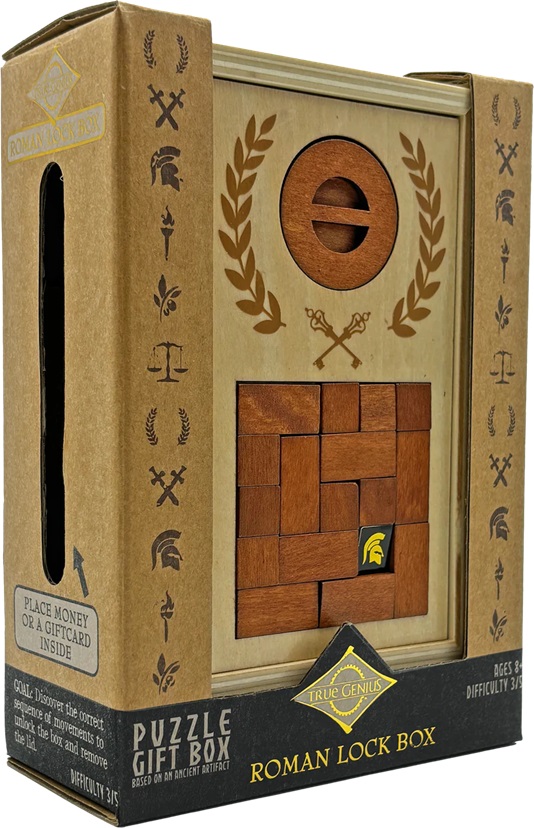
The perfect puzzle gift box needs to walk a difficult tightrope. It has to be challenging enough to justify the cost, intuitive enough that a person understands the basic idea without instructions, and yet not difficult enough to ruin the holiday or event by causing frustration.

(Cue a vivid Christmas memory of my sister shaking a puzzle box so hard she accidentally solved it and sent a gift card flying across the room.)

The Roman Lock Box walks that tightrope deftly. It manages to combine classic puzzle box elements (symbol clues, moving elements requiring careful positioning, parts that look seamless but aren’t) and combines them nicely with a sliding-block puzzle that offers a far different challenge than the usual puzzle box tricks.

Factor in the clean design, the well-made pieces, and the delightful slot in the side (allowing non-solvers to place their gift inside without actually having to solve the puzzle themselves!), and you have a suitably challenging way to keep your giftee busy for a bit.

[The Roman Lock Box is for ages 8 and up, and it’s available from Project Genius and participating websites, starting at $17.99.]
Our second brain teaser is a total 180 from the previous one. The Roman Lock Box has a number of moving parts and things to fiddle with and try out, offering a plethora of options to a solver.

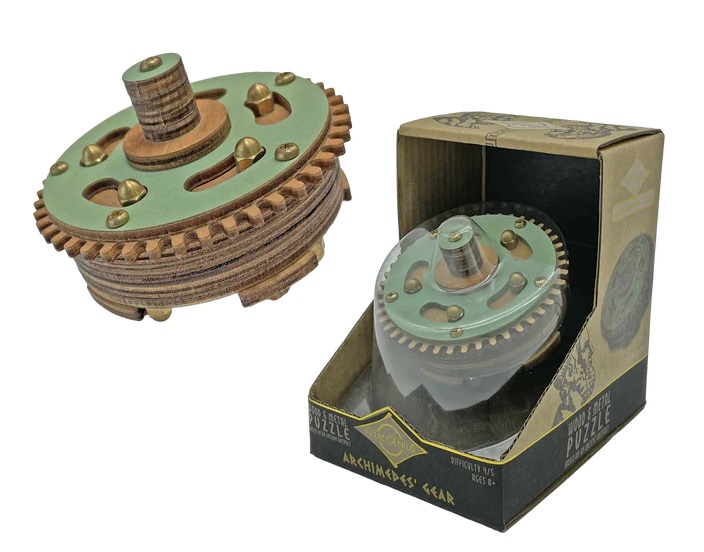
Archimedes’ Gear, on the other hand, is mind-scramblingly rigid. Brutally challenging in its simplicity. Twist and turn it, flip it, rearrange it, hold it at all angles, and it seems to give you nothing. I don’t know that I’ve ever been left so baffled at the start of a solve like I was with Archimedes’ Gear.

Naturally, that’s part of its genius. It really feels like a piece of ancient technology that fell into your hands, and you’re missing some valuable bit of insight that would help you operate it.

That initial bafflement does give you ample time to admire this absolutely beautiful puzzle, though. The color choices, the materials, the feel of the puzzle as you examine it from all sides. There’s even a lovely auditory quality to it, hinting at what awaits the solver inside if its secrets are uncovered.

This puzzle is ranked a 4 out of 5 in difficulty, and I think that’s very fair. I’ve solved a number of brain teasers and puzzles from Project Genius, and Archimedes’ Gear felt a step beyond most of them.

Of course, that only makes it more satisfying when you finally realize what’s going on here. Not a puzzle for the faint of heart (or those lacking in patience and determination), but still one definitely worth your time.

[Archimedes’ Gear is for ages 14 and up, and it’s available from Project Genius and participating websites, starting at $29.99.]

Product Review: That’s Not a Hat

[Note: I received a free copy of this game in exchange for a fair, unbiased review.]

Most memory games are pretty simple, falling into one of two categories: you either observe a pattern and repeat it, or you look at multiple items and remember where they are when hidden/concealed.

Memory games that include a social mechanic are rarer, and memory games with a social mechanic AND bluffing are rarer still.

Imagine a white elephant or Yankee swap gift exchange, except in reverse. You know what all the gifts are to start, but then they are wrapped one by one and traded around, and you need to remember what’s inside each one.

That’s the main idea behind Ravensburger’s social memory game That’s Not a Hat, and it’s brilliantly simple… until it is suddenly not so simple.

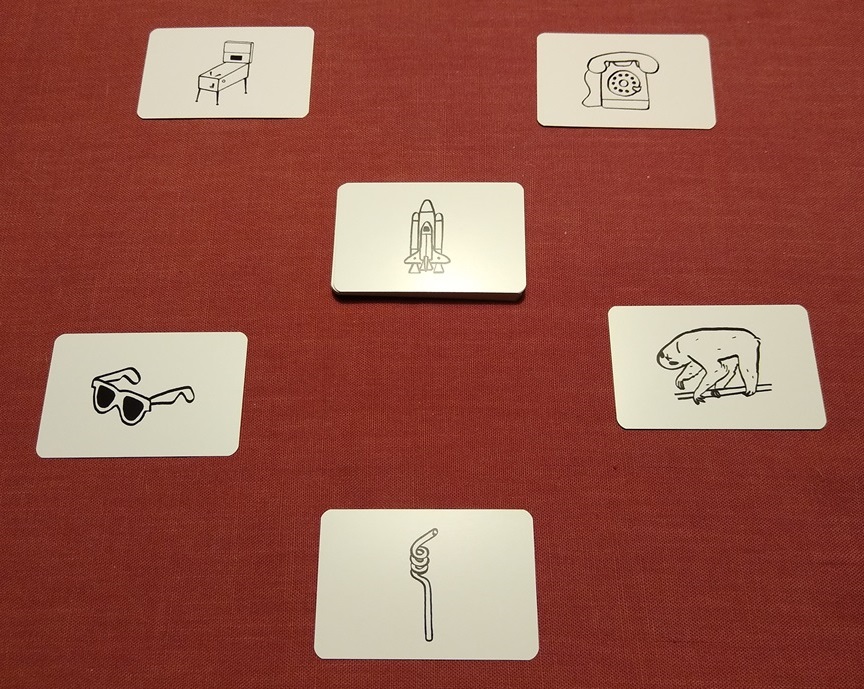
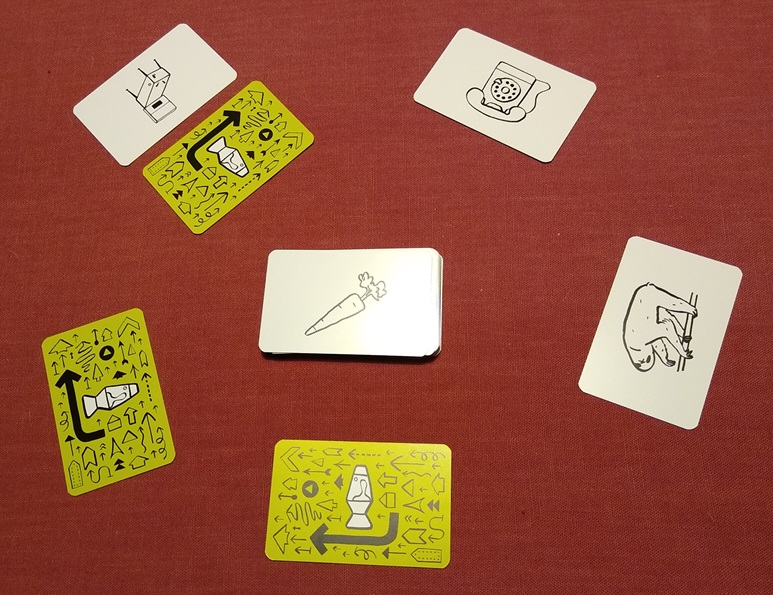
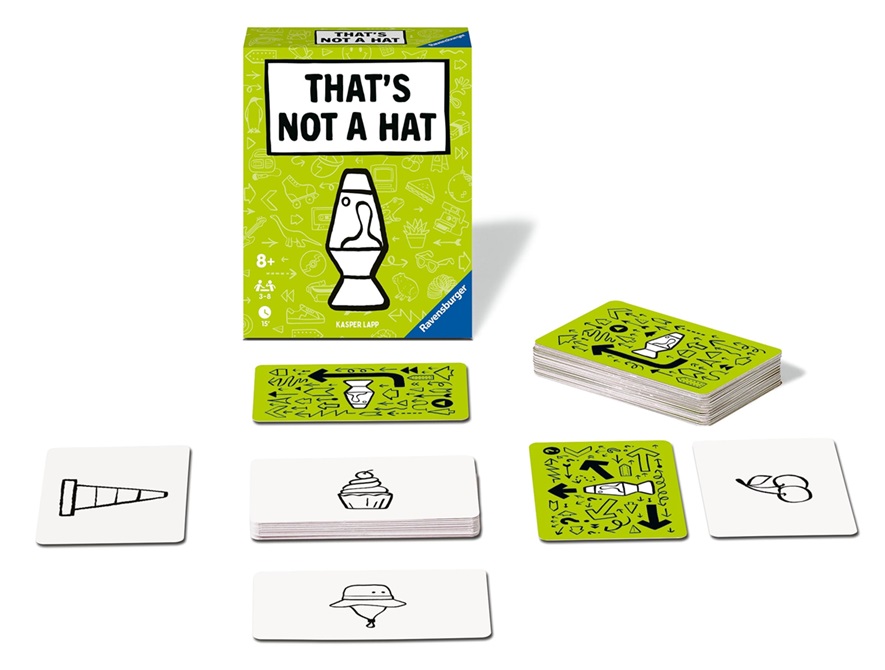
As you can see, everyone starts with a gift. The first player pulls a new gift from the stack in the center of the table, shows it to everyone, then places it facedown.

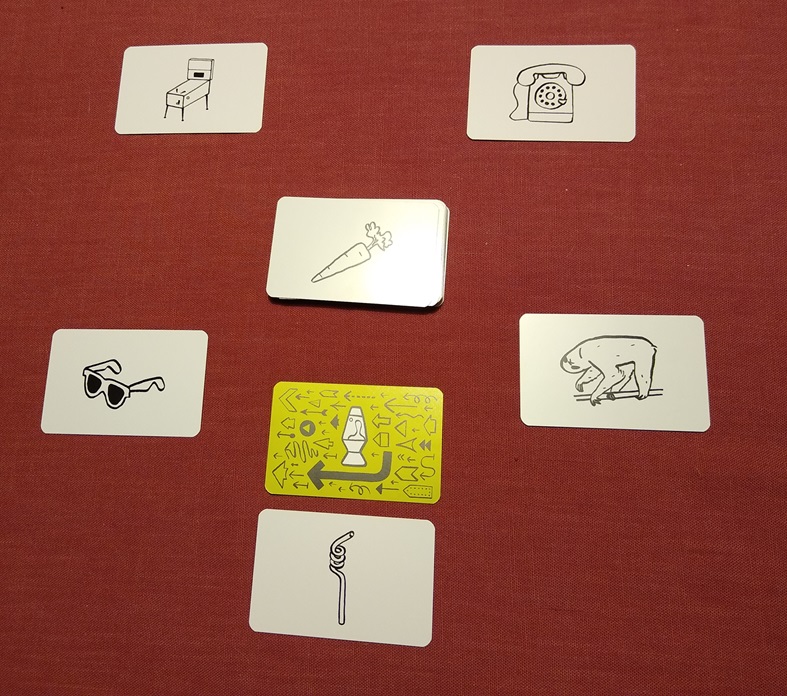
They then hand that gift to the player indicated by the arrow on the back of the card.

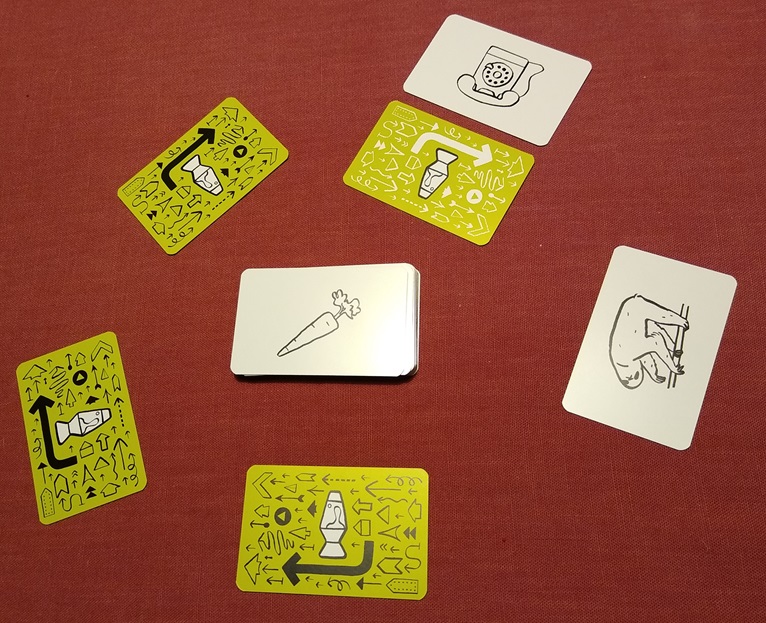
So the player to the right with the sloth card received the space shuttle, flipped it over, and handed it to the swizzle stick player to their left, saying “I have a nice space shuttle for you.”

The player receiving the gift has two options: accept the gift (meaning that they know it’s a space shuttle underneath and agree with the gift giver) or refuse the gift (meaning that they suspect the item underneath is NOT what the gift giver said).

In this case, the game has just started, so our swizzle stick player accepts the gift.

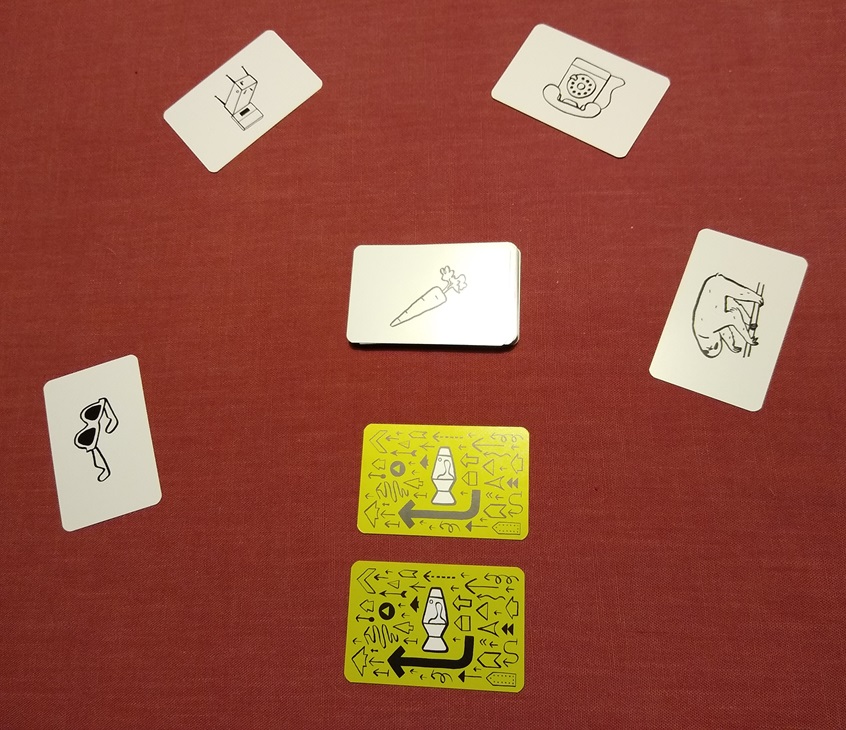
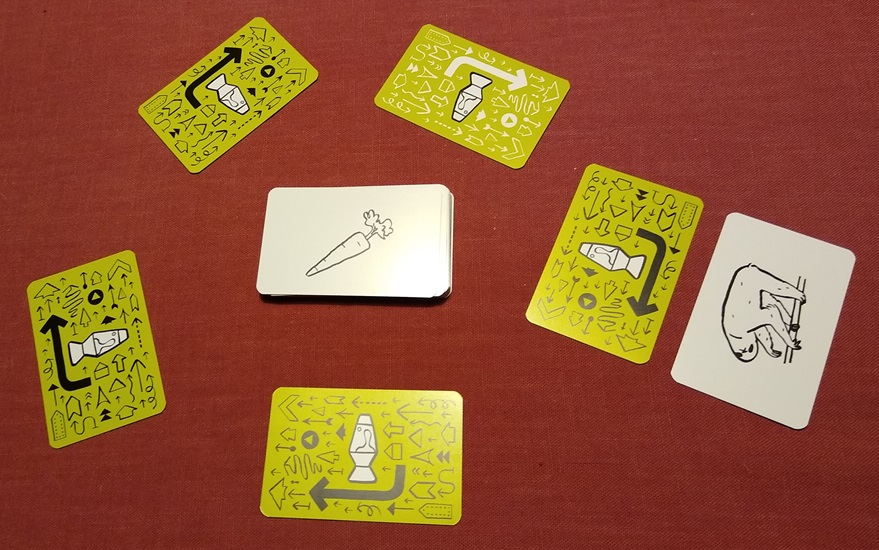
It would be rude to immediately regift what they were just given, so the swizzle stick player turns over their “old gift” and follows the arrow, saying “I have a nice swizzle stick for you” and giving that card to the player to the left (the sunglasses player).

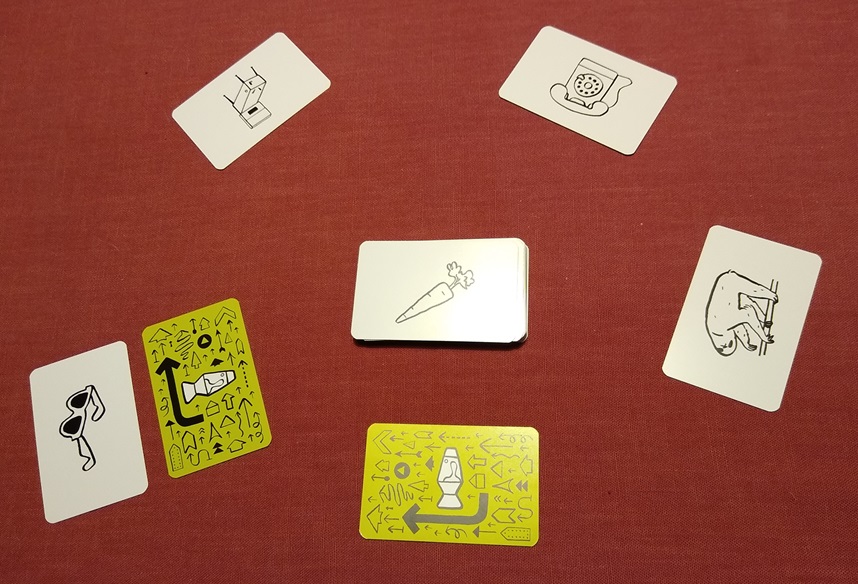
The sunglasses player accepts, turns over their old gift, says their line, and follows the arrow.

In this simplified version, the arrows only go in one direction, whereas in the regular game, arrows can go left or right (or, in the advanced play style, to any player, depending on the arrows).

Now, as the cards continue moving around from player to player, can you remember what was under all those cards? You’re gonna have to, because it gets harder and harder to remember what each card represents.

Eventually, someone is going to forget, and their “I have a nice __ for you” is going to be met with a refusal. If the refusing player is correct and the gift giver has forgotten what’s under the card, the gift giver takes that card and gets a point. If the refusing player is incorrect and the gift giver correctly remembered what’s under the card, then the refusing player takes the card and gets a point.

The game then resumes with a new present and all the previous cards STILL flipped over. The game ends when one player gets three points.


This combination of memory, interaction, and bluffing (if you forget what’s under your card) makes for a very fun, very mellow play experience, one that only grows tougher and more entertaining the more you play.

On the second game, I had so many images in my head from previous rounds that I immediately forgot what was under my card and earned a point.

With up to eight players at the table, 110 cards to choose from, plus mechanics to make the game easier or harder for the players, That’s Not a Hat is instantly replayable and never feels tired.

Now, you may start to worry about your memory before too long. It’s okay, though, because you’ll quickly be distracted by the laughter (and bad bluffs) to come.

[That’s Not a Hat is for 2 to 8 players, ages 8 and up, and it’s available from Ravensburger and participating websites (in two editions) starting at only $9.99!]

Product Review: ThinkFun’s Math Dice

[Note: I received a free copy of this game in exchange for a fair, unbiased review.]

If you’re not currently in school, you probably haven’t thought about Order of Operations in a while. Maybe six little letters will bring it all back to you: PEMDAS. Parentheses, Exponents, Multiplication, Division, Addition, Subtraction. (I learned to remember it as “Please excuse my dear Aunt Sally.)

This was a handy mnemonic device to explain how to break down complex equations into simpler ones. But it’s also the basis for ThinkFun’s latest puzzly game: Math Dice.

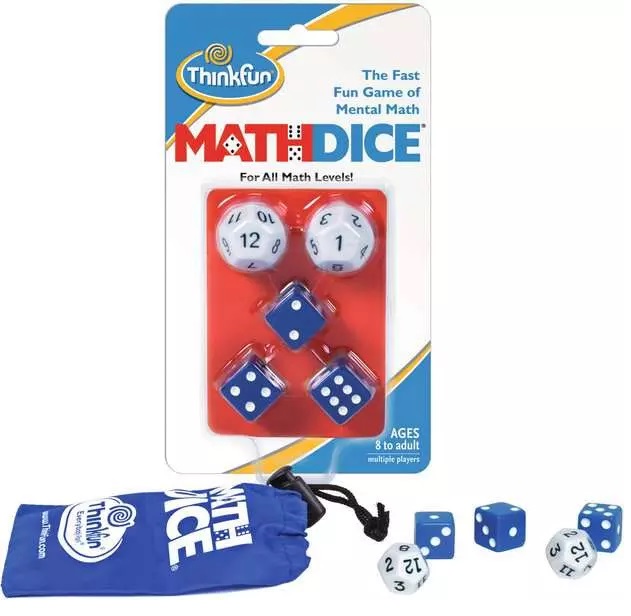
Math Dice challenges players to put their mathematical skills to the test, using randomly rolled dice and their own numerical ingenuity to get the closest to a given number.

But before we get started with the actual gameplay, I want to take a moment to appreciate how the instruction manual eases new players (and players with less confidence in their math skills) into the game.

After explaining the rules, and offering several techniques to make the game easier or harder, depending on player comfort levels, the manual offers numerous examples to make new players more familiar with all the options available to them.

It’s a terrific way to allay player uncertainty and show them some of the creative ways to mix different operations to make different totals.

Now let’s take a look at the gameplay:

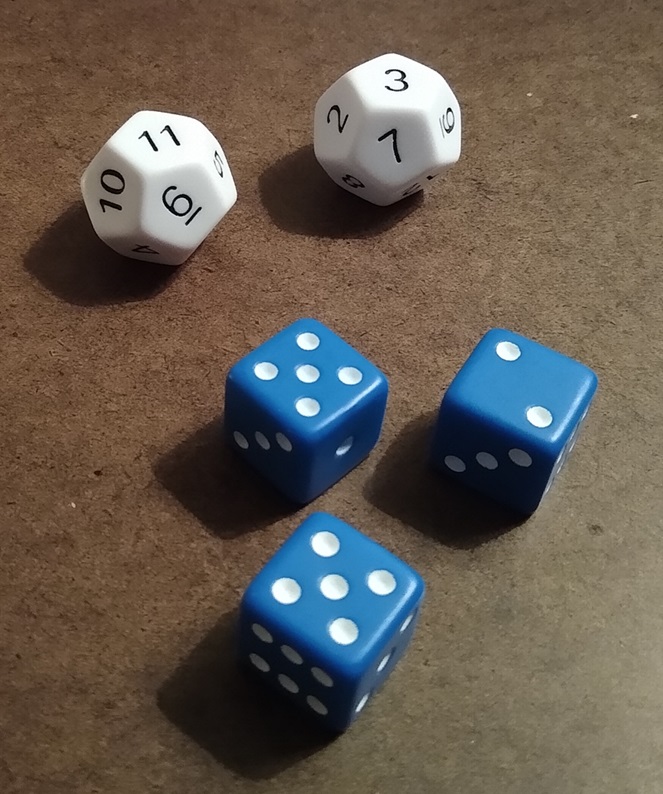
For example, the two 12-sided dice rolled a 12 and a 1. When multiplied, you get your target number of 12. Now the players must try to either match 12 or get closer to 12 than any other player, using the 2, 3, and 6 rolled on the 6-sided dice.

Simple addition will get you to 11.
(3 x 2) + 6 will get you to 12.
(6 – 2) x 3 will also get you to 12.
Can you find any other ways to make 12 from those dice?

This one is a little tougher. The two 12-sided dice rolled an 11 and a 3, giving us a target number of 33. We also have less flexibility with the 6-sided dice, since we have a 2 and two 5s.

(5 x 5) + 2 will get you to 27. Pretty good!
5^2 + 5 will get you to 30.
2^5 + 5 will get you to 37.

In this case, player who got 30 wins a point!

As someone who is always idly playing with words and numbers during mental downtime or between tasks, this game really appeals to the playful side of my puzzly brain. The challenge of making two sets of numbers balance is both challenging and soothing in the best way, like the purely mental equivalent of a fidget toy or other tool to keep your hands and mind engaged.

But this is also a clever launchpad to introduce younger puzzlers to the idea that numbers aren’t just classwork or homework, they’re something to play with. They’re puzzle pieces to rearrange and put together in all sorts of ways to create new results.

ThinkFun excels at turning learning experiences into engaging puzzles and games. Over the years, they’ve done so with logic problems, optics, programming, gravity, deduction, mechanical puzzles, and more, so it’s no surprise they’ve managed to do the same quite deftly with the basics of mathematics.

[Math Dice is for 2 or more players, ages 8 to Adult, and it’s available from ThinkFun and participating websites starting at only $6.99!]

PN Product Review: GeoLogic

[Note: I received a free copy of this puzzle in exchange for a fair, unbiased review.]

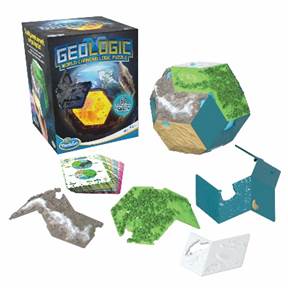
Imagine embodying the forces behind the Big Bang. Science fiction writers do this all the time, bringing into being entire new planets, studding them with swathes of land and bodies of water, devising chemically unfamiliar atmospheres. While I am a writer, fiction is not my forte, meaning that the wonders of world-building are typically out of my wheelhouse—at least, they were. Enter Thinkfun’s GeoLogic: World-Changing Logic Puzzle. This puzzle sells itself as an opportunity to “create your own world,” and “become a planetary architect,” promises that appeal to me as a science fiction fan. The puzzle is recommended for ages eight and up, and requires only one player, though planet-building can be a team activity too.

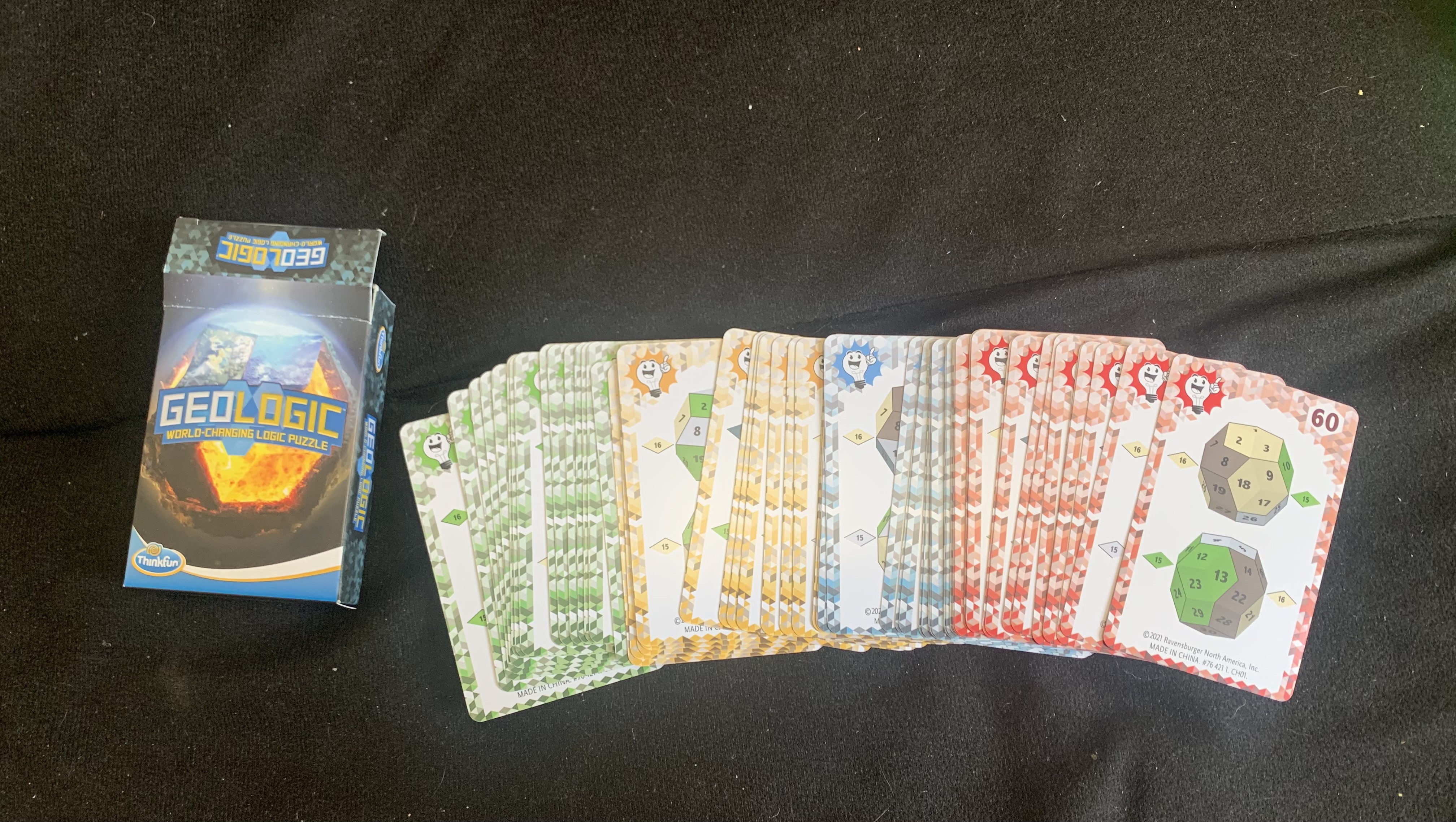
GeoLogic offers a route to science-fictional world-building other than the written word, bringing the invention of alien landscapes into the hands-on, three-dimensional realm. Born from a conversation between inventors Ken and Jeremy about the concept of a thirty-sided game die, the puzzle consists of a thirty-sided planetary core, fourteen snap-in-place pieces representing five biomes, and sixty challenge cards. Cards range from easy to expert, each indicating where certain biome pieces should go on the planetary core to start. The solver is then left to figure out where to insert a list of remaining biome pieces in order to completely cover the globe’s surface.

The challenge cards are optional; they are intended for players who would prefer to test spatial-logical skills rather than engage in more free-form, creative play. This mode of engaging with GeoLogic still has a science-fictional appeal; it just happens to fall more into the category of consuming science fiction than acting as its mastermind. If you dream of discovering new planets through a process of trial-and-error, then you’ll likely find using the challenge cards a perfect way to spend an afternoon, working your way up the ladder of difficulty levels.

If you’d rather ignore the challenge cards instead, you can take the game up on its suggestion that you “get creative and design your own planets.” As the box asks, “Want to create the largest landmass known to humans? Or oceans that span half the globe?” Now’s your chance! This approach to GeoLogic does require a certain amount of spatial-logical skill, as the goal remains the same: cover all thirty sides of the planetary core in some combination of awkwardly-shaped desert, forest, mountains, tundra, and ocean. If you are looking for a purely creative exercise, you might find the limitations of where the different biome pieces fit to be a frustrating hindrance to your imagination running wild.

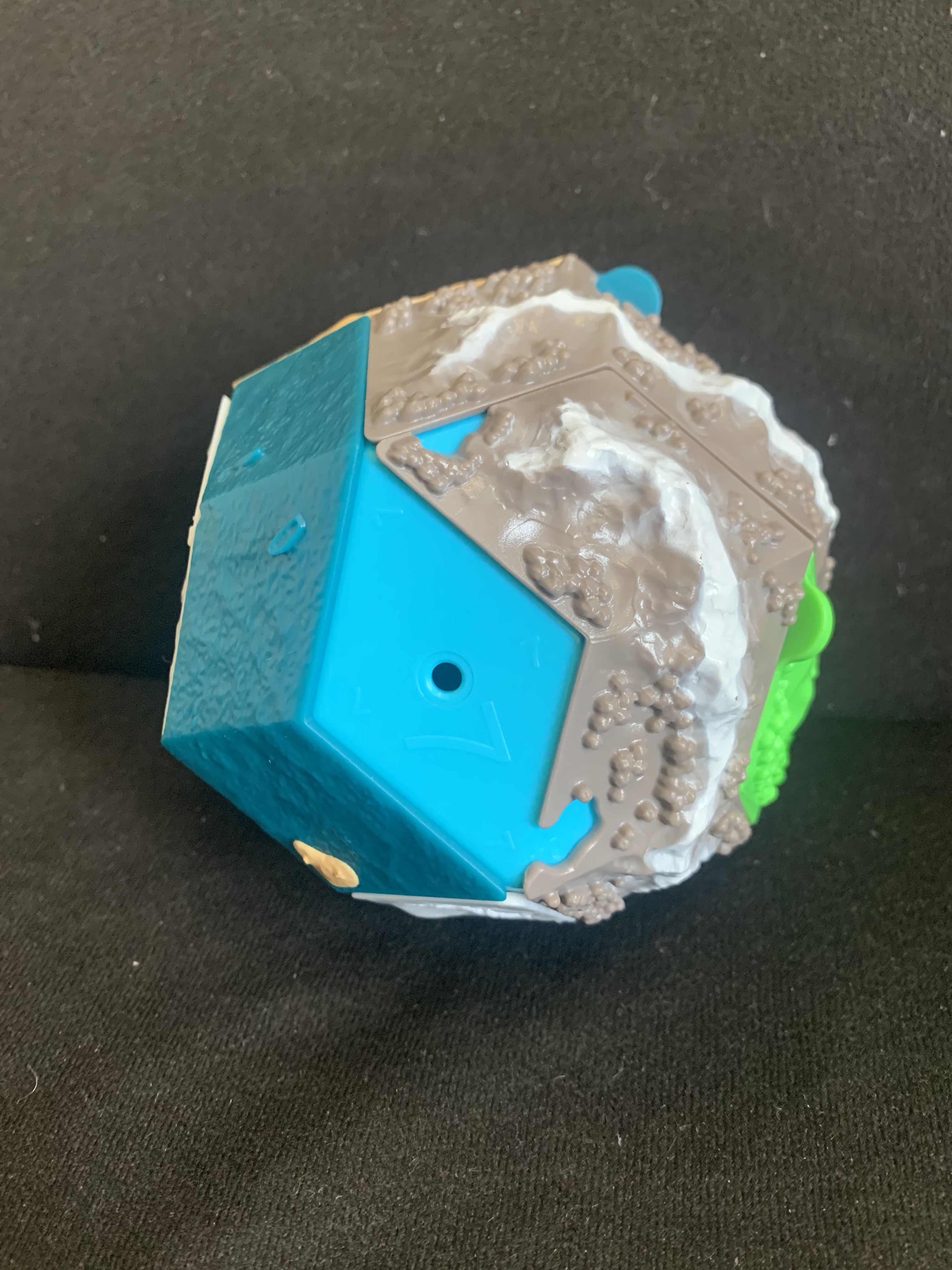
An example of a built world that does not meet the goals of the game.

The solver most likely to be enchanted by GeoLogic, by my estimate, is the Tetris fan who longs for a more tactile experience—snapping the pieces into place on the core is very satisfying—and who can appreciate a sprinkling of science-fictional creativity. Those driven to the product by the idea of creating new worlds are less likely to feel fulfilled, but the core and biomes could certainly be used as a jumping-off point for contemplating what different worlds are possible. Dreaming big and freely when it comes to alternate worlds is important, yes. Possibly more important, for those interested in changing the world we’ve been handed, is knowing how to still dream big when complex limitations are imposed upon us from outside.


You can find delightful deals on puzzles on the Home Screen for Daily POP Crosswords and Daily POP Word Search! Check them out!

Thanks for visiting PuzzleNation Blog today! Be sure to sign up for our newsletter to stay up-to-date on everything PuzzleNation!

PN Product Review: Star Trek Fluxx: The Archer Expansion and The Porthos Expansion

stfluxxall

[Note: I received a free copy of this game in exchange for a fair, unbiased review. Due diligence, full disclosure, and all that.]

Crossovers have always been part of the fabric of Star Trek. The Next Generation‘s debut episode had Dr. McCoy (and later cameos by Spock and Scotty), Deep Space Nine‘s debut had Picard (and later Worf joined the cast), and Voyager‘s debut actually launched from Deep Space Nine. Intermingling across time and space made the franchise feel like one enormous, interconnected, living universe, and it made each show stronger.

So it’s only natural that the folks at Looney Labs would want the same thing for their Star Trek-themed editions of Fluxx. Star Trek Fluxx and Star Trek: The Next Generation Fluxx could be played together with The Bridge Expansion, but there was no way to introduce cards or characters from Star Trek: Deep Space Nine Fluxx or Star Trek: Voyager Fluxx.

Until now, that is.

Yes, now you can combine all four decks into one massive, constantly changing game with The Archer Expansion and The Porthos Expansion.

archerporthos

For the uninitiated, Fluxx is a straightforward card game. You collect keeper cards and put them into play. Different combinations of keeper cards complete different goals, and each player has the chance to put different keeper cards and goal cards into play in order to win. So you might find yourself working toward completing the goal at hand when suddenly somebody plays a new goal, and the object of the game changes.

Along the way, players affect how the game is played by utilizing action cards and new rule cards which alter what players can and can’t do. Suddenly, you’ll have to trade your hand with another player, or start drawing three cards each turn instead of one.

The game can turn against you or spin in your favor in an instant; that’s both the challenge and the fun of playing Fluxx.

expansions 2

The Archer Expansion introduces elements from Star Trek: Enterprise, as well as time travel references that allow the cards from other Star Trek Fluxx decks to overlap (including having Goal cards in play from multiple decks).

Although the original four games will be overwhelmingly represented in your now massive mixed deck, multiple playthroughs quickly revealed that clever players still managed to use the expansion cards to their advantage more than expected. The sheer variety of Goals available meant that no one could keep track of every possible way to win, so a casual scan of the Keepers on the table wouldn’t reveal if anyone was close to winning.

And for anyone worried that mixing the decks would make it hard to return the cards to their original decks, the team at Looney Labs is one step ahead of you.

expansions 1

From top to bottom, you’ve got the unique fonts for Star Trek Fluxx, Star Trek: TNG Fluxx, The Bridge Expansion, Star Trek: DS9 Fluxx, Star Trek: Voyager Fluxx, The Archer Expansion, and The Porthos Expansion. Although it’s easy to mix up cards from the expansion decks, there’s no mistaking any of the cards from the main four decks.

Speaking of expansions, let’s take a look at the other new offering on deck.

expansions 3

The Porthos Expansion introduces a few more Star Trek: Enterprise characters (including Captain Archer’s dog Porthos), but is mostly focused on tying together the five Star Trek shows through new Goals and Keepers.

Easily the highlight of the deck is Data’s cat Spot, though I’m also a fan of the Starfleet Medical Goal and the New Rule card that grants an extra card to every player if Star Trek is on TV while you play.

Not only that, but the cards are packed to capacity with inside jokes and fun references to events from the series. (The “Former Borg” card even feels like a reference to the recent Star Trek: Picard show.)

expansions 4

Star Trek fans could easily lose plenty of game time unearthing all of the connections, quotes, and moments from each show that are represented across both expansion packs. Seeing all the ways the franchise is interconnected is truly a joy, both as a Star Trek fan and a regular Fluxx player who is always looking for new opportunities to snatch victory from my fellow players.

Yes, mixing all four decks virtually guarantees much longer games — the sheer volume of cards makes matching Keepers and Goals tougher! — but if you’re looking for a dynamic, enjoyable way to get more out of your Star Trek Fluxx decks, these expansion packs are a brilliant way to go.

The Archer Expansion and The Porthos Expansion are both available from Looney Labs for $5 each. And you can find the Star Trek Fluxx decks for The Original Series, The Next Generation, Deep Space Nine, and Voyager for $20 each.

And you can check them out, alongside dozens of other great puzzles and games, in this year’s Holiday Puzzly Gift Guide!


   dailypopwsicon

Treat yourself to some delightful deals on puzzles. You can find them on the Home Screen for Daily POP Crosswords and Daily POP Word Search! Check them out!

Thanks for visiting PuzzleNation Blog today! Be sure to sign up for our newsletter to stay up-to-date on everything PuzzleNation!

PN Product Review: Coaster Games

[Note: I received a free copy of this game in exchange for a fair, unbiased review. Due diligence, full disclosure, and all that.]

Games come in all shapes and sizes these days. Some are so elaborate that they practically come with their own wheeled suitcases to transport everything, while others happily fit in an Altoid tin.

But even with today’s market for micro-games, it’s rare that six different activities can all fit in your pocket at once.

Still, the game designers at The Dark Imp have managed to do precisely that with the subject of today’s review. Please join us as we explore Coaster Games, a six-pack of games each designed to fit on a drink coaster.

Coaster Games is designed to be played with nothing more than the coasters themselves, something to write with, and something to write on. Some games are for two players, while others are for 2 or more. And each one offers a totally different sort of gameplay.

Alien Farm is a hand-drawn version of Sushi Go, where you place different aliens in different spots on your farm, hoping to maximize your score at the end of the game.

Letter Market is a curious mix of Boggle and Scrabble. You have 25 points to spend on letters, and the letters have different values. You’re trying to write down as many valid words as possible, using the letters you’ve purchased.

Ice Cream Truck is a wagering game where you try to make the most successful ice cream truck business on a budget. Each round, you wager some of your money on either ice cream or investments and see how the weather affects your business.

Free the Frog is like a mixing pot of Hangman, Charades, and 20 Questions. One player is the frog, and chooses a word to break the spell. All the other players are trying to guess that word using the questions available on the coaster.

Treasure Split is essentially the Prisoner’s Dilemma made into a game. You and your fellow player walk along a path, picking up treasure. But you have to secretly decide whether you’re splitting the loot or stealing it. Each has its benefits, but the path is different depending on the choices both players have made.

Sleuth Box is like Battleship, but there’s only one spot your opponent is hiding. But you’re hiding somewhere too, and each of you has to sleuth out the other’s location.

Each game has its pluses and minuses, but even if one isn’t your cup of tea, you’re bound to enjoy some of the other offerings. Free the Frog was an instant hit, and we were able to vary the game’s difficulty through our choices of vocabulary.

Similarly, Sleuth Box inspired lots of replays. We would quickly start to develop techniques to find our foes, which our opponents started to counter the more we played. Instead of replays detracting from the fun, it allowed for some very cool, intense showdowns of cleverness and guile across a half-dozen sessions in a row.

Each game only lasts a matter of minutes (no more than 10 or 12 for the most involved ones), so new players are invited to sample all sorts of play styles, whereas people more familiar with each game monopolize their favorites for a few rounds before passing them along and picking up another one. This collection is a great way to keep a group occupied without making anyone wait too long for their turn, which can be a serious concern when you’re gaming with a big group or at a family gathering.

All in all, I was pretty impressed with Coaster Games. The gameplay for each was easy to pick up with a single playthrough, and none of the games invited burnout even after multiple quick replays. If you need a great stocking stuffer or travel game, look no further.

[Coaster Games is available from The Dark Imp for just £6.99.]


dailypopwsicon

Halloween is almost here, and we have some spookily good deals for you to check out. You can find them on the Home Screen for Daily POP Crosswords and Daily POP Word Search! Check them out!

Thanks for visiting PuzzleNation Blog today! Be sure to sign up for our newsletter to stay up-to-date on everything PuzzleNation!