PuzzleNation Product Review: Word Domination

Gathering letters to spell words and gain points… it’s a game mechanic so familiar and traditional that it’s easy to take for granted these days. Whether you’re talking about the wooden tiles of Scrabble or the electronic tiles of Words With Friends, the mind-bending spin of Unspeakable Words or the three-dimensional challenge of Upwords, it’s a classic concept.

Word Domination builds on that concept by adding a new strategical element. As you spell words, you claim letters from a shared letter pool. It’s essentially a more aggressive form Boggle.

Each player assumes the identity of a James Bond-style villain, and each letter tile doubles as a prize or piece of loot that can be captured by a player.

The player then uses a letter tile drawn at random with some of the letters laid out in the play area to spell a word, temporarily capturing those letters. (Unlike Boggle, the letters in the word don’t need to be touching.)
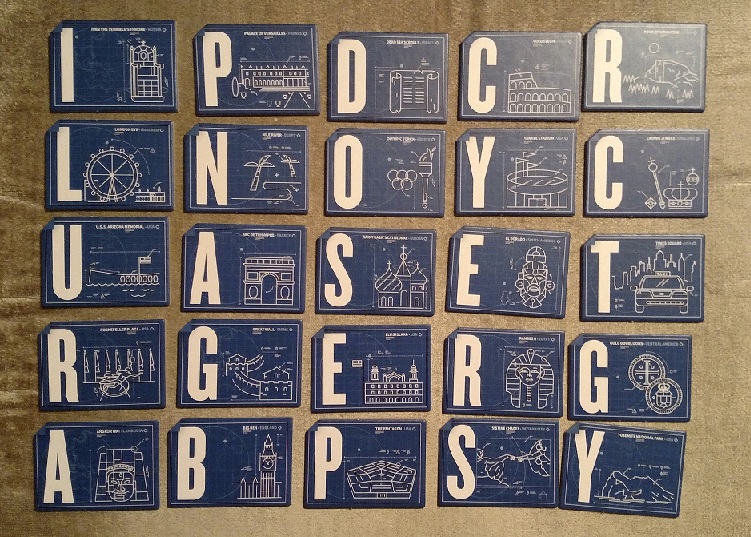
For example, in the first round, Player 1 spells the word ODYSSEY, placing zeppelin tokens on each of the 7 letters in the world, including the O that the player added on their turn. Player 1 then draws a new random tile for the next round, and play moves to Player 2.

Player 2 spells the word FORGERY and places her zeppelin tokens. And since she used three letters that Player 1 had captured, she captures those letters and removes his zeppelin tokens from the board.

Let’s jump ahead slightly. Player 3 spells the word TESSERACT, stealing some captured letters from both Player 1 and Player 2, and that concludes the first round. When round 2 starts up, Player 1 spells the word DYNASTY and places his zeppelins.

And since the letters D and Y were already captured by Player 1 in the first round, capturing them a second time means Player 1 has stolen those letters from the game board, and claims them for himself.

Those letters are given to Player 1 to use for the rest of the game, and replaced with STOLEN tiles, which are worth points at the end of the game.

After six rounds of play, the player who has claimed the most territory (and earned the most points) wins the game.

Now, naturally there are wrinkles to add to the gameplay, like helping other players spell words in order to split the profits with them, arming yourself with certain rare letters and weaponizing them, and even utilizing special abilities only your character has access to.

Between these twists and the baseline gameplay, you have a rich and variable game experience that really allows a strategic player to shine when matched up against players that might have stronger vocabularies or better luck drawing letter tiles.

And the game aesthetic really adds to the playing experience. The idea of stealing letter treasures, claiming territory with little zeppelin tokens, and running amok as a film villain (complete with bizarre letter-based weapontry and a punny name) is the perfect mix of silly and clever, spicing up a solid game with enjoyable little quirks.

Word Domination balances luck, strategy, and vocabulary skills to create a game that feels familiar but keeps you on your toes. What a treat.

Word Domination is created by Jeff Beck and is available through Uproarious Games and select online retailers for $32.99.


Thanks for visiting PuzzleNation Blog today! Be sure to sign up for our newsletter to stay up-to-date on everything PuzzleNation!

You can also share your pictures with us on Instagram, friend us on Facebook, check us out on Twitter, Pinterest, and Tumblr, and explore the always-expanding library of PuzzleNation apps and games on our website!

PuzzleNation Product Review: Roller Coaster Challenge

ThinkFun’s products are all about learning through experimentation. Whether you’re making music note-by-note with Compose Yourself, mastering the basics of programming in Robot Turtles, or tackling complete-the-path puzzles with marbles, lasers, robots, or electronic circuits, kids and adults alike get the chance to put their puzzly chops to the test.

Roller Coaster Challenge is the largest, most ambitious ThinkFun puzzle game to date, featuring several dozen pieces and challenge cards galore to test your ability to bend momentum and gravity to your will as you complete unfinished roller coaster tracks!

[With multiple track lengths, posts for building support pylons, 90-degree turns to navigate, and even a loop you can construct, you’ve got all the ingredients you need for a roller coaster worthy of the name.]

The concept is fairly simple. You have challenge cards that offer a starting layout. You’re given the beginning and ending points of the track, and some pieces in between. You are also told which pieces you’ll need to use to bridge the gaps and finish the track. Now it’s up to you to place them correctly and then test your creation with the little red roller coaster car.

Not only is the building plate bigger than those in any previous ThinkFun puzzle game, but the sky is the limit as you build onwards and upwards in order to solve your challenge card and give your little roller coaster car the ride of its life!

The challenge cards serve as the perfect introduction to solving the game’s puzzles, teaching the solver how to identify pieces by length, how to avoid missteps, and even how to get the most out of the available pieces.

But the challenge cards are just the beginning. Roller Coaster Challenge encourages you to develop your own roller coaster layouts, and even share them with the company!

After battling my way through numerous challenge cards of all difficulties — ranked from easy to super hard — I began indulging my creative side by constructing my own layout.

Naturally I had to go above and beyond, trying to weave two tracks together so one would use the loop, and the other would rocket the roller coaster car through the loop and over a gap before reuniting with the track itself.

[OSHA would shut down my roller coaster so fast…]

In terms of scale, creativity, and sheer visual panache, Roller Coaster Challenge is the most ambitious and impressive ThinkFun puzzle game to date. The DIY encouragement built into the solving experience really adds something extra to the enjoyable (and sometimes challenging) layouts provided by the game’s designers.

Roller Coaster Challenge was the result of ThinkFun’s first venture into crowdfunding, and when it came time to go big or go home, they went big, and solvers reap the benefits with this dynamic, fun product.

Roller Coaster Challenge is available through ThinkFun and other vendors for the very affordable price of $29.99.


Thanks for visiting PuzzleNation Blog today! Be sure to sign up for our newsletter to stay up-to-date on everything PuzzleNation!

You can also share your pictures with us on Instagram, friend us on Facebook, check us out on Twitter, Pinterest, and Tumblr, and explore the always-expanding library of PuzzleNation apps and games on our website!

PuzzleNation Product Review: Less

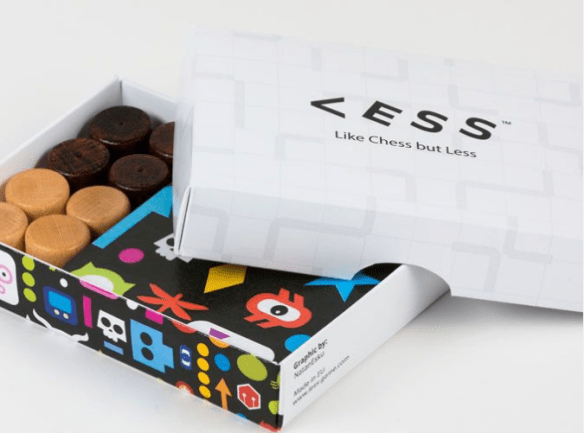
lessgame

There are many games out there that pair nicely with food or drink. Many party games even revolve around this mechanic, like Jason Anarchy’s alcohol-fueled roleplaying game Drinking Quest.

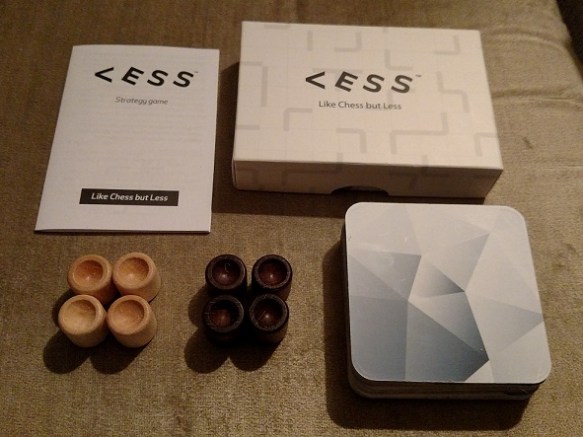
But I think Less is the first game where the playing tiles intentionally double as coasters for your drinks. It feels like a game that could be played in a tavern at a moment’s notice, which lends its minimalist style an old-world gaming charm.

less1

But I’m getting ahead of myself here. Less is a strategy game that combines the tactical planning of chess with the dynamic maneuverability of checkers.

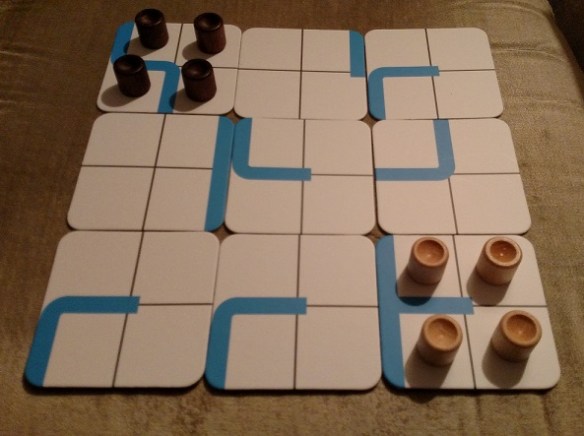
The game consists of 12 tiles and 8 game pieces, 4 white and 4 black. The players randomly select 9 of the 12 tiles and arrange a 3×3 game board. (With 12 tiles and four ways to place each tile, you’re virtually guaranteed a different game board every time you play.)

One player sets up their 4 game pieces in one corner, and the other player sets up their game pieces in the opposite corner. The goal of the game is to move all 4 of your pieces into your opponent’s corner before your opponent can occupy your corner.

less2

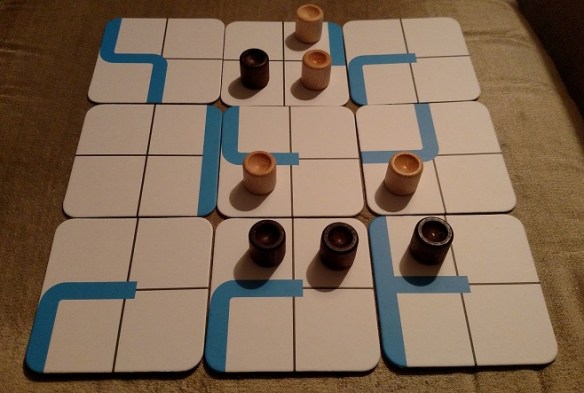
To do so, you are allowed three moves per turn. You can use all three moves for a single game piece, or spread them out over multiple game pieces. Moving a piece from one square to a neighboring square is one move. Jumping over a game piece to the next open square is also one move. (Here’s where checkers-style planning comes in handy.)

By now, you’ve probably noticed those blue walls on some of the tiles. Those walls require an extra move to traverse, so moving a game piece over a wall requires two moves. (And if neighboring squares each have a wall between them, jumping that double wall requires all three moves that turn.)

This three-move system offers players loads of options going forward, but your best bet is to arrange a sequence of leapfrog jumps to move your pieces as efficiently as possible across the board. (Unlike chess or checkers, there is no capturing or removing your opponent’s pieces from the board.)

less3

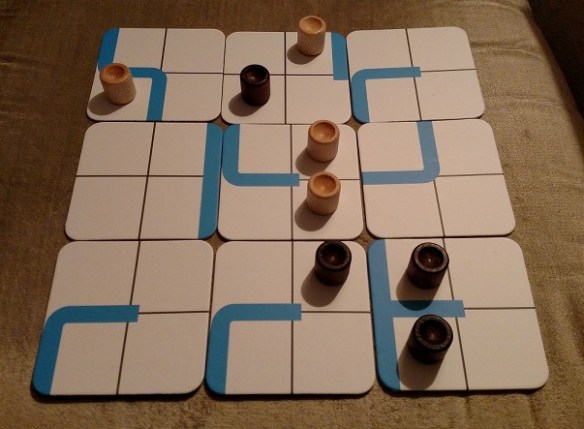
[Here, black has more pieces near the opposing corner, but that blue wall will make it harder to occupy the corner efficiently. Meanwhile, more of white’s pieces are farther away, but there are fewer obstacles to slow those pieces down.]

Mixing a tactical approach with the improvisation that comes with reacting to your opponent’s movements makes Less a very engaging gaming experience, even if a game routinely lasts less than ten minutes. And on the puzzle side of things, figuring out the most efficient way to navigate a path toward your opponent’s corner is great fun, since every game is different, and your opponent has different obstacles to tackle than you do, given the random placement of walls on the board.

Plus, if you’re willing to invest in two copies of the game, you can play with four players, as you and your partner coordinate your efforts across a 4×4 game board in the hopes of occupying your opponents’ corners first.

It’s a game that takes a few minutes to learn and offers near-infinite replayability. It might be called Less, but it feels like a very complete, very satisfying challenge.

less4

Less is published by InventedFor and is available online at less-game.com (with numerous coaster designs for the reverse side of the tiles). Click here for full details.


Thanks for visiting PuzzleNation Blog today! Be sure to sign up for our newsletter to stay up-to-date on everything PuzzleNation!

You can also share your pictures with us on Instagram, friend us on Facebook, check us out on Twitter, Pinterest, and Tumblr, and explore the always-expanding library of PuzzleNation apps and games on our website!
PuzzleNation Product Review: Chemistry Fluxx

chemistryfluxx

[Note: I received a free copy of this game in exchange for a fair, unbiased review. Due diligence, full disclosure, and all that.]

As a puzzle and game guy, people ask me for recommendations a lot. Sometimes, they like a particular type of puzzle or style of game play, but they want to try something new in that vein. Other times, they want to try a one-player puzzle or game experience, but in a group setting.

More and more, though, I get requests from parents and grandparents for puzzles and games that educate or reinforce learning without sucking all the fun out of playing.

And if you want a fun card game that mixes real-world science with chaotic, enjoyable gameplay, Chemistry Fluxx might be just what you’re looking for.

chemfluxx1

The latest edition of Fluxx from the designers at Looney Labs, Chemistry Fluxx takes an elementary approach to the game. Literally. You have to combine different elements in order to secure victory in this game.

For the uninitiated, Fluxx is a straightforward card game. You collect keeper cards and put them into play. Different combinations of keeper cards complete different goals, and each player has the chance to put different keeper cards and goal cards into play in order to win. So you might find yourself working toward completing the goal at hand when suddenly somebody plays a new goal, and the object of the game changes.

Along the way, players affect how the game is played by utilizing action cards and new rule cards which alter what players can and can’t do. Suddenly, you’ll have to trade your hand with another player, or start drawing three cards each turn instead of one.

chemfluxx2

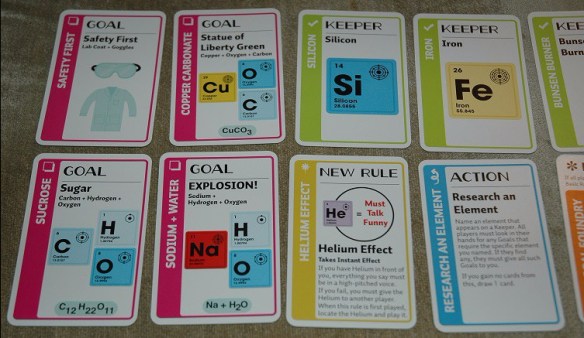
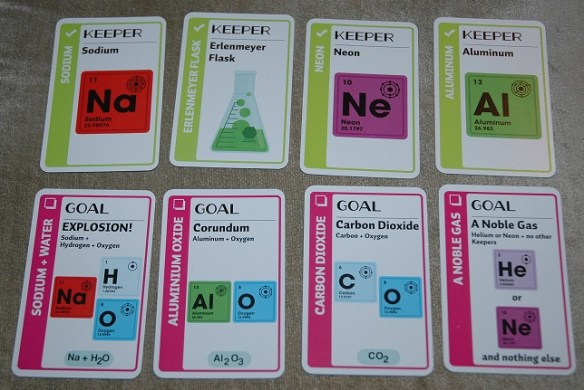
But instead of matching images like you do in most versions of Fluxx, in Chemistry Fluxx players have to use keeper cards with elements or lab equipment on them in order to complete different compounds or procedures.

The subject of chemistry is a brilliantly appropriate fit for Fluxx. Elements are literally the building blocks of everything around us, so to make them the keepers and various molecules and compounds the goals of the game is seamless.

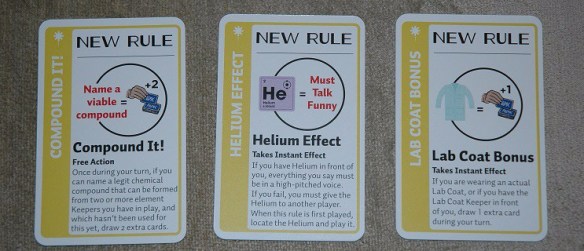
But the game’s creators didn’t stop there. They went all out with chemistry lab trappings, introducing new rule cards that reward you for actually wearing a lab coat during game, for speaking in a high voice when the Helium card is in play, or granting you bonus cards by testing your knowledge of chemistry.

chemfluxx3

The goal cards even display the actual elemental chains formed by these combinations of elements at the bottom, reinforcing the chemistry information on the cards and helping to build associations between the keeper cards and the compounds they form. It’s subliminal learning, which keeps the game fun while still offering chances for parents and families to encourage the young minds around them.

Chemistry Fluxx combines the best of education-based games and Looney Labs’ signature brand of madcap immersive gameplay to create a fun and accessible way to bring STEM concepts and learning home. Even if you’re just looking for a quick round of chaotic cards, you might find yourself learning anyway.

Chemistry Fluxx will be available May 25, but you can preorder it from Looney Labs by clicking here! And to check out all of our reviews of Looney Labs games and products, click here!


Thanks for visiting PuzzleNation Blog today! Be sure to sign up for our newsletter to stay up-to-date on everything PuzzleNation!

You can also share your pictures with us on Instagram, friend us on Facebook, check us out on Twitter, Pinterest, and Tumblr, and explore the always-expanding library of PuzzleNation apps and games on our website!
PuzzleNation Product Review: Lunar Landing

all-lunar-6802-hiresspill

[Note: I received a free copy of this puzzle in exchange for a fair, unbiased review. Due diligence, full disclosure, and all that.]

ThinkFun has emerged as the premiere vendor of logic puzzles for solvers of all ages. Whether they’re challenging you with marbles, lasers, or electronic circuits, their complete-the-path games offer lots of puzzly fun.

Their latest offering, Lunar Landing, seems at first to fall into the same pattern, but as you learn the rules and begin tackling the challenge cards included, you quickly realize there’s more than meets the eye at play.

moon_landing_1920x1200_wallpaper

In Lunar Landing, your goal is to pilot the red shuttle to an emergency entry port in the center of the landing grid. Sounds easy enough, right? But the twist is how you get there.

Scattered across the landing field are helper bots which help your shuttle move around the landing field. The shuttle can only move toward one of the helper bots in the same row or column. The shuttle must move from helper bot to helper bot until it reaches the emergency entry port.

Because Lunar Landing is set in space, the shuttle can’t just stop wherever it chooses. Once the shuttle is set on a path toward a helper bot, it continues along that path until it reaches that bot. This means you can pass right over the emergency entry port unless there’s a helper bot in the correct position to stop the shuttle on that red square.

solvell

This movement mechanism is the engine behind each of the 40 challenge cards in the deck. Progressing in increasing difficulty from beginner to intermediate to advanced to expert, the challenge cards provide you with the starting layouts for each landing grid. You place the shuttle and helper bots as instructed, and then try to puzzle out how to complete the task at hand.

The early scenarios are all about moving the shuttle from place to place. In later challenges, you’ll have to move the helper bots as well, positioning them to form a path that’ll bounce your shuttle to the center of the grid.

The helper bots move in the same way as the shuttle — toward another helper bot along a row or column — and as the scenarios evolve, you’ll rely on moving the helper bots more and more.

It’s a bit like a sliding-tile puzzle, since you can only move the shuttle along certain paths, as determined by the locations of the helper bots. Many of the challenge cards can only be conquered by setting up a chain reaction, which gives Lunar Landing the feeling of a one-person chess game: You’re trying to see several moves ahead, looking for the perfect sequence of moves that will let you achieve victory.

Taking a simple scientific concept — objects in motion tend to stay in motion — and building a logic game around it is very clever, and it makes for a solving experience that feels new and challenging. Since each piece can potentially move, depending on the challenge card layout, there are more variables at play here than in previous ThinkFun logic puzzles.

helperbot

The helper bots are modeled on classic robot designs from the 1940s and 1950s, and that adds to the game’s charm, as if the vivid Technicolor visions that predated the Space Race have finally been realized.

The landing grid doubles as storage for the challenge cards and game pieces, making for an easily transported puzzle game that can be enjoyed anywhere at the drop of a hat.

Lunar Landing continues the fine tradition of ThinkFun puzzle games, keeping even experienced puzzlers on their toes with inventive gameplay and outside-the-box thinking. What a treat.

Lunar Landing is available from ThinkFun through Amazon and other online retailers. Click here to check out other ThinkFun product reviews!


Thanks for visiting PuzzleNation Blog today! Be sure to sign up for our newsletter to stay up-to-date on everything PuzzleNation!

You can also share your pictures with us on Instagram, friend us on Facebook, check us out on Twitter, Pinterest, and Tumblr, and explore the always-expanding library of PuzzleNation apps and games on our website!
PuzzleNation Product Review: Tak

6bb7918f3732d73fba879a55065cad0d_original

Puzzles and games are constantly advancing and innovating, incorporating new technologies, new production techniques, and a lengthy legacy to build upon. In this blog alone, we’ve looked at 3-D printed puzzles, logic games that involve actual lasers, and puzzles that were brought to life thanks to internet crowdfunding; none of these were possible fifteen or twenty years ago.

But today’s game is something different. It’s a brand new game that feels like a classic from centuries past, a board game that feels timeless.

Today, we’re reviewing Tak by James Ernest and Patrick Rothfuss.

tak2

You may recognize Rothfuss’s name from his Kingkiller Chronicles novels, including The Wise Man’s Fear, where he first referenced the tavern game Tak. Now, game designer James Ernest has helped him bring the game to life.

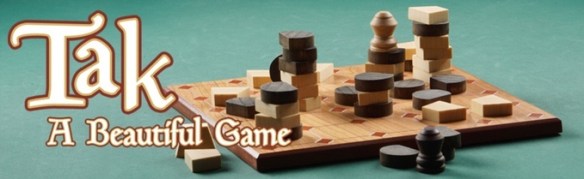
Tak has a very simple concept: two players each attempt to build a road connecting opposite sides of the game board. The first player to successfully complete their road wins.

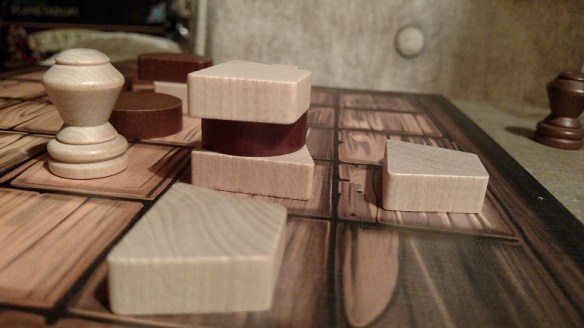
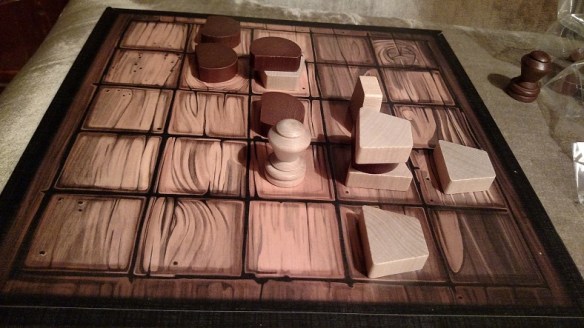
To do so, you place game pieces called stones, one at a time, on various spaces on the board. The stones can either be played flat (meaning they’re part of your road) or standing on edge (meaning they’re a wall, blocking any road’s passage through that space).

tak1

It’s an easily grasped mechanic that allows for a great deal of gameplay flexibility. Since flat stones can be stacked, you can seize control of part of a road by placing your flat stone atop your opponent’s. Then again, your opponent could play his capstone, flatten one of your walls, and instantly make it part of his road.

The game can be played on boards as small as 3×3 and as large as 8×8, allowing for greater difficulty and strategic opportunities. And considering that you can move stacks of pieces (as long as your flat stone tops the stack), that opens the field even more for tactical moves to grant you control of more road.

With so many moves and countermoves available to the player, no two games of Tak feel alike, and even the puzzliest player will no doubt find themselves surprised by a cunning opponent. (And the game encourages this, since your very first move will be to place one of your opponent’s pieces on the board. Each player does this before continuing forward using only their own pieces.)

tak3

This balanced system ensures that players stay engaged until the very last move, making for an elegant play experience that feels earned, win or lose.

The full title of the game is actually Tak: A Beautiful Game, and it’s hard to disagree. The simple, yet distinct game pieces grant an earthy, homegrown feel to the game, and the gorgeous art (both in the companion book and the Selas 3×3 game board, pictured above) only enhance the experience.

Rothfuss and Ernest have really outdone themselves with this one. Tak feels at home in the 21st century as it would in the 18th. That’s something both rare and special.

The core version of Tak is available through Cheapass Games, and you can find other boards and variations at The Tinker’s Packs.


Thanks for visiting PuzzleNation Blog today! Be sure to sign up for our newsletter to stay up-to-date on everything PuzzleNation!

You can also share your pictures with us on Instagram, friend us on Facebook, check us out on Twitter, Pinterest, and Tumblr, and explore the always-expanding library of PuzzleNation apps and games on our website!