PuzzleNation Product Review: Doctor Who Fluxx

[Note: I received a free copy of this game in exchange for a fair, unbiased review. Due diligence, full disclosure, and all that.]

The crew at Looney Labs have masterminded all sorts of pop culture crossovers with Fluxx — Batman Fluxx, Firefly Fluxx, Adventure Time Fluxx, and more — but they’ve outdone them all with the latest addition to the Fluxx card game library: Doctor Who Fluxx.

It’s a natural fit, to be sure. The Doctor travels through time and space, righting wrongs, exploring the universe, and periodically transforming into new versions of himself (a process known as regeneration).

In addition, the show itself can vary wildly from fantasy and science fiction to horror and mystery, all whilst remaining family friendly. So when you’re talking about a game where the rules change constantly, what better represents the Fluxx philosophy than Doctor Who?

And the creators have gone all out to make Doctor Who Fluxx both a great gaming experience for those unfamiliar with the show and an absolute, reference-loaded blast for Doctor Who fans.

For the uninitiated, Fluxx is a straightforward card game. You collect keeper cards and put them into play. Different combinations of keeper cards complete different goals, and each player has the chance to put different keeper cards and goal cards into play in order to win. So you might find yourself working toward completing the goal at hand when suddenly somebody plays a new goal, and the object of the game changes.

Along the way, players affect how the game is played by utilizing action cards and new rule cards which alter what players can and can’t do. Suddenly, you’ll have to trade your hand with another player, or start drawing three cards each turn instead of one.

So not only are the various versions of The Doctor (and his companions) your keeper cards, but long-time enemies like The Master, the Daleks, and the Weeping Angels serve as creeper cards that prevent players from achieving victory. And every Goal card represents either a relationship from the show or a clever reference to a quote, running gag, or key moment from the 50-year history of the TV show.

And the Doctor Who-tinged details don’t end there. New Rule cards and Action cards incorporate quotes and moments from the show, making clever use of Fluxx’s malleable rule set to add more sci-fi-fueled chaos to the game.

Probably my favorite card — among many that pay homage to the source material — is the Future Doctor Keeper Card. Not only does it acknowledge that there’s always a new Doctor lurking in the show’s future, but it makes for a crafty game mechanic, as the card immediately becomes the highest numbered Doctor in the game.

(So, for instance, if you’re trying to achieve the Regeneration Goal — which requires two Doctor Keeper Cards in sequential order, you can pair the Future Doctor card with the Twelfth Doctor.)

Even if I wasn’t a fan of the TV show, I still would’ve thoroughly enjoyed testing out Doctor Who Fluxx. A great deal of time, energy, and creativity has clearly gone into incorporating huge swathes of the Doctor Who franchise into the gameplay itself, and it shows. The game remains infinitely replayable, bringing the best of Fluxx and the best of The Doctor together. This is, without a doubt, the best version of Fluxx yet. What fun!

Doctor Who Fluxx will be available November 23, but is available for pre-order by clicking here! And to check out all of our reviews of Looney Labs games and products, click here!


Thanks for visiting PuzzleNation Blog today! Be sure to sign up for our newsletter to stay up-to-date on everything PuzzleNation!

You can also share your pictures with us on Instagram, friend us on Facebook, check us out on Twitter, Pinterest, and Tumblr, and explore the always-expanding library of PuzzleNation apps and games on our website!

PuzzleNation Product Reviews: Big Letter Bananagrams, Qwordie, & Word-A-Melon

[Note: I received a free copy of these games in exchange for a fair, unbiased review. Due diligence, full disclosure, and all that. /end disclaimer]

When it comes to word-forming tile games, the folks at Bananagrams are the masters. Their fruit-inspired packaging is synonymous with that particular brand of puzzling, giving Scrabble a run for its money in terms of letter-tile games. And they have an uncanny knack for putting new spins on classic puzzle-game tropes, breathing new life into the genre.

In today’s post, we’ll take a look at three of their latest efforts: Big Letter Bananagrams, Qwordie, and Word-A-Melon.

Big Letter Bananagrams is pretty much the tried-and-true Bananagrams model you already know: solvers pull tiles from a central pile and use them to build a grid of overlapping words, hoping to be the first to use up all of their letters.

The difference here is simple but important: Big Letter Bananagrams offers greater visibility for solvers with visual impairments. The tiles are 50% larger than those in the regular Bananagrams set — complete with a bold, easily discernable font — ensuring that older generations of puzzlers will still get to enjoy family game night.

Plus, a portion of the sale of each set of Big Letter Bananagrams goes to the American Macular Degeneration Foundation.

Qwordie takes the word-forming basics of Bananagrams and adds a twist: solvers must use their own letter tiles (as well as ones pilfered from a central pile, a can of extra tiles, or another player’s personal tiles) in order to form a word that fits a certain category.

For instance, say the given card asks you to spell one of the five senses. Each player draws tiles from the central pile or the can of extra tiles and tries to spell a word that satisfies the card on the table. The first player to do so adds those tiles to their stack. The first player whose stack of winning letters passes the finish line on the side of the game tin wins!

Qwordie works at a slower pace than traditional Bananagrams games, since there’s a bit of a wagering aspect to grabbing new tiles. Sure, the quickest speller usually still wins, but the gamesmanship offers players more options than the regular game, since you can use wild card tiles (the platypus tiles), steal tiles from other players (the robber tile), or chose from several piles of extra letter tiles to pull.

This more methodical pace offers a distinctly different play experience for players familiar with more rapid-fire Bananagrams-style solving, and skews the game slightly older than most other Bananagrams products.

The categories come in easy and hard sets, allowing you to tailor the game to whichever group of puzzlers you play with. Qwordie is a smart hybrid of word-building games and Family Feud-style name-something-that-fits-this-category games, combining them for a fun solving experience for puzzlers.

Finally, we’ve got Word-A-Melon, one of the most cleverly designed and realized games in the Bananagrams game library.

Not only are the instructions of the game disguised as a watermelon rind cover for the game board, but the game board itself can be used to store the game’s tiles and die for easy transport.

Players race to claim seeds — aka letter tiles — by flipping over random tiles on the watermelon-shaped game board and using those seeds to spell out the longest word possible. You then claim the tiles used in that word and remove them from the board, adding them to your stash of seeds.

A roll of the die determines how many tiles you get to reveal on the board, but any letters you can’t use are turned back over. This adds a marvelous Memory-style mechanic to the word forming, one that adds a bit more strategy to everyone’s gameplay.

As you spell words, you remove those letters from the watermelon board, and the player with the most tiles (or seeds) at the end of the game wins.

You can also tailor the game’s difficulty to your liking: excluding common letters makes it harder to form words during the game, while excluding the tougher, rarer letters (like Q) makes for less of a challenge for younger solvers.

Between these three games, solvers of all ages and levels of experience have a word-forming game that fits them, encouraging group gameplay while challenging the anagram and resource management skills of each and every puzzler. Factor in the high replay value built into all of these games, and you’ve got a trio of winners for any puzzle fan.

The Bananagrams crew has done it again (and again, and again).


Thanks for visiting PuzzleNation Blog today! Be sure to sign up for our newsletter to stay up-to-date on everything PuzzleNation!

You can also share your pictures with us on Instagram, friend us on Facebook, check us out on Twitter, Pinterest, and Tumblr, and explore the always-expanding library of PuzzleNation apps and games on our website!

PuzzleNation Product Review: Brad Hough’s The Maze

Mazes are nothing new to even the most casual solver. Whether it’s a puzzle collection, a place mat at a chain restaurant, or a coloring book loaded with time-filling activities, we’ve all traced a path through a maze with pencil, crayon, or marker.

But in most paper-and-pencil mazes, we look down on the map from above, so we have the advantage of perspective, the ability to spot dead-ends ahead of time, the opportunity to make wiser choices with more information.

As anyone who has ever tackled a corn maze will tell you, maze navigation is far more challenging when you’re inside the puzzle itself, rather than observing it from a bird’s-eye view.

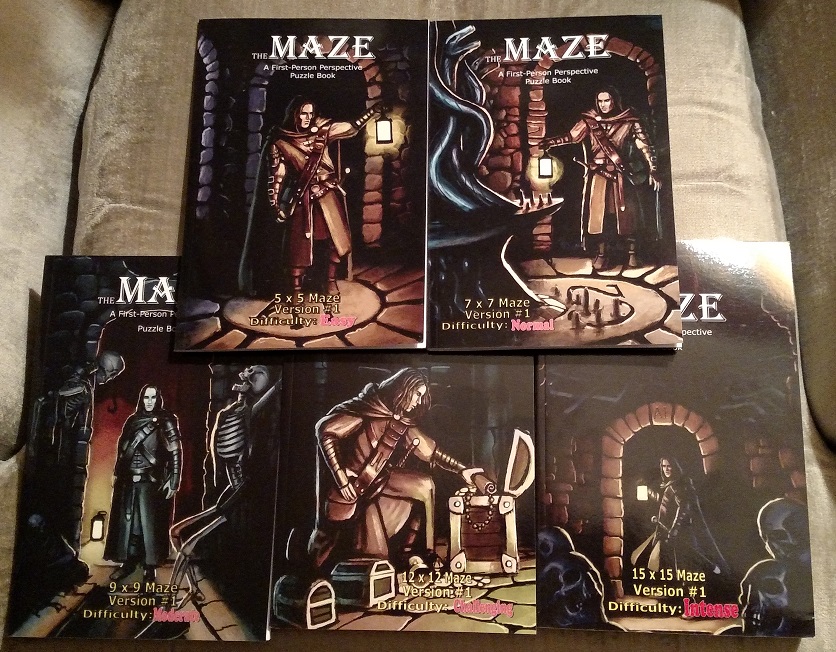
And that’s what makes Brad Hough’s The Maze series of puzzle books something different and far more challenging: they’re mazes designed from the first person perspective. You must imagine yourself walking through this maze, selecting each turn and hoping it will lead you to the promised land.

It’s a marvelous concept, offered in a variety of difficulty levels according to the size of the maze:

  • Easy is a grid of 5 rooms by 5 rooms.
  • Normal is a grid of 7×7.
  • Moderate is 9×9, Challenging is 12×12, and Intense is 15×15.

As you make your choices, you’ll flip to different pages in the book, just as you would in a Choose Your Own Adventure-style story, maneuvering your way to either a dead-end (forcing you to turn back) or your desired exit.

But those are the only decisions you’ll make. There are no monsters to slay or traps to navigate, as there are in labyrinths in Dungeons & Dragons. There are no moral conundrums to unravel, as in Choose Your Own Adventure books. There is simply The Maze… and you. This is bare bones storytelling designed as both a pure puzzle-solving experience and as a blank skeleton upon which you can built your own story.

There are no tricks or endless loops to wander into. This is a fair challenge meant to be unraveled by crafty minds with excellent spacial skills.

Although The Maze lacks the frills of many other labyrinth-style puzzles, it does a marvelous job of portraying the sort of blindness and trepidation that comes with actually residing within a maze, knowing that each choice is more crucial the farther you venture forth.

The Maze (in various sizes) is available from Amazon and other online retailers.


Thanks for visiting PuzzleNation Blog today! Be sure to sign up for our newsletter to stay up-to-date on everything PuzzleNation!

You can also share your pictures with us on Instagram, friend us on Facebook, check us out on Twitter, Pinterest, and Tumblr, and explore the always-expanding library of PuzzleNation apps and games on our website!

PuzzleNation Product Review: //CODE: On the Brink

[Note: I received a free copy of this game in exchange for a fair, unbiased review. Due diligence, full disclosure, and all that. /end disclaimer]

There has been a tidal shift over the last few decades from the analog realm to digital. So much happens in cyberspace, by email, and in the liminal spaces between smartphones and computers, that it feels like we’re leaving behind physical media entirely. In the next decade, knowledge of programming will become an essential skill.

And it’s never too early to begin laying the foundation for that future. The folks at ThinkFun have been ahead of the curve there for a long time — their game Robot Turtles is a prime example — and they continue to push forward with their new //CODE Programming Game Series, a line of puzzly products designed to teach the basics of programming to young solvers.

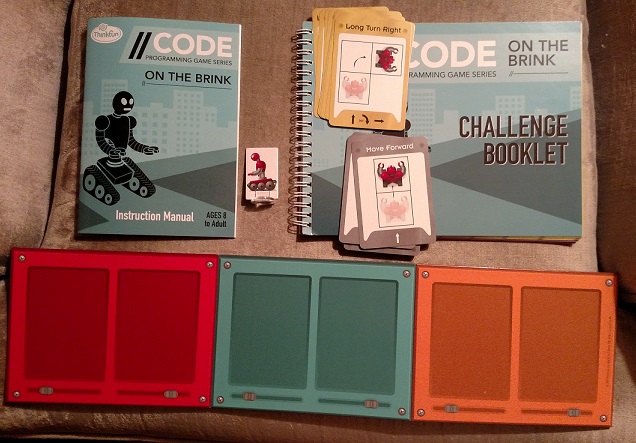
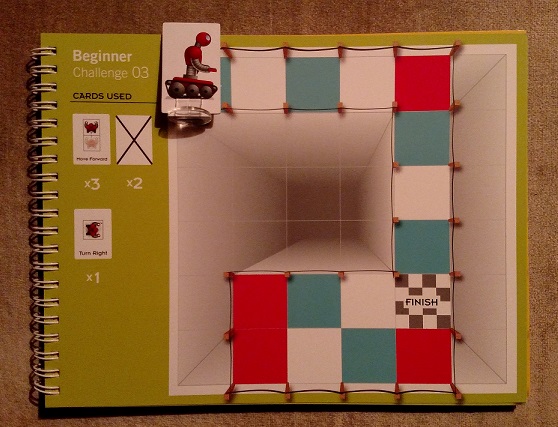
The first game in the series, On the Brink, serves as an excellent primer. The game is based around a simple concept: navigating a robot along a particular path. This path can twist, turn, and even cross itself. But it’s up to the solver to figure out how to use the available programming cards to control and determine the robot’s path.

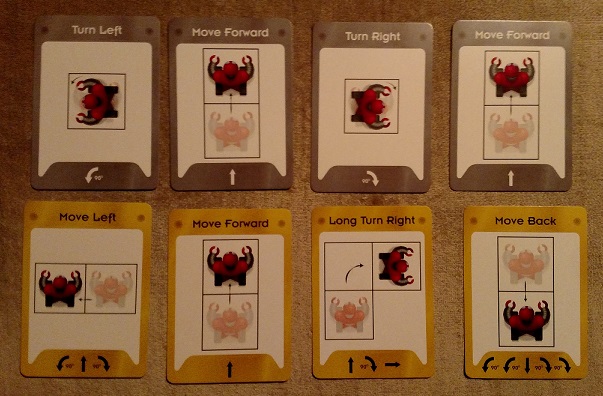
There are two sets of programming cards, one simpler deck designed for the first 20 challenges and one larger deck designed for the more difficult challenges that follow. Just as you learn simpler commands before you learn finer, more detail-oriented, and more complex ones, you must master the basic commands in On the Brink before moving forward.

Whereas Robot Turtles required players to be supervised by a Turtle Master who governed the setup, difficulty, and execution of commands, On the Brink can be played alone, as the solver tackles each puzzle in the challenge booklet, complete with starting cards, a given path to replicate, and colored boxes on the board that align with the three sections of the control panel.

I was impressed by the amount of variety to be found in a relatively small deck of commands. A cagey programmer can navigate the robot through some unexpectedly thorny paths, reminding me a bit of the step-by-step deductive reasoning that made Lunar Landing such a delightful challenge.

One way that On the Brink improves upon Robot Turtles is with the concept of commands that continue to run once activated. In On the Brink, your robot will follow a command for as long as the programming cards and colored spaces on the challenge booklet page dictate. Just as a command in programming requires parameters in order to know when to stop, your robot needs similar commands. Otherwise, it’s liable to pass right over the finish square instead of landing there perfectly.

On the Brink invites players as young as 8 to tackle the various challenges in the booklet, either alone or in groups, and the steady ratcheting-up of difficulty teaches the young programmer as they advance, putting new wrinkles and obstacles in the player’s path.

It’s the sort of patient, clever gameplay we’ve come to expect from ThinkFun, and they do not disappoint here. Figuring out how to utilize the available commands and complete the path given makes for an excellent puzzly challenge — especially the later scenarios! — but it never feels inaccessible or overwhelming.

You’re always in good hands with ThinkFun, and they’ve proven it again here with On the Brink.

On the Brink is available from ThinkFun and participating brick-and-mortar and online retailers for $14.99.


Thanks for visiting PuzzleNation Blog today! Be sure to sign up for our newsletter to stay up-to-date on everything PuzzleNation!

You can also share your pictures with us on Instagram, friend us on Facebook, check us out on Twitter, Pinterest, and Tumblr, and explore the always-expanding library of PuzzleNation apps and games on our website!

PuzzleNation Product Review: Nanofictionary

[Note: I received a free copy of this product in exchange for a fair, unbiased review. Due diligence, full disclosure, and all that.]

We’re used to puzzles where you have to combine pieces to reveal a picture, or you use clues to complete a grid, or you employ deduction to unravel a series of events. It’s far less common for puzzlers to put those skills to use telling a story.

The latest offering from the crafty crew at Looney Labs challenges players to do precisely that: tell a story. More specifically, Nanofictionary tasks you with telling the best story possible from the ingredients available.

And you better do it quickly. Imagine you’re pitching a movie and you’ve only got the length of an elevator ride to sell it to a producer.

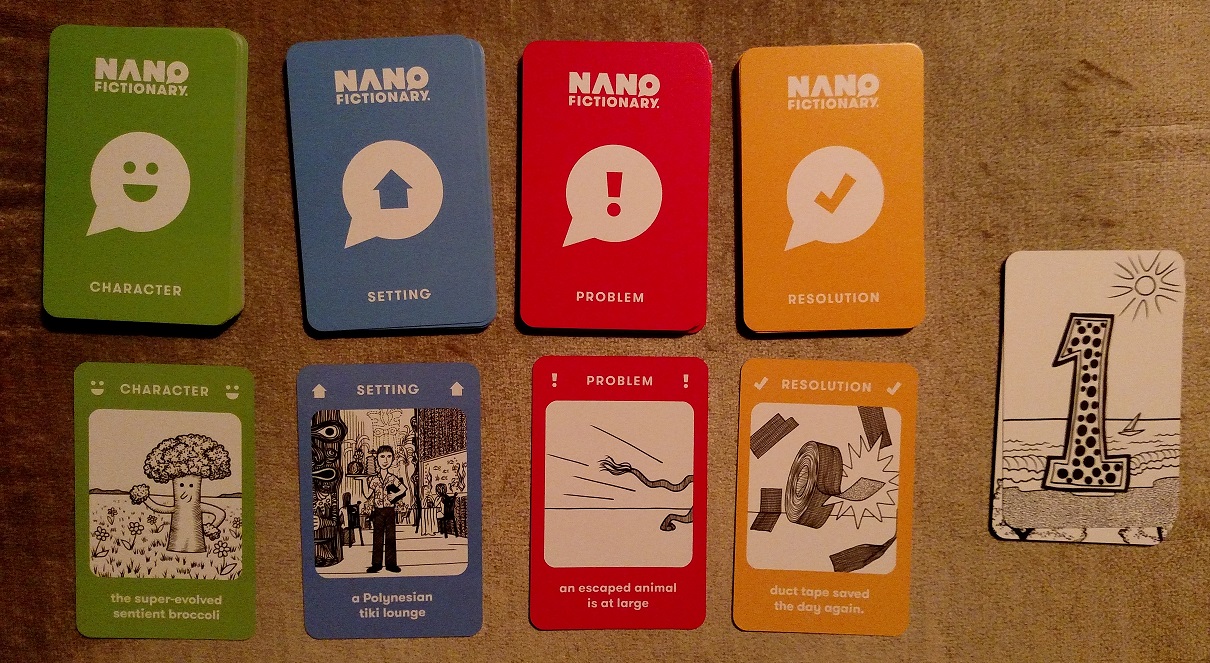
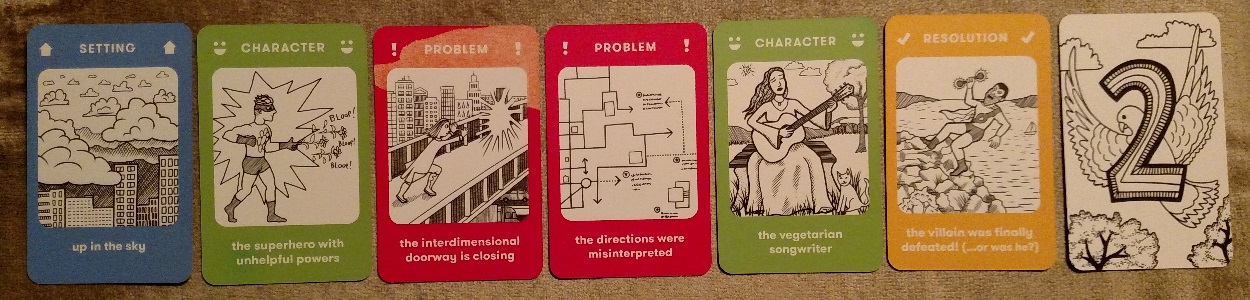
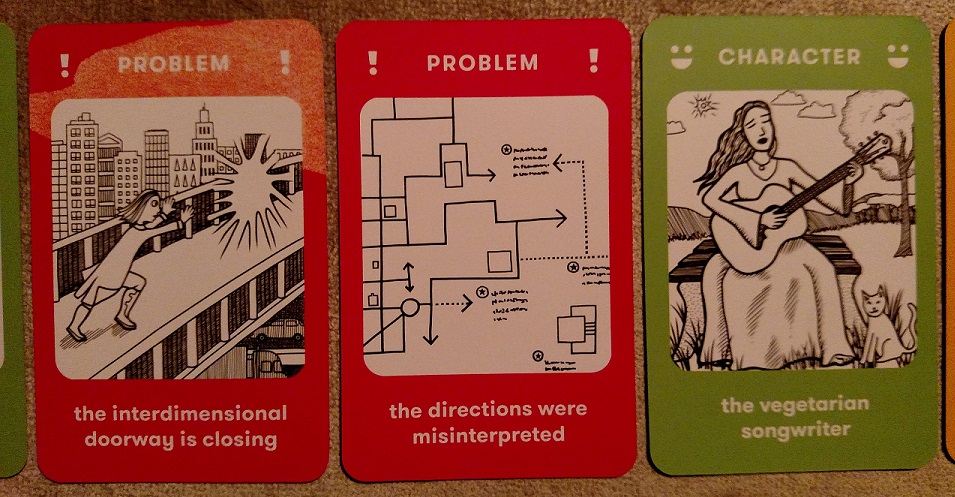
Nanofictionary offers up to six players a selection of four decks of cards: characters, settings, problems, and resolutions. Each player draws a starting hand, consisting of two characters, one setting, one problem, and one resolution. Players then try to build an entertaining narrative from the options at hand, by drawing and discarding cards, before declaring themselves ready to pitch.

Here is the first element of strategy in the game: deciding when you’re ready to present your story. If you do so quickly, you secure an earlier slot than the other players. Although this means other players can add additional cards to their hands (and thereby enhance their stories), it also means that ties are settled in favor of players who readied their stories faster. It’s a tradeoff, more cards in the short term vs. a tactical advantage in the long term.

After everyone has assembled their stories, each player has a turn performing their elevator pitch, doing so in the order in which they declared themselves ready. After all the stories are shared, the players then vote for their favorite story. (Naturally, to prevent every player from doing so, you cannot vote for yourself.)

Nanofictionary is an intriguing mix of strategy, luck, and ingenuity. The strategy involves not only when to declare your story ready, but what choices you make to get there. Do you choose the unexpected new card on your turn, or rifle through the cards discarded by the other players? Do you wait for a few other players to declare their stories ready, allowing yourself access to more cards in your hand, or do you go for the tie-breaking advantage you might need?

Luck, of course, comes into play with the cards you randomly draw. Perhaps you’ll end up with elements that quickly form an entertaining tale in your mind. Or perhaps you’ll struggle to ditch the pieces that don’t inspire you, hoping to trade them for a more exciting setting or a problem that makes the most of the characters in your hand.

But, as you might expect, the ingenuity side is where the game comes alive. Just sitting back and watching these delightfully brief (and yet hilariously detailed) stories come to life is a real treat, and quite honestly, it makes the voting aspect so hard. Because with the right group of players, virtually any combination of cards can turn into gold with the right storyteller.

The designers fit a surprising amount of variety and reusability into these four small decks of cards, allowing storytellers to run wild with tales as fantastic as they are ridiculous. It’s not your usual puzzle game, but that’s part of the charm.

Nanofictionary is available now from Looney Labs and select participating retailers for $16.


Thanks for visiting PuzzleNation Blog today! Be sure to sign up for our newsletter to stay up-to-date on everything PuzzleNation!

You can also share your pictures with us on Instagram, friend us on Facebook, check us out on Twitter, Pinterest, and Tumblr, and explore the always-expanding library of PuzzleNation apps and games on our website!

PuzzleNation Product Review: Color Cube Sudoku

[Note: I received a free copy of this product in exchange for a fair, unbiased review. Due diligence, full disclosure, and all that.]

Sudoku is one of the most popular pen-and-paper puzzles in the world. It’s found in numerous daily newspapers, puzzle books, and smartphone apps.

After years of tackling regular Sudoku, Extreme Sudoku, Word Sudoku, Mega Sudoku, Samurai Sudoku, Geometric Sudoku, Sum-Doku, and numerous other variations, you’d think the puzzle community at large would’ve exhausted every possible version of Sudoku.

Enter the crafty folks at ThinkFun, who have put a unique spin on another Sudoku variant: Color Sudoku. In Color Sudoku, you have nine colors to arrange instead of numbers.

ThinkFun has upped the ante with Color Cube Sudoku, their latest puzzle-game, by combining the twisty-turny cube possibilities of a Rubik’s Cube with Sudoku-style deductive solving.

It seems like a simple enough set-up. You’ve got a tray and nine multi-colored cubes. Each cube has four of the six possible colors: green, red, blue, yellow, orange, and white. And it’s up to you to arrange the nine cubes in the grid in a 3×3 pattern so that each color only appears once in each row and column.

But that arrangement already introduces complications. Unlike a pen-and-paper puzzle, where you can place any number (or in this case, any color) in any square you choose, the preset color arrangements on each cube limit your choices.

If you need a blue square in the first row, sixth column, given the cubes available to you, you might end up with a second yellow square in your row. Which means, instead of needing a new cube, you need to change one of the cubes you’ve already placed and try again.

What once seemed simple now offers a greater challenge.

But, like many ThinkFun puzzle-games, the more you play around with the possibilities, the more you begin developing new strategies and get into the psychology of the puzzle itself.

Once you’ve placed a few of the cubes, next-level deductive reasoning kicks in, and you can eliminate certain possibilities and begin working more than one step ahead at a time.

For instance, if you’ve placed two cubes in a column, you’ll know you need to change one of the cubes if the third cube will need a green spot in both columns. Since that’s impossible, even without placing the third cube, you know you need to change one of the two you’ve already placed. Which means you’re preventing wasted moves and pushing closer to an actual solution.

Whether you’re tackling Color Cube Sudoku alone or with partners, whether you’re trying to crack a regular 6×6 pattern or taking a whack at some of the variant challenges they suggest — like knight’s paths and other difficult patterns — this is a deduction puzzle that feels like play instead of work.

When I tested this out with a fellow puzzler, we immediately began playing it in a slightly more competitive way. One of us would place a cube, and then the other would place a cube, and we would keep going until no cube could be placed.

You can end the game there, or you can take it a step further, and introduce rules where moving or shifting previously-placed cubes becomes part of the game in order to extend the puzzly gameplay. Heck, if you go long enough, it eventually becomes a race to see who can actually solve the Color Cube Sudoku layout first!

The designers state that there are 2,641,807,540,224 different ways to arrange the 9 cubes, and with seemingly endless variation in such a simple set-up, this is one puzzle-game you can put down and return to numerous times without burning out or feeling like you’ve conquered it forever.

Color Cube Sudoku is available for $19.99 from ThinkFun and select retailers!


Thanks for visiting PuzzleNation Blog today! Be sure to sign up for our newsletter to stay up-to-date on everything PuzzleNation!

You can also share your pictures with us on Instagram, friend us on Facebook, check us out on Twitter, Pinterest, and Tumblr, and explore the always-expanding library of PuzzleNation apps and games on our website!