First Look: Puzzle, A Film About Finding the Right Pieces

[Image courtesy of Steven Teagarden.com.]

Satisfaction. Nothing encapsulates the feeling of completing a puzzle quite like the word “satisfaction.”

Whether we’re talking about crosswords, brain teasers, mechanical puzzles, or jigsaw puzzles, it’s a gratifying feeling to write that final letter, place that final piece, make the final twist/move/connection and unlock the solution.

“When you complete a puzzle, you know you have made all the right choices.” That idea is at the heart of a new movie coming out next month entitled Puzzle.

[Image courtesy of IMDb.]

From one of the press packets for the film:

Agnes, taken for granted as a suburban mother, discovers a passion for solving jigsaw puzzles, which unexpectedly draws her into a new world – where her life unfolds in ways she could never have imagined.

The film stars Kelly MacDonald (who you might know from Brave, Boardwalk Empire, Gosford Park, or Trainspotting), Irrfan Khan (Life of Pi, Slumdog Millionaire, In Treatment, and Jurassic World), and David Denman (The Office, Angel, 13 Hours, and Logan Lucky), but even from the brief glimpses offered in the trailer, this is clearly Kelly MacDonald’s show.

Transitioning from a warm reception at Sundance to wider release in July and August, the film looks like a wonderful character piece, a nice bit of counterprogramming after the usual summer blockbuster fare.

I’m looking forward to seeing the film when it’s released — it opens July 27th in select theaters — and I’ll write a full review for the blog when I do.

But in the meantime, check out the trailer, and if you’re intrigued, spread the word.


Thanks for visiting PuzzleNation Blog today! Be sure to sign up for our newsletter to stay up-to-date on everything PuzzleNation!

You can also share your pictures with us on Instagram, friend us on Facebook, check us out on TwitterPinterest, and Tumblr, and explore the always-expanding library of PuzzleNation apps and games on our website!

Winning Monopoly With Math!

I’m always on the hunt for tips to make myself a better puzzler and gamer. Sometimes you stumble across those tips in unexpected places.

For instance, I was reading, of all things, a book about mathematics and Christmas — The Indisputable Existence of Santa Claus: The Mathematics of Christmas — and inside, I found a statistical analysis of the best strategy for winning a game of Monopoly.

Yes, we’ve discussed this topic before, but even that previous deep-dive into the mechanics of the game wasn’t as thorough or as revealing as the work by Dr. Hannah Fry and Dr. Thomas Oleron Evans in this Christmas-fueled tome of facts and figures.

They started with a breakdown of how your first turn could go, based on dice rolls. This is the same breakdown as in our previous post, but with some important differences. For instance, they also considered the chances of going to jail after multiple doubles rolls.

Also, they covered the statistical impact of how landing on card spaces can affect where you land on your first turn. The Community Chest is a curveball, because of the possible sixteen cards, three will send you somewhere on the board: Go, Mediterranean Ave, and Jail.

A simple statistical analysis is complicated even further by the Chance cards — nearly half of the sixteen cards send you elsewhere: Go, Income Tax, St. Charles Place, Pennsylvania Railroad, Illinois Ave., Jail, and Boardwalk.

If you extrapolate forward from this point, you uncover some interesting patterns:

The orange property set benefits from all the ex-cons leaving their cells, and after their next turn the reformed criminals will likely end up somewhere between the reds and yellows… Illinois Avenue, with its own dedicated Chance card directing people to it, gets an extra boost, making it the second most visited square on the board.

The property that is visited least frequently is Park Place, where players spend just 2.1% of their time.

Check out this graph. This shows potential earnings from each complete color set, with the dotted line marking the point where your purchase of the property is canceled out by how much the property has earned in rent thus far. Everything above that is profit.

As you can see, blue and brown properties start close to the dotted line, because they’re affordable to buy and build on. The standouts on this graph are New York Avenue (which earns $30 a roll up through thirty rolls statistically) and Boardwalk, which is an expensive investment, but pays off handsomely down the line, remaining the top earning spot past thirty rolls.

Of course, that’s only single properties, and you can’t build on single properties. Let’s look at a chart for full color set revenue:

Some of our previous findings change radically. Boardwalk’s rating drops significantly, because of Park Place’s relative infrequency of being landed on (as we mentioned above).

So which properties should you nab to give yourself the best chance of winning? Well, that depends on how long the game lasts.

The average game of Monopoly takes approximately thirty turns per player, so the larger the number of players, the longer the game will last.

So, for a two-player game, your best bet is to go after the light blue or orange sets, since they’re better in the short term, and the odds are in your favor if the game stays short.

In a three- or four-player game, the orange and red sets are better, because the game is likely to last a while.

And if five or more people are playing, you’re really playing the long game, so the green set becomes your best chance for success.

What about building on those properties? Well, Fry and Evans considered that as well. If you’re playing against multiple opponents and know you’ll be in for a long game, then you definitely want to buy and place houses. But don’t fear if the first house takes a long time to start paying for itself.

As it turns out, your best strategy is to put three houses on your properties as quickly as possible, because the third house is the fastest to recoup on investment. So once the three houses are in place on each property, you can rest for a bit and regenerate your bank before investing further.

And there you have it. Better gaming through mathematics! The only thing better would be, well, playing practically any other game.

Kidding! (But not really.)


Thanks for visiting PuzzleNation Blog today! Be sure to sign up for our newsletter to stay up-to-date on everything PuzzleNation!

You can also share your pictures with us on Instagram, friend us on Facebook, check us out on TwitterPinterest, and Tumblr, and explore the always-expanding library of PuzzleNation apps and games on our website!

Turn Your Smartphone Into a Rubik-Solving Sidekick?

I just can’t resist a bit of Rubik’s Cube news.

We’ve covered Rubik’s Cubes a lot on this blog. We’ve seen them solved underwater, while being juggled, during a skydive, and one move at a time by strangers on a world tour. And yes, we’ve seen them solved in increasing faster times, both by humans and machines.

The human record hovers around the five-second mark, while the machine record stands at .38 seconds, which is brain-meltingly fast.

Now there’s a new tool on the market to up your Rubik-solving game like never before. It’s called GoCube, and it’s on Kickstarter right now.

GoCube is a Rubik’s-inspired twisty puzzle that is Bluetooth-enabled in order to interact with a phone or tablet. It offers real-time updates on your solving progress — which corresponds to areas of the physical cube that light up — as well as carrying a whole host of other features.

You can use it as a training tool to teach you the tricks of the solving trade, whether you’re just learning how to solve a twisty puzzle or you have aspirations of being a speed-solver.

GoCube’s connectivity even allows you to compete in head-to-head solves with other users. Plus you can use the cube as a controller for mini-games, in dexterity challenges, and more.

This seems like an impressive step forward for twisty puzzles. Although the price tag is pretty hefty — the basic Kickstarter package starts at $69 (although the creators claim it will retail for $119) — the campaign has already blown past its initial goal of $25,000. It currently sits at over $400,000 in Kickstarter-backed funds with over a month to go.

Puzzles continue to grow and adapt to the modern technological revolution in unexpected and fascinating ways. I can’t wait to see what tech-savvy puzzlers cook up next.


Thanks for visiting PuzzleNation Blog today! Be sure to sign up for our newsletter to stay up-to-date on everything PuzzleNation!

You can also share your pictures with us on Instagram, friend us on Facebook, check us out on TwitterPinterest, and Tumblr, and explore the always-expanding library of PuzzleNation apps and games on our website!

Tackling the 2018 Indie 500 Puzzles!

June 2 marked the fourth annual Indie 500 Crossword Tournament, hosted in Washington, D.C., by constructors Erik Agard, Neville Fogarty, Andy Kravis, Peter Broda, and Angela Olsen Halsted. The first tournament had a racing theme, the second had a prom theme, the third had a time theme, and this year was fashion-themed!

While I couldn’t attend the tournament, I did download the tournament puzzles, and last weekend I finally had the opportunity to sit down and tackle them. And today, I thought I’d offer my thoughts on those puzzles, for any interested PuzzleNationers who might be considering participating in the event in the future.


Before the official tournament puzzles start, there’s a warm-up puzzle, a 13x grid entitled “Top Gear” by Neville Fogarty and Erik Agard. The hook is simple and accessible — celebrity names where the first name is a type of top, like COTTON MATHER for “crop top” or SHERMAN HEMSLEY for “tank top” — and with good fill and some tricksy cluing, you’ve got a nice pace-setter for the tournament puzzles to come.

Interesting grid entries included COSTUME CHANGE, GAINER, OMEN II, and THAT TOO. My favorite clue was the Arrested Development-inspired “What you might find in a bag marked ‘DOVE – DO NOT EAT'” for BAR SOAP.

[Image courtesy of Vertigo Mag.]

#1 On the Walk by Angela Olsen Halsted

The tournament proper opened with this terrific puzzle. The grid had solid fill entries with very little crosswordese, making for a marvelous introduction to the high quality level you’ve come to expect from Indie 500 puzzles. The theme entries all contained the word CAT in shaded boxes in the grid, slowly descending the main diagonal path of the grid, making for a literal catwalk.

The comment beneath the title, “Please, no meowing,” is not only a fun hint, but a hilarious callback to the Crossword De-Cat-hlon puzzle from last year’s Lollapuzzoola tournament, which had solvers meowing out loud as part of the solving experience. (That’s immediately what came to mind for me, anyway.)

All in all, a cracking opener for the tournament.

Interesting grid entries included PREGGERS, SABRA, ANITA HILL, and IMAC. My favorite clue was “Something you shouldn’t tell a woman to do” for SMILE.

[Image courtesy of Slideshare.]

#2 Unmentionables by Anna Gundlach

Puzzle 2 immediately raised the difficulty level, layering long interesting entries along the top right and bottom left corners of the grid to challenge the solver a bit more.

Couple that with a hook that required some very tight grid construction: unclued entries (making them “unmentioned”) in the grid like BRIEFS and BRA, each of which appears under the word WEAR in the grid. So you’ve got unmentionables and underwear. A really fun and clever execution of a good hook.

Interesting grid entries included AFAIK, RED STATES, TWENTY-ONE, and ROOMBA. My favorite clue was easily “Things that might come out in a row?” for SWEAR WORDS.

#3 Mall Shook Up by Laura Braunstein

As you might expect from the title, this puzzle involved clothing stores at the mall which had been all jumbled up. For example, one line read SECRET BANANA GAP, referencing Victoria’s Secret, Banana Republic, and Baby Gap. So those missing words would end up in other jumbled store listings. Laura went above and beyond in her store mixing, probably providing the most entries I’ve ever seen in a puzzle of this style.

There was one awkward crossing that tripped me up — NEW ME crossing AD WAR — but for the most part, this was a strong puzzle to mark the halfway point for the tournament.

Interesting grid entries included MANTA RAY, NO REPLY, TONSURE, RICOTTA, and BREW PUBS. My favorite clue was “Cat in a Blake poem” for TYGER.

[Image courtesy of Garment Care.]

#4 Tailoring Instructions by Andy Kravis and Sophia Maymudes

Probably the hardest puzzle in the tournament, strictly for its cluing style for the theme entries, which felt more like Crostic clues. Each themed hint would have a straightforward clue, and then in parentheses, tailor’s instructions for how to trim or manipulate the actual answers to fit into the grid.

For instance, the clue “Setting of ‘The Hobbit’ (‘Take this one up a bit’)” takes the full answer reading down, MIDDLE EARTH, and “takes it up a bit,” excluding the bottom two letters and leaving the answer MIDDLE EAR.

Although the vocabulary of the grid itself wasn’t much harder than the usual fare, this was definitely the toughest theme to unravel. Kudos to those who did so in a timely fashion.

Interesting grid entries included GO PRO, RIHANNA, LIAISE, RAIN GOD, and TRANS AM. My favorite clues were “App for a lift but not a Lyft” for UBER and “Word after baby or before cat” for FAT.

[Image courtesy of Cyanide & Happiness.]

#5 Coin Purses by Neville Fogarty

The visual design here — featuring shaded boxes forming u’s in order to create little visual purses, complete with a coin (a box with a circle inside, waiting for a correct answer). Managing to name four five-letter purse brands — GUCCI, COACH, FENDI, and PRADA — each one with a letter inside that spelled out CASH, and the very clever revealer in the center of the grid, reading simply “moneybags.”

Interesting grid entries included IM FED UP, LEFT ARM, DINGUS, TENUTO, DINOS, and SPAMBOT. My favorite clues were probably 2 Down and 44 Down — clues reading that each entry was an anagram of the other — eventually revealing LIMEADE and EMAILED as the anagrammical pair.

#6 Addition by Subtraction by Lily Silverstein and Erik Agard

The final puzzle provided a really solid challenge for the solve, but otherwise was relatively straightforward. The revealer here was POCKET SQUARE, and indeed, there were four black squares that served as hidden pockets for missing letters throughout the grid. For instance, when applied to the bottom left corner, the answers TIE and NEON, as well as URS reading down, became TIE ONE ON and OURS.

And wouldn’t you know it, those pocket letters spelled out the word DONE when solvers were done. A challenging and worthy finale for the event.

Interesting grid entries included E-SHARP, ALDO GUCCI, ATTAQ, and ICE PLANET. My favorite clues were a tie between “Simba’s kingdom” for ANIMALIA and “Figure with two axes, perhaps” for GRAPH.

It was a strong closing puzzle — and the clues on both the Outside Track and Inside Track were well-written and clever — but I’d be remiss if I didn’t mention one of the bonus puzzles in the packet.

The Tiebreaker concept made for a theme that was brilliant in its literalness. The grid featured shaded boxes, each split by a black square, which “broke” types of ties. AS/COT (alas and cotton), BO/LO (garbo/locke), and CRA/VAT (fulcra/vats) were all tiebreakers. A marvelous visual gag. I loved it.


Overall, this was the best edition of the Indie 500 yet. The puzzles mingled the inventiveness of the previous three tournaments with strong grid design, clever clues, and a real willingness to play around with crossword conventions.

The constructors made the most of the fashion theme, resulting in some super-impressive wordplay and theme ideas. All in all, this was an engaging and worthy series of puzzles, designed to delight and challenge solvers in equal measure.

I look forward to its return next year, and hopefully some of you will join me in accepting the Indie 500 challenge!

Note: There were additional puzzles included in the puzzle packet, but since they were outside the regular tournament puzzles, I didn’t review them. But believe me, they are worth your time.


Thanks for visiting PuzzleNation Blog today! Be sure to sign up for our newsletter to stay up-to-date on everything PuzzleNation!

You can also share your pictures with us on Instagram, friend us on Facebook, check us out on TwitterPinterest, and Tumblr, and explore the always-expanding library of PuzzleNation apps and games on our website!

Puzzles in Pop Culture: The Challenge: Champs Vs. Stars

One of the first reality TV shows to make an impact was MTV’s The Real World, which debuted back in 1992. A show wherein seven strangers would live together in a house and have their lives and interactions taped, it is credited with helping launch the modern reality TV genre.

In the decades since, one of the show’s longest-lasting spin-offs has been The Challenge, a competition show where former Real World alums and other reality show figures compete against each other in physical and mental games, both individually and as teams. There is also a social element to the show, as players form alliances, scheme against other competitors, and often vote out players at regular intervals.

As you might expect, puzzles have worked their way into The Challenge from time to time. Memory games, sliding tile puzzles, and variations on the Tower of Hanoi puzzle.

The most recent iteration of the show, The Challenge: Champs Vs. Stars, pits celebrity guests (athletes, reality stars, actors, etc.) against some of the top competitors from previous seasons of The Challenge. Each player earns money for a certain charity as they win challenges and outmaneuver their opponents.

At this point in the game, there were four teams of two remaining: the all-stars team of Louise and Casper, the all-champs team of CT and Tony, the star/champ team of Kailah and Drake, and the star/champ team of Wes and Robert.

In last week’s episode, as the four teams arrived, there was a puzzly surprise waiting for them: the Text Tile Challenge.

In teams of two, the competitors had to roll a giant crate across a length of beach — one player lifting and rolling the crate while their partner scrambled atop it to avoid falling to the ground — until they reached an empty grid.

An empty crossword grid, complete with clues. (Technically it’s a criss-cross, but hey, most non-puzzlers don’t know the distinction.)

The competitors then broke open their crates to retrieve lots and lots of letter tiles, which then had to be placed into the grid.

The teams had varying strategies. CT and Tony opted to just fill in words as fast as they could, choosing to ignore that other competitors could cheat by looking over at their board. (Kailah and Drake, in fact, did precisely that, stealing looks at everyone’s boards in order to make up time.)

Louise and Casper, on the other hand, laid out their tiles in the sand, spelling words out and eliminating tiles, but not making it as easy for other players to cheat off them.

The criss-cross itself was pretty underwhelming, consisting mostly of straightforward clues for contemporary slang and Internet terms, like NO FILTER, THIRSTY, WOKE, and SHADE.

Although Casper and Louise’s technique was good, and they were the first team to get their crate to the grid area, CT and Tony ended up completing their grid first, and achieving victory.

In the end, CT and Tony would choose Casper and Louise to go into elimination, and the remaining three teams voted Kailah and Drake to join them, meaning that Wes and Robert were safe, and made the finals alongside CT and Tony. The winner of Casper and Louise vs. Kailah and Drake would be the third and last team in the finals. The loser would go home.

Honestly, if the American Crossword Puzzle Tournament is looking to beef up the level of competition, this might be a cool place to start. If nothing else, it would make for one heck of a pairs challenge.

Although this wasn’t the most difficult puzzle-based event I’ve seen in previous editions of The Challenge, it was a nice variation and certainly kept the competitors on their toes. I look forward to seeing if there are any puzzly obstacles awaiting the three teams that’ll be competing in the finale of The Challenge: Champs Vs. Stars.


Thanks for visiting PuzzleNation Blog today! Be sure to sign up for our newsletter to stay up-to-date on everything PuzzleNation!

You can also share your pictures with us on Instagram, friend us on Facebook, check us out on TwitterPinterest, and Tumblr, and explore the always-expanding library of PuzzleNation apps and games on our website!

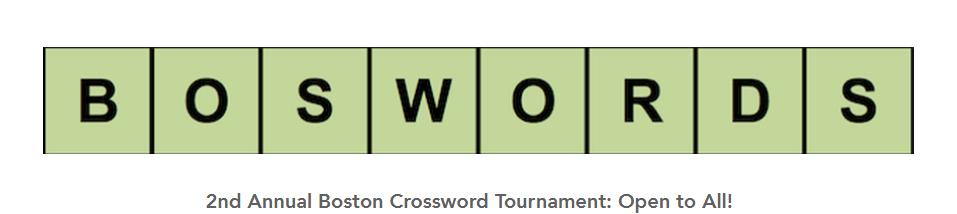
The BosWords Crossword Tournament Returns Soon!

Sunday, July 29th, from noon to 5 PM, puzzlers from all over will gather at The Roxbury Latin School in West Roxbury, Massachusetts for the second edition of the BosWords Tournament, and registration opens today!

With three divisions to choose from — Red Sox (Expert), Paw Sox (Amateur), and Pairs — puzzlers of all ages and experience levels will have the opportunity to test their puzzly wits.

The five themed puzzles in regular competition have been constructed by Laura Braunstein, Andrew Kingsley, John LiebJoon Pahk, and Brendan Emmett Quigley, and after the scores from those puzzles are tabulated, a championship themeless crossword by David Quarfoot awaits the top three solvers in each division!

BosWords is asking for $20 for adults, $20 for pairs, and $10 for students to attend and compete, which is a real bargain!.

You can check out their Facebook page for full details!

Will you be attending the BosWords tournament, fellow puzzlers and PuzzleNationers? Let us know! We’d love to hear from you!


Thanks for visiting PuzzleNation Blog today! Be sure to sign up for our newsletter to stay up-to-date on everything PuzzleNation!

You can also share your pictures with us on Instagram, friend us on Facebook, check us out on TwitterPinterest, and Tumblr, and explore the always-expanding library of PuzzleNation apps and games on our website!