Dangerous and disturbing this puzzle is.

I couldn’t resist, it’s the only line in all six Star Wars movies that uses the word “puzzle,” and it’s a Yoda quote to boot!

Greetings, my fellow puzzlers! It’s Star Wars Day, and we here at PuzzleNation simply had to join in the festivities, so we’ve got two Star Wars themed puzzles for your enjoyment!

The first is a standard cryptogram of one of the series’ most famous quotations. This should be an easy one for crypto-fans and Star Wars devotees alike!

UOKOXJH LOKCSZ, POJXW JUC PCB WOXEOT IP VJFGOX ZK FGO MHCKO QJXW. KCQ GO SOUW PCB FC GOHD GZI ZK GZW WFXBUUHO JUJZKWF FGO OIDZXO. Z XOUXOF FGJF Z JI BKJSHO FC MCKEOP IP VJFGOX’W XORBOWF FC PCB ZK DOXWCK, SBF IP WGZD GJW VJHHOK BKTOX JFFJML, JKT Z’I JVXJZT IP IZWWZCK FC SXZKU PCB FC JHTOXJJK GJW VJZHOT. Z GJEO DHJMOT ZKVCXIJFZCK EZFJH FC FGO WBXEZEJH CV FGO XOSOHHZCK ZKFC FGO IOICXP WPWFOIW CV FGZW X2 BKZF. IP VJFGOX QZHH LKCQ GCQ FC XOFXZOEO ZF. PCB IBWF WOO FGZW TXCZT WJVOHP TOHZEOXOT FC GZI CK JHTOXJJK. FGZW ZW CBX ICWF TOWDOXJFO GCBX. GOHD IO, CSZ-QJK LOKCSZ. PCB’XO IP CKHP GCDO.

And the second is a Word Seek featuring characters from all six films (plus Ahsoka from the Clone Wars TV show). The entries in all caps are hidden within the grid, and once you’ve found them all, you’ll reveal a concealed message spelled out by the remaining letters!

AAYLA Secura
Admiral ACKBAR
AHSOKA Tano
ANAKIN
BAIL ORGANA
BEN KENOBI
Aunt BERU
BIGGS
BOBA FETT
BREN Derlin
CHEWBACCA
DARTH Vader
DENGAR
Jan DODONNA
Count DOOKU
EMPEROR
GREEDO
General GRIEVOUS
HAN SOLO
JABBA the Hutt
JANGO Fett
KIT FISTO
LANDO
LEIA
LUKE
LUMINARA Unduli
Darth MAUL
MAX REBO
MON MOTHMA
MOTTI
NEEDA
OBI-WAN
Uncle OWEN
OZZEL
PADME
PALPATINE
PIETT
QUI-GON
RANCOR
RIEEKAN
SHAAK TI
SIDIOUS
SKYWALKER
TARKIN
VEERS
WEDGE Antilles
WICKET
Mace WINDU
YODA

Good luck, and May the Fourth Be With You, puzzle Jedi!

What’s your position on that puzzle?

The line between puzzles and games can be razor-thin, and some of the best multiple-player games have distinct puzzle aspects to them.

Today, let’s take a brief look at puzzle games I consider “position puzzles,” or puzzles where the key aspect of the solve/gameplay is a matter of tactical positioning.

The puzzle game that always comes to mind when I think of positioning is Hex.

Hex is a simple game that can get fiendishly complicated in a hurry. The goal is to create a linked chain of cells from one wall to the opposite wall, while your opponent tries to do the same. So not only is positioning a key element to building your chain of cells, but it’s crucial to depriving your opponent of similar positioning.

Best of all, the only things you need to play are a grid and a couple of pencils. My astronomy teacher in high school introduced me to Hex, and I’ve been playing it on and off for years ever since.

From Hex, let’s move on to another puzzle game that demands positioning skills and a level of strategic forethought: The Icosian Game.

The goal of the Icosian Game is familiar to anyone who’s done a Pencil Pusher or similar puzzle, requiring that you trace a path without lifting your pencil tip or revisiting any point in the diagram.

You want to visit every letter-marked spot once, and complete what is known as a Hamiltonian cycle, named for the puzzle’s creator, William Rowan Hamilton.

(Also, PuzzleNation fans will no doubt recognize some major similarities between the Icosian Game grid and the grid for our word-hunting game Starspell.)

Another classic positioning puzzle goes by many names, including Mills and Cowboy Checkers, but you probably know it best as Nine Men’s Morris.

Nine Men’s Morris is a two-player game where you try to place three tokens in a row while thwarting your opponent’s efforts to do the same. Every three-token row means your opponent loses a token, and the winner is whichever player reduces an opponent to two tokens or forces a stalemate.

Variations of this game date back to the days of the Roman Empire, but I suspect most people would recognize it in a simpler, more popular form. After all, it’s an easy leap from Nine Men’s Morris to Tic-Tac-Toe.

Today’s final positioning puzzle is a little different from the others, but it’s a personal favorite of mine. This is another game that goes by many names and appears in many forms. The version I play is called Turf Wars.

In Turf Wars, your goal is to capture as many squares as possible by drawing one line each round that connects two points. Your opponent does the same, and you slowly winnow down the board, creating opportunities to seize single squares or blocks of squares. Any time a box is enclosed on three sides, whomever draws the fourth side seizes the box.

(In this case, the puzzle game is hosted on the Ninja Burger website, so the boxes become either “Ninja” or “Samurai” depending on whether you or the computer capture the box.)

And if seizing one box encloses the third side of another box, you can seize that one as well. So there is the potential to seize multiple boxes in a single turn with some strategic line placement.

All of these games can be played with ease on paper, or with tokens scrounged up from other games, and they provide a great challenge and serious fun.

Just remember: In positioning puzzles, as in real estate, it’s all about location, location, location.

[For more ninja-centric puzzle and games fun, including the phenomenal Ninja Burger roleplaying game, click here.]

Puzzles in Pop Culture: The Simpsons (revisited!)

In previous editions of Puzzles in Pop Culture, I’ve recapped a classic episode of M*A*S*H and delved into the rich puzzling history of MacGyver.

Today, however, I’m returning to the ever-giving well of puzzly goodness provided by that unstoppable animated juggernaut, The Simpsons.

In an earlier blog post, I discussed the show’s hilarious ventures in the worlds of brain-teasers and crosswords, but I neglected one shining example of puzzleriffic fun in Season 20 episode “Gone Maggie Gone.” (Oddly enough, the same season that featured “Homer and Lisa Exchange Cross Words.”)

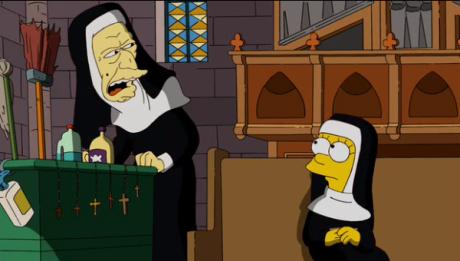
In an episode that playfully melds elements of Gone Baby Gone, Ratatouille, and The Goonies, while delightfully skewering National Treasure and The Da Vinci Code, Homer accidentally leaves Maggie on the doorstep of a convent. When the nuns take her in and Homer can’t retrieve her, Lisa infiltrates the convent, discovering a series of elaborate puzzles that may lead to both Maggie and a jewel hidden in Springfield.

The puzzles take center stage early in this episode, as Homer encounters his own version of the cabbage, wolf, and goat river-crossing puzzle — in this case, featuring Maggie, Santa’s Little Helper, and a colorful bottle of rat poison. (His attempt to solve this puzzle is how Maggie ends up in the convent in the first place.)

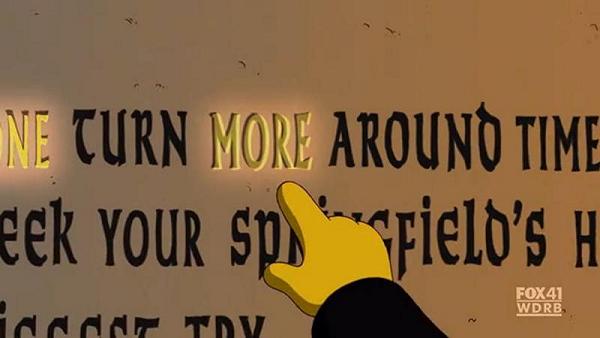
Lisa’s first clue is to “seek God with heart and soul,” which leads her to play “Heart and Soul” on the church organ. After a ridiculously overelaborate Rube Goldberg device opens up, the next clue tells her to seek the biggest man-made ring in Springfield.

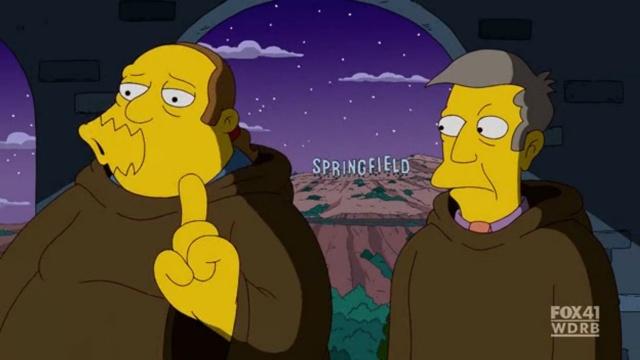
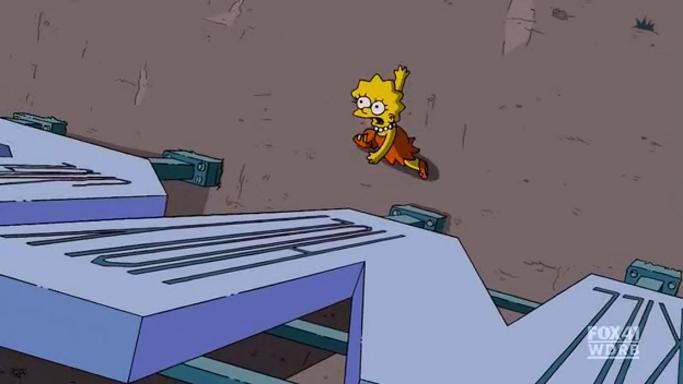
After a red herring and a stop for some goofy exposition from amateur puzzle-solvers Comic Book Guy and Principal Skinner, Lisa deduces that the biggest ring in Springfield is, in fact, the word RING in the Hollywood-esque Springfield Sign in the hills, and the adventurous trio sets off.

Hidden on the giant letters of the Springfield Sign is the message “Great crimes kill holy sage,” which Lisa dutifully anagrams into the message “Regally, the rock gem is Lisa.” Naturally, she does so just in time for Mr. Burns (the requisite shadowy Freemason figure) to emerge and take everyone back to the convent.

When she arrives, the nuns tell her Maggie is in fact the gem they’ve been seeking, and they re-anagram the message to read, “It’s really Maggie, Sherlock.” A pretty impressive feat of wordplay, I’d say.

(Naturally, Marge enters the scene here and sets everyone to rights by taking Maggie home. Bart sits on the throne of the gem child just vacated by Maggie, and ends up transforming the world into a nightmarish hellscape, as you’d expect.)

With elements of logic puzzles, brain-teasers, and anagram goodness, this episode is a treat for puzzlers of all ages, plus it’s hysterical to boot. The Simpsons excels at not simply including puzzles in their stories, but making the puzzles the linchpin of the story, something to drive the characters to learn and grow and challenge themselves.

While this episode was a little goofier and a little less heartfelt than “Homer and Lisa Exchange Cross Words,” it remains a worthwhile entry in the Puzzles in Pop Culture library.

Da Vinci’s got nothing on these codes.

Cryptograms and similar coded puzzles have been a mainstay of newspapers and puzzle books for decades now, and it’s not hard to see why. Codebreaking has been a puzzler’s playground for centuries.

Back in November, the skeleton of a carrier pigeon from World War II was found, along with a coded message the dearly departed bird had been ferrying somewhere.

One of Britain’s national intelligence agencies declared that the message couldn’t be decoded without access to the original material responsible for the code.

What puzzler could resist a challenge like that?

A Canadian puzzle fiend, Gordon Young, with the help of his great-uncle’s World War I codebook, cracked the code in 17 minutes.

Now, of course, wartime codecracking stories are common, given the importance of reliable communication and strategy during combat and operations. Most people are familiar with terms like the ENIGMA machine or one-time pads.

(Codebreaking and cryptography were considered so crucial to the war effort that Agatha Christie was investigated for her novel N or M?, which featured a character named Major Bletchley, a name that made the government nervous, considering that their major codebreaking center was Bletchley Park.)

But wartime was hardly the only opportunity for codecracking to yield great results.

Among the many storied cases of San Francisco detective Isaiah Lees — a man considered one of the real-life rivals to Sherlock Holmes in terms of detection — there’s another curious case of codebreaking.

A bank robber had been arrested, and his coded journal came into Lees’ possession. When Lees cracked the code, he got much more than he bargained for.

The bank robber was no mere thief. He was William Fredericks, a man who’d killed a Nevada sheriff and provided the weapons for a Folsom prison jailbreak. It’s only due to Lees’ diligence that the murderer was duly punished for his crimes.

But the highlights of codebreaking history are hardly relegated to the past. Plenty of young puzzlers have been given the chance to flex their mental mettle in Britain, thanks to the National Cipher Challenge.

Tasked with decrypting a series of cryptic codes, thousands of students had two months to best everything from simple letter-shifting codes (known as Caesar cyphers) to much more complicated codes involving anagramming, letter-shifting, and other obfuscation techniques.

Aimed at attracting young people to math and computer science, the National Cipher Challenge is just one more example of how puzzle skills are helping pave the way to the future.

Notes:

For more info on the National Cipher Challenge, check out their website.

For more on the curious crossing of Bletchley Park and Agatha Christie, check out this terrific article on the Daily Mail.

For more on codes and codebreaking in general, I highly recommend Secret Language: Codes, Tricks, Spies, Thieves, and Symbols by Barry J. Blake.

I’m gonna need a stepladder.

Plenty of places claim they offer large crosswords for the truly devoted solver, but nobody holds a candle to the Ukraine, whose citizens crafted this 100-foot-tall monument to puzzling.

Located in the city of Lviv (Lvov, to Russian speakers), the puzzle is an art installation perfectly designed to keep visitors thoroughly challenged. The clues are scattered on landmarks throughout the city, further encouraging both tourism and brain-boosting.

The puzzle appears incomplete during the day, but at night, special lighting reveals the answers in fluorescent paint.

I can only hope this will inspire other communities to raise the stakes even higher. Crop crosswords that can only be solved with Google Maps! Landscaping sudoku hedges complete with topiary set numbers! Cowboy-style word searches where you actually lasso words on cattle!

Okay, maybe not that last one. But hey! At least I’m trying! The artists of Lviv have set the bar — not to mention the grid — pretty darn high.

Puzzles in Pop Culture: MacGyver

From Stanley’s love of crosswords on The Office to the clever conundrums constantly conjured by the Riddler in various iterations of Batman, puzzles have played roles both big and small in numerous TV shows and films.

In previous editions of Puzzles in Pop Culture, I’ve recapped a classic episode of M*A*S*H and discussed the numerous puzzle-centric episodes of The Simpsons.

This time around, we’re delving into the rich history of another famous TV puzzler, tinkerer, and all-around problem solver, Angus MacGyver.

Oh yes, make no mistake; while plenty of bullets were flying and criminal enterprises unraveling over the course of the show, MacGyver remained a puzzle solver through and through, displaying at least once an episode an almost-magical ability to solve brain teasers, mechanical puzzles, and other challenges.

True, the average puzzle-solving experience doesn’t usually include building an airplane out of bamboo or making a cannon from a garbage can and discarded cleansers, but a lot of the same skills apply, like abstract thinking and an affinity for combining contextual clues with a storehouse of personal knowledge and trivia.

At heart, I think we can all agree that when he wasn’t globetrotting, battling shadowy conspiracies, debunking UFOs, or encountering yet another ex-girlfriend in peril, MacGyver was probably doing the Sunday New York Times Crossword and solving Rubik’s Cubes with his feet.

And so, with that in mind, let’s take a look at a season-six episode of MacGyver titled “Eye of Osiris.”

In this Raiders of the Lost Ark homage/ripoff, MacGyver is recruited to help out at an archaeological dig seeking evidence of Alexander the Great’s tomb. (MacGyver has one third of a medallion that will supposedly lead to the tomb; the researchers have the other two pieces.)

As expected, there are criminal forces at work, and two (count them!) former foes of MacGyver’s are lurking in the shadows. The puzzling — well, poetry-decoding / riddle-solving, really — begins when MacGyver deduces the location of the tomb after the crooks steal the medallion.

(MacGyver, naturally, manages to reproduce the medallion from an imprint of the original in a box of sand.)

He and the scientists head for the tomb, only to be sealed inside with the criminals by an ancient booby trap. (Ain’t that always the way?)

Here, MacGyver confronts the first of the puzzles awaiting him inside the tomb, as the episode basically becomes a monsterless Dungeons & Dragons-style dungeon romp.

A statue of Anubis is in the room, along with a few dozen urns of different shapes and sizes. Naturally, Mac realizes they have to find the right urn, and it becomes a classic mechanical balance-the-weight puzzle.

When they do so correctly, a door opens, and they head into a grand crypt for Alexander the Great, with another elaborate mechanical puzzle (based on the Tree of Life, and requiring fire, water, and all kinds of elemental shenaniganry).

Any viewer who has been paying even the slightest attention can solve the puzzles faster than the heroes or villains, and soon enough, we earn our reward:

Yup, a sapphire the size of a small watermelon or a fat house cat, supposedly created when a meteorite crashed to Earth nearby.

Naturally, disturbing the sapphire activates another trap — closing walls this time — and more riddle-solving allows MacGyver and the scientists to escape the room before a giant stone smashes through the wall and chases them down a corridor. (Sound familiar?)

One last puzzle awaits our heroes before they escape, sapphireless but alive. (The various traps managed to thwart the villains for the heroes, as you’d expect.)

Once again, a solid knowledge of trivia and puzzling has saved the day!

Hope you enjoyed this little trip down memory lane. Until next time, keep calm, puzzle on, and I’ll catch you again soon.

P.S. It’s worth noting that I first saw this episode years and years ago while home sick from school. In the years before the Internet became the storehouse of all information, trivial and otherwise, I could find little to no proof that this episode existed as I remembered it.

Until a few years ago when I tracked the episode down on Netflix, I was half-convinced I’d conjured it in some sort of fever dream. *laughs*