I’m always on the lookout for new and different puzzle styles to discuss here, because there’s a seemingly endless supply of puzzly inventiveness in the world, and I endeavor to share as much of it as possible with my fellow PuzzleNationers.
A few days ago, I was reminded of a brain teaser variation that’s a little different from our usual fare, and I thought I’d put it in the spotlight.
Today, we’re talking about guided lateral thinking puzzles!
Let me start you off with a standard lateral thinking puzzle (which is a fancy way of saying “brain teaser”). This one is an all-time favorite of mine:
A man is found murdered on the floor with 53 bicycles scattered around the room. How did he die?
Now, this may sound like a particularly violent end at a local bike shop, but the lateral thinkers and brain teaser proficient types out there have probably already sussed out the true answer.
The man cheated at cards and was killed for it. Bicycle is a famous brand of playing cards, and with 52 cards in your standard deck, 53 implies cheating.
That’s a pretty simple one.
The difference between regular brain teasers like that one and guided lateral thinking puzzles is that a guided lateral thinking puzzle requires two people: one to ask questions in the hopes of solving it, and the other to know the solution and answer the other player’s questions with only yes or no responses.
The scenarios are often more involved than your usual brain teaser, but you’re only given a brief story to start with. These are not rigid brain teasers like the seesaw one we tackled earlier this year. These puzzles depend on your ability to narrow down the possibilities with strategically worded questions.
Here’s an example of a guided lateral thinking puzzle:
Ann, Ben, and Chris are siblings who were conceived on the same day. This year, Ann will be attending third grade while Ben and Chris attend kindergarten. Why?
While you could try to come up with a solution with just this information, guided lateral thinking puzzles encourage you to talk through your suspicions as you ask questions and uncover the truth.
So, what would you ask? What’s your starting theory? (My first instinct was to go straight to imagining how Leap Day was involved, before quickly realizing that was a ridiculous supposition.)
But maybe you have a better theory. Were they conceived by different people? Was it the same day, but different years?
Posing these questions to your partner in puzzly crime could help you find the answer.
The folks at I09 posted a link to six guided lateral thinking puzzles (including the Ann/Ben/Chris one I mentioned above). Give it a listen and try cracking these puzzles alongside the podcasters!
And let me know how you did! Did you solve any of them right away? Did any of them thoroughly stump you? And would you like to see more puzzles like this on PuzzleNation Blog in the future?
Visual trickery plays an important role in puzzles. It can be the clever rebus that challenges you to find the words each image represents, or a visual brain teaser that forces you to think outside the box.
But nowhere in the realm of puzzles is visual trickery more obvious or more disconcerting than in optical illusions. Some are simple, like the famous old woman/young woman image above (or this hilarious video version). But others are not only more complex, they’re absolutely mind-bending.
And if we’re talking mind-bending optical illusions, at some point, you have to mention the work of Akiyoshi Kitaoka.
[Akiyoshi Kitaoka’s “A Bulge,” featuring nothing but squares.]
Dr. Kitaoka is a professor of psychology at Ritsumeikan University in Kyoto, Japan, and he has extensively studied biology and psychology. He has quickly emerged as a modern master of optical illusions, utilizing not only shapes and color gradients to trick the eye, but also to simulate motion in a static image!
Two of the techniques frequently cited in his work with illusions are perceptual transparency and visual completion. Both rely heavily on how our brain and eye process the incredible amount of information we perceive every second of every day.
This is probably the most famous example of a visual completion illusion:
Basically, our brain employs mental shortcuts in order to simplify the information. For instance, visual completion (also known as filling-in) occurs when information unavailable to the eye is assumed to be there and mentally added by the brain.
Perceptual transparency, on the other hand, involves how we can perceive one surface behind another.
[The mountains in the background look transparent,
even appearing to overlap each other in impossible ways.]
Dr. Kitaoka’s illusions utilize visual shortcuts and processes such like these, but his most famous creations involve a perceptual technique known as the Fraser-Wilcox Illusion, which involves using lighter and darker gradients of black and white in order to trick the eye into perceiving motion. Essentially, moving from dark to light gradually creates the illusion of motion.
Kitaoka’s work, however, maximizes this effect by employing contrasting color schemes in order to challenge the eye further.
Feast your eyes upon “Rotating Snakes,” Kitaoka’s most diabolical optical illusion:
[For the full effect, click the image and
scroll down for a full-screen version!]
By employing color as well, the rotation illusion is even more striking. In all honesty, I can’t look at it too long or my stomach starts to feel a little off-kilter!
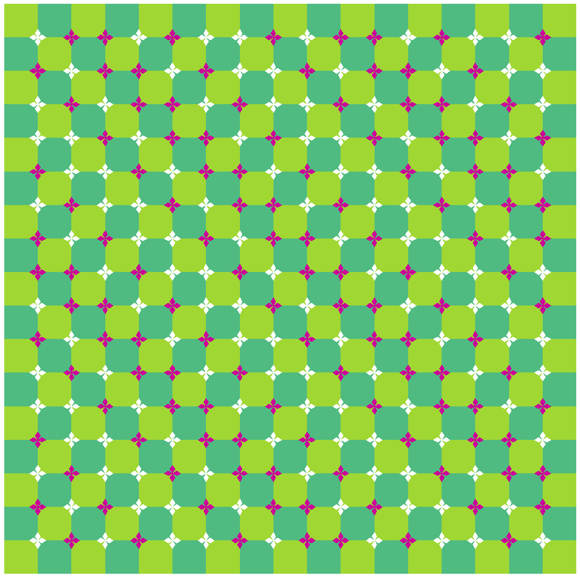
Similarly, Kitaoka tricks the eye into perceiving waves rolling diagonally over this quilt-like sheet in “Primrose’s Field:”
As we understand more about the eye and how it perceives the visual stimuli it receives, as well as more about the brain and how it processes information, I suspect we’ll be able to craft even more convincing, mind-blowing, and unnerving examples of visual sleight of hand.
And undoubtedly, Akiyoshi Kitaoka will be leading the way.
Many thanks to Dr. Kitaoka for granting permission for me to feature three of his illusions in this post. You can check out more of his amazing work on his website, as well as some of his books on Amazon here!
By this time, you know the drill. Follow-Up Friday is a chance for us to revisit the subjects of previous posts and bring the PuzzleNation audience up to speed on all things puzzly.
You may be familiar with the board game Schmovie, hashtag games on Twitter, or @midnight’s Hashtag Wars segment on Comedy Central.
For the last few months, we’re been collaborating on puzzle-themed hashtag games with our pals at Penny/Dell Puzzles, and this month’s hook was Penny/Dell Broadway Puzzles!
Examples might be The Lord of the Diamond Rings or The Da Vinci Codeword or Alphabet Soup for the Soul.
So, without further ado, check out what the puzzlers at PuzzleNation and Penny/Dell Puzzles came up with!
Charlotte’s Spider’s Web
Right Angles and Demons
The Grapes of Word Math
The Scarlet Letterboxes / The Scarlet Letter Logic
The Fault in Our Starspell / The Fault in Our Star Words
Harry Potter and the Halftime Prince
Harry Potter and the Sorcerer’s Stepping Stones
Brave New Word Seeks / Brave New Word Games
The Lion, the Witch, and the Word Seek
The Wizard Words of Oz
The “Mystery Person” of Edward Drood
To Kill a Missing Word (List)
The Fountainheads & Tails Word Seek
Around the Block in Eighty Days / Around the Bend in 80 Days
A Tale of Two-Step Cities
The Three of a Kind Musketeers
Oh, the Places, Please You’ll Go!
Peyton’s Places, Please
Anagrams Karenina
Anagram of Green Gables
North & South of Eden
The Swiss Family Robinson Ties
Bowl Game of Thrones
Ender’s Bowl Game
Fahrenheit Two for One / Fahrenheit 451 and Only
Sudoku Road
Cryptograms Wake / Fill-Ins Wake / Figgerits Wake
Kakuro Pioneers!
Little Puzzler on the Prairie
First and Last of the Mohicans
The Picture Sleuth of Dorian Gray / The Picture This of Dorian Gray
Watership Spelldown
Buried Treasure Island
The Countdown of Monte Cristo
Take It from There to Eternity
The Sign of Four Corners / The Big Four Corners
The Doomsday Bookworms
Great Crostictations
A Wrinkle in Time Machine
The Perks of Being a WallFlower Power
Catch-22 for One
The Hotel on the Poet’s Corner of Bitter and Sweet
50 Shades of Grey Shadows
The Joy Luck Crosswords Club
Jurassic Park What’s Left
My What’s Left Foot
Only The Shadow Knows
From Alphabet Soup to Nuts
Match Up Made in Heaven
Beat the Clock-work Orange
A Hive for a Honeycomb
Star Words
The Lost Symbol-lic Logic
Lord of the Rings: The Fellowship of the Ringmaster
The Sylla-rillion
The Hunger Word Games
198-Four Square
The Sum Totals Also Rises
And one overachiever…
The “Lion” (‘Em Up), the “Which” (Way Words), and the “Word”robe by C(ircle) S(ums) Lewis
We also received a terrific one from @_Screenhog, Cross Sums of All Fears!
Have you come up with any Penny/Dell Puzzle Books of your own? Let us know! We’d love to see them!
Given the nature of my line of work, I think about puzzles a lot. But, as it turns out, even when I’m not thinking about puzzles, puzzles seem to find me anyway.
As followers of our Instagram account know, last night I was reading a collection of supernatural short stories, Dark Detectives, edited by Stephen Jones. Partway through a story titled “Vultures Gather,” I encountered the following passage:
That’s right, an encrypted passage smack dab in the middle of my supernatural mystery story!
As it turns out, our investigators uncover a message left behind by the deceased, indicating that he was murdered! Not only that, but he makes a cagey reference to one of my favorite horror movies in order to provide a method for both exposing and punishing his duplicitous attackers.
It all starts with a letter and two pieces of parchment with Greek lettering. The letter entrusts the paper and their secret contents to the two men, in case anything suspicious should happen. (Fortuitous!)
The investigators, with the help of two of their friend’s books — The Boy’s Book of General Knowledge and The Boy’s Book of Puzzles and Brain Teasers — try to crack it with a simple transposition code, meaning one letter or number represents another. This is the basis of standard cryptograms and many other crypto-puzzles.
But this only yields gibberish. That is, until they remember something from the letter he left them: “The locks are my favorite books, the key is seven.”
The seventh letter is G, meaning that should be the starting letter of their transposition pattern.
Unraveling the encryption reveals some sinister-sounding magical incantations, which they put aside for the moment.
Then they turn their attention to the remaining bits of code in the letter: the strings (5,2,2,5) and 831214926142252425798. Assuming their friend would want these codes cracked quickly, they employ a simple alphanumeric cipher.
Now, alphanumerics can work several ways.
Sometimes, the numbers coincide with those of a push-button telephone, meaning 5 can be J, K, or L.
Other times, the numbers represent that letter’s position in the alphabet. A is 1, B is 2, Z is 26, etc.
They can also be transposition codes, where each letter corresponds to a random number. This is the case in Codewords.
8312149261422524225798 uses the second style of alphanumeric code. So 8 would be H, 3 would be C…
Wait, that doesn’t work! Unless you remember that “the key is seven,” as mentioned above. Which means that G would be 1, H would be 2, etc.
So now, with some trial and error, 831214926142252425798 becomes 8/3/1/2/14/9/26/14/2/25/24/25/7/9/8, or NIGHTOFTHEDEMON. As it turns out, (5,2,2,5) is a hint to breaking up your answer into words, like the indicator of word length that follows a British-style crossword clue or cryptic crossword clue. This makes the answer NIGHT OF THE DEMON.
[Unfortunately, no one in the story seems to notice that THE is 3 letters, and the clue should’ve read (5,2,3,5). Oops.]
So, in the end, not only did I get a great supernatural detective story (with mystical revenge to boot!), I got a brief refresher on some of the most popular encryption styles employed by puzzlers today.
By this time, you know the drill. Follow-Up Friday is a chance for us to revisit the subjects of previous posts and bring the PuzzleNation audience up to speed on all things puzzly.
While I couldn’t attend the tournament, I did download the tournament puzzles, and after a few weeks, I had the opportunity to sit down and tackle the six puzzles prepared for the event. And today, after a few weeks’ reflection, I thought I’d offer my thoughts on those puzzles, both for the organizers and for any interested PuzzleNationers who might be considering participating in the future.
[Note: I solved the PDF versions of these puzzles, which apparently differed in some ways from the PUZ versions.]
Puzzle 1: Welcome to D.C. by Erik Agard
The opening puzzle offered a solid challenge, utilizing the colors for the various lines of the Washington Metro as clues for the themed entries. (For instance, “Red Line” led you to the answer BASE PATH.)
Agard’s effort set the tone for the rest of the tournament with a some accessible pop culture-fueled clues as well as a fleet of strong, fair clues most puzzlers should have no difficulty cracking. A few more obscure references were made — an Internet meme and a Hunger Games “ship” name among them — but without hindering fair cluing.
Interesting grid entries included GINSU, YOUSE GUYS, and NIQAB, and my favorite clue was probably “Summer’s end?” for TOTAL.
Puzzle 2: Looseness of the Vowels by Peter Broda
Broda’s puzzle incorporated shared boxes — some grid squares were divided in half, allowing two vowels to be placed instead of one — and answering each themed clue required a two-word phrase that shared every consonant.
(For instance, clue 52 Across read “With 52 Across, what David Ortiz practices that annoys his neighbors?” And the grid, once filled, read B[I/A]GP[A/I]P[IE]S, a.k.a. BIG PAPI’S BAGPIPES. This is why the clue cites itself in “With 52 Across,” so that the solver knows the answer word applies twice)
Those neat touches of wordplay weren’t the only tough crossings, however. The crossing of two unusual phrases in BE GENTLE with LAYS STAX actually forced me to abandon the puzzle at one point and return to it later to complete.
Interesting grid entries included TV CHEF, ICE KING, and VISA BILL, and my favorite clue was “Former red giant” for USSR. (Being a science and astronomy geek, I was instantly misled by this one.)
Puzzle 3: Candy Bars by Finn Vigeland
Finn was chosen as the guest constructor to join the five fierce puzzlers who organized the Indie 500, and I was thoroughly impressed with the very clever construction of his grid. In Finn’s puzzle, certain paired black squares were replaced with a graphic of a candy bar, and it was up to the solver to deduce that each entry, either down or across, that touched the candy bar was missing either C, Y, or both.
[The candy bars were in color in the PDF, but I printed them in b and w for solving.]
For instance, in this section of the grid, DIS and ALL (clued as “Checker, for one” and “Word after straight or male, in social justice conversations,” respectively) were actually DISC and ALLY when you added the CY. [Get it? CandY bar?] Similarly, REST and ALTA were actually CREST and YALTA, and the across entry CLING WRAP was actually the theme entry CYCLING WRAP.
This was my favorite of the six puzzles in the tournament, one with a great hook and excellent execution.
Interesting grid entries included SENIOR GALA, DOT GOV, OH BEHAVE!, and PT BOATS, and my favorite clue was easily “Brian who crosswords would have you believe is the only musician worth knowing (other than 97-Across, maybe)” for ENO. (97-Across was, predictably, ONO.)
Puzzle 4: A Cute Puzzle by Andy Kravis
After a pair of heavy-thinking puzzles, Puzzle 4 was an excellent palate cleanser difficulty-wise, complete with solid cluing and some fun entries. Kravis’s puzzle had solvers adding an accented E to the end of themed entries in order to complete them. For instance, “A giant leap for elephant-kind?” was JUMBOJETE.
A well-constructed puzzle (quite possibly designed to lure solvers into a false sense of security before Puzzle 5 walloped them), this was probably the most accessible puzzle of the six, one that casual solvers would quite enjoy.
Interesting grid entries included MINAJ, TEAM USA, KOOPA, and A-MINUS, and my favorite clues were the mildly-risque pair of “Prince Albert’s can?” for both ARSE and LOO.
Fogarty’s puzzle was by far the toughest of the six, and I admit, it took me forever to uncover the hook: antonyms which crossed at the same starting box were swapped. For instance, 1-Across was “Numbskulled” for THICK and 1-Down was “Dilute” for THIN, but you had to place THICK as 1-Down and THIN as 1-Across.
Beyond that, challenging crossings like IDEA MAN and LAD MAG kept me guessing, and the creative grid entries left few crossword standards for any struggling solvers.
Interesting grid entries included ONE SEC, SHAKY CAM, FAIR GAME, XKCD, and IRISH STEW, and my favorite clue was probably “Number for the troops” for OVER THERE.
[Say, since we’re discussing crosswords, have you checked out the Penny Dell Crosswords App? This concludes our shameless plug.]
Puzzle 6: The Final Lap by Evan Birnholz
The closing puzzle of the tournament was offered in two difficulty levels: the Inside Track (designated for solvers who finished in the top 25% of the field in a crossword tournament with published standings in the past 5 years) and the Outside Track (designated for everyone else). I opted for the Outside Track, then looked over the cluing for the Inside Track.
This themeless closer was no layup, though; no matter which track you were on, the cluing relied on solid trivia knowledge and classic puzzle-solving skill. (Kudos to Evan for crafting a solid grid with tough AND tougher clues. And for dropping a much-appreciated Army of Darkness reference in the Inside Track clues.)
Interesting grid entries included WHAT ON EARTH?, MOON UNIT, EDIT MENU, and PIE CHART, and my favorite clue (among many I quite liked) was probably “Things a benched player might work on during practice” for ETUDES.
Overall, I thought the Indie 500 was an impressive series of puzzles, rich with cleverness and style. Puzzle 5 easily rivaled ACPT’s Puzzle 5 in terms of difficulty, and the cluing was topnotch. I look forward to its return next year, and hopefully some of you will join me in accepting the Indie 500 challenge!
Tricky clues can come in all shapes and sizes, from wordplay that sends you down the wrong path (like “Intel processor?” for SPY) to clues with some tongue-in-cheek humor (like “Car bomb?” for EDSEL). But perhaps the most diabolical are clues that rely on alternate pronunciations to deceive solvers.
These clues are especially crafty, because oftentimes, it’s only when spoken aloud that the alternate meaning reveals itself. There were two prime examples of this cluing style in the Indie 500 puzzles I’ll be reviewing later this week.
At first blush, the clue “Layers of rock?” seems to point toward STRATA or something similar, except the question mark indicates some sort of wordplay is afoot. But if you use lay-ers (as in “those who lay”) of rock, suddenly the answer is apparent: MASONS.
Similarly, the clue “Water tower?” seems straightforward until you consider the question mark. But pronounce tower tow-er (one that tows) and you’ve cracked it: TUG.
Friend of the blog and Penny Press crossword guru Eileen Saunders also contributed a terrific example, “Sewer junction?” for SEAM.
Of course, the perils of pronunciation are hardly restricted to the world of crossword cluing. One need only travel abroad and encounter some of the towns in England to discover some curious pronunciations awaiting them.
In the music video below, chap-hop artist Sir Reginald Pikedevant, Esq. offers a litany of examples of curious British pronunciations in his song “Shibboleth.”
In the video, he defines shibboleth as a word which distinguishes between group members and outsiders by the way it is pronounced. The word comes from the Hebrew Bible, where the word itself was used to distinguish between Ephraimites (who could not pronounce the word properly) and Gileadites (who could).
And while historical uses of shibboleths usually had unpleasant connotations, Sir Reginald’s video is simply a whimsical look at the weirdness of language:
And now, given the subject at hand, I have a challenge for you, my fellow puzzlers and PuzzleNationers!
Below I’ve posted a poem called “The Chaos,” designed to highlight the many irregularities in spelling and pronunciation in the English Language. Created by Dutch writer and teacher Gerard Nolst Trenite, it has appeared in various formats for nearly a century, and it’s a taxing read, to be sure.
I hereby challenge any member of the PuzzleNation readership to create a video of you reading the poem in its entirety! [Note: this is, in fact, a truncated version, but I feel it would be torturous to make you read all 274 lines of this version!]
So, if you accept the challenge, post your video on Facebook, Twitter, YouTube, or wherever, and send me a link! The most impressive performance will earn a suitably puzzly prize!
Good luck!
The Chaos
Dearest creature in creation,
Study English pronunciation.
I will teach you in my verse
Sounds like corpse, corps, horse, and worse.
I will keep you, Suzy, busy,
Make your head with heat grow dizzy.
Tear in eye, your dress will tear.
So shall I! Oh hear my prayer.
********
Just compare heart, beard, and heard,
Dies and diet, lord and word,
Sword and sward, retain and Britain.
(Mind the latter, how it’s written.)
Now I surely will not plague you
With such words as plaque and ague.
But be careful how you speak:
Say break and steak, but bleak and streak;
Cloven, oven, how and low,
Script, receipt, show, poem, and toe.
********
Hear me say, devoid of trickery,
Daughter, laughter, and Terpsichore,
Typhoid, measles, topsails, aisles,
Exiles, similes, and reviles;
Scholar, vicar, and cigar,
Solar, mica, war and far;
One, anemone, Balmoral,
Kitchen, lichen, laundry, laurel;
Gertrude, German, wind and mind,
Scene, Melpomene, mankind.
********
Billet does not rhyme with ballet,
Bouquet, wallet, mallet, chalet.
Blood and flood are not like food,
Nor is mould like should and would.
Viscous, viscount, load and broad,
Toward, to forward, to reward.
And your pronunciation’s OK
When you correctly say croquet,
Rounded, wounded, grieve and sieve,
Friend and fiend, alive and live.
********
Ivy, privy, famous; clamour
And enamour rhyme with hammer.
River, rival, tomb, bomb, comb,
Doll and roll and some and home.
Stranger does not rhyme with anger,
Neither does devour with clangour.
Souls but foul, haunt but aunt,
Font, front, wont, want, grand, and grant,
Shoes, goes, does. Now first say finger,
And then singer, ginger, linger,
Real, zeal, mauve, gauze, gouge and gauge,
Marriage, foliage, mirage, and age.
********
Query does not rhyme with very,
Nor does fury sound like bury.
Dost, lost, post and doth, cloth, loth.
Job, nob, bosom, transom, oath.
Though the differences seem little,
We say actual but victual.
Refer does not rhyme with deafer.
Foeffer does, and zephyr, heifer.
Mint, pint, senate and sedate;
Dull, bull, and George ate late.
Scenic, Arabic, Pacific,
Science, conscience, scientific.
********
Liberty, library, heave and heaven,
Rachel, ache, moustache, eleven.
We say hallowed, but allowed,
People, leopard, towed, but vowed.
Mark the differences, moreover,
Between mover, cover, clover;
Leeches, breeches, wise, precise,
Chalice, but police and lice;
Camel, constable, unstable,
Principle, disciple, label.
********
Petal, panel, and canal,
Wait, surprise, plait, promise, pal.
Worm and storm, chaise, chaos, chair,
Senator, spectator, mayor.
Tour, but our and succour, four.
Gas, alas, and Arkansas.
Sea, idea, Korea, area,
Psalm, Maria, but malaria.
Youth, south, southern, cleanse and clean.
Doctrine, turpentine, marine.
********
Compare alien with Italian,
Dandelion and battalion.
Sally with ally, yea, ye,
Eye, I, ay, aye, whey, and key.
Say aver, but ever, fever,
Neither, leisure, skein, deceiver.
Heron, granary, canary.
Crevice and device and aerie.
********
Face, but preface, not efface.
Phlegm, phlegmatic, ass, glass, bass.
Large, but target, gin, give, verging,
Ought, out, joust and scour, scourging.
Ear, but earn and wear and tear
Do not rhyme with here but ere.
Seven is right, but so is even,
Hyphen, roughen, nephew Stephen,
Monkey, donkey, Turk and jerk,
Ask, grasp, wasp, and cork and work.
********
Pronunciation — think of Psyche!
Is a paling stout and spikey?
Won’t it make you lose your wits,
Writing groats and saying grits?
It’s a dark abyss or tunnel:
Strewn with stones, stowed, solace, gunwale,
Islington and Isle of Wight,
Housewife, verdict and indict.
********
Finally, which rhymes with enough —
Though, through, plough, or dough, or cough?
Hiccough has the sound of cup.
My advice is to give up!
You can submit your videos to any of our social media platforms below! Good luck!




 PuzzCulture