But I have all the koalafications!

Good cluing is one of the cornerstones of quality crossword writing. Not only do the clues have to be interesting, clever, and challenging, but they need to be accurate as well. After all, there’s a big difference between playfully misleading and misleadingly wrong.

Thankfully, this is the Golden Age of cluing assistance, and there are numerous cluing archives and websites loaded up with crossword clues galore. Places like Crossword Nexus, Crossword Tracker, Wordplays, and XwordInfo are searchable, not only allowing constructors to look for new clues, but assisting solvers with troublesome clues.

It also makes researching crossword controversies a whole lot easier, like Hugh Stephenson’s koala-centric kerfuffle in The Guardian’s crossword blog.

You see, fellow puzzlers, a setter named Qaos used the following clue in a cryptic crossword:

Bear a left, then a right, then reverse (5)

This clue was intended to point toward the answer KOALA, both with the word “bear” and the directions “a left, then a right” — meaning A L, A OK — “then reverse” — KOALA. But some solvers took issue with Qaos referring to the koala as a bear, despite the common vernacular term “koala bear.”

Now, if we’re going by strict dictionary definition, those solvers are correct. The koala is a marsupial, not a bear. Of course, dictionaries were recently amended to say that “literally” no longer just means “literally” — it can mean “figuratively” as well. So I’m inclined to go beyond the dictionary definition and plumb the depths of crossword clue archives to see where the crossword community as a whole stands on the question of koala vs. koala bear.

The Crossword Solver lists the clue [Australian “bear”], but mostly avoids the controversy with a litany of clues like [Gum leaf eater], [Australian critter], and [Down Under climber].

If you go to Crossword Tracker, you mostly get clues that hedge their bet, like [Australian “bear”], [Marsupial sometimes called a bear], and [Australian bearlike beast], but there are a few hard-nosed clues like [It isn’t really a bear].

Crossword Giant agrees on this front, while Wordplays wavers wildly, citing both [Cute “bear”] and [Cute bear] in its archives.

I’d hoped for a definitive answer when searching XwordInfo, which is dedicated to clues featured in the New York Times Crossword. The Shortz era comes down firmly on the side of “bear”, not bear, but the pre-Shortz era is less rigid, with clues like [Living Teddy bear], [Bear of Down Under], and [Kangaroo bear].

And while I feel that the koala vs. koala bear issue remains unresolved, Mr. Stephenson is firmly in the koala bear camp, jokingly citing the 1983 Paul McCartney / Michael Jackson collaboration “Ode to a Koala Bear” as evidence.

Of course, if we’re going to start citing songs as evidence, that means “pompatus” is a real word, and that opens a whole new can of worms.

Thanks for visiting PuzzleNation Blog today! You can share your pictures with us on Instagram, friend us on Facebook, check us out on TwitterPinterest, and Tumblr, and be sure to check out the growing library of PuzzleNation apps and games!

5 Questions with constructor Patrick Blindauer!

Welcome to another edition of PuzzleNation Blog’s interview feature, 5 Questions!

We’re reaching out to puzzle constructors, video game writers and designers, board game creators, writers, filmmakers, musicians, and puzzle enthusiasts from all walks of life, talking to people who make puzzles and people who enjoy them in the hopes of exploring the puzzle community as a whole. (Click here to check out previous editions of 5 Questions!)

And I’m excited to have Patrick Blindauer as our latest 5 Questions interviewee!

Any list of the top constructors in crosswords today simply has to include Patrick Blindauer. His puzzles have appeared in the New York Times, the Los Angeles Times, the American Values Club Crossword, GAMES Magazine, and numerous other outlets, and Patrick is known for his devilishly clever themes and challenging puzzle grids.

As a regular contributor to the American Crossword Puzzle Tournament and co-host of this year’s Lollapuzzoola, Patrick represents both classic crossword traditions and the enterprising spirit of today’s most innovative constructors, pushing boundaries and continuing to explore just how devious and delightful crosswords can be.

Patrick was gracious enough to take some time out to talk to us, so without further ado, let’s get to the interview!

5 Questions for Patrick Blindauer

1.) How did you get started with puzzles?

My parents instilled my love of puzzles and games from an early age. I remember my mom got me an educational toy called Mr. Light, and my dad had a subscription to GAMES Magazine, which I would flip through when he was done with it. I loved the visual puzzles and the contests, but I didn’t get into crosswords until many years later when I decided to give up cigarettes and take up solving.

It was one of the best decisions I ever made, simultaneously improving my health and leading me to a new hobby and eventually to a new career. After a year of solving I tried constructing, and after a year of constructing something clicked and I made my first sale (a Thursday for the NYT, which ran on 7/21/05).

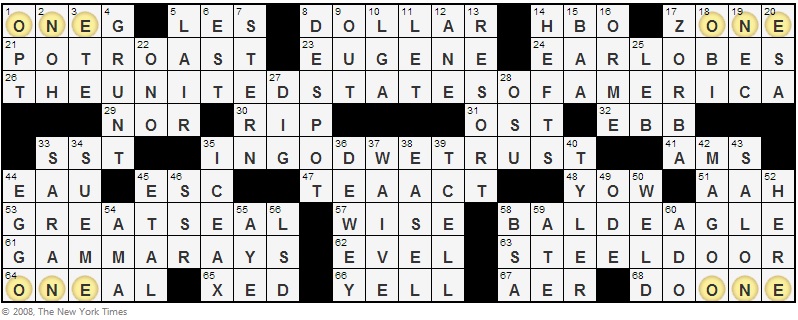
2.) Whether it’s the New York Times or the American Values Club Crossword, you’ve created some truly innovative and diabolical puzzles, like your famous dollar-bill-shaped crossword (featured above) or the New York Times puzzle from last year where multiple movie titles shared boxes. Do you have any favorite puzzles or clues, either your own or constructed by others? And on the flip side, what’s your least favorite example of crosswordese?

Thanks! Those are certainly the 2 New York Times crosswords which have gotten the most attention. Other favorites which spring to mind are my 7/4/07 New York Times puzzle*, the 12/17/09 New York Times puzzle I made with Francis Heaney, and the stuff I wrote for the NY Sun when I started out, which are collected in the book Patricks’ Puzzle Pandemonium: A Cavalcade of Crossword Craziness.

[*Glenn’s note: The 7/4/07 crossword was designed so that the letters “USA” could be found when certain boxes were shaded. It was no doubt a beast to construct. The 12/17/09 crossword was Noah’s Ark-themed, and animal names appeared side-by-side in the grid.]

I’m also the proud poppa of 5 Puzzlefests (interconnected xword suites with a final answer), which I offer through my website, and I’ve written a bunch of puzzle books (“Crossword Word Search” and “Wide-Screen Crosswords” are two of my favorites).

There are lots of other constructors whose work I enjoy, especially those who devise novel gimmicks that really push the envelope.

blindauer beard

My least favorite xwordese is probably LST, though I try to avoid all xwordese when I can. Coming up with a fresh SST clue is tough too, so I just avoid putting it in the grid in the first place.

[Glenn’s note: LST is an abbreviation for an amphibious military craft, short for Landing Ship Tank. SST is an abbreviation for supersonic transport, like the former Concorde.]

3.) You’re also a musician, and both the best puzzles and enjoyable musical performances often have a sense of flow and elegance about them. Do you ever find yourself relying on your more puzzly skills while performing, conducting, or teaching?

Not consciously, no, but maybe I should!

4.) What’s next for Patrick Blindauer?

I actually have something very exciting to announce: I’ve been commissioned to write a 6-puzzle set for the New York Times! It will run Monday-Saturday sometime this fall, and the plan is to make it a contest, as well. I’m thrilled and honored to have the opportunity to do something like this. Wish me luck!

5.) If you could give the readers, writers, and puzzle fans in the audience one piece of advice, what would it be?

Keep your pencil sharp and your mind even sharper.


Many thanks to Patrick for his time. You can check out his PuzzleFests and other puzzly works on his website, and be sure to follow him on Twitter (@pblindauer) to keep up on all things Patrick. (You can also learn more about the Lollapuzzoola tournament at BeMoreSmarter.com.) No doubt, Patrick will have something fiendishly fun for solvers soon.

Thanks for visiting PuzzleNation Blog today! You can share your pictures with us on Instagram, friend us on Facebook, check us out on TwitterPinterest, and Tumblr, and be sure to check out the growing library of PuzzleNation apps and games!
It’s Follow-Up Friday: That Has a Name?! edition

Welcome to Follow-Up Friday!

For those new to PuzzleNation Blog, Follow-Up Friday is a chance for us to revisit the subjects of previous posts and update the PuzzleNation audience on how these projects are doing and what these people have been up to in the meantime.

And today, I’d like to revisit crosswords for a moment.

We’ve explored crosswords a lot in this blog. From great cluing to the curse of crosswordese, from advice for constructing quality puzzles to tips for solving them, crosswords have been the centerpiece for many PuzzleNation Blog posts.

But friend of the blog Cathy Quinn recently passed along an article with an interesting bit of crossword trivia attached.

Have you encountered a difficult crossing in a crossword that left you baffled? This happens with proper names, archaic terms, and other more difficult grid entries, and when two of them cross, you might find yourself guessing instead of solving.

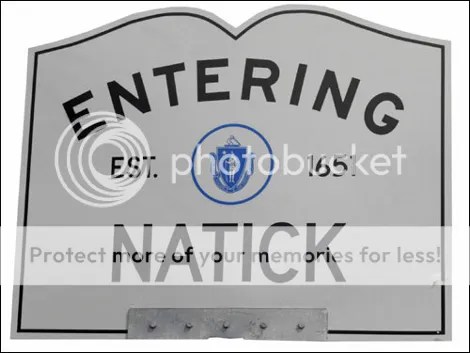
As it turns out, that difficult crossing, that unfillable square, that unsolvable spot, has a name, and it’s “Natick”.

From the article:

Back in 2008, The New York Times crossword puzzle featured a crossing of NATICK (“Town at the eighth mile of the Boston Marathon”) with N.C.WYETH (“Treasure Island” illustrator, 1911). If you weren’t from ’round these parts and were unfamiliar with the less-well-known Wyeth, it was a tough intersection.

Readers were not happy, and the term “a Natick” became shorthand for what is basically an unsolvable part of the crossword grid. (You can check out constructor Brendan Emmett Quigley’s take on the Natick here!)

So, if you’re ever flummoxed by a challenging crossing or an obscure intersection of terms, at least now you know what to call it.

Thanks for visiting PuzzleNation Blog today! You can share your pictures with us on Instagram, friend us on Facebook, check us out on TwitterPinterest, and Tumblr, and be sure to check out our library of PuzzleNation apps and games!

5 Questions with Constructor Trip Payne

Welcome to another edition of PuzzleNation Blog’s interview feature, 5 Questions!

We’re reaching out to puzzle constructors, video game writers and designers, board game creators, writers, filmmakers, musicians, and puzzle enthusiasts from all walks of life, talking to people who make puzzles and people who enjoy them in the hopes of exploring the puzzle community as a whole.

And I’m excited to have Trip Payne as our latest 5 Questions interviewee!

A freelance puzzle constructor for over twenty years, Trip Payne is one of the most prolific and respected names in puzzles. A multi-time champion at the American Crossword Puzzle Tournament, he’s been published in The New York Times, The Wall Street Journal, Uptown Crossword Club, GAMES Magazine, Will Shortz’s WordPlay, and numerous other outlets.

On August 1, he’s launching his latest Puzzle Extravaganza, a collection of a dozen different puzzles (plus a special metapuzzle) for only $10! Previous extravaganzas have featured themes like the 2011-2012 television season and the Man of Steel himself, Superman, but this year’s theme is a closely guarded secret! Check out the details here, including an offer for three bonus crosswords!

Trip was gracious enough to take some time out to talk to us, so without further ado, let’s get to the interview!

5 Questions for Trip Payne

1.) How did you get started with puzzles?

As a very young child, I was attracted to the black-and-white crossword patterns, and my parents noticed that interest and bought me children’s puzzle books. I was always into riddles, magic, games — everything sort of related to puzzles.

Eventually I started coming up with puzzles for my elementary and junior high school newspapers, and when I was 15 I had my first puzzle published nationally in GAMES Magazine.

2.) What, in your estimation, makes for a great puzzle? What do you most enjoy — or try hardest to avoid — when constructing your own?

In terms of crosswords, my #1 rule has always been: It’s All About The Fill. Of course you want a great theme and clever clues, but the second you resort to weak entries, you’ve lost my interest. A lot of people are willing to “justify” weak entries because they’re “necessary” to pull off a wide-open grid or an ambitious theme; I don’t agree with that. With enough work, and perhaps a willingness to pull back a little from the original concept, you can pretty much always avoid poor fill.

Look at Patrick Berry: his themes are great, and you’d have to inspect his puzzles with a microscope to find a weak entry anywhere. That’s not magic — he just has high standards and a willingness to put in the work to make his puzzles as good as they can be.

A great puzzle is one that gives a satisfying “a-ha” at some point, that makes the solver glad that they’ve invested the time with it.  In a logic puzzle, it may be some clever leap that has to be taken; in a word puzzle, it may be an interesting anagram or misleading clue; it may be on a larger scale, as when you discover how the answers to various puzzles interact to solve an overall “metapuzzle.” 

3.) You’re a three-time American Crossword Puzzle Tournament champ and a perennial top 10 finisher. How does tournament solving differ from regular solving, and do you think your experiences with game show environments (like Who Wants to Be a Millionaire?, Million Dollar Password, and Scrabble Showdown ) helped you thrive in the ACPT?

Well, not perennial, since I retired in 2011 (though I did compete one final time in Lollapuzzoola in 2013). My game show work all came after my ACPT championships, so there was no real connection there. But I do think that the fact that I was a professional puzzlemaker before I started competing in puzzle tournaments helped me; for one thing, you get a sense of letter patterns and a feel for how a puzzle constructor might have filled a corner.

4.) What’s next for Trip Payne?

I’m currently editing the Daily Celebrity Crossword for PuzzleSocial, and I have a few other regular assignments, such as the “wordoku” in TV Guide and my themeless crosswords for the Washington Post Puzzler.

I plan to continue making my annual extravaganzas and hope to completely overhaul my website, tripleplaypuzzles.com, within the year. And I also hope to continue doing work writing and researching for TV game shows, and perhaps pitching my own game show ideas to producers.

5.) If you could give the readers, writers, and puzzle fans in the audience one piece of advice, what would it be?

Enjoy the puzzles that you love, but experiment: there are all sorts of great innovative puzzles out there, and you might be surprised what you end up enjoying.

Also, buy my puzzle extravaganza!


Many thanks to Trip for his time. Check out his website for links to all his puzzly endeavors, and be sure to follow him on Twitter (@PuzzleTrip) for the latest updates on his many irons in the fire! Can’t wait to see what puzzle fun he conjures next.

Thanks for visiting PuzzleNation Blog today! You can share your pictures with us on Instagram, friend us on Facebook, check us out on TwitterPinterest, and Tumblr, and be sure to check out the growing library of PuzzleNation apps and games!

5 Questions with Constructor Brendan Emmett Quigley

Welcome to another edition of PuzzleNation Blog’s interview feature, 5 Questions!

We’re reaching out to puzzle constructors, video game writers and designers, board game creators, writers, filmmakers, musicians, and puzzle enthusiasts from all walks of life, talking to people who make puzzles and people who enjoy them in the hopes of exploring the puzzle community as a whole.

And I’m overjoyed to have Brendan Emmett Quigley as our latest 5 Questions interviewee!

A professional puzzle constructor for almost 20 years, Brendan is one of the top names when it comes to crosswords with strong craftsmanship and clever cluing. One of the most prolific contributors to The New York Times Crossword in the modern era, his puzzles have appeared everywhere from GAMES Magazine and The Los Angeles Times to Wired.com and The Crosswords Club.

In addition to the two puzzles he constructs every week for his website, he’s created many puzzle books of his own, and contributed puzzles to an American Red Cross fundraiser for Hurricane Sandy victims. (He also masterminded Puzzle #5 at this year’s American Crossword Puzzle Tournament, the puzzle only a few dozen solvers managed to conquer in the time allotted.)

Brendan was gracious enough to take some time out to talk to us, so without further ado, let’s get to the interview!

5 Questions for Brendan Emmett Quigley

1.) How did you get started with puzzles?

I started making puzzles at a very early age. In Kindergarten art class, specifically. We were given 11×17 sheets of paper and told we could draw anything. I drew mazes. Shortly after that, I realized I could make the puzzles more complicated if I eschewed crayons and used finely sharpened pencils. When I discovered GAMES Magazine, sometime in second grade, I was hooked and became a puzzler for life.

I didn’t get into crosswords until much later. It was a way to while away the hours at a miserable summer job in 1995. After a whole summer of dutifully attempting (and not necessarily succeeding) at solving the Times crossword, I was determined to make and sell one. Which I did by January of 1996. I haven’t stopped since.

2.) What, in your estimation, makes for a great puzzle? (Other than your signature knack for stacking long entries.) What do you most enjoy — or most commonly avoid — when constructing your own? What do you think is the most common pitfall of constructors just starting out?

A good original and hopefully funny theme is all you need to make a great puzzle.

The most common pitfall for newbies is unoriginal themes, or ones that don’t employ enough wordplay. The English language is full of nuances, we should exploit them.

[Check out Brendan’s latest collection, Sit & Solve® Marching Bands!
For more information on marching band puzzles, click here!]

3.) Will Shortz has credited you with bringing some hipness to the New York Times Crossword with your cluing and entry-word choices. Do you have any favorite clues or entries that have appeared there, either in your puzzles or puzzles by other constructors?

Mike Shenk once wrote the clue “Strips in a club” for BACON, and well, that’s a classic.

4.) What’s next for Brendan Emmett Quigley?

I think I’m going to have a beer.

5.) If you could give the readers, writers, and puzzle fans in the audience one piece of advice, what would it be?

Don’t do drugs. Be drugs.


Many thanks to Brendan for his time. Check out his website for twice-weekly puzzles, and be sure to follow him on Twitter (@fleetwoodwack) for updates on all things Quigley. I look forward to solving whatever he cooks up next.

Thanks for visiting PuzzleNation Blog today! You can share your pictures with us on Instagram, friend us on Facebook, check us out on TwitterPinterest, and Tumblr, and be sure to check out the growing library of PuzzleNation apps and games!

5 Questions with Constructor Matt Gaffney!

Welcome to another edition of PuzzleNation Blog’s interview feature, 5 Questions!

We’re reaching out to puzzle constructors, video game writers and designers, board game creators, writers, filmmakers, musicians, and puzzle enthusiasts from all walks of life, talking to people who make puzzles and people who enjoy them in the hopes of exploring the puzzle community as a whole.

And I’m overjoyed to have Matt Gaffney as our latest 5 Questions interviewee!

Matt Gaffney is a puzzle constructor, and over the last twenty-five years — fifteen as a full-time constructor! — he has made a name for himself as one of the most innovative names in crosswords. Whether it’s his signature Weekly Crossword Contest puzzles or the crossword murder mystery he launched on Kickstarter, he’s become synonymous with puzzles that contain a little something extra.

In addition to puzzle books and books about puzzles, he’s been published in The New York Times, The Washington Post, Slate Magazine, and GAMES Magazine, among numerous others. All told, he estimates he’s created more than 4,000 puzzles in his career!

Matt was gracious enough to take some time out to talk to us, so without further ado, let’s get to the interview!

5 Questions for Matt Gaffney

1.) How did you get started with puzzles?

My older sister starting bringing home Dell and Penny Press puzzle magazines when I was about 8 or 9. I have a hypercompetitive personality with certain things, and puzzles turned out to be one of them, so I starting submitting crosswords to Dell Champion. They ran my first two published puzzles when I was 13.

2.) In addition to your daily crossword puzzles, you host a Weekly Crossword Contest, featuring crosswords with a puzzle-within-a-puzzle lurking inside. These “metapuzzles” have grown in popularity over the years. What separates a quality metapuzzle from a bonus answer that simply feels tacked on? What are some of your favorite past metapuzzles?

Ideally a metapuzzle is like a good hiding place in hide-and-go-seek. The seeker shouldn’t find you right away; they should overlook you a couple of times, walk past you a couple of times, and only later say, “Ah, I should’ve found you sooner.”

My favorite meta that I myself wrote in the past year is called “Corporate Structure” and can be found here.

My favorite meta that someone else wrote is called “Seasonal Staff” by Francis Heaney and you can buy it for $1 here (under “Puzzle” scroll down to 2013-12-18).

[Just one of many puzzle-themed titles Matt has authored.]

3.) When you celebrated 5 years of your Weekly Crossword Contest, you stated that MGWCC will run for 1,000 weeks, which would put the final edition around August 6, 2027. Do you have any predictions for how crosswords might have changed by then?

I think by then individual crossword writers will be more brandable than we are now. With a few exceptions like Merl Reagle, familiar crossword brands are still usually publications or, in the case of Will Shortz, an editor.

The Web has allowed constructors like myself, Brendan Quigley, Liz Gorski, Erik Agard, and many others to get our work out independently, so I think solvers will move more towards seeking out their favorite individual constructors rather than solving newspaper puzzles. Sort of like how you can buy an album by your favorite artist instead of waiting for them to play on the radio.

4.) What’s next for Matt Gaffney?

I’m going to market my Daily Crossword this summer. I’ve been too busy to find a good home for it but the number of hits it gets, with zero marketing on my part, is amazing to me.

5.) If you could give the readers, writers, puzzle fans, and aspiring constructors in the audience one piece of advice, what would it be?

I would encourage people to explore the indie crosswords. If the newspaper dailies are ABC, NBC, and CBS, then the independent puzzle writers are HBO and Showtime. Go here and click on any of the names on the bottom-left sidebar and see what’s good.

Not all of them are indie crossword sites (some are crossword critique sites, some are other crossword-related stuff) but about half of them are personal sites of independent crossword writers.


Many thanks to Matt for his time. Check out his Daily Crossword, his Weekly Crossword Contest, his blog about crosswords, and his website, and be sure to follow him on Twitter (@metabymatt) for the latest updates on all his projects. I can’t wait to see what other puzzly tricks he has up his sleeve.

Thanks for visiting PuzzleNation Blog today! You can share your pictures with us on Instagram, friend us on Facebook, check us out on TwitterPinterest, and Tumblr, and be sure to check out the growing library of PuzzleNation apps and games!