How Far Away Are Computer-Generated Crosswords?

[Image courtesy of ESLTower.]

There’s no denying that computers play a large role in the world of crosswords today.

Some companies use computer programs to generate their unthemed crosswords, no human intervention necessary. Computer programs like Crossword Compiler aid constructors in puzzle design and grid fill, allowing them to build and cultivate databases of words with which to complete their grids.

And, of course, with those little computers in your pocket, you can solve all kinds of crosswords (like those in our Daily POP Crosswords and Penny Dell Crosswords apps).

Heck, computers are even getting pretty good at solving crosswords — just look at Matt Ginsberg’s evolving crossword program, “Dr. Fill.”
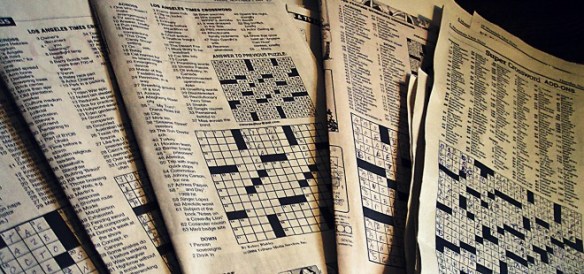
An article in Smithsonian Magazine posed the question, “why haven’t computers replaced humans in crossword creation?”

The answer, as you’d expect, is simple: computers are just fine at plugging words into established grids and generating basic, unthemed crosswords.

But unthemed is the key word there.

When people think of The Los Angeles Times, The New York Times, The Chronicle of Higher Education, The American Values Club, The Crosswords Club, or any of the other well-respected crossword outlets in the market today, I doubt unthemed puzzles are what comes to mind.

And when it comes to creating themes, innovating, and playing with the conventions of crosswords in order to create puzzles that surprise and challenge solvers, computers simply don’t have the chops.

They might be able to solve puzzles, but as far as I can tell from my research, there’s no program out there capable of generating and executing a theme with any sort of wordplay element involved.

[Image courtesy of Crossword Compiler.]

There is an art to creating an exciting grid, an intriguing theme, or a new puzzle mechanic that solvers have never seen before. The creativity of constructors is truly boundless.

And, it seems, the potential for crossword grids is just as boundless.

Recently, Oliver Roeder of FiveThirtyEight challenged the puzzle fans in his readership to calculate how many different crossword puzzle grids were possible.

He offered the following conditions:

  • They are 15-by-15.
  • They are rotationally symmetric — that is, if you turn the grid upside down it appears exactly the same.
  • All the words — that is, all the horizontal and vertical sequences of white squares — must be at least three letters long. All the letters must appear in an “across” word and a “down” word.
  • The grid must be entirely connected — that is, there can be no “islands” of white squares separated from the rest by black squares.

Now, obviously, all of those rules can be violated for the sake of an interesting theme. We’ve seen grids with vertical symmetry, islands of white squares, and more. Heck, plenty of grids allow words to go beyond the grid itself, or allow multiple words to share puzzle squares.

[“Cutting Edge” by Evan Birnholz. A puzzle where answers extend
beyond the grid. Image courtesy of The Washington Post.]

But assuming these rules are standard, what total did solvers come up with?

None. They couldn’t find a total.

One solver managed to calculate that there were 40,575,832,476 valid 13-by-13 grids following the above conditions, but could not apply the same technique to 15-by-15 grids.

40 billion valid grids. For a comparison, there are 5,472,730,538 unique solutions for a 9×9 Sudoku grid, and I previously calculated it would take 800 years to use every possible 9×9 Sudoku grid.

Of course, that’s 40 billion 13-by-13 grids. The number of possible 15-by-15 grids must be orders of magnitude larger.

Consider this: There were 16,225 puzzles published in The New York Times before Will Shortz took over the NYT crossword. The current number of NYT crosswords in the XWordInfo database is somewhere in the neighborhood of 25,000 puzzles.

And they’re one of the oldest crossword outlets in the world. Even when you factor in the number of newspapers, magazines, subscription services, and independent outlets for crosswords there are these days, or have been in the past, we barely scratch the surface of a number like 40 billion.

Maybe by the time we’ve run through that many, AI constructors will have caught up.


Thanks for visiting PuzzleNation Blog today! Be sure to sign up for our newsletter to stay up-to-date on everything PuzzleNation!

You can also share your pictures with us on Instagram, friend us on Facebook, check us out on Twitter, Pinterest, and Tumblr, and explore the always-expanding library of PuzzleNation apps and games on our website!

How Tweet It Is!

Crosswords occupy a curious niche in popular culture.

They’re a part of everyday life, appearing in newspapers, apps, puzzle books, mysteries, and more. That simple patterning of black and white squares, no matter where it appears, brings them to mind.

And yet, despite their ubiquity, they’re not always viewed as something for the everyman. Some consider them off-putting or intimidating, steeped in obscure cluing and peculiar verbiage intended to keep casual solvers out.

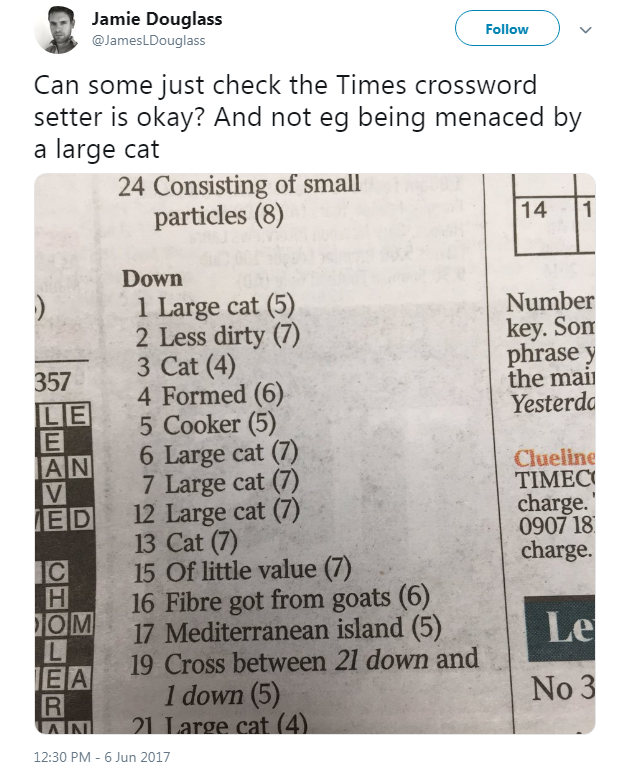
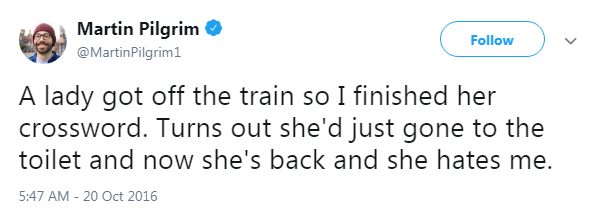
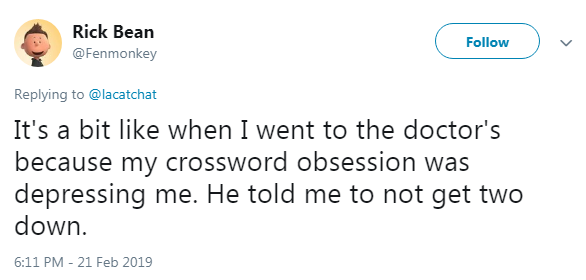
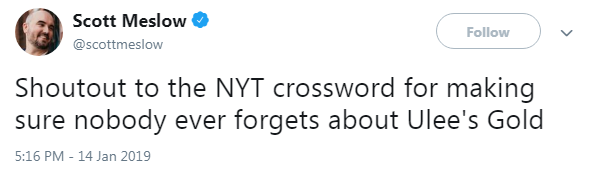
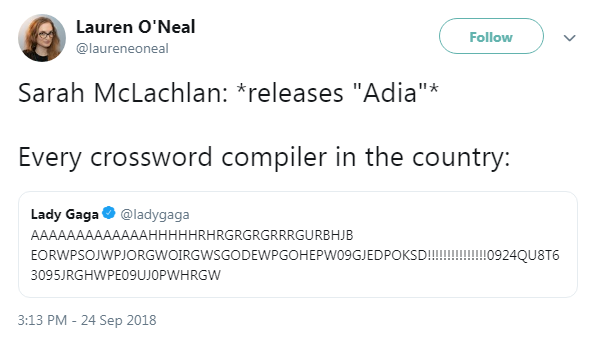
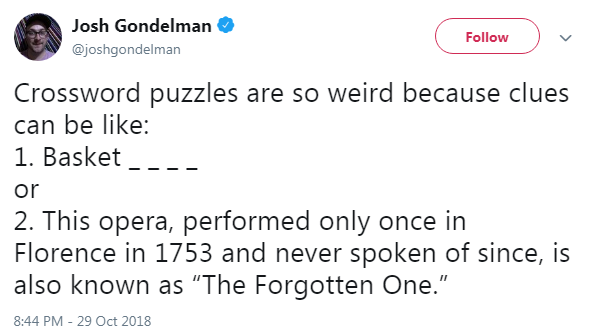
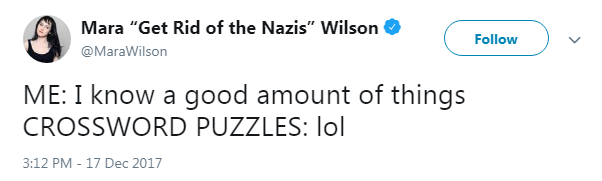
That mix of familiarity and unfamiliarity makes crosswords the perfect fodder for comedians. The crew at HuffPost proved this by compiling a list of humorous tweets focusing on crosswords.

Some of them referenced the odd letter combinations you encounter in grids…

Or the difficulty some clues offer…

Or just the general difficulty of the puzzle…

But other tweets had fun with specific puzzles…

Or with the act of solving itself…

And, given how often wordplay finds its way into crosswords, it’s only appropriate to close out with a pun…

(That last one wasn’t in the HuffPost article. There’s plenty more puzzle humor out there, I just happened to stumbled across it yesterday before writing this post.)

Have you encountered any funny crossword-themed tweets recently? Let us know in the comments section below! (And be sure to follow us on Twitter, where we share little gems like these whenever we can.)


Thanks for visiting PuzzleNation Blog today! Be sure to sign up for our newsletter to stay up-to-date on everything PuzzleNation!

You can also share your pictures with us on Instagram, friend us on Facebook, check us out on Twitter, Pinterest, and Tumblr, and explore the always-expanding library of PuzzleNation apps and games on our website!
Puzzles… in… Space!

When you’re a puzzle enthusiast, you never know where your interest might take you, or what interesting and unexpected people you’ll encounter along the way. All sorts of folks enjoy puzzles, after all.

If you enjoy puzzles with trivia, you could bump into Who Wants to Be a Millionaire? winners or Jeopardy! champions like Ken Jennings. The New York Times has introduced us to several famous crossword enthusiasts. The British government is publishing puzzle books. Heck, actors Joel McHale and Neil Patrick Harris both included puzzles in their autobiographies!

Even astronauts are getting into the puzzly spirit!

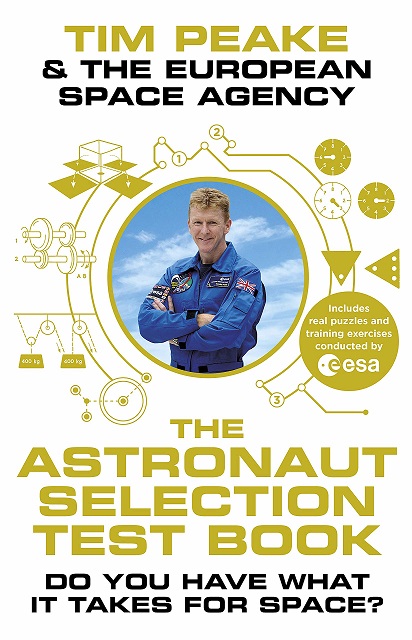
Astronaut Tim Peake spent half a year in one of the most fascinating places in the solar system: the International Space Station. He was the first British astronaut to serve under the banner of the European Space Agency, and the first British astronaut to perform a spacewalk.

Upon returning to Earth, he turned his attention to more literary efforts, penning three books about space. The third, published last year in partnership with the European Space Agency, takes readers behind the scenes of the ESA screening process for astronauts.

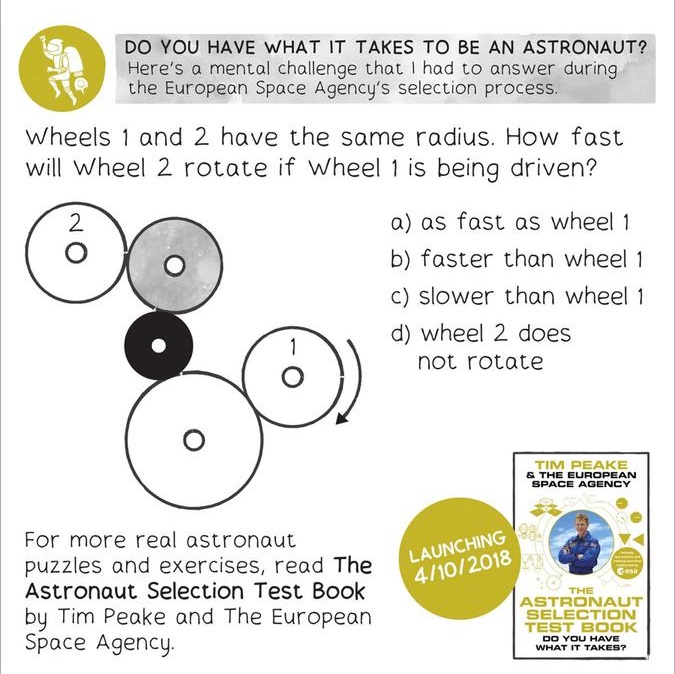
Yes, puzzles are part of the screening process for the ESA.

Would you like to try your hand at solving some of them?

How did you do? Let us know in the comments section below! We’d love to hear from you

And if you’d like, you can find more of these puzzles in Peake’s delightful book The Astronaut Selection Test Book: Do You Have What it Takes for Space?

Do you have what it takes? I suspect that you do, fellow puzzler.


Thanks for visiting PuzzleNation Blog today! Be sure to sign up for our newsletter to stay up-to-date on everything PuzzleNation!

You can also share your pictures with us on Instagram, friend us on Facebook, check us out on Twitter, Pinterest, and Tumblr, and explore the always-expanding library of PuzzleNation apps and games on our website!
A Puzzly Nom de Plume?

[Image courtesy of Writers Write.]

There was an intriguing blog post on The Wall Street Journal‘s website a few days ago about their crossword editor, Mike Shenk.

For those who don’t know, Shenk is a well-respected name in the world of puzzles who has contributed puzzles to numerous outlets, including GAMES Magazine, The New York Times, the American Crossword Puzzle Tournament, and of course, The Wall Street Journal.

The blog post revealed that Shenk had published puzzles in the WSJ under pseudonyms in the past, but going forward, that would no longer be the case. In the spirit of transparency, any puzzles constructed by Shenk would appear under his real name.

Greater transparency in crossword publishing is definitely a good thing. If you recall, part of the issue with Timothy Parker’s tenure for the Universal Crossword involved other constructors’ puzzles being reprinted under Parker’s pseudonyms instead of the actual constructor’s name. Ben Tausig found one example, and further investigation turned up others.

From a FiveThirtyEight article discussing the story:

The puzzles in question repeated themes, answers, grids and clues from Times puzzles published years earlier. Hundreds more of the puzzles edited by Parker are nearly verbatim copies of previous puzzles that Parker also edited. Most of those have been republished under fake author names.

Obviously, no such accusations mar Shenk’s tenure at The Wall Street Journal. His reputation is pristine.

[Image courtesy of Politico.]

But it made me wonder. Last year, we discussed how many women were being published in various crossword outlets. From January 1st to April 29th of 2018, nine out of the 99 puzzles published by The Wall Street Journal were constructed by women. Were some of those actually Shenk under a pseudonym? (One of the noms de plume mentioned in the WSJ blog post was Alice Long.)

Naturally, this whole topic got me thinking about pseudonyms in general. In British crosswords, most constructors (or setters, as they’re called in the UK) publish under a pseudonym. Among loyal solvers, names like Araucaria, Qaos, Paul, Enigmatist, Shed, and Crucible are as familiar there as C.C. Burnikel, Jeff Chen, Brendan Emmett Quigley, or Patrick Berry would be here.

How common are pseudonyms in American-style crosswords, do you suppose? Has usage of aliases increased or decreased over the years? I might have to follow up on that in the future.

In the meantime, it’s intriguing to see one of the most respected crossword outlets in the market today, The Wall Street Journal, take a stand on visibility and transparency in puzzle publishing. Maybe it’s the start of something bigger.


Thanks for visiting PuzzleNation Blog today! Be sure to sign up for our newsletter to stay up-to-date on everything PuzzleNation!

You can also share your pictures with us on Instagram, friend us on Facebook, check us out on Twitter, Pinterest, and Tumblr, and explore the always-expanding library of PuzzleNation apps and games on our website!
Happy One Year Anniversary, Crossword Puzzle Collaboration Directory!

It’s funny how crosswords can seem like a solitary pursuit — and are often depicted as such in pop culture — and yet, there’s such a sense of camaraderie that comes with being a solver.

I talk a lot about the PuzzleNation community and my fellow PuzzleNationers, or about the puzzle community in general, because it’s one of my favorite aspects of being a puzzle guy.

Whether it’s engaging in a puzzly activity with friends (like an escape room or a D&D adventure), hanging out with fellow puzzlers at events like the American Crossword Puzzle Tournament (registration is open now!), or just teaming up with a pal to crack a particularly devious puzzle or brain teaser, those moments of shared experience are as encouraging as they are welcome.

So it’s very cool to see one of the newer parts of the puzzle community celebrating its one-year anniversary: The Crossword Puzzle Collaboration Directory.

This Facebook group is part gathering place for established and aspiring constructors and part resource for constructors of all skill levels.

Over the last year, people have posted and shared information about everything from grid construction, editing programs, and cluing advice to networking, test-solving, and encouraging feedback.

[Some constructors even offer visual aids when answering questions!]

Inexperienced and aspiring constructors meet and collaborate with established names. Obstacles, problems, and questions are handled with equal care and support. Heck, some constructors have even posted rejection notices they’ve received in order to share the valuable feedback it contains.

And some members of the group have greater ambitions for the Crossword Puzzle Collaboration Directory, hoping to encourage more constructors from underrepresented groups to construct and submit their puzzles, bringing a genuine level of equality and equal representation in the world of puzzles.

It’s a place to learn, to network, to grow, to celebrate one’s successes, and learn from one’s setbacks. One of the regular visitors of the group even managed to cross off one of her New Year’s resolutions last year by submitting a crossword to The New York Times, thanks in part to the resources and support provided by this marvelous group of people.

And that’s definitely something worth celebrating.


Thanks for visiting PuzzleNation Blog today! Be sure to sign up for our newsletter to stay up-to-date on everything PuzzleNation!

You can also share your pictures with us on Instagram, friend us on Facebook, check us out on Twitter, Pinterest, and Tumblr, and explore the always-expanding library of PuzzleNation apps and games on our website!
A Happy Ending and A New Beginning for the Universal Crossword!

Some stories have happy endings, eventually.

In one particular case, it took nearly three years for the satisfying resolution to arrive.

Allow me to explain.

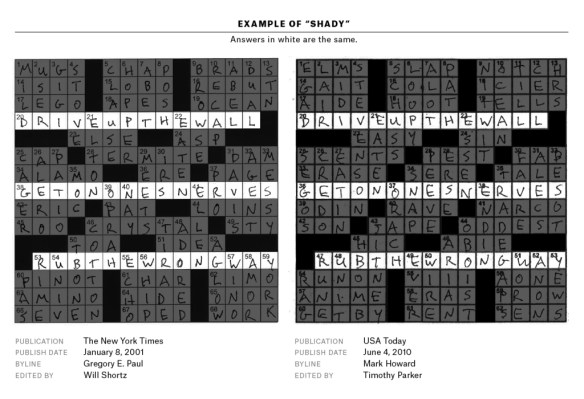
In March of 2016, programmer Saul Pwanson and constructor Ben Tausig uncovered a pattern of unlikely repeated entries in the USA Today and Universal crosswords, both of which were edited by Timothy Parker.

Eventually, more than 65 puzzles were determined to feature “suspicious instances of repetition” with previously published puzzles in The New York Times and other outlets, with hundreds more showing some level of repetition.

The troubling pattern uncovered by Tausig and Pwanson sparked an investigation, and a day after the story first broke, Universal Uclick (which owns both the USA Today crossword and the Universal syndicated crossword) stated that Parker had agreed to temporarily step back from any editorial role for both USA Today and Universal Crosswords.

We were among the first to report that constructor Fred Piscop would serve as editor in the interim, but after that, the story went quiet for two months.

Then, in early May, Oliver Roeder of FiveThirtyEight reported that Universal Uclick had completed its investigation, and despite the fact that they’d confirmed some of the allegations of puzzle repetition, they were only giving Parker a three-month leave of absence.

The puzzle community was unhappy with the reaction, and USA Today and Universal Uclick soon felt the pressure from constructors and content creators alike.

Many other game companies and constructors joined in the boycott, and less than a week later, Gannett (who publishes USA Today) declared that “No puzzles that appear in Gannett/USA TODAY NETWORK publications are being edited by Timothy Parker nor will they be edited by Timothy Parker in the future.”

Parker was out as far as USA Today went, but his relationship with Universal Uclick was still unclear. (Even now, despite inquiries, I’m unable to determine if he’s still associated with Universal Uclick.)

We’d never seen anything like this. Not only did it galvanize the puzzle community like nothing before, but it raised the very important issue of creator’s rights when it comes to puzzles.

And, as I said, the story has a happy ending. Constructor David Steinberg has been named the new editor of the Universal Crossword and Universal Sunday Crossword!

Although this means the end of The Puzzle Society Crossword that Steinberg was previously editing (as it is being folded into the Universal Crossword), there is a bright side, as it guarantees fresh, well-vetted puzzles for many more solvers from a young, respected voice in the field.

David’s resume is impressive, as the youngest constructor to be published in The LA Times crossword, and the second-youngest to be published in The NY Times. He was also named the crossword editor for the 24 newspapers associated with The Orange County Register.

Between those accomplishments, his work with the archival Pre-Shortzian Puzzle Project, and his prolific and creative crossword output, it’s obvious why Universal Uclick (now Andrew McMeels Universal) would want him for the job.

Several puzzles under his stewardship have already appeared, featuring constructors like Jim Peredo, Doug Peterson, and Samuel A. Donaldson!

David offered some details in an announcement email:

Each week I’m publishing eight themed Universal crosswords—seven 15x15s and one 21×21. Puzzles appear in all venues that formerly ran the Universal Crossword, as well as in those that ran the Puzzle Society Crossword.

Among the many new venues that run the 15x15s are The Boston Globe, The Philadelphia Inquirer, and The Seattle Times; new venues that run both the 15x15s and the 21x21s include The Chicago Sun-Times, The New York Daily News, and The Miami Herald. The Universal Crossword is also truly universal, appearing in countries as far-flung as China, India, and Saudi Arabia!

We wish David the best of luck in his latest puzzly endeavor. We know the Universal Crossword is in great hands!


Thanks for visiting PuzzleNation Blog today! Be sure to sign up for our newsletter to stay up-to-date on everything PuzzleNation!

You can also share your pictures with us on Instagram, friend us on Facebook, check us out on Twitter, Pinterest, and Tumblr, and explore the always-expanding library of PuzzleNation apps and games on our website!