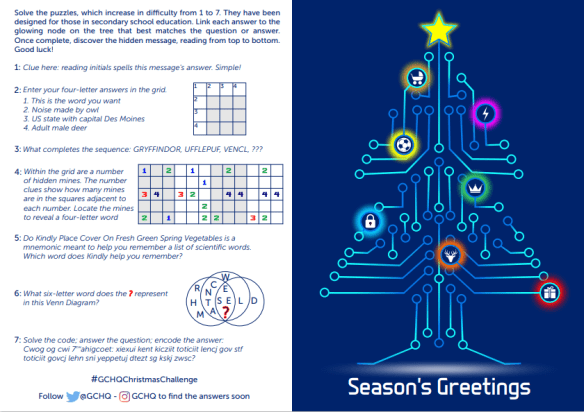
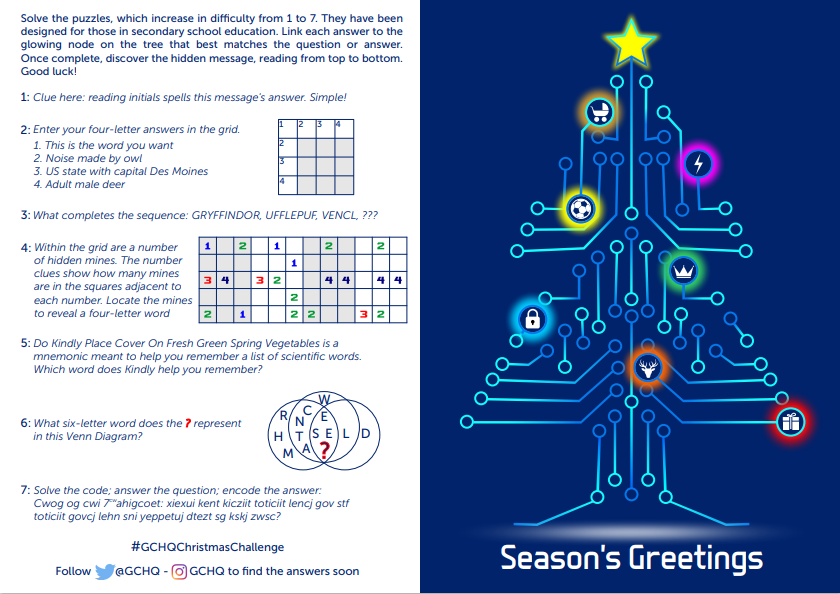
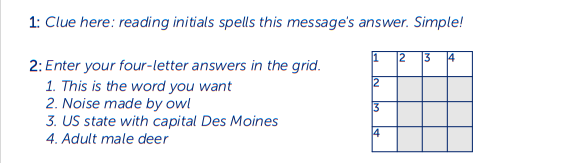
The 2025 GCHQ Christmas Challenge Launches Tomorrow!

One government agency in England celebrates Christmas a little bit differently than most.

The GCHQ — or Government Communications Headquarters — provides security and intelligence services for the British government. Back when they were known as GC&CS — Government Code and Cypher School — they were responsible for funding Bletchley Park and its successes cracking the German “Enigma” code during World War II.

And now, they provide one of the coolest and puzzliest challenges of the year, designed for solvers aged eleven to eighteen to test their skills, hoping to inspire the next generation of puzzle solvers.

Yes, it’s time once again for the GCHQ Christmas card.

GCHQ card
A look at 2021’s GCHQ Christmas Card.

We provided detailed breakdowns of their Christmas cards in 2016 and 2021, and if you’d like a sample of the GCHQ Christmas Challenge, they have an archive of puzzles from three previous years ready for you to solve!

The 2025 edition of the GCHQ Christmas Challenge launches tomorrow, Wednesday December 10th for the general public. (Schools were able to register for early access to the puzzles, complete with lesson-planning materials, which is very cool.)

Here’s what the GCHQ has to say about the event:

At GCHQ, we love creating puzzles and breaking codes. That’s why every year we create the GCHQ Christmas Challenge, a series of fiendish brainteasers and puzzles, designed by our very own team of codebreakers. It encourages children aged 11-18 to think laterally and work as a team, as well as showcasing some of the skills they might need to become a spy.

The puzzles are not designed to be solved alone, and each student will bring something different to the challenge. At GCHQ, we believe the right mix of minds enables us to solve seemingly impossible problems.

I’ve always been impressed with what festive puzzly efforts GCHQ brings each year, and I can’t wait to see what the 2025 edition has in store for solvers.

So, fellow puzzlers, do you accept this year’s Christmas Challenge? Let us know in the comments section below!

The 2024 GCHQ Christmas Challenge Launches Tomorrow!

One government agency in England celebrates Christmas a little bit differently than most.

The GCHQ — or Government Communications Headquarters — provides security and intelligence services for the British government. Back when they were known as GC&CS — Government Code and Cypher School — they were responsible for funding Bletchley Park and its successes cracking the German “Enigma” code during World War II.

And now, they provide one of the coolest and puzzliest challenges of the year, designed for solvers aged eleven to eighteen to test their skills, hoping to inspire the next generation of puzzle solvers.

Yes, it’s time once again for the GCHQ Christmas card.

GCHQ card
A look at 2021’s GCHQ Christmas Card.

We provided detailed breakdowns of their Christmas cards in 2016 and 2021, and if you’d like a sample of the GCHQ Christmas Challenge, they have an archive of the last three years ready for you to solve!

The 2024 edition of the GCHQ Christmas Challenge launches tomorrow, Wednesday December 11th for the general public. (Schools were able to register for early access to the puzzles, complete with lesson-planning materials, which is very cool.)

Here’s what the GCHQ has to say about the event:

At GCHQ, we love creating puzzles and breaking codes. That’s why every year we create the GCHQ Christmas Challenge, a series of fiendish brainteasers and puzzles, designed by our very own team of codebreakers. It encourages children aged 11-18 to think laterally and work as a team, as well as showcasing some of the skills they might need to become a spy.

The puzzles are not designed to be solved alone, and each student will bring something different to the challenge. At GCHQ, we believe the right mix of minds enables us to solve seemingly impossible problems.

I’ve always been impressed with what festive puzzly efforts GCHQ brings each year, and I can’t wait to see what the 2024 edition has in store for solvers.

So, fellow puzzlers, do you accept this year’s Christmas Challenge? Let us know in the comments section below!

Tackling the GCHQ 2021 Christmas Card!

GCHQ card

Every year, one of the puzzliest challenges many solvers will encounter all year descends upon the world, as the GCHQ issue their Christmas card.

The GCHQ — or Government Communications Headquarters — provides security and intelligence services for the British government. Back when they were known as GC&CS — Government Code and Cypher School — they were responsible for funding Bletchley Park and its successes cracking the German “Enigma” code during World War II.

This year’s Christmas card was directed toward solvers with a secondary school education (essentially solvers age 11 and up), and was less complicated than offerings in previous years, but still offered an engaging challenge.

Here’s the link in case you’d like to try it for yourself.

***

**

*

Last chance before we walk through the solution!

***

**

*

Okay, ready? Good! Let’s do this!


GCHQ card 1a

Clue number one is an easy one, as you simply read the first letter of each word in the message. Your solution is CHRISTMAS.

Clue number two is a simple 4×4 across-and-down grid where 1-Across and 1-Down are the same word, 2-Across and 2-Down are the same word, and so on. The completed grid reads:

T H I S
H O O T
I O W A
S T A G

And the letters in THIS are highlighted in the grid, so the solution is THIS.

GCHQ card 1b

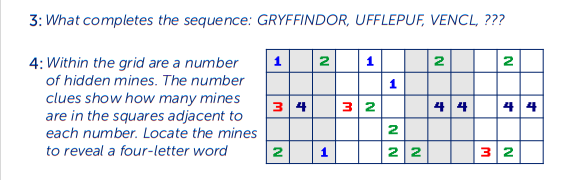
Clue number three is a complete-the-sequence puzzle where the names of the Hogwarts houses from Harry Potter are listed, but each house in the sequence has more letters missing from the beginning and end of the word. Slytherin is the missing house, and with three letters missing from the beginning and end of the word, your solution is THE.

Clue number four is a Blackout! or Minesweeper-style puzzle where you deduce the location of bombs in the grid according to numbers in the neighboring squares. Once you’re marked off each of the bombs, the remaining spaces form letters and spell out a word. Your solution is SAFE.

GCHQ card 1c

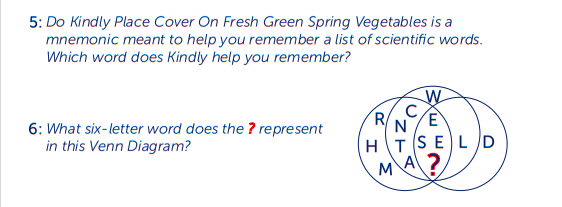
Clue number five is a mnemonic device, and solvers must puzzle out what chain of related words is represented by the device. In this case, the major taxonomic ranks that are used to organize related living things are represented, and the word Kindly points toward the second word in the taxonomic ranks, so your solution is Kingdom.

Clue number six has three overlapping circles, each with letters inside, and you have to figure out not only what the words are, but what missing six-letter word would sit in the middle of this Venn diagram.

I found this to be the hardest puzzle in the card by far, as I tried and failed in numerous attempts to anagram the letters into recognizable words. Finally, I decoded the shortest word — LEEDS — only because I remembered that this is a British organization and I have friends who live in Leeds.

Leeds led me to unraveling the other two answers — MANCHESTER and NEWCASTLE — and my meager knowledge of European football provided the missing six-letter word. The solution is UNITED.

GCHQ card 1d

Clue number seven is a simple cryptogram, and is quickly decoded to read “This is the 7th question: people born between nineteen forty-six and nineteen sixty-four are commonly known as baby what?”

The solution appears to be BOOMERS, but there is an additional instruction to follow after decoding the message, and you must encode the answer. Following the same letter-substitution rule, BOOMERS becomes KEEPING, and that is your solution.

GCHQ card 2

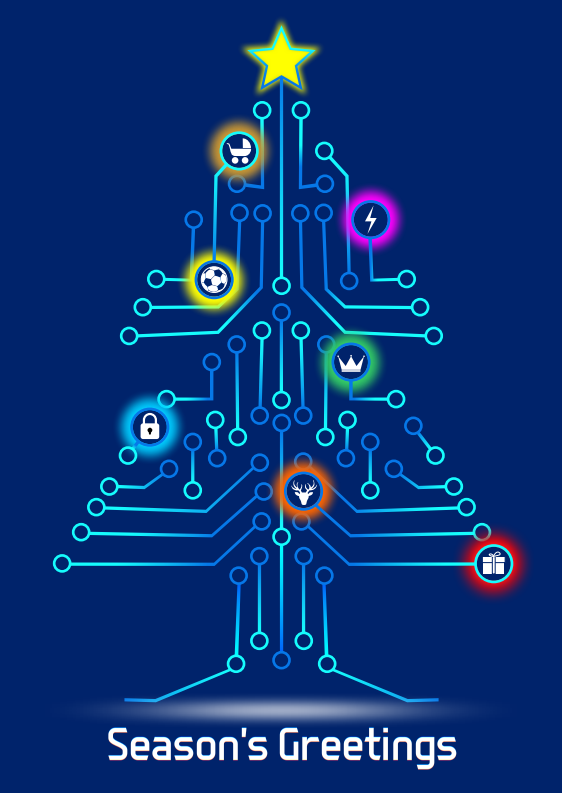
Now each word must be placed in order on the tree for your message to properly read out.

  • The word BABY in clue 7 points toward the stroller icon, so our message begins with KEEPING.
  • The lightning bolt icon refers to Harry Potter, so the word THE from clue 3 goes next.
  • The soccer ball icon points to clue 6, so the word UNITED continues the message.
  • The word KINGDOM from clue 5 aligns with the crown icon, so that’s our fourth word.
  • The lock icon is most closely associated with SAFE from clue 4, so that’s next.
  • At first, I thought the image of the Stag was a Harry Potter reference, but I then realized that STAG was one of the answers in clue 2’s grid, so this was the place for THIS.
  • Finally, the present is the perfect spot for clue 1’s solution, CHRISTMAS.

And the message is revealed, celebrating the mission of the GCHQ itself: Keeping the United Kingdom Safe This Christmas.

Did you unravel this festive puzzly challenge, fellow PuzzleNationers? Let us know in the comments section below! We’d love to hear from you.


   dailypopwsicon

Treat yourself to some delightful deals on puzzles. You can find them on the Home Screen for Daily POP Crosswords and Daily POP Word Search! Check them out!

Thanks for visiting PuzzleNation Blog today! Be sure to sign up for our newsletter to stay up-to-date on everything PuzzleNation!

Alan Turing Will Be on the New £50 Note Soon!

turing3_sculpture-photo2

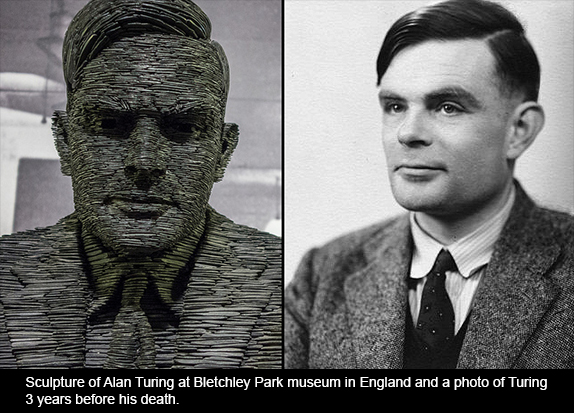
When it comes to influential puzzlers, it’s hard to top the impact mathematician and codebreaker Alan Turing had on the world.

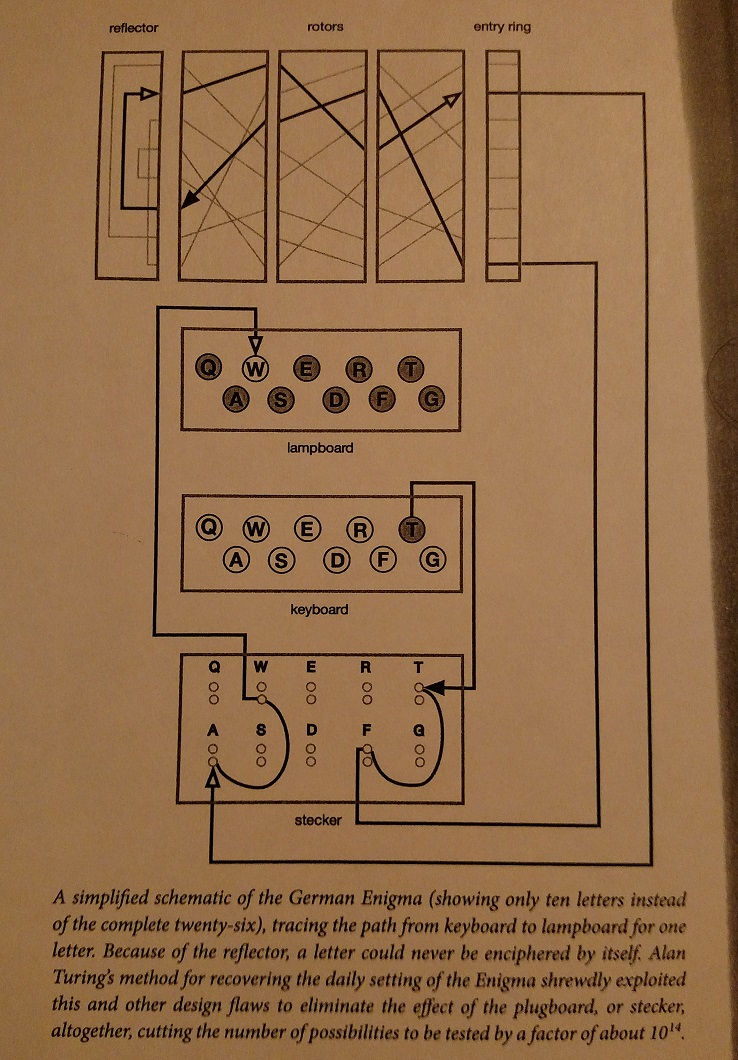
Admittedly, there are numerous names — too numerous to mention, really — associated with the ENIGMA project and Bletchley Park’s codebreaking efforts in general that deserve recognition. World War II was shortened by YEARS by the work of the folks at Bletchley Park, and Alan Turing was a pivotal figure in the war effort.

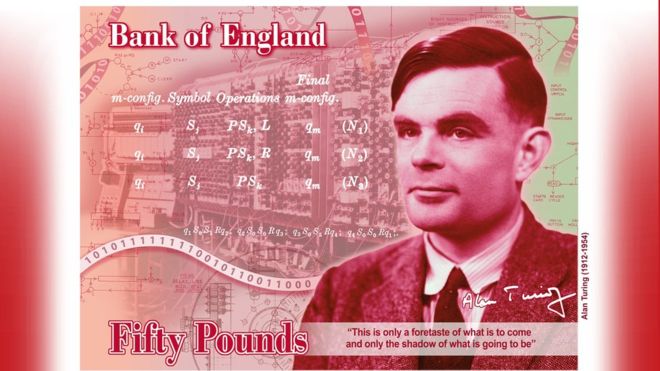
And he has been selected as the face of the new £50 note for British currency.

turingnote

[Image courtesy of the BBC.]

The Bank of England received over 227,000 suggestions of British scientists to appear on the new version of the note, and Turing was selected from the shortlist of 12 official nominees, a list that included Rosalind Franklin, James Clerk Maxwell, Dorothy Hodgkin, Mary Anning, Paul Dirac, Srinivasa Ramanujan, and Stephen Hawking, as well as pairs like Ada Lovelace and Charles Babbage and William and Caroline Herschel.

Naturally the Queen will still appear on the front of the note, and Turing on the reverse side, replacing former note design figures as James Watt, Matthew Boulton, and Christopher Wren.

But the elevation of Alan Turing isn’t just a victory for a historical figure or a puzzling icon, it’s one for the LGBTQ+ community as well. Because of his sexuality, Turing was forced out of his work at the GCHQ — Britain’s governmental codebreaking operation — and driven to suicide by government persecution and abuse.

After a campaign led by numerous British luminaries like Richard Dawkins, Stephen Fry, and Peter Tachell, an apology was issued by then prime minister Gordon Brown in 2009. A posthumous pardon by the Queen in 2013 followed.

These acts don’t undo the crimes of the past. But they are a symbolic promise for the future that anyone like Turing — no matter their historical importance, social status, or personal choices — will not endure the same horrors that he did.

Nearly 70 years after he and his colleagues helped bring an end to World War II, Turing will continue to inspire and impact the world as a face on the £50 note. That’s something to celebrate.


For more details on this announcement, please check out this article from Pink News. For more information on Turing’s work and Bletchley Park in general, you can check out a previous PN Blog post here. And for the American equivalent of Bletchley Park — Arlington Hall — you can click here.

Thanks for visiting PuzzleNation Blog today! Be sure to sign up for our newsletter to stay up-to-date on everything PuzzleNation!

You can also share your pictures with us on Instagram, friend us on Facebook, check us out on TwitterPinterest, and Tumblr, and explore the always-expanding library of PuzzleNation apps and games on our website!

Puzzles… in… Space!

When you’re a puzzle enthusiast, you never know where your interest might take you, or what interesting and unexpected people you’ll encounter along the way. All sorts of folks enjoy puzzles, after all.

If you enjoy puzzles with trivia, you could bump into Who Wants to Be a Millionaire? winners or Jeopardy! champions like Ken Jennings. The New York Times has introduced us to several famous crossword enthusiasts. The British government is publishing puzzle books. Heck, actors Joel McHale and Neil Patrick Harris both included puzzles in their autobiographies!

Even astronauts are getting into the puzzly spirit!

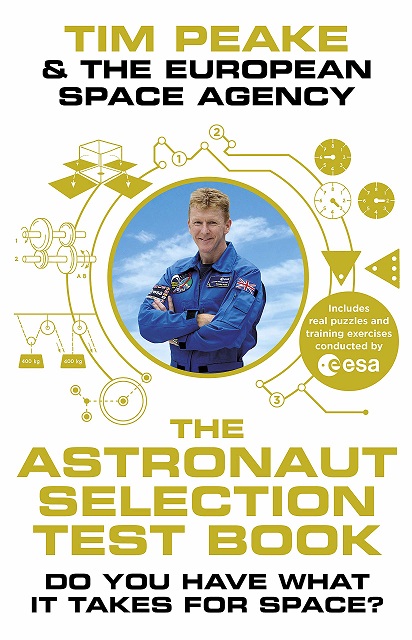
Astronaut Tim Peake spent half a year in one of the most fascinating places in the solar system: the International Space Station. He was the first British astronaut to serve under the banner of the European Space Agency, and the first British astronaut to perform a spacewalk.

Upon returning to Earth, he turned his attention to more literary efforts, penning three books about space. The third, published last year in partnership with the European Space Agency, takes readers behind the scenes of the ESA screening process for astronauts.

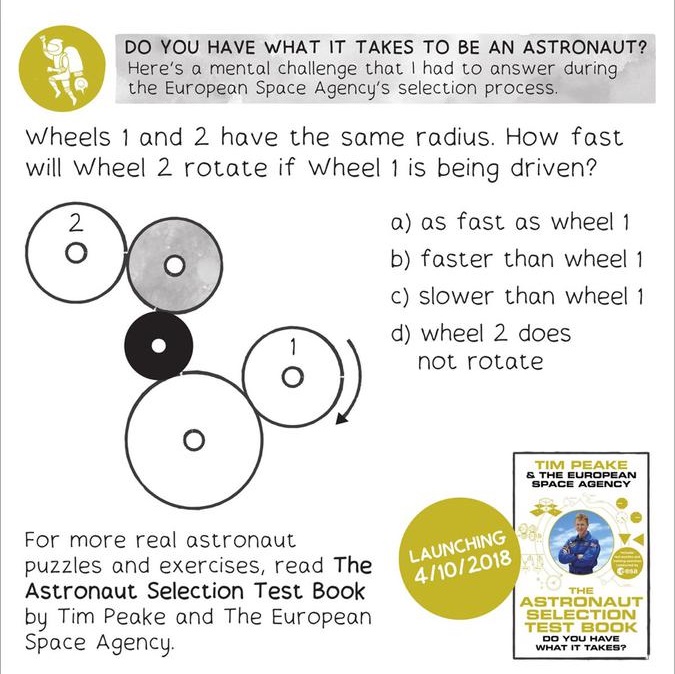
Yes, puzzles are part of the screening process for the ESA.

Would you like to try your hand at solving some of them?

How did you do? Let us know in the comments section below! We’d love to hear from you

And if you’d like, you can find more of these puzzles in Peake’s delightful book The Astronaut Selection Test Book: Do You Have What it Takes for Space?

Do you have what it takes? I suspect that you do, fellow puzzler.


Thanks for visiting PuzzleNation Blog today! Be sure to sign up for our newsletter to stay up-to-date on everything PuzzleNation!

You can also share your pictures with us on Instagram, friend us on Facebook, check us out on TwitterPinterest, and Tumblr, and explore the always-expanding library of PuzzleNation apps and games on our website!
Puzzle History: Codebreaking and the NSA, part 3

[Image courtesy of NSA’s official Twitter account.]

At the end of part 2 in our series, we left off during the early days of the NSA, as American cryptographers continued to labor under the shadow of the Black Friday change in Russian codes.

You may have noticed that part 2 got a little farther from puzzly topics than part 1, and there’s a reason for that. As the NSA evolved and grew, codebreaking was downplayed in favor of data acquisition. The reasons for this were twofold:

1. Context. You need to understand why given encrypted information is important in order to put it toward the best possible use. As Budiansky stated in part 1, “The top translators at Bletchley were intelligence officers first, who sifted myriad pieces to
assemble an insightful whole.”

2. Russian surveillance and bugging continued to grow more clever and sophisticated, pushing attention away from codebreaking. After all, what good is breaking codes or developing new ones if they can just steal unencrypted intel firsthand by monitoring
agents in the field?

Moving forward, the NSA would continue to pursue all manner of data mining, eventually leaving behind much of the codebreaking and analysis that originally formed the backbone of the organization. But that was in years to come. Cryptography was still a major player in NSA operations from the ’50s and onward.

[The progression of “secret” and “top secret” code words.
Image courtesy of NSA’s official Twitter account.]

In May 1956, NSA cryptanalytic veterans pushed a proposal titled “Recommendations for a Full-Scale Attack on the Russian High-Level Systems,” believing that specially designed computers from IBM could provide the key for cracking the impenetrable Russian cryptography wall. Some cryptographers believed that ever-increasing processor speeds would eventually outpace even sophisticated codes.

By 1960, the NSA had spent $100 million on computers and analytical tools.

The problem? The NSA was collecting so much information that their increasingly small team of cryptoanalysts couldn’t dream of processing even a tiny portion of it.

But the quest for data access would only grow more ambitious.

In the wake of Sputnik’s launch in October of 1957, US signals intelligence would go where no man had gone before. The satellite GRAB, launched alongside Transit II-A in June of 1960, was supposedly meant to study cosmic radiation. (GRAB stood for Galactic Radiation and Background.)

[Image courtesy of NSA’s official Twitter account.]

But it was actually intended to collect radar signals from two Soviet air-defense systems. This was the next step of ELINT, electronic intelligence work. (The younger brother of SIGINT.)

The NSA would later find a huge supporter in President Lyndon Johnson, as the president was heavily invested in SIGINT, ELINT, and any other INTs he could access. This did little to quell the intelligence-gathering rivalry growing between the CIA and NSA.

Of course, that’s not to say that the NSA ceased to do any worthwhile work in codebreaking. Far from it, actually.

During the Vietnam War, NSA analysts pored over North Vietnamese signals, trying to uncover how enemy pilots managed to scramble and respond so quickly to many of the US’s airstrikes conducted during Operation Rolling Thunder.

Careful analysis revealed an aberrant character (in Morse code) in messages that appeared in North Vietnamese transmissions before 90 percent of the Rolling Thunder airstrikes. By identifying when the enemy used that aberrant character, the analysts
were able to warn US pilots whether they were heading toward a prepared enemy or an unsuspecting one during a given sortie.

Other NSA teams worked to protect US communications by playing the role of an enemy analyst. They would try to break US message encryptions and see how much they could learn from intercepted US signals. Identifying flaws in their own procedures — as well as members of the military who were cutting corners when it came to secured communications — helped to make US communications more secure.

[Image courtesy of NSA.gov.]

In 1979, Jack Gurin, the NSA’s Chief of Language Research, wrote an article in the NSA’s in-house publication Cryptolog, entitled “Let’s Not Forget Our Cryptologic Mission.” He believed much of the work done at the agency, and many of the people
hired, had strayed from the organization’s core mission.

The continued push for data acquisition over codebreaking analysis in the NSA led to other organizations picking up the slack. The FBI used (and continues to use) codebreakers and forensic accountants when dealing with encrypted logs from criminal organizations covering up money laundering, embezzlement, and other illegal activities.

And groups outside the government also made impressive gains in the field of encryption, among them IBM’s Thomas J. Watson Research Center, the Center for International Security and Arms Control, and even graduate student programs at universities like MIT and Stanford.

For instance, cryptographer Whitfield Diffie developed the concept of the asymmetric cipher. Joichi Ito explains it well in Whiplash:

Unlike any previously known code, asymmetric ciphers do not require the sender and receiver to have the same key. Instead, the sender (Alice) gives her public key to Bob, and Bob uses it to encrypt a message to Alice. She decrypts it using her private key. It no longer matters if Eve (who’s eavesdropping on their conversation) also has Alice’s public key, because the only thing she’ll be able to do with it is encrypt a message that only Alice can read.

This would lead to a team at MIT developing RSA, a technique that implemented Diffie’s asymmetric cipher concept. (It’s worth noting that RSA encryption is still used to this day.)

[Image courtesy of Campus Safety Magazine.com.]

The last big sea change in encryption came when the government and military realized they no longer had a monopoly on codebreaking technology. Increased reliance and awareness of the importance of computer programming, greater access to computers with impressive processing power, and a groundswell of support for privacy from prying government eyes, led to dual arms races: encryption and acquisition.

And this brings us to the modern day. The revelations wrought by Edward Snowden’s leak of NSA information revealed the incredible depth of government data mining and acquistion, leading some pundits to claim that the NSA is “the only part of government that actually listens.”

Whatever your feelings on Snowden’s actions or government surveillance, there is no doubt that the National Security Agency has grown and changed a great deal since the days of cracking the ENIGMA code or working with the crew at Bletchley Park.

Where will American codebreaking go next? Who knows? Perhaps quantum computing will bring codes so complicated they’ll be impenetrable.

All I know is… it’s part of puzzle history.


I hope you enjoyed this multi-part series on the history of 20th-century codebreaking in America. If you’d like to learn more, you can check out some of the valuable sources I consulted while working on these posts:

Code Warriors: NSA’s Codebreakers and the Secret Intelligence War Against the Soviet Union by Stephen Budiansky

Whiplash: How to Survive Our Faster Future by Joichi Ito

The Secret Lives of Codebreakers by Sinclair McKay


Thanks for visiting PuzzleNation Blog today! Be sure to sign up for our newsletter to stay up-to-date on everything PuzzleNation!

You can also share your pictures with us on Instagram, friend us on Facebook, check us out on TwitterPinterest, and Tumblr, and explore the always-expanding library of PuzzleNation apps and games on our website!