Stranger Things has come to its epic conclusion (planned follow-up shows aside), and it has absolutely made an impact on pop culture.
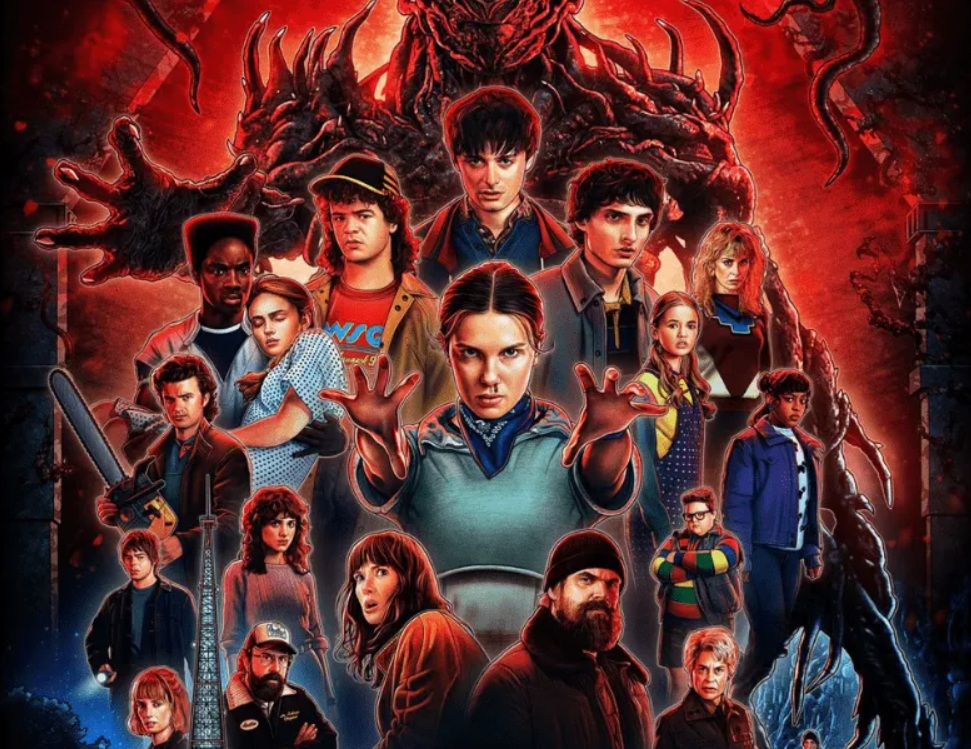
Part of the show’s lasting legacy is introducing people to roleplaying games, specifically Dungeons & Dragons. Yes, shows like Freaks and Geeks and Community got there first, not to mention the sitcom juggernaut The Big Bang Theory, but I don’t know that any of them made the experience as accessible to new viewers as Stranger Things did.
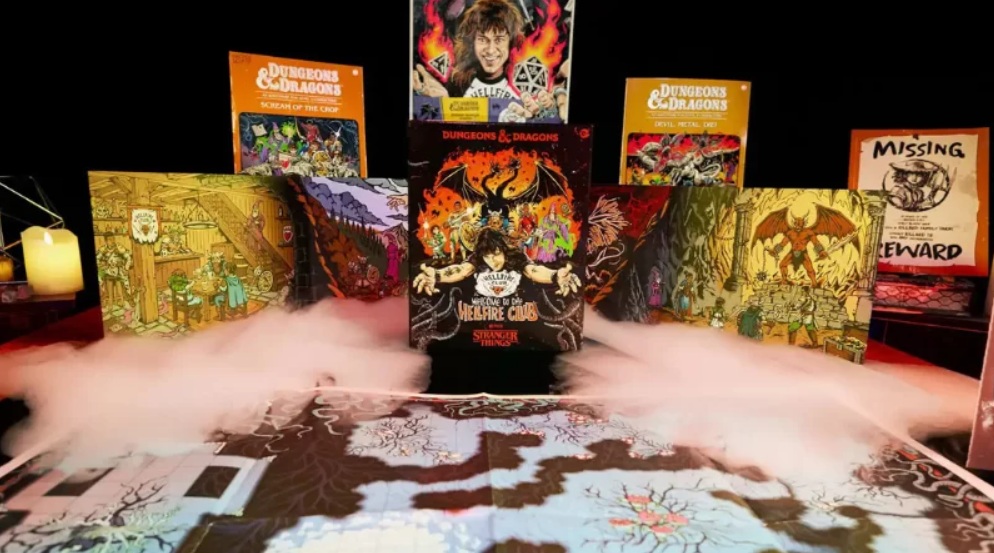
Heck, there’s been two different Stranger Things/D&D starter packs to bring those new players into the fold!
And it got me thinking about D&D moments in movies and television shows.
Not moments that mention D&D or its lore or show gameplay or anything like that. I mean moments that FEEL like someone playing D&D.
There are certain moments in pop culture that feel like a D&D solution to a problem, as if this exact scenario appeared in a D&D game and this was the solution devised by the players.
It’s hard to define exactly what makes a scene in TV or cinema FEEL like a D&D moment. Sure, you can pick any buckwild action movie like Crank or Shoot ‘Em Up or Hardcore Henry or Mad Max: Fury Road, but for all the big setpieces and chaotic energy in those films, they don’t necessarily FEEL like a D&D game.
But these scenes definitely do.
It’s only natural to start with a scene from Stranger Things. In season 4, the heroes infiltrate the Upside Down to stop Vecna and try to rescue Max, but they need a distraction.
So, naturally, Eddie performs a wicked guitar solo and blasts metal music to distract the bat creatures and help Steve, Robin, and Nancy get closer.
This feels like such a D&D move for a bard to do, performing a badass yet ridiculously out-of-place musical number in order to help the party.
In the dead zone between the films Pitch Black and 2013’s Riddick, there was the film Chronicles of Riddick, detailing Vin Diesel’s antihero adventures after the events of Pitch Black.
In the film, we’re told this prison planet is so scorchingly hot that it’s uninhabitable, and you’re surely die within moments.
So naturally Vin Diesel’s character dumps a bottle of water over his back and swings into a canyon through the direct sunlight, and the water saves him. It feels like such a D&D player solution to the problem.
Viewer warning: language.
A ridiculous big-swing attack is also a D&D hallmark, so there’s a scene from The Boondock Saints that comes to mind.
In this film, two brothers become vigilantes and begin hunting down criminals. When several mobsters show up after the brothers got the better of them in a bar fight, Connor is handcuffed to a toilet while the thugs drag off Murphy.
So, as you might expect, Connor rips the toilet out of the floor, then carries it to the rooftop, dropping the toilet and then leaping, still handcuffed, onto the thugs, saving his brother.
There has never ever been a game of D&D without at least one player throwing themselves off a high thing and leaping onto the bad guys, gravity be damned. It’s a classic trope.
I reached out to several of my fellow roleplayers for suggestions of other scenes that feel like D&D, and they had two excellent recommendations.
The first is this hilarious sequence from Three Amigos!, where our heroes (?) meet the Singing Bush and encounter the Invisible Swordsman.
It goes so perfectly wrong, and every player has seen a quest go pear-shaped in similar fashion.
There are a lot of scenes from Galaxy Quest that could fit the bill, given that you have a bunch of actors pretending they’re characters from a Star Trek-like sci-fi show.
My friend Troy recommended the scene where Commander Taggart and Dr. Lazarus pretend they’re fighting (like their characters did in an episode) in order to distract the guards and ambush them. They do an awful job, but the ruse still succeeds.
But I think my favorite is the rock monster scene shown above. The panic, the fumbling around for a solution… it’s all so D&D.
So, fellow players, do you have any favorite scenes from film and TV that FEEL like D&D play, either in execution or silliness? Let us know in the comments section below. We’d love to hear from you!
Timing is a fascinating thing. You never know what will suddenly become relevant again, or how something from the past will reemerge with new context and impact later.
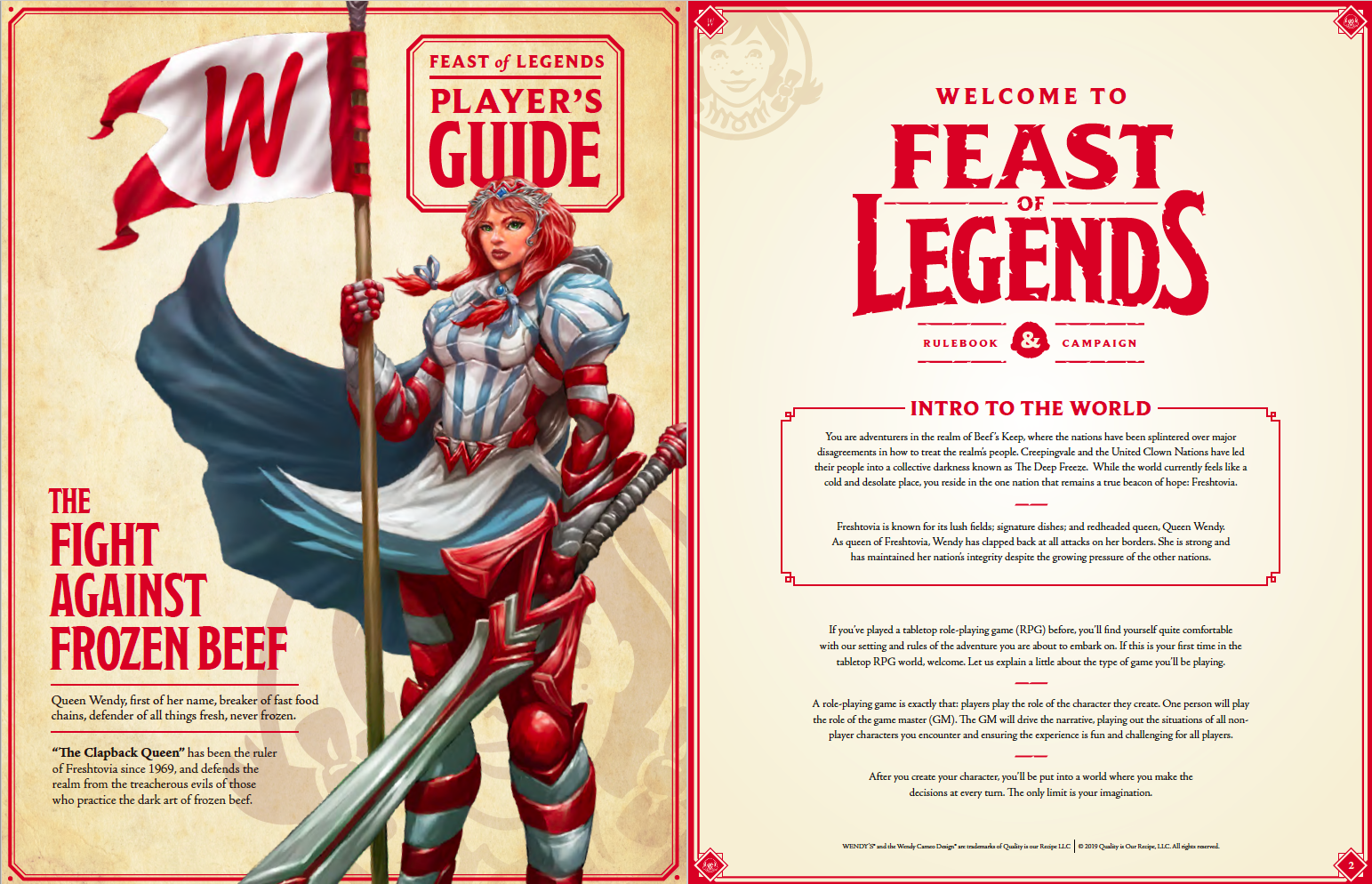
Now, Feast of Legends made a big splash in 2019, but it’s fair to say that six years later, it’s not as relevant in RPG circles as it once was.
However, it’s funny that I wrote about it just a few weeks ago, and now it seems like Burger King is suddenly getting in on the roleplaying game scene!
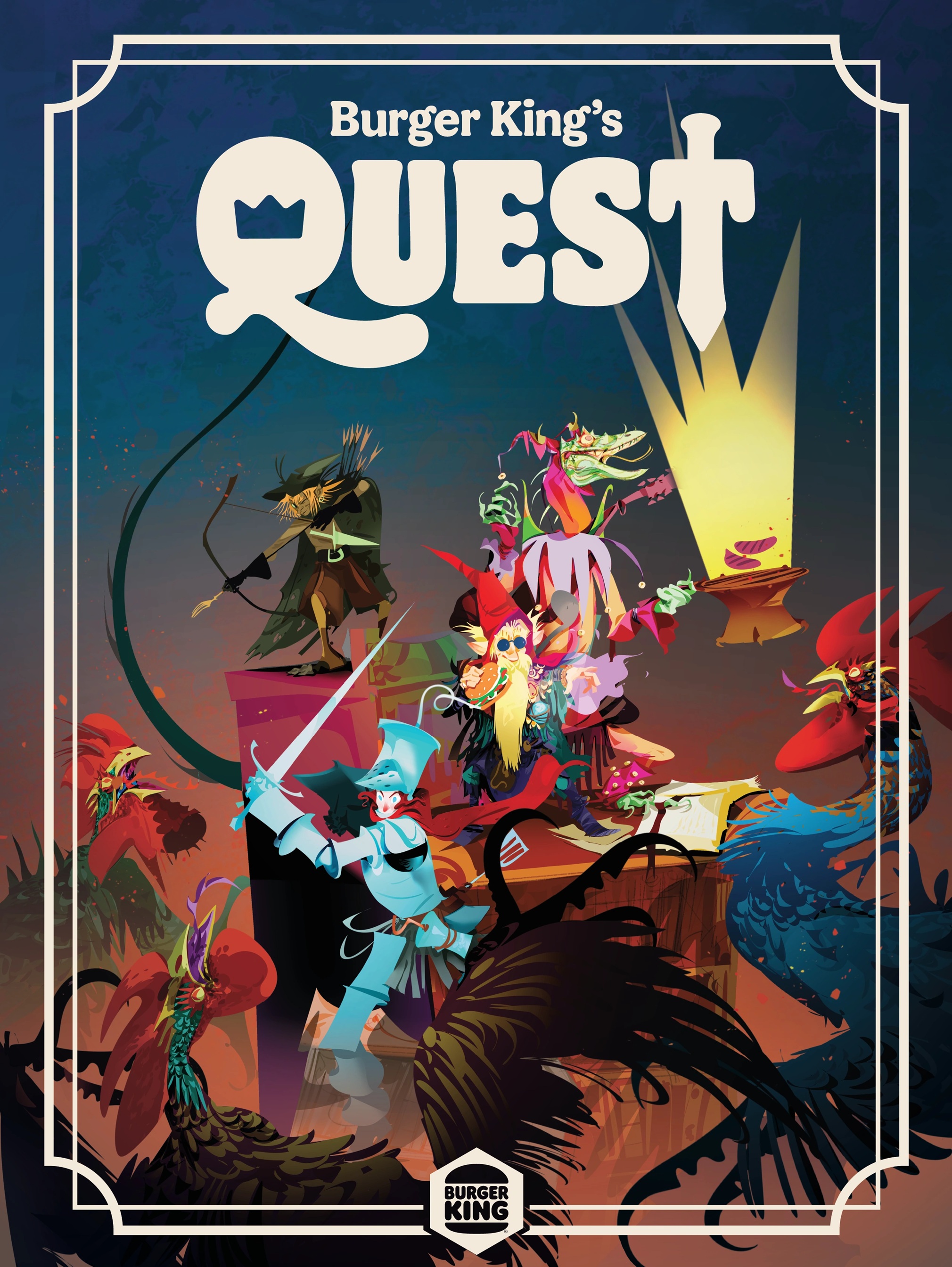
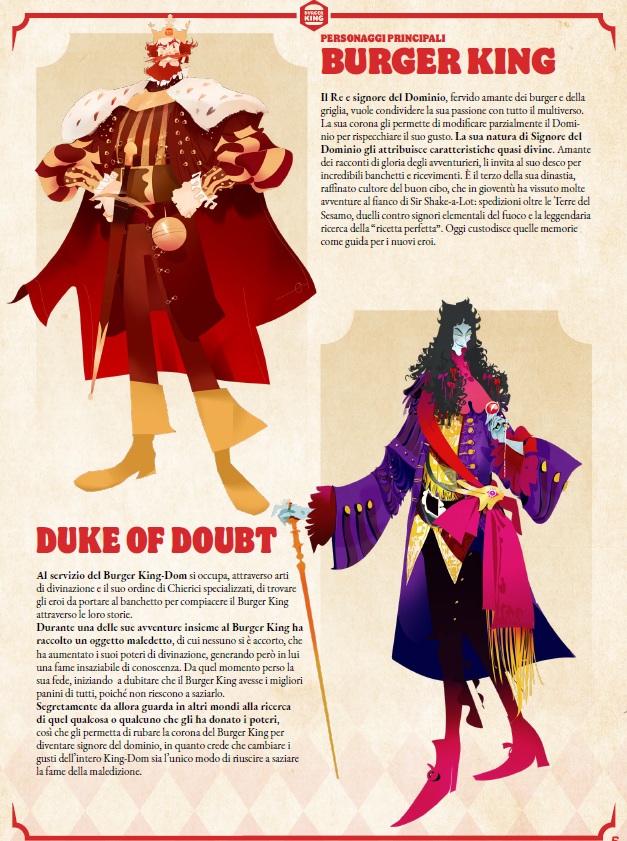
Yes, Burger King’s Quest is a playable supplement for Dungeons & Dragons, featuring the Burger King Kingdom as its setting, and resurrecting several characters from Burger King’s promotional efforts in the 1970s and 1980s to counter McDonalds’ McDonaldland and its characters.
You definitely know the Burger King, but do you remember Sir Shake-A-Lot, the Duke of Doubt, or The Wizard of Fries? I sure don’t! (Who knew that The Home of the Whopper was a real place, not just a slogan?!)
Well they’re getting new life in this RPG supplement, which was unveiled at Lucca Comics & Games as part of Milan Games Week.
Right now, the game is only in Italian, so we’re not sure if English-speaking roleplayers will get their own version in the future. But thankfully the hardworking crew at the Burger King WIKI have some details on the game for non-Italian readers.
I don’t speak Italian, but I did download the game’s PDF, naturally. The art is beautiful, and clearly a lot of work went into this promotional stunt.
But you can already see a rivalry brewing with the Feast of Legends loyalists in the RPG community. (After all, I only found out about Burger King’s Quest BECAUSE of the Feast of Legends subreddit!)
I reached out to the Burger King Public Relations team to try to learn more about the promotion and any plans for it to expand beyond Italy, but I haven’t heard back yet.
So, for now at least, this remains a roleplaying curiosity. But who knows what the future holds. Wendy’s, Arby’s, and now Burger King. The fast food/roleplaying crossover space is certainly heating up!
Every 85 cents donated means 1 meal given to someone in need. A $40 donation is FIFTY meals.
Tabletop game designers from all over the world are helping amplify the reach of this project, spreading the word across social media and contributing to a special gift for donors.
And there is a bonus for any RPG enthusiasts who donate:
Everyone who donates to this campaign can receive a free PDF bundle including an epic one-shot adventure and a new playable species for Pathfinder and Dungeons & Dragons, letting you and those you love play the heroes in your games that you are in real life. You are saving real lives while forging bonds and memories across the game table.
Please click this link for more information, and if you’re an RPG fan, just use your email to sign up for alerts, follow the instructions, and share the PDF receipt of your donation to receive your free PDF bundle.
And for those unfamiliar with the world of tabletop RPGs, you might be wondering about the origins of the name Power Word Meal.
There are a series of spells in Dungeons & Dragons based on the idea that you’ve learned a word of power, and that by speaking that single word, you can cause a magical effect. Power Word Stun, Power Word Blind, and most famously, Power Word Kill, are terribly dangerous, terribly effective spells.
Which makes it genuinely lovely to see that idea turned on its head with Power Word Meal, spreading the idea that we DO have the power to help others. Not with a magic word of eldritch might, but with a few clicks, a few screen taps, a few dollars, a few moments of our time.
So please cast Power Word Meal with us and make the lives of some deserving strangers better.
We love a bit of wordplay around here. We get it in riddles, crossword clues, brain teasers, and the simple shameless joy of a well-executed pun.
I’m sure plenty of roleplaying game enthusiasts have encountered puns and wordplay in their travels. Sometimes it’s a funny reference or an offhand remark or even a character’s name that inspires groans or chuckles.
But some folks are unaware that there are puns lurking not just at the D&D table… but in the very mechanics of the game Dungeons & Dragons itself.
One of the interesting aspects of spellcasting in D&D is the inclusion of spell components. These are actual physical materials the character must carry on them and use in order to properly perform a given spell. When combined with verbal cues or physical actions, the material components help the spellcaster summon the magic to life.
Some material components are quite thematically appropriate. You need bat guano and sulfur — two ingredients in gunpowder — to produce Fireball. To cast Lightning Bolt requires either a glass rod or a piece of amber, plus a piece of fur to rub it with… just as you would in a science lab to make static electricity.
A pinch of sand for Sleep, a drop of molasses for Slow, a bit of copper wire for Message.
Looks like another tragic instance of out-sorcery…
But if you look at the material components used for some spells, you can’t help but notice a jokey recurring theme.
For instance, the material component for the spell Detect Thoughts is a copper piece, a coin of small denomination. The spell literally requires a penny for one’s thoughts.
To cast Confusion, it requires three nutshells. You know, like the ones you’d use in a shell game to make them lose track of the pea they’d just bet on.
All sorts of illusion spells require a bit of fleece or wool. Like the wool you pull over someone’s eyes.
To cast Feeblemind, you need a handful of clay, crystal, or glass spheres. Like the marbles you want your target to lose.
Levitate has several options, but one of them is a simple loop of leather. Like the bootstraps you’re expected to pull yourself up by. (Reinforcing the original meaning of that phrase by proving IT’S TOTAL FANTASY TO ACTUALLY DO SO.)
To cast Tongues, you have to smash a small clay tower or ziggurat. You need to symbolically smash the Tower of Babel.
Passwall requires sesame seeds. Open Sesame, anyone?
Rary’s Mnemonic Enhancer gives you the ability to retain additional spells. Its material component is an ivory plaque… because elephants never forget!
Perhaps the silliest is Gust of Wind. It was later changed to require a “tiny leather bellows,” but in different editions of the game, all it requires is a legume seed.
A bean. A bean to give you wind.
I told you earlier that many puns are shameless.
Still, it’s fun to find these little easter eggs tucked away in the D&D rulebook. It shows the playfulness and the level of attention to detail that helps make roleplaying games an immersive escape like none other.
Have you found any wordplay lurking unexpectedly in your games, fellow puzzler? Let me know in the comments section below, I’d love to hear from you!
I’ve always been a sucker for a story where puzzlers help make someone’s life better, their world a little bit more magical. I’ve had the privilege of constructing and facilitating several puzzly marriage proposals, for instance.
I asked someone out using a riddle, and they responded with another one, but now I can’t solve it. We both dm at our local game store, and we’re running games tomorrow, I need a quick solution. I don’t need someone to give me the answer, but can someone please help walk me through how to solve this?
First off, that’s very cute.
Secondly, my dude, they responded to a riddle with your riddle. That’s a yes, my friend! Congrats.
As you might expect, his fellow riddle fans and puzzle fiends quickly explained how to find the solution, hoping that this marvelous exchange of riddles leads to more! Everyone loves a meet-cute, especially a puzzly one!
But what about you, fellow solver? Could you crack it?
I’ll give you a bit of space before I reveal how to solve it.
.
..
…
….
…..
……
…….
……
…..
….
…
..
.
Ready? Okay, let’s get to the riddle itself.
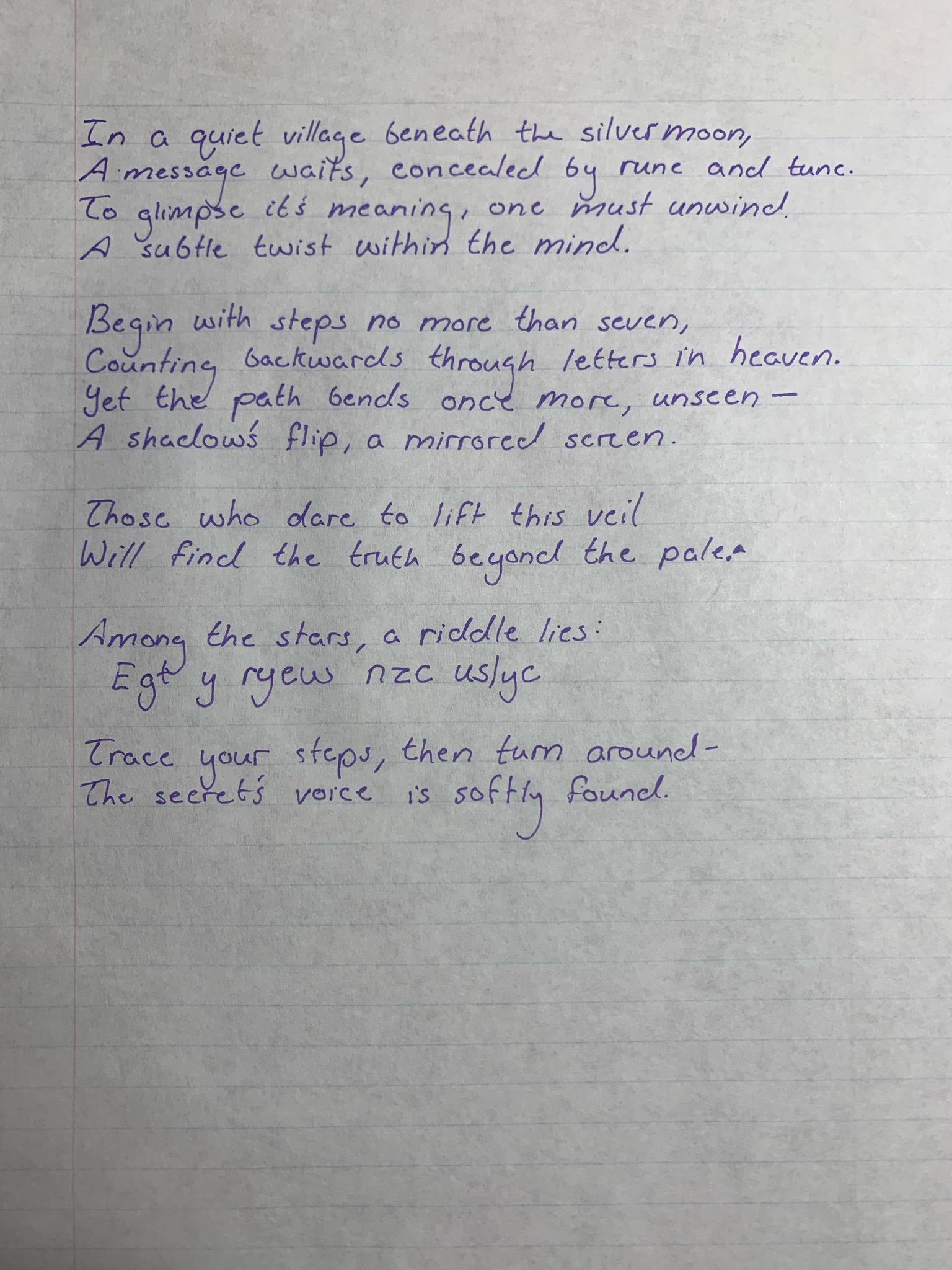
Egt y ryew nzc uslyc
This is clearly a single substitution cipher, also known as a simple substitution cipher, where each letter represented by another.
You could tackle this in a brute force way, treating it like a cryptogram. We know that “y” is going to be A or I. The most common three-letter word is “the”, which is a good place to start. At the very least, we can probably assume that “c” is the letter E, since it’s at the end of several words.
But the poem tells us how to solve it.
Start with the “letters in heaven,” your alphabet.
ABCDEFGHIJKLMNOPQRSTUVWXYZ
We get references to a mirrored screen or a shadow’s flip, so let’s try the alphabet backwards and placed underneath.
We’re told to count backwards with steps no more than seven.
So let’s take the first letter in our secret message, E. Counting backwards (and wrapping around the alphabet again), that brings us to X. And in the mirror of X, we have C.
Continuing, seven letters back from G is Z, and in the mirror, A. Seven letters back from T is M, and in the mirror, N.
Egt Y ryew nzc uslyc CAN
Continue for all the letters, and you get your answer written in the stars (presumably replying to his riddle):
Can I pick the movie?
Here’s hoping we get some updates in the future (or more riddles) from this pair of dice-rolling riddle-crafting delights.
And let’s offer one more huzzah for the anonymous puzzlers who helped crack the code!
There have been some huge announcements in the actual play / live play space on YouTube, Twitch, and elsewhere, and it has huge ramifications for the RPG industry in general.
(If you’re unfamiliar with roleplaying games, I’ll have a brief glossary at the bottom of the post explaining the bolded terms in today’s post. Let me know if I should add more, or create a separate RPG glossary page to link to!)
So not only are industry icons Jeremy Crawford and Chris Perkins working on material for Daggerheart, but it was announced that Keith Baker is creating a new setting for Daggerheart!
(This video by Todd Kenreck — another popular public face for D&D, and another recent loss for WOTC after they unceremoniously fired him — details all the exciting new developments for Daggerheart.)
Most RPG games have core rulebooks that explain the game mechanics (why and how and when to roll dice) and a system for building characters to play, but it takes an exciting, immersive setting to help build a fanbase of players that want to return to the game again and again.
Keith Baker created Eberron, one of the most popular D&D settings ever, so his contributions are a big plus for the burgeoning Daggerheart gameplay space.
Darrington Press are making smart moves to position Daggerheart as a genuine challenger for the tabletop RPG market’s top spot, one that D&D has been losing its stranglehold on after years of unpopular business and creative choices.
But that’s not the only industry-shaking news being made by the Critical Role / Darrington Press camp.
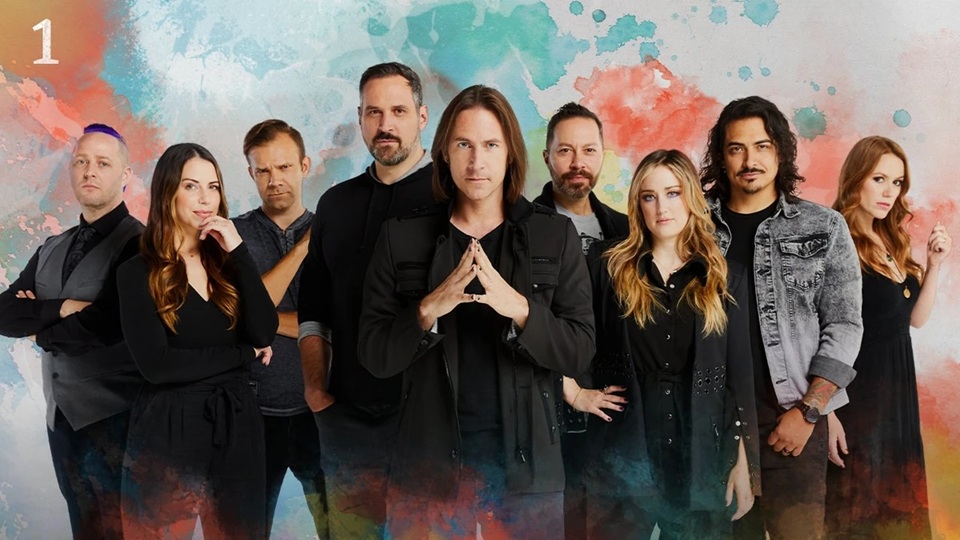
They recently announced during one of their live shows that their upcoming fourth campaign — a years-long storytelling endeavor hotly anticipated by their fans — will have a new game master. For a decade now, Matt Mercer has told three epic-length stories with the Critical Role cast, all set in his homebrew setting of Exandria.
But for Campaign 4, there will be a new setting, new characters, and a new GM.
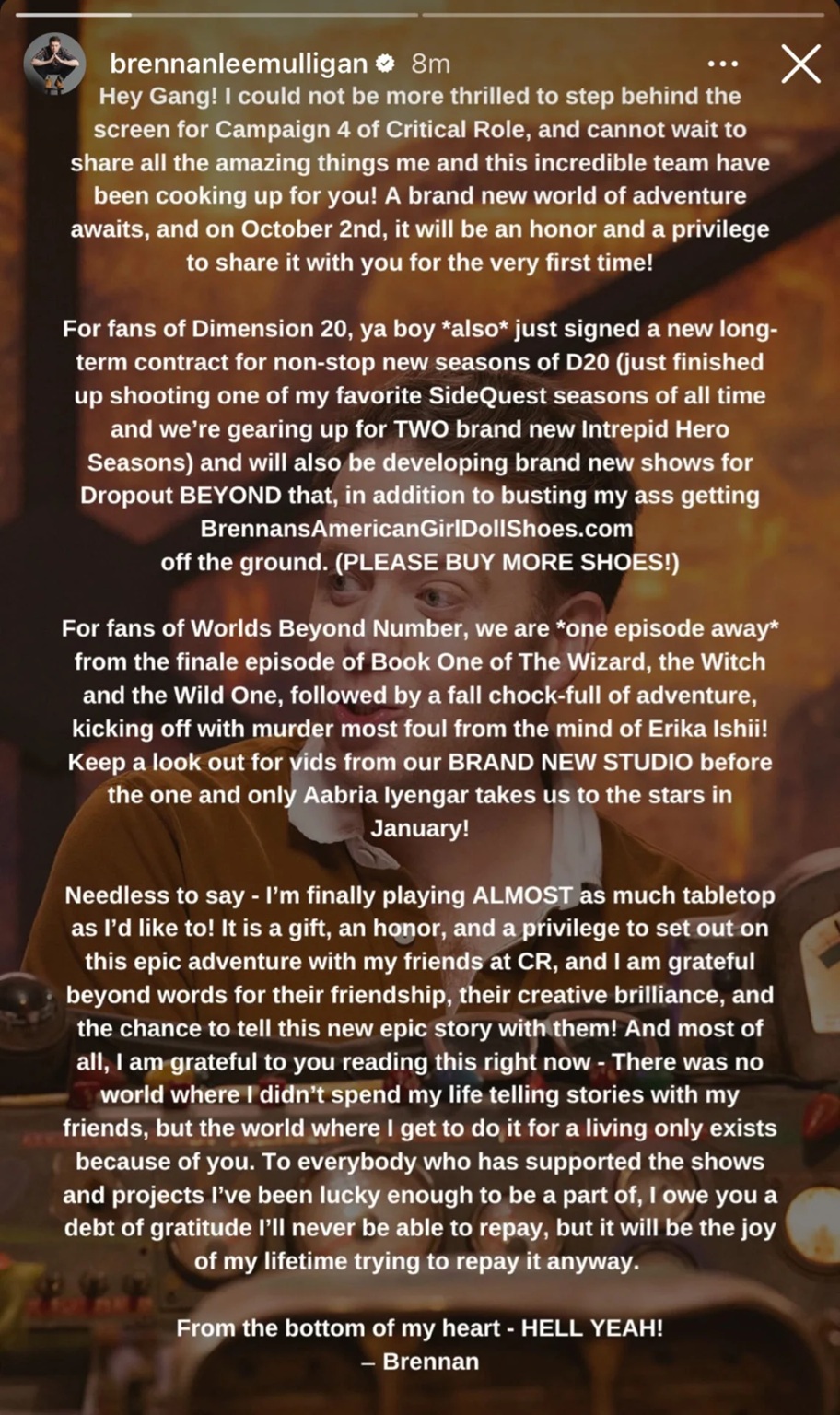
Brennan Lee Mulligan will be shepherding the Critical Role crew through Campaign 4, and Matt Mercer will finally get to step out from behind the GM screen and play a long-term PC on his own show.
Now, Brennan Lee Mulligan is a popular name in the liveplay TTRPG world. He GMs for Dropout’s Dimension 20 series, as well as running the wonderful audio-only RPG podcast Worlds Beyond Number, which will be wrapping up their flagship campaign “The Wizard, The Witch, and The Wild One” very soon.
Despite signing on for a potentially years-long storytelling adventure with the Critical Role team, Brennan claims that his GM work at Dropout will NOT be slowing down.
I envy him both his energy and his creative output.
As for all of this potentially industry-altering RPG news…
I have some thoughts.
1. Yay Keith Baker!
Keith Baker is absolutely one of my favorite creators in the world of games and RPGs. Eberron is a wonderful game setting that he continues to add to and enhance with blog posts and worldbuilding through his Patreon. (He also created one of my all-time favorite card games, Gloom.) He’s brilliant and I cannot wait to see what he creates for Darrington Press.
(This is not meant to downplay the good work being done at Darrington Press already OR to ignore the forthcoming creative contributions from Chris Perkins and Jeremy Crawford. I’m excited to see what they have in store as well.)
2. Wizards of the Coast/Hasbro seriously needs to watch out.
While they have been making money-first decisions for years and burning decades of good will with the players (the OGL scandal, the Spelljammer cultural insensitivity kerfuffle, sending actual Pinkertons after someone for leaking Magic: The Gathering details), Darrington Press has been quietly building and expanding their efforts.
They’re actively seeking out new game ideas and systems to diversify what they can offer their audience. They’ve got in-house D&D alums with DECADES of experience, and they’re collaborating with other prominent names in the RPG world (as well as the crew from the popular D&D podcast Tales of the Stinky Dragon).
While D&D keeps stumbling, Darrington Press is rolling. The next year or so is going to tell us a lot about the future of the industry.
3. I’m stoked for Matt Mercer.
He’s been running Critical Role’s game for over ten years, creating a world not just for his friends and fellow players, but for an audience of tens or hundreds of thousands of viewers. That’s daunting, even when you do love GMing (as Matt clearly does).
But the chance to set that aside, recharge your creative batteries, and play instead of run? I hope Matt gets to really spread his storytelling wings in a different way and enjoy Campaign Four.
4. A new setting, a new Game Master, and a reshuffling of players could breathe new life into Critical Role.
Their third campaign was divisive, and I think a clean break could not only offer some excellent roleplay and storytelling opportunities, but it could help the audience MISS the setting of Exandria for a while. Absence makes the heart grow fonder, and this might just be what both the audience and the cast and crew of Critical Role need to continue telling hilarious, engrossing, emotionally-affecting stories around the table with some dice. Here’s hoping.
5. Brennan Lee Mulligan is an absolute madman.
I mean, I get it; at one point, I was running four weekly games AND playing in a fifth. I once roleplayed eight days in a row, and my week feels weird if there’s only one game that happens. Gods forbid there’s a week with NO games. It’s a hobby, a release, and it brings me joy.
But still, he’s putting a lot on his plate. Someone on social media referred to him as “the world’s most employed man,” and it’s hard to disagree.
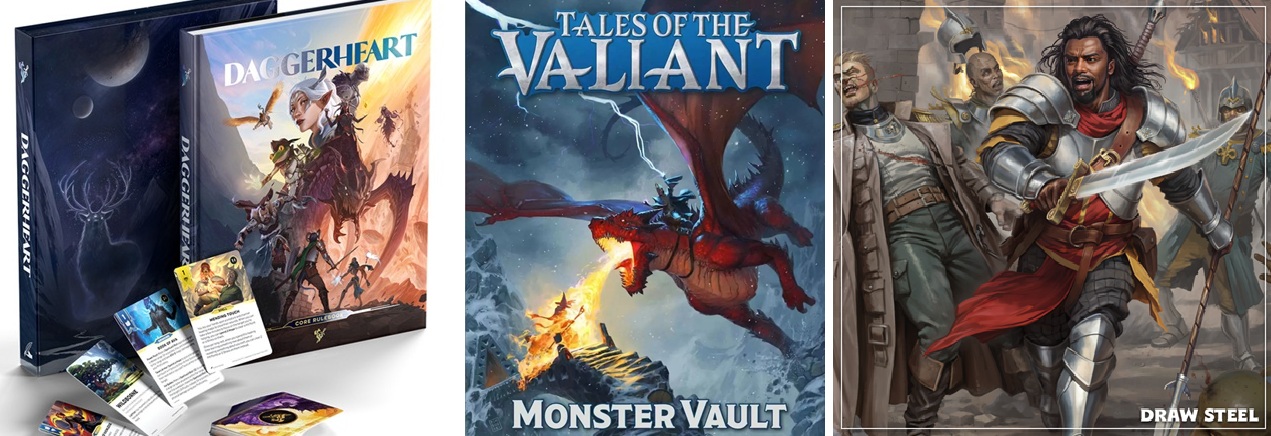
6. With all the talk about D&D and Daggerheart, it’s a little bit of a bummer that I’m not hearing more about Matt Coville’s Draw Steel and Kobold Press’s Tales of the Valiant.
When the OGL Scandal exploded a few years ago, they were among the three games constantly touted as a rising competitor to D&D (Daggerheart was the third). But it feels like Daggerheart is taking up a lot of the oxygen in the room these days, so I hope that Draw Steel and Tales of the Valiant can also carve themselves out a nice chunk of the market space D&D is ceding.
The live play TTRPG space is vast, and there are so many great live plays to choose from, big and small. (Maybe I should do a future post about my favorites!)
It’s certainly going to be interesting to see if Daggerheart live plays begin to gain traction on YouTube and Twitch, and D&D live plays fall out of favor over the next few years. (With the company’s new franchise business model focusing on monetizing the brand over relying on D&D gameplay and sourcebooks as a lure, they might’ve already unconsciously ceded some territory online to their competitors.)
And speaking of competition, a lot of people view Dimension 20 and Critical Role as competitors. Sure, any companies that operate in the same space are in competition somewhat, but I prefer to think of them as siblings scrambling for slices of the same fresh-baked pie. No one is cutting throats over pie, after all.
In the end, I just want people to be excited to sit around a table (either a real one or a virtual one) and play roleplaying games with their pals. If any of these big changes, collaborations, or endeavors mean we get more players trying RPGs, then I’m calling it a win.
How do you feel about all of this RPG live play hullabaloo, fellow dice-rollers? Let me know in the comments section below! I’d love to hear from you.
…
…
…
…
…
…
…
Brief RPG Glossary!
Campaign: Shorthand for all of the creative work that goes into running a D&D game for any length of time. The campaign is the mix of your choice of game, the players, the setting, and the story you all tell together. Campaigns can be as short as a few sessions or run as long as decades, all depending on player interest, scheduling, and enthusiasm for the game. For comparison, Dimension 20’s live play campaigns range from 4 sessions to multiple chapters with 10-20 sessions per season.
Session: A single instance of gameplay. If you play a game four times in the same story in the same world as a continuing narrative, you’ve had four sessions of gameplay.
Players & Player Characters / PCs: Those who play the game. They create a character that explores the world, interacting with the other players as well as NPCs performed by the DM
Non-Player Characters / NPCs: Characters played by the DM/GM. Everyone the players interact with in the game, friend or foe.
DM / GM / Dungeonmaster / Game Master / Storyteller: the person who runs the game. They describe what the players see and experience, they play all of the characters the players interact with, and they explain the consequences and results of all the dice rolls the players make. They create villains to fight, conflicts to be solved, and provide every voice, sound, and piece of description the players encounter. A good description for the GM is “everyone and everything else.” (Thanks to the audio-only D&D podcast Worlds Beyond Number for that perfectly concise phrasing.)
Setting: The world where the story and the game’s events take place, described to the players by the GM. Some settings are created especially for a given RPG (and can have dozens of sourcebooks dedicated to them), but many GMs create their own settings (which are known as “homebrew” settings). An intriguing and exciting setting can be crucial to helping an RPG attract and retain an audience of players.
Actual play / live play: Dungeons & Dragons or other RPGs played live on YouTube, Twitch, or other online video services. Some are run/played by professional actors or comedians (Critical Role, Dimension 20), others by enthusiastic players outside the entertainment sphere. Production values can vary, and some are audio only. But there’s a whole world of them out there to explore.




 PuzzCulture