It’s Follow-Up Friday: Hashtag Hilarity edition!

Welcome to Follow-Up Friday!

By this time, you know the drill. Follow-Up Friday is a chance for us to revisit the subjects of previous posts and bring the PuzzleNation audience up to speed on all things puzzly.

And today, I’m posting the results of our #PennyDellPuzzleComedy hashtag game!

You may be familiar with the board game Schmovie, hashtag games on Twitter, or@midnight’s Hashtag Wars segment on Comedy Central.

For the last few months, we’ve been collaborating on puzzle-themed hashtag games with our pals at Penny Dell Puzzles, and this month’s hook was #PennyDellPuzzleComedy, mashing up Penny Dell puzzles and anything and everything having to do with stand-up comics, film and television comedians, funny movies, funny shows, funny plays… even one-liners or jokes!

Examples include: David Letterboxesman, The Three Anagr-amigos, or “Take a Letter, Please!”

So, without further ado, check out what the puzzlers at PuzzleNation and Penny Dell Puzzles came up with!


Puzzle Comedians!

Rodney Danger-Textfields

George Carlinkwords

“Weird Al”-phagrid Yankovic

Dr. Dementossing and Turning

Fill-In Diller / Phyll-Ins Diller

Kenken Jeong

David Cross Pairs

Lewis Blackout!

Andrew Dice Game

Cryptomedian Adam Scrambler

Rows-anne Garden

Alphabet Soupy Sales

Dan Ayk-wordplay

Gilda-Quote Radner

Rose-anagrams Rose-anagrams Dannagrams


Puzzle Comedy Films!

History of the World, Part One and Only

Happy Fill-in More!

Meet the Frameworks

You Don’t Maze with the Zohan

Austin Flower Powers

April Sillycrostics!

Four Square Weddings and a Funeral

Three from Nine to Five

Roxanne-agrams

Across and Down and Out in Beverly Hills

Alphabet Duck Soup

Animal Crackers House


Puzzle Comedy TV Shows!

A Bits and Pieces of Fry and Laurie

Two for One and a Half Men

Rowan and Martin’s Fill-In

Three of a Kind’s Company

“I Love Loosey Tiles!”

Saturday Night Line ‘Em Up

Sanford and Sunrays

All in the Family Ties

Happy Daisy

Leave It to Weaver Words

The Odds and Evens Couple

[Plus there were a few Seinfeld references in puzzly form:]

“By the way, they’re real, and they’re Sudoku Spectacular!”

“The Bubbles Boy”


Puzzle Jokes and Routines!

“Who’s on first and last?” / “Who’s Calling on first! What’s Left on second!”

Knock, Knock! Who’s Calling?

Why did the chicken cross the Middle of the Road? To get to the other Slide-o-gram!

“Nehh…What’s Left, Doc?”

How do you send a message to a skeleton? By Crypt-O-Gram!

What do you get when you insult a puzzle editor’s work? Cross words!

Have you heard about the most amazing Framework ever constructed? It was a Revelation!

Knock-knock.
Who’s there?
Guess
Guess Who?
Hey, that’s my favorite puzzle!

Knock-knock
Who’s there?
Lotto
Lotto who?
I bet there’s a lotto people entering this hashtag game!

Knock-knock
Who’s there?
The Wizard
The Wizard who?
The Wizard is wise and humorous. Didn’t you read the blurb?

Knock-knock
Who’s there?
Zip It
Zip It who?
Zip it, you! I’ve had enough of your knock-knock jokes


And the PuzzleNation audience got involved as well! @_screenhog tweeted the excellent entries Funny or Diagramless and Patchwords Adams!

Have you come up with any Penny Dell Puzzle Comedy entries of your own? Let us know! We’d love to see them!

Thanks for visiting PuzzleNation Blog today! Be sure to sign up for our newsletter to stay up-to-date on everything PuzzleNation!

You can also share your pictures with us on Instagram, friend us on Facebook, check us out on Twitter, Pinterest, and Tumblr, and explore the always-expanding library of PuzzleNation apps and games on our website!

At least there’s no giant boulder chasing you…

[Is this the way out or a costly dead end?]

We’ve tackled all sorts of brain teasers in the past. From the Brooklyn Nine-Nine desert island seesaw to several hat puzzles, from Cheryl’s birthday logic puzzle to a diabolical light switch puzzle, we have conquered all challengers thus far!

But never before have we confronted a puzzle with as much backstory as today’s contender. Ladies and gentlemen and PuzzleNationers of all sorts, today we battle the Temple Tunnel puzzle.

Imagine that you’re a professor leading a group of eight grad students on an expedition into a booby-trap-filled temple.

[No, not THAT professor.]

After two of the students bump into an altar, they activate a trap, sending everyone scrambling for the exits before the temple collapses all around you.

The group finds itself in a room with five tunnels and an hourglass detailing how much time you have to escape. One of them leads back to the altar and the other four are possible routes of escape. Unfortunately, you can’t remember which one it is!

All you remember is that it took approximately twenty minutes to get here from the exit. How do you determine which tunnel is the correct one, and get everyone to safety?

Oh wait, there’s one more little complication. That altar the students bumped into? It released the vengeful spirits of the temple’s king and queen, which have possessed two of your students. So you can’t trust what they say.

So how do you figure out which tunnel is the right one without being deceived by your two compromised students?

[Image courtesy of XKCD.com.]

*deep breath* Wow, that’s quite a setup! So let’s summarize:

  • You have an hour to escape, and four corridors to explore.
  • Each corridor will require 40 minutes to explore: 20 minutes to determine if it’s the exit, and 20 minutes back to report your findings.
  • Whatever groupings you break the team up into, you have two possible liars among them, and no way to determine which ones are the liars before sending them down a tunnel.

For a wonderful animated version of this puzzle, as well as its solution, check out the YouTube video below from TED-Ed:

Now, while the solution itself is quite clever, I can’t help but ask certain questions:

It says that the possessed students can’t harm the others, but can they mislead them with actions as well as words?

I’ve seen several proposed solutions that included not only sending groups down the tunnels, but instructing one or more of them to leave the temple immediately if they find the exit (meaning that not seeing them return would confirm they’d found the exit). But if the liars can simply stay at the dead end, that would be a false confirmation of finding the exit.

The video is ambiguous about this, because it says the spirits will lead them to their doom, but then it also says that the curse only affects their communication.

How does the group know you’re not one of the liars?

The solution is entirely dependent upon you being able to explore a tunnel alone, because that determines the groupings for the other three tunnels. If you have to take someone with you (either an honest student or a liar), that affects your ability to draw proper conclusions from the other groupings. And even if you find the exit, the student with you could lie about it, and there’s no way to prove the truth to the group definitively.

Why not just ask each student individually a question the ancient king or queen wouldn’t know the answer to?

Presumably the spirits of ancient royalty wouldn’t know about the latest episode of NCIS or which version of Windows we’re up to.

In any case, this was a delightful mind-bender, one that has stumped many an intrepid solver. How did you do? Tell us in the comments below!


Thanks for visiting PuzzleNation Blog today! Be sure to sign up for our newsletter to stay up-to-date on everything PuzzleNation!

You can also share your pictures with us on Instagram, friend us on Facebook, check us out on Twitter, Pinterest, and Tumblr, and explore the always-expanding library of PuzzleNation apps and games on our website!

It’s Follow-Up Friday: ACPT View a Clue answers!

Welcome to Follow-Up Friday!

Follow-Up Friday is an opportunity to look back on past posts and puzzly topics. Whether we’re updating you with new developments, providing answers to a previously posted brain teaser or puzzle, or simply revisiting a subject with a fresh perspective, Follow-Up Friday lets us look back and look forward.

In today’s post, I’ve got the answers to last Friday’s pre-ACPT edition of the View a Clue game!


If you recall, we selected ten animals that commonly show up in crossword grids — some have become crosswordese at this point — to see if the PuzzleNation audience could identify them from pictures.

So, without further ado, let’s get to it!


#1 (3 letters)

Answer: GNU, also known as a wildebeest

#2 (4 letters)

Answer: LYNX, a wild cat native to the colder regions of the Northern Hemisphere

#3 (6 letters)

Answer: ONAGER, a wild Asian donkey-like animal

#4 (4 letters)

Answer: RHEA, a flightless South American bird

#5 (6 letters)

Answer: IMPALA, an African antelope

#6 (9 letters)

Answer: SPRINGBOK, an African gazelle

#7 (4 letters)

Answer: ZEBU, a humpbacked bull native to India

#8 (5 letters)

Answer: COYPU, a South American beaverlike rodent, also known as a nutria

#9 (4 letters)

Answer: KUDU, another type of African antelope

#10 (5 letters)

Answer: HYRAX, a rodent-sized relative of the elephant, native to Africa and Asia


How did you do? Let us know in the comments below!

Thanks for visiting PuzzleNation Blog today! Be sure to sign up for our newsletter to stay up-to-date on everything PuzzleNation!

You can also share your pictures with us on Instagram, friend us on Facebook, check us out on Twitter, Pinterest, and Tumblr, and explore the always-expanding library of PuzzleNation apps and games on our website!

Follow-Up Friday: ACPT View a Clue edition!

Welcome to Follow-Up Friday!

Follow-Up Friday is an opportunity to look back on past posts and puzzly topics. Whether we’re updating you with new developments, providing answers to a previously posted brain teaser or puzzle, or simply revisiting a subject with a fresh perspective, Follow-Up Friday lets us look back and look forward.

In today’s post, we’ve got another edition of the View a Clue game!

In fact, the PuzzleNation audience is getting the first look at the View a Clue game I’ve put together for the American Crossword Puzzle Tournament this weekend!

We’ve got ten animals that commonly show up in crossword grids — some have become crosswordese at this point — and I want to see if the PuzzleNation audience can identify them from pictures. It’s a visual puzzle I call View a Clue!

And, as an extra treat, people who submit their answers will have a chance to win a copy of Scrimish, provided by the creative team behind that terrific card game!

So, without further ado, let’s get to it!


#1 (3 letters)

#2 (4 letters)

#3 (6 letters)

#4 (4 letters)

#5 (6 letters)

#6 (9 letters)

#7 (4 letters)

#8 (5 letters)

#9 (4 letters)

#10 (5 letters)


Submit your answers in the comments below (or reach out to us across all of our social media platforms) for a chance to win! Good luck, and enjoy!

Thanks for visiting PuzzleNation Blog today! Be sure to sign up for our newsletter to stay up-to-date on everything PuzzleNation!

You can also share your pictures with us on Instagram, friend us on Facebook, check us out on Twitter, Pinterest, and Tumblr, and explore the always-expanding library of PuzzleNation apps and games on our website!

A puzzle in your pocket

Brain teasers come in all shapes and sizes, but there’s one particular brand of brain teaser that fits in your pocket. Today we’re talking about matchstick puzzles (or toothpick puzzles).

Matches as we know them (relying on friction to ignite, rather than dipping or crushing) were invented in 1826 by English chemist John Walker, and in the decades that followed, numerous improvements were made, especially in terms of safety and ease of use. Matchsticks soon grew ubiquitous and match companies started putting little puzzles on their boxes.

And the matchstick puzzle was born.

(I have no historical documentation to back me up on this, but I suspect that bar bets also played a role in the rise of matchstick puzzles, because the sort of cleverness and trickery that goes into solving some of these puzzles would be perfectly at home in the repertoire of someone looking to con a few free drinks out of fellow tipplers.)

So, for the uninitiated, what are matchstick puzzles?

These are rearrangement or transformation puzzles, where you’re given a certain shape (laid out in matchsticks, toothpicks, straws, pencils, or anything else of equal length), and you have to move the items into another shape or configuration. Sometimes, it’s simply about placing the matchsticks economically, but other times, you have to get crafty and think outside the box to complete your task.

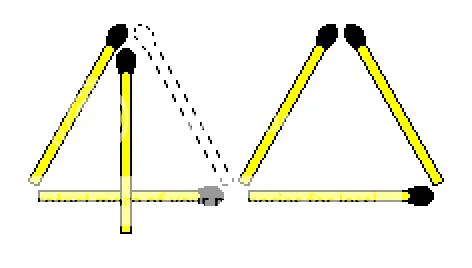
For instance, here’s the first matchstick puzzle I ever remember seeing:

[This image, and the one below, courtesy of Matchstick Puzzles on Blogspot.]

You have two triangles formed from six matchsticks. Move one matchstick to make four triangles.

Now, you could easily use all of these matchsticks to make four triangles, but that would involve moving more than one of them. So clearly there’s something else at work here if you only need to move one to solve the puzzle.

That something, in this case, is a little visual trickery.

As you can see, you turn one triangle into a numeral four, making the matchsticks literally read out “4 triangle.” Sneaky sneaky.

There are literally hundreds of these puzzles if you go hunting for them. (I found a treasure trove of them here.)

A curious variation, though, applies the same rules to mathematical formulas laid out in matchstick form.

Here’s one that’s been making the rounds on Facebook recently:

Now, the big difference between these mathematical ones and the shape ones mentioned above, as far as I’ve found, is that the math ones are far more alternate prone.

For instance, this equation puzzle has at least four solutions that I’ve found:

  • You can move one match to make the 6 a 0, so that 0+4=4.
  • You can move one match from the 6 to the second 4 to make the 6 a 5 and the 4 a 9, so that 5+4=9.
  • You can move one match from the plus sign to the 6 to make the plus sign a minus sign and the 6 an 8, so that 8-4=4.
  • You can move one match from the plus sign to the equal sign to make the plus sign a minus sign and the equal sign a doesn’t-equal sign, so that 6-4 does not equal 4.

As you can see, with matchstick puzzles,  the possibilities are endless and the building blocks — whether matches, toothpicks, Q-Tips, or straws — are easily accessible.

I’ll leave you one more to ponder, this time provided by the folks at IO9:

Using six matchsticks of equal length, create four identical, equilateral triangles. There’s no need for snapping, burning, or otherwise altering the matchsticks.

Good luck!


Thanks for visiting PuzzleNation Blog today! Be sure to sign up for our newsletter to stay up-to-date on everything PuzzleNation!

You can also share your pictures with us on Instagram, friend us on Facebook, check us out on Twitter, Pinterest, and Tumblr, and explore the always-expanding library of PuzzleNation apps and games on our website!

5 Questions with Author Elizabeth Singer Hunt!

Welcome to 5 Questions, our recurring interview series where we reach out to puzzle constructors, game designers, writers, filmmakers, musicians, artists, and puzzle enthusiasts from all walks of life!

It’s all about exploring the vast and intriguing puzzle community by talking to those who make puzzles and those who enjoy them! (Click here to check out previous editions of 5 Questions!)

And I’m excited to welcome Elizabeth Singer Hunt as our latest 5 Questions interviewee!

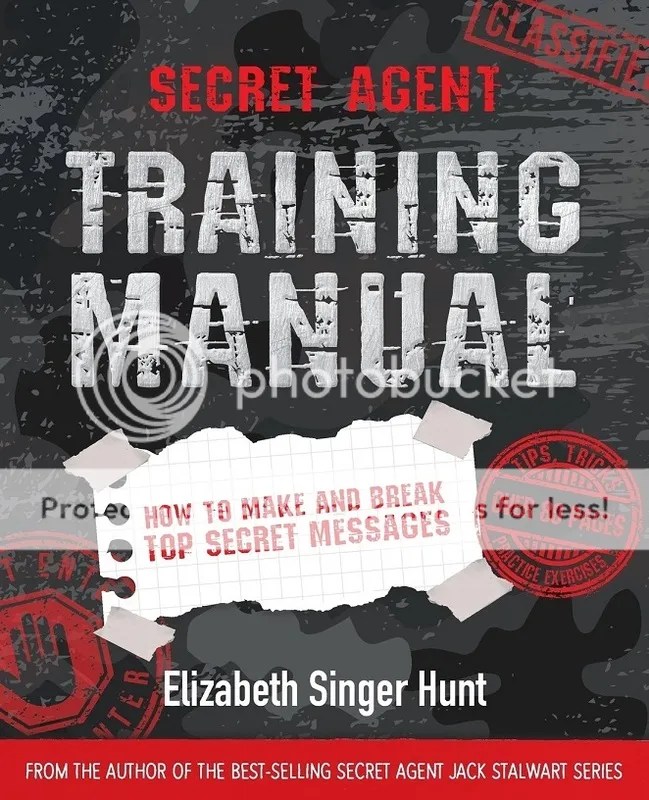
Elizabeth Singer Hunt is the author behind the globe-spanning Jack Stalwart books, a young adult series featuring a nine-year-old secret agent, with over two million books sold to her credit! She’s recently expanded into the world of puzzles with the publication of the Secret Agent Training Manual, a terrific introductory guide to codecracking and concealment.

Anagrams, ciphers, scytales, and encoding with other letters, numbers, or symbols are all explained with easy-to-understand instructions and plenty of examples. She even provides sample encryptions to crack, letting readers practice their newfound skills and techniques, giving young readers the chance to become their own Jack Stalwart-style secret agents!

Elizabeth was gracious enough to take some time out to talk to us, so without further ado, let’s get to the interview!


5 Questions for Elizabeth Singer Hunt

1. What inspired the adventures of Jack Stalwart?

As a young girl, I struggled to read. It wasn’t so much that reading was a problem for me. I couldn’t find any books that I identified with. I grew up in a small town in Louisiana, and spent most of my weekends fishing, crabbing, playing with frogs and tossing around footballs. Basically, I was a tomboy. It was difficult to find books that I could relate to since most of the ‘girl’ books were about friendship issues, horses and fairies.

At around that same time, Raiders of the Lost Ark opened in theatres. That movie introduced me to archaeology and adventure, and showed me that there was a world outside of Louisiana. As a southern girl, I had no idea that places like ‘Nepal’ and ‘Peru’ even existed!

When I was in my late twenties, I decided to take a crack at writing a children’s book series. I drew upon my childhood experiences and inspirations to create the series’ main character, nine-year-old Jack Stalwart. Jack moonlights as a junior secret agent for the Global Protection Force, or GPF. In every book, he’s sent on a mission to an exotic locale in order to protect one of the world’s most precious treasures.

Millions of children around the world have fallen in love with Jack, largely because they identify with him and want to be like him. He’s like a pint-size Indiana Jones, sprinkled with a bit of James Bond and written for the nine-year-old ‘reluctant reader’ me.

Did they, in turn, inspire the Secret Agent Training Manual, or was that meant to be a standalone creation?

Over the years, I have received thousands of emails from children asking how they can become a secret agent like Jack. So I thought it would be fun to create a series that introduced them to basic secret agent/spy skills. Code-breaking seemed a natural place to start! The first book in the series is called How to Make and Break Top Secret Messages. Subsequent books will discuss basic spy craft and the history of intelligence gathering.

2. Are you a puzzle fan yourself, or did your aptitude with encryption and codebreaking puzzles come out of your research and work as a writer?

A little bit of both! I have always had an affinity and aptitude for word puzzles. My favorite game growing up was Boggle and to this day, I am the family Boggle Champion! Recently, my children and I discovered Bananagrams.

It’s right up my alley, since it relies on the ability to quickly arrange and re-arrange letter tiles into words. That being said, I didn’t know too much about the world of cryptography (except for some of the basics) until I began researching for this book.

Do you have a favorite method of encryption or one that didn’t make it into the SATM?

I am fascinated by all of the methods of encryption featured in the book because each has its use depending upon the situation. I suppose my favorite is the ‘cipher’ because it’s ever-changing and difficult for the average person to solve without a key.
3. Let’s talk a little bit about your writing process, since composing a novel is a puzzle in itself. Do you start with characters, plot, certain scenes in your head already? How do you approach the process of writing a book?

Good question! It depends upon the type of book that I am writing.

For my (fiction) Jack Stalwart chapter book series, I have a fairly unorthodox way of writing. I establish the setting, mission and villain and then I start writing! Everything is free-flowing, and little is planned. I love movies and am extremely influenced by film, so in a way I am writing as though I am watching a film play out before my eyes.

For the (non-fiction) Secret Agent Training Manual book, things needed to be a lot more structured. Research was done, notes were taken and the book was organized from the most basic cryptographic methods to those that took a bit more time and thought to decode. Most of this book was handwritten, while many of my fiction books are typed onto a computer screen from the get-go.

4. What’s next for Elizabeth Singer Hunt?

I’m excited to say that Costco is planning an exclusive nationwide launch of the Jack Stalwart series in volume form next month, i.e. in April of 2016. That means that children across the country will be able to enjoy the Jack Stalwart series four books at a time in a specially produced keepsake volume.

Besides this news and the launch of the Secret Agent Training Manual book, I’ve also recently published the first book in a new middle grade series called Swamp Mysteries: The Treasure of Jean Lafitte. The series chronicles the adventures of four twelve-year-old friends as they solve paranormal mysteries in the swamps and bayous of Louisiana. It’s a bit like Scooby-Doo with a southern twist.

5. If you could give the readers, writers, and puzzle fans in the audience one piece of advice, what would it be?

As my mother always says, “There’s always a solution to everything. Persevere!”

When I first had the idea for the Jack Stalwart series, I shopped it around to various agents and publishers and they promptly rejected it. I could have felt sorry for myself and given up. But I believed in the idea and in myself. So, I found a solution to the problem. I published it myself, i.e. hired an editor, illustrator, designer and found a local printer to produce the books. I printed thousands of Jack Stalwart books, and sold them personally to as many booksellers as I could find.

After five months of hard work, the series caught the attention of an agent and the head of children’s fiction at Random House UK. (I was living in England at the time). Random House acquired the Jack Stalwart series, and commissioned me to write a total of fourteen books.

The rest as they say is history. Had I listened to the naysayers, Jack Stalwart never would have existed and I never would have had a career as an author. Thankfully, I took my mother’s advice. It’s the same advice that I would give to anyone with a dream. Never give up. Be resourceful, and persevere.


A huge thank you to Elizabeth for her time. Be sure to visit her website for updates on her latest projects. I cannot wait to see what she has in store for us next!

Thanks for visiting PuzzleNation Blog today! Be sure to sign up for our newsletter to stay up-to-date on everything PuzzleNation!

You can also share your pictures with us on Instagram, friend us on Facebook, check us out on Twitter, Pinterest, and Tumblr, and explore the always-expanding library of PuzzleNation apps and games on our website!