It’s Follow-Up Friday: Murder Mystery edition!

Welcome to Follow-Up Friday!

By this time, you know the drill. Follow-Up Friday is a chance for us to revisit the subjects of previous posts and bring the PuzzleNation audience up to speed on all things puzzly.

And in today’s post, I’d like to follow up on last week’s murder mystery post.

In the previous post, I gave you some of the backstory and logistics of our in-office murder-mystery event, and today, I wanted to discuss the event itself.

Our murder happened Monday night — the fictional J. Augustus Milverton Puzzlenationo would breathe his last breath near the photocopier — so Tuesday morning marked the official start of the game.

And since we’re an office full of puzzlers, the morning began with something of a logic puzzle, as the players were given a list of passcodes used to enter the building, but they needed to figure out who had used them and at what time.

You see, someone’s passcode being used at a certain time didn’t necessary mean that person was actually entering the building at that time. Someone could’ve used another player’s code. (Information involving times and identities was scattered throughout emails to all 10 participants, so it would take a fair amount of cooperation to unravel this.)

But since all of the players were suspicious of each other — which was wise, given that several “solvers” were actually following my orders throughout the event to fulfill certain tasks — the first day didn’t involve as much cooperative solving as I’d hoped. (That would come the next day out of necessity, as alliances began to form and more information was shared.)

As I fielded questions from players asking for further details — and several clues were discovered and analyzed — the first of several complications for the players was revealed: a fellow player was “killed.”

This not only upped the stakes for the players, but led to one of my favorite moments in the game. You see, when a fellow player stumbled upon the body, he wasn’t sad that his coworker was dead…he was sad because he couldn’t ask him any questions. (Though, intrepid solver that he was, he asked if a Ouija board was out of the question.)

For the rest of the day, I was fielding all sorts of instant messages and emails from players, asking for information, cashing in Holmes Tickets, clarifying things, and trying to fit the pieces of the puzzle into place. Early theories emerged. Some were wild guesses, and some were surprisingly close to the truth.

Our event played out in real time, so the players were aware that things could happen outside the workday that would impact the game. People seemed reluctant to leave, just in case they missed a clue.

Day Two opened with another red herring — punny threats sent to three of the players, delivered in envelopes that pointed to another player (a gambit by the killer to put the spotlight on someone else) — and a few secrets had already come out.

Players openly offered information to each other in a group email, which helped resolve some red herrings and put other pieces into place. More clues were uncovered, but the murder weapon remained elusive.

Lunchtime was orchestrated to be a tipping point. Not only would another murder occur, but other plans and clues would come together. I gave one of my collaborators two missions to accomplish while the players were away from their desks. Hopefully, she’d be able to accomplish both, but at the very least, she had to accomplish one of the tasks.

There were a few of these open-ended narrative moments written into the story where the players had the chance to surprise me with what happened and what didn’t. Not only did those moments make the game more fun for me to run, but it gave other players chances to really inhabit their characters and get into the performance side of the gameplay.

Lunchtime allowed for more group theorizing — something that the workday hampered, as you might expect — but the real fireworks awaited players upon their return.

A trap was sprung, and another player died unexpectedly. Although some chaos did ensue, most of the players realized this latest death was the work of another party, and several of the players solved it quickly before returning their attention to the first two murders.

In the midst of all this, two real-world complications arose on Day Two.

The first involved a player dropping out due to a mix of time constraints (she felt the game was distracting her too much from work) and general frustration with the format of the game (which, for someone unfamiliar with immersive storytelling like this, is totally understandable). I was sad to see her go, and adjusted the story accordingly, recovering a clue from her and redistributing it to an active player.

The second involved the pace of the game itself. I’d hoped to run it over the course of Tuesday and Wednesday and have it wrapped up that second day. But between the elaborate unfolding plot and the difficulty in balancing gameplay with, you know, actually getting our work done, things were progressing more slowly than expected.

That darn workday. Such a nuisance.

So the game rolled into Day Three, and players could sense the end was near. Most of the puzzle pieces were there for the taking, and several compelling theories emerged. (Honestly, one of them was better than the story I’d actually written, which was both funny and a little humbling.)

To add a bit of drama, I set a deadline of mid-afternoon. If the murders hadn’t been solved by then, the killer would escape scot-free.

Things finally steamrolled to their conclusion when the murder weapon was revealed — in the hands of a thief who had been woven into the plot — and one of the players came close enough to cracking all three murders that I declared the mystery solved. (And our ace detective did so before the deadline, so no escape for our dastardly murderer.)

It was different from any murder-mystery event I’d run before, and everyone seemed to enjoy it. There were certainly flaws in execution, as there are in any first attempt, but I learned some valuable lessons in this play-through that will make other such events in the future smoother, more satisfying, and more engaging.

Although…I hadn’t considered the potential consequences of the event on workdays going forward; everyone seems a bit more wary of each other. (And there are a few vengeful “spirits” lurking about, hoping to avenge themselves in future games.)


Thanks for visiting PuzzleNation Blog today! Be sure to sign up for our newsletter to stay up-to-date on everything PuzzleNation!

You can also share your pictures with us on Instagram, friend us on Facebook, check us out on TwitterPinterest, and Tumblr, and explore the always-expanding library of PuzzleNation apps and games on our website!

It’s Follow-Up Friday: Carpet Conundrum edition!

Welcome to Follow-Up Friday!

By this time, you know the drill. Follow-Up Friday is a chance for us to revisit the subjects of previous posts and bring the PuzzleNation audience up to speed on all things puzzly.

And in today’s post, I’d like to return to the subject of visual puzzles.

We’re keeping it simple today. In this photo that’s been making the rounds on Facebook and Reddit, can you find the iPhone?

Let us know if you spotted it! It’s tougher than you might think!

Happy Friday!


Thanks for visiting PuzzleNation Blog today! Be sure to sign up for our newsletter to stay up-to-date on everything PuzzleNation!

You can also share your pictures with us on Instagram, friend us on Facebook, check us out on TwitterPinterest, and Tumblr, and explore the always-expanding library of PuzzleNation apps and games on our website!

Interactive Puzzling is Murder on a Work Day!

[Image courtesy of Carriageway.com.]

It all started with a board game at lunchtime.

TableTop Day is a popular annual event here at PuzzleNation, and several of my fellow puzzlers enjoyed it so much that they wanted it every week. Well, we couldn’t swing that — deadlines and all — so we play games every Wednesday during lunch.

During a particularly spirited round of 10 Minutes to Kill — a game where every player controls a hitman trying to take out three targets without being identified by the other players or the police — the subject of murder mysteries came up, and I let slip that I’d helped write and run several murder mystery dinners in the past.

[Image courtesy of Vancouver Presents.com.]

So, naturally, the idea of running a murder mystery at work became a recurring topic of discussion.

As a huge fan of interactive storytelling — be it tabletop role-playing games like Dungeons & Dragons, improv theater, LARPing, or other group activities — the idea appealed to me.

Of course, I had one huge hurdle to overcome: the work day.

You see, murder mystery dinners thrive on the theatricality of the event. Attendees can overhear arguments, catch snippets of banter and exposition as they walk around, and engage characters in conversation to learn more. The more you interact with the story, the better chance you have of solving the mystery, but even passive players will get the big picture.

But in a normal workday, I can’t stage big elaborate sequences, like a failed marriage proposal or someone tossing wine in another’s face. I’d have to find another way to deliver information, mysteries, and drama.

Thankfully, as a puzzler, I’m accustomed to writing clues. Cluing is simply delivering information in unexpected ways. Whether it’s through deceptive wordplay, puns, or connections with other entries, crosswords and logic problems are excellent training for being creative and stealthy while presenting important information.

So, I mapped out the murder and the characters I’d need to pull it off, and cast those characters from a group of fellow puzzlers. At the same time, I gauged interest from other coworkers to see who’d be interested in trying to crack the case, and began devising ways to weave them into the narrative. (This was more intimate than writing your usual murder mystery dinner for random attendees, since the latter is more about creating scenes than tailoring it to specific people and circumstances.)

[Can’t have a murder mystery without an animal for someone to pet fiendishly.
In this case, my trusty armadillo in a cowboy hat, Armando.]

My goal was to get everyone prepped to play on Monday, and then actually run the mystery on Tuesday and Wednesday, with the murder having occurred overnight.

Which led to another big hurdle. I couldn’t exactly stage an elaborate murder scene in a way that was unobtrusive to the workday, so I’d have to describe the scene to the players and let them ask questions about it.

But how do I leave clues for the players that are readily identifiable as clues and not just the ephemera of a working office? After all, any good murder investigation needs some convenient clues to uncover that will help unravel the mystery.

I opted to mark any clue (which were most often color pictures of actual items, like a stashed wallet or a threatening letter) with the symbol below, to remove any doubt that this item was involved someway in the murder mystery:

Okay, that takes care of the clues. But what about the actual interaction, where players ask questions of characters and gain the valuable knowledge needed to solve the crime?

Sure, a lot of that can be done through group emails and instant messenger programs, encouraging the investigators to share what they’ve learned, so there wouldn’t be random gaggles of investigators creating a distraction as they ponder the latest clue found or deduction made.

As a storyteller, whether you’re running an RPG or a murder mystery, you not only need to know the details of your story backwards and forwards, but you need to anticipate what questions the audience will ask.

And no matter how prepared you are, I assure you, the players will ALWAYS find a way to monkey-wrench your plans, whether they approach the problem from an unexpected direction or they ask for information you hadn’t prepared in advance. There had to be a simple way to reflect this in the actual gameplay.

To deal with this, I borrowed an idea from Lollapuzzoola and created Holmes Tickets, which were catch-all requests for deeper insight or information than had been provided. Basically, anything that would require outside intervention or skills beyond that of the casual investigator could be revealed by spending a Holmes Ticket.

Dusting for fingerprints, getting ahold of a coroner’s report, uncovering information on a missing check…all of these and more were results of investigators cashing in their Holmes Tickets at various points in the investigation.

So, how did the actual murder mystery go? Well, I’d love to tell you, but it’s not finished yet! The work day proved more intrusive than expected — damn those pesky deadlines and responsibilities! — so we’re rolling into a third day of passive gameplay.

By hook or by crook, the story will be wrapped up today, and I’ll be able to fill you in more on the actual story, clues, and progression of each investigation. For now, I’ll just let you know that there are currently three bodies to account for (our killer has been busy since Monday night), and a host of theories, but no firm accusations yet.

We shall see if justice is served or if our crafty killer gets away.


Thanks for visiting PuzzleNation Blog today! Be sure to sign up for our newsletter to stay up-to-date on everything PuzzleNation!

You can also share your pictures with us on Instagram, friend us on Facebook, check us out on TwitterPinterest, and Tumblr, and explore the always-expanding library of PuzzleNation apps and games on our website!

5 Questions with Game Designer Andrew Looney

In honor of the 20th anniversary of Looney Labs this weekend, as well as the launch of the LooneyCon event today, we’re doing Follow-Up Friday a little differently today.

And so, welcome to another edition of 5 Questions, our recurring interview series where we reach out to puzzle constructors, game designers, writers, filmmakers, musicians, artists, and puzzle enthusiasts from all walks of life!

It’s all about exploring the vast and intriguing puzzle community by talking to those who make puzzles and those who enjoy them! (Click here to check out previous editions of 5 Questions!)

And I’m excited to welcome Andrew Looney as our latest 5 Questions interviewee!

pic243321

[Image courtesy of BoardGameGeek.com.]

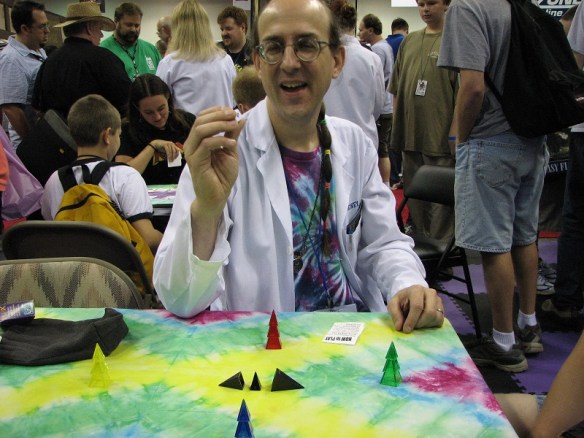
Andrew Looney is the chief game designer and co-founder of Looney Labs, a company specializing in games with serious replayability and dynamic rules that make every session a new experience. Founding the company in 1996 with his wife and partner-in-aerospace Kristin, he has gone on to launch such innovative games as Fluxx (and its many variations) and the Looney Pyramids series.

With two decades of experience in game design, he has presided over the growth of a major brand in games, one whose homegrown roots and values are still very much a part of the company’s fabric today.

Andrew was gracious enough to take some time out to talk to us in the days before LooneyCon, so without further ado, let’s get to the interview!


5 Questions with Andrew Looney

1. You’re celebrating twenty years of Looney Labs innovation and game design this month, and you’ve really cemented a reputation for fun games with a high replay value. How do you know when a game is right for your brand? And what role do you play in bringing these games to market?

I design everything we make myself. So I play a pretty big role. But the decision about what we publish next is not up to me… Ultimately, Kristin makes that call (although she gets input from everyone in the company and beyond).

When I feel that a game design is working, I’ll declare it ready for consideration, at which point it goes into the pool of possibilities. And some of my designs spend a lot of time waiting around in the pool before the company decides to publish them. In other cases, such as when I’m asked to create a game on a specific subject or when I come up with something particularly exciting, I have more deadline pressure.

But the ultimate test of when a game is ready is when everyone who plays it says, “This is great! Let’s play again!”

gaminggoh

[The heart and soul of Looney Labs, Andrew and Kristin Looney.
Image courtesy of WindyconBlog.]

2. In the last year, Looney Labs released more games than ever before, with new licensing deals for Fluxx variations like Batman Fluxx and Firefly Fluxx, a Mad Libs game, and a wildly successful Kickstarter campaign for Pyramid Arcade, a relaunch of sorts for your Looney Pyramids series. How is Year 20 of Looney Labs different from Year 1, and what lessons have you learned along the way?

Wow, the difference is so vast. Twenty years ago we were still working at our day jobs in the aerospace industry, and learning how to start a company in our spare time. We’re still living in the same house, but the similarities end there. For many years, we ran the business out of our house, but now it’s just our house again, since our company has an 11-room office suite up the road, where our 8 full-time employees work.

Twenty years ago I had an idea for a wacky new card game… now there are almost 20 different versions of that game on the market, that have sold almost 3 million copies, and our games are in about 20 different languages.

Twenty years ago, we were struggling to find a way to manufacture the little plastic pyramids needed for our first game idea. Now we’re about to release an incredible boxed set featuring twenty different games I’ve invented since then for the pyramids.

Plus we have a bunch of other cool games I’ve invented along the way! It’s amazing, I never would have believed it. Where will we be in another twenty years?

firefly2

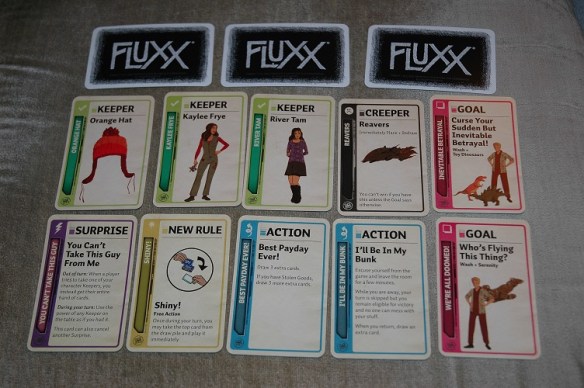
[Sample cards from Firefly Fluxx, one of many games
released under the Looney Labs banner.]

3. You’ve created games of your own and helped others bring their games to life. What puzzles and board games, either in game-play style or in the experience of producing them for sale, have most influenced you?

I grew up on the old-school classics, so they were my obvious first influences. Sorry was an early favorite. Another was a sixties board game about the Civil War called Battle Cry. I think my first real game design effort was a small-scale, simplified version of Battle Cry I made as a kid, small and fast enough to be played at a restaurant during a meal. (Sadly, I lost that prototype long ago.)

Another early effort was combining the missile and warhead cards from Nuclear War with the board game Risk. Another of my earliest efforts was coding my own text adventure games, like Colossal Cave, a game so inspirational to me that it also first motivated my desire to program computers.

Kristin and I were independently inspired, during our high school days, by the dice game Cosmic Wimpout. Indie game companies like them are everywhere now, but at the time it was a revelation that such companies could exist. We were particularly inspired by their occasional newsletter and their grassroots approach to marketing.

My favorite card game from way back is Hearts, and certain elements of that game still inspire me, most notably the way it has two paths to victory (avoid taking points vs. take all the points).

Lastly, Fluxx was inspired by a conceptual game engine called Nomic, in which the game rules are created by the players as the game is played. I found Nomic to be an interesting idea, but felt I could do better…

I think a lot of game designers, and indeed inventors of every stripe, are driven by this sort of inspiration, the desire to improve on what someone else did, to go even further with the idea.

looneycon

4. What’s next for Andrew Looney and Looney Labs?

Well, the very next thing is LooneyCon, a micro-convention for fans of our games which we’re running this weekend! And as mentioned, this fall we’ll be releasing Pyramid Arcade, the culmination of everything we’ve been doing with the pyramid system these past 20 years.

Well, almost — it doesn’t include Zendo, which is too big to fit in Pyramid Arcade. But a new standalone edition of that game is something we’re planning separately, and we have some pretty neat ideas for that, too.

And I’ve got other exciting stuff planned for the future, including 3 completely new board games I’ve been developing for the past few years. Sorry, I can’t even tell you their names yet, let alone when they will be released, but I’m pretty satisfied by each one.

5. If you could give the readers, writers, aspiring game designers, and puzzle fans in the audience one piece of advice, what would it be?

“Don’t get left behind when the car goes into town.”

This is something my mom used to say (which I actually only learned at her funeral). It was a lesson she’d learned as a kid in rural Kansas, and it literally just refers to the limited availability of opportunities to catch a ride from the farm into town.

But I love it as a mantra for every fleeting chance we get at doing something fun. Pay attention to everything, because doors sometimes open and close quickly, and always say yes to travel and excitement!

Life is one big game, and whoever has the most fun wins!


A huge thank you to Andy for his time. Be sure to check out the Looney Labs site for updates on all things Looney, and check out their Facebook to keep up on all the activities for this weekend’s LooneyCon event, which starts today and runs through Sunday July 24, the actual 20th anniversary! I cannot wait to see what he has in store for us next!

Thanks for visiting PuzzleNation Blog today! Be sure to sign up for our newsletter to stay up-to-date on everything PuzzleNation!

You can also share your pictures with us on Instagram, friend us on Facebook, check us out on TwitterPinterest, and Tumblr, and explore the always-expanding library of PuzzleNation apps and games on our website!

Puzzle Vandalism!

[Image courtesy of Milliande.com.]

It’s hard to know sometimes what qualifies as art.

Artists and entrepreneurs are constantly pushing the boundaries of visual and intellectual expression. Everything from paint and stone to light and shadow are used to realize artistic visions. Christo wraps buildings and calls it art.

That can make it tough for those who are less familiar with the fluid definition of art.

There was a famous incident back in May when a seventeen-year-old left his glasses on the floor of an art gallery and many patrons mistook them for an art installation.

This has only grown more complicated with the advent of interactive art pieces. Some works of art can only be viewed from a specific vantage point, while others actively engage patrons.

Recently a woman unintentionally vandalized a piece of art when she mistook it for part of an interactive exhibit.

And wouldn’t you know, that piece of art was based on a crossword puzzle.

[Image courtesy of Thoibao.today.]

The 91-year-old woman was visiting the Neues Museum in Nuremberg with a senior citizens group when she found the piece, “Reading-work-piece” by artist Arthur Koepcke, and began filling in the empty grid.

These days, you can understand her confusion and sympathize with her mistake. I mean, the exhibit did say “insert words,” after all. Those sound like instructions to me.

Plus the grid has remained incomplete since its creation in 1965. It’s about time somebody finished the puzzle.


Thanks for visiting PuzzleNation Blog today! Be sure to sign up for our newsletter to stay up-to-date on everything PuzzleNation!

You can also share your pictures with us on Instagram, friend us on Facebook, check us out on TwitterPinterest, and Tumblr, and explore the always-expanding library of PuzzleNation apps and games on our website!

It’s Follow-Up Friday: LEG-OH NO WAY edition!

Welcome to Follow-Up Friday!

By this time, you know the drill. Follow-Up Friday is a chance for us to revisit the subjects of previous posts and bring the PuzzleNation audience up to speed on all things puzzly.

It’s been quite a week here at PuzzleNation Blog!

After posts that ran the gamut from Comic-Con encryption puzzles and new puzzle sets for the Penny Dell Crosswords app to becoming a sharper Hangman or Guess Who? player and enjoying the puzzly chain reactions known as Rube Goldberg devices, I was left with quite a conundrum: How do I close out such an eclectic week?

This will be my sixth post in six days after all. What would be an appropriate capper?

Well, I think I found the perfect Friday post idea: some visual LEGO puzzle wizardry.

Specifically, it’s a moving piece of puzzle art that combines the visual wonder of the pop-up book with the puzzly skill of a LEGO master builder.

I give you the LEGO Pop-Up Himeji Castle:

I’ve watched the video over and over, and I have no idea how the castle fits together OR compresses itself flat enough to fit between the “covers.” This is mind-blowing LEGO skill and puzzly three-dimensional manipulation of space.

And apparently, this sort of next-level three-dimensional spatial reasoning is second-nature to YouTuber Talapz, since he also managed to create this multi-dimensional sculpture that allows a ball to traverse it in three different arrangements:

I first stumbled across Talapz’s works on this site (written in French, no less!), and quickly followed his work on his YouTube page. Be sure to click the link for more brain-melting works of puzzly LEGO art.


Thanks for visiting PuzzleNation Blog today! Be sure to sign up for our newsletter to stay up-to-date on everything PuzzleNation!

You can also share your pictures with us on Instagram, friend us on Facebook, check us out on TwitterPinterest, and Tumblr, and explore the always-expanding library of PuzzleNation apps and games on our website!