No Prep Road Trip Games!

Summer is nearly upon us, and with the arrival of summer, one cannot help but think of road trips with friends and ways to pass the time in the car.

While singalongs, I Spy, and the License Plate Game are all well and good, perhaps you would like a little more challenge with your road trip games.

Well, you’ve come to the right place. Here’s a few suggestions for road trip games that require no preparation, save for a little imagination!


The Movie Game

I learned this game while stuck on a long train ride, and it certainly made the delays go faster.

Someone starts with a film, and the next player names an actor in that film. The next person names ANOTHER film that actor has appeared in, and the next person names ANOTHER actor from that film. And you keep going until someone can’t continue the game.

(If you present an actor or film in the chain that the next player can’t continue, you can only eliminate them by offering another answer, showing that the chain can continue. If you give them a chain link you can’t continue either, you’re out!)

It’s surprisingly difficult, because the more you play, the more devious you try to get. You want to lure other players down garden paths, but you have to make sure you don’t go so obscure that you can’t find your way out as well.


Playlist

Friend of the blog Jen Cunningham created a music-themed version of The Movie Game: Playlist.

In this version, you start with a song and an artist, and the next player either names another song by that artist OR another song using one of the key words in the song.

So, for instance, if you say “Sgt. Pepper’s Lonely Hearts Club Band” by the Beatles and you need to match the song, you could do “Owner of the Lonely Heart” by Yes or “Only the Lonely” by Roy Orbison. Then someone needs to name another Yes song or another Roy Orbison song, and then the chain continues.

I find this game slightly more challenging than The Movie Game because of both the musical knowledge (which isn’t as strong as my movie knowledge) and the associative nature of the song title aspect. But many hours have been wiled away with this game!


My Friend Is An Expert… / Conspiracy Theory

In this game, the first player picks two random subjects, and then prompts the next player with them, and it’s the next player’s job to explain in entertaining fashion something fascinating about them that only an expert would know.

For instance, the first player would go “My friend is an expert in ancient archaeology and polka music” and the next player has to riff on those subjects for a bit. Other players can ask questions to continue the silliness.

The game continues with different topics and additional nonsense.

There’s a similar game to this called Conspiracy Theory where someone has to rant about the grand conspiracy behind two seemingly unrelated topics provided by the other players.

Both of these are great fun with a group of improvisers or snake oil salesman during a long road trip.


Alien Ambassador

(I haven’t played this one yet, but a friend recommended it, so I’m happily including it.)

In this game, one player is selected to be the alien ambassador, an alien visiting Earth for the very first time. The other players must answer the alien’s questions and explaining simple concepts to them. (It’s sorta like that comic strip with the aliens.)

As the alien ambassador asks more questions about this, the players will invariably scramble to explain the very weird things we accept as normal, everyday life, and laughter will ensue.


Hastur Horta Hodor Mordor

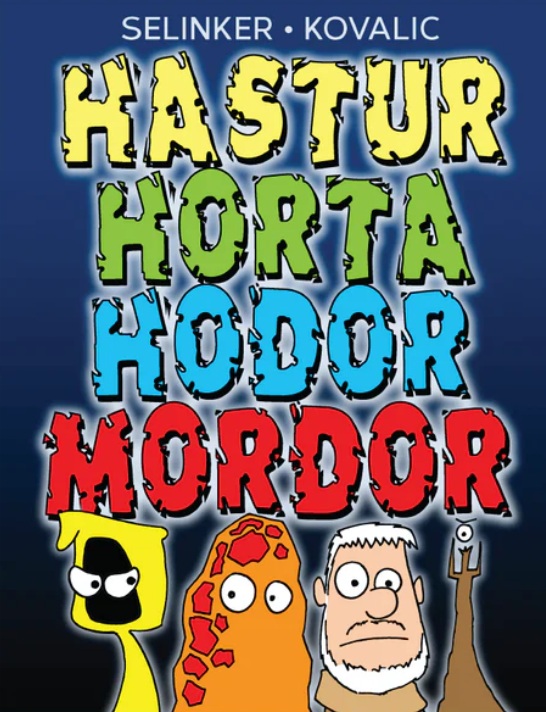
Inspired by a Dork Tower comic, Hastur Horta Hodor Mordor is a road trip game that actually became a real card game. But let’s focus on the road trip version.

This is a memory game where one player says a word — preferably one related to fandom, geek culture, etc. — in order to begin a nerdy tongue twister. The next player says that word AND another word. The next player says the two previous words AND another word, and the chain continues.

If you can’t complete the chain or you hesitate too long, you get a Hodor point, and a new chain begins.

If you get 3 Hodor points, you can only say “Hodor” for the rest of the car ride. (That’s a reference for the Game of Thrones fans in the audience, if there are any of you left after those dismal final seasons.)


Do you have any favorite no prep road trip games, fellow puzzlers? Let us know in the comments section below! We’d love to hear from you.

Antonym TV Shows!

In today’s post, I’ve got a silly little puzzly challenge for you. I’m going to give you the antonym of a television show’s title, and you need to give me the show.

For example, “Not at All Justified” would mean “Justified” or “Lawlessness and Chaos” would be “Law and Order.”

And yes, they do get wackier, more specious, and more elaborate as we go.

So, without further ado, let’s play!


ANTONYM TV SHOWS

  1. Enemies
  2. Found
  3. The Idle Alive
  4. Less Peculiar Nothings
  5. Misery
  6. Before Twelve
  7. Southern Obscurity
  8. Me
  9. Saving Adam
  10. White Non-Reflective Surface
  11. The First of Them
  12. Ugly Large Honest People
  13. Heaven’s Dining Room
  14. The Small Pop Certainty
  15. Very Vulnerable
  16. The Basses
  17. Unfettered Lack of Progress
  18. Water Walk
  19. Near Stay
  20. Many Whole
  21. Unseriousness Rises
  22. Truth Angel
  23. Attachment
  24. Drives and Work
  25. Minor Childless Man
  26. Keep a Potato in Pristine Condition
  27. Bullgirl Classical
  28. Legal Disobeys
  29. Uncertain Key
  30. Jeers

How many did you get, fellow solver? And how many did you groan at when you figured them out? Let me know in the comment section below!

New Rubik’s Speed-Solving Record: Blink and You’ll Miss It!

Clever, quick-fingered solvers are constantly pushing the boundaries of what can be accomplished with a Rubik’s Cube.

I’ve seen the world’s most complex Rubik’s-style cube being solved, a building turned into a solvable Rubik’s Cube, and a Rubik’s Cube solved one move at a time by strangers across the globe.

I’ve even seen a Rubik’s Cube solved during a skydive.

But, amidst all those amazing achievements, there has been something lurking in the background. Over the years, there has been an escalating cold war in the world of Rubik’s Cubes.

The two sides? Human and machine.

The battlefield? Speed-solving.

Human speed-solvers often count their records in seconds, not minutes. The current record for a 3×3 cube solve is 3.05 seconds!

But speed-solving devices are often so fast that they end up ripping the cube to pieces instead of completing the solve. So puzzly designers must carefully walk a tightrope between speed and power in order to challenge speed records for mechanical solvers.

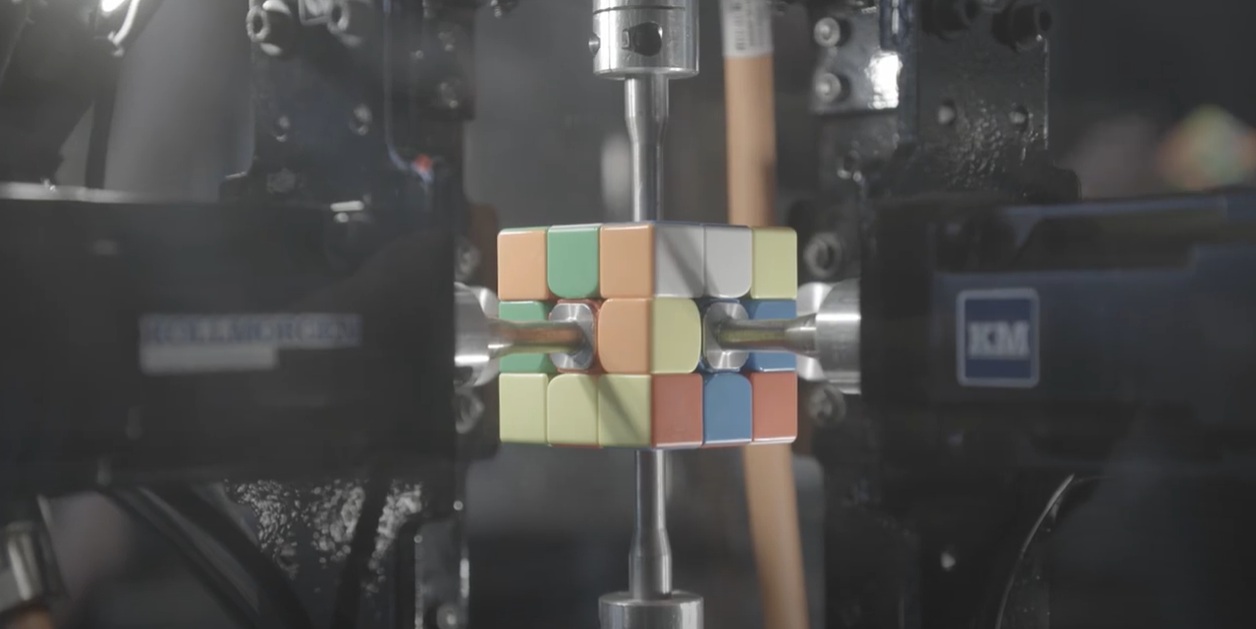
The record for an automated solve is an astonishing 0.305 seconds – ten times faster than the fastest human solve! — set by Mitsubishi Electric engineers in Japan in May 2024.

Or it was, until a few days ago.

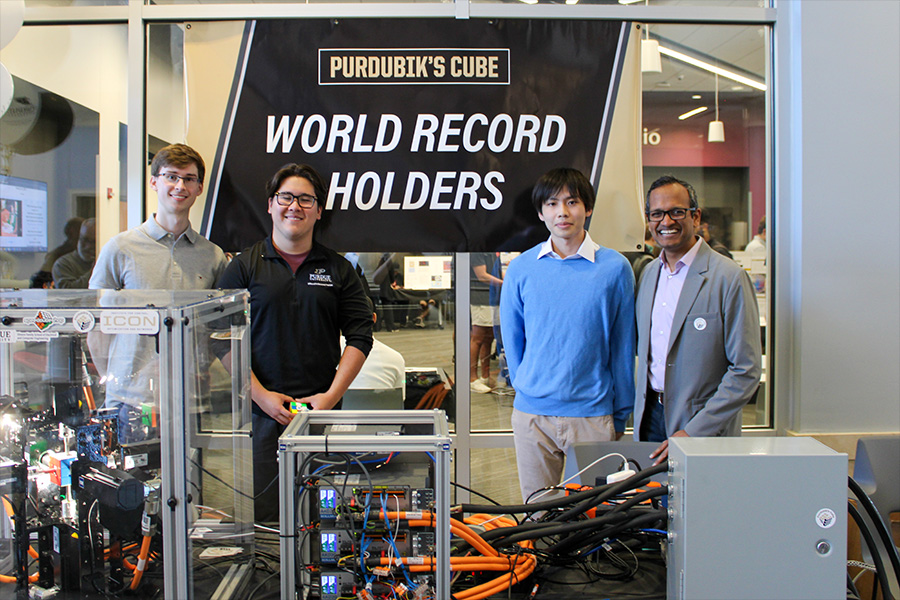
The new Guinness World Record for “Fastest robot to solve a puzzle cube” belongs to Purdubik’s Cube, the robot created by Junpei Ota, Aden Hurd, Matthew Patrohay, and Alex Berta, a team of students from Purdue University’s Elmore Family School of Electrical and Computer Engineering.

The new record? 0.103 seconds.

It’s hard to fathom how quick that is. Thankfully, one of Purdubik’s Cube’s creators has an apt analogy:

“We solve in 103 milliseconds,” Patrohay said. “A human blink takes about 200 to 300 milliseconds. So, before you even realize it’s moving, we’ve solved it.”

Utilizing a combination of color recognition and finely-tuned industrial-grade motion-control hardware — guided by algorithms written by the students themselves — Purdubik’s Cube carefully accelerates and decelerates its movements faster than the eye can see.

And despite the fact that a team of four college students smashed a record previously held by a billion-dollar corporation, they’re not done yet.

They aspire to solve a Rubik’s Cube with Purdubik’s Cube in less than a tenth of a second! I don’t know how they expect to shave a few milliseconds off their time to achieve their goal, but you know what? I fully believe they can do it. In less than a year, they set their goal of a new Guinness World Record and achieved it.

Who knows what they’ll achieve next?

[You can read the full story of their journey from the initial goal to their world record success on the Purdue Engineering website. I highly recommend it!]

Optical Illusions Made of Wood!

Learning about the science behind optical illusions has been one of my favorite parts of this job. More and more, scientists are figuring out WHY optical illusions work on us, utilizing combinations of color, shadow, perspective, and how we process information to create impossible images, illusions of movement, and visual wonders to challenge how we interpret the world.

And I love seeing how people have responded by pushing the boundaries of what we can do with optical illusions. Earlier this year, I wrote about the glitch quilt, a fascinating and eye-wobbling work of brain-melting color play and meticulous execution.

In a world increasingly reliant on computer assistance and push-button AI-fueled shortcuts, there’s something both comforting and immensely charming about glitch quilts being handmade.

So it should come as no surprise to you, fellow puzzler, that I was overjoyed to discover another example of handmade optical illusion crafting… this time, made of wood.

This is the end grain optical illusion cutting board. It appears to bend and swirl and warp as you stare at it, despite being made of straight lines and alternating colors.

Although I discovered it through Obsessed Woodworking, this particular piece is the handiwork of Ryan Hawkins, who has a woodworking YouTube channel where he detailed the elaborate step-by-step process involved in creating this sturdy perspective-twisting delight:

Ryan, to his credit, pointed to another woodworking content creator who supplied the design plans for the cutting board: mtmwood.

mtmwood has numerous examples of handcrafted visual tricky, employing tessellations and tricks of perspective to fool the eye into following intricately laid patterns, and my favorite is easily one that they call the butterfly board:

Employing a similar technique to the optical illusion cutting board, but managing to shape four twisting patterns, is truly impressive and a testament to the hard work, skill, and technique required to bring these stunning pieces to life.

And, as you might expect, this sent me down a YouTube rabbit hole looking for other wooden optical illusions, and there are plenty to choose from.

This is a nicely executed attempt at showing dimension and depth to get us started.

Whereas this one walks us through all the stages of preparing to take a familiar optical illusion from a drawing to a three-dimension form:

I confess, I watched this next one three times in a row, trying to spot the seams:

I could go on and on, but honestly, instead of closing out on the illusions, I’d like to end this celebration of creativity and artisanship with a simple photo showing the preparation and painstaking work it takes to bring these pieces to life.

This is the optical illusion cutting board in its embryonic stage, a lineup of different pieces and thicknesses of wood. All marked and cut with precision, waiting for the next step in assembly. I stare at this picture, and consider every mark, every cut, every spin of the table saw’s blade as the creator runs piece after piece after piece through those whirling metal teeth, each of them perfect and crisp.

It’s a remarkable thing to ponder, and a joy to watch in both progress and in final realization. I’m glad I could share that with you today.

Happy puzzling, everyone!

A Rhyming Puzzle For You!

One of my favorite memes is “You’ve heard of Elf on a Shelf, now…”

Inspired by the family-friendly surveillance toy that took the world by storm, this meme (which dates back to 2016!) gives you the format of “elf on a shelf” and sets you up with a little visual puzzle to solve.

The image above, for instance, gives you Shrek on a deck!

And this one gives us Grogu on a snowshoe!

Now, my Photoshop skills are pretty much nonexistent, but my cluing skills are fairly sharp, so I’ve opted to create a bunch of clues for you.

All you have to do is come up with an “elf on a shelf”-style rhyme that fits the clue.

Ready? Here we go!


Grumpy person on a sofa

Golf helper in a rice field

Magical boy atop an aquatic mammal

Tucker or Turner on an award

Female scientist on a panel

Mythical creature on a pitcher

Alcoholic drink poured over Mr. Morris or Mr. Levi

Public defender on an excursion

Chewy candy at a steak/lobster restaurant

Food storage atop a crane

Ruse involving a pastry store

Greater attention to detail regarding a coup asea

Prodigious author atop a candy egg

Infectious agent atop an old thin writing surface

Distress call regarding a check

Building material atop a musician or a whale

Camel located in cafeteria

Ball of air atop a device in space

Plants growing on industrial devices

Guide to freedom atop a horse-drawn ride

A Gibb brother on a cleaning device

Famed magician atop a sandwich

Autocratic rule in the Iberian peninsula

Arthropod atop a city transport terminal

Sports official atop an ape


These last few are a little tougher, good luck!

French poet using federal health insurance

Correction for a stitch

My French brother atop ceramics

“The Wolf of Wall Street” star in Arab city

Old-fashioned person in a gory home office


How many did you get? Did any stump you? Let me know in the comments below!

Fictional Games That Became Real!

Many TV shows, films, and novels help add character to their narrative universes by mentioning the games played by the characters.

Shows and franchises as wildly disparate as Battlestar Galactica, New Girl, It’s Always Sunny in Philadelphia, The Witcher, and Pretty Little Liars have fictional games that enrich their worlds.

But sometimes, either through clever marketing or the affection of fans, these games go from fictional recreational activities to real ones, crawling fully formed from the imagination to be enjoyed across tabletops worldwide.

Today, I’d like to introduce you to a few of them. Let’s play, shall we?


Tri-Dimensional Chess

Star Trek has been a source of many fictional games and sports over the years. Dom-jot, Chula, Dabo, Parrises Squares, and Stratagema are some of the more famous ones, but the granddaddy of Star Trek games is Tri-Dimensional Chess.

First appearing in the original series back in 1966, Tri-Dimensional Chess follows the normal rules of chess, but spread across different vertical levels. So a knight could move in its usual L-shaped format, but on its own board OR the boards above and below.

Over the years — and across different Star Trek series — we’ve heard stories about key maneuvers like the Aldabren Exchange and the Kriskov Gambit in games of Tri-Dimensional Chess, helping flesh out how influential the game is for several characters. (Heck, in one episode, Spock beats the Enterprise computer at the game, saving Kirk from a court martial!)

The Franklin Mint has released limited edition versions of the game on two occasions, and I’ve seen homemade games of Tri-Dimensional Chess at gaming and pop culture conventions over the years.

Chess remains incredibly popular — as do many variants of Chess — so it’s no surprise this fictional game made the leap to the real world. (I suspect the complicated three-person Chess game developed by Sheldon in The Big Bang Theory is less likely to make a similar leap. Especially since there are already three-person Chess games on the market today.)


Cones of Dunshire

Ben Wyatt of Parks and Recreation enjoyed many nerdy pastimes, but Cones of Dunshire was his masterpiece.

Initially treated as a mistake, a nonsensical result of his boredom and frustrations, the game becomes a running gag in the show after Ben leaves a copy as a gift for the accounting firm that he has been hired by (and walked away from) several times during the show’s run.

Later, we find out the game has been commercially produced, and Ben stumbles across it when dealing with a dotcom company. He mentions that he invented it, but his claims are dismissed. He then proves not only his gaming skill but his authorship of the game when he beats the dotcom bosses in a tense playthrough.

It’s mentioned once that a gaming magazine called Cones of Dunshire “punishingly intricate,” a point that makes Ben proud.

Part of the fun of Cones of Dunshire (other than the parody of Settlers of Catan) is that the viewer never really understands what’s going on, so supposedly dramatic moments can be played for laughs. (I also appreciate that the name of the game is basically a fancy way of saying “dunce hat.”)

And, in the sort of cyclical storytelling that could only happen in a nerdly pursuit like board games, the company that made Settlers of Catan — Mayfair Games — produced a giant version of the game as part of a charity event at GenCon.

2783642-2767076242-563bb

Both the silliest and most ambitious game to cross from fictional to real, Cones of Dunshire is a nerdy highlight of a now classic sitcom.


tak1

Tak: A Beautiful Game

Originally introduced in Patrick Rothfuss’s Kingkiller Chronicles novels as a tavern game, Tak made the leap to the real world as a stretch goal in a Kickstarter campaign for another game.

Game designer James Ernest accepted the challenge of bringing the game to life, and his collaboration with Rothfuss created one of my all-time favorite board games.

Tak has a very simple concept: two players each attempt to build a road connecting opposite sides of the game board. The first player to successfully complete their road wins.

tak2

To do so, you place game pieces called stones, one at a time, on various spaces on the board. The stones can either be played flat (meaning they’re part of your road) or standing on edge (meaning they’re a wall, blocking any road’s passage through that space).

It’s a rare thing when a new game feels like something that could’ve been played in taverns centuries ago. For me, this is the gold standard when it comes to adapting fictional games to the real world.


Image courtesy of Glowforge.com

Pai Sho

A key storytelling device in the much-beloved show Avatar: The Last Airbender, Pai Sho was a tactical tile-based game that reinforced important themes in the show.

The game had many variants (often played differently depending on the faction or nation featured) but each had the feeling of an ancient game passed down across generations.

In the most popular variant, Skud Pai Sho, the goal is to form a harmony ring around the center point of the board. Players create harmonies by placing two harmonious tiles on the same line without other tiles or obstacles. There are gates, gardens, and lines that help dictate play, as well as multiple flower tiles for players to place that accomplish different things when placed properly.

There are entire forums and websites dedicated to the rules of Pai Sho and its many variants, and the thriving fan community that continues to nurture these games well after the show’s conclusion make this one of the most heartfelt and successful transitions from fictional to real life that I can think of.


Image courtesy of starwars.com.

Sabacc

In The Empire Strikes Back, we learn about the friendly rivalry between Lando Calrissian and Han Solo, and how a wager led to the Millennium Falcon changing hands.

But exactly how it happened was only revealed later in supplementary material like the Star Wars Visual Encyclopedia and the novel Lando Calrissian and the Mindharp of Sharu.

The second draft of the script for The Empire Strikes Back mentioned that Lando won Cloud City in a “sabacca” game, but by the time additional stories fleshed out the relationship between Lando and Han, the game had been shortened to Sabacc.

It’s sort of a combination of poker and Blackjack. You want the value of the cards in your hand to be as close to 23 or -23 as possible. Sounds simple, right?

Well, imagine a game of poker where the cards in your hand changed periodically unless you publicly locked them in by placing them on the table, where they stayed until the hand was over. That’s the basic idea behind Sabacc.

There were numerous fan versions of the game over the years, but now you can get Sabacc decks at Disney theme parks (alongside many, many, MANY other items).


Do you have a favorite fictional game that made the leap to the real world? Did we miss any major ones? Let us know in the comments below!