What makes a great riddle?

[Image courtesy of PNG Find.]

I have always suspected that riddles were our first experiments with puzzles and puzzly thinking. Long before crosswords, Sudoku, codebreaking, and magic squares, the potential for wordplay and outside-the-box thinking would have appealed to storytellers, teachers, philosophers, and other deep thinkers.

Who doesn’t enjoy unraveling a riddle, parsing the carefully constructed sentences for every hint and nuance lurking within, and then extracting that tiny purest nugget of a solution from the ether?

Riddles appeal to our love of story and adventure, of heroes with wits as sharp as their swords. Riddles are the domain of gatekeepers and tricksters, monsters and trap rooms from the best Dungeons & Dragons quests.

And so, for centuries upon centuries, even up to the modern day, riddles have been a challenging and intriguing part of the world of puzzling.

We can trace them back to the Greeks, to Ancient Sumeria, to the Bible through Samson, and to mythology through the Sphinx. Riddles abound in literature; we find riddles in Shakespeare, in the works of Joyce, Carroll, and Austen, all the way up to the modern day with The Hobbit and Harry Potter. Every locked room mystery and impossible crime is a riddle to be unraveled.
[Image courtesy of Campbell County Public Library.]

But this raises a crucial question: what makes a good riddle?

At first glance, it should be confusing or elusive. But after some thought, there should be enough information within the riddle to provide a solution, either through wordplay/punnery OR through looking at the problem from a different perspective.

Let’s look at an example. In this instance, we’ll examine the riddle from Jane Austen’s Emma, which is posed to the title character by a potential suitor:

My first displays the wealth and pomp of kings,
Lords of the earth! their luxury and ease.
Another view of man, my second brings,
Behold him there, the monarch of the seas!

The answer is “courtship.”

The first half of the riddle refers to the playground of royalty — court — and the second half to the domain of her suitor — ship — and when combined they form the suitor’s desire. This riddle is confusingly worded, to be sure, but it makes sense when analyzed and it’s totally reasonable when the clever Emma figures out the answer… and turns down the suitor’s attempt at riddly courtship.
[Image courtesy of Yale.edu.]

So, what’s an example of a bad riddle? Well, unfortunately, we don’t have to look too hard for an example of one. Let’s examine Samson’s riddle from The Book of Judges in the Old Testament, which he poses to his dinner guests (with a wager attached):

Out of the eater,
something to eat;
out of the strong,
something sweet.

The answer, bafflingly, is “bees making a honeycomb inside the carcass of a lion.”

This is borderline nonsense unless Samson actually told you the story of killing a lion with his bare hands and later returning to the corpse to find bees building a hive inside. So, basically, this riddle not only screws over his dinner guests — who lost a wager to buy fine clothing if they couldn’t solve the rigged riddle — and serves as an excuse to brag about killing a lion. Samson is a jerk.

This is a bad riddle, because it’s designed to be confusing, but does not offer enough information to get to the desired solution. It’s purposely unsolvable, and that sucks. Riddles shouldn’t be arbitrary or nonsensical.

James Joyce pulled this in Ulysses. Lewis Carroll pulled it in Alice’s Adventures in Wonderland. And each of these examples give riddles a bad name. (Even if they do serve a literary purpose, as scholars claim they do in the Joyce and Carroll examples.)

Even if you want the hero to seem (or be) smarter than the reader, the riddle should still make sense. When confronted with five riddles by Gollum in The Hobbit, Bilbo Baggins solves four of them (and answers the fifth through charmingly dumb luck). It doesn’t hurt his character or make the reader feel like they’re being cheated when these riddles are resolved.

That’s another quality of a great riddle. Even if you don’t solve it, when you DO find the answer, it should feel like you were outwitted and you learned something, not that you were involved in a rigged game.

Oh, and speaking of learning, that reminds me of another example of a challenging yet fair riddle, one that comes from Ancient Sumeria (now, modern-day Iraq):

There is a house. One enters it blind and comes out seeing. What is it?

The answer, as you might have puzzled out, is “a school.”

Riddles can be devious or tricky; they can rely on misdirection, our own assumptions and biases, or careful word choice to befuddle the reader. But they should always be learning experiences, like the house you enter blind and leave seeing.

What are some of your favorite riddles, fellow puzzlers? Let us know in the comments section below. We’d love to hear from you!


Thanks for visiting PuzzleNation Blog today! Be sure to sign up for our newsletter to stay up-to-date on everything PuzzleNation!

You can also share your pictures with us on Instagram, friend us on Facebook, check us out on Twitter, Pinterest, and Tumblr, and explore the always-expanding library of PuzzleNation apps and games on our website!
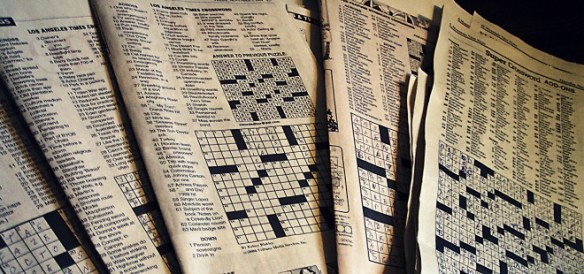
The Hunt for New Crossword-Friendly Vocabulary!

crossword1

Epee. Etui. Acai. Amie. Anoa. Oleo. Iota.

We’ve seen a lot of curious words in crosswords over the years. Some of them are blips on the radar, appearing for a bit then vanishing without a trace. Others become part of the fabric of crosswords, forever synonymous with those enigmatic black-and-white grids under the banner of “crosswordese.”

It does make me wonder, though. What words haven’t we seen yet? What curious combinations of vowels and consonants await solvers in the future? Will they be blips or will they be the stuff of legends?

So I decided to try out different words that were either heavy on vowels or had strange letter patterns to see which ones had appeared in The New York Times crossword and when, according to the database on XWordInfo. And I turned up some curious results.

COOEE hasn’t appeared since April 1996. FLYBY hasn’t been in since 2007. QWERTY has only appeared twice, and not in almost a decade.

And yet, equally strange words like VORPAL and CRWTH haven’t appeared at all.

It’s hard to predict what odd vocabulary will strike a chord with constructors.

obiwanobi

I mean, sure, there’s a whiff of disdain surrounding crosswordese, but surely as former obscurities become more familiar, crosswordese must evolve and move forward as well. What will be the new crosswordese?

It’s not like we’re going to have new rivers, mountains, bays, or other geographical areas, for the most part. (True, the Aral Sea is pretty much the Aralkum Desert now, but that hasn’t stopped constructors from continuing to reference it.)

But I’m getting off-topic. Where would we find this new potential grid fill?

There are some delightful nuggets of linguistic oddness lurking in old dictionaries that have promise as part of a new generation of crosswordese. I mean, ECHO and OCHO are all well and good, but what about OCHE?

That’s the line behind which a darts player must stand, by the way. Zero hits in XWordInfo.

You need peculiar letter combinations to help fill your grid? How about BADAUD, UGHTEN, YERK, CAGG, and BORT? I could easily see these weird words getting constructors out of some jams when it comes to grid construction.

Sure, we’d have to educate solvers on these words, but if we can make ETUI a well-known form of crosswordese, why not these?

(Yes, I know, you want definitions. Don’t worry, I’ve got you covered. A badaud is a dimwitted gossip-spreader who believes just about anything. Ughten is morning twilight, the light that appears in the sky before the sun rises. To yerk is to beat someone vigorously and with rapid efficiency. A bort is a poor-quality diamond or a fragment of such a diamond (as well as a license plate that commonly runs out at Itchy and Scratchy Land). A cagg is a solemn vow not to drink for a certain amount of time.)

None of those words have appeared in the Times according to XWordInfo. Except BORT, but even that hasn’t appeared since 1993. Which is amazing, because the BORT joke on The Simpsons I referenced above happened in October of 1994. Come on, constructors, don’t leave us hanging. BORT did not have to lapse into irrelevance.

Speaking of words that have fallen by the wayside, I decided to try lost positives next.

Lost positives are words that were previously commonplace, but have been lost to time, while words with negative connotations based on them have survived. You know inept, inert, disheveled, uncouth, unkempt, and inane, but how often do you see ept, ert, sheveled, couth, kempt, pecunious, or ane?

Thus, lost positives.

So what happened when I checked them against the XWordInfo database?

EPT has appeared in the Times — as slang or a joking reference — but ERT hasn’t (except as a Scottish word). Nor has SHEVELED. KEMPT isn’t exactly common, but it has appeared in the last five years. COUTH hasn’t since 2003.

ANE, meanwhile, has hundreds of appearances, but as a hydrocarbon suffix, a Wheel of Fortune reference (“an e”), or as part of Sue Ane Langdon’s name.

So there’s some potential here.

frenchenglishwords

[Image courtesy of A Date With An Amateur.]

Hey, ERT gives me an idea. If we’re really going to discover some exciting, strange, and unexpected new grid fill, I think we have to look toward other languages.

All sorts of words that originate in other languages end up as part of the expansive English vocabulary. As James Nicoll once said, “We don’t just borrow words; on occasion, English has pursued other languages down alleyways to beat them unconscious and rifle their pockets for new vocabulary.”

Why not continue on in that fine tradition and add to the potential puzzle word lexicon?

In the last few years, the concept of hygge has grown in popularity. Hygge is a Danish and Norwegian word for a mood of coziness and comfortable conviviality with feelings of wellness and contentment. You can see how people would latch onto the concept for themselves.

So I was surprised to discover that hygge hadn’t appeared in the NYT. That’s a letter pattern begging for crossings.

Personally, I think we should start with words like hygge. A word that exists in another language to describe a concept that there simply isn’t a word for in English.

Saudade, while a bit long for casual grid use, is another word that has started making the transition into English vernacular. Saudade is a deep emotional state of nostalgic or profound melancholic longing for an absent something or someone that one cares for and/or loves.

There is a world of vocabulary out there waiting to be harnessed for crossword obscurity, and there’s even a website dedicated to it.

If you check out Eunoia, you’ll find hundreds of foreign words to encapsulate moods and ideas, feelings and expressions that can plug holes both in your vocabulary and your grids.

Crossword.

Here’s a small sampling of words I found on the site that might help cruciverbalists who have constructed themselves into a corner:

Resfeber is a Swedish word for “the feeling of excitement and nervousness experienced by a traveler before undertaking a journey.”

Ubuntu is a Zulu word for “a quality that includes the essential human virtues, a combination of compassion and humility.”

Mångata is a Swedish word for “the road-like reflection of moonlight on water.”

Wegbier is a German word for “a beer you’re having on your way somewhere (i.e. a party).”

Karelu is a Tulu word for “the mark left on the skin by wearing something tight.”

Rauxa is a Catalan word for “sudden determination or action.”

Umay is a Tagalog word for “getting tired of a certain food.”

To Fernweh is to have a yearning to see distant places (in German).

Either half of wabi-sabi, a Japanese word meaning “finding beauty within the imperfections of life and peacefully accepting the natural cycle of growth and decay” could prove handy in a grid.

So I put the question to you, fellow puzzlers and PuzzleNationers. What words would you like to see appear in crosswords more? Where do you think we should look for fresh, new, peculiar crosswordese? Let us know in the comments section below. We’d love to hear from you!


Thanks for visiting PuzzleNation Blog today! Be sure to sign up for our newsletter to stay up-to-date on everything PuzzleNation!

You can also share your pictures with us on Instagram, friend us on Facebook, check us out on Twitter, Pinterest, and Tumblr, and explore the always-expanding library of PuzzleNation apps and games on our website!
An Act of Unintentional Puzzling?

Hey there, fellow puzzlers and PuzzleNationers. I’ve got a question for you today:

Have you ever accidentally created a puzzle for yourself?

It could take any number of forms.

A vase you accidentally knocked over and the pieces simply won’t fit back together (until you realize one of the pieces slipped under the table).

An item left in a prominent place, meant to remind you to do something, fix something, move something, accomplish something, complete something.

A Post-it note with a quickly scratched phrase that made total sense when you scribbled it down, but now proves to be nigh-incomprehensible gibberish. (Everyone at one point or another has jotted down a phone number and later struggled to decode it. At least, everyone before the advent of smartphones.)

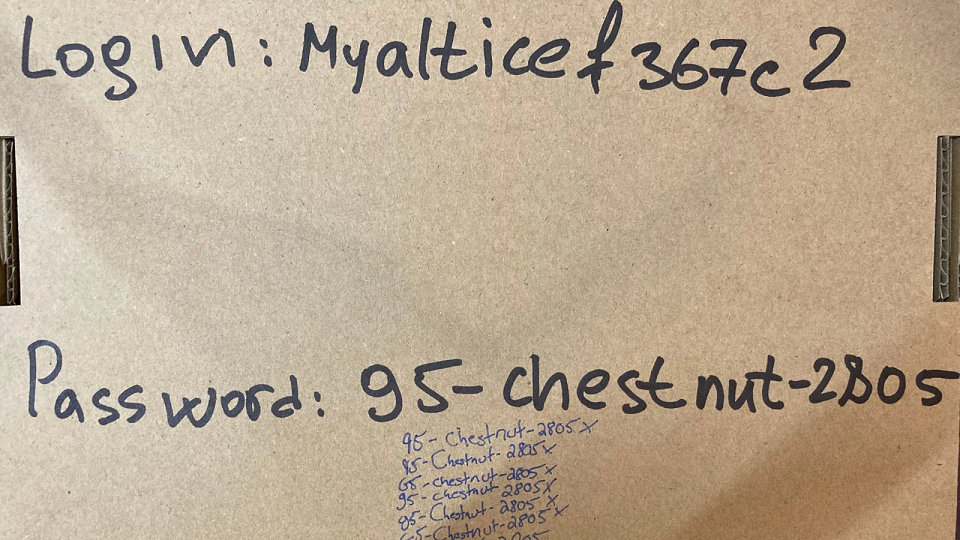
Gizmodo writer Brian Menegus was presented with a scenario similar to our last example when his modem stopped working. After it didn’t respond to reboots, being unplugged, or “strong language,” he ended up with a new modem after a service call.

All he needed to complete the process and rejoin the greater Internet community was to enter his log-in and password.

And therein lies the puzzle.

wifi password

The password didn’t work as written. The problem was… some of those characters are a little ambiguous.

The first character could be a lowercase G or a 9. The third-to-last could be an 8, an ampersand, or a capital B. Chestnut could be one word or two. There were a litany of different possible interpretations of what was written here.

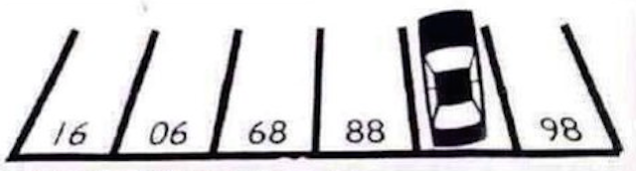
Multiple interpretations are at the heart of some visual puzzles. Long-time readers may remember the parking lot puzzle, where the solver must unravel how the numbering of spaces in this parking lot works:

The trick is simple: the numbers are upside-down.

Similarly, the wifi password employs a similar level of misdirection, although in this case, it’s quite unintentional.

As you can see from the scribblings at the bottom of the image, Menegus made a list of the possible permutations and tried them all one-by-one, a classic brute force form of puzzle-solving.

So, which version was it?

Well, after trying every combination and getting nowhere — and then resetting the modem to its factory settings — it turned out to be the most obvious one: 95-chestnut-2805.

Sadly, many of these self-made puzzles end up having frustratingly simple solutions.

Still, they do keep life interesting.


Thanks for visiting PuzzleNation Blog today! Be sure to sign up for our newsletter to stay up-to-date on everything PuzzleNation!

You can also share your pictures with us on Instagram, friend us on Facebook, check us out on Twitter, Pinterest, and Tumblr, and explore the always-expanding library of PuzzleNation apps and games on our website!

We’re Number Pun! We’re Number Pun! — The ReHASHtag Game

93621380_2954757837904277_3852074769562206208_n

You may be familiar with the board game Schmovie or hashtag games on Twitter.

For years now, we’ve been collaborating on puzzle-themed hashtag games with our pals at Penny Dell Puzzles, and this month’s hook was #PennyDellPuzzleSports. Today’s entries all mash up Penny Dell puzzles with teams, athletes, famous quotations, and more things associated with the world of sports!

Examples include: Seventh Inning Stretch Letters or Basketball For One.

(The entries leaned heavily towards baseball — understandably, since it only returned a few weeks ago.)

So, without further ado, check out what the puzzlers at PuzzleNation and Penny Dell Puzzles came up with!


Puzzly Athletes!

CrackerJackie Robinson

Simone Biles Says

Tara Blipsinski

Wayne Grepsky


Puzzly Teams!

Arizona Diamond Ringbacks

MilwauKeyword Brewers

Minnesota Twin Crosswords

Philadelphia Fill-Innies

Tampa Bay Sunrays

Washington Wizard Words

Orlando Magic Squares

Chicago Bull’s-Eye Spiral


Puzzly Sports Terminology!

FenWord Ways Park

Doubleheader Trouble

A Few Fielder’s Choice Words

Box Scoremaster / Lucky Box Score

Perfect Dart Game / Perfect Fit Game

Right of Way field

End Zone of the Line

End of the Line drive

BaseLine ‘Em Up

Base Pathfinder

Baseball Diamond Mine

Grand Tour slam

Draw the Defensive Lineman

False Start and Finish

Game, Set, Match-up!

Hall of Framework

These Three-Pointers

Super Bowl Game

Scramble Across & Touchdown

Picker-Upper Deck Home Runs


Puzzly Famous Quotations!

“Are you ready for some Quotefalls?!”

“…The Thrill of Victory and the Agony of Delete”

“I never said most of the Everything’s Relative I said.” – Yogi Berra

“This is like Deja vu All Four One again.” – Yogi Berra

“It ain’t Overlaps til it’s over.” -Yogi Berra

“Window Boxes isn’t everything, it’s the only thing” — Red Sanders

“…it seems to me they give these ball players now-a-days very peculiar names… Well, let’s see, we have… Guess Who’s on first, What’s Left on second, You Know the Odds is on third…”


Several of our puzzlers went above and beyond, crafting calls from the announcers at these puzzly events!

The Call of the Game presented by Hall of Framework puzzle announcer Neil Simon Says:

“There’s two Drop-Outs here in the bottom of the Nine of Diamonds, One & Only one man on base, and Wade Mind Boggler steps up to the plate for the Tampa Bay Sunrays. This will be his First and Last at bat of the Word Games World Series. The Pitcher Sleuth looks to his What’s Left, then checks his Right Angles, sets his feet and Square Deals the pitch. It’s swung on by Mind Boggler and holy cow it’s a walk-off Home Run! That Baseball for One was crushed to Bits & Pieces! The Scoreboard says it all folks with a Three-to-One victory for the Sunrays. Who in the world could Picture This kind of ending? Just wow!”


Wide World of Sports reporting from the National Figure Skating competition:

Today, during the synchronized figure skating event, The Ice Chips team, sponsored by Penny Dell Puzzles, began their program divided up into Pairs and glided out onto the ice Two at a Time, and Step by Step taking their positions Face to Face. They gracefully began their number, first skating in a Mirror Image, then dividing up into Odds and Evens. A Small Change in the pace of the music brought a sequence of fast mohawks, turns, spread eagles, swizzles, lifts, and a Shuffle.


Have you come up with any Penny Dell Puzzle Sports entries of your own? Let us know! We’d love to see them!

Thanks for visiting PuzzleNation Blog today! Be sure to sign up for our newsletter to stay up-to-date on everything PuzzleNation!

You can also share your pictures with us on Instagram, friend us on Facebook, check us out on Twitter, Pinterest, and Tumblr, and explore the always-expanding library of PuzzleNation apps and games on our website!
Rock Your World With These Puzzly Mysteries!

Dighton_Rock-Davis_photograph

[Image courtesy of Atlas Obscura.]

We’ve spent a lot of time over the last few months discussing treasure hunts, but those are far from the only puzzly adventures that can send solvers out into nature. If you prefer your puzzling to have a codebreaking or cryptographic angle, we’ve got you covered there as well.

There are three mysterious stones in the United States alone that bear mysterious messages that have boggled the minds of puzzlers for decades upon decades.

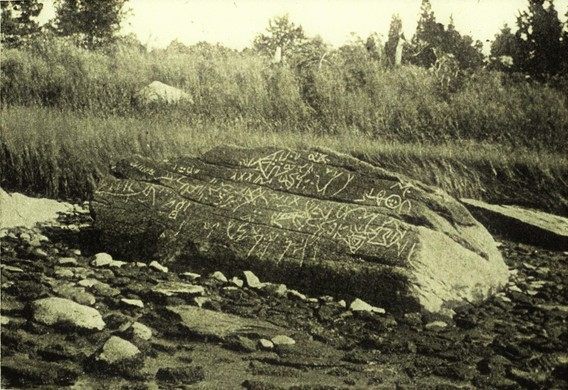
In Massachusetts, an eponymous state park museum is the home of the Dighton Rock, a stone covered in petroglyphs that has baffled viewers for centuries. (The earliest writings about the rock date back to 1690!)

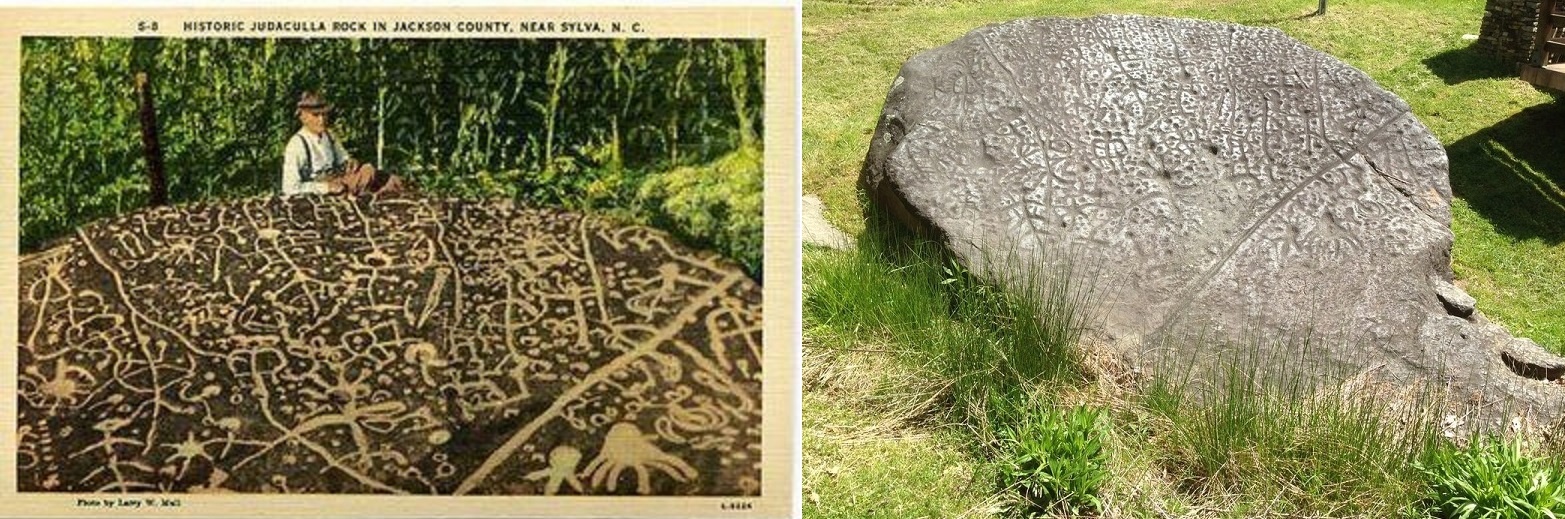
judaculla

[Images courtesy of Atlas Obscura. Look at the difference
between the two photos. Time is definitely running out…]

In the mountains of North Carolina, the petroglyphs of the Judaculla Rock defy decoding. Even dating the petroglyphs proves difficult, with estimates placing the origins of the rock’s message between 200 BC and 2000 BC. Sadly, efforts to solve the mystery of this former sacred site of the Cherokee people are fighting the forces of time itself, as erosion threatens the integrity of the glyphs.

And for solvers in the Southwest, New Mexico has the Decalogue Stone, which bears an inscription that, depending on the language used to decode it, could be a record of the Ten Commandments or a report from a lost explorer or warrior. (The possibility that it’s a hoax has been floated by more than one investigator as well.)

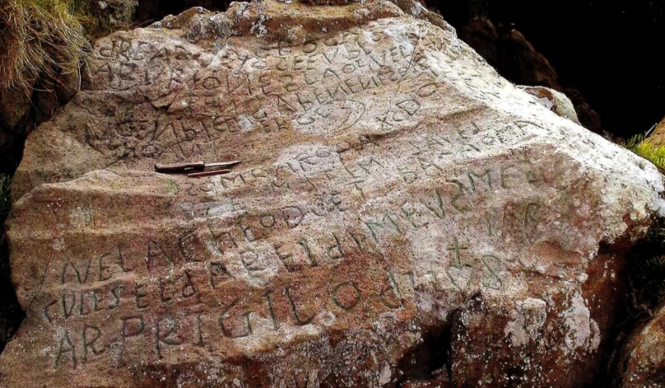
rock-inscription

[Image courtesy of The Connexion.]

But for today’s mystery, we turn toward the country of France, more specifically the village of Plougastel-Daoulas in Brittany, the home of a rock that has baffled solvers for at least a century.

Unlike the Dighton Rock, which was moved from the waterline of the Taunton River, the inscription on this rock spends most of its time submerged in the Atlantic Ocean, revealing itself only at low tide. The 20-line inscription utilizes letters from the French alphabet, but the actual language used has eluded solvers. Suggestions include Basque and Old Breton. (There are also two dates on the rock: 1786 and 1787.)

Those dates lead some articles to estimate that the inscription’s origins date back as far as 250 years, but I think that’s unlikely. The rock was only discovered four or five years ago, so that’s a huge window wherein those dates could’ve been carved into the rock.

So, what makes this rock so interesting, given the examples we’ve shared above? Well, this rock inspired the village of Plougastel-Daoulas to host a contest last year to decipher it, offering a prize of 2000 Euros to anyone who could translate it.

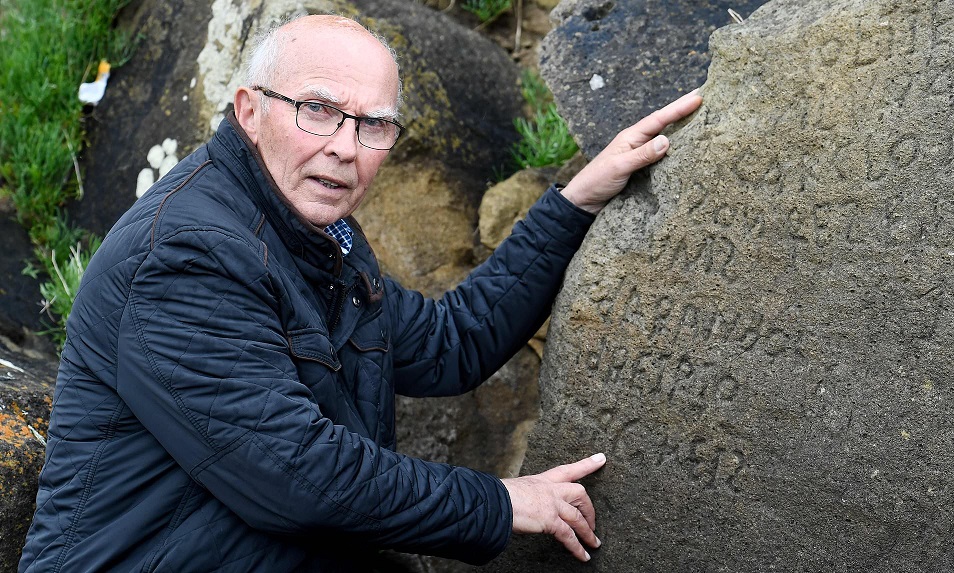
13445296-0-image-a-39_1557760832524

[Image courtesy of The Daily Mail.]

In February of this year, the prize was awarded to two solvers who pitched different solutions to the inscription:

The first hypothesis came from Noël René Toudic, professor of English, who has a degree in Celtic Studies. He said that the inscription was likely about a soldier, Serge Le Bris, who may have died at sea during a storm. Another soldier, Grégoire Haloteau, was then asked to engrave the rock in memory of the dead man.

The second hypothesis came from reporter and writer Roger Faligot, and comic book author and illustrator Alain Robert. They suggested that the inscription was by someone expressing their anger against those who caused the death of a friend.

Despite those pitches — and all of the headlines declaring the mystery solved — this case is not officially closed yet. Perhaps other towns will follow the Plougastel-Daoulas model to encourage both visitors and solvers.

It certainly couldn’t hurt.


Thanks for visiting PuzzleNation Blog today! Be sure to sign up for our newsletter to stay up-to-date on everything PuzzleNation!

You can also share your pictures with us on Instagram, friend us on Facebook, check us out on Twitter, Pinterest, and Tumblr, and explore the always-expanding library of PuzzleNation apps and games on our website!
Another Treasure-Filled Puzzle Hunt in the Works?

When it rains, it pours.

Just last week, after lamenting the (possible) end of Forrest Fenn’s famed treasure hunt, we spread the word about a new treasure hunt based in Michigan that had emerged unexpectedly from the ongoing circumstances caused by the Coronavirus.

As it turns out, Michigan may not be the only place an intrepid treasure-seeking puzzler can look for a challenge that ends with riches.

We recently received a message about the latest cache being hidden by “the Treasure Man” H. Charles Beil, a curious figure who is supposedly hiding caches of gold, coins, crystal skulls, and other valuables all over the country.

His goal is to hide a cache in each of the fifty states, and apparently, the hunt for his fifteenth cache — the Gallows Harbor Treasure Hunt — will soon be underway.

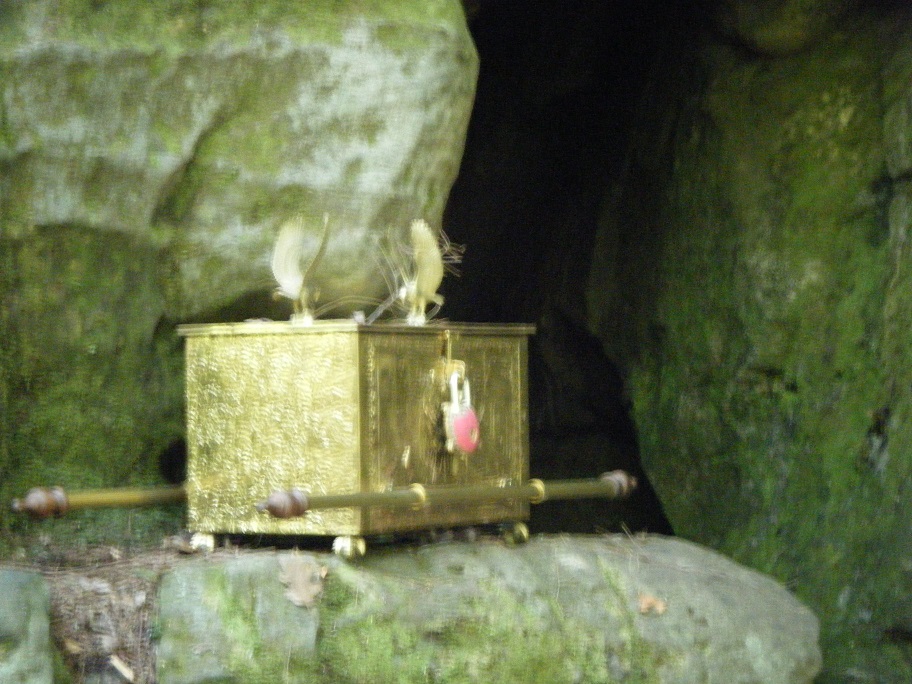
ark of the covenant

[This chest, designed to look like the Ark of the Covenant,
is supposedly already in place, awaiting cagey solvers.]

From the message, which was structured like a press release:

H.Charles Beil has hidden a multi-million dollar treasure weighing nearly a half ton in the Appalachian Mountains.

The treasure consists of six large brass chests, crystal skull signed by actor Dan Aykroyd and six smaller chests filled with gold, silver, precious gems, coins, pewter, jewelry, historical items and custom art objects.

I went looking for more information, and was a little surprised to see mentions of H. Charles Beil confined to treasure hunting forums and other odd corners of the Internet, rather than being reported in the major news outlets, as Forrest Fenn’s hunt was.

That’s especially curious if five of the caches have been found. How were none of them reported in online news sources? (At least, as far as I could tell.)

Of course, Fenn’s treasure hunt was quiet for years before it gained mainstream press, so it’s not impossible that this has flown under the radar, just highly unlikely.

The Treasure Man caches have evocative names like The Lost Cache of Wolf Run, The Secret Lovers Lost Cache, or The Legend of Woodsy Swamp, and they’re often steeped in local lore. (Click here for a rundown of many of the caches.)

Although sites like GallowsHarbor.com and TheTreasureMan.com have some details, they’re more like teases — hints you’d expect in a promotional campaign — instead of fully informational sources. It appears that most of the helpful information for these hunts are tied to the Treasure Man’s Facebook Group, where many hunters post videos and information relating to their efforts to hunt down these caches.

The Gallows Harbor Treasure Hunt is apparently tied to a book that hasn’t been released yet. This does make the websites, as well as all the cloak-and-dagger elusiveness feel like a PR stunt to sell a book, rather than a puzzly adventure. But again, I have no proof one way or the other.

gallows harbor

I wish I had more details to share with you, fellow puzzlers and PuzzleNationers. It seems like the most useful and accessible source of information about the caches is Mysterious Writings, a website and YouTube account dedicated to treasure hunts of all sorts. You can check them out here and here.

If this is all true, then it’s a marvelous endeavor that is bringing joy and excitement to adventurous solvers all over the country. If it’s not, then it’s a fairly elaborate and well-constructed hoax that will hopefully boost some book sales for the Treasure Man.

Either way, it’s an interesting story, one that we hope sparked your imagination and your puzzly spirit.


Thanks for visiting PuzzleNation Blog today! Be sure to sign up for our newsletter to stay up-to-date on everything PuzzleNation!

You can also share your pictures with us on Instagram, friend us on Facebook, check us out on Twitter, Pinterest, and Tumblr, and explore the always-expanding library of PuzzleNation apps and games on our website!