A Deduction Puzzle for Independence Day!

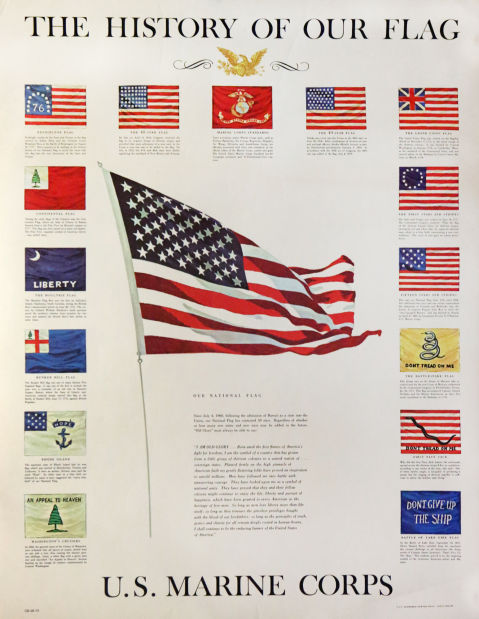
historyoftheflag

[Image courtesy of NWI Times.]

It’s Independence Day, and is there any better way to celebrate the history of America than with a little deduction puzzle based on some classic American symbols? I hardly think so!

Good luck and Happy Fourth of July!


To celebrate America’s birthday, a group of five enthusiastic vexillologists — devotees of the study of flags — decided to stage five days of presentations about different flags from American history.

Each person presented a different flag’s history each day (the thirteen-star flag, the fifty-star flag, the Don’t Tread on Me flag, the Marine Corps flag, or the Coast Guard flag), and the presentations were performed in a different order each day (first, second, third, fourth, or fifth).

Each vexillologist presented one flag per day, and none of them repeated a flag presentation across the five days. Similarly, none of the flag presentations happened in the same order each day. So, for instance, if a flag was first in the order on July 3rd, it wouldn’t be first in the order any other day.

Can you complete the schedule of flag presentations below?

7-4pairoff

Are you having any puzzly celebrations for Independence Day? Let us know in the comments section below, we’d love to hear from you!


Thanks for visiting PuzzleNation Blog today! Be sure to sign up for our newsletter to stay up-to-date on everything PuzzleNation!

You can also share your pictures with us on Instagram, friend us on Facebook, check us out on TwitterPinterest, and Tumblr, and explore the always-expanding library of PuzzleNation apps and games on our website!

PuzzleNation Product Review: Codenames

codenames0

There are all kinds of games where communication is crucial.

In You’ve Got Crabs, you must employ a secret non-verbal signal to inform your partner that you’ve completed a task, but without the other team spotting your signal and intercepting. In Taboo, you have to get a teammate to state a particular word, but without using several words closely associated with the answer.

But other games ratchet up both the creativity necessary to win and the difficulty involved in doing so. Imagine having to communicate volumes with a single word.

In today’s product review, we delve into the world of spycraft and put our communication skills to the test as we try out the card game Codenames.

codenames4

In Codenames, two teams (the red team and the blue team) are tasked with identifying all of their secret agents before their opponents can locate their own agents from the same list. But in order to do so, they must pick those agents out of a field of 25 possible individuals.

In each group, there are red agents, blue agents, innocent bystanders, and an assassin. Each possible individual is marked with a codename that is viewable by all of the players.

So, where does the wordplay and communication come in?

Each team selects one player apiece to serve as the spymaster. The spymaster for each team looks at one of the secret patterns determining which cards/codenames represent blue agents and which red agents.
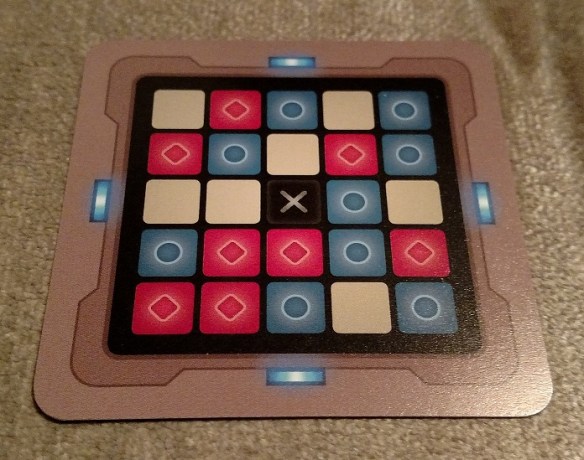
codenames3

So it’s up to the spymaster to point the players in the right direction, but it’s up to the players to actually choose a given person in the field of 25 and label them an agent.

Each round, the spymaster comes up with a one-word clue for the other players on their team that points to their secret agents (as well as a number representing the number of agents in the field that the clue applies to). The word must be specific enough to point them in the right direction, but that can be difficult depending on the words in your play area.

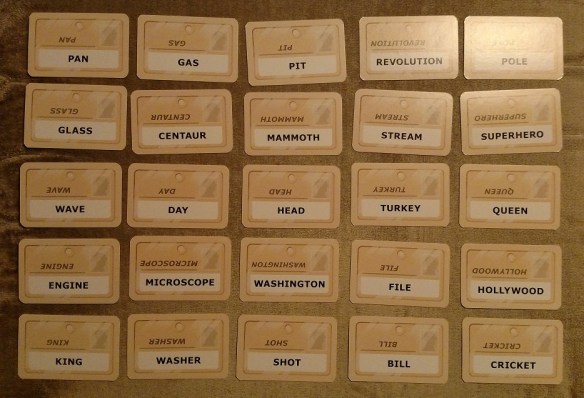
For instance, in our example grid, the clue “royalty: 1” could point toward KING, or QUEEN, or HEAD, or even REVOLUTION, depending on what the other players associate with the word “royalty.” But suppose that you want your players to choose KING and not QUEEN. Then “royalty” is no good, because it’s too vague.

The number aspect of the clue is also important, because it offers the opportunity to gain an advantage over your opponents. For instance, if you wanted both KING and QUEEN to be labeled as your agents, the clue “royalty: 2” would be good, because those would probably be the two most likely choices based on that clue.

codenames2

In our example grid, the red team went first, and the spymaster said “dishes: 2.” The other player on the red team chose GLASS and WASHER from the grid, and both were correct and marked with red agent cards. This was a smart play, but also a risky one, as PAN could also be associated with “dishes.”

The blue team responded with the clue “rasp: 1,” choosing specificity and a single possible answer for the sake of certainty, rather than risk trying for more than one agent in this turn. The blue player correctly selected FILE, and that card was marked with a blue agent card.

The next turn for the red team didn’t go nearly as well. The spymaster used the clue “big: 1” and instead of choosing SHOT (the intended answer), the player opted for MAMMOTH. The card was revealed to be an innocent bystander, and the red team’s turn was immediately over for failing to ID an agent that turn.

And that is one of the big strategic challenges of Codenames. Do you stick to 1 agent per turn with a greater chance of success, or do you try to get more creative and bold by going for less certain clues that could lead to multiple agent IDs in one fell swoop? Do you risk uncovering the assassin (and immediately losing the game) with a clue that could suggest him as well as a secret agent for your team?
codenames1

The field of codenames in the play area can also lead to unexpected challenges. In one game, I was playing the spymaster for my team. The words JUPITER and SATURN were both in the grid, but only JUPITER was one of our agents. So a clue like “planet” was out. Unfortunately, other clues (like “biggest” or “god”) were excluded because they also applied to other codenames in the play area, including the dreaded assassin.

A mix of tactics, efficiency, association, vocabulary, and luck, Codenames is a terrific game that will test your wits, your communication skills, and your ability to make every word count.

The sheer volume of possible codenames (as well as the increased variety offered by each card being double-sided) ensues a huge amount of replay value is built into the game. And not only is it great as a group game, but the two-player version is just as fun!

Codenames, playable for 4 to 8 players (with variant rules for 2 or 3 players) is available at Target, Barnes & Noble, and many online retailers.


Thanks for visiting PuzzleNation Blog today! Be sure to sign up for our newsletter to stay up-to-date on everything PuzzleNation!

You can also share your pictures with us on Instagram, friend us on Facebook, check us out on TwitterPinterest, and Tumblr, and explore the always-expanding library of PuzzleNation apps and games on our website!

Puzzle Furniture Meets Musical Innovation!

[Image courtesy of Praktrik.]

Puzzle furniture is an intriguing, complex subset of the puzzling world that requires skill, craftsmanship, dedication, and ingenuity working in tandem in order to create a single piece.

Now, those qualities are staggeringly common amongst puzzlers. After all, those words apply to many of the constructors and puzzle designers I know, because they all take great pride in their creations, whether we’re talking mechanical puzzles, puzzle grids, or interactive solving events like puzzle hunts or escape rooms.

But there’s something about puzzle furniture that adds an additional wow factor to the endeavor. Sometimes you’re the one assembling the puzzle, as you do with tables from our friends at Praktrik. Other times, you’re unraveling the hidden secrets of what appears, at first, to be a deceptively ordinary (yet still exquisite) piece of furniture, like the ones created by Craig Thibodeau.

Whether you’re finding hidden buttons, using magnets to reveal concealed storage areas, or sliding aside wooden pieces to reveal keyholes or additional hints, pieces of puzzle furniture like the one featured above are challenging and unforgettable solving experiences.

But I don’t think I’ve ever seen one as unique or as mind-boggling as this creation by Kagen Sound…

A musical puzzle table.

Kagen Sound, formerly known as Kagen Schaefer, has built an impressive reputation for unusual and visually striking puzzle furniture. One piece requires you to rotate different rings on a table surface in order to form patterns that unlock other features. Another is a puzzle box that demands nineteen specific moves in the correct order before you can open the lid.

And even these difficult puzzles pale in comparison to one where music is part of the solution.

Each drawer, when opened or closed, produces a different note. But there are additional drawers that must be unlocked before you can perform the entire piece of music concealed within the table.

It’s a remarkable design that rewards patience and experimentation as well as puzzly skill, and I could easily imagine losing hours upon hours exploring the table and trying different patterns and chains of movement in order to unlock other drawers or reveal additional secrets.

I think what makes this brand of puzzling so intriguing and so charming is how it employs old-world craftsmanship with hands-on solving. Although Kagen doesn’t employ 3-D printing or computer modeling, I know that many mechanical puzzle designers incorporate modern tools into classic puzzle styles.

The creativity of puzzle designers like Kagen Sound is truly boundless, and every time I think I’ve seen every trick, every puzzle, or every variation out there, I am gladly, gleefully surprised by twists, reinventions, and fresh ideas I could never have even imagined.

[You can check out more of Kagen’s designs on his website, as well as on this Pinterest board featuring previous works of his.]


Thanks for visiting PuzzleNation Blog today! Be sure to sign up for our newsletter to stay up-to-date on everything PuzzleNation!

You can also share your pictures with us on Instagram, friend us on Facebook, check us out on TwitterPinterest, and Tumblr, and explore the always-expanding library of PuzzleNation apps and games on our website!
Solo Solving and Single-Player Board Game Fun!

Have you ever been in the mood to play a board game or do some non-paper-and-pencil puzzling, but you don’t have anyone around to play with?

Well, there’s no reason to fret, fellow puzzlers, as there are plenty of options out there for solo gamers and puzzlers.

Today, we’d like to suggest a few options for a terrific single-player solving experience!


The Abandons

I’ll start us off with one of our most recently reviewed games. The Abandons is a one-player maze game where you’re exploring a labyrinth that’s different every time you play. You’re at the mercy of the draw pile for the most part, but the more you play, the better you get at managing your meager resources and exploring the seemingly endless corridors. Can you find your way out?

[If you’re looking for a similar gaming experience, you can also try One Deck Dungeon or Brad Hough’s The Maze.]

photo-1024x7682

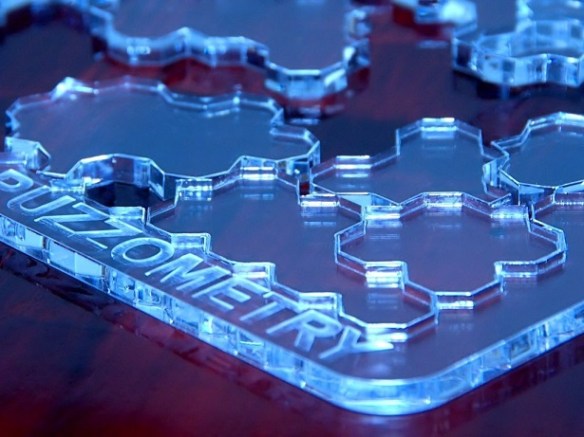
Puzzometry

For a more traditional solving experience, Puzzometry presents classic puzzle-solving with a modern twist. This next-level jigsaw-style solving will push your Tetris skills as you twist, turn, and maneuver the pieces into seemingly endless combinations, trying to find the one solution that completes the grid.

There are several different Puzzometry puzzles — the standard one, an easier junior one, and a squares-based one — but each offers its own challenges.

Knot Dice

Can you twist, turn, and spin these dice to complete beautiful, elaborate patterns inspired by Celtic knots? That’s the name of the game with Knot Dice, a dice game as challenging as it is gorgeous.

This is one of those games I find tremendously relaxing as I trace the various patterns and try to form different designs.

Chroma Cube

Deduction puzzles have never been so colorful! Each challenge card offers a different layout of set cubes, along with clues to unravel in order to place all twelve cubes. The clues grow trickier with every card, ensuring that you’ll constantly find new challenges as you solve.

Thinking Putty Puzzle

Our friends at ThinkFun are masters at putting together single-player puzzle-game experiences, and Thinking Putty Puzzle is just one example. It sounds simple at first: connect two colored dots with a length of stretchable putty. But when you have multiple colors on the board and you can’t overlap your paths, suddenly it’s a much more challenging deductive endeavor.

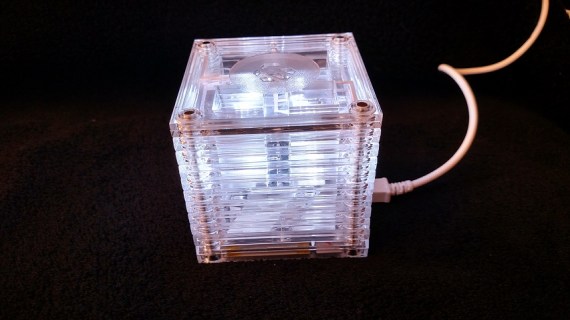
Lightbox

A puzzle box unlike anything you’ve ever seen, Lightbox creates different patterns of shadow and light as you shift and arrange the various plastic plates that make up the box. As you twist and reset them, different electrical connections are made, and different plates light up.

This is another puzzle game that I find quite soothing, even if I can be frustrated by the seemingly endless combinations available.

pandemicgame

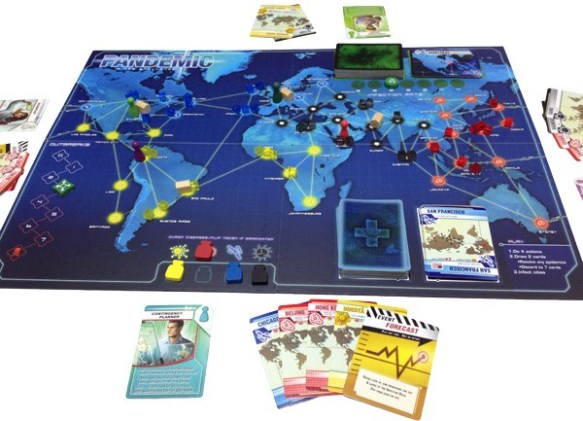
Pandemic

Although co-op games are designed to bring together several players as they work to defeat the game itself, many co-op games also offer satisfying single-player campaigns. Pandemic allows you the chance to singlehandedly save the world from four deadly outbreaks, if you’re quick and clever enough!

[Forbidden Island, Castle Panic!, and other co-op games are also worth your time if you enjoy this kind of gameplay.]

Do you have any suggestions for good single-player puzzles and games, fellow puzzlers? Let us know in the comments section below! We’d love to hear from you!


Thanks for visiting PuzzleNation Blog today! Be sure to sign up for our newsletter to stay up-to-date on everything PuzzleNation!

You can also share your pictures with us on Instagram, friend us on Facebook, check us out on TwitterPinterest, and Tumblr, and explore the always-expanding library of PuzzleNation apps and games on our website!

A Coin Puzzle: My Two Cents (Plus 97 More)

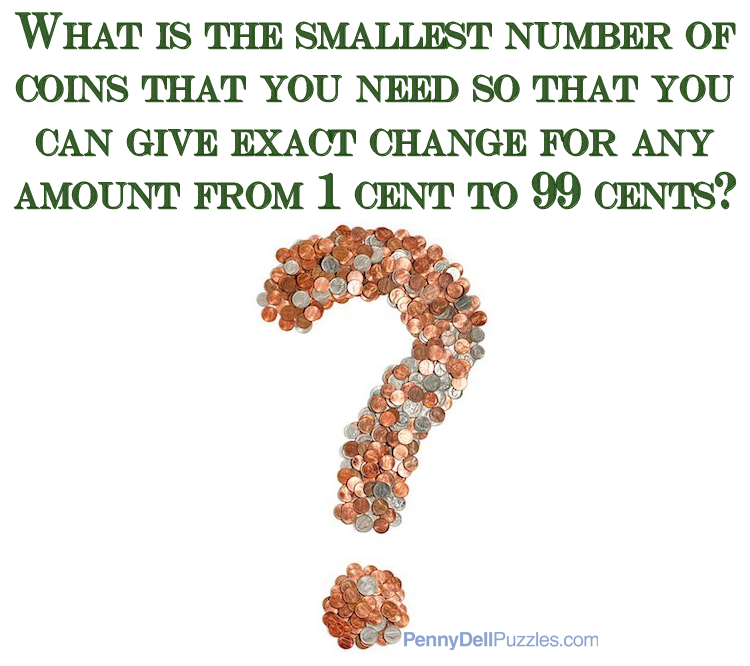
Our friends at Penny Dell Puzzles recently shared the following brain teaser on their social media:

Naturally, we accepted the challenge.

Now, before we get started with this one, we have to add one detail: which coins we’re allowed to use. It’s safe to assume that pennies, nickels, dimes, and quarters are available, but the question doesn’t say anything about half-dollar coins.

So we’re going to figure out the correct answer without half-dollar coins available, and then with half-dollar coins available.

Let’s begin.


[Image courtesy of How Stuff Works.]

The easiest way to get started is to figure out the smallest number of coins we need to make 99 cents, since that’s the highest number we need to be able to form. Once we have that info, we can work backwards and make sure all the other numbers are covered.

For 99 cents, you need 3 quarters, 2 dimes, and 4 pennies. That’s 25 + 25 + 25 + 10 + 10 + 1 + 1 + 1 + 1 = 99.

Right away, we know we’re close with these 9 coins.

You don’t need more than 3 quarters, for instance, because your possible totals are all below $1.

Now, let’s make sure we can form the numbers 1 through 24 with our chosen coins. (If we can, we’re done, because once we’ve covered 1 through 24, we can simply add one quarter or two quarters to cover 25 through 99.)

Our four pennies cover us for 1 through 4. But wait, there’s 5. And we can’t make 5 cents change with 4 pennies or 2 dimes. In fact, we can’t make 5, 6, 7, 8, or 9 cents change without a nickel.

So let’s add a nickel to our current coin count. That makes 3 quarters, 2 dimes, 1 nickel, and 4 pennies. (Why just 1 nickel? Well, we don’t need two, because that’s covered by a single dime.)

Our four pennies cover 1 through 4. Our nickel and four pennies cover 5 through 9. Our dime, nickel, and four pennies cover 1 through 19. And our two dimes, one nickel, and four pennies cover 1 through 29. (But, again, we only need them to cover 1 through 24, because at that point, our quarters become useful.)

That’s all 99 possibilities — 1 through 99 — covered by just ten coins.

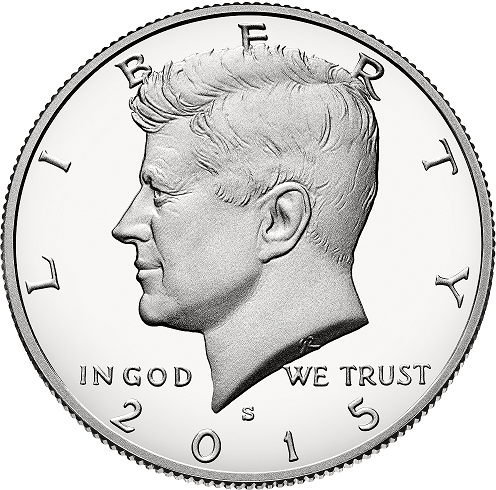
[Image courtesy of Wikipedia.]

But what about that half-dollar?

Well, we can apply the same thinking to a coin count with a half-dollar. For 99 cents, you need 1 half-dollar, 1 quarter, 2 dimes, and 4 pennies. That’s 50 + 25 + 10 + 10 + 1 + 1 + 1 + 1 = 99.

Now, we make sure we can form the numbers 1 through 49 with our chosen coins. (Once we can, we can simply add the half-dollar to cover 50 through 99.)

Once again, we quickly discover we need that single nickel to fill in the gaps.

Our four pennies cover 1 through 4. Our nickel and four pennies cover 5 through 9. Our dime, nickel, and four pennies cover 1 through 19. Our two dimes, one nickel, and four pennies cover 1 through 29. And our one quarter, two dimes, one nickel, and four pennies cover 1 through 54. (But, again, we only need them to cover 1 through 49, because at that point, our half-dollar becomes useful.)

That’s all 99 possibilities — 1 through 99 — covered by just nine coins.


Thanks for visiting PuzzleNation Blog today! Be sure to sign up for our newsletter to stay up-to-date on everything PuzzleNation!

You can also share your pictures with us on Instagram, friend us on Facebook, check us out on TwitterPinterest, and Tumblr, and explore the always-expanding library of PuzzleNation apps and games on our website!

PuzzleNation Product Review: Zendo Expansion

[Note: I received a free copy of this game in exchange for a fair, unbiased review. Due diligence, full disclosure, and all that. And this concludes the disclaimer.]

Expansion sets have become an integral part of the gaming experience. Whether they offer new wrinkles to an established game, allow you to add additional players, or create new ways to use the same game pieces, they revitalize games that might’ve become less fun or interesting after lots of play.

It’s difficult to strike a balance with expansion sets, since they must respect the game that came before and add to it in a meaningful way, but without introducing any game-breaking mechanics or otherwise compromising what made the original game fun in the first place.

The designers at Looney Labs are absolute pros when it comes to balancing their expansion packs. Each one enhances the gameplay without sacrificing any of the original game’s clarity or cohesiveness.

In the past, we’ve looked at Looney Labs expansions like Fluxx Dice (which add further mayhem to an already chaotic game of Fluxx), the Just Coffee and Better with Bacon expansions for Just Desserts (which add new dishes and characters to deepen gameplay options), and the Bridge Expansion for Star Trek Fluxx and Star Trek: The Next Generation Fluxx (which allow you to combine both games into one).

Today, we’re looking at an expansion pack for one of the company’s most immersive and challenging puzzle games: Zendo.

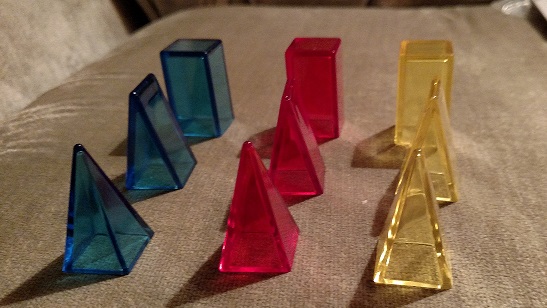
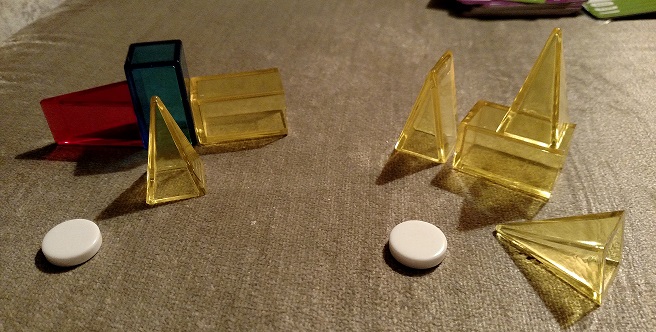
In Zendo, the players pull pieces from a communal pile in order to build different structures, using pyramids, wedges, and blocks. One player, the moderator, chooses a secret rule for the players to uncover, and builds two structures. One of these structures follows the secret rule, and one does not, and both are marked as such.

Secret rules can be as simple as “must contain all three shapes” or “must contain exactly four pieces.” They can be as complex as “must contain more blue pieces than blocks” or “must contain at least one yellow piece pointing at a blue piece.” Some rules involve how pieces touch, or how they’re stacked, while others demand no touching or stacking whatsoever. The field is wide open at the start of the game.

Players then try to deduce the secret rule by building structures themselves, arranging pieces from the communal pile into various patterns and asking the moderator for more information.

So, how does the Zendo Expansion affect the original?

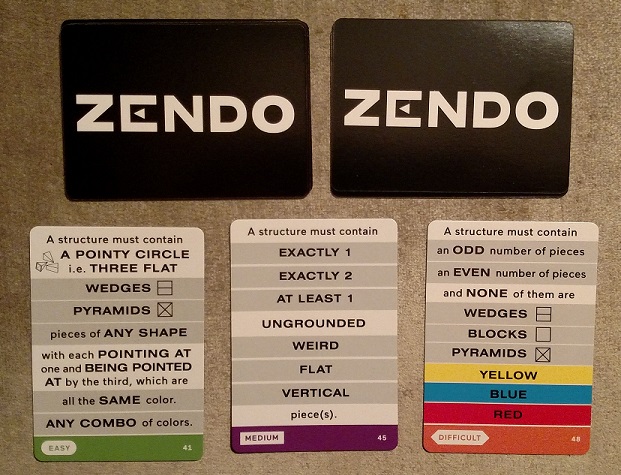
[The gray areas of the card are variable options to choose from, meaning each card offers several different possible rules depending on the moderator’s choices.]

The Zendo Expansion is a ten-card deck of new secret rule cards that allow the moderator to create more complex and challenging structures for the other players to unravel.

But these ten cards offer much more than just the rules themselves. They encourage both the moderator and the players to be more creative, considering not just the shapes and how they interact, but the overall look of the structure.

One of the cards requires players to shape the structure’s shadow into a given shape. Moving beyond the pieces themselves and incorporating the light and shadow of the play area is a clever and unexpected way to use the Zendo pieces.

It immediately sends your brain in new directions, both as a player trying to deduce other secret rules in later game sessions and as a moderator looking for new ways to prove or disprove players’ theories with your own builds.

Not only does the Expansion deck add all sorts of new twists on the original game, but it makes you want to be more ambitious and clever in your guesses and structures the more you play.

With new rule cards ranging from easy to difficult, players of all skill levels will benefit from adding this set of cards to their puzzle game arsenal.

Zendo and the Zendo Expansion are available from Looney Labs, and both are featured in this year’s Holiday Puzzly Gift Guide!


Thanks for visiting PuzzleNation Blog today! Be sure to sign up for our newsletter to stay up-to-date on everything PuzzleNation!

You can also share your pictures with us on Instagram, friend us on Facebook, check us out on TwitterPinterest, and Tumblr, and explore the always-expanding library of PuzzleNation apps and games on our website!