Puzzles in Pop Culture: Square One TV

Puzzles in Pop Culture is all about chronicling those moments in TV, film, literature, art, and elsewhere in which puzzles play a key role. In previous installments, we’ve tackled everything from The West Wing, The Simpsons, and M*A*S*H to MacGyver, Gilmore Girls, and various incarnations of Sherlock Holmes.

And in today’s edition, we’re jumping into the Wayback Machine and looking back at the math-fueled equivalent of Sesame Street: Square One TV!

[The intro to Square One TV, looking more than a little dated these days.]

This PBS show ran from 1987 to 1994 (although reruns took over in 1992), airing five days a week and featuring all sorts of math-themed programming. Armed with a small recurring group of actors, the writers and producers of Square One TV offered many clever (if slightly cheesy) ideas for presenting different mathematical concepts to its intended audience.

Whether they were explaining pie charts and percentages with a game show parody or employing math-related magic tricks with the aid of magician Harry Blackstone, Jr., the sketches were simple enough for younger viewers, but funny enough for older viewers.

In addition to musical parodies performed by the cast, several famous musicians contributed to the show as well. “Weird Al” Yankovic, Bobby McFerrin, The Fat Boys, and Kid ‘n’ Play were among the guests helped explain fractions, tessellations, and other topics.

[One of the many math-themed songs featured on the show.]

Two of the most famous recurring segments on Square One TV were Mathman and Mathcourt. (Sensing a theme here?)

Mathman was a Pac-Man ripoff who would eat his way around an arcade grid until he reached a number or a question mark (depending on this particular segment’s subject).

For instance, if he came to a question mark and it revealed “3 > 2”, he could eat the ratio, because it’s mathematically correct, and then move onward. But if he ate the ratio “3 < 2”, he would be pursued by Mr. Glitch, the tornado antagonist of the game. (The announcer would always introduce Mr. Glitch with an unflattering adjective like contemptible, inconsiderate, devious, reckless, insidious, inflated, ill-tempered, shallow, or surreptitious.)

Mathcourt, on the other hand, gave us a word problem in the form of a court case, leaving the less-than-impressed district attorney and judge to establish whether the accused (usually someone much savvier at math than them) was correct or incorrect. As a sucker for The People’s Court-style shenanigans, this recurring segment was a personal favorite of mine.

But from a puzzle-solving standpoint, MathNet was easily the puzzliest part of the program. Detectives George Frankly and Kate Tuesday would use math to solve baffling crimes. Whether it was a missing house, a parrot theft, or a Broadway performer’s kidnapping, George and Kate could rely on math to help them save the day.

These segments were told in five parts (one per day for a full week), using the Dragnet formula to tackle all sorts of mathematical concepts, from the Fibonacci sequence to calculating angles of reflection and refraction.

These were essentially word problems, logic problems, and other puzzles involving logic or deduction, but with a criminal twist. Think more Law & Order: LCD than Law & Order: SVU.

Granted, given all the robberies and kidnappings the MathNet team faced, these segments weren’t aiming as young or as silly as much of Square One TV‘s usual fare, but they are easily the most fondly remembered aspect of the show for fans and casual viewers alike.

Given the topic of Tuesday’s post — the value of recreational math — it seemed only fitting to use today’s post to discuss one of the best examples of math-made-fun in television history.

Square One TV may not have been nearly as successful or as long-lasting as its Muppet-friendly counterpart, but its legacy lives on in the hearts and memories of many puzzlers these days.


Thanks for visiting PuzzleNation Blog today! Be sure to sign up for our newsletter to stay up-to-date on everything PuzzleNation!

You can also share your pictures with us on Instagram, friend us on Facebook, check us out on TwitterPinterest, and Tumblr, and explore the always-expanding library of PuzzleNation apps and games on our website!

A pickle of a puzzler!

A little touch of absurdity never hurts when it comes to a good logic problem or brain teaser.

There’s the classic river-crossing puzzle (with either a fox, a goose, and a bag of beans and or a wolf, a goat, and a cabbage) that challenges you to get all three across without one eating one of the others, but it never explains why you have a wolf or a fox in the first place!

We never really question why we need to know the weights of castaways or why knowing the color of your hat might save your life; we just accept the parameters and forge onward.

Some brain teasers, curiously enough, seem intentionally nonsensical by design. Many claim that Lewis Carroll’s famous Alice in Wonderland riddle “Why is a raven like a writing-desk?” was created without a solution. Of course, that hasn’t stopped many (myself included) from posing solutions to the riddle anyway.

And that brings us to today’s brain teaser — “Pickled Walnuts” by Hubert Phillips — which I discovered on io9.com:

You are given a series of statements which may seem to you more or less absurd. But, on the assumption that these statements are factually correct, what conclusion (if any) can be drawn?

1. Pickled walnuts are always provided at Professor Piltdown’s parties.
2. No animal that does not prefer Beethoven to Mozart ever takes a taxi in Bond Street
3. All armadillos can speak the Basque dialect.
4. No animal can be registered as a philatelist who does not carry a collapsible umbrella.
5. Any animal that can speak Basque is eligible for the Tintinnabulum Club.
6. Only animals that are registered philatelists are invited to Professor Piltdown’s parties.
7. All animals eligible for the Tintinnabulum Club prefer Mozart to Beethoven.
8. The only animals that enjoy pickled walnuts are those who get them at Professor Piltdown’s.
9. Only animals that take taxis in Bond Street carry collapsible umbrellas.

I will tell you, as a starter, that a conclusion CAN definitively be drawn from these statements. (Honestly, if there wasn’t some solution, I wouldn’t waste your time with it.)

So, what conclusion can be drawn from these statements?

Armadillos do not enjoy pickled walnuts!

How do I know this for sure? Allow me to walk you through my deductive process.

We know that all armadillos speak Basque, according to statement 3. Therefore, according to statement 5, armadillos are eligible for the Tintinnabulum Club.

Now, according to statement 7, armadillos prefer Mozart to Beethoven. But, in statement 2, we’re told that no animal that does not prefer Beethoven to Mozart ever takes a taxi in Bond Street, which means that armadillos do NOT take taxis in Bond Street.

Therefore, according to statement 9, armadillos do not carry collapsible umbrellas, which also disqualifies them from being registered as philatelists, according to statement 4. And since only registered philatelists are invited to Professor Piltdown’s parties (according to statement 6), armadillos are not invited to the Professor’s parties.

Finally, statement 8 tells us that the only animals that enjoy pickled walnuts are those who get them at Professor Piltdown’s, which means armadillos do not enjoy pickled walnuts!

Honestly, I didn’t find this brain teaser particularly difficult because you can find those middle links very quickly, and by linking more and more statements, you eventually find the two ends — armadillos and pickled walnuts — and your conclusion is waiting for you.

This would’ve been a more difficult puzzle if some red-herring statements were thrown in that didn’t connect to the rest, like “All squirrels on Beaumont Avenue have Tuesdays off” or “The birdbaths on Bond Street were designed by a German sculptor who enjoyed hot dogs.”

Nonetheless, this is a terrific exercise in finding order in what at first appears to be chaos. It’s what puzzlers do: we make sense of the universe, one puzzle at a time.


Thanks for visiting PuzzleNation Blog today! Be sure to sign up for our newsletter to stay up-to-date on everything PuzzleNation!

You can also share your pictures with us on Instagram, friend us on Facebook, check us out on TwitterPinterest, and Tumblr, and explore the always-expanding library of PuzzleNation apps and games on our website!

PuzzleNation Product Review: ThinkFun’s Laser Maze Jr.

Whether you’re unraveling locks and ropes in Houdini, bending gravity to your will in Gravity Maze, making music note-by-note with Compose Yourself, or mastering the basics of programming in Robot Turtles, playing with the puzzle games by ThinkFun always encourages you to learn while you solve.

Today, we see if Laser Maze Jr. matches the high standard set by those other puzzly products.

Now, for those of you familiar with the original Laser Maze, you might be expecting a simplified version, akin to the Jr. versions of Rush Hour or other puzzle games where the difficulty lessens but the game remains the same. Worry not. Laser Maze Jr. is actually a heavy redesign that keeps the best aspects of the original and tailors itself to players as young as 6, both in gameplay and in safety.

Perhaps the biggest change from the original is the board itself.

Not only is the laser fixed in place, but the board is surrounded by red plastic barriers that both protect young eyes and highlight where the beam is projecting at any given time. You would have to seriously tamper with the game to endanger your eyes with this layout; with the original, there was a greater (though still quite slim) chance that unmonitored gameplay could lead to an accident.

The laser also has a switch instead of a button to press, so if you choose, you can leave the laser on and see the beam’s path change as you add elements to the game board. As a learning tool, this is a super-helpful feature for younger minds. (The original encouraged more of a wait-and-see approach to placing the elements.)

The final change to the board’s layout involves the cards that provide the specifics of each puzzle. Instead of small cards that tell you which elements are fixed and which you add in order to solve the puzzle and light up the targets, the new cards actually slide into place beneath the board, showing you where to place the set pieces. Again, ease of setup and play is a main consideration.

The game pieces also got retooled. Instead of the gateway piece that players had to direct the laser beam through en route to the targets, Laser Maze Jr. has large rocks that block the laser’s path. This is a simple, effective way of providing obstacles for younger solvers to overcome.

The three light-up targets have been replaced with two light-up rockets. While this does eliminate some of the most complex puzzles from the original game, that’s forgivable, given that this is intended for younger solvers.

I was slightly disappointed with the laser, though. It’s less powerful than the previous one (either that or the rockets don’t light up as brightly as the original targets), and to be honest, part of the appeal of the puzzle is seeing your targets light up when you’re done!

[Taken at night with most of the lights off. Unless you’re willing to play in near-darkness — and use the night feature on your camera — the end result won’t be as bright.]

The 40 puzzles (2 on each challenge card) range from easy to super-hard, and solving them in order is a great way to slowly introduce new players to the game. Although “super-hard” is clearly a ranking for kids, not adults, the challenge of placing the beam splitter properly and avoiding the rocks is still a lot of fun for an older solver.

(Be careful when getting started, though; one of the explanatory graphics in the instructions is wrong. ThinkFun is aware of the error, and they’ll be correcting it on their next printing.)

In the end, I was pretty impressed with Laser Maze Jr. and the many changes made to tailor it to younger solvers, both in terms of safety and gameplay. While the laser is a little underwhelming, it doesn’t impact the gameplay too much, and the same solid foundation of logic and experimentation that drove the fun of the original is alive and well here.


Thanks for visiting PuzzleNation Blog today! Be sure to sign up for our newsletter to stay up-to-date on everything PuzzleNation!

You can also share your pictures with us on Instagram, friend us on Facebook, check us out on Twitter, Pinterest, and Tumblr, and explore the always-expanding library of PuzzleNation apps and games on our website!

A ten-digit brain teaser to melt your mind!

I’ve started to develop a reputation as something of a brain-teaser pro, given some of the beastly brain teasers we’ve featured on the blog over the last few months.

And, as such, I’ve started to receive brain teasers from friends and fellow puzzlers, challenging me to unravel them AND explain my methods to the PuzzleNation audience.

I’ve never been one to shirk a challenge, so here we go! This puzzle is entitled Mystery Number, and a little googling after solving it reveals it most likely came from this Business Insider link. (Although their solution is slightly flawed.)

Enjoy!


There is a ten-digit mystery number (not starting with zero) represented by ABCDEFGHIJ, where each numeral, 0 through 9, is used once. Given the following clues, what is the number?

1. A + B + C + D + E = a multiple of 6.
2. F + G + H + I + J = a multiple of 5.
3. A + C + E + G + I = a multiple of 9.
4. B + D + F + H + J = a multiple of 2.
5. AB = a multiple of 3.
6. CD = a multiple of 4.
7. EF = a multiple of 7.
8. GH = a multiple of 8.
9. IJ = a multiple of 10.
10. FE, HC, and JA are all prime numbers.

(And to clarify here for clues 5 through 9, AB is a two-digit number reading out, NOT A times B.)


[Image courtesy of Wikipedia.]

Now, anyone who has solved Kakuro or Cross Sums puzzles will have a leg up on other solvers, because they’re accustomed to dealing with multiple digits adding up to certain sums without repeating numbers. If they see three boxes (which would essentially be A + B + C) and a total of 24, they know that A, B, and C will be 7, 8, and 9 in some order.

[For those unfamiliar with Cross Sums or Kakuro solving, feel free to refer to this solving aid from our friends at Penny/Dell Puzzles, which includes a terrific listing of possible number-combinations that will definitely prove useful with this brain teaser.]

And since the digits 0 through 9 add up to 45, that provides a valuable starting hint for clues 1 and 2 (in which all 10 digits appear exactly once). A multiple of 6 (6, 12, 18, 24, 30, 36, 42) plus a multiple of 5 (5, 10, 15, 20, 25, 30, 35, 40, 45) will equal 45. And there’s only one combination that works.

So A + B + C + D + E must equal 30, and F + G + H + I + J must equal 15.

The same logic applies to clues 3 and 4 (in which all 10 digits appear exactly once). A multiple of 9 (9, 18, 27, 36, 45) plus a multiple of 2 (2, 4, 6, 8, 10, etc.) will equal 45. And there’s only one combination that works.

So A + C + E + G + I must equal 27, and B + D + F + H + J must equal 18.

And now, we jump to clue 9. Since IJ is a multiple of 10, and all multiples of 10 end in 0, we know J = 0.

This tells us something about JA in clue 10. J is 0, which means A can only be 2, 3, 5, or 7.

There may a quicker, more deductive manner of solving this puzzle, but I couldn’t come up with it. I went for a brute force, attrition-style solve.

So I wrote out all of the possibilities for clues 5 through 9, and began crossing them off according to what I already knew. Here’s what we start with:

AB = 12, 15, 18, 21, 24, 27, 30, 33, 36, 39, 42, 45, 48, 51, 54, 57, 60, 63, 66, 69, 72, 75, 78, 81, 84, 87, 90, 93, 96, 99
CD = 12, 16, 20, 24, 28, 32, 36, 40, 44, 48, 52, 56, 60, 64, 68, 72, 76, 80, 84, 88, 92, 96
EF = 14, 21, 28, 35, 42, 49, 56, 63, 70, 77, 84, 91, 98
GH = 16, 24, 32, 40, 48, 56, 64, 72, 80, 88, 96
IJ = 10, 20, 30, 40, 50, 60, 70, 80, 90

Now, we can remove any double numbers like 33 because we know each letter represents a different number.

AB = 12, 15, 18, 21, 24, 27, 30, 36, 39, 42, 45, 48, 51, 54, 57, 60, 63, 69, 72, 75, 78, 81, 84, 87, 90, 93, 96
CD = 12, 16, 20, 24, 28, 32, 36, 40, 48, 52, 56, 60, 64, 68, 72, 76, 80, 84, 92, 96
EF = 14, 21, 28, 35, 42, 49, 56, 63, 70, 84, 91, 98
GH = 16, 24, 32, 40, 48, 56, 64, 72, 80, 96
IJ = 10, 20, 30, 40, 50, 60, 70, 80, 90

[Sorry guys, you’re out.]

And we know that J = 0, so we can remove any numbers that end in zero for AB, CD, EF, and GH.

AB = 12, 15, 18, 21, 24, 27, 36, 39, 42, 45, 48, 51, 54, 57, 63, 69, 72, 75, 78, 81, 84, 87, 93, 96
CD = 12, 16, 24, 28, 32, 36, 48, 52, 56, 64, 68, 72, 76, 84, 92, 96
EF = 14, 21, 28, 35, 42, 49, 56, 63, 84, 91, 98
GH = 16, 24, 32, 48, 56, 64, 72, 96
IJ = 10, 20, 30, 40, 50, 60, 70, 80, 90

And for AB, we know that A can only be 2, 3, 5, or 7, so we can delete any numbers that don’t start with one of those four digits.

AB = 21, 24, 27, 36, 39, 51, 54, 57, 72, 75, 78
CD = 12, 16, 24, 28, 32, 36, 48, 52, 56, 64, 68, 72, 76, 84, 92, 96
EF = 14, 21, 28, 35, 42, 49, 56, 63, 84, 91, 98
GH = 16, 24, 32, 48, 56, 64, 72, 96
IJ = 10, 20, 30, 40, 50, 60, 70, 80, 90

Hmmm, that’s still a LOT of options. What else do we know?

Well, we know from clue 10 that FE and HC are prime numbers. So they can’t be even numbers OR end in a 5. So we can eliminate any options from CD and EF that begin with an even number or a 5.

AB = 21, 24, 27, 36, 39, 51, 54, 57, 72, 75, 78
CD = 12, 16, 32, 36, 72, 76, 92, 96
EF = 14, 35, 91, 98
GH = 16, 24, 32, 48, 56, 64, 72, 96
IJ = 10, 20, 30, 40, 50, 60, 70, 80, 90

Alright, now we need to look at those big addition formulas again. Specifically, we need to look at B + D + F + H + J = 18.

We know J = 0, so the formula becomes B + D + F + H = 18. Now, take a look at our lists of multiples for AB, CD, EF, and GH. Look at the second digit for each. There’s a little nugget of information hiding inside there.

Every D and H digit is an even number. Which means that B and F must either both also be even, or both be odd in order to make an even number and add up to 18.

But, wait, if they were both even, then they would use all of our even numbers, and some combination of B, D, F and H would be 2 + 4 + 6 + 8, which equals 20. That can’t be right!

So let’s delete any even numbered options from AB and EF.

AB = 21, 27, 39, 51, 57, 75
CD = 12, 16, 32, 36, 72, 76, 92, 96
EF = 35, 91
GH = 16, 24, 32, 48, 56, 64, 72, 96
IJ = 10, 20, 30, 40, 50, 60, 70, 80, 90

Okay, we’ve whittled down EF to 2 possibilities: 35 and 91. [Here is where the Business Insider solution goes awry, because they never eliminate one of these two options.]

Clue 10 tells us that FE is a prime number, but that doesn’t help, because both 53 and 19 are prime. So now what?

Let’s return to those starting formulas.

We know that A + B + C + D + E = 30, and our handy-dandy number-combination listing tells us there are six possible ways that five digits can add up to 30: 1-5-7-8-9; 2-4-7-8-9; 2-5-6-8-9; 3-4-6-8-9; 3-5-6-7-9; and 4-5-6-7-8.

Look at the possibilities for A, B, C, D, and E according to our work thus far:

AB = 21, 27, 39, 51, 57, 75
CD = 12, 16, 32, 36, 72, 76, 92, 96
EF = 35, 91

There’s not a single 8 in any of those pairings! And five of our six possible answers for A + B + C + D + E = 30 include an 8 as one of the five digits.

Therefore, 3-5-6-7-9 and A-B-C-D-E match up in some order.

EF is either 35 or 91, but with both 3 and 5 counted among the letters in A-B-C-D-E, EF cannot be 35, so EF is 91. Let’s eliminate any option for AB, CD, GH, or IJ that include 9 or 1.

AB = 27, 57, 75
CD = 32, 36, 72, 76
EF = 91
GH = 24, 32, 48, 56, 64, 72
IJ = 20, 30, 40, 50, 60, 70, 80

Because E = 9, that leaves 3, 5, 6, and 7 as the only possible digits available for A, B, C, and D. So let’s eliminate any combinations that use numbers other than those four.

AB = 57, 75
CD = 36, 76
EF = 91
GH = 24, 32, 48, 56, 64, 72
IJ = 20, 30, 40, 50, 60, 70, 80

We can also eliminate any combinations for GH and IJ that include those four numbers.

AB = 57, 75
CD = 36, 76
EF = 91
GH = 24, 48
IJ = 20, 40, 80

Since our only possibilities for AB use 5 and 7 in some order, CD cannot be 76, so it must be 36.

AB = 57, 75
CD = 36
EF = 91
GH = 24, 48
IJ = 20, 40, 80

So, here are our options at this point:

AB = 57, 75
CD = 36
EF = 91
GH = 24, 48
IJ = 20, 40, 80

All possible solutions for GH include the number 4, so we can delete 40 as a possibility for IJ.

AB = 57, 75
CD = 36
EF = 91
GH = 24, 48
IJ = 20, 80

Let’s look at those formulas one more time. We know A + C + E + G + I = 27.

We also know C = 3 and E = 9, so A + G + I = 15. And the only combination of available digits that allows for that is 5, 2, and 8, meaning AB = 57, GH = 24, and IJ = 80.

So ABCDEFGHIJ = 5736912480.


I don’t think I’ve tackled a puzzle this tough since the seesaw brain teaser!

Thanks for visiting PuzzleNation Blog today! You can share your pictures with us on Instagram, friend us on Facebook, check us out on TwitterPinterest, and Tumblr, and be sure to check out the growing library of PuzzleNation apps and games!

It’s Follow-Up Friday: Crosswordnado edition!

Welcome to Follow-Up Friday!

By this time, you know the drill. Follow-Up Friday is a chance for us to revisit the subjects of previous posts and bring the PuzzleNation audience up to speed on all things puzzly.

And today, I’m posting solutions to our Sharknado and Crosswordese puzzles from the last two weeks!

Two Follow-Up Fridays ago, I posted a deduction puzzle in honor of Sharknado 3 rampaging its way across TV screens all over the world, and I challenged you to complete the schedule of mayhem wrought by our five heroes with five different weapons across five different cities on five different days! (Whew!)

How did you do?

And that brings us to our second solution. Last week, we discussed crosswordese — those words that only seem to appear in crosswords, to the dismay and bafflement of casual solvers — and I created a 9×9 grid loaded with crosswordese.

Did you conquer the challenge?

ACROSS

1. Toward shelter, to salty types — ALEE
3. Arrow poison OR how a child might describe their belly button in writing — INEE
5. Flightless bird OR Zeus’s mother — RHEA
6. Hireling or slave — ESNE
8. “Kentucky Jones” actor OR response akin to “Duh” — DER
9. Compass dir. OR inhabitant’s suffix — ESE
12. Wide-shoe width OR sound of an excited squeal — EEE
15. No longer working, for short OR soak flax or hemp — RET
16. Like a feeble old woman OR anagram of a UFO pilot — ANILE
17. Actress Balin OR Pig ____ poke — INA

DOWN

1. Mean alternate spelling for an eagle’s nest — AYRIE
2. Old-timey exclamation — EGAD
3. Unnecessarily obscure French river or part of the Rhone-Alpes region — ISERE
4. Supplement OR misspelling of a popular cat from a FOX Saturday morning cartoon — EKE
7. Maui goose — NENE
10. An abbreviated adjective covering school K through 12 OR how you might greet a Chicago railway — ELHI
11. My least favorite example of crosswordese OR good and mad — IRED
12. Ornamental needlecase — ETUI
13. Movie feline OR “Frozen” character — ELSA
14. Shooting marble OR abbreviation for this missing phrase: “truth, justice, and ____” — TAW

I hope you enjoyed both of these challenging puzzles! If you haven’t had your fill of crafty puzzlers, worry not! We’ll be tackling another tough brain teaser in two weeks!

Thanks for visiting PuzzleNation Blog today! You can share your pictures with us on Instagram, friend us on Facebook, check us out on TwitterPinterest, and Tumblr, and be sure to check out the growing library of PuzzleNation apps and games!

Puzzles in Pop Culture: Brooklyn Nine-Nine

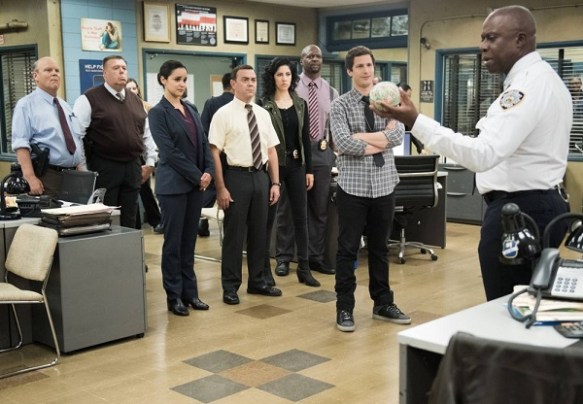
brooklyn-nine-nine-season-2-episode-16-captain-holt-jake-peralta-terry-jeffords

In previous editions of Puzzles in Pop Culture, we’ve explored opinions about crosswords, embarked on scavenger hunts with sitcom characters, and even saved New York with brain teasers alongside John McClane in Die Hard with a Vengeance. But it’s rare when a movie or TV show poses a puzzler and leaves it to the audience to solve it.

In “Captain Peralta,” a recent episode of the Fox police sitcom Brooklyn Nine-Nine, a subplot featured Captain Holt posing a brain teaser to his fellow officers.

There are 12 men on an island. 11 weigh exactly the same amount, but one of them is slightly lighter or heavier. You must figure out which.

The island has no scales, but there is a seesaw. You can only use it three times.

maxresdefault4

With Beyonce tickets going to the person who solved the puzzle, the competition was fierce. Rosa suggested using the seesaw to threaten the men into confessing. Amy and Terry suggested that the first seesaw ride involve putting six men on one side and six on the other, which Captain Holt quickly said wouldn’t work.

As it turns out, Holt was hoping one of his officers would solve the puzzle for him, since he’s been unable to crack it for years. The episode ended without providing the audience with a solution.

Thankfully, your friends here at PuzzleNation Blog would never leave you high and dry like that. Let’s get puzzling!

bizarroshipwrecked07-02-95

Now, this WOULD be a simple logic problem if you knew you were looking for someone lighter or you knew you were looking for someone heavier. In that case, a 3×3 ride, 4×4 ride, or even the 6×6 ride Amy and Terry suggested, would eliminate part of the field immediately, and the remaining two uses could determine the heavy person or the light person.

Unfortunately, in Captain Holt’s puzzle, you don’t know if the person is heavier or lighter, which makes this more difficult. For instance, if you knew you were looking for someone heavier, you could immediately eliminate anyone on the side of the seesaw higher in the air. But if you don’t know if the subject in question is lighter or heavier, then you could have a heavier person on one side or a lighter person on the other.

Diabolical.

But, with some careful deduction, you CAN solve this puzzle.

First, let’s identify our 12 castaways with the letters A through L. Now let’s divide them into three groups of four: ABCD, EFGH, and IJKL.

seesaw

For the first seesaw ride, let’s weigh ABCD vs. EFGH.

There are three possible outcomes:

  • They balance, meaning we can eliminate all eight of them and our mystery person is in IJKL.
  • ABCD sinks while EFGH rises, meaning there’s a heavier person in ABCD or a lighter person in EFGH, so we can eliminate IJKL.
  • EFGH sinks while ABCD rises, meaning there’s a heavier person in EFGH or a lighter person in ABCD, so we can eliminate IJKL.

OUTCOME 1: They balance

For the second seesaw ride, we’ll take IJK and weigh them against any three of the eliminated people — let’s say ABC — because we know they weigh the same.

OUTCOME 1-1: if IJK balances against ABC, we know that L is our guy. For the third seesaw ride, weigh L against A to determine if L is lighter or heavier.

OUTCOME 1-2: if IJK sinks, one of them is heavier than ABC. For the third seesaw ride, weigh I against J. If they balance, K is the heavy one. If I or J sinks, he’s the heavy one.

OUTCOME 1-3: if IJK rises, one of them is lighter than ABC. For the third seesaw ride, weigh I against J. If they balance, K is the light one. If I or J rises, he’s the light one.


article-2401231-1b6471bd000005dc-74_634x452

OUTCOME 2: ABCD sinks while EFGH rises

For the second seesaw ride, we have eight possible suspects — four heavy, four light — so we mix up the two previous groupings in order to eliminate some suspects. We’ll take E, F, and A and weigh them against G, B, and L. That’s two from the lighter side and one from the heavier vs. one from the lighter, one from the heavier, and one we know is standard.

Again, there will be three possible outcomes:

OUTCOME 2-1: If EFA balances with GBL, they’re all eliminated, leaving either H as a lighter person or either C or D as a heavier person. For the third seesaw ride, weigh C against D. If they balance, H is lighter. If they don’t, whichever is heavier is our guy.

OUTCOME 2-2: If EFA sinks, either A is heavy (because E and F were on the lighter side before) or G is light (because B was on the heavier side and L has already been eliminated), and we can eliminate C, D, and H. For the third seesaw ride, weigh G against L. If they balance, A is heavy. If they don’t, then G is light.

OUTCOME 2-3: If EFA rises, either B is heavy (because G was on the lighter side and L has already been eliminated) or either E or F is light (because A was on the heavier side), and we can eliminate C, D, and H. For the third seesaw ride, weigh E against F. If they balance, then B is heavy. If they don’t, whichever is lighter is our guy.


giant-see-saw

OUTCOME 3: EFGH sinks while ABCD rises

For the second seesaw ride, we have eight possible suspects — four heavy, four light — so we mix up the two previous groupings in order to eliminate some suspects. We’ll take A, B, and E and weigh them against C, F, and L. That’s two from the lighter side and one from the heavier vs. one from the lighter, one from the heavier, and one we know is standard.

Again, there will be three possible outcomes:

OUTCOME 3-1: If ABE balances with CFL, they’re all eliminated, leaving either D as a lighter person or either G or H as a heavier person. For the third seesaw ride, weigh G against H. If they balance, D is lighter. If they don’t, whichever is heavier is our guy.

OUTCOME 3-2: If ABE sinks, either E is heavy (because A and B were on the lighter side) or C is light (because F was on the heavier side and L has already been eliminated), and we can eliminate D, G, and H. For the third seesaw ride, weigh C against L. If they balance, E is heavy. If they don’t, then C is light.

OUTCOME 3-3: If ABE rises, either F is heavy (because B was on the lighter side and L has already been eliminated) or either A or B is light (because E was on the heavier side), and we can eliminate D, G, and H. For the third seesaw ride, weigh A against B. If they balance, then F is heavy. If they don’t, whichever is lighter is our guy.


This was one whopper of a brain teaser, to be sure, and I’m not surprised it stumped even the likes of the impressive Captain Holt. But, as a special treat, if you’d like to see the Captain himself explain the solution, go here and check out the embedded video. Enjoy.

Of course, it doesn’t answer the real question: who cares about weight? Why aren’t they building a boat to escape the island?

Thanks for visiting PuzzleNation Blog today! You can share your pictures with us on Instagram, friend us on Facebook, check us out on TwitterPinterest, and Tumblr, and be sure to check out the growing library of PuzzleNation apps and games!