PN Product Review: ThinkFun’s Cold Case: A Story to Die For

a story to die for box

[Note: I received a free copy of this game in exchange for a fair, unbiased review. Due diligence, full disclosure, and all that.]

Detective novels, police procedurals, murder mysteries, forensic shows… there’s an entire entertainment industry out there built on the idea of solving crimes. And why do we watch and read and participate?

Because we all like to believe we can catch the crook. Deep down, we all want to be Batman or Miss Marple or Sherlock Holmes or Temperance Brennan or Jessica Fletcher or Gil Grissom or the NCIS team or members of the NYPD or any of those quick minds who unravel cases and bring the guilty to justice.

Board games are no different, encouraging us to solve crimes through process of elimination (Clue/Cluedo), careful examination of the evidence (Deception: Murder in Hong Kong), or exploring Victorian London through maps, directories, and newspapers (Sherlock Holmes: Consulting Detective).

ThinkFun has taken a different route with their new line of Cold Case mysteries for you to solve.

Today’s review is based on A Story to Die For, the first of two Cold Case mysteries being released in the next few weeks.

In A Story to Die For, you try to solve the 1988 murder of a young journalist.

Yes, this is a cold case, meaning you’re coming in after an investigation has already taken place, yet the case remains unsolved.

You have transcripts of police interviews with suspects, evidence, photographs, and other items collected by the police during their initial investigation. But it’s up to you to comb through the evidence and find what they missed.

There is an absolute wealth of material here to read, creating an entire world of suspects, motives, events, and red herrings for you to unravel. And the materials are top-notch. Full-color photographs, plus different papers and fonts to represent the different sources of information collected.

a story to die for 1

I was very impressed by the presentation of the case. A lot of hard work and detail went into crafting the materials for you to read and reread as you assimilate more information about Andy Bailey’s life. (I would love to tell you specifics, but I want to keep this review spoiler-free!)

And once you think you’ve cracked the case and found answers for all of the questions left behind by the initial investigation, you can test your theory by going to the ThinkFun Cold Case website and submitting your answers.

If you’re on the wrong track, the replies from the website will give you clues on where to look in order to correctly solve the case. And if your detective skills are in tiptop condition, you’ll get more information and a chance to read the suspect’s confession!

It’s a game built on observation, deduction, and wits, and I think it’s one of ThinkFun’s most impressive creations yet. Whether you’re solving alone or with friends, the hour or two you spend unraveling this mystery will be time well spent.

[Cold Case: A Story to Die For is part of ThinkFun’s Cold Case series, designed for players ages 14 and up, and is available for $14.99 from ThinkFun and other associated retailers. Pre-orders start May 18th!]


Thanks for visiting PuzzleNation Blog today! Be sure to sign up for our newsletter to stay up-to-date on everything PuzzleNation!

You can also share your pictures with us on Instagram, friend us on Facebook, check us out on TwitterPinterest, and Tumblr, and explore the always-expanding library of PuzzleNation apps and games on our website!

May the Fourth Be With You!

Hello fellow puzzlers and PuzzleNationers! It’s Star Wars Day, and what better way to celebrate than with a puzzly Star Wars brain teaser!

Yes, we’ve created a Jedi-themed logic puzzle for you to unravel! Can you crack this Star Wars-inspired mystery?


On a small planet in the Mid Rim, a group of Jedi dispatched several squads of battle droids. Reporters had a hard time piecing together descriptions of the five Jedi who saved the day, even after interviewing many witnesses.

The only thing the reporters were sure of? The names of the five Jedi:

  • Drosco Wrs
  • Ko Duus
  • Pramyt Gorc
  • Wendo Grars
  • Seredwok

Each of the Jedi wielded a different color lightsaber (green, yellow, blue, orange, or purple). Each held a different title within the Jedi Order (Padawan, Knight, Master, Instructor, or Council Member). And each of them was a different species (Barabel, Bith, Nautolan, Twi’lek, or Wookiee).

Based on the information gathered below, can you figure out which lightsaber color, title, and species belongs with which Jedi?

1. Drosco Wrs (whose lightsaber is either orange or green) is neither the padawan nor the knight.

2. Either Ko Duus or the Bith is the council member, and the other has the yellow lightsaber.

3. The Jedi has the blue lightsaber (who isn’t on the council) is either the Twi’lek or the Wookiee; if Twi’lek, then Drosco Wrs is the instructor, but if Wookiee, then Seredwok is the instructor.

4. The padawan (who has neither the blue lightsaber nor the green lightsaber) is not Seredwok.

5. Wendo Grars (who isn’t the knight) doesn’t have the yellow lightsaber or the blue lightsaber.

6. The Barabel (who is either Pramyt or Seredwok) isn’t the Jedi with the purple lightsaber.

7. The master has either the purple lightsaber or the yellow lightsaber. Neither the purple lightsaber nor the yellow lightsaber are wielded by the Nautolan.

Good luck, fellow puzzlers! This puzzle requires NO actual knowledge of Star Wars to solve. All you need are your puzzly wits!

Let us know if you solved it in the comments below! And May the Fourth Be With You!


Thanks for visiting PuzzleNation Blog today! Be sure to sign up for our newsletter to stay up-to-date on everything PuzzleNation!

You can also share your pictures with us on Instagram, friend us on Facebook, check us out on TwitterPinterest, and Tumblr, and explore the always-expanding library of PuzzleNation apps and games on our website!

Be a Sleuth with Detective Riddles!

cluedupp1

Brain teasers come in many forms. Riddles, logic problems, math puzzles, and deduction games all fall under the umbrella of brain teasers.

One variety of brain teasers that has always appealed to me is the detective riddle. It’s probably because, deep down, who wouldn’t want to glance at a crime scene and deduce what happened, a la Sherlock Holmes?

While brain teasers can consist of all sorts of scenarios, detective riddles usually center around a crime committed or a police investigation to be completed.

crossword mysteries td 0

Here’s an example of a detective riddle:

A dead female body lies at the bottom of a multistory building. It looks as though she committed suicide by jumping from one of the floors.

When the detective arrives, he goes to the first floor of the building, opens the closed window, and flips a coin towards the floor. He goes to the second floor and does the exact same thing. He continues to do this until he gets to the top floor of the building.

When he comes back down, he states that it was a murder and not a suicide. How does he know that?

This is a good example of the detective riddle, because you’re given all of the information you need in the writeup. Some detective riddles involve making strange, unlikely assumptions, which are a sign of a poorly constructed brain teaser. This one is fair, but not ideal.

The solution, of course, is that the window was closed on every floor, meaning that someone shut the window after the person’s body went out the window. (We ARE told that the body fell from “one of the floors,” but doesn’t that necessarily preclude the roof? That little question mark keeps this riddle from being an ideal example of the form.)

bestpuzsherlock

Now, here’s an example of a bad detective riddle:

Nicole went to the police to report that someone had stolen her vintage ring. When the police got to her house they notice that the window was broken, there was a total mess inside, and there were dirty footprints on the carpet. But, there were no other signs of a break-in.

The next day, the police arrested Nicole for fraud. Why?

The solution? Well, according to the source I found: As soon as the police got to the “crime scene,” they knew that Nicole has most likely staged the break-in. The glass from the broken window was all outside of the house, meaning that it had been broken from the inside.

But the riddle doesn’t mention any glass. In fact, it says there were “no other signs of a break-in,” which would include the glass on the OUTSIDE.

See? This one is full of holes.

Now that you have a sense of how detective riddles work, let’s test your puzzly skills with a few!


#1

A Japanese ship was leaving the port and on its way to open sea. The captain went to oil some parts of the ship and took his ring off so it wouldn’t get damaged. He left it on the table next to his bunk. When he returned, it was missing. He suspected three crew members could be guilty and asked them what they had been doing for the ten minutes that he had been gone.

The cook said, “I was in the kitchen preparing tonight’s dinner.”

The engineer said, “I was working in the engine room making sure everything was running smoothly.”

The seaman said, “I was on the mast correcting the flag because someone had attached it upside down by mistake.”

The captain immediately knew who it was. How?


chemistryfluxx

#2

A chemist was murdered in his own lab. The only evidence was a piece of paper that had the names of chemical substances written on it. The substances were nickel, carbon, oxygen, lanthanum, and sulfur. The chemist only had four people come by his lab on the day of the murder: fellow scientist Claire, his nephew Nicolas, his wife, and his friend Marc.

The police arrested the murderer right away. How did they know who it was?


#3

A man was found on the floor dead with a cassette recorder in one hand and a gun in the other. When the police arrived at the scene they pressed play on the recorder. It was the man’s voice. He said, “I have nothing else to live for. I can’t go on,” followed by the sound of a gunshot.

After listening, the police knew that this was a murder, not a suicide. How?


Did you unravel these detective riddles? Let us know in the comment section below! We’d love to hear from you.

Thanks for visiting PuzzleNation Blog today! Be sure to sign up for our newsletter to stay up-to-date on everything PuzzleNation!

You can also share your pictures with us on Instagram, friend us on Facebook, check us out on TwitterPinterest, and Tumblr, and explore the always-expanding library of PuzzleNation apps and games on our website!

Answer to our Thanksgiving Logic Puzzle!

Last week, we celebrated Thanksgiving with a social distance-themed logic puzzle in honor of this time of year and the peculiar circumstances of 2020.

So let’s take a look at how to untangle this puzzle and sort things out so everyone enjoys the holiday, shall we?


First, a quick reminder about the puzzle, so the clues are fresh in our minds (and you have one last chance to solve it before we walk you through the solution).

On a curious Thanksgiving in 2020, five housemates were social distancing, each engaged in different activities throughout the day. (One was streaming Hulu.)

Each housemate (including Brian) wore a different outfit — one was wearing a tank top and shorts — and was doing their activity at a different time that day (1 PM, 2 PM, 2:30 PM, 3 PM, or 3:30 PM).

From the information provided, can you determine what time each housemate did which activity, as well as what outfit they were wearing?

1. The person doing Zoom trivia did so earlier than Alex but later than the one who wore a t-shirt and jeans.

2. Luke’s activity was earlier in the day than Denise’s, but later than that of the person who wore a Christmas sweater and pants.

3. Alex (who was wearing a Pokemon onesie) had her activity earlier than the person texting Grandma but later than Denise.

4. The person playing Among Us did so later than the person Facetiming their Mom, but earlier than the one wearing pajamas (who did their activity earlier than Adam).


Okay, first things first, let’s organize the information we have.

  • There are five housemates: Adam, Alex, Brian, Denise, Luke.
  • There are five activities: Facetiming Mom, playing Among Us, streaming Hulu, texting Grandma, doing Zoom trivia.
  • There are five outfits: Christmas sweater/pants, Pajamas, Pokemon onesie, Tanktop/shorts, T-shirt/jeans.

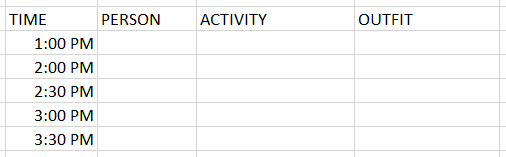
Since many of the clues reference who or what happened earlier or later than other events, it makes sense to use the times as our anchor points, so our starting grid should look like this:

turkey logic 1

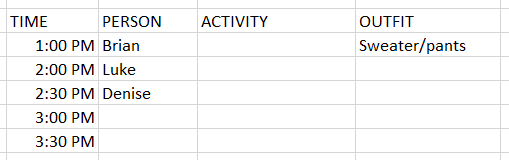
And we can immediately mark down who did the activity at 1 PM. In clue 1, the person doing Zoom trivia did their activity earlier than Alex, so Alex wasn’t the person at 1 PM. Clue 2 tells us that both Luke and Denise had someone doing activities before them, so it couldn’t be them at 1 PM. And Clue 4 tells us that the person in pajamas did their activity before Adam, so he couldn’t be the 1 PM person either. That leaves Brian as the 1 PM person.

That information tells us more as well. Alex can’t be the 2 PM person, because Clue 1 says both the Zoom trivia person and the person in t-shirt and jeans did activities before Alex. Denise can’t be the 2 PM person, because Clue 2 says both Luke and the person in the Christmas sweater did activities before Denise. And Adam can’t be the 2 PM person because Clue 4 says that both the person playing Among Us and the person wearing pajamas did activities before Adam. So Luke must be the 2 PM person.

Not only that, but since Luke did his activity after the person in a Christmas sweater and pants, that makes the sweater/pants Brian’s outfit.

We can fill in one person based on time as well. Clue 3 tells us that Alex’s activity was after Denise’s, so Alex can’t be the 2:30 PM person. And Clue 4 tells us that Adam’s activity happened after the person Facetiming Mom, the person playing Among Us, and the person in their pajamas, so Adam can’t be the 2:30 PM person. That leaves Denise as the 2:30 PM person.

So now our chart looks like this:

turkey logic 2

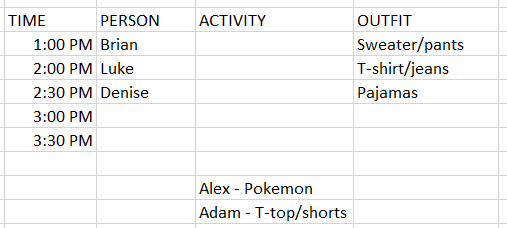
Let’s look at the outfits now. We know from Clue 3 that Alex is wearing the Pokemon onesie, but we’re not sure where to place Alex yet. But we can place the pajamas based on what we know.

In Clue 4, we’re told that the person wearing pajamas has their activity after the person Facetiming Mom and the person playing Among Us, and before Adam. So Adam is out. Alex and Brian are also out, because we know what they’re wearing. And Luke can’t be the person in pajamas, because his activity is second (2 PM) and at least two activities have to be done before the person wearing pajamas. That leaves Denise as the person in pajamas.

That leaves only two outfits unaccounted for: the tanktop/shorts and the t-shirt/jeans. But we can eliminate those as well. In Clue 1 we’re told that the person in t-shirt and jeans does their activity before both the person doing Zoom trivia and Alex. But Adam can’t be that person, because Adam’s activity happens after the person Facetiming Mom, the person playing Among Us, and the person wearing PJs. So Adam is wearing a tanktop and shorts, and Luke is wearing a t-shirt and jeans.

Let’s look at our chart now:

turkey logic 3

As you can see, I’ve added notes below for person/outfit combos we know that we can’t yet place.

But the information above does tell us something else.

Clue 4 tells us that the person playing Among Us did so later than the person Facetiming Mom, but earlier than the person wearing pajamas. And we know the person wearing pajamas is Denise. So that means Luke is playing Among Us and Brian is Facetiming Mom.

This information also tells us what Alex is doing. Clue 1 tells us Alex is not doing Zoom trivia, and Clue 3 tells us that Alex is not texting Grandma. And since she can’t be playing Among Us or Facetiming Mom, the only remaining option is streaming Hulu.

This same process of elimination can tell us who did the last two activities. We know Denise isn’t playing Among Us, Facetiming Mom, or streaming Hulu. But Clue 3 tells us she wasn’t texting Grandma either, so she must have been doing Zoom trivia.

Which means Adam was the one texting Grandma.

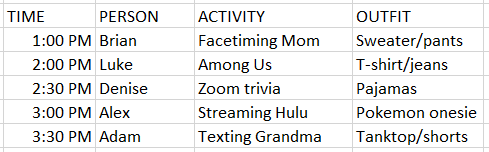
And since Clue 3 tells us that Alex’s activity happened before the person texting Grandma, we can complete our grid:

turkey logic 4

How did you do? Did you manage to unravel this holiday puzzler? Let us know in the comments section below! We’d love to hear from you!


Thanks for visiting PuzzleNation Blog today! Be sure to sign up for our newsletter to stay up-to-date on everything PuzzleNation!

You can also share your pictures with us on Instagram, friend us on Facebook, check us out on TwitterPinterest, and Tumblr, and explore the always-expanding library of PuzzleNation apps and games on our website!

A Puzzle for Thanksgiving!

Happy Thanksgiving, PuzzleNationers!

Today is a day for celebrating with family and friends (although that’s harder this year), and giving thanks for all the good things in our lives.

We here at PuzzleNation want to thank you, our fellow puzzlers and PuzzleNationers, because you help make PuzzleNation one of the greatest puzzle communities in the world.

And when it comes to saying thanks, a Thanksgiving puzzle seems like the perfect offering. So we’ve cooked up a little Thanksgiving logic puzzle for you to enjoy!

Can you unravel this holiday puzzler?


On a curious Thanksgiving in 2020, five housemates were social distancing, each engaged in different activities throughout the day. (One was streaming Hulu.)

Each housemate (including Brian) wore a different outfit — one was wearing a tank top and shorts — and was doing their activity at a different time that day (1 PM, 2 PM, 2:30 PM, 3 PM, or 3:30 PM).

From the information provided, can you determine what time each housemate did which activity, as well as what outfit they were wearing?

1. The person doing Zoom trivia did so earlier than Alex but later than the one who wore a t-shirt and jeans.

2. Luke’s activity was earlier in the day than Denise’s, but later than that of the person who wore a Christmas sweater and pants.

3. Alex (who was wearing a Pokemon onesie) had her activity earlier than the person texting Grandma but later than Denise.

4. The person playing Among Us did so later than the person Facetiming their Mom, but earlier than the one wearing pajamas (who did their activity earlier than Adam).


Did you unravel this holiday puzzler? Let us know in the comments section below! We’d love to hear from you!

Thanks for visiting PuzzleNation Blog today! Be sure to sign up for our newsletter to stay up-to-date on everything PuzzleNation!

You can also share your pictures with us on Instagram, friend us on Facebook, check us out on TwitterPinterest, and Tumblr, and explore the always-expanding library of PuzzleNation apps and games on our website!

Answer to the Fiendish Second Conway Puzzle, The Ten Divisibilities!

John_H_Conway_2005_(cropped)

Last month, in honor of mathematician and puzzly spirit John Horton Conway, we shared two of his favorite brain teasers and challenged our fellow PuzzleNationers to crack them.

Two weeks ago, we shared the solution to puzzle #1The Miracle Builders, and offered a few hints for puzzle #2, The Ten Divisibilities.

Now that we’ve heard from a few solvers who either conquered or got very close to conquering the second puzzle, we happily share both the solution and how we got there.


The Ten Divisibilities

I have a ten digit number, abcdefghij. Each of the digits is different, and:

  • a is divisible by 1
  • ab is divisible by 2
  • abc is divisible by 3
  • abcd is divisible by 4
  • abcde is divisible by 5
  • abcdef is divisible by 6
  • abcdefg is divisible by 7
  • abcdefgh is divisible by 8
  • abcdefghi is divisible by 9
  • abcdefghij is divisible by 10

What’s my number?

[To clarify: a, b, c, d, e, f, g, h, i, and j are all single digits. Each digit from 0 to 9 is represented by exactly one letter. The number abcdefghij is a ten-digit number whose first digit is a, second digit is b, and so on. It does not mean that you multiply a x b x c x…]

And here are the hints we offered to help:

-If you add all the digits in a number, and the total is divisible by 3, then that number is also divisible by 3.
-If the last two digits of a number are divisible by 4, then that number is divisible by 4.
-If the last three digits of a number are divisible by 8, then that number is divisible by 8.


The solution is 3816547290.

So, how do we get there?

First, we use process of elimination.

Any number divisible by 10 must end in a zero, so j = 0.

Any number divisible by 5 must end in a zero or a five, so e = 5 (because each digit only appears once).

That gives us abcd5fghi0.

But that’s not all we know.

If a number is divisible by an even number, that number must itself be even. So that means b, d, f, and h must all be even numbers (i.e. some combination of 2, 4, 6, and 8). That also means that a, c, g, and i must all be some combination of the remaining odd numbers (1, 3, 7, and 9).

That’s a lot of information that will come in handy as we solve.

So, where to next? Let’s look at one of those even-numbered spots.

We’ve been told that abcd is divisible by 4. But any number is divisible by 4 if the last two digits are divisible by 4. So that means cd is divisible by 4.

So, if c is odd, d is even, and cd is divisible by 4, that limits the possibilities somewhat. cd must be 12, 16, 32, 36, 72, 76, 92, or 96.

So d is either 2 or 6.

That will be helpful in figuring out def. And knowing def is the key to this entire puzzle.


One of the clues we offered in our last post was that if the sum of a number’s digits is divisible by 3, then that number is also divisible by three. We know abc is divisible by 3, so that means a + b + c is also divisible by 3.

And if something is divisible by 6, then it’s also divisible by 3, so a + b + c + d + e + f is divisible by 3.

Here’s where things get a little tricky. Since a + b + c + d + e + f is divisible by 3, and a + b + c is divisible by 3, then when you subtract a + b + c from a + b + c + d + e + f, the result, d + e + f would also be divisible by 3.

Why is that helpful? Because it means we can look at def instead of abcdef, and we know a lot about def right now.

d is either 2 or 6. e is 5. f is either 2, 4, 6, or 8. And the sum of d + e + f is divisible by 3.

So that gives us two possibilities to deal with, either 2 + 5 + f, where the sum is divisible by 3, or 6 + 5 + f, where the sum is divisible by 3.

Since each number is only used once, that’s six possible equations:

  • 2 + 5 + 4 = 11
  • 2 + 5 + 6 = 13
  • 2 + 5 + 8 = 15
  • 6 + 5 + 2 = 13
  • 6 + 5 + 4 = 15
  • 6 + 5 + 8 = 19

Only 258 and 654 have sums divisible by 3, so they’re our two possibilities for def.

We’ll have to try both of them to see which is the correct choice. How do we do that?

Let’s start with the assumption that def is 258.


That would mean our answer is abc258ghi0. We know b and h have to be even numbers, and only 4 and 6 are left as options. Since fewer numbers are divisible by 8 than by 2, let’s look at abc258gh.

One of the other hints we offered was that if the last three digits of a number are divisible by 8, then the whole number is divisible by 8.

So that means if abc258gh is divisible by 8, then 8gh is divisible by 8. That’s much more manageable.

So, f is 8, h is 4 or 6, and g is either 1, 3, 7, or 9. That gives us eight possibilities for 8gh: 814, 834, 874, 894, 816, 836, 876, and 896.

Dividing each of these by 8 reveals only two possible choices: 816 and 896. That means, in this scenario, h is 6, b is 4, and our number is a4c258g6i0.

What’s next? Well, remember that trick we did with abcdef before? We’re going to do it again with abcdefghi.

Any number divisible by 9 is divisible by 3. Our rule of sums tells us that a + b + c + d + e + f + g + h + i is also divisible by 3. And since a + b + c + d + e + f is divisible by 3, subtracting it means that g + h + i is also divisible by 3.

With 816 and 896 as our possibilities for fgh, that means our possibilities for ghi are 16i and 96i. That gives us the following possibilities: 163, 167, 169, 961, 963, 967, where the sum of our answer must be divisible by 3.

  • 1 + 6 + 3 = 10
  • 1 + 6 + 7 = 14
  • 1 + 6 + 9 = 16
  • 9 + 6 + 1 = 16
  • 9 + 6 + 3 = 18
  • 9 + 6 + 7 = 22

963 is the only one that works, which gives us a4c2589630. With only 1 and 7 remaining as options, our possible solution is either 1472589630 or 7412589630.

But, if you divide either 1472589 or 7412589 by 7 — which is faster than running every one of the 10 conditions through a calculator — neither divides cleanly. That means 258 is incorrect.


I know that was a lot of work just to eliminate one possibility, but it was worth it. It means 654 is correct, so our solution so far reads abc654ghi0.

And we can use the same techniques we just employed with 258 to find the actual answer.

We know b and h have to be even numbers, and only 2 and 8 are left as options. Again, since fewer numbers are divisible by 8 than by 2, let’s look at abc654gh.

4gh is divisible is 8. So, f is 4, h is 2 or 8, and g is either 1, 3, 7, or 9. That gives us eight possibilities for 4gh: 412, 432, 472, 492, 418, 438, 478, and 498.

Dividing each of these by 8 reveals only two possible choices: 432 and 472. That means b is 8, and our number is a8c654g2i0.

Now, let’s look at ghi.

With 432 and 472 as our possibilities for fgh, that means our possibilities for ghi are 32i and 72i. That gives us the following possibilities: 321, 327, 329, 721, 723, 729, where the sum of our answer must be divisible by 3.

  • 3 + 2 + 1 = 6
  • 3 + 2 + 7 = 12
  • 3 + 2 + 9 = 14
  • 7 + 2 + 1 = 10
  • 7 + 2 + 3 = 12
  • 7 + 2 + 9 = 18

Okay, that leaves us four possibilities for ghi: 321, 327, 723, and 729.

Stay with me, folks, we’re so close to the end!

Let’s look at our four possibilities:

  • a8c6543210 (79)
  • a8c6543270 (19)
  • a8c6547230 (19)
  • a8c6547290 (13)

Next to each number, I’ve placed the only digits missing in each scenario, two for each.

That means there are only 8 possible ways to arrange the remaining numbers:

  • 7896543210
  • 9876543210
  • 1896543270
  • 9816543270
  • 1896547230
  • 9816547230
  • 1836547290
  • 3816547290

So let’s do what we did last time, and divide each chain at the seventh number by 7.

  • 7896543 / 7
  • 9876543 / 7
  • 1896543 / 7
  • 9816543 / 7
  • 1896547 / 7
  • 9816547 / 7
  • 1836547 / 7
  • 3816547 / 7

Only one of the chains can be cleanly divided by 7, and it’s 3816547.

Which means the solution for abcdefghij is 3816547290.


I know this was a monster of a solve — it rivals our Brooklyn Nine-Nine seesaw puzzle solution in complexity — but it’s one that every one of our fellow PuzzleNationers are capable of puzzling out.

How did you do on this diabolical brain teaser, folks? Let us know in the comments section below. We’d love to hear from you!


Thanks for visiting PuzzleNation Blog today! Be sure to sign up for our newsletter to stay up-to-date on everything PuzzleNation!

You can also share your pictures with us on Instagram, friend us on Facebook, check us out on TwitterPinterest, and Tumblr, and explore the always-expanding library of PuzzleNation apps and games on our website!