PN Product Review: Zendo Expansion #2

[Note: I received a free copy of this game in exchange for a fair, unbiased review. Due diligence, full disclosure, and all that.]

Even the best designed games need a little sprucing up from time to time. This is especially true of logic/deduction games, where after a while, it can feel like you’ve seen every trick either the game or the other players can offer.

And there are very few game companies that consistently deliver great expansions. It’s a brutal tightrope to walk; you have to add to the established game in an interesting or fresh way, but without breaking the rules, introducing problems that players won’t know how to handle mechanically, or betraying in some manner the spirit of the original game.

For the team at Looney Labs, though, creating an expansion pack seems like another day at the office. We’ve reviewed expansion packs in the past for Fluxx (Fluxx Dice), Just Desserts (Just Coffee/Better with Bacon), and Star Trek Fluxx (the Bridge Expansion), and each one revitalizes the game and adds delightful new wrinkles without hampering any of the qualities that made the original game such a treat.

Today, we’re looking at a new expansion pack for one of the company’s most immersive and challenging puzzle games: Zendo.

In Zendo, the players pull pieces from a communal pile in order to build different structures, using pyramids, wedges, and blocks. One player, the moderator, chooses a secret rule for the players to uncover, and builds two structures. One of these structures follows the secret rule, and one does not, and both are marked as such.

Secret rules can be as simple as “must contain all three shapes” or “must contain exactly four pieces.” They can be as complex as “must contain more blue pieces than blocks” or “must contain at least one yellow piece pointing at a blue piece.” Some rules involve how pieces touch, or how they’re stacked, while others demand no touching or stacking whatsoever. The field is wide open at the start of the game.

Players then try to deduce the secret rule by building structures themselves, arranging pieces from the communal pile into various patterns and asking the moderator for more information.

So, how does Zendo Expansion #2 affect the original?
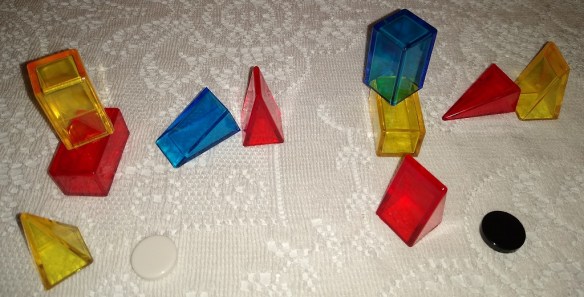
[Here are two sculptures: one that follows the secret rule and one that doesn’t. Can you figure out the secret rule? Is it about shapes? Colors? Placement? More?]

Zendo Expansion #2 is a ten-card deck of new secret rule cards that allow the moderator to create fresh challenges for the other players to unravel. The structures and arrangements may look the same, but players must reexamine what they think they know and observe to figure out the new secret rules.

Because, you see, the cards offer more than just the new rules. They demand greater cleverness from the moderator, in order to create designs that are fair for the players — not immediately obvious, but not impossible to discern either. It’s a difficult task for moderators.

And the challenge is even greater for players. After all, it’s not just about the shapes and how they interact, but all aspects of what the players see. Zendo Expansion #1 had cards where the rule involved the shape of the structure’s shadow. You could look at the pieces, the colors, how they’re placed, where they’re placed, how close, how far away, how many of each, and the shape of the shadow could NEVER occur to you.
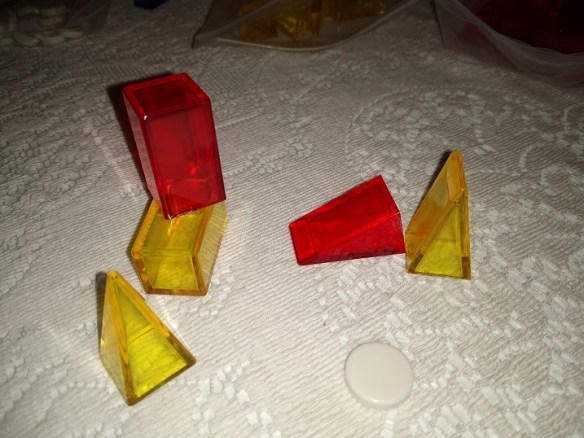
[Here’s another sculpture that removes blue pieces as a possible
element in the secret rule. Have you figured it out yet?]

With one medium rule card and nine difficult rule cards (as opposed to the easy-to-difficult range of the first expansion pack), the game will only become more surprising and thoughtful from here.

These cards include rules about relationships between pieces, conditional rules (example: something that’s true of the sculpture if something else happens theoretically), and even rules regarding something that ISN’T happening in a particular sculpture. Players will have to wrack their brains and truly example both sculptures from every angle to puzzle out these new rules.

There are even decoy tags on certain cards, to make players think the card has more variables than there actually are! Diabolical!

Although I’m a moderator far more frequently than a player, I’m excited to try out both sides of these new rule cards. After all, with the base set and two expansions’ worth of cards, there’s no way I can remember ALL of the possible combinations available. I’m as likely to be outwitted and outpuzzled as the next player.

[One more chance. Here’s a much simplified version that DOESN’T
adhere to the secret rule. What can we learn from this one?]

And that’s the charm of Zendo. From a small gathering of pieces and rules, you can make practically any scenario you wish. Will the players figure it out first try, or will the moderator’s ability to reinvent their sculptures as needed be put to the ultimate test?

Zendo is at once the most collaborative and one of the most curiously devious puzzle-games in the Looney Labs catalog, and with this expansion pack, only the truly inventive and observant will thrive. What a treat.

[Zendo and the new Zendo Expansion #2 are available from Looney Labs, and the expansion pack is only $5!]


Oh, and if you figure out our secret rule for the post, we’ll send you a Zendo-themed prize!


dailypopwsicon

Have you checked out our special summer deals yet? You can find them on the Home Screen for Daily POP Crosswords and Daily POP Word Search! Check them out!

Thanks for visiting PuzzleNation Blog today! Be sure to sign up for our newsletter to stay up-to-date on everything PuzzleNation!

Solution to the Smith-Jones-Robinson Problem!

[Image courtesy of SharpBrains.com.]

A week ago, we shared a brain teaser sent in by a PuzzleNationer named Brian, who challenged us to solve the following challenge.

Today, we’re going to share not only the solution, but how we got there! Please enjoy this brief solve and tutorial, inspired by one of your fellow PuzzleNationers!


The Smith-Jones-Robinson Problem

Every fact is important. The puzzle is as follows:

On a train, three men named Smith, Jones, and Robinson are the fireman, brakeman, and engineer, but not necessarily in that order. Also on the train are three businessmen who have the same names as the train crew. They will be referred to as Mr. Smith, Mr. Jones, and Mr. Robinson.

  • Mr. Robinson lives in Detroit.
  • The brakeman lives exactly halfway between Chicago and Detroit.
  • Mr. Jones earns exactly $20,000 per year, paid in thousand-dollar bills.
  • The brakeman’s nearest neighbor, one of the passengers, earns exactly three times as much as the brakeman, and is also paid in thousand-dollar bills.
  • Smith beats the fireman at billiards.
  • The passenger whose name is the same as the brakeman’s lives in Chicago.

From the information listed above, can you figure out the name of the engineer?


ticket to ride

We’re given one exact number, so let’s start there.

The brakeman’s nearest neighbor, one of the passengers, earns exactly three times as much as the brakeman. Mr. Jones earns exactly $20,000 per year, which cannot be divided evenly by three (in thousand dollar bills), so Mr. Jones is NOT the brakeman’s nearest neighbor.

The brakeman lives exactly halfway between Chicago and Detroit, and Mr. Robinson lives in Detroit, so Mr. Robinson cannot be the passenger who lives nearest to the brakeman. And as we just determined, Mr. Jones is also not the brakeman’s nearest neighbor. That leaves Mr. Smith as the brakeman’s nearest neighbor.

This tells us about the passengers, but how does it help us with the train crew?

Well, the passenger whose name is the same as the brakeman’s lives in Chicago. And neither Mr. Robinson nor Mr. Smith (who is nearest to the brakeman) can live in Chicago. That tells us Mr. Jones lives in Chicago.

This means that the brakeman’s name is Jones.

We can finally turn our attention to the train crew now.

Now that we know the brakeman’s name is Jones, that leaves only Smith and Robinson as possibilities. And we know that Smith beats the fireman at billiards. Smith can’t be the fireman or the brakeman, so Smith must be the engineer.

Did you identify the engineer and outwit the Smith-Jones-Robinson Problem? Let us know in the comments section below. We’d love to hear from you!


dailypopwsicon

Hey, have you checked out our special summer deals yet? You can find them on the Home Screen for Daily POP Crosswords and Daily POP Word Search! Check them out!

Thanks for visiting PuzzleNation Blog today! Be sure to sign up for our newsletter to stay up-to-date on everything PuzzleNation!
Another Brain Teaser Submitted For Your Puzzly Pleasure!

[Image courtesy of SharpBrains.com.]

A few weeks ago, we shared two brain teasers submitted by one of our fellow PuzzleNationers! Well, that must have inspired some of the readership, because we received another brain teaser to solve and share this week!

This brain teaser, submitted by puzzle fan Brian, is called The Smith-Jones-Robinson Problem, and Brian says it has been slightly altered from the original for clarity’s sake.

So, without further ado, let’s get to the puzzle! (We’ll share the solution next week!)


The Smith-Jones-Robinson Problem

Every fact is important. The puzzle is as follows:

On a train, three men named Smith, Jones, and Robinson are the fireman, brakeman, and engineer, but not necessarily in that order. Also on the train are three businessmen who have the same names as the train crew. They will be referred to as Mr. Smith, Mr. Jones, and Mr. Robinson.

  • Mr. Robinson lives in Detroit.
  • The brakeman lives exactly halfway between Chicago and Detroit.
  • Mr. Jones earns exactly $20,000 per year, paid in thousand-dollar bills.
  • The brakeman’s nearest neighbor, one of the passengers, earns exactly three times as much as the brakeman, and is also paid in thousand-dollar bills.
  • Smith beats the fireman at billiards.
  • The passenger whose name is the same as the brakeman’s lives in Chicago.

From the information listed above, can you figure out the name of the engineer?

Will you be accepting this puzzly challenge from a fellow PuzzleNationer? Let us know in the comments section below. We’d love to hear from you!


dailypopwsicon

Have you checked out our special summer deals yet? You can find them on the Home Screen for Daily POP Crosswords and Daily POP Word Search! Check them out!

Thanks for visiting PuzzleNation Blog today! Be sure to sign up for our newsletter to stay up-to-date on everything PuzzleNation!

Solutions to Our June Brain Teasers!

Two weeks ago, we shared a pair of brain teasers sent in by a PuzzleNationer who discovered these particular deduction and math thinkers in a book of riddles and puzzles.

Today, we’re going to share not only the solutions, but how we got there! Please enjoy this brief solve and tutorial, courtesy of brain teasers from your fellow PuzzleNationers!


[Image courtesy of SharpBrains.com.]

Brain Teaser #1: There is a three-digit number. All three digits are different. The second digit is four times as big as the third digit, while the first digit is three less than the second digit. What is the number?

Solution: 582

This is a fairly simple one, but if you’re unfamiliar with brain teasers, or uncomfortable in general with number puzzles, it can be off-putting. No worries, though! We’ve got you covered.

We know the second digit is four times as big as the third. That leaves only two options for those digits: 4 and 1 or 8 and 2.

If the first digit is three less than the second digit, it can’t be 4 and 1, because that would be 4 minus 1, or 1 for the first digit, and the first and third digits can’t be the same.

That means it’s 8 and 2 for the second and third digits. So if the first digit is three less than the second, the first digit is 5, and the three-digit number is 582.


calendar pages

Brain Teaser #2: When asked about his birthday, a man said, “The day before yesterday, I was only 25, and next year I will turn 28.” This is true only one day in a year – what day was he born?

Solution: He was born on December 31st and spoke about it on January 1st.

The wording in this one is especially important, because at first glance, this sounds impossible.

“Next year, I will turn 28.”

But if you look at the key word in what the man says — “turn” — the puzzle starts to unravel.

If next year, he will turn 28, this means that, at some point this year, he will turn 27. Which means he is currently 26.

Let’s look at what we know:

  • Day before yesterday: 25
  • Currently: 26
  • This year (at some point): 27
  • Next year: 28

Since he’ll be both 26 and 27 this year, the day before yesterday had to be last year.

Which means that yesterday was his birthday.

But at some point this year, he turns 27. That means both yesterday and the day before yesterday had to be last year.

Which leaves us with this timetable:

  • December 30 (day before yesterday, last year): 25
  • December 31 (yesterday, last year, his birthday): 26
  • January 1 (today, this year): 26
  • December 31 (later this year): 27
  • December 31 (next year): 28

He was born on December 31st and spoke about it on January 1st.


Did you unravel one or both of these brain teasers? Let us know in the comments section below! We’d love to hear from you.

dailypopwsicon

Hey, have you checked out our special summer deals yet? You can find them on the Home Screen for Daily POP Crosswords and Daily POP Word Search! Check them out!

Thanks for visiting PuzzleNation Blog today! Be sure to sign up for our newsletter to stay up-to-date on everything PuzzleNation!

A Pair of Brain Teasers From Your Fellow PuzzleNationers!

[Image courtesy of SharpBrains.com.]

We love brain teasers here at PuzzleNation Blog. Whether they’re riddles, logic problems, math puzzles, or challenging bits of wordplay, we take on all comers here.

We’ve solved some doozies in the past, like the Brooklyn Nine-Nine seesaw brain teaser, the diabolical long division brain teaser, and the curious way to tell time brain teaser.

In April 2019, we did a whole week of brain teasers while your friendly neighborhood blogger was at a convention. Last year, we honored the life of mathematician and puzzle icon John Horton Conway by sharing two of his favorite brain teasers.

There’s a long, proud PuzzleNation Blog tradition of cracking whatever brain teasers come our way, whether we find them ourselves, stumble across them in pop culture, or receive them from our marvelous PuzzleNationers when asked for solving assistance.

A friend of the blog discovered two brain teasers in a book of riddles and puzzles during a bookshelf cleanout recently, and they sent them our way to share with you!

We’ll post them below, and share the solutions next week! Good luck, fellow puzzlers!


Brain Teaser #1: There is a three digit number. All three digits are different. The second digit is four times as big as the third digit, while the first digit is three less than the second digit. What is the number?

Brain Teaser #2: When asked about his birthday, a man said, “The day before yesterday, I was only 25, and next year I will turn 28.” This is true only one day in a year – what day was he born?

Have you unraveled either of these brain teasers? Let us know in the comments section below! We’d love to hear from you.


dailypopwsicon

Have you checked out our special summer deals yet? You can find them on the Home Screen for Daily POP Crosswords and Daily POP Word Search! Check them out!

Thanks for visiting PuzzleNation Blog today! Be sure to sign up for our newsletter to stay up-to-date on everything PuzzleNation!

PN Product Review: ThinkFun’s Cold Case: A Pinch of Murder

pinch of murder box

[Note: I received a free copy of this game in exchange for a fair, unbiased review. Due diligence, full disclosure, and all that.]

A puzzle can leave you baffled for the longest time. You think you’ve examined it from every possible angle, and yet, you’re still left without a solution. Then a fresh pair of eyes arrives, and suddenly all of the pieces fall into place.

Maybe it’s a friend or colleague who sees something you’ve missed, or simply hasn’t been stuck running through the same paths over and over. Or maybe it’s you, having taken a break from the puzzle, stepped away, and returned, now recharged and refreshed and ready to start again.

And that’s the mindset behind ThinkFun’s new Cold Case series. In this puzzle game, you are picking up where a previous investigation left off, trying to close an unsolved murder case.

pinch of murder 2

In today’s spoiler-free review, we’re looking at A Pinch of Murder, the second of two Cold Case mysteries being released in the next few weeks.

A Pinch of Murder presents players with the story of Harold Green, a loyal churchgoer found dead late one afternoon in 1983.

You have transcripts of police interviews with suspects, witness statements, evidence, photographs, and other items collected by the police during their initial investigation. But it’s up to you to comb through the evidence and find what they missed.

There is so much material here that it’s a bit daunting at first. The dizzying array of suspects and names takes a while to get a handle on, even as you carefully read through every scrap of evidence. The presentation is very impressive, with different types of paper and full-color reproductions of photographs and other materials really adding to the immersive feel of the game.

And this case file feels totally different from the one included in the previous entry in the Cold Case series, A Story to Die For. You receive bits of evidence in unfamiliar formats, the interviews are presented differently, and it genuinely feels like a separate team of investigators put this set together.

pinch of murder 1

Harold Green’s life unfolds before you in little bits and bobs, and the glimpses you get of his town, the people around him, and his day-to-day existence feel so credible.

And once you think you’ve cracked the case and found answers for all of the questions left behind by the initial investigation, you can test your theory by going to the ThinkFun Cold Case website and submitting your answers.

If you’re on the wrong track, the replies from the website will give you clues on where to look in order to correctly solve the case. And if your detective skills are in tiptop condition, you’ll get more information and a chance to read the suspect’s confession!

But with no shortage of suspects and a wealth of material to pore over in order to track down the killer and tie up every loose end, this is hardly a cakewalk. You’ll need to pay attention, read between the lines, and make connections like a proper detective.

Solving puzzles is great fun, but to actually feel like you’re solving a murder? That’s something special. Whether you’re solving alone or with friends, the hour or two you spend eliminating suspects and narrowing down the truth in this mystery game will absolutely be worthwhile. When you have that a-ha moment and you know you’ve earned it, there’s nothing quite like it.

ThinkFun has only made two of these so far, and I cannot wait to get my hands on the next ones.

[Cold Case: A Pinch of Murder is part of ThinkFun’s Cold Case series, designed for players ages 14 and up, and is available for $14.99 from ThinkFun and other associated retailers. Pre-orders start June 1st! Links coming soon!]


Thanks for visiting PuzzleNation Blog today! Be sure to sign up for our newsletter to stay up-to-date on everything PuzzleNation!

You can also share your pictures with us on Instagram, friend us on Facebook, check us out on TwitterPinterest, and Tumblr, and explore the always-expanding library of PuzzleNation apps and games on our website!