Darmok: Another Crossword-Solving Program Claims a Tournament Win!

Image courtesy of World of Weird Things.

In 2021, Matt Ginsberg’s crossword-solving program Dr.Fill won the American Crossword Puzzle Tournament. The top prize still went to a flesh-and-blood solver, but the program solved most of the tournament puzzles in under a minute and only made three mistakes the entire tournament, recording the top score for puzzles 1 through 7.

Of course, Dr.Fill had been “competing” for years at the ACPT before this victory. I believe in its first competition, it placed 141st.

As it turns out, Dr.Fill is not alone. The world of cryptic crosswords has its own Dr.Fill in the form of Dr. Siddhartha Chatterjee’s AI program, Darmok.

At last year’s Times Crossword Championship, Darmok solved two of three semifinal puzzles in seven minutes, but gave up on the last puzzle with one clue unsolved. (That tournament was won by champion solver Mark Goodliffe, who notched his FOURTEENTH win at the tournament.)

But this year was different.

Not only because Goodliffe’s potential 15th title was instead claimed by 29-year-old solver Liam Hughes — marking the first new name on the championship in a quarter century — but because this year, Darmok outperformed every human competitor at the tournament.

The final puzzle tripped up Goodliffe, third place finisher Peter Steggle, and Chloe Hutton, who actually finished the puzzle first, but with the same critical error made by Goodliffe and Steggle.

Hughes got it right in ten minutes.

Darmok got it right too, and faster.

And I do have to say, this is a more impressive result than Dr.Fill’s because cryptic crosswords involve a different level of wordplay in its cluing than American-style crosswords. Answer words can hide in other phrases, in anagrams, in initialisms, in pairs of definitions, in soundalike words, in rebus-style assemblies of words and letters.

So for an AI program to parse all that linguistic trickery… that’s quite something.


So what was the clue that stumped much of the field, save for our human and AI champions?

2-Down: Wolf trap missing its lowest crosspiece? (5)

I’ll leave the explanation at the bottom of the post. Good luck!
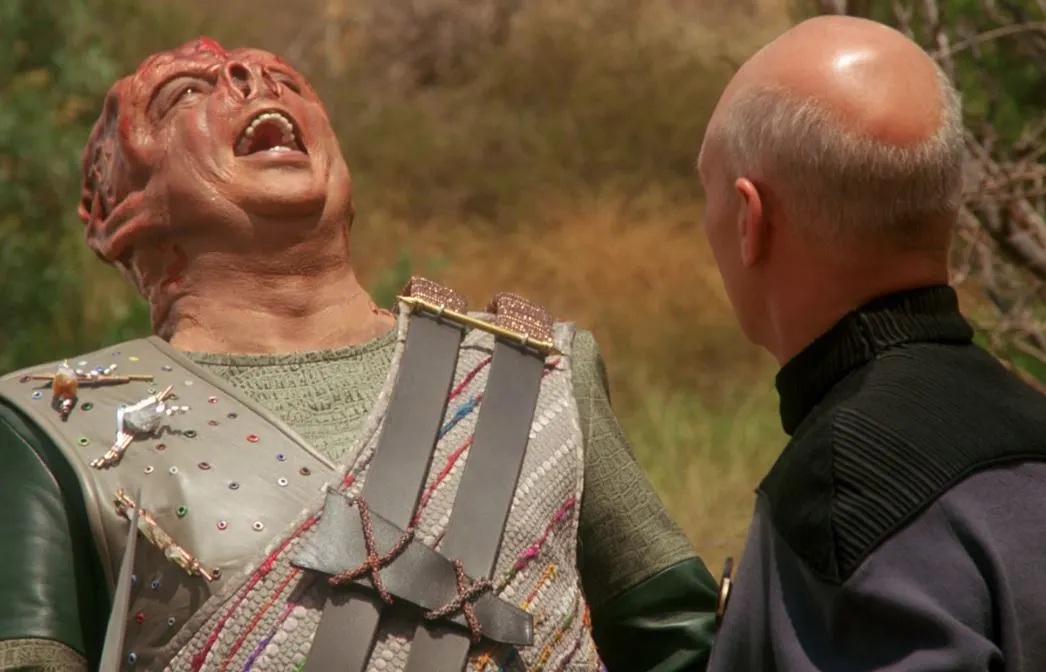

Star Trek fans and meme enthusiasts will no doubt recognize the inspiration for the name of Dr. Chatterjee’s creation. “Darmok” is an iconic episode of Star Trek: The Next Generation where Captain Picard struggles to communicate with an alien species that communicates through metaphor and allusion.

Although the alien captain sadly perished in his attempt to bridge the communication gulf between himself and Picard, the Darmok AI’s victory required less bloodshed.

And yet, there was a loss.

AI programs have taught themselves to solve Rubik’s Cubes, Deep Blue bested Russian chess grandmaster Garry Kasparov, and IBM’s supercomputer Watson defeated previous Jeopardy! champions Brad Rutter and Ken Jennings to nab a million-dollar prize.

An AI program called DeepMind taught itself to play several Atari games with superhuman proficiency, and AlphaGo, an AI developed by Google based on DeepMind, twice defeated Ke Jie, the 19-year-old Go tournament champion ranked number one in the world.

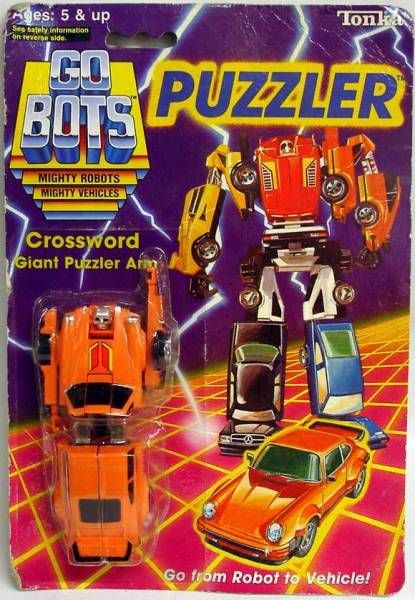
Dr.Fill claimed crosswords, and now Darmok has claimed cryptic crosswords.
robo-machine---puzzler-robot---crossword-p-image-262284-grande

Did you solve that cryptic clue yet?

Here’s a hint: other answers would’ve given you the crossings S_A_F.


So, yes, the robots have arrived, and they know their wordplay.

The question now becomes: how long before they’re creating crosswords and cryptics that rival the creativity and cleverness of humans?

It’s a good question, one that has already been pondered by setter Amoeba in the aftermath of Darmok’s achievement.

And I think Amoeba’s conclusion is as heartening as it is accurate:

As a solver, I love the feeling of going head to head with a setter (even an anonymous one), and unravelling and admiring the clues they’ve written. As a setter, that’s what I hope people who solve my puzzles enjoy. This human part of crossword-setting is not, I believe, something that technology will one day supersede; it is an essential part of why we do them.

I’ve solved computer-generated crosswords. I’ve seen AI-created art.

And I’ve found both lacking.

Just as American solvers know the constructors who challenge them and tickle their brains with sparkling wordplay, cryptic setters have built wonderful reputations for themselves as cunning, playful, and surprising.

We look for these names. We accept their challenges. And we celebrate the joy of solving together, the symbiosis of creation and solution, tying linguistic knots and unraveling devious wordplay.

Community in puzzling, that’s the missing bit AI can’t match. A constructor/setter and a solver, meeting across the grid, through the clues.

That’s magic.


And speaking of, here’s the solution to the cryptic clue that tripped up so many.

Wolf trap missing its lowest crosspiece? (5)

“Wolf” is the definition. Both SCARF and SNARF could fit that clue, as all mean to devour or eat.

But the rest of the clue eliminates one of those options.

“Trap” points to the word SNARE, and reading down the grid, a trap missing its lowest crosspiece would be a SNARE with the bottom part of the E cut off.

SNARE becomes SNARF.

Did you get it?


What do you think of Darmok’s cryptic-solving success story, fellow puzzler? Let me know in the comments section below. I’d love to hear from you!

PuzzleNation Product Review: Star Trek Fluxx and Star Trek: TNG Fluxx

[Note: I received a free copy of this game in exchange for a fair, unbiased review. Due diligence, full disclosure, and all that.]

Innovation is part of the fabric of the puzzle/game industry. Constructors and game designers are constantly pushing the envelope, finding new ways to reinvent the puzzles and games we love in order to create new solving and playing experiences. Every new wrinkle is a step forward, and Looney Labs has been at the forefront of that movement for years now.

And it’s only fitting that Fluxx, a card game all about dynamic gameplay and ever-shifting rules, continues to grow, evolve, and adapt, adding new gameplay mechanics to an already loaded bag of tricks.

Their newest release also fits that ambitious aesthetic. After all, the Star Trek series has always been about boldly going where no one has gone before. Today, we’re doing the same as we review Star Trek Fluxx, Star Trek: The Next Generation Fluxx, and a special expansion pack.

For the uninitiated, Fluxx is a straightforward card game. You collect keeper cards and put them into play. Different combinations of keeper cards complete different goals, and each player has the chance to put different keeper cards and goal cards into play in order to win. So you might find yourself working toward completing the goal at hand when suddenly somebody plays a new goal, and the object of the game changes.

Along the way, players affect how the game is played by utilizing action cards and new rule cards which alter what players can and can’t do. Suddenly, you’ll have to trade your hand with another player, or start drawing three cards each turn instead of one.

Star Trek Fluxx marries the chaotic gameplay of the now-classic card game with familiar characters and themes from the iconic science fiction franchise to create a fresh and enjoyable play experience.

The special touches are immediately identifiable, as the title at the top of every single card is written with the famous Star Trek font.

Even as you collect and play cards bearing the images of beloved characters like Kirk, Uhura, and Spock, you’ll find yourself on a strange new world, as unfamiliar new actions and obstacles appear in your path. I encountered Action cards I don’t recall ever seeing in previous Fluxx games, like Taxation, which requires every other player to give you one card from their hands, and Brain Transference, where you switch seats, cards, Keepers, and Creepers with another player.

Not only that, but lurking in the deck amidst rules, keepers, and goals is an Ungoal, a card that works like a goal, except when all of the conditions on the card are met, everyone loses.

But that unpleasantness is balanced nicely by the many references to the classic show featured throughout the game. As a long-time Star Trek fan, it warmed my heart to see the goal card Majel’s Voice, which credits actress Majel Barrett (wife of Star Trek creator Gene Roddenberry) in her dual roles as Christine Chapel and the voice of the Starfleet computers in future editions of the series (as well as Deanna Troi’s mother, Lwaxana, in The Next Generation).

I was also delighted to see the Fizzbin card, which features ridiculous rules reminiscent of the fictional game Kirk and Spock make up as a distraction in the episode “A Piece of the Action.”

These clever touches not only add depth to the gameplay, but serve as welcome nerdy reminders to fans of the series, little inside jokes that entertain, even as they wink and nod in tongue-and-cheek fashion.

The Star Trek: The Next Generation edition of Fluxx covers a lot of the same ground as Star Trek Fluxx — including a special font for the card titles, Ungoals, and gameplay mechanics built around the technology like the Transporter — but adds numerous little touches that make for an enjoyably distinct play experience.

The Holodeck, for instance, comes into play with several cards, proving to be just as big a distraction (and occasionally, annoyance) as it was in the TV show. Some of the Keeper cards also grant additional actions to the players who use them — like taking additional cards, resolving Creepers that would prevent you from winning the game, etc. — that make them more desirable and handy than Keepers in other editions of the game.

Not only that, but the cards are packed to capacity with inside jokes and fun references to events from the series. From the officers’ poker night to Picard’s harrowing declaration that “There Are Four Lights,” many of the show’s most memorable moments are reflected in some way in the gameplay.

Heck, there’s even a rule card that rewards you for communicating using only names and numbers like the aliens in the classic episode “Darmok.” It’s a super-clever idea based on a much-loved episode of the show.

Star Trek: The Next Generation Fluxx has all of the strengths embodied by Star Trek Fluxx, but still feels like it was created specifically for fans of the Picard years. It’s an elegantly balanced approach.

And, for the very first time, two Fluxx games have been designed so that you can combine and mix them to create a unique play experience!

Although there’s nothing stopping you from mixing Fluxx games — the card backs always look the same, after all — sometimes differing games don’t mesh well, spoiling the fun. But in this case, not only were the two games designed to have similar elements — crew members, technology, ships named Enterprise — but there’s a small bonus pack, The Bridge Expansion, which is crafted to make the most of merging your two games.

Yes, much like the Borg, you can assimilate each game’s individual strengths into a single, unified core.

With goals that encourage crossovers between the two shows, as well as a rule card called The 5 Card Mission (referencing the U.S.S. Enterprise’s original 5-year mission), The Bridge Expansion allows for double the Fluxx-fueled chaos and fun.

Whether you’re choosing to play one of these new star-spanning editions of the game, or combining all three products for the ultimate Star Trek Fluxx experience, you are guaranteed to be surprised and amused. Looney Labs games continue to innovate, entertain, and grow in both complexity and cleverness, and they’ve truly outdone themselves this time around.

[Star Trek Fluxx, Star Trek: The Next Generation Fluxx, and The Bridge Expansion are all available now from Looney Labs and certain online retailers.]


Thanks for visiting PuzzleNation Blog today! Be sure to sign up for our newsletter to stay up-to-date on everything PuzzleNation!

You can also share your pictures with us on Instagram, friend us on Facebook, check us out on Twitter, Pinterest, and Tumblr, and explore the always-expanding library of PuzzleNation apps and games on our website!