

In 2021, Matt Ginsberg’s crossword-solving program Dr.Fill won the American Crossword Puzzle Tournament. The top prize still went to a flesh-and-blood solver, but the program solved most of the tournament puzzles in under a minute and only made three mistakes the entire tournament, recording the top score for puzzles 1 through 7.
Of course, Dr.Fill had been “competing” for years at the ACPT before this victory. I believe in its first competition, it placed 141st.
As it turns out, Dr.Fill is not alone. The world of cryptic crosswords has its own Dr.Fill in the form of Dr. Siddhartha Chatterjee’s AI program, Darmok.
At last year’s Times Crossword Championship, Darmok solved two of three semifinal puzzles in seven minutes, but gave up on the last puzzle with one clue unsolved. (That tournament was won by champion solver Mark Goodliffe, who notched his FOURTEENTH win at the tournament.)
Not only because Goodliffe’s potential 15th title was instead claimed by 29-year-old solver Liam Hughes — marking the first new name on the championship in a quarter century — but because this year, Darmok outperformed every human competitor at the tournament.
The final puzzle tripped up Goodliffe, third place finisher Peter Steggle, and Chloe Hutton, who actually finished the puzzle first, but with the same critical error made by Goodliffe and Steggle.
Hughes got it right in ten minutes.
Darmok got it right too, and faster.
And I do have to say, this is a more impressive result than Dr.Fill’s because cryptic crosswords involve a different level of wordplay in its cluing than American-style crosswords. Answer words can hide in other phrases, in anagrams, in initialisms, in pairs of definitions, in soundalike words, in rebus-style assemblies of words and letters.
So for an AI program to parse all that linguistic trickery… that’s quite something.
So what was the clue that stumped much of the field, save for our human and AI champions?
2-Down: Wolf trap missing its lowest crosspiece? (5)
I’ll leave the explanation at the bottom of the post. Good luck!
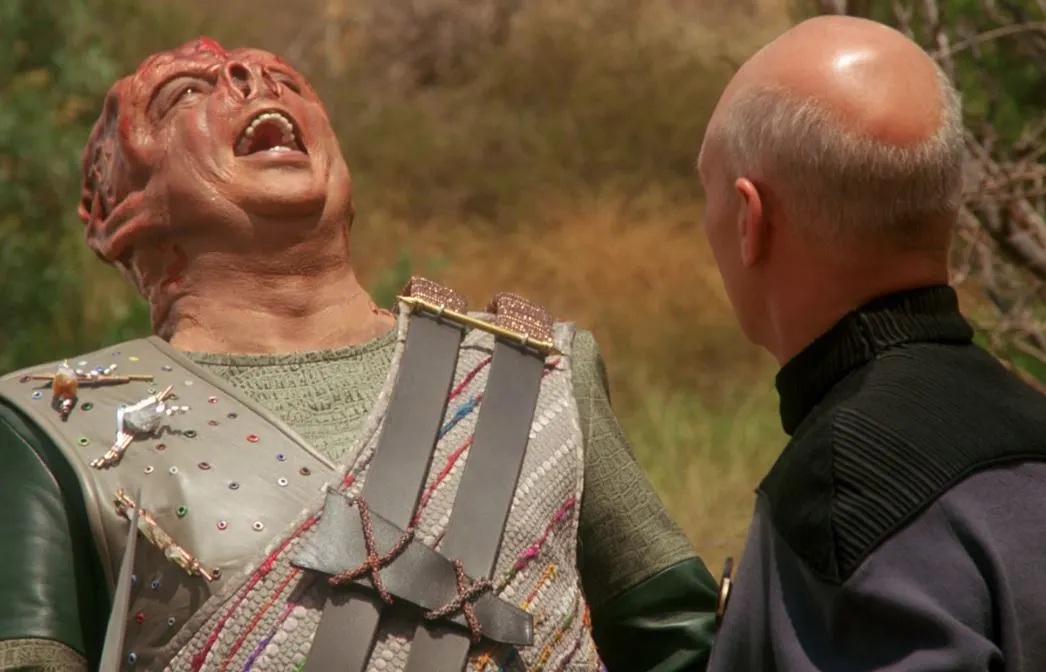
Star Trek fans and meme enthusiasts will no doubt recognize the inspiration for the name of Dr. Chatterjee’s creation. “Darmok” is an iconic episode of Star Trek: The Next Generation where Captain Picard struggles to communicate with an alien species that communicates through metaphor and allusion.
Although the alien captain sadly perished in his attempt to bridge the communication gulf between himself and Picard, the Darmok AI’s victory required less bloodshed.
And yet, there was a loss.
AI programs have taught themselves to solve Rubik’s Cubes, Deep Blue bested Russian chess grandmaster Garry Kasparov, and IBM’s supercomputer Watson defeated previous Jeopardy! champions Brad Rutter and Ken Jennings to nab a million-dollar prize.
An AI program called DeepMind taught itself to play several Atari games with superhuman proficiency, and AlphaGo, an AI developed by Google based on DeepMind, twice defeated Ke Jie, the 19-year-old Go tournament champion ranked number one in the world.
Dr.Fill claimed crosswords, and now Darmok has claimed cryptic crosswords.
Did you solve that cryptic clue yet?
Here’s a hint: other answers would’ve given you the crossings S_A_F.
So, yes, the robots have arrived, and they know their wordplay.
The question now becomes: how long before they’re creating crosswords and cryptics that rival the creativity and cleverness of humans?
It’s a good question, one that has already been pondered by setter Amoeba in the aftermath of Darmok’s achievement.
And I think Amoeba’s conclusion is as heartening as it is accurate:
As a solver, I love the feeling of going head to head with a setter (even an anonymous one), and unravelling and admiring the clues they’ve written. As a setter, that’s what I hope people who solve my puzzles enjoy. This human part of crossword-setting is not, I believe, something that technology will one day supersede; it is an essential part of why we do them.
I’ve solved computer-generated crosswords. I’ve seen AI-created art.
And I’ve found both lacking.

Just as American solvers know the constructors who challenge them and tickle their brains with sparkling wordplay, cryptic setters have built wonderful reputations for themselves as cunning, playful, and surprising.
We look for these names. We accept their challenges. And we celebrate the joy of solving together, the symbiosis of creation and solution, tying linguistic knots and unraveling devious wordplay.
Community in puzzling, that’s the missing bit AI can’t match. A constructor/setter and a solver, meeting across the grid, through the clues.
That’s magic.
And speaking of, here’s the solution to the cryptic clue that tripped up so many.
Wolf trap missing its lowest crosspiece? (5)
“Wolf” is the definition. Both SCARF and SNARF could fit that clue, as all mean to devour or eat.
But the rest of the clue eliminates one of those options.
“Trap” points to the word SNARE, and reading down the grid, a trap missing its lowest crosspiece would be a SNARE with the bottom part of the E cut off.
SNARE becomes SNARF.
Did you get it?
What do you think of Darmok’s cryptic-solving success story, fellow puzzler? Let me know in the comments section below. I’d love to hear from you!


As a programmer and a setter, I can see the joy of writing something like Dr Fill, but at the same time, I really don’t want it to exist!
Let us hope that Amoeba is right with his prediction.