Puzzle Plagiarism?

[Image courtesy of PlagiarismToday.com.]

Today’s post isn’t the usual Follow-Up Friday fare. Instead of returning to a previous subject, I’d like to discuss a topic that I expect I’ll be returning to in Follow-Up Friday form in the near future.

There is a certain pride and sense of accomplishment you experience as a puzzler when you come up with an exciting, innovative, unexpected theme idea for a puzzle, or when you pen a terrific clue for a word. Whether the wordplay is spot on or you’ve simply found a way to reinvigorate a tired bit of crosswordese, you feel like you’re adding something to the ever-expanding crossword lexicon, leaving a mark on the world of puzzles.

Unfortunately, there’s also the flip side of that coin, and those who would pilfer the hard work of others for their own gain. And in a story broken by the team at FiveThirtyEight, there may be something equally unsavory going on behind the scenes of the USA Today crossword and the Universal syndicated crossword.

You can check out the full story, but in short, an enterprising programmer named Saul Pwanson created a searchable database of crossword puzzles that identified similarities in published crosswords, and it uncovered an irregularly high number of repeated entries, grids, and clues in the USA Today and Universal crosswords, both of which are edited by Timothy Parker.

More than 60 puzzles feature suspicious instances of repetition — the word “plagiarism” comes to mind, certainly — and it has sparked an investigation. In fact, only a day after the story first broke, Universal Uclick (which owns both the USA Today crossword and the Universal syndicated crossword) stated that the subject of the investigation, Parker himself, “has agreed to temporarily step back from any editorial role for both USA Today and Universal Crosswords.”

I’ve heard that oversight of the USA Today crossword has already passed to another editor of note in the crossword world, constructor Fred Piscop (author of last Wednesday’s New York Times crossword), but I wonder if more examples of crossword duplication are lurking out there.

With resources like XWord Info and the Pre-Shortzian Puzzle Project out there, the history of crosswords is becoming more and more accessible and searchable. I can’t help but wonder if more scandals are lurking down the pike.


Thanks for visiting PuzzleNation Blog today! Be sure to sign up for our newsletter to stay up-to-date on everything PuzzleNation!

You can also share your pictures with us on Instagram, friend us on Facebook, check us out on TwitterPinterest, and Tumblr, and explore the always-expanding library of PuzzleNation apps and games on our website!
Neil Patrick Harris: Actor, Magician, Puzzler?

I’m a puzzle guy, so naturally I’m always on the lookout for new puzzles, whether it’s in the newspaper, the bookstore, the Internet, or anywhere else I happen to be browsing.

But sometimes, you stumble upon a puzzle in the unlikeliest of places. Like a celebrity’s autobiography.

neil-patrick-harris

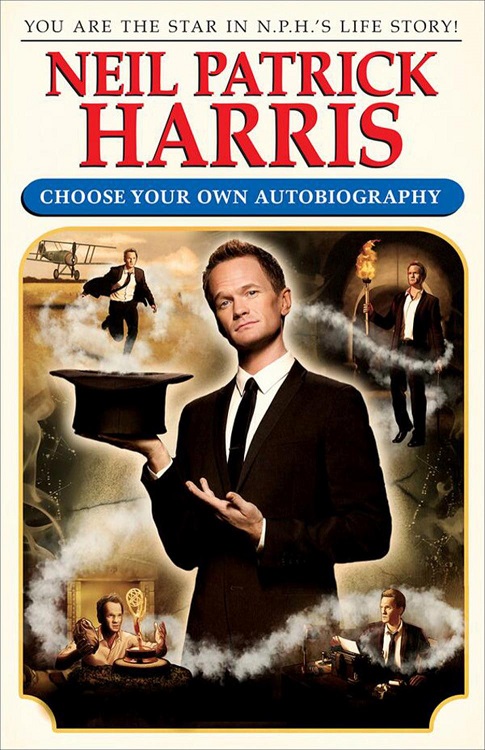
I recently got around to reading the autobiography of comedian, actor, magician, award-show host extraordinaire, and all-around champion of entertainment Neil Patrick Harris, and, as you’d expect from someone as creative as him, it was no ordinary affair. It’s written in the style of a Choose Your Own Adventure book, where you can make life decisions (as he did) and see where they lead!

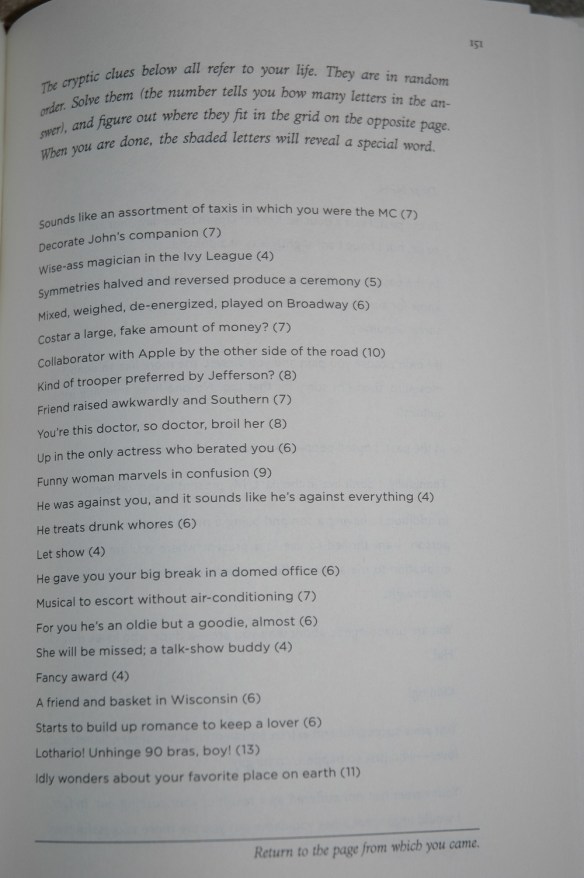
Some lead to hilarious fake deaths, while others lead to genuine poignant moments from his life. We learn about his career, his discovery of magic, the peaks and valleys of his acting career, and his search for love, and it’s a great story. But he also includes messages from friends, drink recipes, and other hidden gems in the book, one of which was an unexpected cryptic crossword puzzle!

nphcryptic1

nphcryptic2

Now, I’ve made no secret of the fact that I’m hardly the strongest cryptic solver around, but I couldn’t resist tackling a surprise Neil Patrick Harris-themed puzzle. (Thankfully, I was able to call in a friend who’s really good with cryptics for the clues that stumped me.)

To Neil’s credit, there are some very clever clues here, in addition to more traditional cryptic clues like “Let show (4)” for RENT and “Symmetries halved and reversed produce a ceremony (5)” for EMMYS. And, as you’d expect, most or all of them apply to events in his life, so you have to read the book to have any chance of solving this one.

Let’s look at a few of my favorites:

  • Sounds like an assortment of taxis in which you were the MC (7): An assortment of taxis is a CAB ARRAY, which sounds like CABARET, a show in which he played an emcee.
  • Costar a large, fake amount of money? (7): Actor Nathan FILLION costarred in Dr. Horrible’s Sing-Along Blog with Neil, and FILLION certainly sounds like a large, fake amount of money.
  • He was against you, and it sounds like he’s against everything (4): There’s a terrific story in the book where Neil is accosted by actor Scott CAAN, whose name sounds like CON.
  • Lothario! Unhinge 90 bras, boy!: This one takes a little work. “Unhinge” indicates this is an anagram clue, so if you anagram “ninety bras,” you get BARNEY STIN. Add “SON” as a synonym of “boy,” and you get BARNEY STINSON, the lothario he played in How I Met Your Mother.

Once you have your 24 answer words, it’s time to fill in the words Framework-style. Quite helpfully, there are several places in the grid where only one word fits, due to word length, which offers the solver several points of access.

However, only 23 of those words will fit in the grid, allowing for an alternate solve for the answers RENT and PENN. But there’s only one way to place the other answers so that the shaded squares spell out a ten-letter word that has a special meaning for clever and attentive readers, a code word Neil suggests as a sign of kinship with the reader.

I debated whether to share the word here, but I don’t want to deprive others of the joy of solving a surprisingly tough and enjoyable puzzle lurking inside an already fun read.


Thanks for visiting PuzzleNation Blog today! Be sure to sign up for our newsletter to stay up-to-date on everything PuzzleNation!

You can also share your pictures with us on Instagram, friend us on Facebook, check us out on TwitterPinterest, and Tumblr, and explore the always-expanding library of PuzzleNation apps and games on our website!

New Puzzle Sets for the Penny Dell Crosswords App!

Hello puzzlers and PuzzleNationers!

That’s right, it’s a bonus blog post today because we’ve got some exciting news!

We’ve got a new puzzle set available for both the Android AND iOS versions of the Penny Dell Crossword App!

After a cold and windy winter, I think we’re all ready for spring, so to kick off the season right, we’ve got our Spring 2016 Deluxe Set! You get 30 easy, medium, and hard puzzles, plus 5 Spring-themed bonus puzzles!

But wait, there’s so much more!

We’ve got some mind-blowing new puzzle bundles for the iOS edition of the app as well!

Looking to catch up on previous collections? Well, our Mega Pack Volume 5 features Collections 9 and 10 in one handy bundle, and Mega Pack Volume 6 features Collections 11 and 12! Each set offers 300 puzzles to solve!

Or you could opt for our Supreme Volume 4, which brings together Collections 10, 11, and 12 for a 450-puzzle package!

But we’re not done yet! If you pick up Double Supreme Volume 2, you’ll double that, nabbing 900 puzzles in an array that includes Collections 7 through 12!

Still hungry for puzzles? We’ve got you covered with the Ultra Supreme, an 1,800 puzzle bundle so awesome that we needed two impressive adjectives to describe it!

And finally, for a treasure trove of puzzles unlike anything we’ve offered before, check out the aptly-named Big Bundle, which features over 2000 puzzles, including all of the 2015 Deluxe Sets!

It’s a certified puzzle bonanza! How can you go wrong?


Thanks for visiting PuzzleNation Blog today! Be sure to sign up for our newsletter to stay up-to-date on everything PuzzleNation!

You can also share your pictures with us on Instagram, friend us on Facebook, check us out on TwitterPinterest, and Tumblr, and explore the always-expanding library of PuzzleNation apps and games on our website!
Playing with your words!

One of the unexpected perks of writing this blog is being contacted by fellow puzzlers. Some send me links and “Have you seen this?” messages, while others ask questions about puzzles and games that make for terrific blog post ideas.

In the last year or so, there has been an increase in actual puzzles. Whether a puzzle goes viral and gets shared around Facebook or they encounter it somewhere and ask for help solving it, it’s fun and a little humbling to represent the puzzle community as a (fairly minor) authority on puzzles.

Of course, I suspect some of those people are trying to stump me. And that’s okay too.

Recently, I received a message with the following brain teaser:

What’s common between the following set of words (Tiny, Noun, English, Polysyllabic, Sesquipedalian)?
Also, what’s common between these words (Verb, German, Misspelled, Hyphenated, and Monosyllabic)?

As a puzzle fan and a word nerd, I quickly realized that wordplay was afoot!

The first set of words are all autonyms (also known as autological words or homological words). They describe themselves. Tiny is a small word, Noun is a noun, etc.

It can be fun to go hunting for autonyms. How about real, pentasyllabic, mellifluous, self-explanatory, or grandiloquent?

There are lots of wordplay possibilities here. The fear of long words is called hippopotomonstrosesquipedaliophobia, which seems a bit cruel. Also, lethologica is the inability to remember the correct word for a given concept or item. But that’s a hard word to remember, so it’s quite possible to have lethologica lethologica.

It’s rare to see wordplay like this in crosswords, but you do see it on occasion. For instance, if you see the clue “Civic center?,” it might take you a second to come up with the answer VEE.

As for the second set of words, they’re the opposite of autonyms, since they don’t describe themselves. Verb isn’t a verb, Misspelled isn’t misspelled, Monosyllabic isn’t single-syllabled, etc. These words are called heterological words.

And these words work their way into common wordplay with ease. Who hasn’t received a forward or seen a Facebook post asking, “Why is ‘abbreviated’ so long?” Because it’s heterological.

You could ask “Why isn’t ‘alphabetical’ alphabetical?” Well, it would be if we spelled it “aaabcehillpt.” Similarly, “backwards” would be backwards if we spelled it “sdrawkcab” and “vowelless” would be vowelless if we spelled it “vwllss.” That makes heterological words autological.

There’s even a paradox that applies to this specific word: the Grelling-Nelson paradox.

It’s both simple and brain-melting all at once. If “heterological” is heterological, then it describes itself, which makes it autological, which is a contradiction. But if “heterological” is not heterological, then by default, it is autological, which it can’t be since it doesn’t describe itself, so again, contradiction.

That makes your head hurt. It’s like a wordy version of the Barber paradox.

In a small town, the barber shaves all those, and only those, who do not shave themselves.” So if he shaves himself, he doesn’t. And if he doesn’t, he does.

Thanks, paradoxes, but I think I’ll stick with autonyms for now. They make life easier.


Thanks for visiting PuzzleNation Blog today! Be sure to sign up for our newsletter to stay up-to-date on everything PuzzleNation!

You can also share your pictures with us on Instagram, friend us on Facebook, check us out on TwitterPinterest, and Tumblr, and explore the always-expanding library of PuzzleNation apps and games on our website!

It’s Follow-Up Friday: Crossword Contest Conclusion edition!

Welcome to Follow-Up Friday!

Follow-Up Friday is a chance for us to revisit the subjects of previous posts and bring the PuzzleNation audience up to speed on all things puzzly.

And today, I’m returning to the subject of crossword contests!

Last month, I announced the latest crossword contest from the topnotch puzzlers at Barany and Friends. The contest, titled Eliminating the Competition, wrapped up on February 8, but the answer to the meta puzzle concealed within each grid was only revealed this week!

As it turns out, the crafty cruciverbalists paid tribute to the American Crossword Puzzle Tournament by dropping the letters A, C, P, and T from the theme entries in the grid! Not only that, but there were no As, Cs, Ps, or Ts to be found anywhere else in the puzzle grid! Diabolical!

Open division puzzle theme answers:

  • They are left over after division: REMINDERS (“Remainders” with the A eliminated)
  • Lack of affection, say: HILLINESS (“Chilliness” with the C eliminated)
  • A cylindrical utensil used to flatten dough: ROLLING IN (“Rolling pin” with the P eliminated)
  • They’re often found in churches or on campuses: BELL OWERS (“Bell towers” with the T eliminated)

They also hid the reveal, MHU, in the lower right corner. (Fiendishly, MHU is MATCHUP with A, C, P, and T eliminated!)

You can check out the full details of the meta puzzle here, including the theme answers for both the Open Division puzzle and the Master Division puzzle, which was a doozy!

But there’s more! They’ve also announced the prizes for the winners, which include paid registrations to the ACPT, puzzle e-books, crossword subscriptions, autographed puzzle books, and specialized crossword puzzles with the winner’s name built into the grid!

They’ve truly gone all out this year to make the Eliminating the Competition contest something special. Kudos to George Barany, Ralph Bunker, John Child, Michael Hanko, and Roy Leban for creating a terrific challenge and a puzzly feast for solvers.

Did you accept the Barany and Friends challenge this year, fellow puzzlers and PuzzleNationers? Let us know if you did! We’d love to hear from you!


Thanks for visiting PuzzleNation Blog today! Be sure to sign up for our newsletter to stay up-to-date on everything PuzzleNation!

You can also share your pictures with us on Instagram, friend us on Facebook, check us out on TwitterPinterest, and Tumblr, and explore the always-expanding library of PuzzleNation apps and games on our website!

What Crosswords (May) Tell Us About Language

Several friends of the blog linked me to a post in The New York Times about the ever-evolving use of language in crosswords.

Essentially, the authors analyzed the frequency of foreign word use in NYT crosswords, and then extrapolated what that means about our language and our cultural evolution and development over the course of the crossword century.

And the authors unearthed some interesting patterns when it comes to the use of foreign language entries and clues: they’ve gone down. “Foreign-language clues and answers peaked in the 1960s and now make up less than 4 percent.”

The authors point out that this contrasts with the growing globalization of communication and pop culture, perhaps making a statement about crosswords as a linguistic bulwark against dastardly foreign words — the wordy equivalent of keeping the metric system at bay with feet and miles and other Imperial units.

But to me, that simply reflects the ongoing refinement and evolution of puzzles away from obscurities — both foreign and domestic — in favor of better, more accessible crossings. To be honest, a lot of these foreign references qualify as crosswordese, because you’d rarely, if ever, encounter them in casual conversation, even in this increasingly globalized society.

I often joke that crosswords have improved my knowledge of African animals, European rivers, and Asian mountain ranges, none of which really affect my life in any other way. I can file them away with all the high school science I learned, like the definition of osmosis.

Some of their assertions did make me laugh, though. In their closing paragraph, they state:

But we are more likely to encounter Uma as an actress (117 answers since 1990), and not as a Hindu goddess (five answers, none since 1953).

[Pictured: a Hindu goddess enjoying a milkshake.]

And at no point do they mention that Uma as an actress would likely have been used — quite gratefully — by constructors in the ’40s and ’50s, had there been a prominent (or even remotely famous) Uma in films at the time. Heck, I’ve been begging for someone to discover the next megastar Una or Ona or Oona or Ana to help revitalize my cluing.

There will always be a drive to innovate new entries and keep up with the latest in popular culture. That’s part of what maintains the quality and interest in crosswords: they evolve with us.

Admittedly, it’s fun to imagine someone hundreds or thousands of years from now, trying to reconstruct our society and general knowledge based on crossword entries and cluing. They’d no doubt wonder why poetic terminology and female sheep were so important to us.


Thanks for visiting PuzzleNation Blog today! Be sure to sign up for our newsletter to stay up-to-date on everything PuzzleNation!

You can also share your pictures with us on Instagram, friend us on Facebook, check us out on TwitterPinterest, and Tumblr, and explore the always-expanding library of PuzzleNation apps and games on our website!