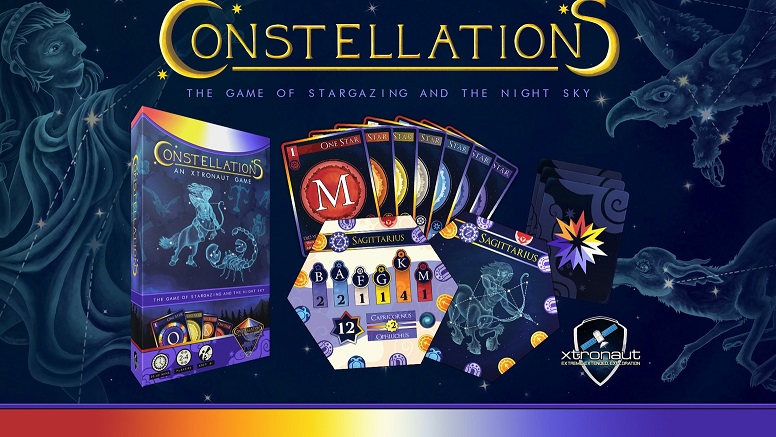
PuzzleNation Product Review: Constellations

Plenty of games offer ambitious goals for the players to achieve. You become a real estate tycoon in Monopoly, a castle owner in Castellan, and a time-traveling adventurer in U.S. Patent Number 1. You could traverse the country in The Oregon Trail, save the world in Pandemic, or conquer it in Risk. That’s part of the magic of games.

But what if you could build the night sky? What if you could harness the stars themselves, assemble constellations, and place them into the heavens above?

Now that is a puzzly endeavor worthy of your attention. And that’s the concept behind the game in today’s product review. We’ll be trying out Constellations by Xtronaut Enterprises.


Constellations combines the resource management card game mechanics of Just Desserts with the pattern-matching tile play of Carcassonne to create an educational and engaging play experience.

Each player starts with five star cards. Each star card represents a different type of star (or in some cases, two of that type of star). The star cards are used to assemble various constellations in order to score points.

The game begins with one constellation already placed in the sky, as well as three possible constellations to build. Players may reserve one of the three constellations, making it their primary goal and removing it from play for the other players.
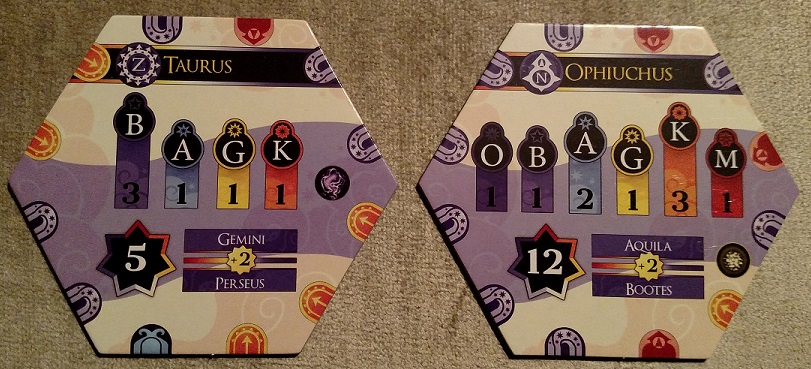
As you can see in the picture above, different constellations require different combinations of star cards. Some constellations are simpler, so they’re worth fewer points. Other constellations have higher values, but more complex combinations of star cards, which may be harder or more time-consuming to collect.

[One constellation tile, plus the star cards played to complete it. As you can see, you can use extra stars as needed (like a Two B-Type Stars card above), as well as using O cards as wild cards (as I did for the two A-type stars needed to complete this constellation.]

Once a player has gathered all of the star cards necessary to complete the constellation, they then must play it in the night sky, placing it adjacent to one or more of the constellations already completed.

You score points by placing a constellation so that the gemstones along the edges match the neighboring constellation(s), and there are additional points available for placing constellations beside other constellations (as they would appear in the actual night sky). For instance, Leo Minor offers a two-point bonus when placed next to either Leo or Lynx.

Different arrangements of gemstones around the edges of the constellation tile require you to be crafty when and where you place your tile, since more matching gemstones means more points.

[In this layout, Taurus was added perfectly, matching gemstones with both Perseus and Ophiuchus. Pegasus, on the other hand, matched Perseus nicely, but only matched one gemstone with Orion.]

Unfortunately, you have to play a completed constellation, and sometimes the gemstone patterns don’t match up at all. If that’s the case, you’ll lose two points for a constellation played out of place. (Once again, the closer you get to placing your constellation as it would actually appear in the night sky, the better it is for your game.)

All of the game’s mechanics are designed around actual science, which is a very cool touch. The star cards include “Did You Know?” facts about each type of star, and the instruction booklet also includes a short guide to stargazing, star classification, and little write-ups for each constellation included in the game. (There’s even a criss-cross-style crossword on the back page!)

Constellations is great fun, requiring strategy, timing, and puzzly observational skills in order to effectively play the game. The educational aspect doesn’t detract from the gameplay at all, and the alternate rules offered in the back (as well as rules for shorter and longer gameplay times) offer an impressive amount of replay value.

All in all, Constellations mixes card games and tile games with ease, and it makes for a fun and mellow gameplay experience.

[Constellations is available from Xtronaut Enterprises and other select retailers.]


Thanks for visiting PuzzleNation Blog today! Be sure to sign up for our newsletter to stay up-to-date on everything PuzzleNation!

You can also share your pictures with us on Instagram, friend us on Facebook, check us out on TwitterPinterest, and Tumblr, and explore the always-expanding library of PuzzleNation apps and games on our website!

Tackling the 2018 Indie 500 Puzzles!

June 2 marked the fourth annual Indie 500 Crossword Tournament, hosted in Washington, D.C., by constructors Erik Agard, Neville Fogarty, Andy Kravis, Peter Broda, and Angela Olsen Halsted. The first tournament had a racing theme, the second had a prom theme, the third had a time theme, and this year was fashion-themed!

While I couldn’t attend the tournament, I did download the tournament puzzles, and last weekend I finally had the opportunity to sit down and tackle them. And today, I thought I’d offer my thoughts on those puzzles, for any interested PuzzleNationers who might be considering participating in the event in the future.


Before the official tournament puzzles start, there’s a warm-up puzzle, a 13x grid entitled “Top Gear” by Neville Fogarty and Erik Agard. The hook is simple and accessible — celebrity names where the first name is a type of top, like COTTON MATHER for “crop top” or SHERMAN HEMSLEY for “tank top” — and with good fill and some tricksy cluing, you’ve got a nice pace-setter for the tournament puzzles to come.

Interesting grid entries included COSTUME CHANGE, GAINER, OMEN II, and THAT TOO. My favorite clue was the Arrested Development-inspired “What you might find in a bag marked ‘DOVE – DO NOT EAT'” for BAR SOAP.

[Image courtesy of Vertigo Mag.]

#1 On the Walk by Angela Olsen Halsted

The tournament proper opened with this terrific puzzle. The grid had solid fill entries with very little crosswordese, making for a marvelous introduction to the high quality level you’ve come to expect from Indie 500 puzzles. The theme entries all contained the word CAT in shaded boxes in the grid, slowly descending the main diagonal path of the grid, making for a literal catwalk.

The comment beneath the title, “Please, no meowing,” is not only a fun hint, but a hilarious callback to the Crossword De-Cat-hlon puzzle from last year’s Lollapuzzoola tournament, which had solvers meowing out loud as part of the solving experience. (That’s immediately what came to mind for me, anyway.)

All in all, a cracking opener for the tournament.

Interesting grid entries included PREGGERS, SABRA, ANITA HILL, and IMAC. My favorite clue was “Something you shouldn’t tell a woman to do” for SMILE.

[Image courtesy of Slideshare.]

#2 Unmentionables by Anna Gundlach

Puzzle 2 immediately raised the difficulty level, layering long interesting entries along the top right and bottom left corners of the grid to challenge the solver a bit more.

Couple that with a hook that required some very tight grid construction: unclued entries (making them “unmentioned”) in the grid like BRIEFS and BRA, each of which appears under the word WEAR in the grid. So you’ve got unmentionables and underwear. A really fun and clever execution of a good hook.

Interesting grid entries included AFAIK, RED STATES, TWENTY-ONE, and ROOMBA. My favorite clue was easily “Things that might come out in a row?” for SWEAR WORDS.

#3 Mall Shook Up by Laura Braunstein

As you might expect from the title, this puzzle involved clothing stores at the mall which had been all jumbled up. For example, one line read SECRET BANANA GAP, referencing Victoria’s Secret, Banana Republic, and Baby Gap. So those missing words would end up in other jumbled store listings. Laura went above and beyond in her store mixing, probably providing the most entries I’ve ever seen in a puzzle of this style.

There was one awkward crossing that tripped me up — NEW ME crossing AD WAR — but for the most part, this was a strong puzzle to mark the halfway point for the tournament.

Interesting grid entries included MANTA RAY, NO REPLY, TONSURE, RICOTTA, and BREW PUBS. My favorite clue was “Cat in a Blake poem” for TYGER.

[Image courtesy of Garment Care.]

#4 Tailoring Instructions by Andy Kravis and Sophia Maymudes

Probably the hardest puzzle in the tournament, strictly for its cluing style for the theme entries, which felt more like Crostic clues. Each themed hint would have a straightforward clue, and then in parentheses, tailor’s instructions for how to trim or manipulate the actual answers to fit into the grid.

For instance, the clue “Setting of ‘The Hobbit’ (‘Take this one up a bit’)” takes the full answer reading down, MIDDLE EARTH, and “takes it up a bit,” excluding the bottom two letters and leaving the answer MIDDLE EAR.

Although the vocabulary of the grid itself wasn’t much harder than the usual fare, this was definitely the toughest theme to unravel. Kudos to those who did so in a timely fashion.

Interesting grid entries included GO PRO, RIHANNA, LIAISE, RAIN GOD, and TRANS AM. My favorite clues were “App for a lift but not a Lyft” for UBER and “Word after baby or before cat” for FAT.

[Image courtesy of Cyanide & Happiness.]

#5 Coin Purses by Neville Fogarty

The visual design here — featuring shaded boxes forming u’s in order to create little visual purses, complete with a coin (a box with a circle inside, waiting for a correct answer). Managing to name four five-letter purse brands — GUCCI, COACH, FENDI, and PRADA — each one with a letter inside that spelled out CASH, and the very clever revealer in the center of the grid, reading simply “moneybags.”

Interesting grid entries included IM FED UP, LEFT ARM, DINGUS, TENUTO, DINOS, and SPAMBOT. My favorite clues were probably 2 Down and 44 Down — clues reading that each entry was an anagram of the other — eventually revealing LIMEADE and EMAILED as the anagrammical pair.

#6 Addition by Subtraction by Lily Silverstein and Erik Agard

The final puzzle provided a really solid challenge for the solve, but otherwise was relatively straightforward. The revealer here was POCKET SQUARE, and indeed, there were four black squares that served as hidden pockets for missing letters throughout the grid. For instance, when applied to the bottom left corner, the answers TIE and NEON, as well as URS reading down, became TIE ONE ON and OURS.

And wouldn’t you know it, those pocket letters spelled out the word DONE when solvers were done. A challenging and worthy finale for the event.

Interesting grid entries included E-SHARP, ALDO GUCCI, ATTAQ, and ICE PLANET. My favorite clues were a tie between “Simba’s kingdom” for ANIMALIA and “Figure with two axes, perhaps” for GRAPH.

It was a strong closing puzzle — and the clues on both the Outside Track and Inside Track were well-written and clever — but I’d be remiss if I didn’t mention one of the bonus puzzles in the packet.

The Tiebreaker concept made for a theme that was brilliant in its literalness. The grid featured shaded boxes, each split by a black square, which “broke” types of ties. AS/COT (alas and cotton), BO/LO (garbo/locke), and CRA/VAT (fulcra/vats) were all tiebreakers. A marvelous visual gag. I loved it.


Overall, this was the best edition of the Indie 500 yet. The puzzles mingled the inventiveness of the previous three tournaments with strong grid design, clever clues, and a real willingness to play around with crossword conventions.

The constructors made the most of the fashion theme, resulting in some super-impressive wordplay and theme ideas. All in all, this was an engaging and worthy series of puzzles, designed to delight and challenge solvers in equal measure.

I look forward to its return next year, and hopefully some of you will join me in accepting the Indie 500 challenge!

Note: There were additional puzzles included in the puzzle packet, but since they were outside the regular tournament puzzles, I didn’t review them. But believe me, they are worth your time.


Thanks for visiting PuzzleNation Blog today! Be sure to sign up for our newsletter to stay up-to-date on everything PuzzleNation!

You can also share your pictures with us on Instagram, friend us on Facebook, check us out on TwitterPinterest, and Tumblr, and explore the always-expanding library of PuzzleNation apps and games on our website!

Puzzles in Pop Culture: The Challenge: Champs Vs. Stars

One of the first reality TV shows to make an impact was MTV’s The Real World, which debuted back in 1992. A show wherein seven strangers would live together in a house and have their lives and interactions taped, it is credited with helping launch the modern reality TV genre.

In the decades since, one of the show’s longest-lasting spin-offs has been The Challenge, a competition show where former Real World alums and other reality show figures compete against each other in physical and mental games, both individually and as teams. There is also a social element to the show, as players form alliances, scheme against other competitors, and often vote out players at regular intervals.

As you might expect, puzzles have worked their way into The Challenge from time to time. Memory games, sliding tile puzzles, and variations on the Tower of Hanoi puzzle.

The most recent iteration of the show, The Challenge: Champs Vs. Stars, pits celebrity guests (athletes, reality stars, actors, etc.) against some of the top competitors from previous seasons of The Challenge. Each player earns money for a certain charity as they win challenges and outmaneuver their opponents.

At this point in the game, there were four teams of two remaining: the all-stars team of Louise and Casper, the all-champs team of CT and Tony, the star/champ team of Kailah and Drake, and the star/champ team of Wes and Robert.

In last week’s episode, as the four teams arrived, there was a puzzly surprise waiting for them: the Text Tile Challenge.

In teams of two, the competitors had to roll a giant crate across a length of beach — one player lifting and rolling the crate while their partner scrambled atop it to avoid falling to the ground — until they reached an empty grid.

An empty crossword grid, complete with clues. (Technically it’s a criss-cross, but hey, most non-puzzlers don’t know the distinction.)

The competitors then broke open their crates to retrieve lots and lots of letter tiles, which then had to be placed into the grid.

The teams had varying strategies. CT and Tony opted to just fill in words as fast as they could, choosing to ignore that other competitors could cheat by looking over at their board. (Kailah and Drake, in fact, did precisely that, stealing looks at everyone’s boards in order to make up time.)

Louise and Casper, on the other hand, laid out their tiles in the sand, spelling words out and eliminating tiles, but not making it as easy for other players to cheat off them.

The criss-cross itself was pretty underwhelming, consisting mostly of straightforward clues for contemporary slang and Internet terms, like NO FILTER, THIRSTY, WOKE, and SHADE.

Although Casper and Louise’s technique was good, and they were the first team to get their crate to the grid area, CT and Tony ended up completing their grid first, and achieving victory.

In the end, CT and Tony would choose Casper and Louise to go into elimination, and the remaining three teams voted Kailah and Drake to join them, meaning that Wes and Robert were safe, and made the finals alongside CT and Tony. The winner of Casper and Louise vs. Kailah and Drake would be the third and last team in the finals. The loser would go home.

Honestly, if the American Crossword Puzzle Tournament is looking to beef up the level of competition, this might be a cool place to start. If nothing else, it would make for one heck of a pairs challenge.

Although this wasn’t the most difficult puzzle-based event I’ve seen in previous editions of The Challenge, it was a nice variation and certainly kept the competitors on their toes. I look forward to seeing if there are any puzzly obstacles awaiting the three teams that’ll be competing in the finale of The Challenge: Champs Vs. Stars.


Thanks for visiting PuzzleNation Blog today! Be sure to sign up for our newsletter to stay up-to-date on everything PuzzleNation!

You can also share your pictures with us on Instagram, friend us on Facebook, check us out on TwitterPinterest, and Tumblr, and explore the always-expanding library of PuzzleNation apps and games on our website!

The BosWords Crossword Tournament Returns Soon!

Sunday, July 29th, from noon to 5 PM, puzzlers from all over will gather at The Roxbury Latin School in West Roxbury, Massachusetts for the second edition of the BosWords Tournament, and registration opens today!

With three divisions to choose from — Red Sox (Expert), Paw Sox (Amateur), and Pairs — puzzlers of all ages and experience levels will have the opportunity to test their puzzly wits.

The five themed puzzles in regular competition have been constructed by Laura Braunstein, Andrew Kingsley, John LiebJoon Pahk, and Brendan Emmett Quigley, and after the scores from those puzzles are tabulated, a championship themeless crossword by David Quarfoot awaits the top three solvers in each division!

BosWords is asking for $20 for adults, $20 for pairs, and $10 for students to attend and compete, which is a real bargain!.

You can check out their Facebook page for full details!

Will you be attending the BosWords tournament, fellow puzzlers and PuzzleNationers? Let us know! We’d love to hear from you!


Thanks for visiting PuzzleNation Blog today! Be sure to sign up for our newsletter to stay up-to-date on everything PuzzleNation!

You can also share your pictures with us on Instagram, friend us on Facebook, check us out on TwitterPinterest, and Tumblr, and explore the always-expanding library of PuzzleNation apps and games on our website!

The Penny Dell Crosswords App Summer Sale!

Hey there, fellow puzzlers and PuzzleNationers. I’ve got a quick question for you…

Have you been solving the free daily puzzle in the Penny Dell Crosswords App that shows up every day like clockwork?

If you have been, then you’re already in the know.

But if you haven’t, you really should.

Because not only is there a terrific free crossword delivered right to your phone every single day, but every day for the entire month of June, we’re throwing in a bonus deal exclusively for PDCW solvers!

That’s right, folks! By solving the free puzzle of the day, you’ll then be notified of that day’s awesome deal! It could be a deep discount on a puzzle bundle OR a limited time offer for a rare puzzle set or app upgrade! Some of the deals are worth up to 75% off!

And the only way to find out about these fantastic deals is to solve the daily puzzle every day!

As if a free daily puzzle in your pocket wasn’t incentive enough, right?

Keep puzzling, friends!


Thanks for visiting PuzzleNation Blog today! Be sure to sign up for our newsletter to stay up-to-date on everything PuzzleNation!

You can also share your pictures with us on Instagram, friend us on Facebook, check us out on TwitterPinterest, and Tumblr, and explore the always-expanding library of PuzzleNation apps and games on our website!

Puzzle Fight? Them’s Fightin’ Words!

In this blog, I try to talk about puzzles in all their forms. We’ve explored everything from puzzle games and mechanical brain teasers to pencil-and-paper puzzles, from riddles and deduction puzzles to escape rooms and puzzle hunts. That covers a pretty impressive swath of puzzly varieties.

Naturally, I’ve spent some time talking about puzzle apps as well. Not only our own marvelous offerings — like Daily POP Crosswords and Penny Dell Crosswords App — but others as well that’ve piqued the interest of our in-house app reviewer, Sherri.

And today, I’d like to return to the subject, because there’s a curious subset of puzzle apps that I didn’t even know existed: puzzly fighting games.

[Image courtesy of Mario’s Hat.]

Now, your standard fighting game has a simple concept: two fighters go head-to-head in a match, and the first to drain his opponent’s life bar wins.

There are numerous famous fighting games across many video game systems. Franchises like Street Fighter, Mortal Kombat, Soul Calibur, Tekken, Dead or Alive, Darkstalkers, and Marvel vs. Capcom have built devoted followings with eyecatching fighters, innovative attack combos, and ever-improving graphics.

But in a puzzle fighting game, the outcome of the fight does not depend on button-mashing skill, tricky combinations, or well-timed strikes… it depends on your puzzly talents.

[Image courtesy of YouTube.]

Take, for example, the standard bearer for the genre: Puzzle Fighter.

The layout probably looks familiar. The game combines the aesthetics of Tetris — blocks dropping into a contained play area and being rotated and placed by the player — with the gameplay of Bejeweled, Candy Crush, and other color-matching puzzle games.

You want to group pairs of blocks (or gems) together, because you can clear them from the play area by using “crash gems,” which wipe out any neighboring gems of that color. So, with proper planning, you can wipe out huge sections of your board.

As you clear gems from your play area, your fighter does battle with the opponent’s fighter, succeeding or struggling based on how well you’re doing with your puzzling. (You can play against other opponents online in multiplayer mode or against computer-controlled opponents on your own.)

[Image courtesy of Emu Paradise.]

Puzzle Fighter was followed by a sequel, Super Puzzle Fighter II Turbo, a fun reference to the Street Fighter franchise, which also allows some of its characters to appear as sprites in this puzzly spinoff. There was also a short-lived WWE wrestling-related app  that was more like Tetris in its gameplay, but similar in execution to the Puzzle Fighter series.

It’s an intriguing idea, if only because other head-to-head puzzle games like Dr. Mario and Tetris Arena feel a touch less adversarial. In head-to-head Tetris, it’s simply who’s the better puzzler. In Dr. Mario, as you eradicate the little viruses with color-matching pills, you can also bury your opponent under pill pieces, which adds a form of interaction to the gameplay.

[Watch the player on the left engineer chain reactions that hinder the player on the right.]

In Puzzle Fighter, the game goes two steps further. Not only are you allowed to visualize how you’re winning or losing based on the character sprites fighting above the play area, but your successful use of crash gems will send additional gems into your opponent’s play area, with only a limited amount of time to neutralize them.

But an upcoming entry in the genre has added a curious wrinkle to the puzzly fighting experience: magic.

[Image courtesy of Kotaku.]

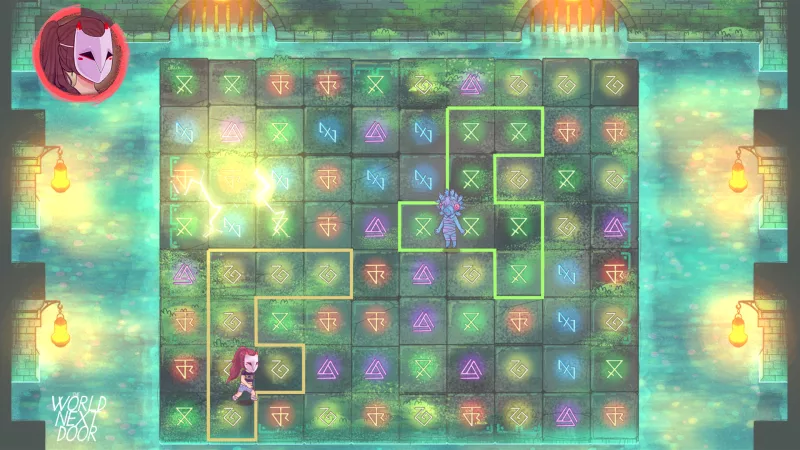
The World Next Door features characters actually running across a shared game board featuring all sorts of colored runes. Your goal is to swap and connect runes of the same color so that they form chains of runes that can be activated.

Each colored rune represents a different attack, which means that, like in Dr. Mario and Puzzle Fighter, a crafty puzzler can create chain reactions where wiping out one set of runes causes another set to connect, triggering another attack.

In The World Next Door, this can lead to devastating combination attacks.

Of course, since you’re sharing a game board with your opponent, there’s the additional elements of defense and sabotage. While you’re building your rune chains, you’re going to want to defend them from your opponent while also disrupting their own attempts to form chains. Defense can truly become a strong offense, if you choose to play that way.

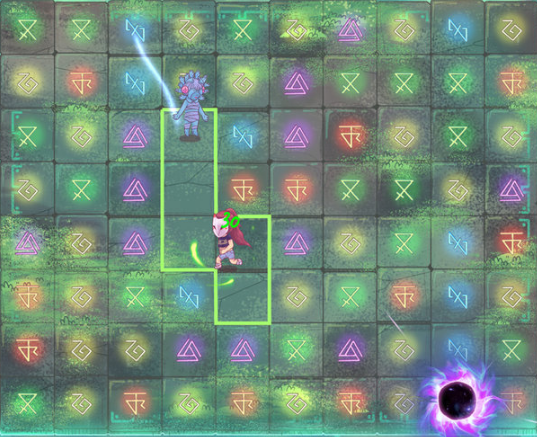
[Here, you can see the result of a rune spell, the small black hole in the corner, waiting for a sprite to wander too close. Image courtesy of The World Next Door.]

This is probably the most direct iteration of puzzly fighting I’ve encountered thus far, since you’re still using puzzle skills to make your attacks, but you’re also interacting head-to-head with your opponent’s game board AND sprite, which really ratchets up both the tension level and the challenge factor.

I’m definitely interested in seeing how this relatively minor subset of puzzle games continues to evolve and grow. The World Next Door is an impressive step up in complexity and style, and with this sort of creativity and innovation at play, the sky is truly the limit.

And let me know if you’d like us to discuss more puzzle apps, puzzly video games, or other related topics on the blog in the future!


Thanks for visiting PuzzleNation Blog today! Be sure to sign up for our newsletter to stay up-to-date on everything PuzzleNation!

You can also share your pictures with us on Instagram, friend us on Facebook, check us out on TwitterPinterest, and Tumblr, and explore the always-expanding library of PuzzleNation apps and games on our website!