It’s Follow-Up Friday: TableTop Day Eve edition!

Welcome to Follow-Up Friday!

By this time, you know the drill. Follow-Up Friday is a chance for us to revisit the subjects of previous posts and bring the PuzzleNation audience up to speed on all things puzzly.

And today, I’d like to return to the subject of puzzly holidays!

Saturday, April 30, is the fourth annual International TableTop Day, a day that has been set aside for family and friends to get together and play games. Board games, card games, role-playing games, puzzles…anything that involves gathering in person and having fun around a table fits the bill!

Although the actual holiday is tomorrow — making today TableTop Day Eve — we celebrated early! The PuzzleNation Crew got together with our friends from Penny Dell Puzzles for a few hours of TableTop Day fun on Tuesday! Games were played, snacks were consumed, and fellow puzzlers and PuzzleNationers were introduced to some terrific games.

[The spread of games available for the event. Can you name them all?]

As usual, the event started with people picking out their favorites and introducing new players to the game. This was the case with Just Desserts (a card game all about serving desserts to hungry customers; guaranteed to make you hungry) and Timeline (a card game about history where you don’t need to know what year things happened, just if they happened before or after other important moments).

One attendee opted to tackle the challenge of Puzzometry (a diabolical jigsaw puzzle) while I played a few rounds of Geek Out! and tested the pop culture and trivia knowledge of my fellow puzzlers.

[The conference room is abuzz with TableTop Day energy and fun, players strategizing deeply.]

I started recommending some new games to the players at this point, and the hit of the day was easily Red Flags, a Cards Against Humanity-style game all about building the perfect dates for other players.

The uproarious laughter inspired by the game was constant background noise while I explained the ever-changing rules of Fluxx to some curious players.

[Forgive the lack of further photos. I was so busy explaining games that I neglected to take more pictures. As a small gesture of apology, please accept this picture of me beneath a half-collapsed puzzle fort.]

We then closed out the event with two terrific card games for smaller groups: 12 Days and Loonacy. (12 Days is a lowest-card-wins wagering game based on the 12 Days of Christmas, and it has the most beautiful cards I’ve ever seen; Loonacy is a pattern-matching card game that rewards quick reflexes.)

The day was a total success, and it was a wonderful break in the middle of the day, allowing for a fun way to interact and recharge before returning to a thoroughly puzzly workday.

But that wasn’t all! To include fellow puzzlers who couldn’t attend the event in person, we had our own in-house session of Schmovie running all day.

I gave participants five What? cards (Undercover, Magical, Teenage, Flying, The Last) and five Who? cards (Barista, Chef, Princess, Pro Wrestler, Spy) to combine as they saw fit, and then challenged them to come up with the funniest Schmovie titles for those subjects.

Here are a few of my favorites:

  • Undercover chef: The Tsai Who Loved Me
  • Teenage barista: Latte to Class
  • Magical barista: Starbucks: The Foam Awakens
  • Teenage princess: Medieval Times at Ridgemont High
  • Flying spy: The Airborne Identity
  • Undercover princess: Leia Confidential

Are you celebrating TableTop Day? Let us know your plans in the comments! We’d love to hear about it, see photos, and share in the fun!


Thanks for visiting PuzzleNation Blog today! Be sure to sign up for our newsletter to stay up-to-date on everything PuzzleNation!

You can also share your pictures with us on Instagram, friend us on Facebook, check us out on TwitterPinterest, and Tumblr, and explore the always-expanding library of PuzzleNation apps and games on our website!

Kickstarter Round-up!

International TableTop Day is this Saturday, a day where we celebrate getting together with family and friends to play games! Board games, card games, role-playing games, puzzles…anything that involves gathering in person and having fun around a table fits the bill!

But we simply can’t wait until Saturday — plus the office is closed that day — so we’re hosting our PuzzleNation’s TableTop Day event in-house TODAY! And I figured what better day could there be for a round-up of puzzly crowdfunding campaigns marking some of the newest and most intriguing projects in the puzzle-game industry today!

I’ve covered various campaigns for board games, card games, and puzzle projects across the Kickstarter and Indiegogo crowdfunding platforms over the years, and today I’d like to share three more that could use your attention.

The first is the strategy game Tak.

Tak is a collaboration between game designer James Ernest, head honcho of Cheapass Games and Hip Pocket Games, and author Patrick Rothfuss, creator of the Kingkiller Chronicle series, to bring to life a game featured in Rothfuss’s novel The Wise Man’s Fear.

The premise sounds simple: build a road of pieces connecting opposite sides of the board. By using some pieces as parts of your road and others as walls to block your opponent, this mix of chess, Stratego, and Go is all about strategy. Plus, the game is adaptable, playable on square boards as small as 3×3 and as large as 8×8.

This is a new pub game that feels like a timeless classic, and it looks perfect for puzzlers of all ages.

Now let’s move from the pub to outer space with another Kickstarter campaign, Avoid the Void.

This is a different sort of strategy game, since it’s all about outlasting your opponents, not completing a task first. In Avoid the Void, whole sectors of space are being replaced with black holes, and everyone is scrambling to gather resources and elude these hungry death traps.

You’ve got an ever-changing gameboard, intriguing alien races (including one resembling a piece of cake), and all the reason in the world to deceive, outmaneuver, and betray your fellow players, just so you can stay in the universe a little while longer.

This is a game designed for replayability, allowing you to indulge in all of the diabolical selfishness of games like Monopoly, but without the huge time commitment. After all, the universe is collapsing and there’s no time to waste!

And speaking of replayability, the makers of this last Kickstarter campaign are known for puzzle games with high replay factor. Let’s talk about Pyramid Arcade from Looney Labs.

We normally talk about Looney Labs card games like Fluxx or Loonacy, but their original product line revolved around the Looney Pyramids system: various games you can play with their signature colored pyramids.

Now, they’re launching Pyramid Arcade, covering TWENTY-TWO different games and encompassing 90 pyramids of various colors. It’s their largest release ever, and with all the variants and mini-games they’ve created for these game pieces over the years, this promises to be a game set with endless possibilities.

Pattern-matching games, chess- and Tic-Tac-Toe-inspired games, bluffing games, strategy games, and even a tower-building game…Pyramid Arcade literally has something for everyone.


These are three intriguing and very worthy projects, and I hope you contribute to one or more of them. As someone who has become a regular donor to various Kickstarter and Indiegogo campaigns, I am proud to have funded some marvelous new ideas and watched them take shape over the months that followed.

Thanks for visiting PuzzleNation Blog today! Be sure to sign up for our newsletter to stay up-to-date on everything PuzzleNation!

You can also share your pictures with us on Instagram, friend us on Facebook, check us out on TwitterPinterest, and Tumblr, and explore the always-expanding library of PuzzleNation apps and games on our website!

PuzzleNation Product Reviews: Takat and Noueni

In today’s product review, we look at two card games that are all about matching colors, identifying patterns, and scoring points, but in very different ways. Today, we put Takat and Noueni under the PuzzleNation Blog microscope!


Let’s start with Takat.

A card game for 2 to 4 players designed by Tyler Kilgore, Takat is different from most pattern-matching tile games or card games because it’s not about maximizing points…it’s about scoring as few points as possible as you place cards and create different colored shapes on the board.

The game starts with each player secretly drawing a card that reveals that player’s color for this game. Not only are you trying to conceal your color from your opponents, but you’re trying to guess what color they have, based on how they place cards and build shapes on the board.

[Some of the multicolored tiles. There are only two legal plays represented here: the second and third tiles in the top row, and the third tile in both the top and bottom rows.]

The multicolored patterns on the cards allow for all sorts of placement options. When you place a card, you can either neighbor a card on the board or partially overlap it, but you always have to make sure the colors match. If the edge of a card is red and blue, the card you place beside it must also be red and blue.

Since the goal of the game is to score as few points as possible, the strategy quickly becomes a mix of bluffing and deduction. You have to complete shapes in your opponents’ colors without revealing your own. (For instance, if you keep building red, blue, and yellow shapes but not green ones, you’ve told your opponents you’re purposely avoiding green, which will only encourage them to build green shapes and give you more points.)

In this game in progress, the players have mostly avoided completing any shapes; there’s the mostly-round yellow shape on the top right as well as the pointy red shape below it (which is partially formed by two overlapping tiles, unintentionally obscuring the black line at the bottom right of the yellow shape.) Those two are the only shapes completed, which means those shapes are worth more points than shapes that aren’t enclosed by black lines.

But since you can score points on neighboring tiles as well as completed shapes, you have to pay as much attention to who placed a tile as you do to what tile they placed.

For instance, on the bottom left, there’s 2 points for the neighboring red tiles, 3 points for the blue shape above it, and 2 points for the yellow rectangle beside the blue shape, despite none of those shapes being closed by black lines.

The game ends when all cards have been played. Then the players reveal their colors, and the points on the board are tallied up, based on how many shapes were made (and how many were completed), as well as how many cards were used in making each shape. The lowest score wins.

The game play of Takat is pretty easy to pick up, but the scoring is a bit more esoteric and takes some getting used to. It does, however, make for a fun variation on the usual tile-placement scoring game, and as a fan of games like Mafia and other bluffing/concealment games, it does make for a more tense playing experience than your average round of Qwirkle.


Now let’s take a look at Noueni.

Designed by 263 Games, Noueni is also a card game for 2 to 4 players that involves pattern-matching, color-based scoring, and cards that can either overlap or sit next to other cards. But there are some important distinctions between Noueni and Takat.

For example, each player chooses their color at the start of the game, and there’s no attempt to conceal it from your opponents. Also, like many pattern-matching games, highest score wins. In this game, your score is determined by how many of your scoring orbs are on the board by the end of the game.

Each card has two colored scoring orbs and a pattern of black lines emerging from them. Those lines are the connectors, and they determine how the cards placed on the board line up. Any card played must link up with the other cards on the board, whether there’s zero, one, two, or three connectors along that neighboring edge.

As you can see, the green scoring orb on the upper left connects to the red orb by three connections, but the other red orb connects to a yellow orb with only two. So far, there have been no overlapping cards played, so all four players are tied with two scoring orbs showing apiece. (The connections aren’t part of the scoring; they’re just the mechanism for lining up cards.)

A few moves later into the game, the yellow (upper right), red (upper left), and blue (middle) players have all added to the board using those matching connections, but the green player has overlapped half of a blue card, using those connections and obscuring the blue scoring orb.

Overlaps allow you to cover your opponents’ scoring orbs and claim those spots for yourself, but you have to exactly match the connections they left behind. (You can only overlap half of a card already on the board, so even if the green player had a card exactly matching BOTH of the blue card’s connections, that’s an illegal play. The green player could, however, overlap half of one card and half of another, if the connections lined up.)

And that’s where the strategy aspect of Noueni comes into play. It’s a mix of expanding the board and placing as many scoring orbs as possible, but also seizing the opportunity to hide your opponents’ orbs and match those same connection patterns.

The game ends when all cards have been placed, and the player with the most visible scoring orbs wins.

Noueni is more straightforward than Takat, which will make it more accessible to new players, but it also lacks the tension of hiding your color and ferreting out your opponents’ colors. On the flip side, Noueni does maintain that ever-present paranoia that at any point, someone might drop a card on top of yours and steal a key scoring orb at a crucial moment in the game.

Both are terrific games that build on the pattern-matching color tile game format in interesting ways, requiring more from a player than simply outscoring their opponents. You need to outthink them too.

Takat and Noueni are both available from The Game Crafter.


Thanks for visiting PuzzleNation Blog today! Be sure to sign up for our newsletter to stay up-to-date on everything PuzzleNation!

You can also share your pictures with us on Instagram, friend us on Facebook, check us out on TwitterPinterest, and Tumblr, and explore everything PuzzleNation on our website!

PuzzleNation Product Review: Scrimish

The best card games are simple. People love War and Poker and Hearts and Go Fish because, at their core, they’re games you can learn quickly and play endlessly. There are no long tutorials or play-throughs, so you can learn all the complexities and rules with ease.

It’s difficult to find puzzly card games that are as accessible and replayable. Scrimish, a card game created by Danny Zondervan and recently funded through Kickstarter, fits the bill nicely. The rules are simple, but the strategy in the actual game is what gives Scrimish major replay value.

[On a very festive battlefield, I’ve finished setting up my cards
(bottom of the frame), while my opponent is still working on hers.]

Scrimish is an elegant mix of War, Chess, and Memory.

Each player gets a set of 25 cards, arranging them into five piles of five cards each, face down. The goal? Find your opponent’s crown card before they find yours.

Then you take turns drawing a card from the top of one of your piles and attacking the top card of one of your opponent’s piles in a one-on-one battle. Here’s where the War aspects begin. You see, each card has a number value, and the higher number wins. The losing card is discarded, and the winning card goes back to whatever pile it came from.

So in every encounter, both players learn something, because even if you lost that attack, you’ve learned the value of one of the cards on top of one of your opponent’s piles.

That’s where the Memory aspect comes in, because you have to remember what cards of your opponent’s you’ve seen. (You can check your top cards or your piles as often as you and your opponent see fit.) Then you can plan other moves and try to uncover their crown card.

You’ve got shield cards to defend with, archer cards to attack with, numbered weapon cards to battle with, and one crown card to defend. So, essentially, you’re playing a miniature game of chess with your opponent, except your pieces are hidden from them.

And that’s what makes for such a satisfying playing experience. You’ve got all sorts of strategy going on, plus chances for misdirection in both your attacks and your placement of cards at the beginning of the game. Do you go out heavy with high numbered cards early, or do you test their defenses with low cards? Do you arrange attack stacks and defensive stacks, or do your spread your resources out across all five stacks?

Plus, every card you attack with is one less you have in your stacks. So you’ve got a resource management aspect as well. All of this gameplay and puzzly potential, with fewer cards than your standard poker deck.

It takes only a few minutes to learn, but all the thought that goes into it makes every game of Scrimish feel fresh and new.


Thanks for visiting PuzzleNation Blog today! Be sure to sign up for our newsletter to stay up-to-date on everything PuzzleNation!

You can also share your pictures with us on Instagram, friend us on Facebook, check us out on TwitterPinterest, and Tumblr, and explore the always-expanding library of PuzzleNation apps and games on our website!

PuzzleNation Product Review: Give Me the Brain!

In today’s product review, we look at a game that’s all about using your smarts to get the job done…before someone snatches them away from you.

Welcome to Friedey’s, the fast food restaurant run by zombies. Every zombie has several jobs to do. Some of them are easy, but others are tougher and require a limited resource: the one brain shared by every employee. Only one player can use the brain at a time, so use it wisely before another player steals it!

Give Me the Brain! starts with a very simple premise: empty your hand of cards before your opponents do. But behind that easy-to-follow mechanic lies a game fueled by luck and strategy alike.

There are bid cards (blue) and job cards (yellow and pink). The bid cards are used to try to gain control of the brain, either by stealing it from an opponent or by taking advantage when another player drops it. The job cards come in two varieties, pink ones that require the brain and yellow ones that don’t.

Since, as a zombie, you’ve got two hands (literal hands, not hand like “a grouping of cards”), you can either use two one-handed job cards or one two-handed job card per turn. For jobs that require the brain, you need to roll the die and beat the number on the job card. If you roll higher than the number on the card, you drop that card and keep the brain. If you roll lower, you drop the brain and other players can try to grab it.

Between the different effects the job cards have and the requirements for playing them (one hand or two, needing the brain or not), this quickly becomes a game about maximizing opportunities.

The game comes with the deck of cards and a six-sided die (which also represents “the brain” in play), but you can add a little brain to your set for less than a dollar extra, and I’ve found that passing the brain around the table is much more satisfying than stealing the die from an opponent.

The premise is silly, the artwork is appropriately ghoulish, and the game play is topnotch, offering plenty of replay value. Picking this one up is a no-brainer.

Give Me the Brain! is available from Cheapass Games for $25 and is featured in our Holiday Puzzly Gift Guide!


Thanks for visiting PuzzleNation Blog today! Be sure to sign up for our newsletter to stay up-to-date on everything PuzzleNation!

You can also share your pictures with us on Instagram, friend us on Facebook, check us out on TwitterPinterest, and Tumblr, and explore the always-expanding library of PuzzleNation apps and games on our website!

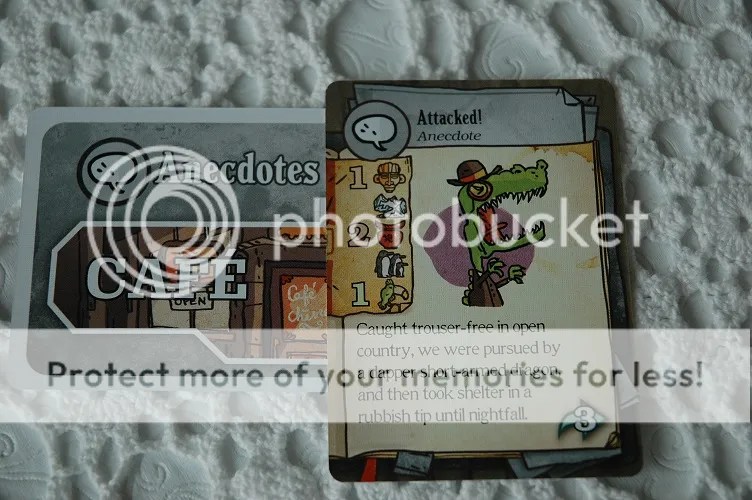
PuzzleNation Product Review: Stuff and Nonsense

In today’s product review, we look at a puzzly game all about telling stories.

Many games are about grand adventures, but only Stuff and Nonsense is about pretending to go on grand adventures to scam your fellow would-be adventurers. Can you sneak around London and gather the props you need for your impressive lie, all while avoiding the fiendishly clever Professor Elemental?

Stuff and Nonsense is a game of position, strategy, and opportunity. You travel around the game board — made of map cards — visiting various spots and picking up cards that will help you tell your fictional tale of derring-do. When you’ve collected the right cards — or enough to sell your fake story — you head to the Adventurer’s Club to tell your story.

Each time you do so, you can cash in those cards for points. Point values can range wildly depending on the cards you have and the value of your setting at a given time.

The cards are silly, creatively imagined, and often hilarious, discussing mythical events, explaining weird artifacts, and offering much-needed color to help sell your false tale.

All the while, you must dodge Professor Elemental, who is moving around the board investigating your shenanigans. If you end up in the same spot as him, you face a penalty (either losing a card or having every card in your hand drop one point each in value.)

[The game comes with these colored tokens (top), but you can opt for the slightly more expensive (& delightful) Meeples of the Professor & various faux adventurers (bottom).]

What makes this game such a puzzly treat is the mix of strategy and opportunity. You can take whatever cards you get and hit the Adventurer’s Club frequently to rack up smaller amounts of points more frequently, or you can bide your time and then hit the club less often for higher point values.

But either way, there’s always the looming threat of crossing paths with the Professor at a bad time and losing a key card or crucial points.

Plus, the map is different every game based on how you lay it out, so there’s a lot of replay value here.

Stuff and Nonsense is available from Cheapass Games for $25, and is featured in our Holiday Puzzly Gift Guide! What great fun.

[youtube https://www.youtube.com/watch?v=JuhGMA–r7M]


Thanks for visiting PuzzleNation Blog today! Be sure to sign up for our newsletter to stay up-to-date on everything PuzzleNation!

You can also share your pictures with us on Instagram, friend us on Facebook, check us out on TwitterPinterest, and Tumblr, and explore the always-expanding library of PuzzleNation apps and games on our website!