Answers to Our 6th Anniversary Instagram Brain Teasers!

Last week, we celebrated six years of PuzzleNation Blog by announcing a week-long puzzly social media blitz.

Facebook and Twitter saw twice-daily alerts for the puzzle of the day for both Daily POP Crosswords and Penny Dell Crosswords App, cuing solvers to contact us with the answers to particular across and down clues.

Instagram solvers were encouraged to tackle a series of brain teasers, and today, we’ve got all the answers for you! Let’s jump right in.

We started off on Tuesday with this relatively straightforward brain teaser: How can you add eight 4s together so that the total adds up to 500?

We got the most responses to this one, and it’s no surprise, as we have some very crafty followers on Instagram. The trick here is number placement. By grouping 4s, you create larger numbers that make it easier to add to your total.

Solution: 444 + 44 + 4 + 4 + 4 = 500


Wednesday’s puzzle involved placing the numbers 1 through 8 into the grid above. Consecutive numbers cannot appear in an adjacent or diagonal box.

This puzzle was actually created and submitted by a PuzzleNationer named Sanjana, so kudos to you, Sanjana, as you made one heck of a brain teaser!

Here’s the solution. (Using the same numbers in reverse or flipped layout creates four different variations on the same solution.)


Thursday’s brain teaser put your Scrabble and Upwords skills to the test, as we played a round of Quad-Doku! The goal is to play each tile, one at a time, onto the board, forming a new common word (or words) each time. Do this with all 8 tiles in any order. By the end, all four corners will have changed.

This is a nice chain-solving puzzle, and here’s the solution we came up with:

F makes FOUR/FIND, S makes FINS/SEEM, A makes SEAM, B makes FIBS, C makes SCAM, W makes SWAM, L makes FOUL/LOOM, and P makes LOOP/SWAP.


On Friday, we posted a riddle to test your puzzly skills. Once I am 24, twice I am 20, three times I am unclean. What am I?

Solution: The answer is X. It’s the 24th letter of the alphabet, two X’s makes 20 in Roman numerals, and three X’s marks something as inappropriate for some viewers.


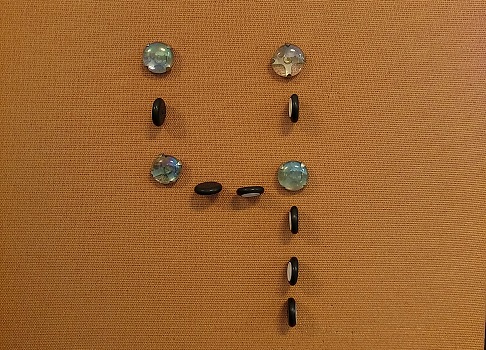
Monday brought us our final brain teaser, a matchstick puzzle (or, in this case, a toothpick puzzle). Can you move four toothpicks in order to change the zigzag path into 2 squares? The two squares do not have to be equal in size.

In the image above, we’ve circled the four toothpicks to move.

And here is the completed puzzle, with two squares of unequal size.


How did you do, intrepid solvers? Well, based on the responses we received, pretty darn well! We’ll be reaching out to contest winners later this week!

But in the meantime, we’d like to thank everyone who participated in our PN Blog 6th Anniversary event. You help make this the best puzzle community on the planet, and we are forever grateful.


Thanks for visiting PuzzleNation Blog today! Be sure to sign up for our newsletter to stay up-to-date on everything PuzzleNation!

You can also share your pictures with us on Instagram, friend us on Facebook, check us out on TwitterPinterest, and Tumblr, and explore the always-expanding library of PuzzleNation apps and games on our website!

The Value of Recreational Math

There was a wonderful opinion piece in The New York Times a few weeks ago about the importance of recreational math.

Now, as author Manil Suri said, I’m sure that to some people, the idea of recreational math sounds like an oxymoron. But it’s everywhere! From poker players calculating their odds based on the cards dealt to the number crunching in role-playing games in order to complete certain tasks (or develop a character’s skills), math is built into many recreational activities.

It’s certainly a part of many kinds of puzzles, including brain teasers. Heck, previous brain teasers featured here in the blog like Mystery Number, the Birthday Puzzle, and the jugs of water trap from Die Hard with a Vengeance would all easily fall under the umbrella of recreational math.

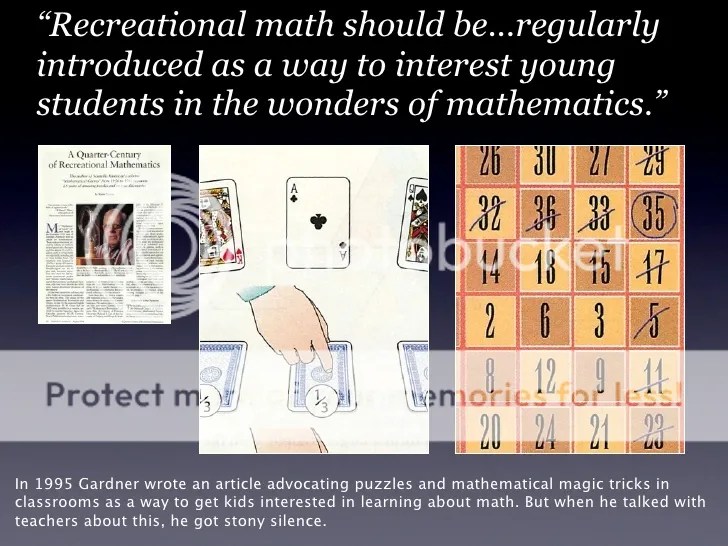
The article goes on to mention the wonderful work of Martin Gardner, whose column “Mathematical Games” in Scientific American was a mainstay of recreational math and puzzly whimsy for over twenty-five years.

From Suri’s article:

In his final article for Scientific American, in 1998, Mr. Gardner lamented the “glacial” progress resulting from his efforts to have recreational math introduced into school curriculums “as a way to interest young students in the wonders of mathematics.”

Indeed, a paper this year in the Journal of Humanistic Mathematics points out that recreational math can be used to awaken mathematics-related “joy,” “satisfaction,” “excitement” and “curiosity” in students, which the educational policies of several countries (including China, India, Finland, Sweden, England, Singapore and Japan) call for in writing.

In contrast, the Common Core in the United States does not explicitly mention this emotional side of the subject, regarding mathematics only as a tool.

This is an excellent counterpoint to the regular argument that the primary value of puzzle-solving and other activities (like recreational math) is to stave off brain health issues later in life.

In a previous post, we discussed the inconsistent reports about the effects of puzzle-solving on the brain, leaving it unclear if regular doses of puzzles and recreational math are beneficial for other aspects of brain health over time, like memory retention, neuroplasticity, and concentration.

That may well be the case, but Suri’s point stands. The idea of instilling a sense of fun and wonder into the field of math, especially for younger minds? That’s one worth pursuing.

Show them that math can be about more than fulfilling homework or graphing parabola. Show them that mathematical concepts can help you crack a diabolical seesaw brain teaser, save a village with a grain of rice, or find an alternate solution to a PSAT question and prove the testers wrong.

It has been championed in the past by television shows like Square One TV and MythBusters, but sadly, examples like that are few and far between.

And if we can instill recreational math as a key facet of math itself, then we’d be one step closer to ensuring that STEM courses will have plenty of participants in the future.


Thanks for visiting PuzzleNation Blog today! Be sure to sign up for our newsletter to stay up-to-date on everything PuzzleNation!

You can also share your pictures with us on Instagram, friend us on Facebook, check us out on TwitterPinterest, and Tumblr, and explore the always-expanding library of PuzzleNation apps and games on our website!