PuzzleNation Product Review: ThinkFun’s Brain Fitness line

The folks at ThinkFun are always trying to raise the bar when it comes to puzzly games that keep the mind in fighting trim. (You may remember them from our review of Laser Maze over the summer.)

In that vein, they’ve unleashed the Brain Fitness line of puzzle games, offering all sorts of exercises to challenge you one-on-one and put your puzzly skills to the test.

They sent us copies of three Brain Fitness games to review, each with its own distinct flavor.
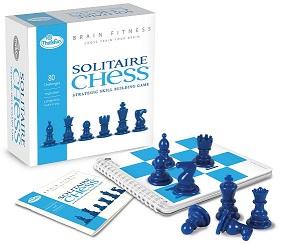
solitairechess

Brain Fitness Solitaire Chess

Solitaire Chess presents you with various layouts of pieces on a 4×4 grid, challenging you to clear the board of all but one piece. Every single move must eliminate a piece until only one remains.

Even the beginner puzzles gave me pause at first, because the need to knock out a piece with every move is a very different style of chess than I’m accustomed to. But I very quickly got into the groove of plotting out the chain of moves necessary to clear each board. With two pawns, two knights, two bishops, two rooks, a queen and a king, there are myriad layouts of varying complexity to solve, and some of them were serious brain melters.

Oddly enough, I found some of the expert-level grids easier than the advanced-level puzzles, though you could easily spend five or ten minutes on a single crafty puzzle.

Not only is it a terrific mental exercise, but it just might make you a better chess player in the long run.

Brain Fitness Chocolate Fix

Chocolate Fix is a marvelous variation on the Sudoku model, offering nine sweets of varying shape and color, and tasking you with deducing the intended position of each in a 3×3 baking sheet.

The beginner-level puzzles are child’s play, and would actually be a terrific introduction for younger puzzlers. But as soon as you reach the intermediate-level challenges, the difficulty begins ratcheting skyward. Some clues give you colors only, others shapes only, and the occasional clue is centered around a given piece’s location on the baking sheet.

Midway through the advanced-level challenges, they stop referencing specific sweets at all, leaving you to do some serious deductive work with shapes and colors alone.

By the time you reach the expert puzzles (which abandon any clues providing all nine squares, leaving you to mentally assemble Tetris-like pieces with shape and color symbols), it becomes a serious mental workout that banishes any false confidence and bravado that the easy early rounds might’ve sparked.

Victory may be sweet, but Chocolate Fix’s later challenges will make you earn it.

Brain Fitness Rush Hour

Rush Hour is a variation on the classic sliding-tile game, except instead of tiles, you’re sliding cars and trucks back and forth in order to clear a path for your heroic little red car to escape the traffic jam.

Rush Hour (in various forms) has been a great success for ThinkFun over the years, and the Brain Fitness version is a brilliantly simple adaptation. Self-contained and perfect for puzzling-on-the-go, Rush Hour takes the chain-move thinking of Chess Solitaire to the next level.

The jump from beginner-level to intermediate-level challenges is a sobering one, if only because the playing grid seems absolutely packed with cars! But you quickly realize that a packed grid means fewer possible moves, which helps to point you toward the solution.

The grid thins out again when you reach the advanced-level puzzles, but greater movement only leads to tougher challenges, since so many more moves are available to you, requiring chains of increasing complexity in order to rescue your little red car.

Having thoroughly tested all three games, I found Rush Hour the most difficult of the three (though Solitaire Chess wasn’t far behind), but I must admit, the multilayered colors / shapes / positioning clue style of Chocolate Fix provided the most unexpected challenge.

As an experienced puzzler, I was thoroughly impressed by the scalability of each idea. The easy puzzles were terrific introductions to the game, and the expert puzzles were challenges quite worthy of your time.

ThinkFun recommends 15 minutes of puzzling time a day with any of their Brain Fitness products in order to give your brain a proper workout, but I suspect you’ll have a hard time stopping there. If only physical workouts were as much fun as these mental ones!

Thanks for visiting the PuzzleNation blog today! You can like us on Facebook, follow us on Twitter, cruise our boards on Pinterest, check out our Classic Word Search iBook (recently featured by Apple in the Made for iBooks category!), play our games at PuzzleNation.com, or contact us here at the blog!

Optical illusions: playing with your perspective

Optical illusions are a delight. Puzzles for the eye, they play with our expectations, our deductive abilities, our biological blindspots, and our ability to process light, shadow, motion, and perspective.

We’ve featured optical illusions several times before, from the large-scale works of Felice Varini to the mystery of the Necker Cube, but we never seem to run out of clever ways to deceive the eye and conjure magical effects from the simplest materials.

So today, I thought we could indulge ourselves in some first-class visual trickery. =)

Our first video was produced by Samsung, and features 10 optical illusions in 2 minutes. Can you suss out the techniques being employed?

This next illusion is a prime example of after-images (the most famous one being the American flag with black stars, a tan/yellow field, and black and blue/green stripes).

Forced perspective (like that in the LEGO picture at the top of the page) has been a cherished film and photographic trick for decades — from Darby O’Gill and the Little People to Honey I Blew Up the Kid — and here’s a particularly wonderful illustration of how effective forced perspective can be.

Finally, we have the video that inspired this entry, courtesy of the science-minded folks at IO9.

There is a famous mathematical conundrum known as the triangle paradox (or Curry’s triangle paradox, after magician Paul Curry), wherein it appears that you can lose or gain area from a shape by cutting it into pieces and moving them around.

The video illustrates the concept behind the triangle paradox by offering an intriguing promise: how to cheat mathematics and make chocolate out of nothing. (Warning: watching this video may aggravate your sweet tooth.)

Thanks for visiting the PuzzleNation blog today! You can like us on Facebook, follow us on Twitter, check out our Classic Word Search iBook (recently featured by Apple in the Made for iBooks category!), play our games at PuzzleNation.com, or contact us here at the blog!

Hold on, let’s be logical about this…

A few weeks ago, I did a blog post exploring the history of paper puzzles, comparing relatively new puzzle innovations like crosswords and Sudoku — crosswords are nearing their 100th anniversary, and Sudoku has only been around a few decades in its current form — to a much older style of puzzling, the riddle.

But it occurs to me that another branch of puzzles, logic puzzles, can trace their formative roots nearly as far back.

Logic puzzles are a curious breed of puzzles, since they rely less on grids and trivia and more on deductive reasoning. (Yes, many solving styles utilize grids, like this one from our friends at Penny/Dell Puzzles, but they’re not strictly necessary.)

If I was to chart the evolution of puzzles like that of animals or plants, riddles and logic puzzles would be offshoots of the same ancestor. Riddles are actually very simplistic logic puzzles, since they often rely on a single twist or turn of phrase.

For example, there’s the riddle “what gets wetter as it dries?”

The answer is “a towel.” The riddle relies on logical misdirection. The structure implies a passive voice (something becoming dry) but its actual structure is active voice (something actually drying another object).

This is known as a garden path sentence, and a terrific example is this quotation often attributed to Groucho Marx: “Time flies like an arrow, fruit flies like a banana.”

The main difference between the two is the complexity of logic puzzles as they’ve developed. Riddles are a one-and-done trick of wordplay, while logic puzzles are multilayered exercises in deduction.

So, from riddles, it’s easy to imagine mystery stories and whodunits as the next precursor in the development of logic puzzles. From the early days of the genre’s creation at the hands of Edgar Allan Poe to its explosion in popularity under the quick and clever pens of Agatha Christie and her fellow authors, the plot of virtually every mystery story is a logic puzzle in itself.

The arrangement is similar. You’re given your setting and the circumstances that gathered the players together. Then you’re given the pertinent information on who was where at a given time, and it’s left to you (and the ubiquitous detective) to unravel the truth from a convoluted mishmash of information.

Except for the detective, that’s the modern day logic puzzle exactly.

(I snagged this helpful image from www.logic-puzzles.org.)

Heck, there are even some mystery stories that are considered unsolved, practically waiting for an enterprising logic puzzle fan to find the key piece of evidence that will unlock the entire story.

Frank Stockton’s story “The Lady, or the Tiger?” comes to mind, as does Stanley Ellin’s “Unreasonable Doubt”. (I encountered these stories in Otto Penzler’s collection Uncertain Endings: The World’s Greatest Unsolved Mystery Stories.)

And in case you’re curious as to why I’m rambling about riddles and Poe and how they directly or indirectly influenced the evolution of logic puzzles as we know them… the answer is simple.

With the hundredth anniversary of the crossword fast approaching, it’s made me wonder just how long the spirit of puzzle-solving has been with us as a civilization.

And when you can trace logic puzzles back hundreds of years and riddles back thousands of years, it’s hard not to smile and imagine that we’re enjoying the same mental and puzzly challenges generations and generations of others have tackled in the past.

It’s a humbling and heartening thought.

Thanks for visiting the PuzzleNation blog today! You can like us on Facebook, follow us on Twitter, check out our Classic Word Search iBook (recently featured by Apple in the Made for iBooks category!), play our games at PuzzleNation.com, or contact us here at the blog!

Wanna bet?

One of my most frequent blog post topics is how puzzles and puzzle skills relate to the modern world. I love seeking out new ways to apply what puzzles teach us to everyday life, and there are few puzzle-centric activities more gratifying than using your puzzly skills to pull a fast one on your friends.

Oh yes, I’m talking about bar bets.

We’ve spotlighted Richard Wiseman’s Quirkology videos twice before, and he’s produced another gem, featuring 10 tricks and brain-teasers with which to baffle and challenge your friends.

(Of course, if you keep bamboozling them out of money, they probably won’t want to hang out with you anymore, so use these tricks sparingly.)

Enjoy this latest batch of crafty cons and puzzly shenanigans.

Riddle me this!

The spirit of puzzle-solving has always been with us — every problem is a puzzle of some sort, after all — so it’s surprising to realize how relatively brief the history of paper puzzles is in the long run.

I mean, the Sudoku puzzle as we know it first appeared in print in Dell Magazines in 1979, a little over thirty years ago! (Yes, some puzzles with similar attributes appeared in French publications nearly a century before, but the Sudoku as we know it is a modern creation.)

This year marks the one-hundredth anniversary of the crossword puzzle. One hundred years! Amazing when you think about it, but also just a drop in the bucket when compared with the span of human history.

So, if the two most famous puzzles are both fairly recent developments, what sort of puzzles kept humans occupied for centuries and centuries before that?

Riddles.

Yes, plenty of wordplay and mathematical games predate the modern puzzles we know and love, like the famous ancient word square found in the ruins of Pompeii that features a Latin palindrome.

But I suspect that riddles were, in fact, our first experiments with puzzles and puzzly thinking.

They appeal to our love of story and adventure, of heroes with wits as sharp as their swords. Riddles are the domain of gatekeepers and tricksters, monsters and trap rooms from the best Dungeons & Dragons quests.

The Riddle of the Sphinx — in its most famous version: “What goes on four legs in the morning, on two legs at noon, and on three legs in the evening?” — has origins as far back as the story of Oedipus and the tales of Sophocles and Hesiod, more than 2000 years ago.

And variations of logic puzzles and riddles have been with us at least as long. Consider the famous “a cabbage, goat, and wolf” river crossing, or the Man with Seven Wives on the road to St. Ives.

Nearly one hundred and fifty years ago, Lewis Carroll unleashed a doozy of a riddle in Alice’s Adventures in Wonderland, one we discussed in detail in a recent blog post.

In more recent times, one of Batman’s most capable and dogged adversaries has employed riddles to confound and challenge the Caped Crusader.

His debut episode of Batman: The Animated Series features a corker of a riddle: “I have millions of eyes, yet I live in darkness. I have millions of ears, yet only four lobes. I have no muscles, yet I rule two hemispheres. What am I?”

While we’ll probably never be able to trace the history of riddles as definitively as that of crosswords and sudoku, it’s fascinating to consider just how long puzzles in one form or another have been with us.

And so, in the spirit of puzzling, here are a few riddles for the road. Enjoy.

A man lay dead on the floor, fifty-three bicycles on his back. What happened?

Bob walked into a bar and asked for a glass of water. The bartender pulled out a gun and pointed it at Bob’s face. A few seconds later, Bob said, “Thank you” and walked out. What happened?

Rhonda lay facedown in the middle of the desert. On her back was something that could have saved her life. What is it?

Frank did not want to go home because of what the masked man held in his hand. What is the masked man holding?

Joe was dead. Across his back was an iron bar. In front of him was some food. What happened?

[Answers will be posted on Friday!]

Thanks for visiting the PuzzleNation blog today! Don’t forget about our PuzzleNation Community Contest, running all this week! You can like us on Facebook, follow us on Twitter, check out our Classic Word Search iBook (three volumes to choose from!), play our games at PuzzleNation.com, or contact us here at the blog!

Carroll’s classic conundrum!

After my post on Brain Melters (the diabolical siblings of brain teasers), I’ve had riddles on the brain, one in particular.

There’s a famous riddle that compares a raven and a writing desk. It was first penned by the brilliant, controversial, and utterly ridiculous Lewis Carroll.

The Hatter asked Alice, “Why is a raven like a writing-desk?”
“I give up,” Alice replied. “What’s the answer?”
“I haven’t the slightest idea,” said the Hatter.
Alice sighed wearily. “I think you might do something better with the time,” she said, “than waste it in asking riddles that have no answers.”

It was purposely devised as a riddle with no answer — prime Brain Melter territory — but that hasn’t stopped people from trying to solve it in various silly, pragmatic, and clever ways through the years.

A practical answer is “They both have legs”, but not only is that terribly boring, but it seems to abruptly ignore Carroll’s legacy of whimsy and logodaedaly.

(Come on, it wouldn’t be a truly Lewis Carroll-worthy post without some curious vocabulary. *smiles* And a pat on the back to those who didn’t have to look it up!)

Many people have incorporated assonance, rhyme, and wordplay into their solves. Here are some of the possible solutions people have conjured over the years:

–It is used to carry on work and work carrion.
–Because the raven has a secret aerie and the writing desk is a secretary.
–It understands its tails and quills would nevar [sic] work with the wrong end in front. (This is a variation on the answer Carroll eventually provided)

Carroll himself was quoted as saying that a raven is like a writing-desk “because it can produce very few notes, tho they are very flat; and it is nevar [sic] put with the wrong end in front.”

Despite Carroll’s typically obtuse and curious response, several sources have stated that the correct answer is that “dark wing site” is an anagram for “a writing desk”.

Ignoring all of these possible solutions, I prefer the one I consider the most simple, the most clever, and the most sensible…

How is a raven like a writing desk? Poe wrote on both. =)

Thanks for visiting the PuzzleNation blog today! You can like us on Facebook, follow us on Twitter, check out our Classic Word Search iBook, play our games at PuzzleNation.com, or contact us here at the blog!