Roll Them Bones!

Meme culture is constantly evolving. As new memes emerge, others are updated. They mutate, they cross over with other meme styles. It’s virtually a language at this point, a hyper-dynamic vernacular where the rules change as fast as the imagery.

And yet, old memes can resurface for new audiences and make an unexpected impact, like the one I stumbled across this week.
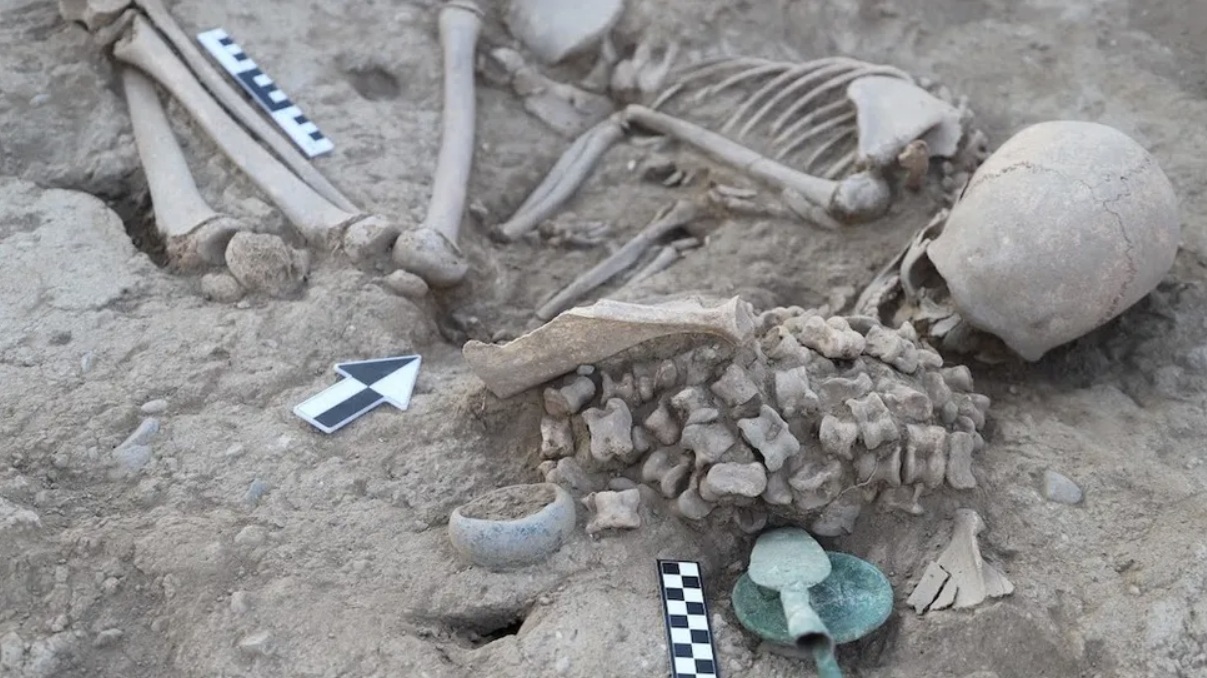
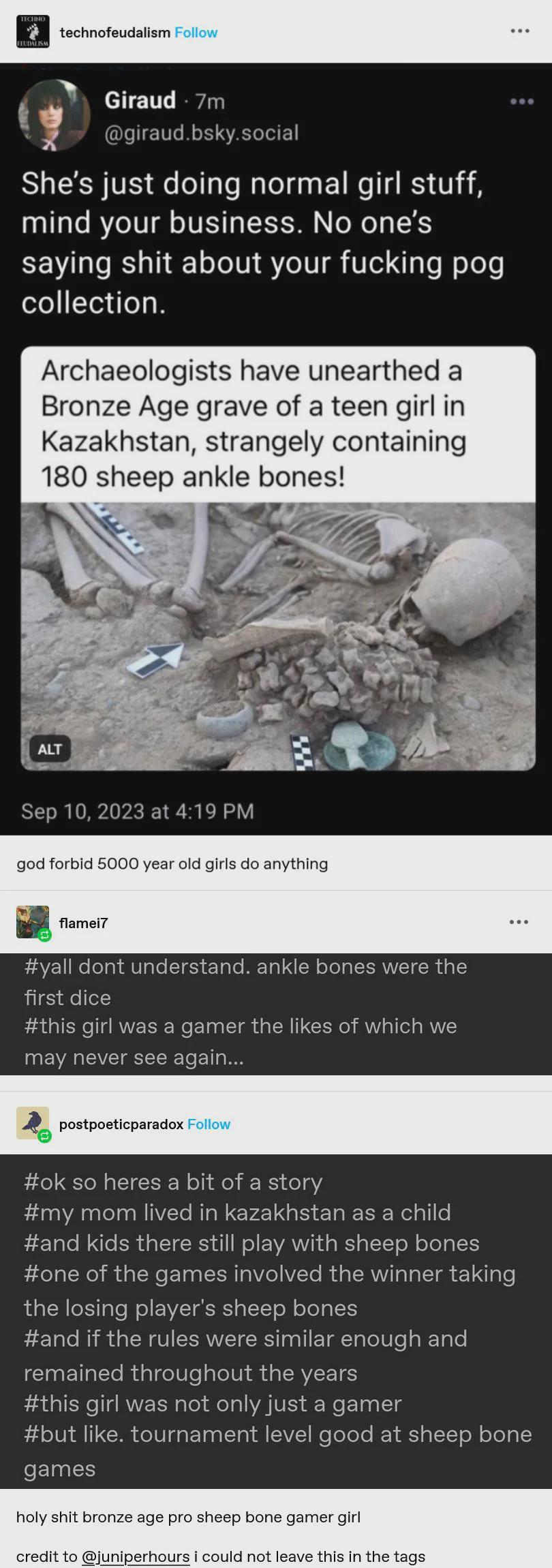
Two years ago, an archaeology report hit internet news feeds. Archaeologists in Kazakhstan uncovered the burial mound of a young girl, somewhere between the ages of 12 and 15. The grave dated back to the Bronze Age, about 5000 years or so.

But that wasn’t what caught the Internet’s attention.

It was the sheep bones that captured everyone’s imagination.
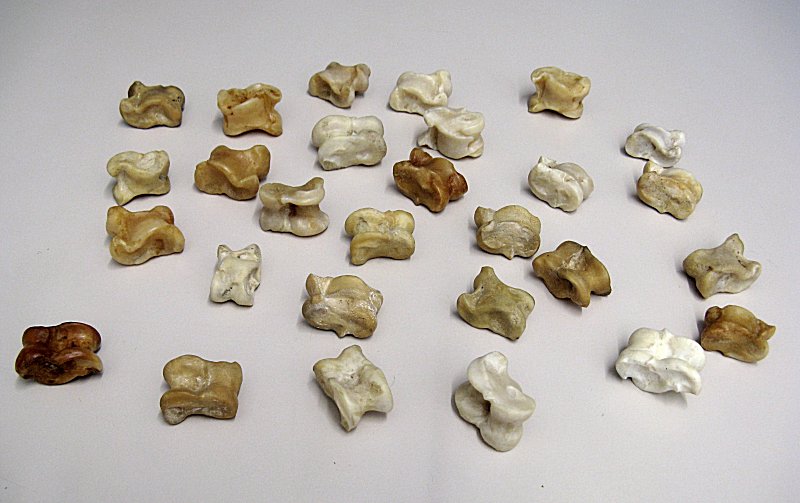
You see, she was buried with 180 ankle bones, also known as astragalus bones, from dozens and dozens of sheep.

Researchers were unsure of the significance of these bones, attributing them to cult practices, totems for meditation, or symbols of good luck to wish the deceased well in their transition to a new world.

Internet readers came to a different conclusion. They believed this young girl was a world-class gamer and these were her trophies, the spoils of victory.

Knuckle bones, ankle bones, and other small, easily-rolled bones have been associated with gaming for centuries. For many cultures, they were the first readily-available dice. This is true in Kazakhstan as well.

In fact, there is a Kazakh game called Assyk, and it’s similar to marbles. Players take an ankle bone and try to knock other ankle bones from the game space. It requires considerable skill, since you’re tossing the assyk from a distance.
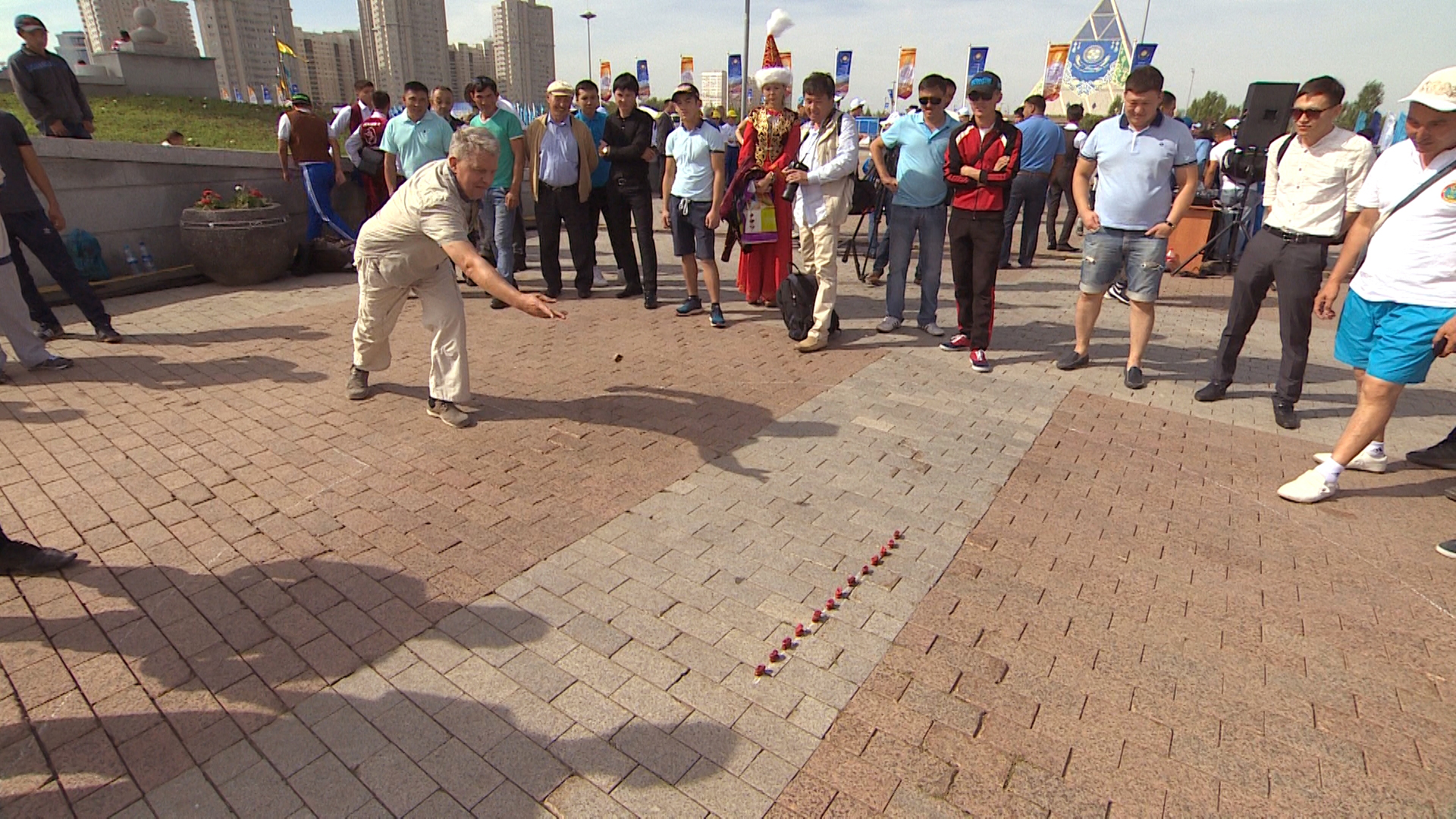
Rules vary depending on your sources, but according to some articles about this traditional Kazakh game, winners would keep the ankle bones they knock out of the circle, just like in marbles, pogs, and other games of this nature.

So, if our Bronze Age assyk master followed this rule — and based on the number of bones in her grave, it’s a distinct possibility — that means she didn’t just dabble in this game… she dominated at it, collecting dozens of victories.

Appropriately, the Internet celebrated her as a pro gamer, a tournament-level champion with the hand-eye coordination to dominate modern games as easily as she did games of assyk around her village.

And honestly, how can you not love something like that? Everybody needs a hero, gamers included. A 5000-year-old Bronze Age astragalus-hoarding game sniper is not a bad place to start.

Happy sheep-bone-tossing, everyone!
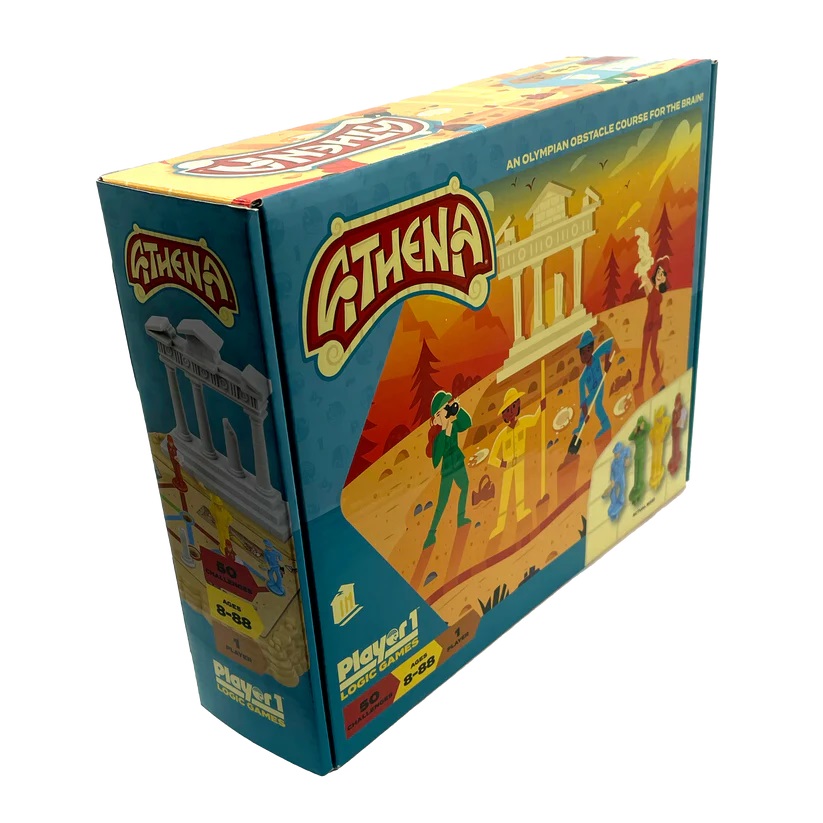
Product Review: Athena

[Note: I received a free copy of this puzzle in exchange for a fair, unbiased review.]

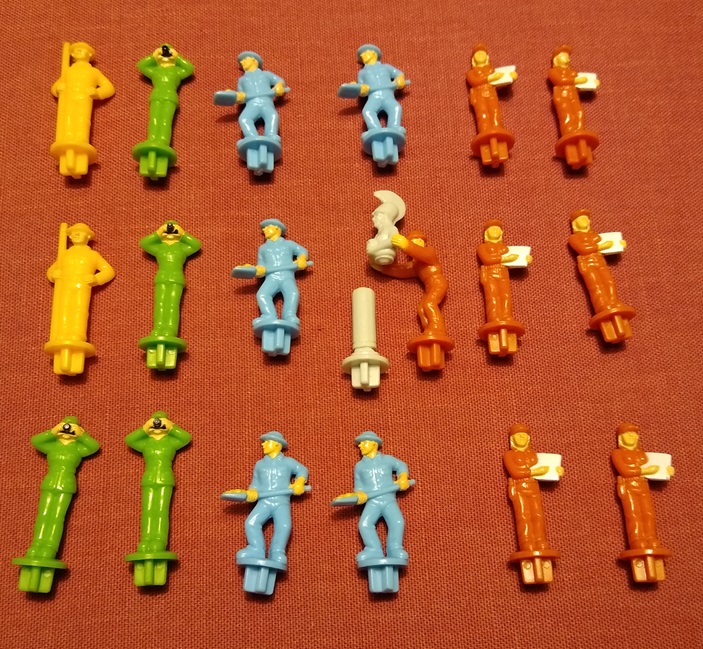
An archaeological dig site can be a very busy place. You’ve got your crew digging, folks photographing the scene and documenting artifacts, staffers keeping meticulous notes… and then there’s you, the lead archaeologist, holding part of a priceless relic: the bust of Athena.

Can you navigate a chaotic dig site and reunite the statue with its pedestal? That’s the puzzly challenge set before you in Athena.

A chain-solving brain teaser in the vein of sliding-tile puzzles or the famous Tower of Hanoi ring puzzle, Athena requires you to think like a tactician or a chess player. You must analyze the scene, move the pieces according to specific rules, and try to plot out the correct path for your lead archaeologist.

There are 50 challenge cards included, each with a particular arrangement of workers on the board and color-coded paths for the pieces to follow.

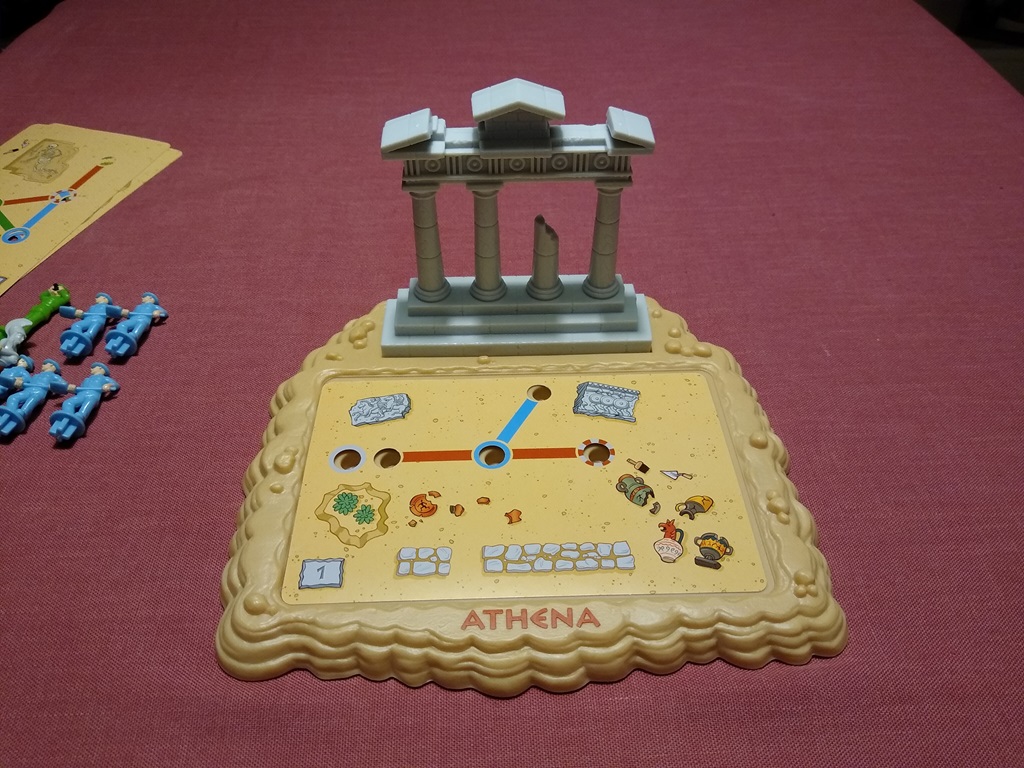
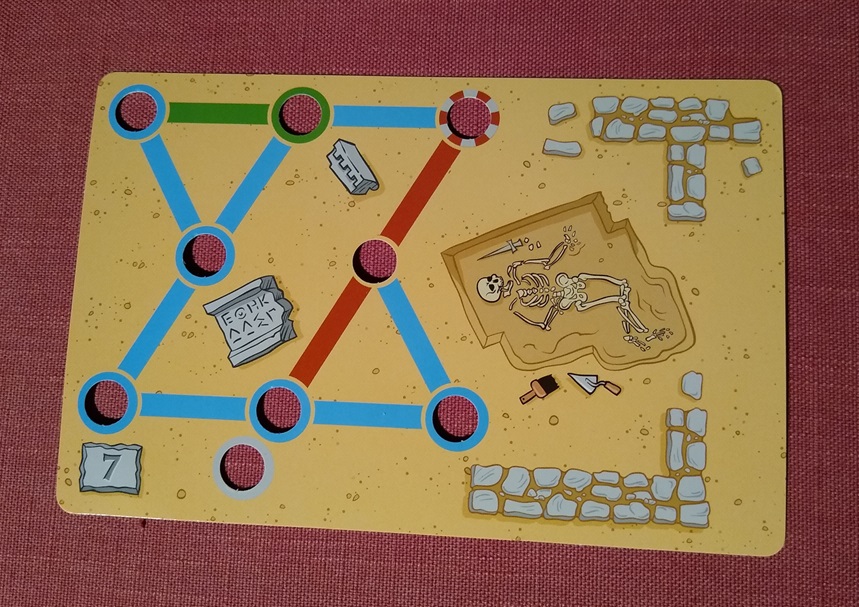
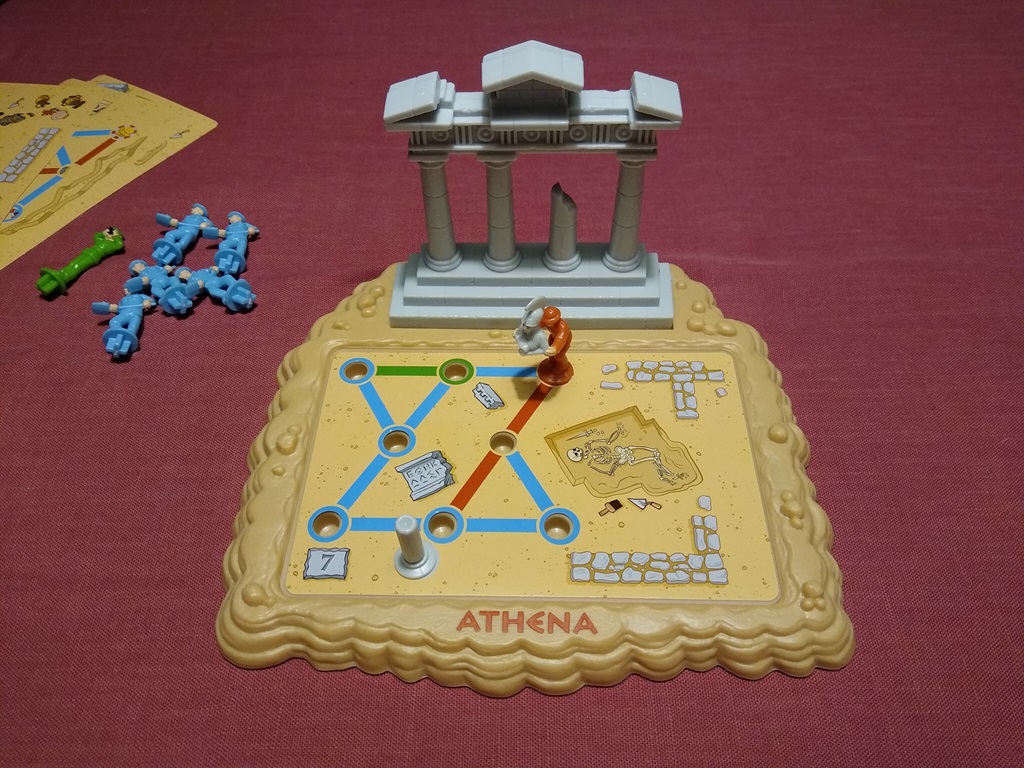
On card #1, you can see the paths available for the blue worker (who begins in the blue circle) and the lead archaeologist (who begins in the brown and gray circle). The pedestal sits in the gray circle.

The blue worker can only move between one of two spots along the blue path, and the lead archaeologist can move along the brown paths.

So you move the blue worker out of the lead archaeologist’s path, and bam, the statue is reunited with the pedestal.

This is a fairly simple setup. What could you need all these other worker pieces for?

I mean, there’s seventeen of them, plus your lead archaeologist and the pedestal for the statue. Where could they all fit?

Oh!

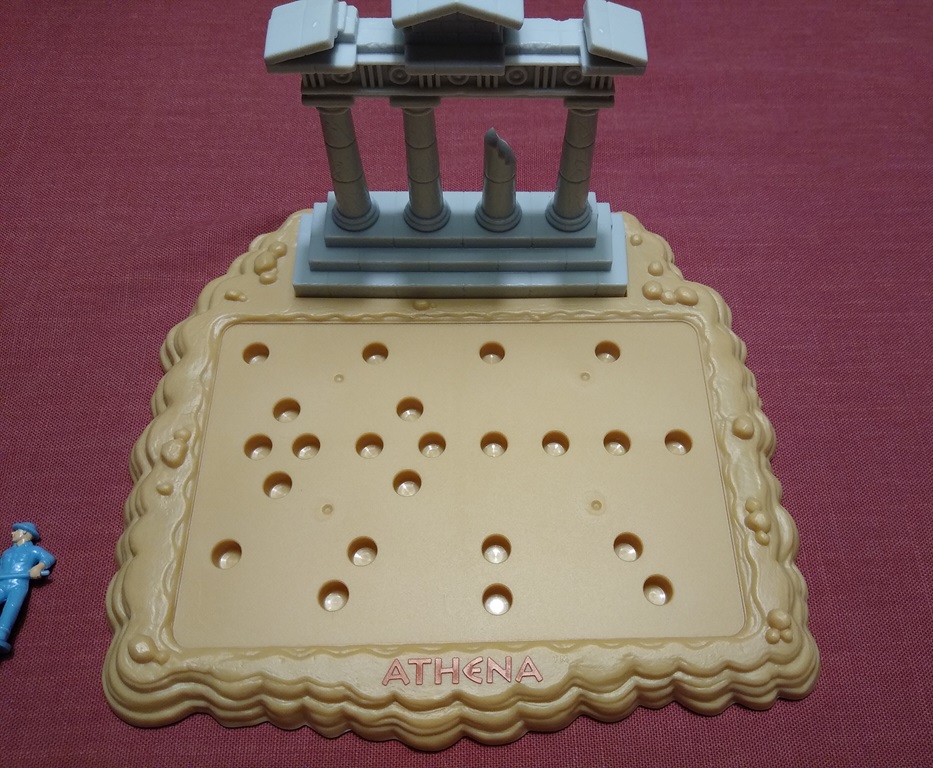
As you can see, the base allows for numerous places for the workers to be positioned, and trust me, those later challenge cards can get crowded very quickly.

Let’s take a look at another card as an example.

Here’s the challenge card. As you can see, the five blue workers (indicated by the five blue rings) have lots of options for movement, while the green worker and the lead archaeologist have very few.

But it seems simple enough. You only need to move the lead archaeologist two spots. How tough could that be?

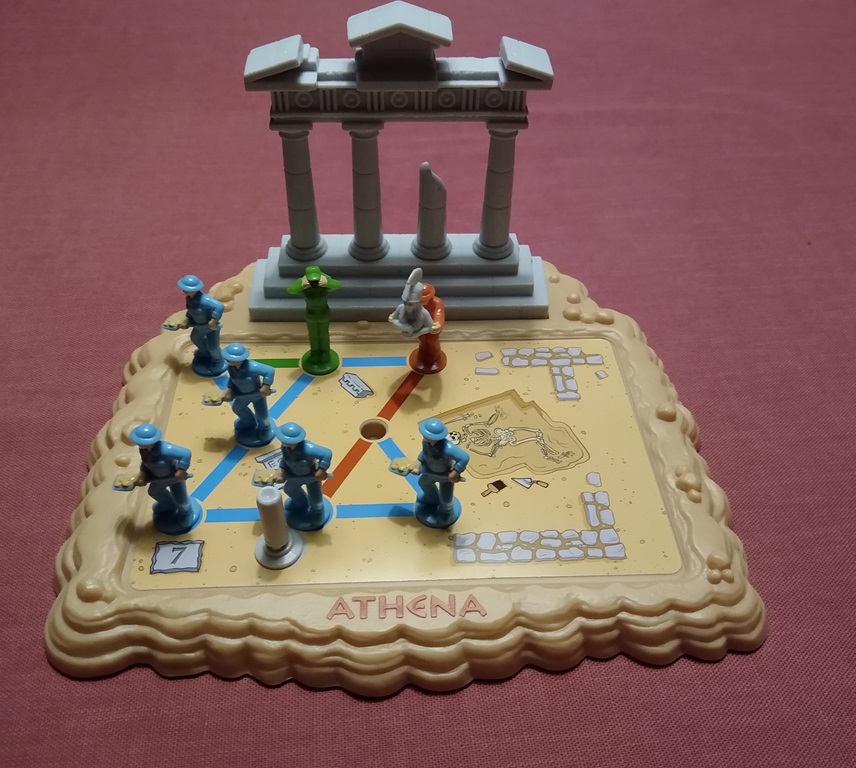
Let’s finish setting the pieces and take a look.

Oh. That’s slightly more daunting.

With only one space available, you’re going to need to move all of the pieces around so that your lead archaeologist can proceed forward.

And suddenly, you’re thinking five moves ahead, looking at how one piece moving creates an opening for another piece, and then another. But wait, this piece can only move to one spot, so these pieces must go over here in this order…

Your mind adapts quickly. You begin to see ALL the possibilities unfurl in front of you. You develop patterns and ideas for how to move things as you’re placing new challenge cards down and setting the pieces in place.

Of course, the challenge cards increase in complexity and difficulty, so as soon as you start hitting your stride, you have new obstacles to overcome. And with some solutions requiring dozens of moves to complete, I can guarantee that you’ll have plenty of challenges awaiting you.

Athena is an engaging reinterpretation of classic chain-solving puzzles, adding a delightfully colorful touch to strategic puzzly thinking. Not only that, but it’s a terrific introduction to the kind of mental gameplay that chess and other puzzly pursuits require.

[Athena is for ages 8 and up, and it’s available from Project Genius and participating websites, starting at $24.99.]

Two Epic Treasure Hunts Come to an End!

Image courtesy of Go.ActiveCalendar.com

Boy, it’s been a good week to be a treasure hunter!

First, the trophy stashed away in Massachusetts by Project Skydrop was found.

This trophy, valued at $26,000, is only part of the prize, since the trophy contained a code that granted the lucky treasure hunter who found it access to a prize pool of over $87,000! This prize pool was composed of entry fees from the many treasure hunters who signed up for the hunt.

Since the prize was found faster than Project Skydrop organizers predicted, they offered $100 each to the first twenty people to guess the exact coordinates of the now-claimed treasure. The deadline for that second-place prize is today, so I’m definitely curious how many folks were able to claim that c-note.

But that was only the beginning of big treasure hunt news, as the hunt for the Golden Owl has also reportedly come to an end.

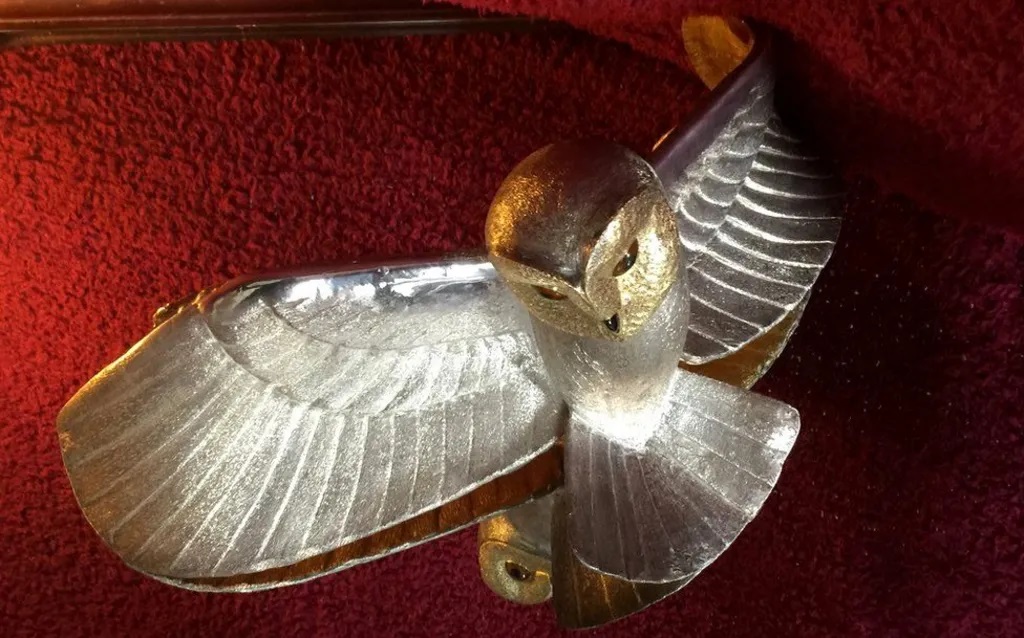
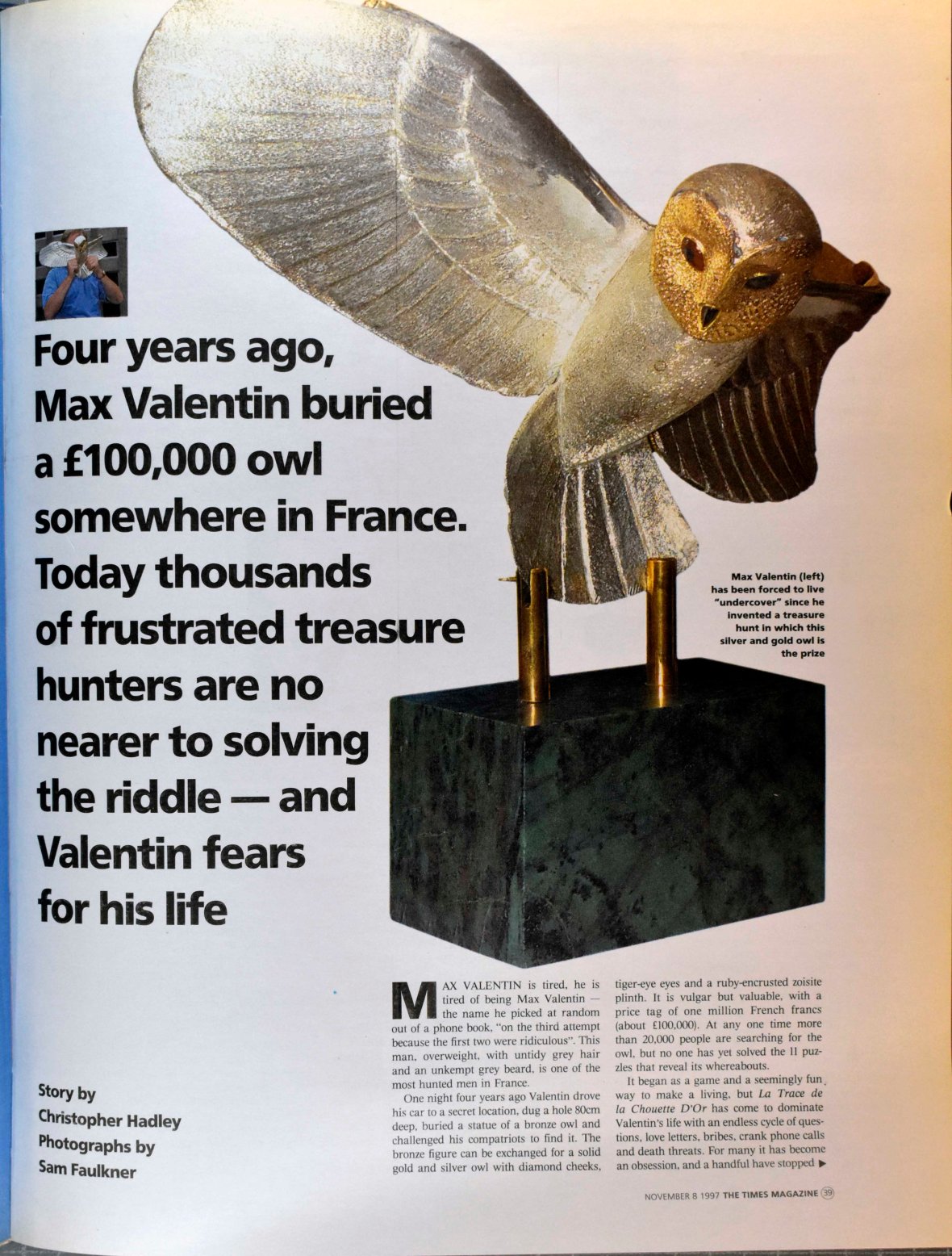
In 1993, the book On the Trail of the Golden Owl was published, igniting a thirty-year search for the titular owl. Solvers had to parse Max Valentin’s eleven riddles to locate the owl, and for decades, the prize eluded even the most ardent solvers.

Hilariously, the creator intended for the hunt to last for only a few months, open to both amateur hunters and experts. “If all the searchers put all their knowledge together, the owl would be found in… two hours”. This sounds like the folks behind Monopoly who claim the game can be played in 45 minutes.

Three years ago, the artist for the original book, Michel Becker, took over the hunt from author Regis Hauser (aka fictional treasure hunt creator Max Valentin), going so far as to dig up the owl to confirm it was still there.

There was supposed to be a bronze owl there (to be exchanged for the actual golden owl, worth over $100,000), but Becker found a rusty iron one instead. He replaced it with a bronze owl, buried it, and continued the hunt for another three years. Chouetteurs — the owl-seeking treasure hunters — got back to work.

Until last week when the owl was finally discovered.

As reported by the BBC, the hunt came to an end in France on October 3rd. Details have been scarce, and hunters around the world have been told to stop looking.

“We confirm that the replica of the golden owl was dug up last night, and that simultaneously a solution has been sent on the online verification system… It is therefore now pointless travelling to dig at any place you believe the cache might be situated.”

Some solvers are relieved that the hunt is finally over, while others are skeptical, believing that instead of hard work and puzzly grit, the prize was found by metal detector instead (which would be expressly against the rules). Still others are disappointed not to have more information, if only to see how tantalizingly close they may have gotten to the correct solution.

The trials and tribulations of the hunt over the years have only added to its legend.

The puzzle hunt lasted so long that it outlived the original publisher of the book, which caused the golden owl to be seized as a bankruptcy asset, something that required four years of legal wrangling to resolve.

The hunt also sadly outlived its creator, who passed in 2009. Some chouetteurs blame the stresses of legal proceedings surrounding the hunt for hastening the death of Hauser.

Two years later, it took the dedicated efforts of a group of treasure hunters to prevent Becker from selling the owl, forcing judicial intervention and saving the hunt from a premature end.

What a saga.

With the end of both the Golden Owl hunt and Forrest Fenn’s treasure hunt a few years ago, this leaves The Secret as the longest ongoing puzzle hunt in the world at this time.

But maybe some intrepid puzzler out there is already cooking up the next great puzzly treasure hunt. I suppose only time will tell.

An Ancient Andean Jigsaw Puzzle?

[Image courtesy of Gizmodo.]

One of the best things about writing this blog is getting to talk about all of the amazing ways that people with puzzly skills have contributed to society. We’ve talked about codebreakers who saved Christmas and hunted Nazis, puzzlers who decoded ancient messages, and solvers who unraveled some of the mysteries of lost civilizations, all with the clever and insightful application of puzzle skills.

I’m surprised we haven’t talked about archaeologists more frequently, because they’re basically detectives of history who try to reassemble the past jigsaw-style.

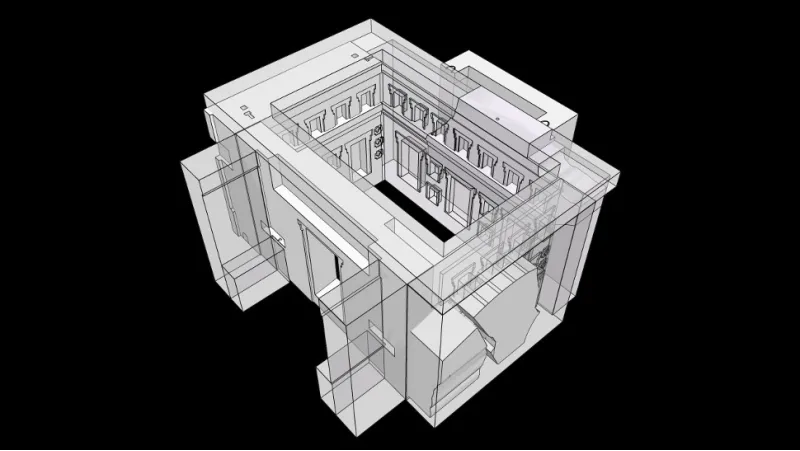
Recently, researchers from UC Berkeley put their puzzly skills to the test to solve a 1,500-year-old mystery: what the pre-Incan Tiwanaku temple known as Pumapunku actually looked like.

[Image courtesy of Gizmodo.]

You see, the temple has been raided, pillaged, and ransacked over the centuries, leaving archaeologists with very little information on what the temple actually looked like, or how the many giant blocks that originally composed the temple were assembled.

But, with a combination of computer modeling, 3-D printed pieces, and their own puzzly knowhow and dedication, they have cobbled together a rudimentary idea of what the Pumapunku temple looked like.

From an article on the project:

The team created miniature 3D-printed models, at 4 percent actual size, of the temple’s 140 known pieces, which were based on measurements compiled by archaeologists over the past 150 years and Vranich’s own on-site observations of the ruins. The researchers used comparative analyses and interpolation to reconstruct broken pieces… Yes, the researchers could have performed this work exclusively in the virtual realm, but they had better luck with tangible, physical pieces they could freely move around.

Yes, not only were they using the pieces they knew about, but they were reassembling decayed or broken pieces as well in order to assemble the temple.

[Image courtesy of Gizmodo.]

And the project continues!

Vranich’s team gave a copy of the 3D-printed blocks to the Pumapunku ruins site director and taught the staff how to record the stones and model them. Vranich hopes that more blocks will be uncovered at the site, and further reconstructions of the temple complex will continue.

“The blocks will also be made available online,” said Vranich. “My hope is that other people will print them out and through the wisdom of crowds, we can find additional matches and continue to reconstruct the form of [another Tiwanaku] building known as ‘the temple of the Andes.’”

With these techniques and the lessons learned by the Pumapunku build, the team is hoping to not only recreate this ancient Andean temple, but other destroyed historical sites as well, including those in the Middle East destroyed by ISIS.

[Image courtesy of Gizmodo.]

It’s an amazing investigative and deductive feat, made possible with puzzly skills.


Thanks for visiting PuzzleNation Blog today! Be sure to sign up for our newsletter to stay up-to-date on everything PuzzleNation!

You can also share your pictures with us on Instagram, friend us on Facebook, check us out on TwitterPinterest, and Tumblr, and explore the always-expanding library of PuzzleNation apps and games on our website!

Remake history at home! (With puzzles!)

Crowdsourcing has become an increasingly popular method for scientists and deep thinkers to solve problems that would otherwise be far too staggering a challenge to tackle on their own.

I’ve written in the past about crowdfunding efforts, but this is something different: actually handing over the problem to the public. It’s citizen science!

The National Museums Scotland are trying to reassemble the shattered design on a Scottish relic dated back to the year 800 or so, hoping that reaching out to nonprofessionals will help them to restore the intricate designs that once adorned a sandstone slab centuries past.

Every fragment has been scanned into a 3-D model and catalogued, making each a small piece of a truly monumental puzzle to be solved. (And without the picture on the box to guide you!)

From an NBC News article:

The pieces will be grouped into categories — for example, corner pieces, or parts of the design’s knotwork. That will help users organize the work into manageable subtasks, as if they were working collectively on a huge jigsaw puzzle. Suggested solutions to parts of the puzzle would be judged by fellow users, and then passed on to the professionals.

This mix of science and puzzle-gaming has engendered marvelous successes before. The Search for Extraterrestrial Intelligence (or SETI) utilizes dozens of citizen computers for processing power in order to more efficiently scan the skies for signs of intelligent life beyond Earth. The FoldIt program led to the crowdsourced discovery of the structure of a monkey HIV virus in ten days, after a decade of attempts by scientists.

(There are similar puzzle-game attempts being made to map the human brain, explore the potential of DNA, and catalogue animal species. Check out this IO9 link for further details.)

This is yet another amazing example of puzzle solving making a true contribution to our understanding of the world. And it’s always nice to remind ourselves that puzzles can be all fun and games, but they can also be something much much more.

Thanks for visiting the PuzzleNation blog today! You can like us on Facebook, follow us on Twitter, check out our Classic Word Search iBook (recently featured by Apple in the Made for iBooks category!), play our games at PuzzleNation.com, or contact us here at the blog!