Farewell, Tom Lehrer.

The world of puzzles and games is larger than constructors and game designers. There are artists, writers, editors, wordsmiths, hosts, musicians, and influences that help shape puzzles and games in so many different ways. Their efforts enrich and popularize these beloved pastimes, contributing to the world by celebrating wordplay, creativity, and nerdy pursuits.

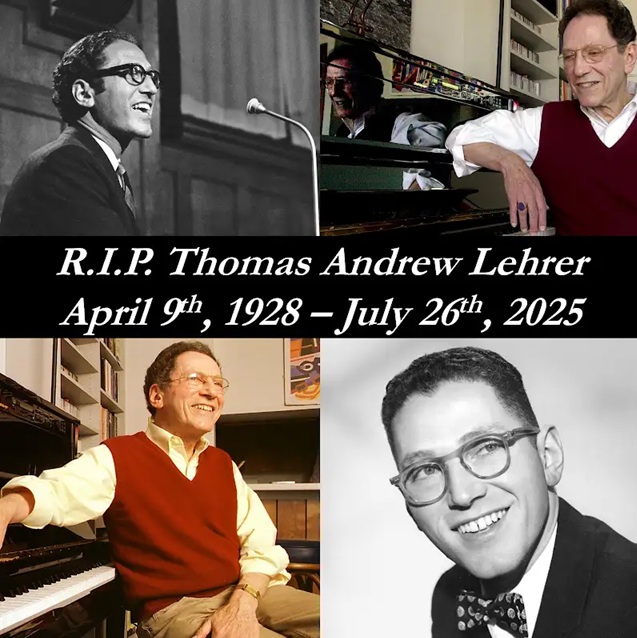
And sadly, the world grew a little less witty, a little less clever, and a lot less bold and outspoken about so many important topics when Tom Lehrer passed away a few days ago.

It’s hard to know where to begin.

How do you describe the cultural influence of a man whose songs still delight, inform, and push boundaries today, even though he wrote most of them over sixty years ago?

How do you describe a successful musician who walked away from public performance after three brilliant albums — thirty-seven songs, each an intricately-crafted dissection of some aspect of culture, science, or current events, often as poignant and sharp-tongued as they were hilarious — and spent the bulk of his life as a teacher and college professor instead?

How do you describe the genius of a man for whom wordplay flowed as easily as scientific lingo or political commentary, a man who could make you laugh (and think, really think) about nuclear annihilation, questionable post-war government programs, or even the Catholic Church itself?

His influence on pop culture can’t be overestimated. Across generations, his songs educated and inspired, and his legacy is bulletproof. He created songs for The Electric Company, Square One TV, and That Was The Week That Was. (Those shows were decades apart!)

He inspired performers like “Weird Al” Yankovic, and I think his fingerprints are unmistakable on other hilarious and educational projects, like the songs of Randy Rogel for Animaniacs. (Trust me, you can’t listen to “the Multiplication song” from Animaniacs and NOT think of Lehrer’s “New Math”.)

Tom retired from live performance in the late 1960s, having felt like he’d said everything he wanted to say with his music. (Plus, as he famously pointed out, “political satire became obsolete when Henry Kissinger was awarded the Nobel peace prize.”)

But his songs wouldn’t be denied.

Dr. Demento’s radio show brought Lehrer’s work to new ears in the 1970s, 80s, and 90s, and Honest2Betsy has brought him to yet another generation’s attention with her videos over the last few years.

His songs are timeless. “The Elements” alone has appeared in Better Call Saul, NCIS, Gilmore Girls, and The Big Bang Theory. (Not to mention Daniel Radcliffe’s famous rendition of the song on The Graham Norton Show, where he called Lehrer his hero. This actually led to Radcliffe starring in the film Weird: The Al Yankovic Story.)

Speaking of “Weird Al,” his New York Times crossword puzzle with constructor Eric Berlin namedropped Tom as part of the grid fill in this pun-heavy collaboration:
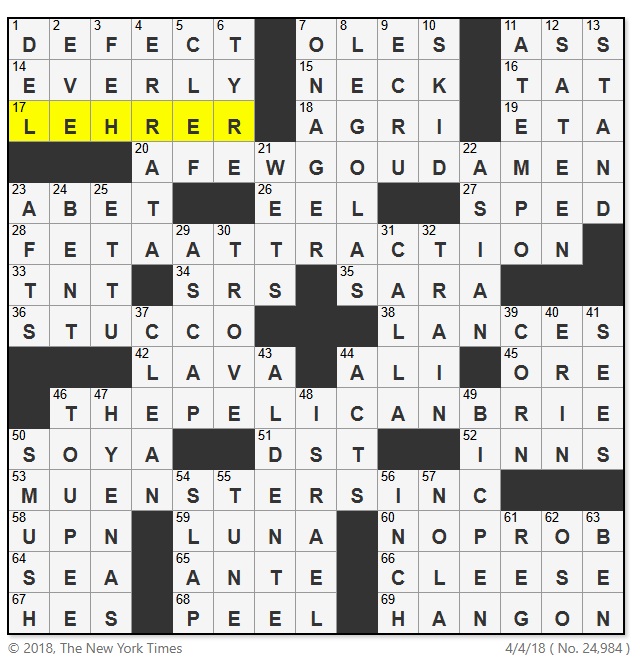
And it is a love of wordplay that sparked this tribute today.

Lehrer’s work is absolutely riddled with clever puns, comedic craftsmanship, and playing with the listener’s expectations: all things that great crossword cluing employs.

You can’t listen to songs like “Silent E” or “Without an S” and NOT imagine clues or themes that Lehrer’s linguistic legerdemain could inspire.

Not to mention this gem:
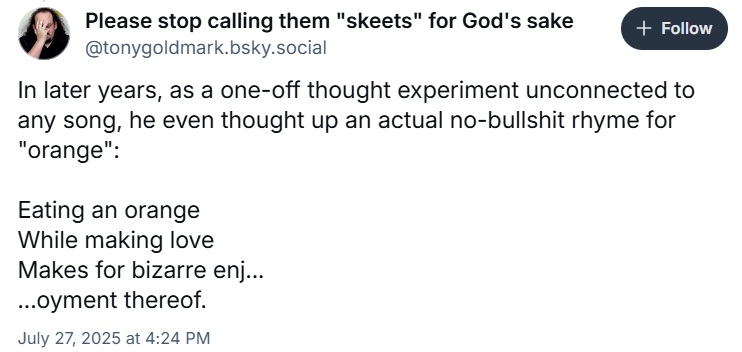
There’s a playfulness there, paired with technique, creativity, and an absolute willingness to bend conventions to their breaking point in order to make something new. How can you not love it?

But wordplay, commentary, and scientific and mathematical literacy weren’t Lehrer’s only gifts to the world.

He claimed to have invented the jello shot while in the military (to skirt rules about alcohol consumption). He wrote the song “Don’t Major in Physics,” which would have been good advice to me in freshman year of college, had I cared to listen.
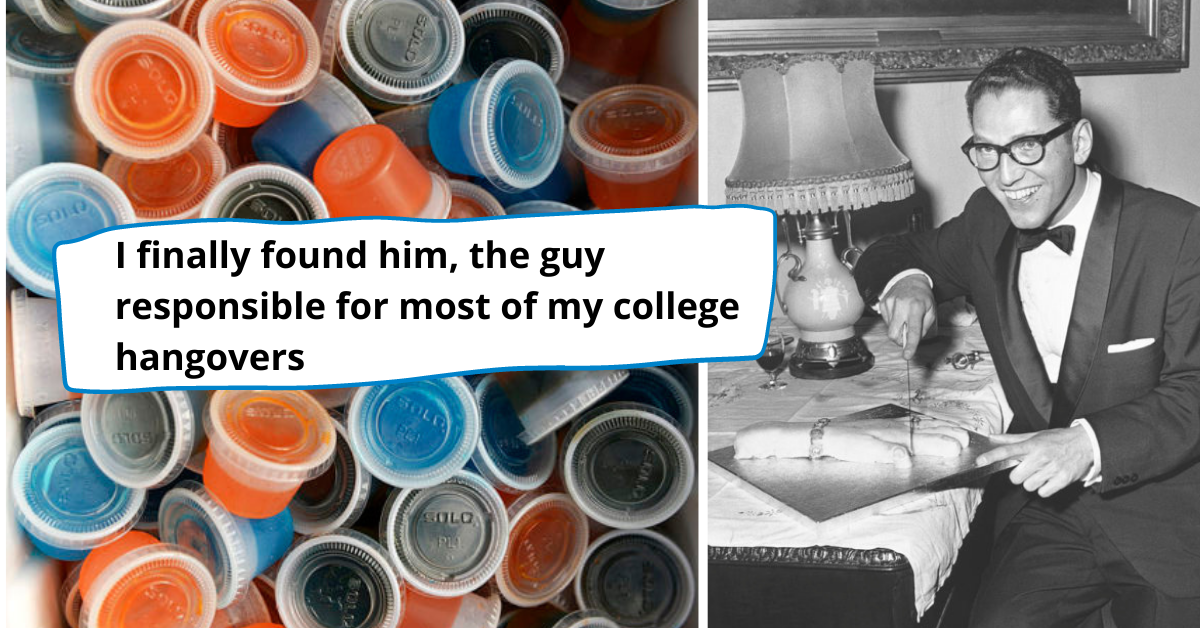
Image courtesy of warhistoryonline.

And he also made the incredible gesture in 2022 of transferring the music and lyrics for all the songs he had ever written into the public domain. He relinquished the copyright and performing/recording rights for his songs as well, making his music and lyrics free for anyone to use. Downloadable lyric and music files are available on his website.

His statement releasing all his works into the public domain concluded with this note: “This website will be shut down at some date in the not too distant future, so if you want to download anything, don’t wait too long.”

For now, at least, the website remains online.

And it seems so apropos that the man who walked away from music decades ago to share his love of mathematics, science, and teaching with others is also the man who would happily sign away the rights to his music to enrich the lives of others once again.

The humanities and the STEM fields both owe Tom Lehrer a debt that can never be repaid.

The world was blessed with his presence for 97 years, and I have no doubt that his words, his music, and the forceful spirit that infused both will be around for many many years to come.

Farewell, Tom. Thanks for warning us about Shakespeare.

Oh, and for this lovely little ditty:
Puzzles in Pop Culture: Pinky and the Brain

As you might expect, I am always on the lookout for puzzles on television.

Sometimes, a complete solvable puzzle appears, like in the seesaw brain teaser from Brooklyn Nine-Nine. Sometimes, they’re only referenced, like in a murder mystery involving a crossword editor on Bones.

Other times, a major portion of an episode revolves around them. We’ve seen this countless times from shows as diverse as The Simpsons and NCIS: New Orleans.

But I didn’t realize an entire plot for world domination once hinged on a puzzle.

Pinky and the Brain was a spinoff of a recurring series of animated shorts from the show Animaniacs, and the concept was simple.

Two mice plotted to take over the world from their lab cage, and their plans were invariably foiled by either Pinky’s idiocy or Brain’s almost magical ability to snatch defeat from the jaws of victory.

The schemes ranged from time travel and mind control to hypnotic songs and (my personal favorite) a papier mache duplicate of Earth.

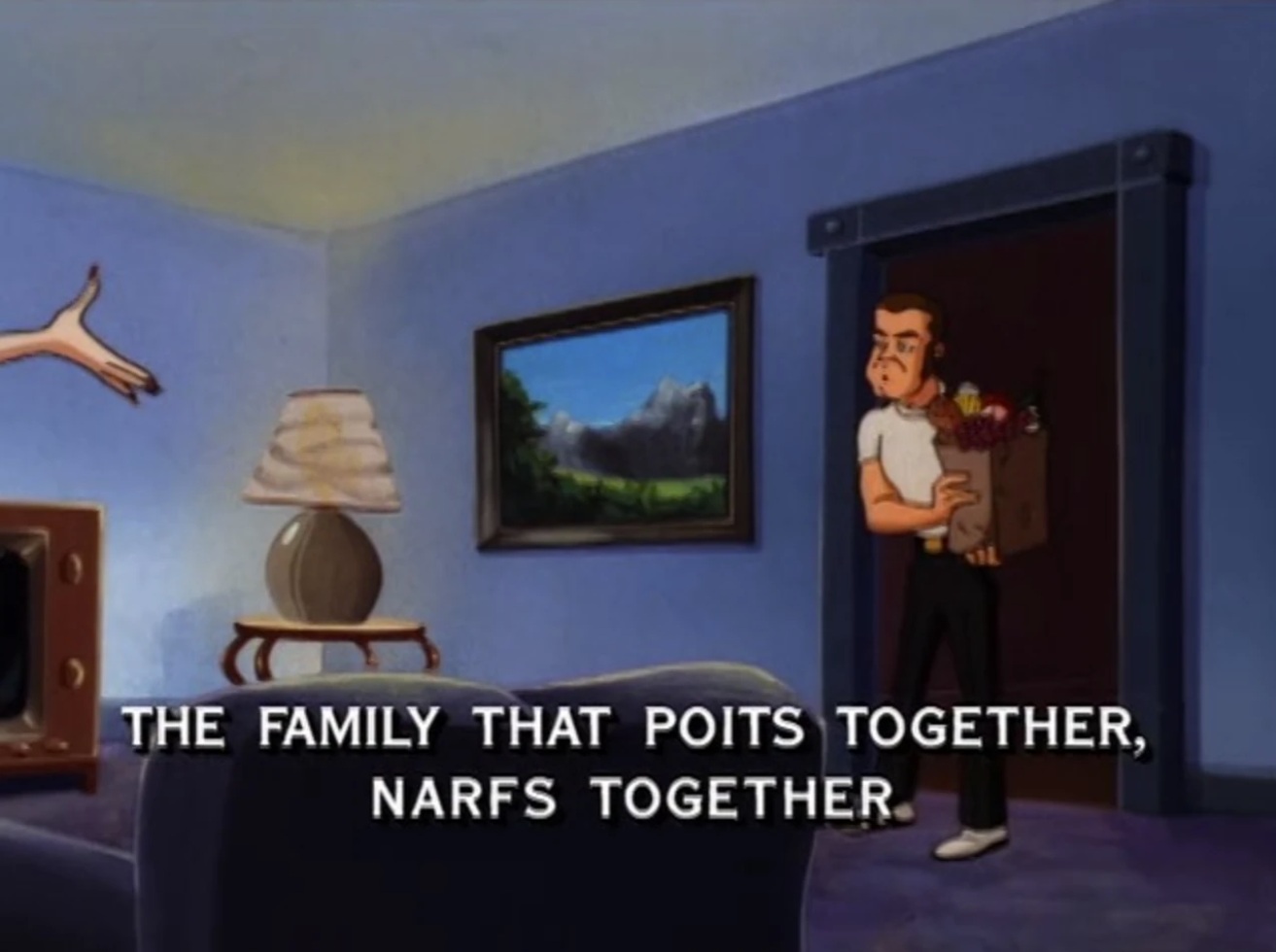
But on February 21st, 1998, the show aired its 53rd episode, The Family That Poits Together, Narfs Together.

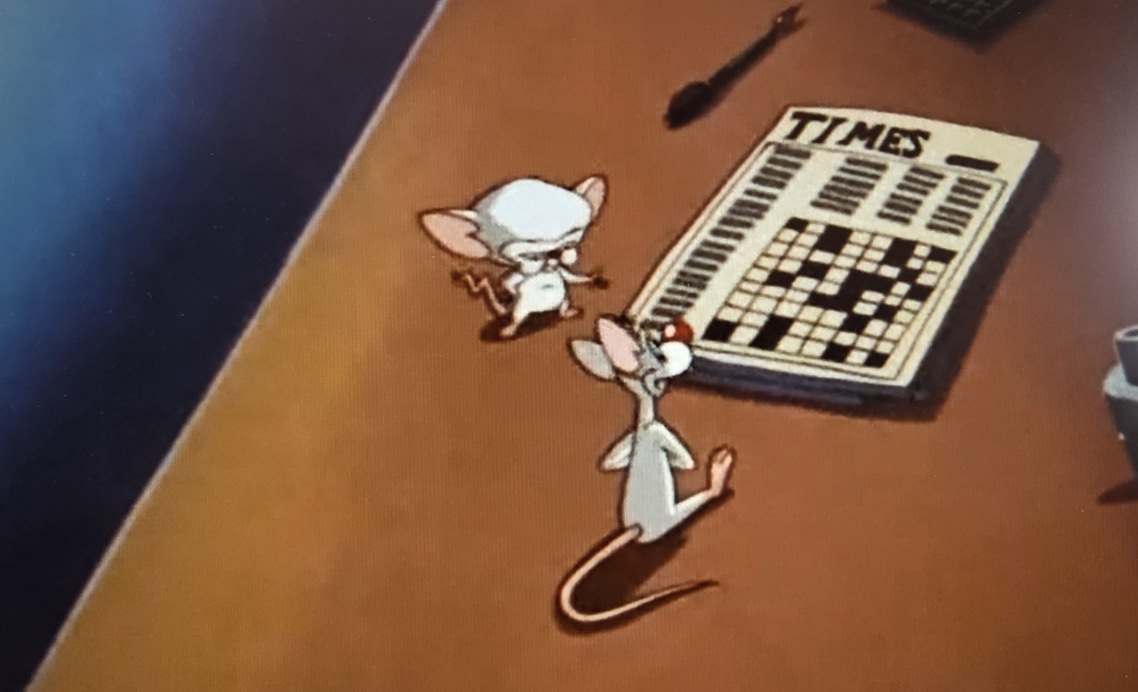
The Brain’s latest plan for global domination targeted the intellectual elite by sabotaging the daily crossword in every newspaper in the world.

Here, I’ll let The Brain explain his diabolical endeavor:

This is the Sunday crossword puzzle. The most educated people all around the world spend hours each weekend deciphering its complex web of interlocking verbiage. But change just one clue, and the whole puzzle becomes impossible to solve…

I will change one clue in the crossword puzzle in every newspaper around the globe, throwing the intelligentsia into a hopeless dither. While they frantically ripple through their dictionaries and thesauri, I will step into the breach, and take over the world!

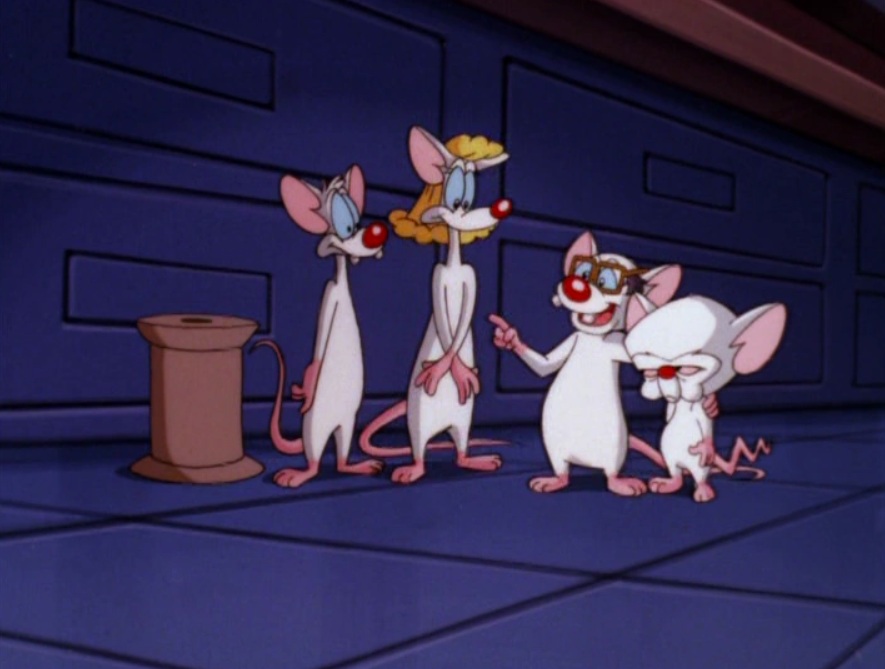
Unfortunately, he needs $25,000 to fund this operation (including the cost of bagels with cream cheese), so he plans to reunite Pinky’s family and put them on a talk show to win the prize for the world’s most perfect family.

Naturally, shenanigans ensue — and Eric Idle plays both Pinky’s mom AND dad, which is very entertaining — but the family actually wins the prize!

A trip around the world valued at $25,000.

The Brain’s dastardly plans have been scuttled once more.

But that does raise the question…

Would it have worked?

(Let’s ignore for the moment the fact that the intelligentsia for the most part aren’t currently in positions of power, especially in the United States.)

In a world before resources like Xwordinfo and online forums where solvers can share their grievances, it could have given the puzzle solvers of the world pause.

Especially on a Sunday, where you’d think at least some of them would be at home and not at their various important duties.

So there could have been a window.

But was The Brain equipped to seize that opportunity? Did he have the manpower to be in all those places? To snatch up those resources and reins of power for himself?

I don’t think so. Not on a budget of $25,000 (which again, covered the crossword modification and snacks, NOT the ensuing power grab). That’s barely gonna cover a few henchmen, even at 1998 prices.

So, sadly, I think the plan would have failed.

BUT!

He would have had the personal victory of denying that moment of solving satisfaction to puzzlers around the world.

Which is arguably even more villainous.

What do you think, fellow solver? Would it have worked? You can watch the episode for free here on Dailymotion.

And to close out today’s post, let’s enjoy an earworm together and listen to that marvelous theme song:

Happy puzzling and/or plotting world domination!

It’s Follow-Up Friday: Cartoons and Crosswords edition!

Welcome to Follow-Up Friday!

By this time, you know the drill. Follow-Up Friday is a chance for us to revisit the subjects of previous posts and bring the PuzzleNation audience up to speed on all things puzzly.

And today, I’m posting the results of our #PennyDellPuzzleCartoons hashtag game!

You may be familiar with the board game Schmovie, hashtag games on Twitter, or@midnight’s Hashtag Wars segment on Comedy Central.

For the last few months, we’ve been collaborating on puzzle-themed hashtag games with our pals at Penny Dell Puzzles, and this month’s hook was #PennyDellPuzzleCartoons, mashing up Penny Dell puzzles and anything and everything having to do with stand-up comics, film and television comedians, funny movies, funny shows, funny plays…even one-liners or jokes!

Examples include Letter Powerpuff Girls, SpongeBob Four SquarePants, and Betty Blips.

So, without further ado, check out what the puzzlers at PuzzleNation and Penny Dell Puzzles came up with!


Slide-o-Futurama (and therefore Around the Bender)

Aaahh!!! Real Mon-Star Words

The Anagram Magic Square Bus

Who Fiddler’s Framed Roger Rabbit? / Who Frameworked Roger Rabbit?

He-Man and the Masterwords of the Universe

“By the power of GraySkill-O-Grams! I have the power!”

“That’s All Fours, folks!”

“Wonder Twins Flower Power, activate!”

“There’s no need to fear, Underdog is Here & There!”

“I hate meeces to Bits and Pieces!”

“Ups and Downs and at ‘em, Atom Ant!”

“Exit! Stage Right of Way!”

“Zip It Dee-Doo-Dah!”

“Heroes in a Halftime, Turtle Power!”

Teenage Multiplier Ninja Turnabouts

Beavis and Butt-Headings / Beavis and Buttheads and Tails

Crypto-Family Guy

Porky Piggybacks

The Jungle Bookworms

Dr. Joshua Sweet Stuff

Flower (from Bambi) Power

Lotsa Buck Cluck

Looney Rooney Tunes

Dancing Bo-Peep Feet

Top to Bottom Cat

Quick Draw the Line McGraw

Courage the Coming and Going Dog

DartBoard Duck / Bartboard

Dartwing Duck

(Home R)uns Simpson

101 Dial-a-Grams

Blackout-man and Robin

Successorgram-man

Johnny Word Quest

Dudley Do-Right of Way

Scooby Two by Two, Where are you?

Mystery Word Machine

Alvin and the Chips-munks

Patchwork Patrol

“Friendly Neighborhood Spider’s Web”

Wonder Twin Crosswords

“Lolly, Lolly, Lolly Get Your Add Ones Here” / “Lolly, Lolly, Lolly Get Your Codewords Here”

“Three From Nine Is the Anagram Magic Number”

“In A Word Planet Janet”

“Syllability, Syll-a-bility”

“I’m Just a Blips, Yes I’m Only a Blips”

“Connections Junction, What’s Your Function”

AnagraManiacs Magic Squares, with Yakk-odewords, Wakk-o Words and Dot Matrix.

Stepping Flintstones

Miss Piggybacks


A fellow puzzler even cooked up a version of the Steven Universe theme song all about Crypto puzzles!

We are the Crypto-Gems
We’ll always save the day
And if you don’t believe us
We’ll always find a way
That’s why the people of this earth
Believe in
Geo, Zoo, and Verse…
And Steven!


Have you come up with any Penny Dell Puzzle Cartoons entries of your own? Let us know! We’d love to see them!

Thanks for visiting PuzzleNation Blog today! Be sure to sign up for our newsletter to stay up-to-date on everything PuzzleNation!

You can also share your pictures with us on Instagram, friend us on Facebook, check us out on TwitterPinterest, and Tumblr, and explore the always-expanding library of PuzzleNation apps and games on our website!

Letter rip! It’s lipogram time!

[Building words and phrases, one letter at a time.]

This week I did something a little different in the preview for today’s blog. Usually on Mondays, I post a brief preview of the week’s blog posts, Facebook and Twitter content, et cetera.

But instead of a short teaser about the entry, I posted the following clue:

How quickly can you find out what is unusual about this paragraph? It looks so ordinary that you would think that nothing was wrong with it at all and, in fact, nothing is. But it is unusual. Why? If you study it and think about it you may find out, but I am not going to assist you in any way. You must do it without coaching. No doubt, if you work at it for long, it will dawn on you. Who knows? Go to work and try your skill. Par is about half an hour.

Did you figure out what’s curious about it? It’s missing the letter E!

[A keyboard displaying the most commonly used letters in the language in delightful bar-graph form. It should come as no surprise which letter appears most frequently.]

That paragraph is a terrific example of a lipogram, a written work that purposely avoids or leaves out a given letter. Lipograms are part writing challenge and part puzzle, taxing your vocabulary and your creativity.

(Removing any letter can make things tougher. I remember when my friend’s L key on his keyboard stopped working. “I think it will do well” became “I think it wi do we” until he started using the 1 key as a substitute L.)

And if you think writing a paragraph without the letter E is tough, imagine writing an entire novel without it. Ernest Vincent Wright did just that in 1939 with his 50,000 word novel Gadsby. He even went so far as to rephrase famous lines by William Congreve and John Keats in order to keep the letter E away.

Gadsby partially inspired a French author named Georges Perec to do the same, and his novel La Disparition (also known as A Void) doesn’t feature a single E over the course of three hundred pages.

There are numerous other lipogrammatic works and puzzles, but I think my favorite is the novel Ella Minnow Pea by author Mark Dunn.

Not only is the novel told through letters or notes shared by several characters, but the narrative grows increasingly lipogrammatic as the story progresses.

Check out this summary from Wikipedia:

The novel is set on the fictitious island of Nollop, off the coast of South Carolina, which is home to Nevin Nollop, the supposed creator of the well-known pangram “The quick brown fox jumps over the lazy dog.” This sentence is preserved on a memorial statue to its creator on the island and is taken very seriously by the government of the island.

Throughout the book, tiles containing the letters fall from the inscription beneath the statue, and as each one does, the island’s government bans the contained letter’s use from written or spoken communication. A penalty system is enforced for using the forbidden characters, with public censure for a first offense, lashing or stocks (violator’s choice) upon a second offense and banishment from the island nation upon the third.

So as the book progresses, fewer and fewer letters are used! It’s both an impressive linguistic feat and a wonderful work of totalitarian satire. (And how can you not love a character’s name sounding like LMNOP?)

[In a Christmas episode of the ’90s cartoon Animaniacs, Wakko keeps spelling Santa “Santla,” inspiring a rousing, punny version of “Noel” to correct Wakko’s spelling.]

Our friends at Penny/Dell Puzzles have a lipogram puzzle: Dittos. In Dittos, you’re given a series of letters, and then told to spell five common words using those letters AND a given letter. You can repeat the given letter as many times as necessary.

For example, if you were given the letters AAENRY and then told to make 2 five-letter words, using D as many times as necessary, you might come up with DREAD and DANDY.

But what about the flip side? What if you decided you were only going to use one vowel? Well then, my ambitious friend, you’ve accepted the challenge of creating a univocalic.

I’m not familiar with any longer works that are univocalic. You usually see them in paragraph form or, occasionally, palindrome form. “A man, a plan, a canal… Panama!” is probably the most famous univocalic in history.

(Univocalics are not to be confused with supervocalics, which are words that include all five vowels, like sequoia or abstemious.)

I hope you’ve enjoyed this look at a curious subset of puzzles and wordplay. One of my fellow puzzlers suggested I pursue lipograms as a follow-up to my post a little while back about single-letter puzzles, and I couldn’t resist.

Have you ever tried to write a lipogram or univocalic, PuzzleNationers? Let me know! I’d love to see them!

Thanks for visiting PuzzleNation Blog today! You can share your pictures with us on Instagram, friend us on Facebook, check us out on TwitterPinterest, and Tumblr, and be sure to check out the growing library of PuzzleNation apps and games!