
The American Crossword Puzzle Tournament was this past weekend, and unfortunately I wasn’t able to attend. I did my best to keep up with the event through social media, enjoying everyone’s observations, jokes, highlights, victories, trials and tribulations.
One message in particular stuck out to me, though.
I can’t remember if it was posting the results after the sixth or the seventh puzzle, but they remarked that they were excited to see some new blood in the top ten.
I couldn’t help but laugh, because all the names were pretty familiar to me.
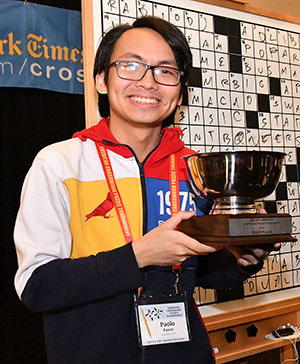
Paolo Pasco won the tournament for the second year in a row, dominating the final puzzle with a record-breaking time of 3 minutes and 45 seconds. (Solver Paul Edward did the math on Facebook and calculated that Paolo spent less than 34 minutes across the 8 puzzles that weekend. WOW.)
Will Nediger and former champ Dan Feyer duked it out for second place, with Will edging out Dan by ONE SECOND, solving the puzzle in 4 minutes and 38 seconds. What a nailbiter!
The next day, after the tournament was over, I still had that message lurking in my brainspace.
Now, anyone who reads this blog can tell that I’m a nerd for many things. I’m a nerd for puzzles, games, and RPGs. I’m a nerd for trivia.
And I am absolutely a nerd for statistics. I love numbers and analysis and compiling data.
If you’ve ever perused the website for the American Crossword Puzzle Tournament, you’ll find it to be a treasure trove of data just waiting for analysis.
So I read through the full results available for each tournament going back years, focusing on the top ten from this year’s tournament and reflecting on their ACPT careers. I had to see if that “new blood” message had any merit or not, and I figured this was the best way to find out.
Let’s see, shall we?

- Emily O’Neill
Emily has been competing since 2005 (unless there’s a name change involved, which is possible), and has been in the top ten twice. She has been in the top 30 ten times!
- Glen Ryan
Glen has been competing since 2013 (where he placed 3rd in Division B), and has been in the top ten five times. He has been in the top 30 ten times!
- Al Sanders
Al has been competing since 1999 (where he placed in the top three), and has been in the top ten TWENTY times. He has been second place twice and in the top 3 seven times. He has never ranked lower than 21!
- Stella Zawistowski
Stella has been competing since 2001, and has been in the top ten THIRTEEN times. She has been in the top 30 nineteen times!
- Andy Kravis
Andy has been competing since 2011, and has been in the top ten six times. He has been in the top 30 ten times!
- Tyler Hinman
Tyler has been competing since 2001 and is a seven-time champion! He has been in the top ten NINETEEN times (including five times in a row at second place and fourteen times in the top three). He was the Division B winner in his second appearance.
- David Plotkin
David has been competing since 2010, and has been in the top ten TWELVE times. He has been in the top 3 six times and has never ranked lower than 28th!
- Dan Feyer
Dan has been competing since 2008 and is a nine-time champion! He has been in the top ten SIXTEEN times (literally every time except his first tournament appearance).
[It’s not until the final two names that we really get anyone who qualifies as new blood.]
- Will Nediger
Will has been competing since 2021 and has been in the top 3 twice. He has been in the top ten three times (meaning every time he’s competed).
- Paolo Pasco
Paolo has been competing since 2021 and is a two-time champion! He has been in the top ten five times (every time he’s competed). He was also the Division B winner in 2022.
You have to go back to the year 1998 to find a tournament that didn’t feature one of these ten people as a solver. That’s amazing!
Originally, I was just going to focus on the top ten solvers from this year’s tournament and their many accomplishments.
But as I was going through the rankings year by year, I was struck by how many names I recognized, and how many times I got to see those names. I got to experience the tournament community as a microcosm across literal decades.
I watched the changing of the guard as some names slowly slipped out of the top ten and were replaced by others. Names like Anne Erdmann and Trip Payne and Jon Delfin and Ellen Ripstein and Douglas Hoylman. I was more familiar with some than others.
The slow evolution of solvers really struck both the puzzle nerd in me and the history nerd in me. I ventured back before my own career in puzzles started (back in 2003).
I’ve never competed at the ACPT, but I attended the event for several years, working the Penny Press / Puzzlenation table in the common area, and I grew familiar with a lot of attendees. Puzzle people are genuinely nice folks, and so many of them were happy to visit for a bit, introducing themselves, checking out our magazines, and taking advantage of our pencil sharpeners.
Everyone was so friendly, sharing their excitement for the event and letting me know their thoughts on each puzzle as the tournament went on. It really is a delight.
(Just don’t start a conversation about which pencils are the best for solving and you’ll be fine!)
New blood or not, the crossword scene is clearly thriving, and I can’t wait to see what next year’s tournament brings.
Happy puzzling, everyone!


 PuzzCulture