Anagram Cluing: Hiding in Plain Sight!

I’ve got anagrams on the brain today.

The Puzzmo mini crossword is always accompanied by notes from the constructor and the editor. The comments from yesterday’s puzzle centered around anagrams, since the mini had not only an anagram in the theme entries — MAORI and MARIO — but actually had the word ANAGRAMMED crossing those entries.

In those comments, both Will Eisenberg and Brooke Husic discussed a really playful subset of cluing involving misdirection.

You give the solver an anagram, but present it is as a statement, rather than just saying “ABLE, to BALE.” When done properly, it takes a second for your brain to actually register the anagram, even though it’s right in front of you!

Will used the example “Ancients, for instance,” which cleverly employs the standard crossword trope of “for example / for instance / for one / e.g.” to conceal the anagram. Brooke had another banger example, offering “Anemone, to name one.”

I delved into the archives on Xwordinfo to look for other examples of this misdirection cluing style, and I found some fun ones. (Obviously, ANAGRAM isn’t an incredibly common entry, but I was genuinely surprised by the variety of options that awaited me in the archives.)

Back in 2011, Oliver Hill and Eliza Bagg gave us “Neo, for one,” which is such an effective misdirect than I can imagine writing the wrong answer more than once in the grid before realizing the trick, since this sort of clue is used so often for things like HERO or ROLE.

Other constructors phrased their anagrams as if they were slang or specialized jargon, leading solvers down the garden path while showing off their own impressive anagramming talents.

  • Ryan McCarty and Nelson Hardy gave us “Schoolmaster for the classroom, e.g.”
  • Margaret Saine offered “Illustration for an ill tourist?”
  • Sam Trabucco crafted “Nerd’s epithet for the president?”
  • Bryant White presented “Coasters for Socrates, e.g.”

Naturally, cryptic crossword or British-style crossword solvers probably suss out these clues faster, since this sort of stealthy wordplay is standard in cryptic cluing, where clues are written out like sentences, rather than the more direct cluing typically used in American crosswords. (Cryptic crossword icons Emily Cox and Henry Rathvon had one ANAGRAM clue in the Xwordinfo archives, the elegant “Broadcast of bad actors, e.g.”

Some constructors take it even further, employing the age-old trick of apropos anagrams for celebrities.

The Simpsons helped popularize knowledge of this game when Lisa learned that ALEC GUINNESS anagrams into GENUINE CLASS. Another famous one is CLINT EASTWOOD anagramming to OLD WEST ACTION. FLORENCE NIGHTINGALE aptly anagrams to FLIT ON, CHEERING ANGEL.

Patrick Merrell employed this nicely with his clue for ANAGRAM, “Horrid glances from Charles Grodin?”

I could go on and on listing examples, but Patrick’s clue is hard to top.

I’m obviously a huge fan of misdirection clues, so it was a joy to deep-dive into a different genre of cluing and watch clever people work their magic. Hopefully you enjoyed taking this puzzly stroll with me.

Happy puzzling, everyone!

Intersections of Puzzle and Poetry

The more you look, the more you can find puzzles in all sorts of interesting places. We find them in literature, in historical documents, and in popular culture.

So it should come as no surprise that puzzles can be found in the world of poetry as well.

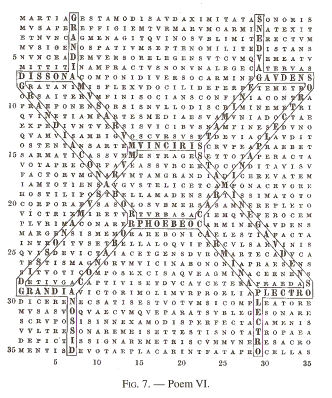
We’ve covered a few examples where poetry and puzzles have overlapped in the past, whether it’s the creations of Peter Valentine, the works of Edgar Allan Poe, or the art of carmina figurata.

carminafig7

But that’s only scratching the surface.

One of the most common ways that puzzly techniques find their way into poetry is through acrostics. Acrostics spell out messages with the first letter of each line or verse.

One of the most famous is a poem by Lewis Carroll at the end of Through the Looking-Glass where he reveals the identity of the girl who inspired his famous stories:

A boat beneath a sunny sky,
Lingering onward dreamily
In an evening of July—

Children three that nestle near,
Eager eye and willing ear,
Pleased a simple tale to hear—

Long has paled that sunny sky:
Echoes fade and memories die.
Autumn frosts have slain July.

Still she haunts me, phantomwise,
Alice moving under skies
Never seen by waking eyes.

Children yet, the tale to hear,
Eager eye and willing ear,
Lovingly shall nestle near.

In a Wonderland they lie,
Dreaming as the days go by,
Dreaming as the summers die:

Ever drifting down the stream—
Lingering in the golden gleam—
Life, what is it but a dream?

Carroll certainly offers the most famous example, but I must confess that my favorite example comes from a story on Wikipedia. Poet Rolfe Humphries was banned from Poetry Magazine for life for an acrostic aimed at a diplomat and former president of Columbia University. The acrostic quite bluntly read “Nicholas Murray Butler is a horse’s ass.”

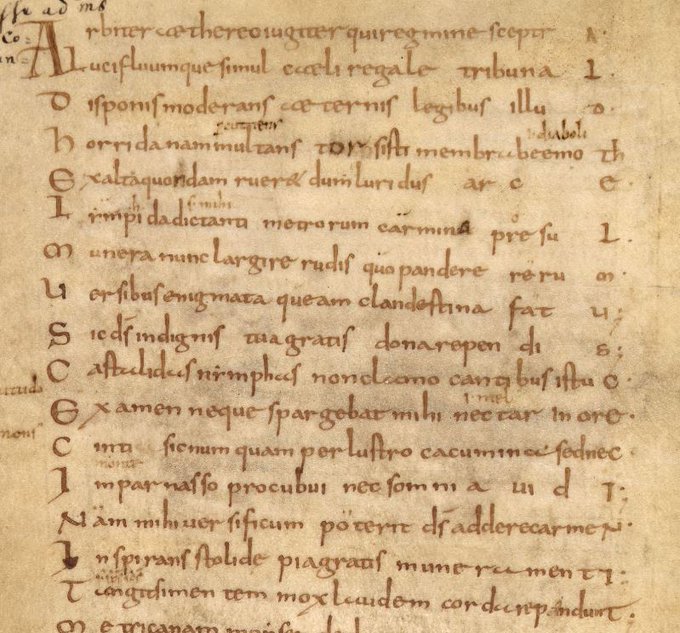
Of course, the message reading down — also known as an acrostich — isn’t the only way these messages can be hidden.

There are also examples of mesostich — where the word or message is spelled with letters in the middle of the verse — and telestich, where the last letters of each line spell a name or message.

Dd8mL6_UwAA3OTY

[Image courtesy of Twitter.]

These techniques were also used in ancient Greek inscriptions, where one particular example, AL205, featured acrostich, mesostich, and telestich messages at the same time.

Other puzzly stylings have also allowed poets to flex their wordplay muscles.

For instance, David Shulman wrote a 14-line sonnet about George Washington’s famous river crossing where every line is an anagram of “Washington crossing the Delaware”:

A hard, howling, tossing water scene.
Strong tide was washing hero clean.
“How cold!” Weather stings as in anger.
O Silent night shows war ace danger!

The cold waters swashing on in rage.
Redcoats warn slow his hint engage.
When star general’s action wish’d “Go!”
He saw his ragged continentals row.

Ah, he stands – sailor crew went going.
And so this general watches rowing.
He hastens – winter again grows cold.
A wet crew gain Hessian stronghold.

George can’t lose war with’s hands in;
He’s astern – so go alight, crew, and win!

There are also ABC poems, a form where the goal of each poem is to use words starting with each letter of the alphabet in order. You can find some entertaining and impressive examples here.

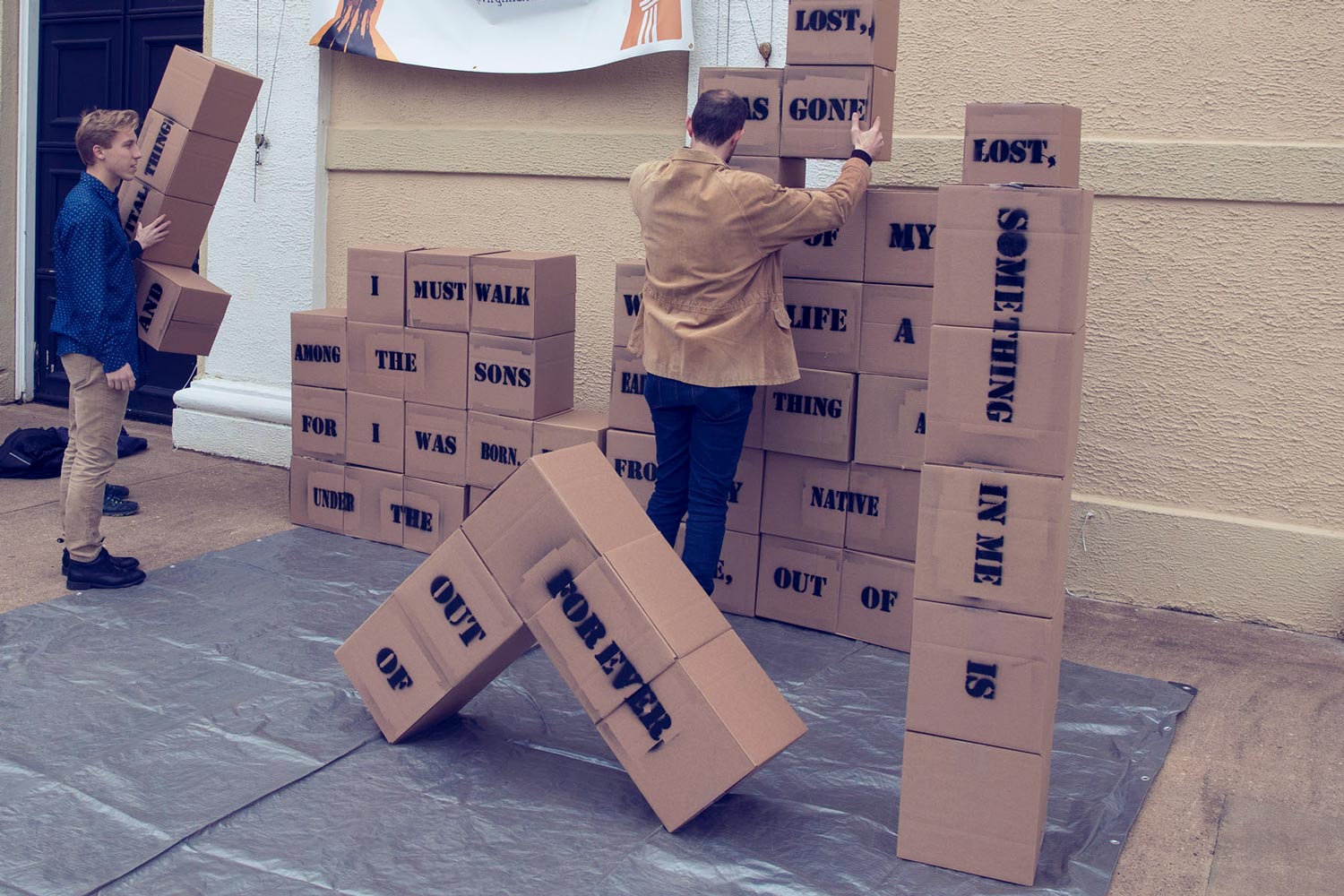
Some poets, however, have flipped the puzzle poem on its head by treating the poems like puzzles. The folks at UVA’s Puzzle Poetry group utilize Tetris-like puzzle pieces with words on them to assemble poems.

poetry_puzzle_da_header_3-2

[Image courtesy of the University of Virginia.]

The concept dates back to 2017, a creation of Neal Curtis and Brad Pasanek, serving as a way to both explore and deconstruct the art of poetry itself by making a puzzle out of it.

It’s a very cool idea, reminiscent of how magnetic poetry sets allow you to turn your fridge into a canvas by assembling and reworking the order of the various available words.

Puzzles by their very nature are about finding a solution, bringing order out of chaos, whether it’s assembling puzzle pieces, answering devious crossword clues to fill a grid, or unraveling a tricky brain teaser that pushes you to think in a different way.

And since poetry is all about expressing truths in a personal way, it makes a lovely sort of sense that puzzly techniques would intertwine with this thoughtful, elusive form of art.


Thanks for visiting PuzzleNation Blog today! Be sure to sign up for our newsletter to stay up-to-date on everything PuzzleNation!

You can also share your pictures with us on Instagram, friend us on Facebook, check us out on TwitterPinterest, and Tumblr, and explore the always-expanding library of PuzzleNation apps and games on our website!

A Clued Sudoku Puzzle? It’s More Than Meets the Eye

cryptic

The hunt is always on for the next big puzzle idea.

Sometimes, it’s an old idea that gets repackaged and catches fire. That’s what happened with Sudoku, a puzzle that had been around since the late ’70s, but only rose to prominence decades later.

Other times, it’s a combination of different puzzle types that yields something special. Our friends at Penny Dell Puzzles, for instance, have a popular puzzle called Anagram Magic Square, which combines crossword-style cluing, anagrams, and the mathematical element of a magic square to create an engaging puzzle experience you can solve from several angles.

Whether a puzzle is destined for superstardom or not depends on a lot of factors: difficulty, the type of solving it involves, how intuitive the solving is (i.e. needing a lengthy explanation vs. getting the gist of the puzzle from a glance), visual aesthetics, and more.

As a puzzler, it’s always exciting to try out a new puzzle. Wholly original ideas are rare, to be sure, but even a single twist on an old classic can be enjoyable if executed well.

Today, we’re taking a look at a puzzle that combines Sudoku with cryptic crosswords (aka British-style crosswords). It’s called Cluedoku, and it was created by cryptic constructor Charlie Methven, better known in solving circles as Chameleon, a contributor to British puzzle outlets like The Guardian.

cluedoku

[Just a sample of the puzzle. Check out the entire puzzle here.]

Like Sudoku, Cluedoku involves placing the digits 1 through 9 into each row, column, and 3×3 square in the grid. But unlike Sudoku, there are no set letters.

Instead, you have 81 clues, one for every cell in the grid, utilizing cryptic-style cluing to hint toward which of the nine numbers goes in a given cell.

Once you’ve unraveled a clue and placed a number in the grid, standard Sudoku rules apply: that number will only appear once in a row, column, or 3×3 square.

But that’s easier said than done. These clues run the gamut of slyly clever to almost baffling. Even when you consider that there are only nine possible answers for each clue, it’s still a challenge. (Plus, not all of the clues adhere to the standard cryptic cluing mechanic of having both a definition AND a wordplay clue included.)

That being said, you’ll find lots of traditional cryptic cluing tricks at play here.

Now, we’re going to be discussing specific clues and answers from this puzzle, so this is your spoiler warning.

***

***

***

***

***

***

***

Last chance to solve without spoilers!

***

***

***

***

***

***

Okay, here we go.

In terms of traditional cryptic cluing gimmickry, we see hidden words, anagrams, homophones, word reversals, and more.

In clue 6 — Axis revolves without beginning to accelerate — we revolve (aka reverse) axis to spell SIXA, and then drop the A (“without beginning to accelerate”) to spell SIX.

In clue 8 — Prime cut from sloth reeks — the answer hides in plain sight, as a prime number (three) reads out in sloTH REEks (and can be cut out of it).

In clue 22 — Scenes in X-Men Origins reveal how many claws Wolverine has! — the phrase “origins reveal” points towards the first letters of the words that precede it proving the answer, meaning that SIX is the number of claws Wolverine has (three on each hand).

There is a similar game in clue 67 — With only seconds remaining, Officer Columbo outwits crook — which has the second digits of “Officer Columbo outwits crook” spelling out FOUR.

In clue 27 — UFO demolished third of Parliament Square — the letter R (“third of Parliament”) gets mixed up with UFO to make FOUR, a square.

crossword1

But other clues would be familiar to crossword solvers in America.

Clue 29 — Number of Romans in the New Testament? — is simple wordplay for 6, since Romans is the SIXth book. (Similarly, clue 62 — Number of lines taken by bar staff — is a reference to the FIVE lines that make up a staff in sheet music.)

Clue 34 — Top score in Scrabble — is a bit more devious, requiring you to know that T is worth 1 point, O is worth 1 point, and P is worth 3 points, making the correct answer FIVE.

Clue 48 — Man’s arms’ legs’ digit — feels like a clue you’d see at the Indie 500 or Lollapuzzoola, because it’s initially baffling, but then reveals itself as merely clever and challenging. You see, there are THREE legs on the coat of arms for the Isle of Man. But that’s concealed by the wordplay involving three different words that don’t mean what you’d think.

This mix of American and British-style clues made for a fun solve that mixed and mingled two worlds of cluing nicely.

I think my favorite clue was Clue 39 — 192+284 — because it was built like one of those magazine word puzzles, the ones where “rockcaughthardplace” means “caught between a rock and a hard place.” In this case, you have “2+2” literally in 1984. And for anyone familiar with George Orwell’s famous novel, 2+2 in 1984 equalled FIVE.

Although obviously Cluedoku isn’t really sustainable as a recurring puzzle — you’d burn out your anagrams and homophones pretty quickly, as Chameleon himself stated in an interview — it is an impressive marriage of two different puzzles that rarely interact otherwise.

But he did raise the possibility of another variation in the future:

If I did another Chameleon cluedoku, I think I’d use the seven colours of the rainbow plus black and white, as solvers could then colour in each square as they solved. How’s “Cry over Norwich’s core Canary”?

That sounds like a fun follow-up to an interesting puzzle.

What did you think of Cluedoku, fellow puzzlers and PuzzleNationers? Let us know in the comments below! We’d love to hear from you.


Thanks for visiting PuzzleNation Blog today! Be sure to sign up for our newsletter to stay up-to-date on everything PuzzleNation!

You can also share your pictures with us on Instagram, friend us on Facebook, check us out on TwitterPinterest, and Tumblr, and explore the always-expanding library of PuzzleNation apps and games on our website!

How to Get Started in Cryptic Crosswords

cryptic3

[Image courtesy of Amazon. The Times Cryptic Crossword Book.]

On Twitter yesterday, Oliver Roeder from FiveThirtyEight asked, “If one wanted to learn/practice solving cryptic crosswords, with what puzzles should one begin?”

Most of the replies mentioned different cryptic crossword outlets to try out, like The Nation, Harper’s Magazine, and The UK Times Quick Cryptic Crossword Book. The Nation in particular was recommended as a good starter cryptic.

Monthly offerings from constructors like Andrew Ries and Cox & Rathvon were also mentioned, though I would add Patrick Berry’s Son of the Crypt cryptic collection to the list of suggestions. (I would normally also recommend The Guardian because of their great cryptics, but they’re pretty tough, particularly for beginners.)

This, of course, presumes that Roeder meant which cryptic puzzles one should start with.

cryptic

[Image courtesy of The New European.]

It occurred to me that he might be asking what OTHER puzzles are good for beefing up your cryptic crossword solving game.

Given the different kinds of clues used in cryptic crosswords, I have a few suggestions.

1. Anagram puzzle

Anagrams are a staple of cryptic cluing, and any puzzler looking to get into cryptics should have some facility with them. There are plenty of ways to practice — the Jumble, Anagram Magic Square and other puzzles from our friends at Penny Dell Puzzles, and even Bananagrams, Words with Friends, or Scrabble will help build your anagram skills.

2. Rebus

Rebus puzzles are all about adding and subtracting letters to form words or phrases, and there’s plenty of that in cryptic cluing. This is a good way to get used to breaking down longer words into abbreviations, anagrams, and so on in order to puzzle out the answer to a cryptic clue.

3. Brain teaser/riddle

Many cryptic clues rely on words with multiple meanings, as well as words that serve as both instructions and hints. Brain teasers and riddles employ similar wordplay, and they can help you develop a proclivity for looking at words from a new point of view.

cryptic2

[Image courtesy of Eastern Daily Press.]

Of course, if you want help learning to decipher the many variations on cryptic crossword cluing that you’ll encounter, there are some great resources out there.

Penny Dell Puzzles has a PDF containing examples of the most common cluing tricks, and you can bolster that with similar insights from Wikipedia and The Nation.

If you’re looking for deeper dives into all sorts of cryptic cluing, my one-stop shop for insight is The Guardian’s crossword blog. They offer regular features breaking down various kinds of cryptic clues.

In the last few weeks alone, they’ve covered cycling clues, “stuttering” in clues, and how the points of the compass can be used in cluing, and there are dozens of similarly illuminating posts in their archive.

It’s a terrific resource for newbie cryptic solvers and established puzzlers alike.

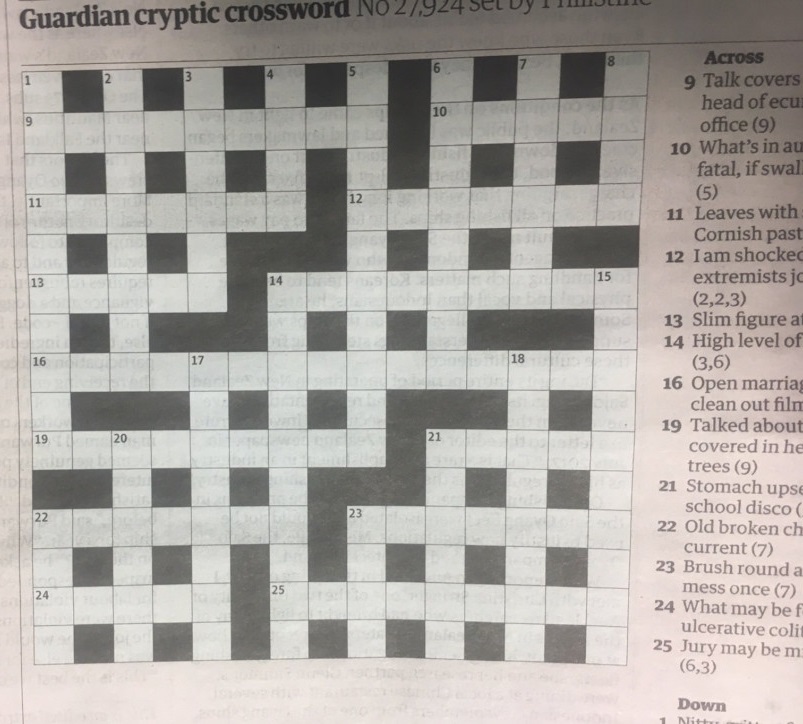
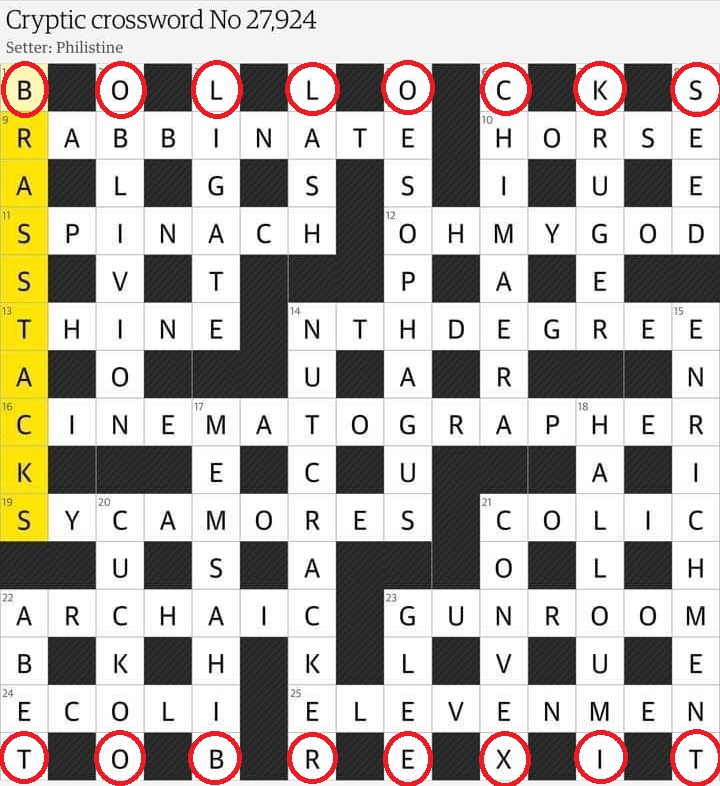
And it’s worth getting into cryptic crosswords, if only for the occasional subversive little Easter egg like this one from yesterday’s The Guardian cryptic:

brexit

Did I miss any resources or outlets for great cryptic crosswords? Let me know in the comments section below! I’d love to hear from you!


Thanks for visiting PuzzleNation Blog today! Be sure to sign up for our newsletter to stay up-to-date on everything PuzzleNation!

You can also share your pictures with us on Instagram, friend us on Facebook, check us out on TwitterPinterest, and Tumblr, and explore the always-expanding library of PuzzleNation apps and games on our website!

Puzzles in Pop Culture: The Challenge: War of the Worlds 2

wotw2logo

[Image courtesy of The Challenge Wiki.]

One of the first reality TV shows to make an impact was MTV’s The Real World, which debuted back in 1992. A show wherein seven strangers would live together in a house and have their lives and interactions taped, it is credited with helping launch the modern reality TV genre.

In the decades since, one of the show’s longest-lasting spin-offs has been The Challenge, a competition show where former Real World alums and other reality show figures compete against each other in physical and mental games, both individually and as teams. There is also a social element to the show, as players form alliances, scheme against other competitors, and often vote out players at regular intervals.

wotw2cast

[Image courtesy of People.com.]

As you might expect, puzzles have worked their way into The Challenge from time to time. Memory games, sliding tile puzzles, and variations on the Tower of Hanoi puzzle.

The most recent iteration of the show, The Challenge: War of the Worlds 2, pits a team of reality show contestants and former Challenge competitors from the UK against a team of previous Challenge competitors from the United States.

At this point in the game, the UK team had lost two players already (as one was sent home at the end of the previous episode, and another left the show for personal reasons).
challengewotw2

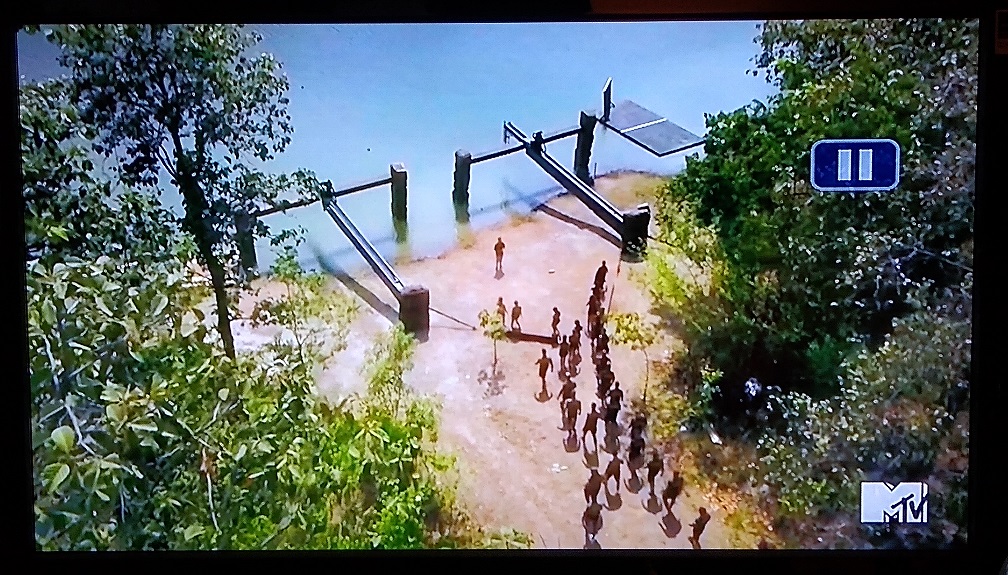
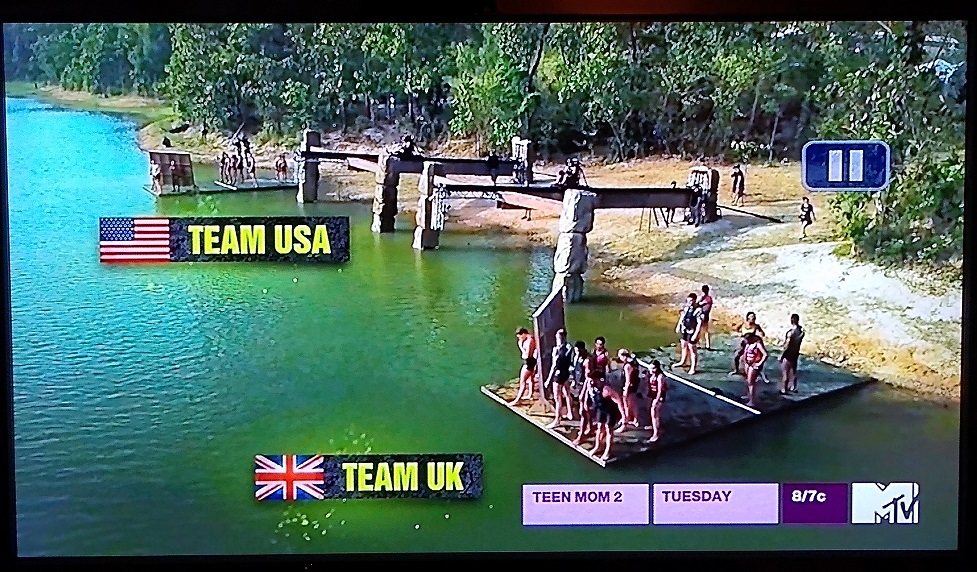
In last week’s episode, as the two teams arrived at a secluded lakeside area, there was a puzzly surprise waiting for them: Cryptic Crossbow.

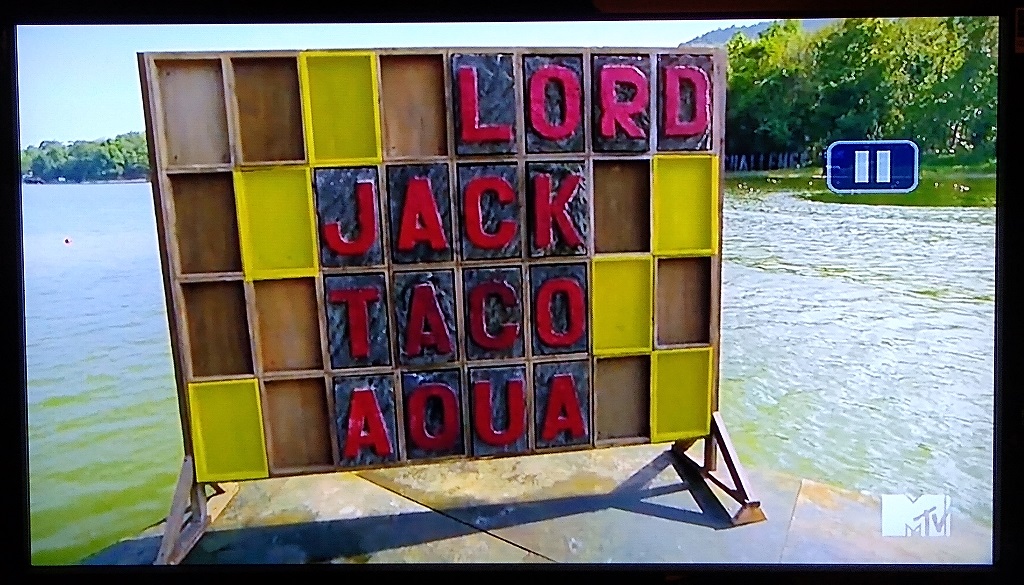
Each team had a giant crossbow, a grid with four four-letter words on it (as well as spaces for additional letters), and a platform from which to jump into the water.
challengewotw5

Eight competitors from each team had to swim out into the water and collect wooden tiles with letters on them. (One letter per tile, one tile per swimmer.) Once eight letters had been retrieved, a second wave of swimmers could jump into the water to retrieve the other eight tiles in the water.

Once all 16 tiles had been retrieved, each team had to add them to the grid in order to form four eight-letter words (using the preset four-letter words as clues). Two things would happen once all 16 tiles were placed on the board:

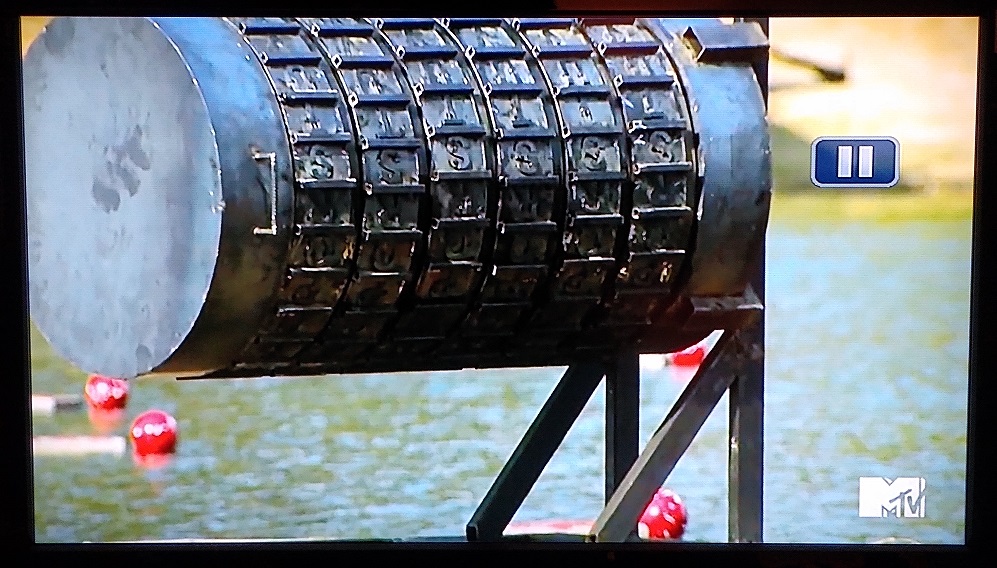
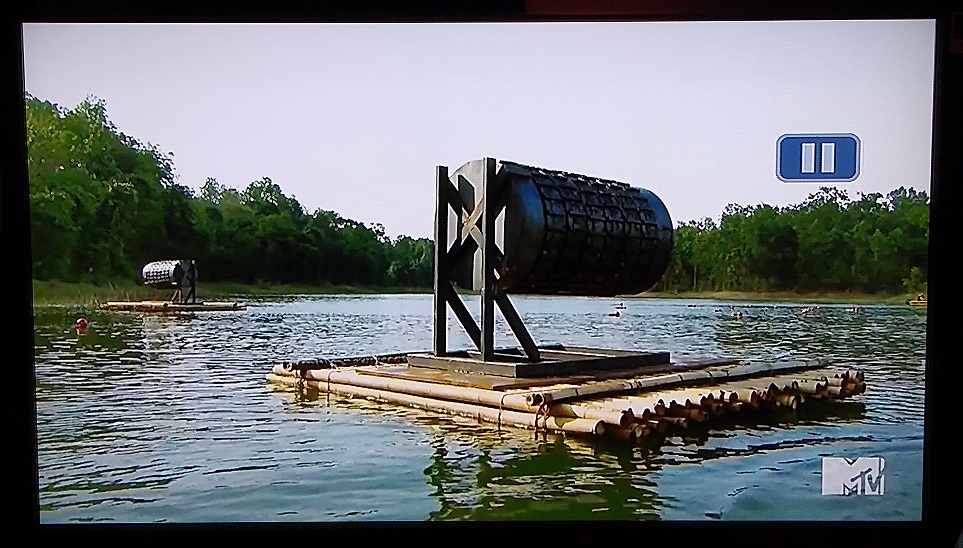
  • The crossbow would activate, and send one of the competitors out into the lake. That competitor would then swim out, retrieve a giant cryptex on a raft, and swim it back to the rest of the team to be solved.
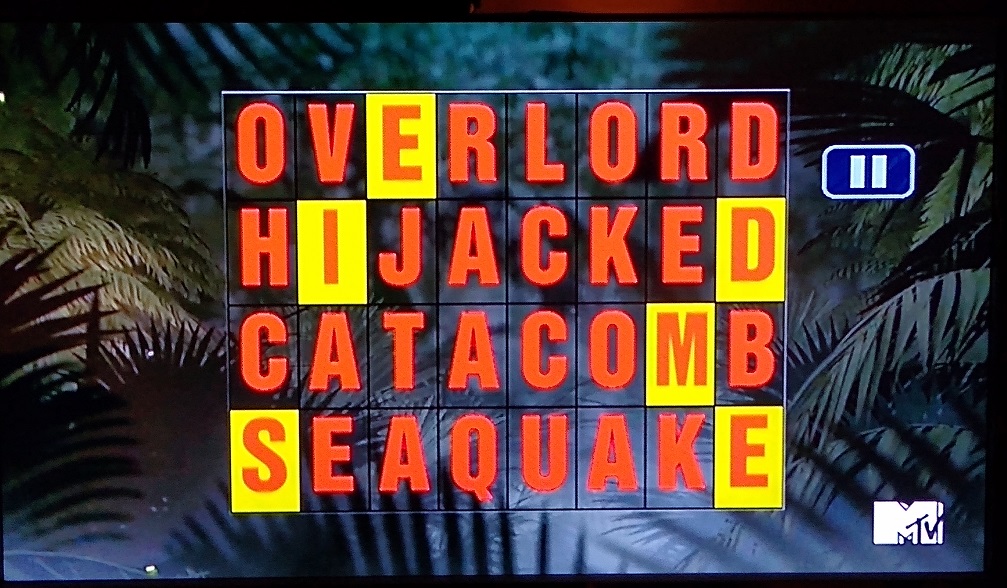
  • When the four eight-letter words in the grid were properly displayed, six highlighted letters in the grid would spell a code word that could be used to open the cryptex once it was delivered to the group.
challengewotw4

Both teams strategized ahead of time.

CT, the Challenge veteran on the UK team, urged his team to simply place all of the letters on the grid as quickly as possible, so they could launch their crossbow-loaded teammate into the water to retrieve the cryptex.

CT noted that the grid didn’t need to be correct for them to win — opening the cryptex was how a team achieved victory — so the grid didn’t matter, so long as they could mentally solve the puzzle and come up with the correct code word for the cryptex.

It’s a solid plan.

On the US side, Laurel pushed her teammates to solve the puzzle before their teammate was launched from the crossbow (to ensure they’d be able to open the cryptex on the first try), but Johnny Bananas had the same instincts as CT and pushed the idea of loading the grid quickly in order to launch their teammate and retrieve the cryptex.

Once the battle plans were in place, the teams then determined who would swim to which letters (in order to use their best swimmers to travel the farthest distance the fastest).
challengewotw1

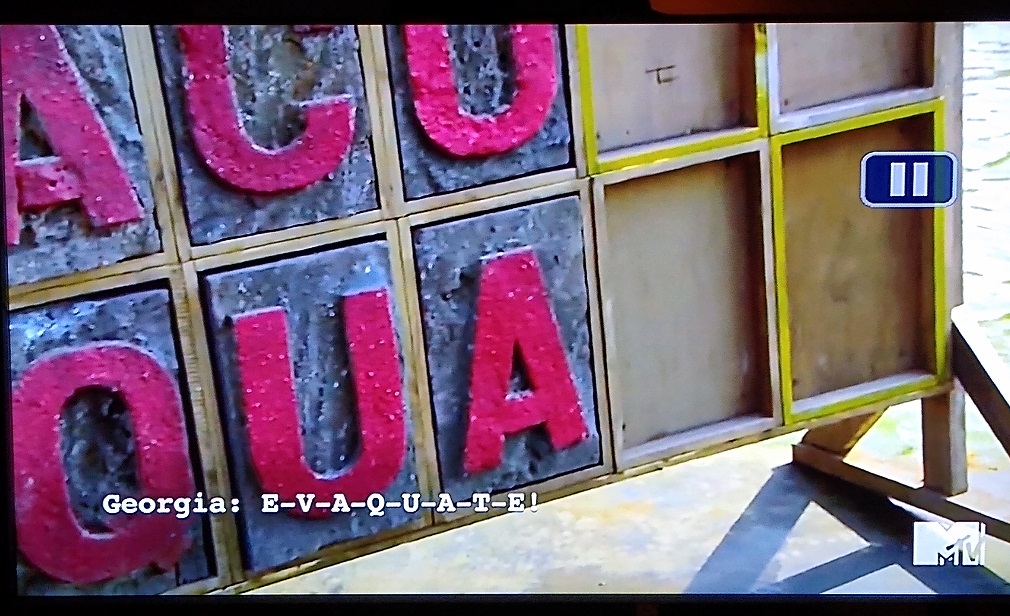
As a puzzler, after one glance at the grid, I immediately tried to figure out the possible eight-letter answers in my head. Naturally. AQUA was the easiest, because SEAQUAKE was the only relatively common word that fit.

Though UK competitor Georgia obviously disagreed with me, as she was certain EVACUATE would fit.
challengewotw6

Similarly, HIJACKED was the only common word that would fit for JACK.

TACO was harder, because it took me a while to come up with CATACOMB as the answer. It’s a cool word, but not one that jumped out at me.

LORD was the most challenging, because SLUMLORD, OVERLORD, LANDLORD, and DRUGLORD all came to mind, although some seemed less likely due to unpleasant connotations. (Not only that, but my nerdy brain kept suggesting possibilities like TIMELORD, STARLORD, DARKLORD, HIGHLORD, STALLORD, etc.)
challengewotw7

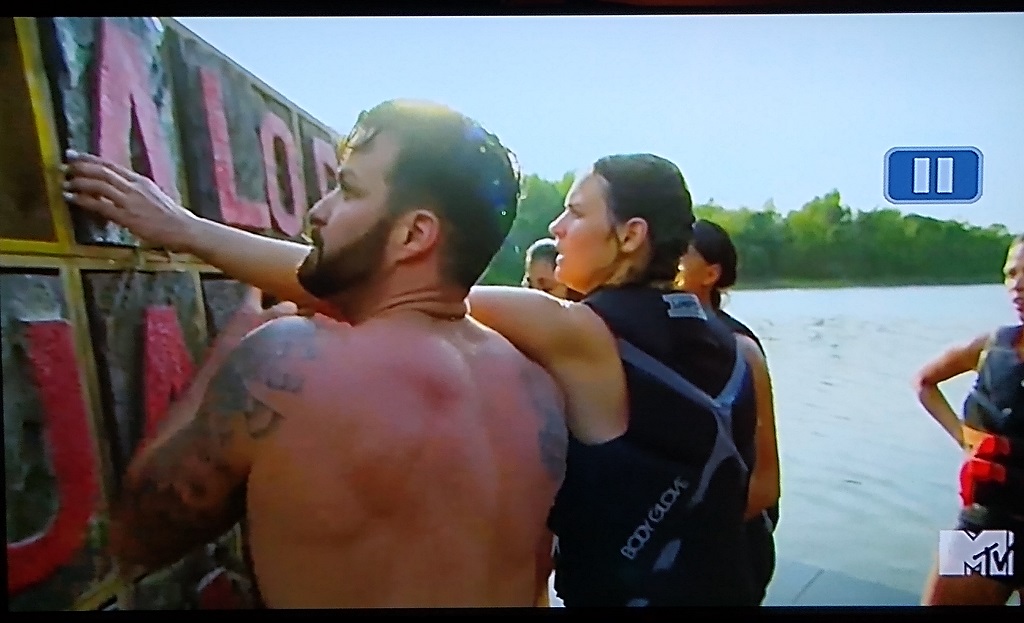
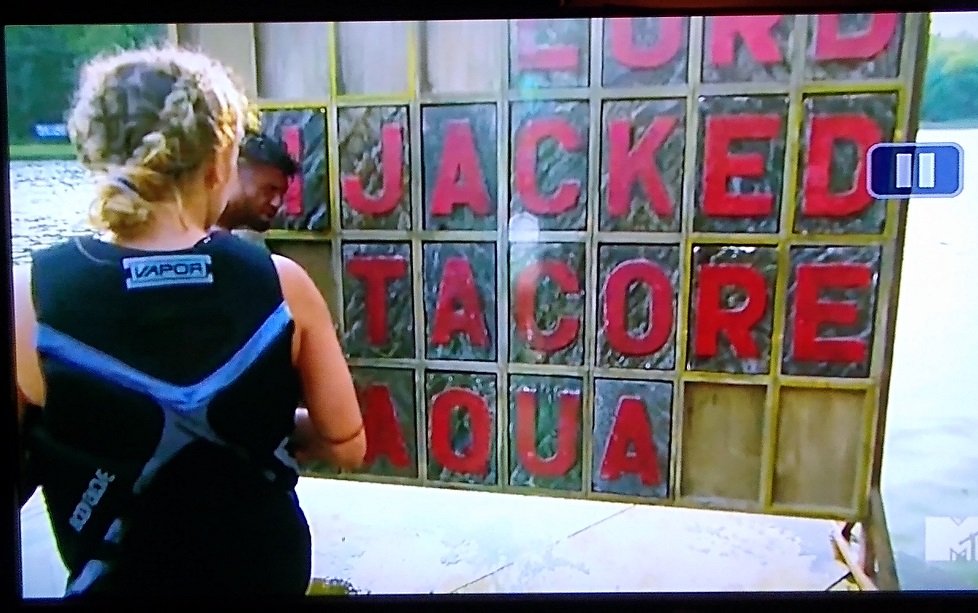
With stronger swimmers on their side, the US team retrieved all of their letters before the UK team did, and according to plan, they simply filled the grid randomly in order to trigger their catapult, launching teammate Jordan into the water and toward the cryptex. They then began mentally reworking the grid to solve the puzzle.

(We couldn’t see all of the available letters, but teammate Paulie correctly determined that the top word was, in fact, OVERLORD.)
challengewotw8

The UK side, on the other hand, struggled to get all 16 letters back to their grid in a timely fashion, and then compounded this mistake by trying to fill in the grid properly, delaying the launch of their crossbow-loaded teammate.

While they tried to solve the puzzle (and failed), Jordan had already unlocked the US team’s cryptex and started swimming it back to his team’s platform.
challengewotw3

Finally, the UK team listened to CT and just filled the grid in order to launch their teammate Joss into the water, but by this point, Jordan was more than halfway to the US team’s platform with their cryptex.

Joss had barely reached the UK team’s cryptex when the US team unlocked theirs with the code word DEMISE.
challengewotw9

The US team made it two Challenge event wins in a row, and the UK team was sent off to choose one member of their team for possible elimination.

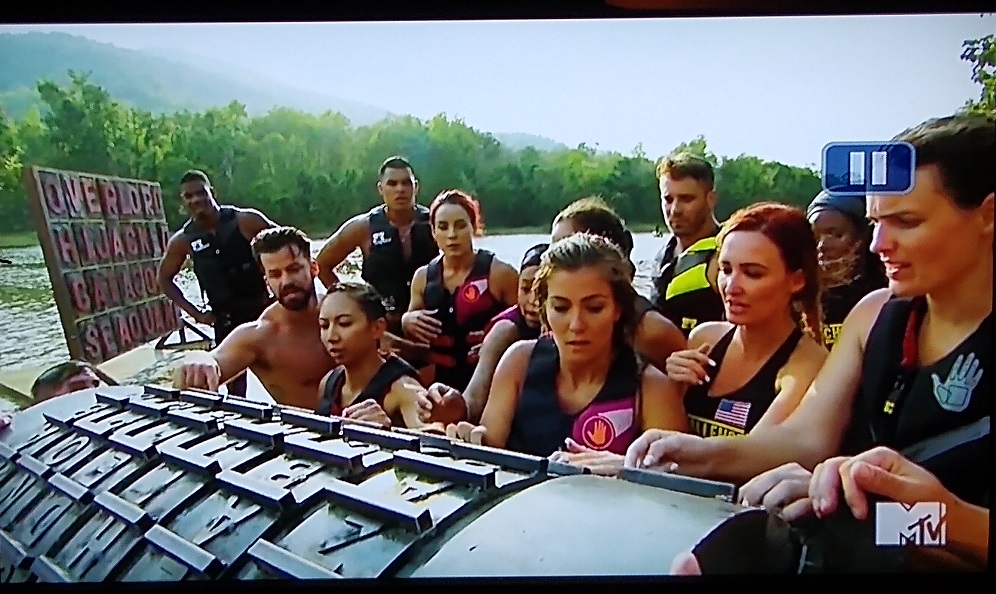
In short, the UK team was decimated in this challenge. They were outswam, outpuzzled, and outstrategized by the US team. Although they were behind at the start due to some of their slower swimmers, they would’ve had a better chance if they’d follow the US team’s lead and just gotten their crossbow teammate into the water sooner while they worked out the puzzle. But alas, it was not meant to be.
challengewotw10

If only they had a PuzzleNationer on their team, this could’ve all been avoided.

Although this wasn’t the most difficult puzzle-based event I’ve seen in previous editions of The Challenge, it was a nice variation and certainly kept the competitors on their toes. I look forward to seeing if there are more puzzly obstacles awaiting the two teams as the competition continues.


Thanks for visiting PuzzleNation Blog today! Be sure to sign up for our newsletter to stay up-to-date on everything PuzzleNation!

You can also share your pictures with us on Instagram, friend us on Facebook, check us out on TwitterPinterest, and Tumblr, and explore the always-expanding library of PuzzleNation apps and games on our website!

Merry Christmas, Happy Holidays, and Puzzly Delights!

Merry Christmas, fellow puzzlers and PuzzleNationers! (And if you don’t celebrate Christmas, then Happy December 25th, fellow puzzlers and PuzzleNationers!)

I’m a sucker for a festive event, so I’ve got a puzzly double feature lined up for you today.

First, allow me to present a delightful video concocted by friend of the blog Hevesh5. Lily is a domino master who has created numerous domino chains and Rube Goldberg-style machines with elements that fit a given theme. So naturally, given the season, she’s devised a marvelous domino chain with all sorts of holiday elements. Enjoy!

And since we’re on a holiday kick, there’s an anagram challenge for you too!

What are the longest common words you can make from the letters in the following phrase?

M-E-R-R-Y C-H-R-I-S-T-M-A-S

No plurals or proper nouns are allowed, and you can only use the letters in the phrase. (Meaning, for instance, you can use 3 Rs, but not 4, since there are only 3 in the phrase.)

We came up with one 10-letter word, four 9-letter words, twelve 8-letter words, and thirty 7-letter words.

Let’s see how you do!

Have a marvelous holiday (or day), and happy puzzling to you!


Thanks for visiting PuzzleNation Blog today! Be sure to sign up for our newsletter to stay up-to-date on everything PuzzleNation!

You can also share your pictures with us on Instagram, friend us on Facebook, check us out on TwitterPinterest, and Tumblr, and explore the always-expanding library of PuzzleNation apps and games on our website!