The Curious Case of Richard Simon’s Aunt, Hedwig

Back in November, I wrote about how women have shaped the world of puzzles, both in the past and in the present.

One of the first women I mentioned was Richard Simon’s aunt. According to the lore of Simon & Schuster, she was the one who inspired Simon to publish a limited release book — the first crossword puzzle book — that launched their publishing empire.

While I was writing that post, I spent a little time researching, and I never came across her actual name. Everywhere I looked, it was simply Richard Simon’s aunt.

And that question festered in my brain for a while.

So, one day, I reached out to Simon & Schuster directly, asking for more information on Simon’s influential aunt. I heard back from Hannah Brattesani, their backlist manager, who not only volunteered to comb through the various company histories, but also suggested a book for my research (Turning the Pages by Peter Schwed).
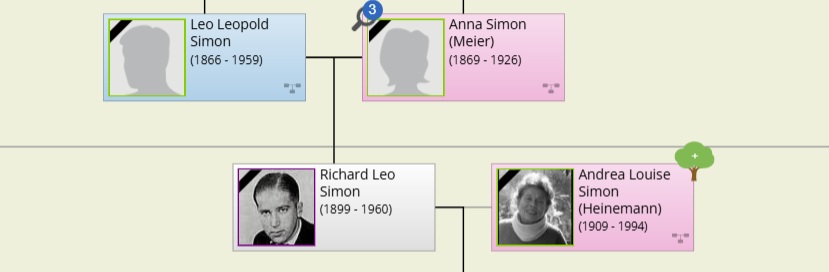
While Hannah investigated from the S&S side of things, I decided to pursue what was publicly available about the Simon family tree. Perhaps I could look up his aunt directly and find a name that way.

I found that Richard L. Simon was the son of Leo Leopold Simon and Anna Simon (nee Mayer). Leo apparently only had brothers, while Anna’s only sister, Julia, died young.

Okay, that was a dead-end. Ah! But what about women who married into the family?

Anna’s brother Max Reinhard Meyer married a woman named Harriet and Leo’s brother Alfred Leopold Simon married a woman named Hedwig.

So we have two possibilities, but nothing concrete tying either of them to crosswords or S&S’s early days.

I heard back from Hannah, who unfortunately came up empty while searching the S&S archives. The closest we got was a reference from a book celebrating S&S’s 75th anniversary, mentioning “Mr. Simon’s strong-willed aunt.”

Sadly, not an actual picture of Richard Simon’s aunt…

Before I continue, I want to take a moment to ponder all the different permutations of the Richard Simon’s aunt story. For a casual anecdote that adds charm to a business’s first success story, there are a surprising number of variations.

In Turning the Pages and The Centenary of the Crossword, the story goes that Dick Simon had been asked by his aunt for a little help with a crossword puzzle to which she had become addicted. She considered there should be a book of these published.

In an article in Pressreader, she asked him where she could buy a book of crosswords like the ones in her favorite newspaper.

In What’s Gnu?: A History of the Crossword Puzzle by Michelle Arnot, she wants a collection of crossword puzzles for her daughter, an avid fan of the weekly puzzle in The World. In The Crossword Century and Thinking Inside the Box, Simon goes to dinner with his aunt, whose niece was addicted to crosswords.

So the only common threads are Simon, his aunt, and crosswords. Sometimes it’s for her (described as “puzzle mad” or, as we’ve already seen, “strong-willed”), or her daughter, or her niece, or a friend. Sometimes he notices her solving crosswords, sometimes she tells him. Sometimes it’s at her house, or over tea, or at dinner.

Sure, lots of anecdotes evolve over the decades. Any story from your family probably has a number of variations, depending on who tells the tale.

But it’s fascinating that such a fundamental moment in S&S’s history doesn’t really have an official version as part of the narrative.
So, we have Richard Simon, his aunt, and crosswords. Those were the common threads.

And it was the third one in that list that finally led me to her name. Not crosswords per se, but crossword history.

There are several marvelous books about the history of crosswords — I’ll post a list of my sources at the bottom of today’s post — and wouldn’t you know it, several of them include a name for Simon’s aunt!

Well, not a name. A nickname.

Wixie.

Yes, it’s somehow so brilliantly fitting that the woman who launched crossword publishing (for herself, a daughter, a niece, whomever) would have a whimsical nickname like that.

Aunt Wixie.

As it turns out, this nickname was sort of an open secret in the annals of crossword history and I’d managed to miss it in my previous searches across the internet. My grand mystery would have been solved much faster if I’d simply asked some of my fellow puzzlers and puzzle historians.

But I wasn’t disappointed to learn that I was late to the table. On the contrary, I was excited to add “Wixie” to the search parameters and see what I came up with.

A few more online sources were revealed, but sadly, not much else about Aunt Wixie herself.
Now, sharp-eyed readers, you’ve probably come to the same conclusion I did at this point.

Thinking back to what I’d learned about the Simon family tree, I had two possible aunts who had married into the family who could be our crossword-loving inspiration.

One was Harriet and one was Hedwig.

It seems like a natural conclusion that Aunt Wixie and Aunt Hedwig would be one and the same. But none of the sources, paper or digital, ever mentioned her real name.

I could’ve called it here, and written my blog post, and gone on my merry way.

But I wanted that last piece of puzzle that I could definitively point to and say, this, this is her.


In all those Google Books links and online articles, there was one source I couldn’t view publicly, because it was behind a paywall. Naturally, it was also the oldest source I could find online that came up using “Wixie” as a keyword: an issue of Publisher’s Weekly from 1954.

And I could read it… for a fee.

You may find it funny that I balked at spending twenty bucks for access to an article. But I did. I mean, none of the other sources told me more than her nickname and some variation on the crossword book creation myth. Would this one be any different?

As it turns out, yes, yes it would.

From the writeup in Publisher’s Weekly:

Among the devotees of the World’s crosswords was a New York Lady, Mrs. Alfred L. Simon. She had a nephew named Richard L. Simon to whom she was known as Aunt Wixie.

It is so perfectly typical that the smoking gun in my search for Richard Simon’s aunt’s name STILL doesn’t directly mention her by name, using her husband’s name instead. What an insanely fitting denouement.

Nonetheless, I finally had the connective tissue to tie the whole story together. From my deep dive into the Simon family tree, I knew that Mrs. Alfred L. Simon was none other than Hedwig Simon (nee Meier), our elusive Aunt Wixie.
So what do we know about Hedwig?

Sadly, very little. She was born in Frankfurt Am Main, Regierungsbezirk Darmstadt, HE, Germany on February 27, 1868. She had two children, Robert and Helen (hopefully a puzzle lover like her mother, depending on the story), and she died in May 26, 1932 in Manhattan.

That’s it. Several Hedwig Simons come up when you search the name, but unfortunately, I wasn’t able to find anything else I could verify was truly about Aunt Wixie.

Date of birth. Names of her children. Date of death. That’s all we know.

Oh, we actually do know one other thing.

We know that she, in some way, influenced the creation of the very first crossword puzzle book, helping to launch a literary dynasty that lasts to this very day.
But did she though?

It turns out… there’s an asterisk on the historical record that’s worth mentioning.

There is a chance that this entire story is apocryphal, and the influential hand of Aunt Wixie in Simon & Schuster’s earliest days was not as influential as the story makes it seem.

Michelle Arnot reported in her book that Margaret Farrar, first crossword puzzle editor for The New York Times, had her doubts about Aunt Wixie’s role in the creation of S&S’s first crossword book.

In the foreword to Eugene T. Maleska’s 1984 book Across and Down: The Crossword Puzzle World, Farrar herself wrote:

There had never been a book of crosswords and Dick Simon’s aunt had suggested one. (Dick later admitted to me that this was all a joke, even unto the framed memo up on the office wall noting this earth-shaking idea.)

Could Aunt Wixie’s role in the history of crosswords simply be Richard Simon’s invention to help sell crossword books and add some whimsy and down-home family charm to Simon & Schuster’s first of many success story?

Margaret Farrar seemed to think so, and she was one of the most respected names in puzzles.

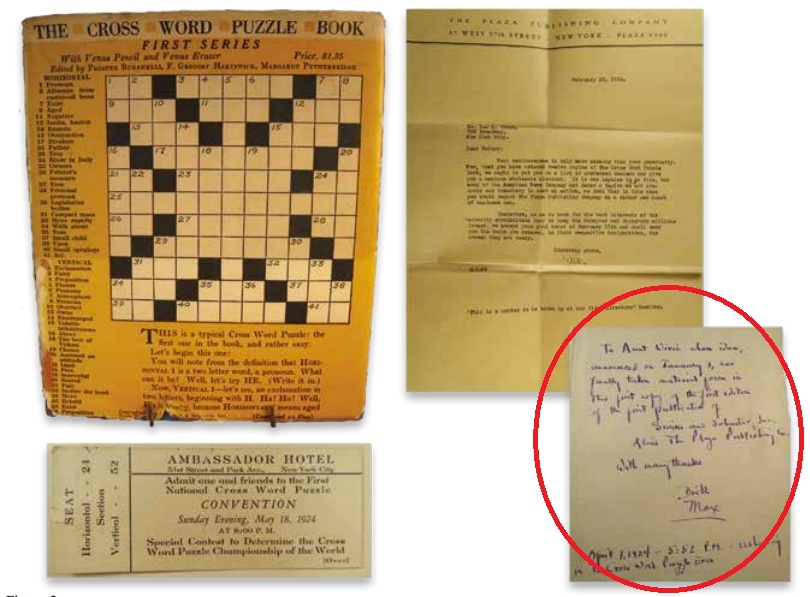
If this IS the case, Simon seemed to go out of his way to sell the story. He had a framed memo on his wall, as Farrar mentioned. He had a presentation copy of the first crossword puzzle book inscribed by both himself and Max Schuster to Aunt Wixie (the note pictured above), which was returned to Richard Simon upon her death, and which now resides in Will Shortz’s private collection.

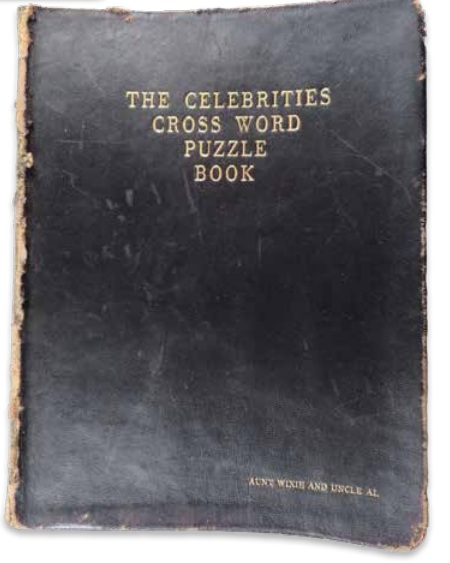
Will’s collection also includes a copy of 1925’s Celebrities’ Cross Word Puzzle Book, a collection by S&S featuring puzzles created by (you guessed it) celebrities. It’s a leatherbound presentation copy specially printed for “Aunt Wixie.”

By the end of 1924, S&S already had four bestselling crossword compilations on the shelves. By the time The Celebrities’ Cross Word Puzzle Book was published in 1925, would Simon still have bothered with perpetuating the Aunt Wixie story, given the runaway success of S&S’s crossword puzzle books?

It seems a tad unnecessary.

The many variations on how Aunt Wixie, Simon, and crosswords influenced that first puzzle book could mean the story was made up, taking on a life of its own as it was shared anecdotally. Or it could mean that it’s true, as many stories from a hundred years ago have variations from being shared over and over again, retold many times. It’s hard to say either way.

That first book sparked a long, successful series…

I choose to believe that Hedwig Simon was in fact the impetus behind that first book. Maybe it’s naive to want her to be a true crossword enthusiast (or the mother of one, or the aunt of one), and not simply one more corporate invention to sell something to someone.

But I’m okay with that.

I’m happy to have spent this time and energy trying to unearth her name and learn a bit more about her, and I’m hoping that I might have the opportunity in the future to continue learning about her.

And I’m happy that this post, in some small way, might bend search algorithms and lead more people to associate the name Hedwig Simon with Simon & Schuster’s successes.

Narratively, I probably shot myself in the foot a little by putting her name in the title of the blog post. But this entire endeavor has been about learning more about her, learning her name, and it would be the height of selfishness to bury it in hundreds of words of text just for a ta-da moment.

So, in closing, let me just say, thanks Aunt Wixie, and it was nice to meet you, albeit very briefly, Hedwig.


My sincere thanks to Hannah Brattesani of Simon & Schuster, Rebecca Rego Barry of finebooksmagazine.com, and especially Ben Zimmer, who provided several key sources and links (and confirmed that the Publisher’s Weekly was the earliest source on the subject).

Sources:

-Turning the Pages: An Insider’s Story of Simon & Schuster 1924-1984 by Peter Schwed
-What’s Gnu?: A History of the Crossword Puzzle by Michelle Arnot
-The Centenary of the Crossword by John Halpern
-The Crossword Century by Alan Connor
-Thinking Inside the Box: Adventures with Crosswords and the Puzzling People Who Can’t Live Without Them by Adrienne Raphel
-Publishers Weekly (April 17, 1954, Volume 165, Issue 16)

Making Wordplay Magic with Word Squares!

[The Smyrna word square, uncovered as a bit of puzzly graffiti in 2016.]

Have you ever tried to make a word square, fellow puzzlers? It’s an intriguing twist on crossword-style construction, except the words you place read both across and down in the grid.

For instance, a five-letter word square could read:

WATER
AWARE
TALON
ERODE
RENEW

As you can see, 1-Across is also 1-Down, 2-Across is also 2-Down, and so on. (Appropriately enough, our friends at Penny Dell Puzzles have a puzzle involving this puzzly trope, and they call it “Across and Down”)

Word Squares have been around for centuries. One of the most famous is dated all the way back to 79 AD in Pompeii (though it has been found in other places throughout history), and is known as the Sator Square:

Not only is it a word square, but it’s a palindrome as well!

It’s a neat little linguistic challenge, and as you might expect, they become more difficult to construct the larger they get.

But physicist, computer programmer, and all-around word enthusiast Eric Tentarelli might’ve cracked the code to making word squares in heretofore impossible sizes…

Doing so in Latin.

In the introduction to his WordWays article “Large Word Squares in Latin,” Tentarelli explains:

Large word squares have been pursued in many languages, but large word squares in Latin appear to have remained unexplored, despite the form’s origins in ancient Rome and despite the benefits offered by Latin inflectional endings.

New word squares constructed in Latin are shown to surpass in size those created in other languages to date, most notably by attaining the holy grail of logology: the first known non-tautonymic ten-squares consisting entirely of solid, uncapitalized words in a single language.

So, what does he mean? Well, essentially, people have been able to pull off word squares of impressive size — 8×8, 9×9, and 10×10 — but not without using certain undesirable words and word variants.

Those variants would include hyphenated words, tautonyms (scientific names where the same words is used twice, like vulpes vulpes for “red fox”), and capitalized words, aka proper nouns. Also, some puzzlers have mixed languages in order to create these word squares, similar to crossword constructors getting themselves out of a tough corner by using a European river.

Ideally, you want a word square consisting of, as he says, solid uncapitalized words in a single language.

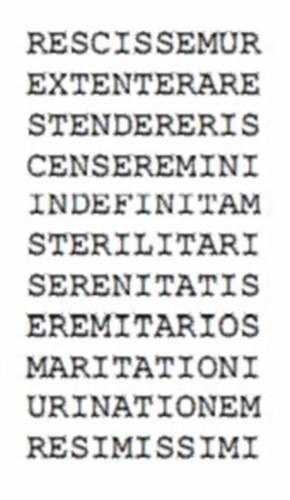
Like this:

tentarelli

Say hello to the first verified 11×11 word square in a single language.

“I produced these squares by selecting final rows that combined to produce common endings and therefore maximize the chance of completing the rest of the grid.”

By compiling lists from reliable, verifiable dictionary sources and building a database of potential words, Tentarelli gave himself a strong base to start with.

But by choosing Latin as the language of choice, he significantly increased his chances of success. Thanks to “its extensive and overwhelmingly regular system of inflectional endings,” Latin was an excellent choice for word squares, which are commonly constructed by placing the bottom words first and building upward from there.

From David Brooks’ article in The Concord Monitor about Tentarelli’s work:

English has some endings that finish up on many words, “-ING” being the most obvious example. but Latin has plenty more including some that extend to four and even five letters, which makes it easier to find word squares. “In Latin, if the words in the bottom rows combine to produce nothing but common inflectional endings, such as -NTUR or -ATIS, there is good reason to hope the remainder of the square may be filled,” he wrote.

tintorelli 2

[Four 10×10 word squares built from the same three final words.]

It’s honestly mind-blowing and so inspiring to see what puzzlers can achieve by combining their own linguistic insights with the processing power of computers.

Tentarelli has helped push an ancient style of puzzling to places it has never gone before, and he managed to do so in the original language. How cool is that?

And he’s not done. Apparently, he’s working on a 12×12 square now.

There’s no telling how much farther he could go in the future.


Thanks for visiting PuzzleNation Blog today! Be sure to sign up for our newsletter to stay up-to-date on everything PuzzleNation!

You can also share your pictures with us on Instagram, friend us on Facebook, check us out on TwitterPinterest, and Tumblr, and explore the always-expanding library of PuzzleNation apps and games on our website!

ACPT 2016 Wrap-Up!

ACPT LOGO

The 39th annual American Crossword Puzzle Tournament was this weekend, and puzzlers descended on the Stamford Marriott Hotel to put their puzzly chops to the test in what is lovingly called “the Nerd Olympics.”

The tournament takes place over two days, with six puzzles to solve on Saturday, followed by one on Sunday. Then the top three finishers solve the championship puzzle on white boards in front of the audience.

On Friday and Saturday night, there are often puzzle events, demonstrations, and panels by top puzzlers and figures in the puzzle world as well.

(This year, Friday night featured author and puzzler Eric Berlin hosting an Escape the Room-themed puzzle hunt that received rave reviews from participants, and Saturday night saw the first Merl Reagle Memorial Lifetime Achievement Award in crossword construction presented to constructor Maura Jacobson. Her husband accepted on her behalf from Merl’s widow, and there wasn’t a dry eye in the house.)

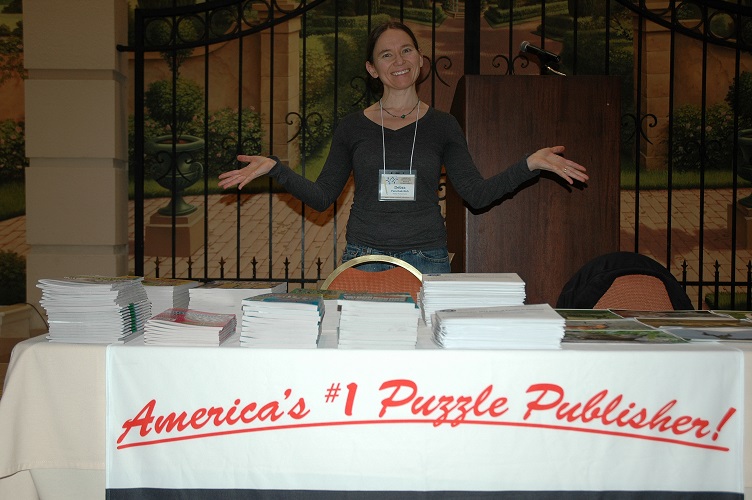
I made the journey down to Stamford myself Saturday morning and sat in with my friend, proofreader and puzzler Debra Yurschak Rich, at the Penny Dell Puzzles booth.

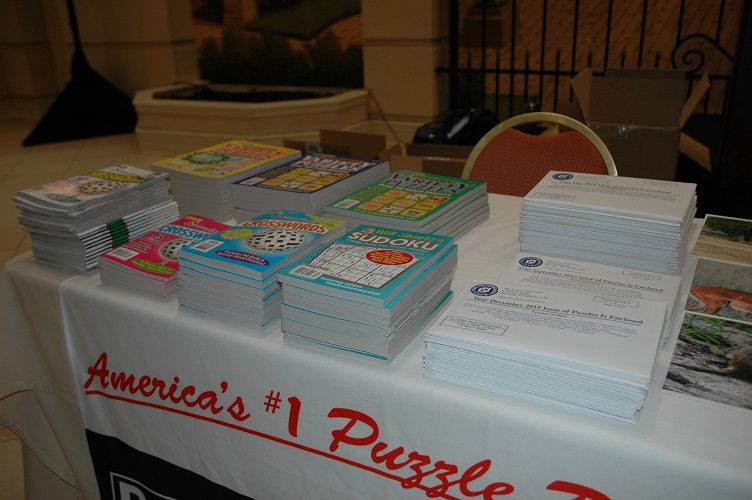
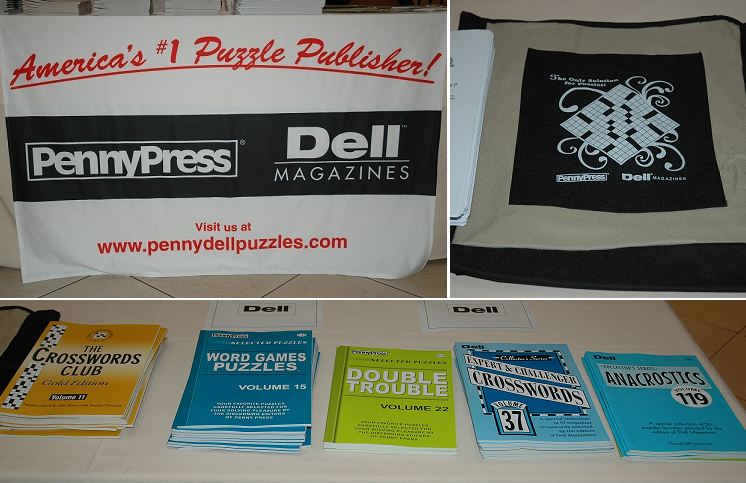
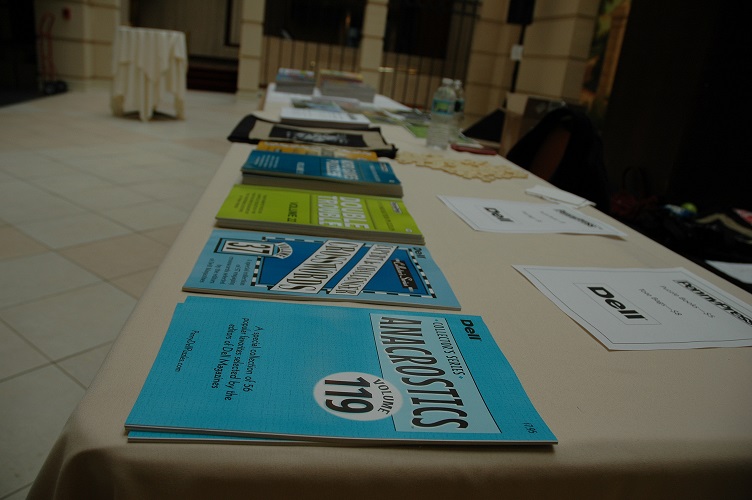
Our pals at Penny Dell Puzzles had a terrific setup as always, with great books and tote bags for purchase and a metric buttload of magazines to give away, including copies of The Crosswords Club, Will Shortz’s Sudoku, and several flavors of Tournament Variety, Master’s Variety, and Dell Sunday Crosswords!

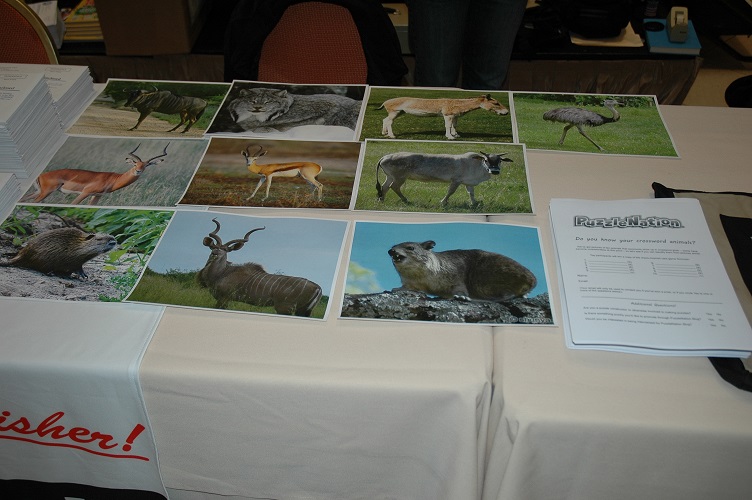
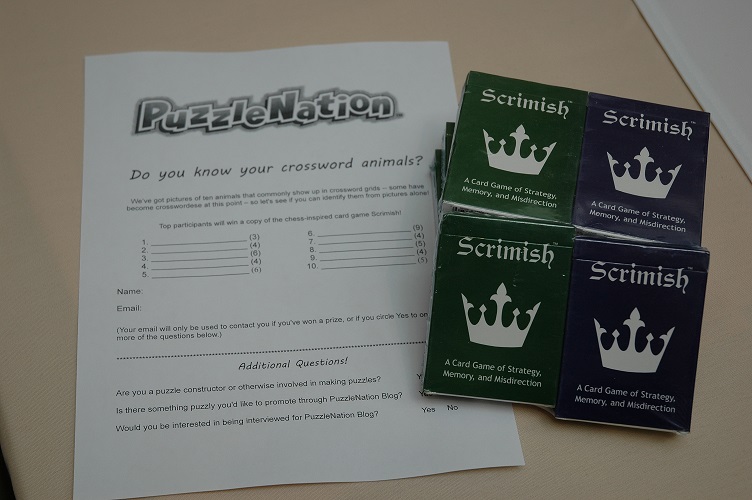
And they didn’t mind at all when I conquered and annexed the middle of the table for PuzzleNation’s in-person version of Friday’s View a Clue crossword animals puzzle. Many competitors stopped by the table to try their luck, allowing some to thoroughly impress their fellow puzzlers with their knowledge of African antelopes, while others were flummoxed trying to match names they’d written into grids dozens of times with images of the actual animal!

(One woman told me she’d seen many of these animals during a trip to South Africa, and even EATEN some of them, but she couldn’t identify them by name. I imagine it’s quite rare to know what an animal tastes like but not what it LOOKS like.)

At 9 AM, the tournament was two hours away, but the marketplace was up and running. In addition to the usual ACPT swag, the marketplace included Hayley Gold and her Across & Down comics, the aforementioned Eric Berlin (repping his Winston Breen books and Puzzle Your Kids subscription puzzles), a collection of Merl Reagle’s puzzle books, and an impressive selection of puzzly titles from the marvelous crew at The Village Bookstore in Pleasantville, New York!

Plus I got to see friends of the blog like Crosswords Club editor Patti Varol, constructor Ian Livengood, crossword gentleman Doug Peterson, and Penny Press variety editor Keith Yarbrough!

Another treat of the tournament is getting to chat with numerous puzzle luminaries I’ve gotten to know through PuzzleNation Blog, like New York Times Wordplay blogger Deb Amlen, constructor and Pre-Shortzian Puzzle Project curator David Steinberg, constructor Joon Pahk, top solver and former champion Ellen Ripstein, constructor George Barany, Evan Birnholz of Devil Cross, top competitor Tyler Hinman, and, of course, New York Times puzzle editor Will Shortz.

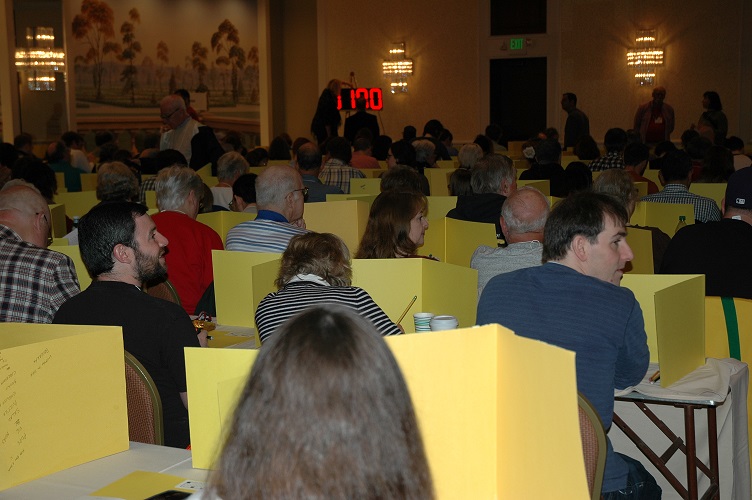
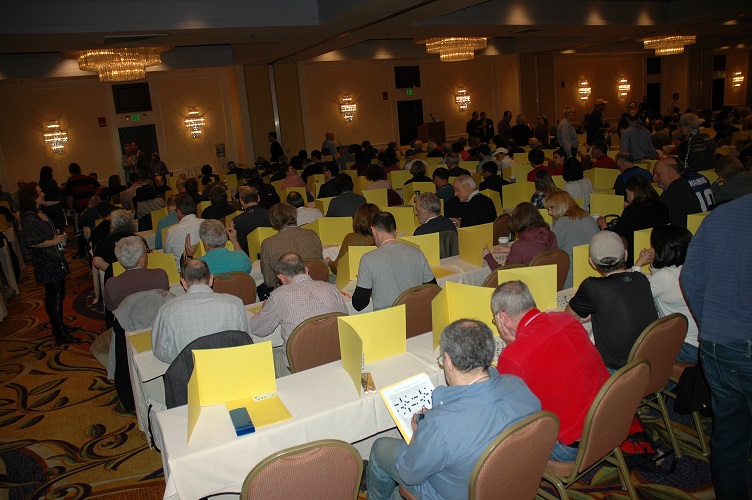
The two hours before showtime passed quickly, and soon, the marketplace emptied and the ballroom filled as competitors took their seats for Puzzle 1.

Puzzle 1 didn’t stagger any of the participants, although there was no repeat of Dan Feyer’s blisteringly fast under-two-minute solve like last year. Three minutes seemed to be the benchmark for the top performers this year.

But Puzzle 2 had a crossing that flummoxed several solvers: CORTANA crossing CONTE. Constructor Patrick Blindauer, not in attendance, was no doubt on the receiving end of some Puzzle 5-level heat for that one. But when Doug reached out to Blindauer, it turns out that THAT wasn’t Blindauer’s corner! It had been edited, with MONTANA becoming CORTANA.

I had no idea puzzles accepted for the tournament were edited that much!

Puzzles 3 and 4 passed without incident, and people seemed to enjoy both the camaraderie of the event and the opportunity to compete against their own best times from previous years.

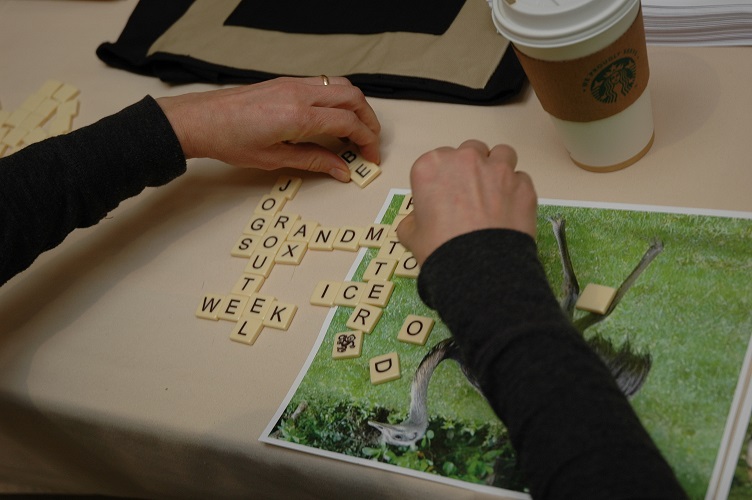
[In our downtime, Debra and I indulged in a round or two of Bananagrams, because it was a day for wordplay of all sorts.]

Then Patrick Berry’s Puzzle 5 arrived, complete with zigzagging entries and a thoroughly impressive fill. (“Wow” was uttered several times by competitors describing their impression of the always-dreaded fifth puzzle of the day.)

Between puzzles 5 and 6, I handed out prizes for our View a Clue crossword animals game: copies of Scrimish, donated by that game’s terrific design team!

Two copies went to our top performers — one got ALL TEN and another got nine out of ten — and two copies went in a drawing from all of the players who gave it their best shot. So congratulations to Robert Moy (who pitched a shut-out), Robert Kern, Abbie Brown, and the man known only as Dan (who got all but one)!

After the diabolical inventiveness of Puzzle 5, Puzzle 6 was tackled by the solvers, who declared it a fun and fair end to the day’s competition. The solvers dispersed to rest their brains; we packed up the table, and headed for home.

And although I wasn’t present for Sunday’s tournament finale, I continued to get updates from friends and fellow puzzlers.

The day started off with Lynn Lempel’s Puzzle 7, which received strong reviews, but did little to alter the standings of the top competitors.

Soon, it was time for the finalists to be announced. When it came time for the top three to solve on their whiteboards in front of their fellow competitors, two of the names were quite familiar to attendees: Dan Feyer, defending six-time champion, and Howard Barkin, four-time champion and perennial participant in the finals.

Conspicuous by his absence was another familiar name and former champion, the performer who made last year’s finals such a nail-biting showdown: Tyler Hinman. An unfortunate error in Puzzle 2 took him out of the running, so the final member of the live-solving trio would be David Plotkin. (Joon Pahk, Francis Heaney, Al Sanders, Jon Delfin and other regular key performers were also near the top.)

He and Howard prepared for a thoroughly wordy and daunting battle with Mr. Feyer, whose excellent performance in the seven previous puzzles had him leading his competitors by three minutes.

You can watch the final puzzle being solved below:

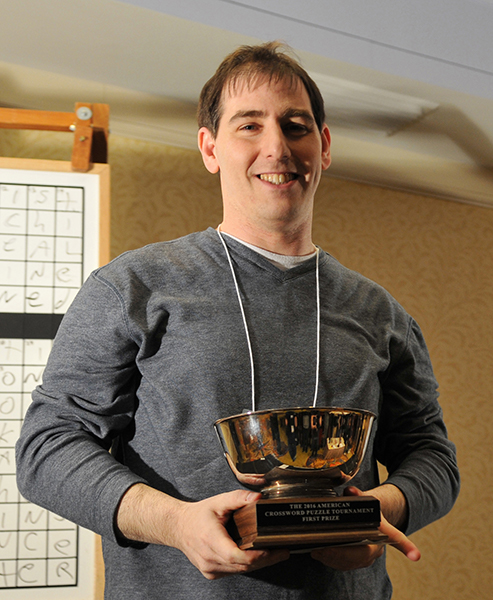
In a stunning upset, Howard Barkin did the seemingly impossible, besting Dan Feyer and claiming the top spot! The room erupted for him as others sat by, stunned that the expected seventh straight win for Dan was not to be.

[Howard poses with his well-earned trophy.]

But that’s not all! Friend of the blog and crossword gentleman Doug Peterson placed 13th overall AND won the finals for Division B! Congratulations to Doug!

And it was a strong showing for many other familiar names! Patti Varol placed 97 (up from last year’s 109 showing), David Steinberg 113th, Kathy Matheson 237th, and Keith Yarbrough 266th out of a field of nearly 600 participants.

It was certainly a day for surprises, strong emotions, and puzzly camaraderie. It’s always great fun to spend time with fellow puzzlers and wordplay enthusiasts, immersing myself in the puzzle community and enjoying all the charm and weirdness that comes part and parcel with it.

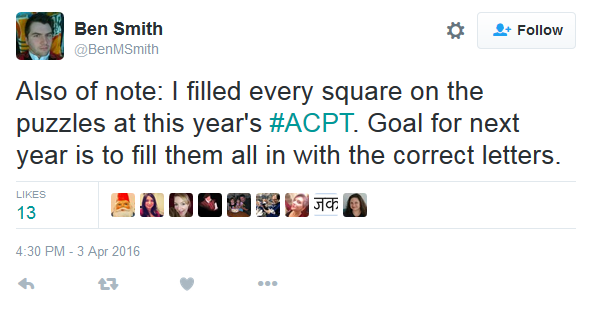
That would’ve been my closing statement, but I think the final word belongs to competitor Ben Smith:


Thanks for visiting PuzzleNation Blog today! Be sure to sign up for our newsletter to stay up-to-date on everything PuzzleNation!

You can also share your pictures with us on Instagram, friend us on Facebook, check us out on TwitterPinterest, and Tumblr, and explore the always-expanding library of PuzzleNation apps and games on our website!


5 Questions with Puzzler/Artist Hayley Gold!

Welcome to another edition of PuzzleNation Blog’s interview feature, 5 Questions!

We’re reaching out to puzzle constructors, video game writers and designers, board game creators, writers, filmmakers, musicians, and puzzle enthusiasts from all walks of life, talking to people who make puzzles and people who enjoy them in the hopes of exploring the puzzle community as a whole. (Click here to check out previous editions of 5 Questions!)

And I’m excited to have Hayley Gold as our latest 5 Questions interviewee!

An enthusiastic puzzle solver as well as an accomplished artist, Hayley combines her interests with Across and Down, a weekly webcomic devoted to The New York Times crossword.

She combines humor and the keen eye of a long-time solver to not only entertain, but offer worthwhile insight into crosswords as a whole and individual puzzles in particular. Whether she’s punning on themed entries or proving her pop culture savvy with references galore, each Across and Down comic brings something unique to the table.

Hayley was gracious enough to take some time out to talk to us, so without further ado, let’s get to the interview!


5 Questions for Hayley Gold

1. Which came first for you: puzzles or art? How did you discover puzzles?

Well, I think art is rather intuitive. As soon as a child gets hold of a crayon their artistic career begins. A lot of people are miffed when artists comment that they’ve been drawing all their life, but I actually did more drawing in my youth than in my maturity, when pressure became attached to it.

That being said, I find doing puzzles much more relaxing and more natural for me. So, though one may have preceded the other doesn’t mean that it’s the dominant hobby.

2. When did you launch Across and Down, and has it evolved from your original vision?

I started the site in January 2014 as a project for my web comics class. The whole operation was rather hasty. We were told we needed to come up with a comic that’s updated weekly, the teacher said the content was completely up to us, though her web comic followed a linear narrative, as did the comics of most of the other students.

I needed something I could do without too much time lost, as the class was only an elective and I had other comics to complete, and something that focused on writing more than visuals as that has always been my strong suit. And of course I wanted it to be fun, and something that I cared about.

I never imagined it would become what it has. Okay, let me rephrase that. I have wild fantasies about it being much MORE than it is, what I never imagined is how much I would NEED it. I experience withdrawal if I go too long without making one.

[Strategy, a wonderful crayon-and-pencil piece, as featured on her portfolio site.]

3. Your comics offer a wonderful mix of humor, tongue-in-cheek wordplay, and savvy commentary from a clearly experienced solver. How have the constructors reacted to your comics? Do you think couching your critiques in this format allows you to say more than a straightforward review or blog post?

In general, I get a good response from constructors. I certainly never got any flak from anyone. Many have reached out to thank me actually, which is a very rewarding gesture. And I’ve never attempting real blogging to compare the reactions side by side, but I would guess that giving everything a lighthearted air does assuage some of the severity of critique.

But, at the same time, I am rarely totally critical and try to be balanced. And though I often address the constructor directly, I try not to make any serious personal attacks if I thoroughly rip something apart, though, by and large, I don’t do comics on puzzles that are completely horrendous. Partly because I don’t wish to be horribly cruel to anyone, and partly because I don’t think it’s very entertaining. At least in a comic, I think nitpicking about the usual crossword faux pas gets repetitive.

[A sample of one of her most recent webcomics.]

4. What’s next for Hayley Gold?

I’m working on a graphic novel, but no ETA on that. And for anyone who’s a fan of my site, I’ll warn you that it’s totally different, both graphically and narratively, so no guarantees that you’ll like it. I also need a job. Hey, anyone out there, hire me! Would love to do some custom crossword comics!

5. If you could give the readers, writers, and puzzle fans in the audience one piece of advice, what would it be?

Er, I’m not really good with this. God knows, my life is a mess. But let’s try to narrow it down a bit. How about advice pertaining to webcomics? Make it about something you’re passionate about. Most of my peers quit their webcomic after the class finished. Now, my stick-to-it-iveness may be due to my uptight nature, but also because it really meant something to me.

Also, keep at it even if you think no one is reading. I hope to get more eyeballs as I go along, though my site still reaches relatively few readers. People may look over it once and then never come back instead of subscribing, or just never come across it even though they are ardent puzzle solvers.

When I go to comics events, so many people come up to me to tell me what a “great idea” my site is — but they personally don’t do the puzzle so it’s not for them. I’ve experienced a very small overlap in the fanbases. The way comics are promoted, as one big giant blob of content, is rather weird — as if readers would be attracted to all of it simply because of the medium, rather than it being placed into subcategories — but I digress.

Choose something you like, stick with it.


Many thanks to Hayley for her time. Check out AcrossandDown.net for her comics and links to her other works, and to keep up on all things Hayley, follow her Across and Down Facebook page, her Twitter (@HayleyRabbit), and her Etsy page! I can’t wait to see what she has in store for us next.

Thanks for visiting PuzzleNation Blog today! You can share your pictures with us on Instagram, friend us on Facebook, check us out on TwitterPinterest, and Tumblr, and be sure to check out the growing library of PuzzleNation apps and games!