The Coronavirus Hits the Board Game Industry

coronavirus

[Image courtesy of NBC News.]

The coronavirus has dominated the news recently. Health organizations in numerous states and countries have posted informational guides on identifying the virus and the stock market has taken a hit due to an upswing in reported cases.

After a few weeks of reporting, we’re starting to get news stories about the global economic impact of the coronavirus, as boats loaded with shipping containers from China are being held up (if the warehouses and factories have been allowed to ship out products at all).

This has hit the board game industry particularly hard.

As you might expect, many board games are manufactured in China due to the competitive pricing available there, but the one-two punch of Chinese New Year and the coronavirus have left many game companies in the lurch with regard to product availability.

chinese-new-year-5

[Image courtesy of How Stuff Works.]

Chinese New Year is a period of tremendous turnover for staffing in factories in China, so production is often shutdown entirely or severely curtailed during the holiday. As new employees are hired, their training time also eats into production time.

Additionally, the Chinese government mandated that all “non-essential” companies stay closed until February 9th, and board game production is naturally considered non-essential. The ports are similarly either closed or dramatically reduced in staff.

Oh, and for many companies, that directive has been extended until March 2nd at the earliest. (Some publishers have speculated that delays of three months could be looming.)

So even in the areas where employees and manufacturers are thankfully healthy, they can’t work. I’ve gotten updates from a half-dozen different board game Kickstarter projects regarding coronavirus-related delays. Whether they’re trying to start production or they’ve got all their games printed, but trapped in warehouses waiting for shipment, they’re in limbo during this crisis.

containership

[Image courtesy of AGU.]

Our hearts go out to those affected by the virus. Here’s hoping the hard-working folks in those factories stay healthy, and can return to work soon.

But if you’re wondering why your Kickstarter goodies haven’t been delivered yet, or why your favorite game’s latest expansion isn’t on shelves yet, here’s why.


Thanks for visiting PuzzleNation Blog today! Be sure to sign up for our newsletter to stay up-to-date on everything PuzzleNation!

You can also share your pictures with us on Instagram, friend us on Facebook, check us out on TwitterPinterest, and Tumblr, and explore the always-expanding library of PuzzleNation apps and games on our website!

Puzzles in Pop Culture: DiscWorld

discworld1

[Image courtesy of Blizzard Watch.]

There are many strange worlds in the realms of fantasy literature, crafted in loving detail across dozens of novels and stories. But no fictional world is as hilarious, as thought-provoking, as sincere, as strange, or as endlessly inventive as the DiscWorld.

DiscWorld is a pizza-shaped planet that rests on the backs of four giant elephants that themselves stand atop the shell of a giant turtle that swims through space. The masterful creation of author Terry Pratchett, DiscWorld is a beloved universe of stories that encapsulates social commentary, parody, and epic adventure, all told through the lens of classic fantasy tropes turned on their heads.

And when you have a world that encompasses everything from witches and golems to time travel and Death himself, you’re bound to encounter a puzzle or two.

In today’s edition of Puzzles in Pop Culture, we’re looking at the colorful ways that Terry Pratchett incorporated puzzles into one of the most singular, expansive worlds in fantasy literature.
discworld2

[Image courtesy of The Daily Star.]

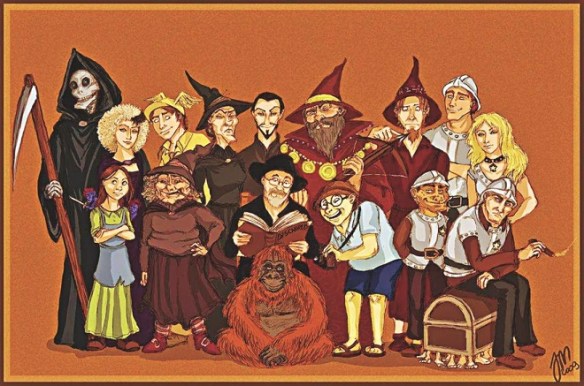
There are numerous capable puzzle solvers in the DiscWorld novels. Across several novels, Commander Vimes of the City Watch cracks both criminal cases and elaborate conspiracies thanks to his street smarts and years of detective work. Career criminal-turned-postmaster Moist Von Lipwig unravels several criminal conspiracies on his journey from miscreant to hero. Even Death, alongside his granddaughter Susan, takes a turn testing his puzzly might over the holidays when they uncover why the Hogfather (DiscWorld‘s version of Santa Claus) has gone missing.

But you cannot talk about capable puzzlers in DiscWorld without mentioning Lord Havelock Vetinari, the Patrician of the fabled city of Ankh-Morpork.

A trained assassin and mastermind who pulls puppet strings all over the city, Vetinari is both hero and villain, doing whatever he deems necessary to keep the city running smoothly.

As you might expect, he’s quite a fan of puzzles. (He plays games as well, like Thud and Stealth Chess, but we’re going to focus on puzzles today.)

discworld3

[Image courtesy of VS Battles Wiki.]

He’s something of a whiz when it comes to decoding and decrypting messages. At the Blind Letter Office in the Post Office — where letters unable to be delivered end up — Vetinari sometimes tests his wits by unraveling the near-gibberish found on some of the letters.

For example, Vetinari encountered a letter addressed to “Duzbuns Hopsit pfarmarrsc” and offhandedly explained that the letter was intended for “K. Whistler, Baker, 3 Pigsty Hill.” How, you ask? By decoding the above into the much-more coherent “Does Buns Opposite the Pharmacy.”

Although the regular employees of the Blind Letter Office manage to translate five out of every six addresses that cross their desks, they view Lord Vetinari’s puzzly skill with awe.
cryptic3

[Image courtesy of Amazon. The Times Cryptic Crossword Book.]

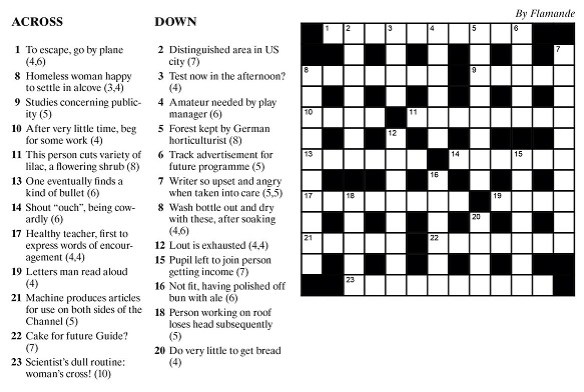
When it comes to British-style/cryptic crosswords, he brings equal skill to the table. In fact, the only discernible sign that Lord Vetinari is drunk is when it takes him 15 seconds longer than normal to solve The Ankh-Morpork Times‘ daily crossword puzzle.

He is routinely challenged by “Puzzler,” the setter for The Ankh-Morpork Times. Naturally, his begrudging respect for the skilled constructor leads him to pursue the secret identity of Puzzler.

In a later DiscWorld novel, Vetinari believes that fellow trivia enthusiast and pet-food shop owner Grace Speaker could be Puzzler. He puts her under observation when it’s revealed she is one of five people in the city who correctly answers the trivia question “What is, or are, Pysdxes?”

(For the record, the other four are Vetinari himself, his assistant Drumknott, Puzzler, and the Curator of Ephebian Antiquities at the Royal Art Museum.)

Later confirming her secret life as Puzzler, Vetinari continues to welcome her challenging puzzles, even if entries like “snarkenfaugister” leave him exasperated at her fiendish and obscure vocabulary choices. (Apparently crosswordese is a thing on DiscWorld as well…)
discworld4

[Image courtesy of Amazon.]

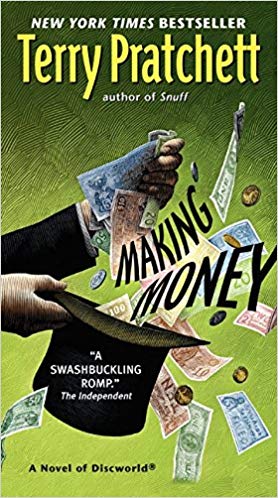
In the novel Making Money, a cryptic crossword clue is presented for the reader to solve as well: Shaken players shift the load (9)

Later in the novel, the answer is revealed. Did you figure it out?

The answer is CARTHORSE. The word “shaken” implies that some letter-mixing is involved, and if you shake up ORCHESTRA (the “players” from the clue), you get CARTHORSE, a device which allows you to “shift the load.”

Naturally, this clue was no match for Vetinari.

[Screenshot from the Penny Dell Sudoku App!]

It’s worth noting that Sudoku has also made its way into DiscWorld, though in a tongue-in-cheek dismissive fashion. In DiscWorld, it is called Jikan no Muda, which is Japanese for “waste of time.” Lord Vetinari considers Jikan no Muda puzzles far easier than the crossword, and therefore less worthy of his attention.

As you’d expect from a master manipulator like the Patrician, he enjoys crosswords more because they allow him to comprehend how another person’s mind works when actively trying to mislead.

In the capable hands of a world-class storyteller, little puzzly details like this don’t simply add color to an established character; they can set the tone for the adventures to come.

In Making Money, for instance, mentioning both crosswords and Jikan no Muda is no coincidence. The entire novel is built around the battle between those who prefer to deal in words (Vimes, Vetinari, Moist) and those who prefer numbers (Mr. Bent, who runs the Royal Bank of Ankh-Morpork).

One of my all-time favorite series even before I compiled these puzzly moments, the DiscWorld books make the most of every story element involved, whether it’s witchcraft, magic, misunderstandings, fiendish plots, or simply one city official’s penchant for puzzles.


Thanks for visiting PuzzleNation Blog today! Be sure to sign up for our newsletter to stay up-to-date on everything PuzzleNation!

You can also share your pictures with us on Instagram, friend us on Facebook, check us out on TwitterPinterest, and Tumblr, and explore the always-expanding library of PuzzleNation apps and games on our website!

PuzzleNation Product Review: Pocket Brainteasers

4j0

[Note: I received a free copy of each brain teaser in exchange for a fair, unbiased review. Due diligence, full disclosure, and all that.]

Whether it’s composed of two simple pieces of twisted metal or a elaborate arrangement of parts, a mechanical brain teaser are great fun. It’s a plaything, a curiosity to be fiddled with, tinkered with, and explored, twisted and turned every which way until you feel like you’ve got a handle on all the different ways you can manipulate it.

And then, suddenly, BAM. Inspiration strikes! The a-ha moment happens, and you unravel its secrets.

ThinkFun, purveyors of deduction and logic puzzle games galore, have returned to the field recently, and in today’s product review, we look at a collection of brain teasers that each offer their own unique a-ha moment, if you’re willing to work at it.

ThinkFun’s Pocket Brainteasers range in difficulty from one to four (one being the easiest/least challenging), and you’ll find your puzzle skills tested in several ways as you tackle each. Although intended for solvers 8 and up, older solvers will still enjoy the puzzly tricks awaiting them in ThinkFun’s latest line of puzzle products.


4j1

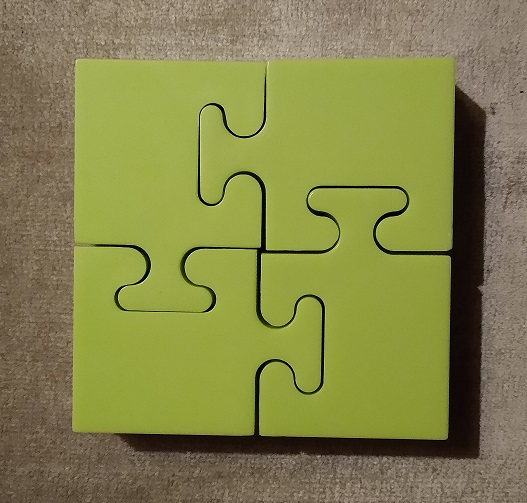
4-Piece Jigsaw

It sounds simple, doesn’t it? A four-piece jigsaw puzzle. Better yet, it’s already assembled for you! All you have to do is take it apart.

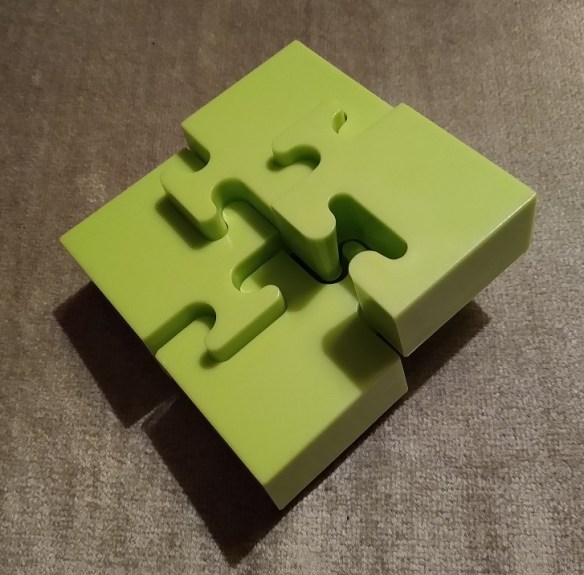
This level 1 brainteaser is obviously more than meets the eye, as the puzzle pieces shift back and forth but never quite seem to separate the way you’d expect.

4j2

The large plastic pieces are perfect for younger solvers to play around with, solid and resistant to the sometimes harsh manipulations of younger hands.

It’s not much of a challenge for an experienced solver, but it was genuine fun to suss out how the pieces worked together and how to finally separate them.

4j3

4-T Puzzle

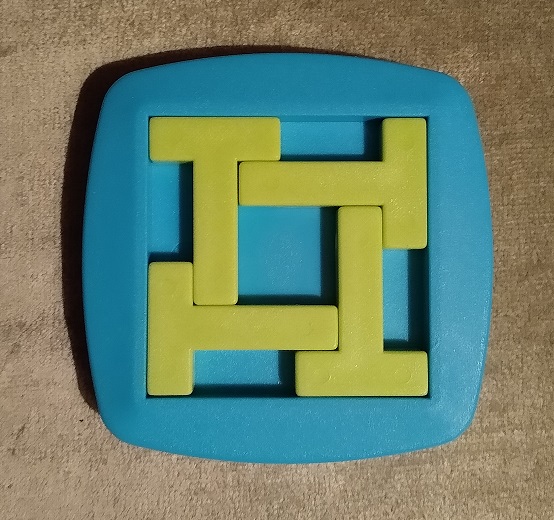
This level 2 brainteaser followed the same basic formula as 4-Piece Jigsaw — four pieces to assemble — but in this case, their interactions were constrained by the small tray included with the puzzle.

4j4

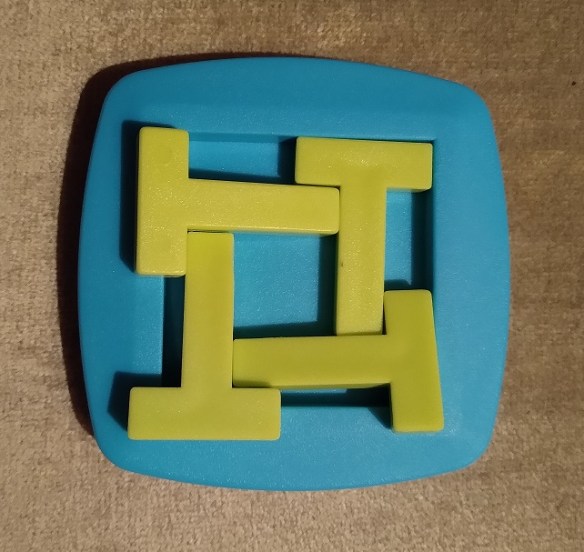
As you can see, the solution offered on one side simply won’t work on the other because the tray is smaller, so solvers will have to be extra crafty to place all four T-blocks into the available space.

The T-shaped pieces made for curious solving — since they don’t fit flush with the corners the way traditional tangrams or Tetrominoes would — but patience and cleverness will be rewarded. It’s amazing how a relatively simple set-up — shapes and a tray — can result in a satisfying puzzly experience.

4j5

The Fifth Chair

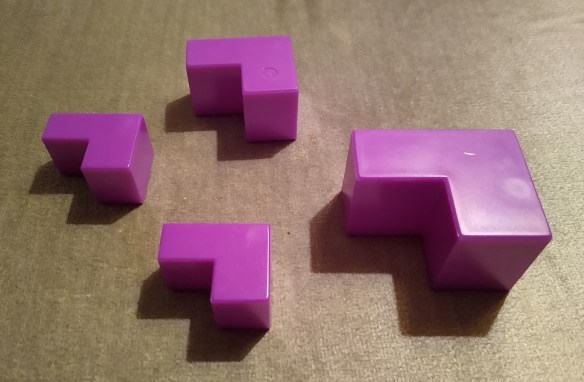
This time around, there’s no tray or framework to negotiate. Instead, you’ve got four L-pieces (or “chairs”) and your goal is to make a larger L-shaped chair by combining the four you already have.

Like a three-dimensional version of tangrams, The Fifth Chair is an enjoyable solve, requiring you to maneuver the chairs in all sorts of combinations, seeing different relationships between them all as you try to figure out how to bring the fifth chair to life.

Despite being the level 3 puzzle in the set, I actually found this to be the most challenging of the quartet, as I was briefly overwhelmed by the sheer number of options available to me.

Of course, as soon as I figured out the solution, it felt obvious, and I breathed a sigh of puzzly relief as I conquered the third of four brainteasers for the evening.

4j6

Rec-Tangle

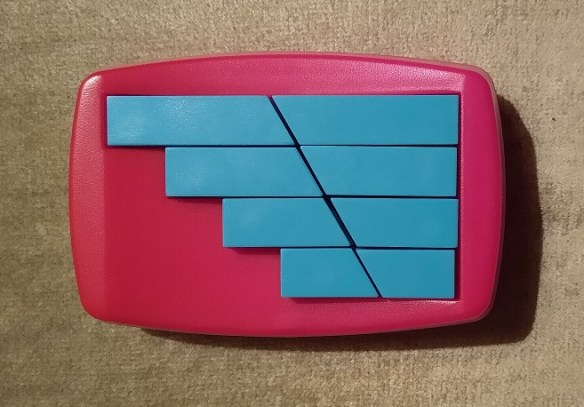
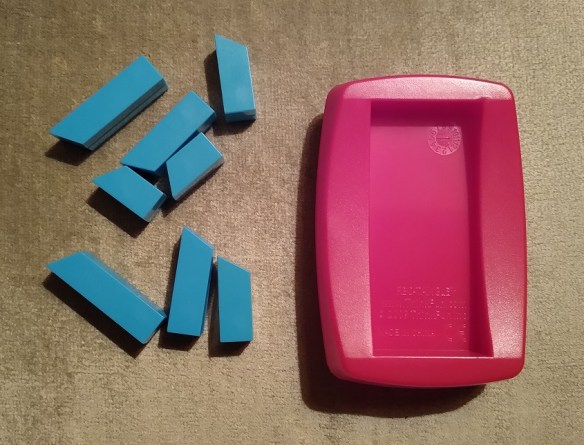
Designed to resemble the service bars of a cellphone or an internet connection, the “bars” are cut diagonally into halves, leaving the solver with 8 pieces to arrange.

This level 4 puzzle solves quite similarly to 4-T Puzzle. You have an array of pieces to place into a smaller space on the backside of the puzzle tray.

4j7

The unusual pieces — long and thin, with an angled edge on one side and a flat end on the other — offered all sorts of possibilities when it comes to placement in the tray, so I found myself discarding quite a few theories and ideas before alighting on the correct solution.

Nonetheless, I would still consider this puzzle easier than The Fifth Chair, though still harder than 4-T Puzzle or 4-Piece Jigsaw.


Tackling this tetrad of brainteasers was a treat, especially as it felt like I was exercising plenty of puzzly skills that aren’t used nearly as often as pen-and-paper puzzles usually demand.

The combination of spacial awareness, physical manipulation of puzzle pieces, and the strategy involved in cracking each made for a feast of puzzly experiences. Any one of the four would be fun, so getting to try all four was a delight.

Whether intended as stocking stuffers or affordable little puzzly surprises for the solver in your life, I suspect these pocket-sized puzzles will have the younger solvers you know puzzling away for a while to come.

Pocket Brainteasers are available from ThinkFun and select online retailers, only $6.99 each for 4-Piece Jigsaw, 4-T Puzzle, The Fifth Chair, and Rec-Tangle!


Thanks for visiting PuzzleNation Blog today! Be sure to sign up for our newsletter to stay up-to-date on everything PuzzleNation!

You can also share your pictures with us on Instagram, friend us on Facebook, check us out on TwitterPinterest, and Tumblr, and explore the always-expanding library of PuzzleNation apps and games on our website!

Intuitive vs. Non-Intuitive Puzzles

littlegirlatgrandmas

[Image courtesy of The Spruce Crafts.]

Sometimes, when you look at a puzzle, you know immediately what to do and how to solve. In my opinion, a great deal of Sudoku’s success is due to its intuitive nature. You see the grid, the numbers, and you know how to proceed.

Crosswords are similarly straightforward, with numbered clues and grid squares to guide new solvers. (The “across” and “down” directions also help immensely.)

That’s not to say that these puzzles can’t be off-putting to new solvers, despite their intuitive nature. I know plenty of people who are put off by crosswords simply by reputation, while others avoid Sudoku because they’re accustomed to avoiding ANY puzzle that involves numbers, assuming that some math is involved. (I suspect that KenKen, despite its successes, failed to replicate the wild popularity of Sudoku for similar reasons.)

But plenty of other puzzles require some explanation before you can dive in. A Marching Bands or Rows Garden puzzle, for instance, isn’t immediately obvious, even if the puzzle makes plenty of sense once you’ve read the instructions or solved one yourself.

The lion’s share of pen-and-paper puzzles fall into this category. No matter how eye-catching the grid or familiar the solving style, a solver can’t simply leap right into solving.

Thankfully, this won’t deter most solvers, who gleefully accept new challenges as they come, so long as they are fair and make sense after a minute or so of thought. Cryptic crossword-style cluing is a terrific example of this. At first glance, the clues might appear to be gibberish. But within each clue lurks the necessary tools to unlock it and find the answer word.

Brain teasers often function the same way. You’re presented with a problem — a light bulb you can’t see and three possible switches for it, for instance — and you need to figure out a way to solve it. It might involve deduction, wordplay, or some clever outside-the-box thinking, but once you find the answer, it rarely feels unfair or unreasonable.

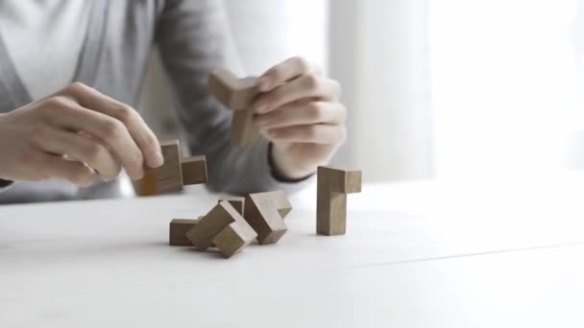
solvingwoodenbrainteaser

[Image courtesy of Deposit Photos.]

But, then again, there are also puzzles that can baffle you even once you’ve read the instructions and stared at the layout for a few minutes. Either the rules are complex or the solving style so unfamiliar or alien that the solver simply can’t find a way in.

In short, puzzles as a whole operate on a spectrum that spans from intuitive to non-intuitive.

Want an example of baffling or non-intuitive? You got it.

GAMES Magazine once ran a puzzle entitled “Escape from the Dungeon,” where the solver had to locate a weapon in a D&D-style dungeon. A very small crossword puzzle was found in one room on a paper scroll.

But the solution had nothing to do with solving the crossword.

The actual solution was to take the crossword to a magician who removed letters from the fronts of words. Removing the C-R-O-S left you with a sword, completing the overall puzzle.

That sort of thinking is so outside the box that it might as well be in a different store entirely. Video games, particularly ones from the point-and-click era, have more than their fair share of non-intuitive puzzles like this. You can check out these lists for numerous examples.

3122

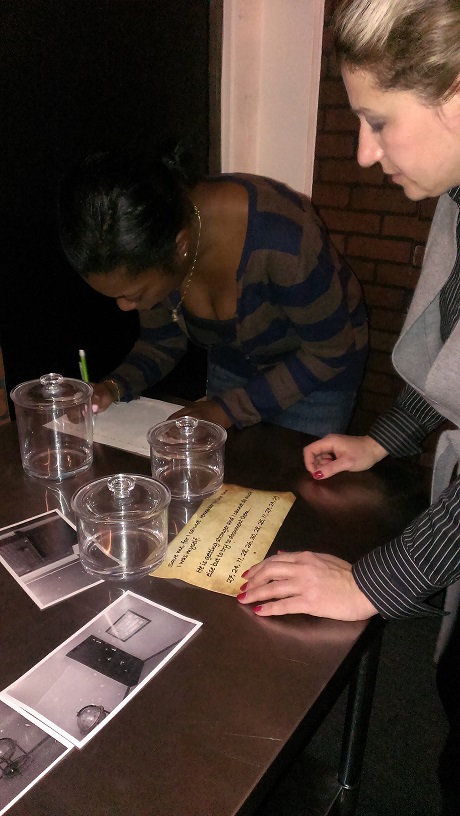
And as escape rooms grow in popularity, more of them seem to be succumbing to less intuitive puzzling as a result of trying to challenge solvers.

For example, in one escape room I tried, various fellow participants uncovered two stars, a picture of the three blind mice, and four different items that represented the seasons. Amidst all the locks to open, puzzles to unravel, and secrets to find, it never occurred to any of us that these three unconnected numbers would have to be assembled as a combination to a lock. By asking for a hint, we were able to figure out to put them together and open the lock, but it’s not a terribly intuitive puzzle.

Perhaps the greatest challenge for a puzzle constructor — be it a pen-and-paper puzzle, an escape room scenario, or a puzzle hunt dilemma — is not creating a dynamite, unique puzzle, but ensuring that finding the solution is fair, even if it’s difficult or mind-boggling.

This sort of thinking informs not only my work as a puzzlesmith, but the designs for my roleplaying games as well. If my players encounter a gap, there’s some way across. If there’s a locked door, there’s a way through it. Oftentimes, there’s more than one, because my players frequently come up with a solution that eluded me.

In the end, that’s the point. All puzzles, no matter how difficult, exist for one reason: to be solved. To provide that rush, that a-ha moment, that satisfaction that comes with overcoming the clever, devious creation of another sharp mind.

And non-intuitive puzzles are tantamount to rigging the game.


Thanks for visiting PuzzleNation Blog today! Be sure to sign up for our newsletter to stay up-to-date on everything PuzzleNation!

You can also share your pictures with us on Instagram, friend us on Facebook, check us out on TwitterPinterest, and Tumblr, and explore the always-expanding library of PuzzleNation apps and games on our website!

The Tap Code (and a Puzzly Love Story)

puzzlelove

Instead of offering a puzzle for Valentine’s Day, this year I thought I’d do something different and share a story, a wartime puzzly love story for the ages.


Our tale begins in Vietnam on April 4, 1965, when Air Force pilot Carlyle Harris is shot down during a failed bombing run. Over the next eight years, Captain Harris — Smitty to his friends — was a POW in Vietnamese hands.

He would be imprisoned in numerous camps over the years — Briarpatch, “the Zoo,” Son Tay, Dogpatch, and even the infamous Hanoi Hilton — enduring illness, mistreatment, psychological and physical torture, and whatever other horrors his captors could conjure up.

But nothing was more taxing than being separated from his beloved wife Louise. With two daughters to raise, a son on the way, and a husband trapped on the other side of the world, Louise became one of the first POW wives. (Smitty was only the sixth American POW captured by the Vietnamese at that time.)

Louise worked hard not only to care for her family, but to try to contact Smitty and keep his spirits up. She also fought for personal rights, including access to her husband’s pay during his imprisonment, becoming a role model for other POW wives to come.

But what, you might be wondering, makes this a puzzly tale?

The Tap Code.

tapcode4

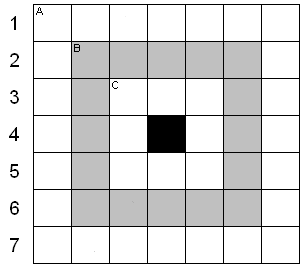
A World War II-era form of communication developed by a POW in Germany, the Tap Code was devised to allow communication when verbal commands wouldn’t do. The simple five-by-five matrix allows each letter to be identified by two simple sets of taps. (The lack of a need for dashes made the Tap Code superior to Morse Code for their efforts.)

Smitty taught it to fellow POWs when given the opportunity, and they taught it to others, and soon, the prisoners could communicate by tapping on walls and water pipes, knocking on buckets, or even through the movements of a broom while sweeping. (Naturally, everyone using the Tap Code did so lightly, so as not to alert the guards to their efforts at clandestine communication.)

This wasn’t the only method of communication employed by the POWs. A one-handed code system similar to American Sign Language was also developed. Some used coughing as a signal that they were being moved, while others managed to pass notes, eventually assembling mental lists of all of the POWs in a given camp.

Of course, Morse Code also proved useful. When one POW was placed on television as a Vietnamese propaganda effort, Jeremiah Denton blinked a message in Morse Code for the world to see. His message? T-O-R-T-U-R-E.

These methods, along with the Tap Code, not only kept morale up, but allowed the POWs to keep track of their ranks even when moved between camps/prisons.

tapcode2

[Image courtesy of PBS.]

It also allowed for covert operations within the camps. An SRO (senior ranking officer) would be chosen for the group, and he could assign tasks to fellow POWs as well as establish rules for newcomers to help them survive the experience.

Key Tap Code abbreviations also emerged:

  • GNST: Good Night, Sleep Tight
  • DLTBBB: Don’t let the bed bugs bite. (A sadly literal wish for the POWs.)
  • GBU: God Bless You.

GBU became shorthand for “you are not alone,” a reassurance that both God and fellow POWs were on your side, watching over you.

But Smitty and his fellow POWs weren’t the only ones using coded messages. Louise was also learning codes in order to both support the war effort and communicate with her husband. She and other POW wives would participate by using the Letter Code:

The long process began when Louise would write a short letter in longhand and send it to the Pentagon. They would rewrite it in code, while at the same time keeping the spirit of what she had written. They would then send the letter back to Louise, and she would rewrite it in longhand on the prescribed form. These then would be mailed to North Vietnam, which didn’t know about the secret strategy. It was a complicated code, and only a select few had been taught how to do it in survival training.

Smitty taught a select few the Letter Code for their own coded messages to send home, but it was hard to tell how many made it out of the camps.

tapcode3

[Image courtesy of The Daily Journal.]

All through that time, Louise was constantly writing letters, sending packages, and making entreaties on behalf of her husband, reaching out to him in any way possible. Although the Vietnamese combed through every package and seized much of the contents for themselves, some items still slipped through, becoming treasures for Smitty to hold onto. (And yes, the US government managed to slip some info and supplies to the POWs spy-style through these packages, including microfilm, maps, and more.)

Louise’s unflagging efforts and Smitty’s determination were finally rewarded when negotiations between the US and Vietnam bore fruit. Before returning to the United States, Smitty was allowed to speak to Louise on the phone. It had been 2,871 days since his capture.

But that wasn’t the end for the Tap Code — later referred to as the Smitty Harris Tap Code after the successes with it during Vietnam. Even when the POWs were finally returned home, staying in a hotel before going their separate ways, they used the Tap Code all night to communicate with each other. Old habits are hard to break.


Not only is this a story of puzzly innovation and determination, but it’s also an inspiring tale of two people in love who never gave up on seeing each other again.

You can read the full story of Smitty and Louise’s trials and tribulations in Tap Code: The Epic Survival Tale of a Vietnam POW and the Secret Code That Changed Everything.

tapcode1

[Image courtesy of Amazon.]


Thanks for visiting PuzzleNation Blog today! Be sure to sign up for our newsletter to stay up-to-date on everything PuzzleNation!

You can also share your pictures with us on Instagram, friend us on Facebook, check us out on TwitterPinterest, and Tumblr, and explore the always-expanding library of PuzzleNation apps and games on our website!

Requiem for a Game Shop

A friendly local game shop (FLGS) can fill a lot of roles. A laboratory to try out unfamiliar games. A sample size to poll potential customers and test new products. A gathering place to share puzzly experiences. A social center to make new friends.

Sadly, there’s one fewer place to enjoy those simple pleasures now, as my friendly local game shop is closing this month.

I don’t know why, precisely. Maybe the 2019 financials weren’t as rosy as they’d hoped. Maybe the landlord raised the rent to unreasonable levels. Maybe the omnipresent threat of cheaper online purchases won out. (I certainly didn’t mind paying a little more for a game there, because I knew who the money was going to. But not everyone feels that way.)

I’m not entirely surprised. Last year, they cleaned out their comics section to focus more directly on games, RPGs, and miniatures. It opened up some space in the store and generally made for a cleaner, more accessible floorplan, which was a plus. But I guess it wasn’t enough.

It’s a bummer.

Sure, there are decent game selections at stores like Target and Barnes & Noble, but nothing as varied or extensive as the spread at the FLGS. I can’t tell you how many games I stumbled across there that I’d never even heard of, whether by wandering the stacks or seeing a play-through of a new acquisition demonstrated by the staff.

It was the perfect place to discover games, often serving to inspire gift ideas for friends. (Similarly, I miss Toys R Us, as simply browsing the selection there led to plenty of spot-on purchases for nieces and nephews.)

I usually stopped in a few times a month. I didn’t always buy something — my game library is pretty beefy already — but I liked to see what was new, what was moving a lot of copies, and what the locals were playing. I even got to meet local designers who were showing off their wares, which was always a treat.

I’ve been back twice since the announcement, and it’s nice to see how loved the place was, even if that couldn’t ensure its long-term success. Regulars have already snapped up tablecloths and other materials with the shop’s logo, and I know at least one person offered to buy the sign outside. I’ve heard several customers lament that they didn’t know where they’d go now for game tournaments, RPG events, and other game-centric fun.

57473-coop3

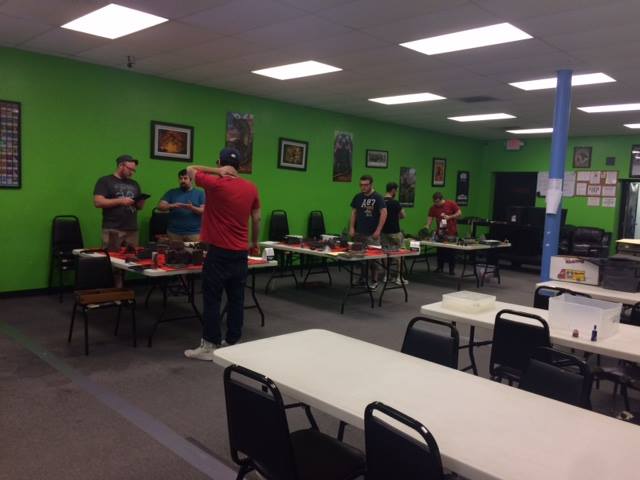
The back tables — usually reserved for trying out new games, hosting tournaments and launch events, or serving as gathering places (charged by the hour) for roleplaying groups to indulge in some social storytelling — are instead full of games, equipment, snacks, promotional materials, and everything else they can slap a tag on and price to move as they liquidate their stock.

But, for the most part, the energy there is good. Games are vanishing from stacks of in-store inventory, as are displays, signs, neon lights, and other trappings of the store. The staff is in decent spirits.

I’m not sure if I’ll go back again before it’s all said and done. But it was nice while it lasted.


Thanks for visiting PuzzleNation Blog today! Be sure to sign up for our newsletter to stay up-to-date on everything PuzzleNation!

You can also share your pictures with us on Instagram, friend us on Facebook, check us out on TwitterPinterest, and Tumblr, and explore the always-expanding library of PuzzleNation apps and games on our website!