The more you look, the more you can find puzzles in all sorts of interesting places. We find them in literature, in historical documents, and in popular culture.
So it should come as no surprise that puzzles can be found in the world of poetry as well.
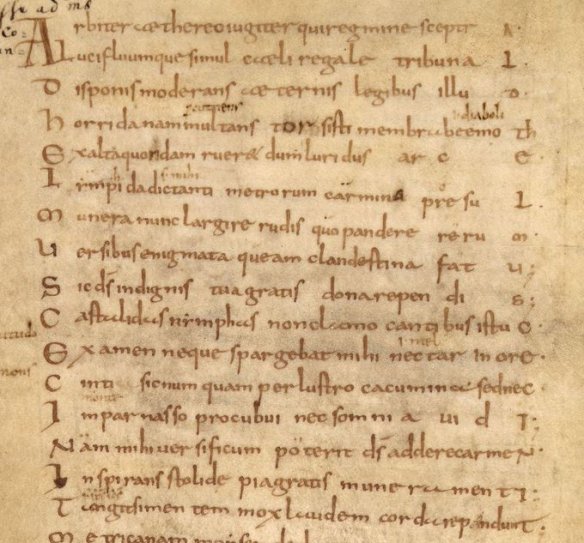
One of the most common ways that puzzly techniques find their way into poetry is through acrostics. Acrostics spell out messages with the first letter of each line or verse.
One of the most famous is a poem by Lewis Carroll at the end of Through the Looking-Glass where he reveals the identity of the girl who inspired his famous stories:
A boat beneath a sunny sky, Lingering onward dreamily In an evening of July—
Children three that nestle near, Eager eye and willing ear, Pleased a simple tale to hear—
Long has paled that sunny sky: Echoes fade and memories die. Autumn frosts have slain July.
Still she haunts me, phantomwise, Alice moving under skies Never seen by waking eyes.
Children yet, the tale to hear, Eager eye and willing ear, Lovingly shall nestle near.
In a Wonderland they lie, Dreaming as the days go by, Dreaming as the summers die:
Ever drifting down the stream— Lingering in the golden gleam— Life, what is it but a dream?
Carroll certainly offers the most famous example, but I must confess that my favorite example comes from a story on Wikipedia. Poet Rolfe Humphries was banned from Poetry Magazine for life for an acrostic aimed at a diplomat and former president of Columbia University. The acrostic quite bluntly read “Nicholas Murray Butler is a horse’s ass.”
Of course, the message reading down — also known as an acrostich — isn’t the only way these messages can be hidden.
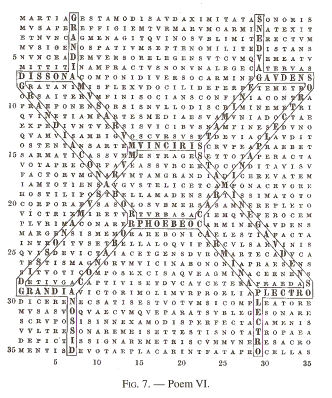
There are also examples of mesostich — where the word or message is spelled with letters in the middle of the verse — and telestich, where the last letters of each line spell a name or message.
These techniques were also used in ancient Greek inscriptions, where one particular example, AL205, featured acrostich, mesostich, and telestich messages at the same time.
Other puzzly stylings have also allowed poets to flex their wordplay muscles.
For instance, David Shulman wrote a 14-line sonnet about George Washington’s famous river crossing where every line is an anagram of “Washington crossing the Delaware”:
A hard, howling, tossing water scene. Strong tide was washing hero clean. “How cold!” Weather stings as in anger. O Silent night shows war ace danger!
The cold waters swashing on in rage. Redcoats warn slow his hint engage. When star general’s action wish’d “Go!” He saw his ragged continentals row.
Ah, he stands – sailor crew went going. And so this general watches rowing. He hastens – winter again grows cold. A wet crew gain Hessian stronghold.
George can’t lose war with’s hands in; He’s astern – so go alight, crew, and win!
There are also ABC poems, a form where the goal of each poem is to use words starting with each letter of the alphabet in order. You can find some entertaining and impressive examples here.
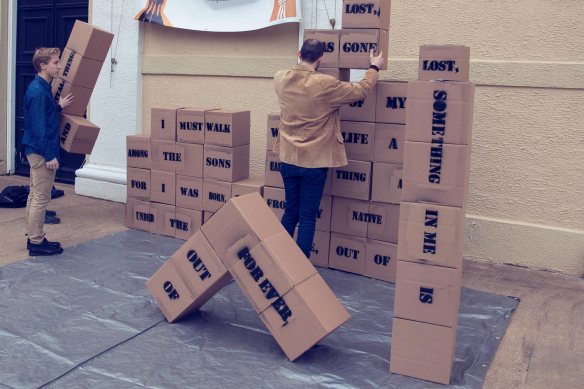
Some poets, however, have flipped the puzzle poem on its head by treating the poems like puzzles. The folks at UVA’s Puzzle Poetry group utilize Tetris-like puzzle pieces with words on them to assemble poems.
The concept dates back to 2017, a creation of Neal Curtis and Brad Pasanek, serving as a way to both explore and deconstruct the art of poetry itself by making a puzzle out of it.
It’s a very cool idea, reminiscent of how magnetic poetry sets allow you to turn your fridge into a canvas by assembling and reworking the order of the various available words.
Puzzles by their very nature are about finding a solution, bringing order out of chaos, whether it’s assembling puzzle pieces, answering devious crossword clues to fill a grid, or unraveling a tricky brain teaser that pushes you to think in a different way.
And since poetry is all about expressing truths in a personal way, it makes a lovely sort of sense that puzzly techniques would intertwine with this thoughtful, elusive form of art.
Thanks for visiting PuzzleNation Blog today! Be sure to sign up for our newsletter to stay up-to-date on everything PuzzleNation!
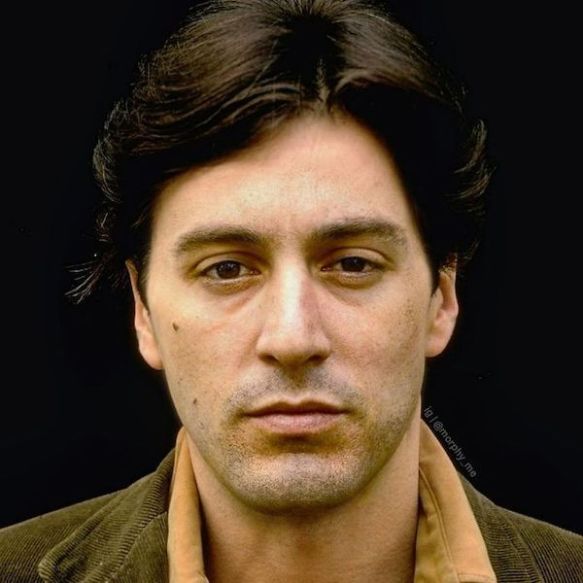
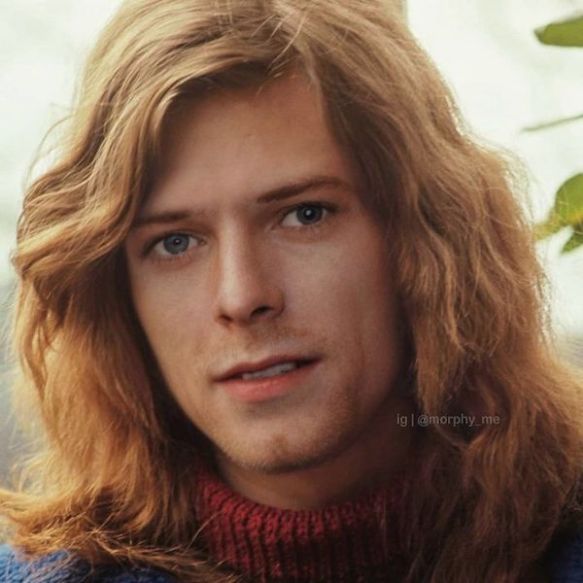
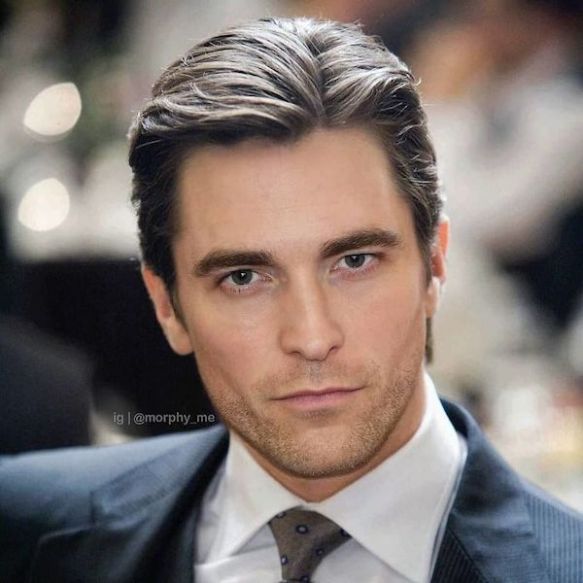
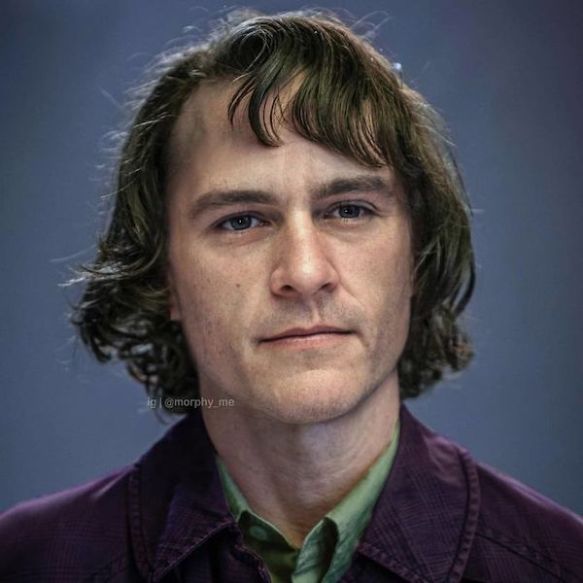
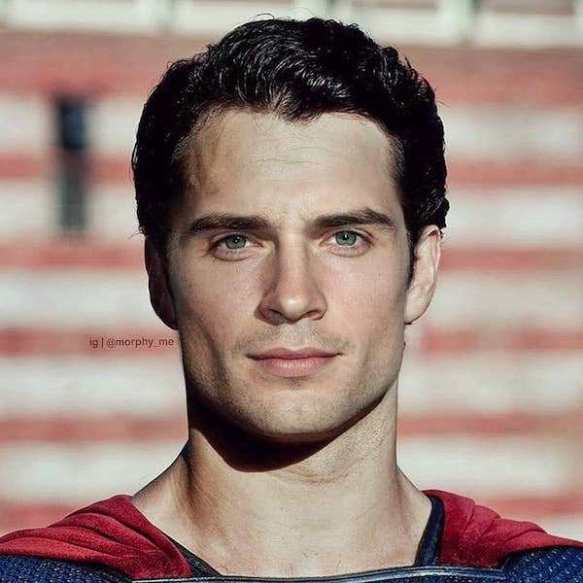
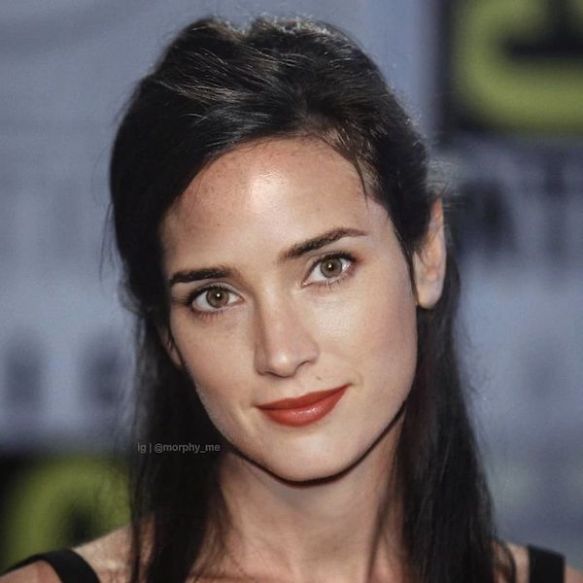
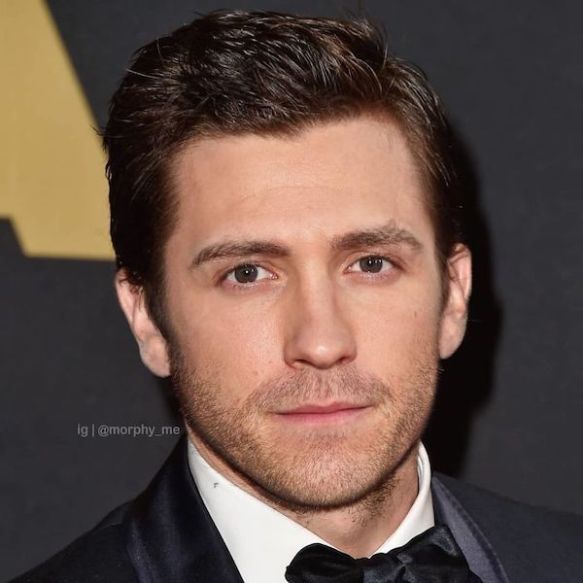
A few weeks ago, we challenged our fellow puzzlers and PuzzleNationers to puzzle out an artistic challenge created by an Instagram account called morphy_me.
The account, credited only as Benji, features images that merge elements of both celebrities, somehow creating an image that is reminiscent of both, and yet feels strangely new.
Did you puzzle out which pairs of celebrities formed these images? Let’s find out!
#1
Answer: Emily Blunt and Katy Perry
#2
Answer: Al Pacino and Robert DeNiro
#3
Answer: Jessica Alba and Ariana Grande
#4
Answer: David Bowie and Kurt Cobain
#5
Answer: Kim Kardashian and Taylor Swift
#6
Answer: Robert Pattinson and Christian Bale
(a future and former Batman)
#7
Answer: Margot Robbie and Sharon Tate
#8
Answer: Heath Ledger and Joaquin Phoenix
(an all-Joker edition)
#9
Answer: Tom Welling and Henry Cavill
(an all-Superman edition)
#10
Answer: Winona Ryder and Jennifer Connelly
#11
Answer: Billie Eilish and Scarlett Johansson
#12
Answer: Rihanna and Cara Delevingne
#13
Answer: Bill Nye and Bill Nighy
(that’s just delightful wordplay)
#14
Answer: Tom Holland and Jake Gyllenhaal
(hero AND villain from the latest Spider-Man film)
#15
Answer: Zendaya and Vanessa Hudgens
How many did you get? Let us know in the comments section below! We’d love to hear from you!
Thanks for visiting PuzzleNation Blog today! Be sure to sign up for our newsletter to stay up-to-date on everything PuzzleNation!
But it’s true. There are numerous ways people can transgress against the noble crossword, harming both the body and the spirit of the crossword itself.
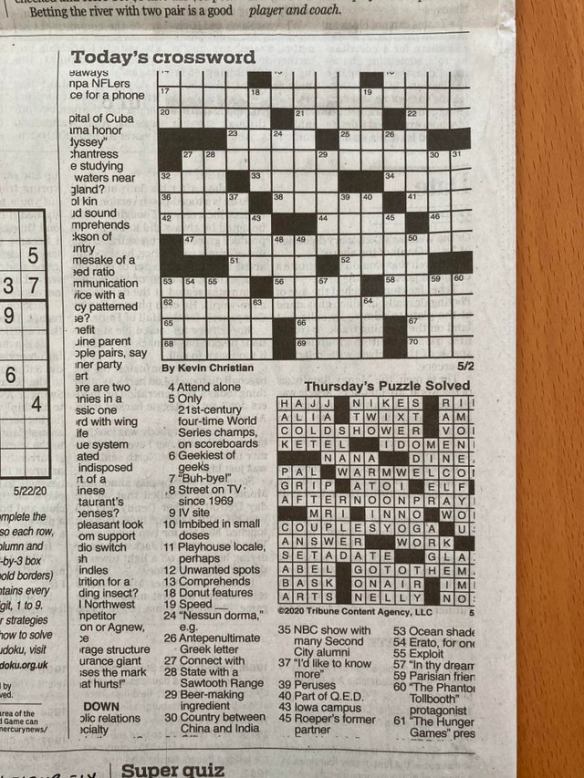
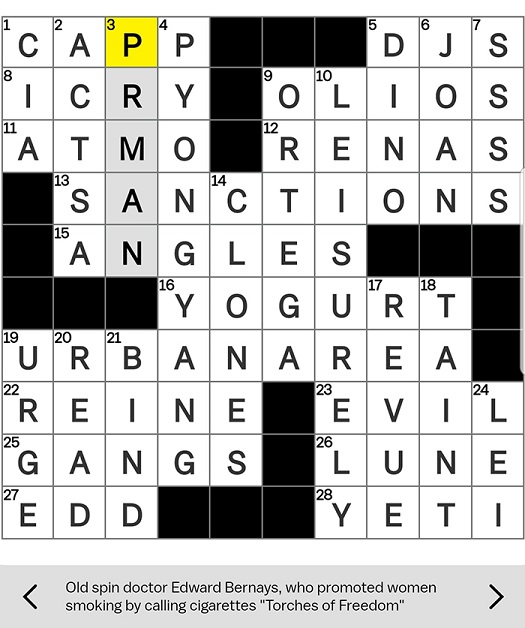
For instance, check out this picture of a crossword from The Los Angeles Times, republished in a local newspaper, which was shared on reddit:
Look at it! They cropped all four sides of the puzzle in order to fit the available space. Good luck figuring out which across word is clued by “mesake of a ed ratio” or one of the many other mangled clues along the left-hand side of the puzzle.
That is a crime against crosswords.
They’re not always so obvious and clumsy, though.
No, sometimes, a crossword is harmed by crummy fill or an abundance of nonsense abbreviations or numerous Naticks formed by crossing obscure words with other obscure words.
Granted, these are far rarer in the major outlets. (Unless you’re checking out r/crossword or reading Rex Parker’s blog, where they find so-called crossword indignities by the dozens. Good lord.)
But in reality, the vast majority of crossword venues won’t publish puzzles so undermined by careless choices.
Yeah, you noticed I didn’t say “all crossword venues.”
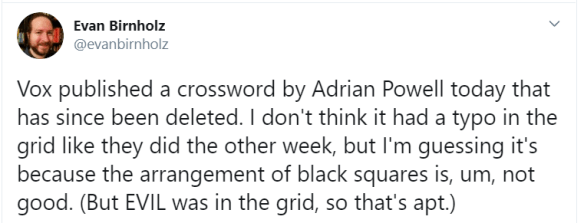
This unfortunate grid was published by Vox, but it was later deleted, as reported on Twitter by constructor Evan Birnholz:
Evan is an avid follower of the Vox crossword, but not because he’s a fan. No, Evan has been dunking on the Vox crossword for what feels like forever. He’s not doing it to make his own puzzles look better by comparison; as a top-flight constructor, he doesn’t need to.
His criticisms are never unfair or mean-spirited; on the contrary, they’re founded in trying to make the puzzle better by pointing out poor choices.
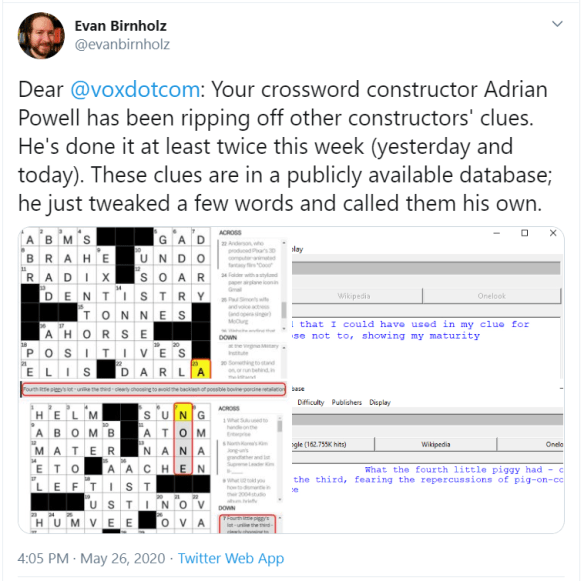
They’re also founded in defending the work of fellow constructors. Evan’s keen eye has caught more than a few questionable examples of clues that seem to have been pilfered wholesale or altered slightly by Vox constructors.
Now, the first puzzle I posted was silly. Sure, it made the crossword nigh-unsolvable, but there’s no malice there. The second puzzle, the one with the unpleasant pattern, doesn’t deserve the same benefit of the doubt. It was a poor choice, and a puzzle that never should have made it to solvers.
But as for stolen clues, that’s something else entirely. If that’s what is happening here — and Evan makes a fairly compelling case — that’s not just a crime against crosswords, it’s a crime against fellow constructors. It’s a sign of disrespect.
I love shouting out smart clues by constructors, not only so other people can enjoy the wit and wordplay, but so that the right person gets the proper credit. The crossword community is a brilliant group of people; they’re clever and hardworking and constantly innovating.
And it sucks to see some members of the community take advantage of others. It hurts the community as a whole, far more than any bad cropping of a puzzle ever could.
Thanks for visiting PuzzleNation Blog today! Be sure to sign up for our newsletter to stay up-to-date on everything PuzzleNation!
I know the last few months have been hard for a lot of people. But it’s also been inspiring to see communities rally and work together, even while social distancing, to take care of each other. And loads of creative folks out there have been raising money for charity in clever and entertaining ways.
One of the biggest annual fundraisers is Red Nose Day, a yearly international event dedicated to eradicating child poverty. There are often special TV events tied into the Red Nose Day, and this year was no exception.
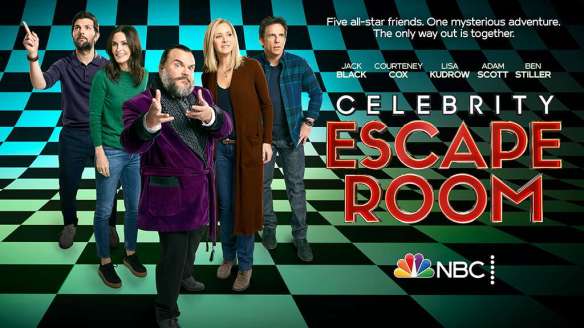
NBC employed a more puzzly route than most participating networks, as they presented an hour-long show dedicated to a celebrity-filled escape room.
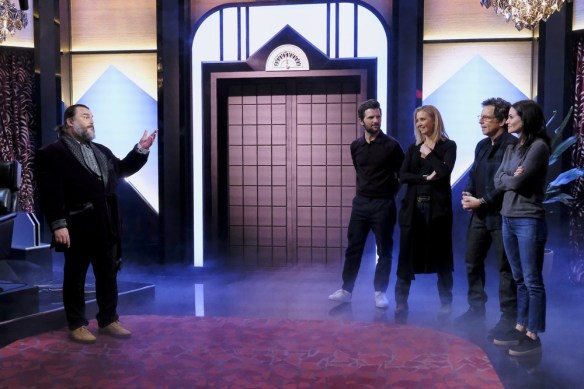
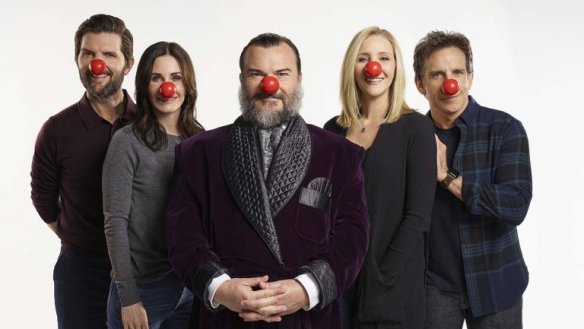
Musician and actor Jack Black hosted, serving as the exuberant and maniacal gamemaster for the event. Ben Stiller, Adam Scott, Courteney Cox, and Lisa Kudrow were the celebrity players, and they had one hour to escape Jack’s series of rooms. For each puzzle they successfully solved, they would earn $15,000 in charitable donations from the event’s sponsor, M&Ms.
Jack explained the rules, and then informed them that they were allowed three hints to help them solve the puzzles. Each hint was represented by a red clown nose, the official symbol of Red Nose Day.
You can watch the entire special video below, or continue reading for a recap of the show and a breakdown of each puzzle:
RECAP
The celebs were escorted into an elevator and sent on their way. The team immediately started trying to figure out how to escape.
But the elevator wasn’t a puzzle room. Jack was just messing with them, sending the elevator up and down before opening it.
The group’s first actual challenge was an 80’s themed room, which contained not only numerous references to the decade (posters, movies, decor, etc.), but references to each actor’s career to serve as a distraction. Jack Black informed the audience of two key locations to pay attention to — a photo wall and the table with pizza on it — but didn’t explain the actual puzzles.
Courteney Cox stumbled upon a clue — a recorded message from Jennifer Lopez — that sent the celebs to their yearbooks on one of the shelves. Inside, they each found a different variation of a picture of people sitting on a couch, each one with more people in it.
Ben Stiller not only realized that they needed to be placed somewhere in order, but spotted where to do so.
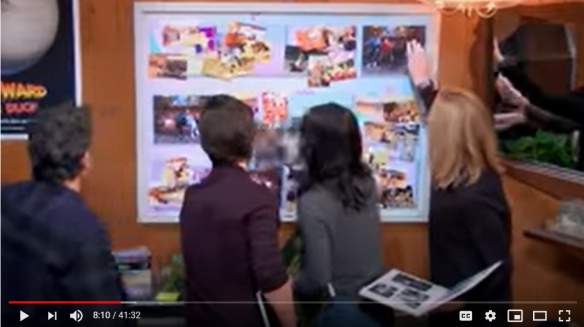
The photo wall was a 3×4 grid, with 8 photos already placed and 4 open spaces. My first instinct would have been to place the photos in order of the rows (as if reading the photos in storyboard order from left to right, row to row).
But the photos had to be placed in column order from left to right, ignoring the rows. Courteney figured this out, and a couch folded out from the wall. Having successfully completed a puzzle, $15,000 was added to the team’s charity total.
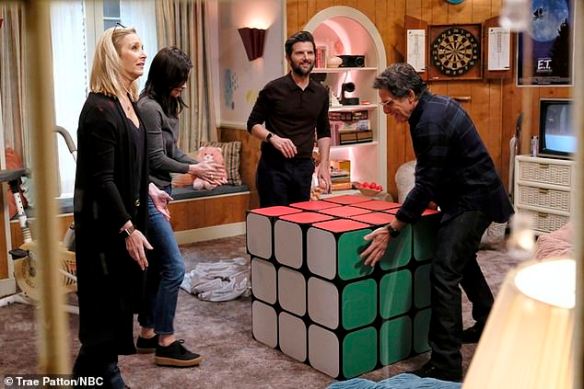
By all sitting on the couch, they activated the TV, which aired a commercial for Rubik’s Cubes. Ben realized the pizza and tablecloth in the center of the room were covering a giant Rubik’s Cube. (Instead of being rotated and twisted, this one had removable magnetic blocks, which made solving it easier.)
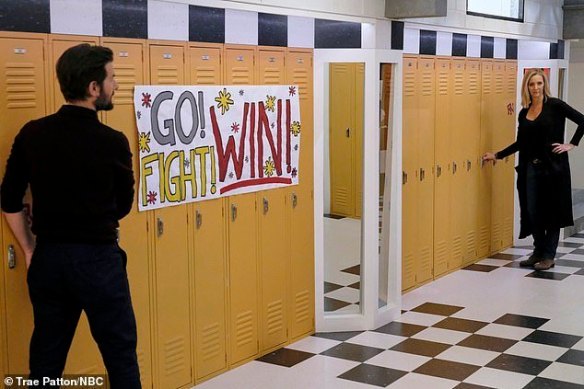
The celebs immediately started checking the lockers, but they were all locked. While searching for their next puzzle, the celebs misinterpreted a banner that said “Let’s get loud” and started screaming.
It’s silly, but hey, in an escape room, sometimes you’ll try anything.
Ben spotted the clue on the floor, and Courteney realized that some of the floor tiles could be pulled up, revealing a picture puzzle to be assembled. They solved the puzzle — a picture of Jack in a mascot costume — and it opened the trophy case. That made their charity total rise to $45,000.
When Adam put the mascot head on, the lights dimmed, and he began looking for the next clue. Three of the celebs tried the mascot head on, but they couldn’t find anything. So they used one of their red noses and asked for a hint.
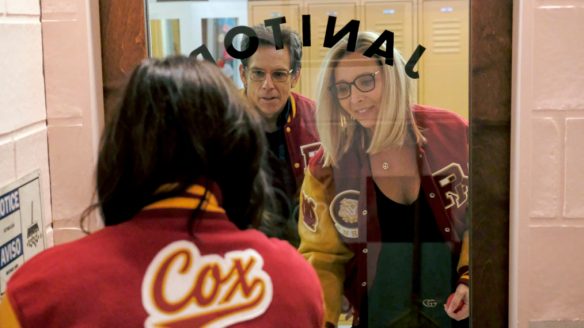
Jack intervened and told them to direct the mascot head’s vision toward the lockers. On certain lockers, the mascot’s head revealed in invisible ink the birthdays of the four players. After some difficulty, Adam realized they should open the lockers in birthday order, which caused all four to open. (Four puzzles completed, $60,000 earned.)
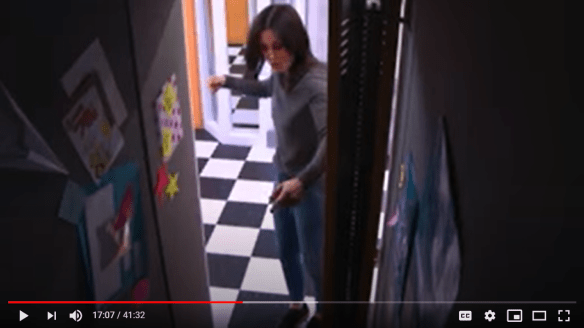
As the other players removed letterman jackets from the lockers, Courteney stepped into her locker (which was larger inside than the others) and Jack shut it behind her, seemingly locking her in. While trying to figure out how to free Courteney, they all decided to put their jackets on.
Jack directed the audience to pay attention to the janitor’s closet, the trophy case, and the cubby area for the next puzzle.
Courteney discovered her locker secretly led into the locked janitor’s closet. Meanwhile, the other players found prom tickets in their jackets.
Unable to free Courteney (the inside door handle came off in her hand), the celebs were flummoxed again, even trying to play rock-paper-scissors to open the door. (Bafflingly, Ben doesn’t know how to play.) They decided to ask for their second Red Nose hint. Jack pointed them toward the janitor’s to-do list, which has four tasks on it, three completed.
The unfinished task referenced the water fountain, and upon investigating it, Adam found the door handle for the janitor’s closet, freeing Courteney (and earning another $15,000).
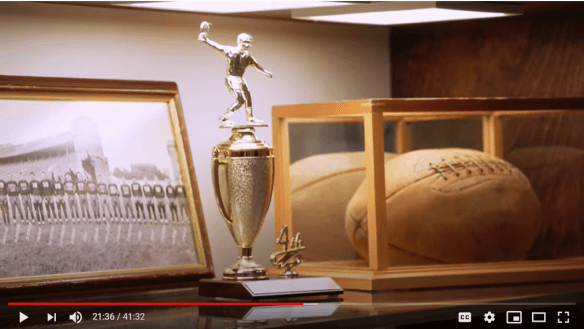
Doing so activated the TV in the trophy case, and special guest “Principal” Kelly Clarkson provided a year-in-review that recounted the trophy won by each celeb, and suggested they hang up their jackets on the Wall of Fame (the cubby area).
The celebs missed the trophy clue and just hung their jackets up (not realizing that the trophies — first place, second place, third place, and fourth place — indicated the order of the jackets).
They tried birthday order again, then headed back to the trophy case, realized their mistake, and put the jackets in the correct order, earning another $15,000 for charity.
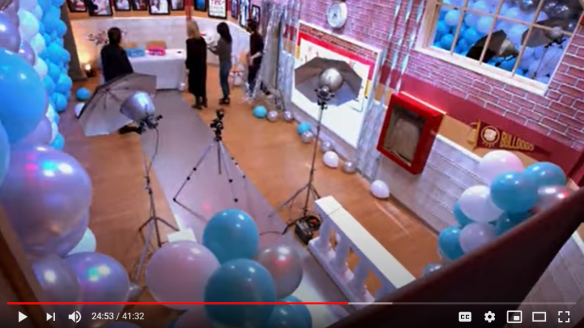
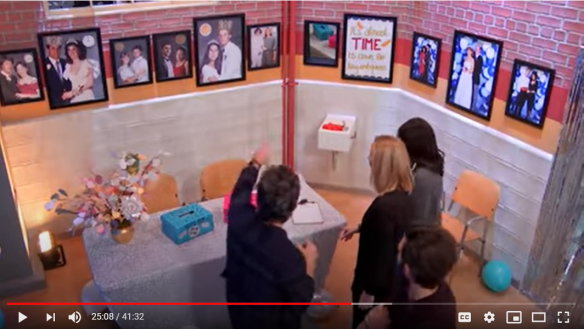
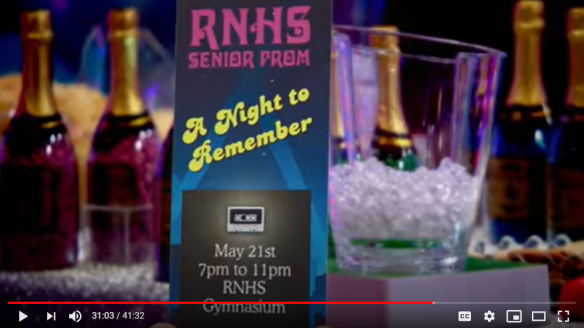
Part of the locker wall then opened up to reveal a room decorated for prom, complete with balloons and a space for couple/group photos. Jack directed viewers to pay attention to the clock on the wall, the photos of couples on the wall, and the photography setup.
Relying on the clue “it’s almost time for crown the king and queen,” they puzzled out that there are clocks on all of the photos, but it reads 9 PM for the crowned couple.
Courteney eventually realized there was a stepladder that would allow her to reach the clock, and rotated it until it read 9 PM. (Their charity total was now $105,000!)
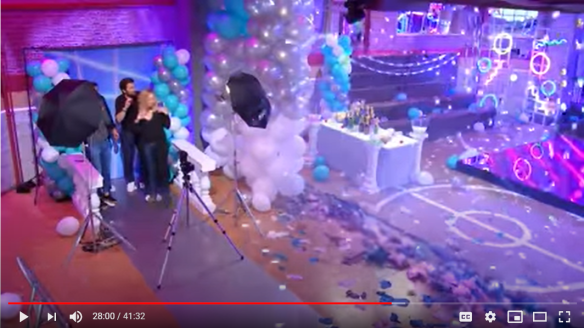
Completing the puzzle activated the lights in the photo area. They posed for their picture, and when they snapped it, the balloon wall burst, revealing a gym decorated for prom. (It also scared the daylights out of them, which made for a great prom photo.)
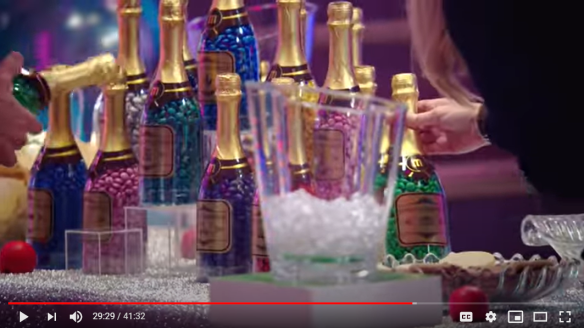
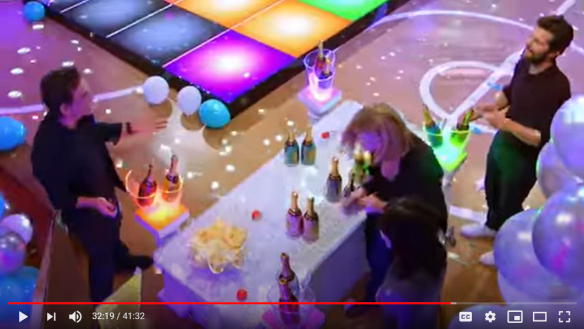
Jack then fully explained the next puzzle to the audience, as the celebs had to match the images on their prom tickets to certain champagne bottles (filled with M&Ms) on the refreshments table, which would then point them to particular light-up squares on the electronic dance floor.
The celebs immediately zeroed in on the symbols on the champagne bottles, but didn’t know what to do with them. Jack taunted them, hoping to goad them into using their third and final hint, until Courteney spotted the matching symbol on her prom ticket.
Now finally pairing up bottles of M&M champagne, Courteney again figured out that the colors of each pair of bottles should combine to match the color of the podium they’re placed on. It’s a pretty impressive bit of puzzling, I must admit.
Each time they placed a pair of bottles correctly, part of the dance floor lit up.
Unfortunately, they confused the colors required to make pink with the colors needed to make orange, which slowed them down. Fixing their mistake and completing the puzzle, they ran to the dance floor with another $15,000 for charity.
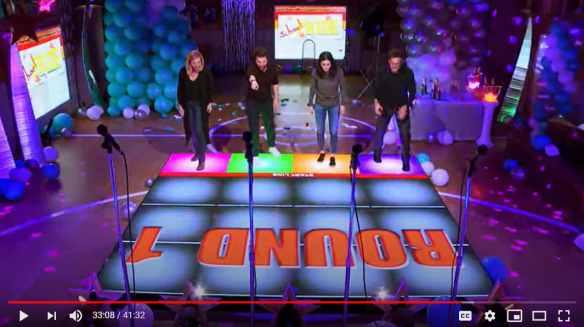
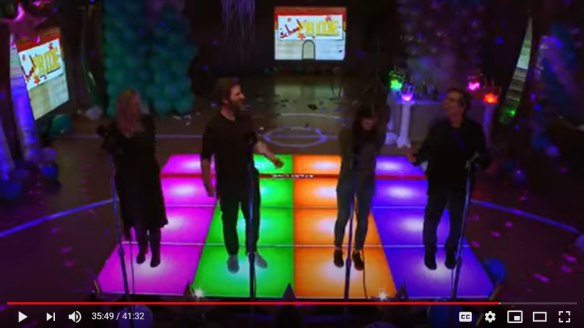
The dance floor was a 4×4 grid, with each player standing in a different colored square in the bottom row. As the dance floor lit up in a sequential pattern of lights, the team realized they were playing a Simon-style game where they had to step forward in a certain order to match the pattern of colored lights displayed on the floor.
There were three rounds of the game. The first (and simplest) required a single step each onto the second row. The second required two steps (meaning eight total moves in order), and third required three steps (meaning a more complicated twelve-step order).
Once they sorted out their timing issues in the first round, they flew through the second and third rounds, solving the puzzle and earning another $15,000.
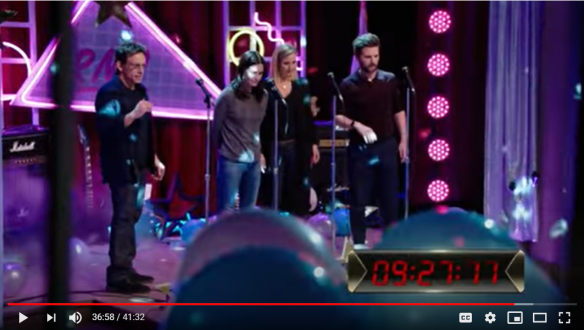
Jack then instructed the group to go onstage and sing their way out of the room as their final challenge. He noted they only had 9 and a half minutes left to escape.
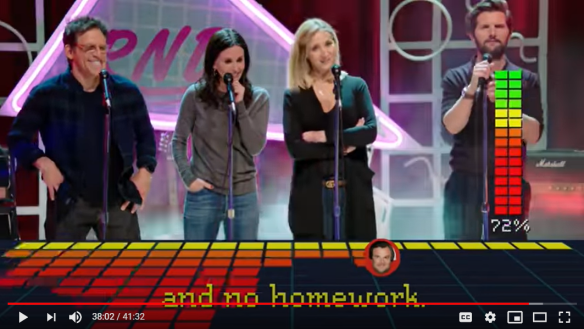
A video wall across the room activated, and Adam and Mike, the two remaining Beastie Boys, wished them luck. When Jack started playing guitar over the intercom, Ben recognized the song as “(You Gotta) Fight For Your Right (to Party),” which they’d have to sing karaoke-style to escape.
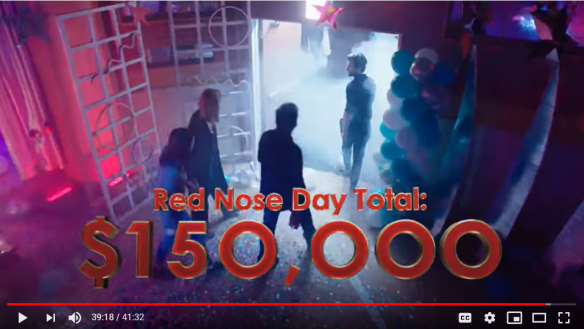
But Lisa didn’t know the song, and she consistently botched the rhythm on each of her turns. Thankfully, that didn’t hinder the group too much, and after being startled one last time (with victory confetti), they escaped the prom with a total $150,000 for charity, and a little over 6 minutes to spare.
Honestly, as a fan of escape rooms, I really enjoyed this. It’s a great — if highly budgeted — example of this puzzle genre, and a strong introduction for anyone who has never tried them.
The puzzles ranged from simple to moderately hard, but for the most part were fairly intuitive. Also, while it’s embarrassing in the moment to try silly things and draw dumb conclusions while trying to solve puzzles, it’s also very entertaining to watch someone else do the same.
All in all, it was a fun event hosted for a great cause, and the four celebrity players (plus gamemaster Jack) made an engaging cast of characters. The little interviews interspersed throughout also added a lot. (Plus, at the end, we found out Courteney loves escape rooms, which explains her mad puzzle skills.)
If you’d like to contribute to the fine charity work Red Nose Day represents, please click here for more details.
Thanks for visiting PuzzleNation Blog today! Be sure to sign up for our newsletter to stay up-to-date on everything PuzzleNation!
At the center of every great mystery, there is a puzzle. When people look at the pyramids of Egypt or the Moai statues of Easter Island, the puzzle at heart is obvious: how? How were these incredible objects created?
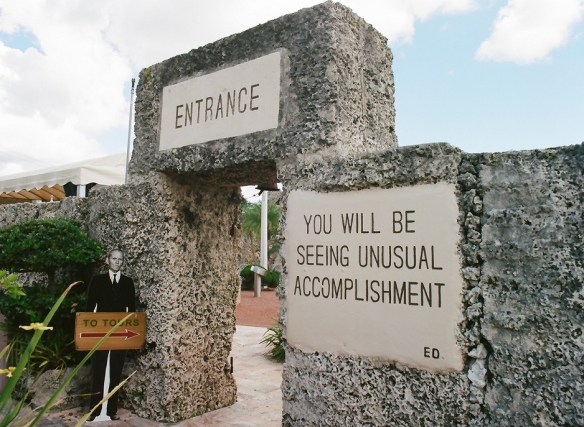
A similar, and no less puzzling mystery, can be found much closer to home for most Americans: the Coral Castle of Florida.
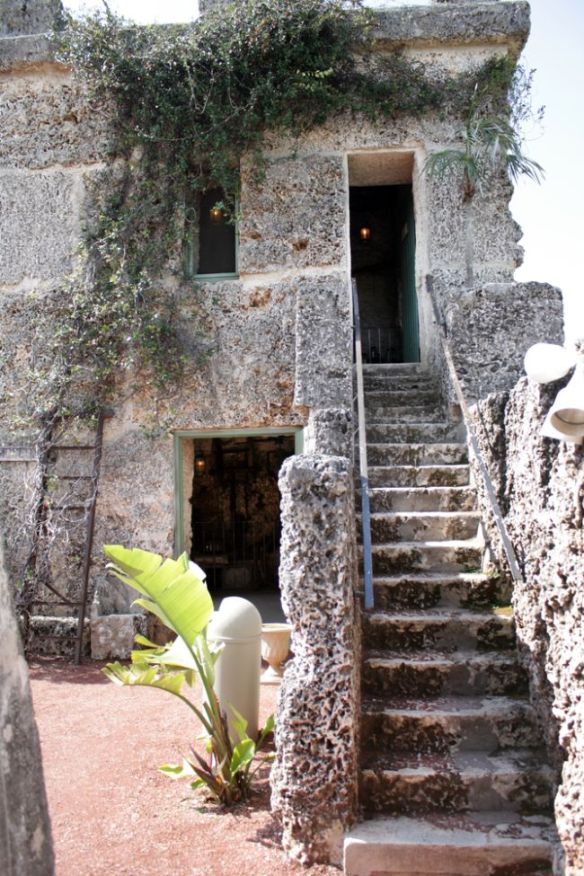
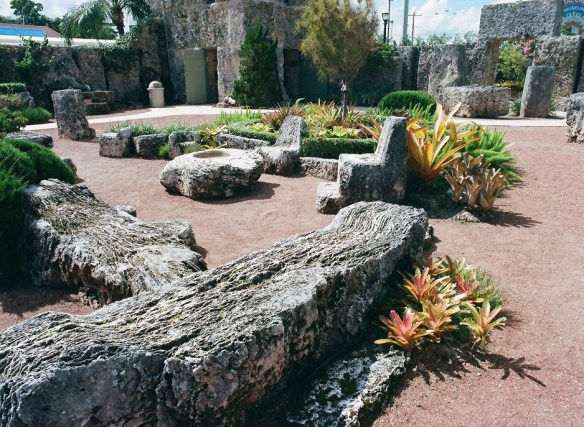
Less a castle and more a varied arrangement of stones into walls, shapes, doorways, and more, the Coral Castle is composed not of coral, but of oolite limestone blocks weighing literal tons. More than 1,000 tons of rock are part of the Coral Castle’s elaborate layout, which was assembled and expanded from 1923 to 1951.
Some of those monstrous stones are seamlessly joined into different structures. Others are so perfectly balanced that they can open like a revolving door with the gentlest push.
There is a sundial, a telescope, and even stone rocking chairs carved from single pieces of rock.
It’s an engineering marvel, to be sure, but what separates the Coral Castle from some of those other creations we mentioned above is the fact that we know who built the Coral Castle.
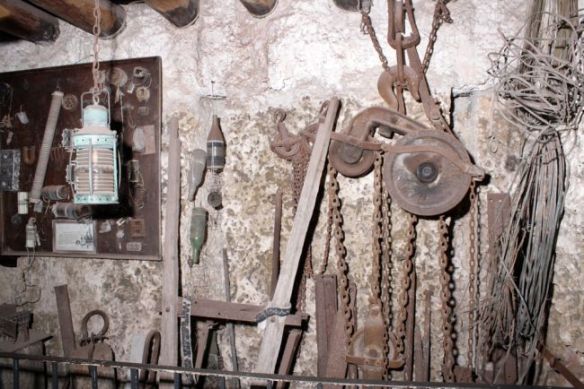
Using basic tools like picks, winches, ropes, and pulleys, Leedskalnin created the Coral Castle in secret, allowing visitors to ponder just how he was accomplishing this remarkable feat.
It’s particularly remarkable when you consider that Leedskalnin only had a fourth-grade education, having gone to work at a young age.
Of course, it’s also worth noting that Leedskalnin was a bit of a kook, claiming he had learned the secrets of the architects of King Solomon’s temples by studying books about the pyramids at the local library.
And yet, he created something amazing. So amazing, in fact, many people attribute the Coral Castle to supernatural efforts, not merely the engineering prowess, cleverness, and determination of a hardworking man.
Over the years, many peculiar theories have circulated surrounding the Coral Castle and Ed Leedskalnin. Unreliable eyewitnesses claimed to see coral blocks floating in the air like balloons while Leedskalnin worked at night.
Some believe Leedskalnin levitated the blocks with telekinesis or psychic powers, or by singing the stones into place. Others attribute the Castle to some sort of strange manipulation of gravity, antigravity, magnetism, ley lines, or earth energies. And, of course, alien technology has been floated as a possibility as well.
(Some people even believe there’s a hidden cipher lurking in several tracts written by Leedskalnin, just waiting to be found to reveal his secrets.)
A friend of Leedskalnin’s wrote a book about the physics and engineering of the Coral Castle, entitled Mr. Can’t Is Dead. It’s one of many books that claims to explain how the Coral Castle came to be.
To me, the Coral Castle seems like one giant mechanical brain teaser, a math problem more about leverage and patience than the paranormal.
And yet, I can’t help but stare at some of these creations with awe. Maybe this one of those puzzles that’s better left unsolved.
There’s good news for aspiring and established crossword constructors out there, as The New York Times crossword is now accepting online submissions.
I could be cynical and say it’s about time for a change like this, given that The Los Angeles Times has been accepting online submissions for at least a decade now, and many of the other major outlets made the transition well before 2020.
But I won’t. This is a moment worth celebrating.
True, it was inevitable that the Times would move in this direction. I don’t know if the tipping point was the pandemic, given how many other companies and businesses have been forced to adapt to a paperless/lower-contact way of doing business, or if the department was simply following a directional shift the industry had already taken.
But I’m glad they have. This may seem like a relatively small change, but it’s significant for several reasons.
1.) It’s simply easier
People send emails, attach documents, and share files every day. How often do you hit the post office?
2.) Electronic submission encourages younger solvers to get involved
New blood is a necessity for any industry, crosswords included, and when the standard-bearer makes a shift toward inclusivity (even if it’s just a matter of technological familiarity), it’s a step in the right direction.
3.) Electronic submission helps level the playing field
Having to mail submissions has a price attached, through envelopes, paper, and postage, whereas electronic submissions don’t. Yes, the price of crossword construction programs is still a hindrance, limiting access to some, but again, this is a step in the right direction.
The submission page is loaded with information, including specs on puzzles, file formats for submission, and the submission form itself.
Plus NYT-savvy constructors and staff like Joel Fagliano have already posted answers online to Frequently Asked Questions in forums like the Crossword Puzzle Collaboration Directory, and have offered to answer any other questions constructors have.
Hopefully this change means not only an influx of new talent, but greater accessibility for underrepresented groups in crosswords.
Thanks for visiting PuzzleNation Blog today! Be sure to sign up for our newsletter to stay up-to-date on everything PuzzleNation!














 PuzzCulture