Oh yes, we’ve got another bonus post this week, and this time, we’re celebrating a new puzzle set for the Penny Dell Crosswords App.
Mere days after launching Dell Collection Ten, our latest 150-puzzle pack, we’re overjoyed to announce our newest downloadable content for the Penny Dell Crosswords app, the November Deluxe set, is now available through the App Store!
Our November Deluxe set offers 35 terrific themed puzzles, and that’s certainly some great puzzle content to be thankful for! Not only do you get 30 easy, medium, and hard puzzles, but there are 5 bonus puzzles you can unlock as you solve!
With this new deluxe set of puzzles, we’ve continued our proud tradition of publishing the best crosswords available to the mobile audience. Terrific crosswords right in your pocket! What more could you ask for?
Thanks for visiting PuzzleNation Blog today! Be sure to sign up for our newsletter to stay up-to-date on everything PuzzleNation!
By this time, you know the drill. Follow-Up Friday is a chance for us to revisit the subjects of previous posts and bring the PuzzleNation audience up to speed on all things puzzly.
And in today’s post, I’m returning to the subject of Rube Goldberg machines.
A Rube Goldberg machine, you may recall, is a device designed to accomplish a simple task in as many unnecessary, ludicrous steps as possible. The name comes, appropriately enough, from Rube Goldberg, a cartoonist and inventor most famous for his cartoons featuring singularly silly and elaborate machines like the one pictured above.
We’ve posted videos of Rube Goldberg machines in the past, because they’re a perfect example of a mechanical puzzle in action. Only when things happen in a precise order does the machine complete its task.
There are numerous competitions pitting clever puzzlers and inventors against each other to build the most spectacular and labyrinthine Rube Goldberg device, but Bob Partington has taken the concept to an unexpected extreme.
You see, he’s designed the world’s slowest Rube Goldberg device. The goal is simple: put the golf ball into the hole. But it takes WEEKS to perform!
Check it out:
When Goldberg started doing his drawings, even he couldn’t have envisioned someone taking his hilariously elaborate ideas this far.
Kudos to Bob Partington for taking the waiting game to the next level. Watching this in real time would be like Zen and the Art of Rube Goldberg Machine Maintenance.
Thanks for visiting PuzzleNation Blog today! Be sure to sign up for our newsletter to stay up-to-date on everything PuzzleNation!
And in today’s edition, we’re jumping into the Wayback Machine and looking back at the math-fueled equivalent of Sesame Street: Square One TV!
[The intro to Square One TV, looking more than a little dated these days.]
This PBS show ran from 1987 to 1994 (although reruns took over in 1992), airing five days a week and featuring all sorts of math-themed programming. Armed with a small recurring group of actors, the writers and producers of Square One TV offered many clever (if slightly cheesy) ideas for presenting different mathematical concepts to its intended audience.
Whether they were explaining pie charts and percentages with a game show parody or employing math-related magic tricks with the aid of magician Harry Blackstone, Jr., the sketches were simple enough for younger viewers, but funny enough for older viewers.
In addition to musical parodies performed by the cast, several famous musicians contributed to the show as well. “Weird Al” Yankovic, Bobby McFerrin, The Fat Boys, and Kid ‘n’ Play were among the guests helped explain fractions, tessellations, and other topics.
[One of the many math-themed songs featured on the show.]
Two of the most famous recurring segments on Square One TV were Mathman and Mathcourt. (Sensing a theme here?)
Mathman was a Pac-Man ripoff who would eat his way around an arcade grid until he reached a number or a question mark (depending on this particular segment’s subject).
For instance, if he came to a question mark and it revealed “3 > 2”, he could eat the ratio, because it’s mathematically correct, and then move onward. But if he ate the ratio “3 < 2”, he would be pursued by Mr. Glitch, the tornado antagonist of the game. (The announcer would always introduce Mr. Glitch with an unflattering adjective like contemptible, inconsiderate, devious, reckless, insidious, inflated, ill-tempered, shallow, or surreptitious.)
Mathcourt, on the other hand, gave us a word problem in the form of a court case, leaving the less-than-impressed district attorney and judge to establish whether the accused (usually someone much savvier at math than them) was correct or incorrect. As a sucker for The People’s Court-style shenanigans, this recurring segment was a personal favorite of mine.
But from a puzzle-solving standpoint, MathNet was easily the puzzliest part of the program. Detectives George Frankly and Kate Tuesday would use math to solve baffling crimes. Whether it was a missing house, a parrot theft, or a Broadway performer’s kidnapping, George and Kate could rely on math to help them save the day.
These segments were told in five parts (one per day for a full week), using the Dragnet formula to tackle all sorts of mathematical concepts, from the Fibonacci sequence to calculating angles of reflection and refraction.
These were essentially word problems, logic problems, and other puzzles involving logic or deduction, but with a criminal twist. Think more Law & Order: LCD than Law & Order: SVU.
Granted, given all the robberies and kidnappings the MathNet team faced, these segments weren’t aiming as young or as silly as much of Square One TV‘s usual fare, but they are easily the most fondly remembered aspect of the show for fans and casual viewers alike.
Given the topic of Tuesday’s post — the value of recreational math — it seemed only fitting to use today’s post to discuss one of the best examples of math-made-fun in television history.
Square One TV may not have been nearly as successful or as long-lasting as its Muppet-friendly counterpart, but its legacy lives on in the hearts and memories of many puzzlers these days.
Thanks for visiting PuzzleNation Blog today! Be sure to sign up for our newsletter to stay up-to-date on everything PuzzleNation!
There was a wonderful opinion piece in The New York Times a few weeks ago about the importance of recreational math.
Now, as author Manil Suri said, I’m sure that to some people, the idea of recreational math sounds like an oxymoron. But it’s everywhere! From poker players calculating their odds based on the cards dealt to the number crunching in role-playing games in order to complete certain tasks (or develop a character’s skills), math is built into many recreational activities.
It’s certainly a part of many kinds of puzzles, including brain teasers. Heck, previous brain teasers featured here in the blog like Mystery Number, the Birthday Puzzle, and the jugs of water trap from Die Hard with a Vengeance would all easily fall under the umbrella of recreational math.
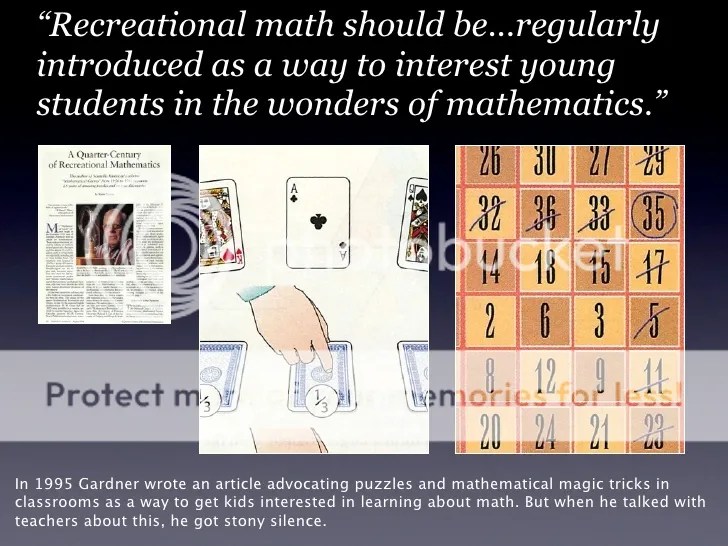
The article goes on to mention the wonderful work of Martin Gardner, whose column “Mathematical Games” in Scientific American was a mainstay of recreational math and puzzly whimsy for over twenty-five years.
From Suri’s article:
In his final article for Scientific American, in 1998, Mr. Gardner lamented the “glacial” progress resulting from his efforts to have recreational math introduced into school curriculums “as a way to interest young students in the wonders of mathematics.”
Indeed, a paper this year in the Journal of Humanistic Mathematics points out that recreational math can be used to awaken mathematics-related “joy,” “satisfaction,” “excitement” and “curiosity” in students, which the educational policies of several countries (including China, India, Finland, Sweden, England, Singapore and Japan) call for in writing.
In contrast, the Common Core in the United States does not explicitly mention this emotional side of the subject, regarding mathematics only as a tool.
This is an excellent counterpoint to the regular argument that the primary value of puzzle-solving and other activities (like recreational math) is to stave off brain health issues later in life.
In a previous post, we discussed the inconsistent reports about the effects of puzzle-solving on the brain, leaving it unclear if regular doses of puzzles and recreational math are beneficial for other aspects of brain health over time, like memory retention, neuroplasticity, and concentration.
That may well be the case, but Suri’s point stands. The idea of instilling a sense of fun and wonder into the field of math, especially for younger minds? That’s one worth pursuing.
It has been championed in the past by television shows like Square One TV and MythBusters, but sadly, examples like that are few and far between.
And if we can instill recreational math as a key facet of math itself, then we’d be one step closer to ensuring that STEM courses will have plenty of participants in the future.
Thanks for visiting PuzzleNation Blog today! Be sure to sign up for our newsletter to stay up-to-date on everything PuzzleNation!
That’s right, it’s a bonus blog post today because we’ve got some exciting news!
Our latest puzzle set for the Penny Dell Crosswords App just launched in the App Store, and it’s one of our best yet!
Say hello to Collection 10! Just in time for autumn!
Collection 10 offers 150 puzzles for your solving pleasure!
Get the Value bundle, including all 150 puzzles at a special low price, or choose from 5 30-puzzle packs — Penny Press Easy, Penny Press Medium, Penny Press Hard, Dell Easy, and Dell Medium!
Five flavors of crosswords in one package! Plus you don’t have to rake any of those colorful leaves! How can you go wrong?
Thanks for visiting PuzzleNation Blog today! Be sure to sign up for our newsletter to stay up-to-date on everything PuzzleNation!
Welcome to Follow-Up Friday! Last week, we had two terrific Halloween-themed games for you, and it’s time to reveal the answers!
First up, it’s our Johnny Depp Cosplay Challenge! I posted this picture and challenged you to identify elements from as many Johnny Depp roles or films as possible:
The Lone Ranger / Tonto: bird on head, sheriff’s star
Edward Scissorhands: scissorhand
Dark Shadows / Barnabas Collins: long vampire nails/claws on other hand
Fear and Loathing in Las Vegas / Raoul Duke: sunglasses, cigarette holder, camera
Pirates of the Caribbean / Captain Jack Sparrow: bandanna, coat, beads in beard
Alice in Wonderland / Mad Hatter: socks, scarf hanging from his pocket, pocket watch on chain




 PuzzCulture