Prodigies and Puzzly Minds

I spend a lot of time here talking about puzzly minds, but I’ve never really defined what I mean by “puzzly mind.” Basically, to me, a puzzly mind is one that enjoys puzzles, one that has a knack for unraveling puzzles that might baffle or deter others.

But defining what makes up a puzzly mind — what qualities, what abilities, that sort of thing — is hard, because there are so many kinds of puzzles in the world, and many of them require different skill sets, even if all of those skill sets still fit under the umbrella of puzzly minds.

For instance, deduction puzzles require different skills than crosswords do, since deduction puzzles usually work off the information given in the puzzle (and extrapolating within that information set), whereas crosswords require you to pull in your own knowledge to solve the clues and fill the grid. There’s obviously some overlap, but they remain quite different forms of puzzle-solving.

And that’s just two types of puzzles. Spot-the-difference puzzles differ from math puzzles, which differ from mechanical puzzles, which differ from strategy puzzles. They all require specific skills, particular solving styles, and oftentimes, an approach tailored to that sort of puzzle.

Even if you’re someone who immerses yourself in the puzzle world, as I do, you’re not necessarily going to be equipped to tackle every form of puzzle. I’m a decent crossword solver, a good hand at brain teasers and logic problems, and quick when it comes to Fill-In-style puzzles, but I’m not the strongest four-in-a-row puzzler, nor am I a deft hand at encryptions.

As it turns out, this is true of minds other than ones found under the “puzzly” umbrella. It applies to child prodigies as well.

Science writer, author, and all-around geek-culture expert Garth Sundem recently wrote about the curious differences between musical prodigies, art prodigies, and math prodigies, and his post revealed some unexpected results.

For instance, math prodigies and music prodigies basically tie when it comes to IQ tests or studies of quantitative reasoning. (Actually, it seems that music prodigies edge out math prodigies when it comes to that sort of pattern recognition!)

They’re also neck-and-neck when it comes to visual spatial skills. But, oddly enough, both groups test AHEAD of art prodigies in that area. Which surprised the heck out of me! You’d think that artists who bring such marvelous works to life would be stronger visual reasoners than musicians and mathematicians.

This applies most strongly to the concept of mentally rotating shapes in their minds.

From Sundem’s post:

The authors write that, “Talented young artists [may] perceive objects differently than less talented young artists and use figurative processes which focus on attention to detailed surface features.” Less talented young artists are trapped in the literal, but it seems that art prodigies are largely unbound by the way things should look. Apparently, when a math prodigy rotates a shape in his or her mind, he or she gets a rotated shape – but when an art prodigy rotates the same shape, he or she gets…Dali!

Just as puzzlers bring different skill sets to bear when cracking their favorite puzzles, prodigies wield different abilities when excelling at various forms of creative expression, be it artistic, musical, or mathematical.

Sundem summed it up nicely when he concluded that “art prodigies can’t visualize shapes with precision and math prodigies are no better than music prodigies at seeing the consequences of numbers.”

And that got me wondering about the brains of some of the puzzlers I know. Do their particular skill sets or interests outside of puzzles reflect on their puzzly strengths and weaknesses?

As you’d expect, there are plenty with majors or strong interests in English (like constructor Brendan Emmett Quigley), history, languages (like constructor Matt Gaffney), and literature in the puzzle biz, particularly crosswords and other word-based puzzles. Several who came from economics, chemistry, or science backgrounds tend to be strong math and deduction solvers.

Crossword constructor and friend of the blog Robin Stears once told me, “If you think about it, math is just one ginormous puzzle that needs to be solved.”

But, again, like Sundem found with the child prodigies, there were some unexpected connections lurking in the data. I know several musicians who enjoy puzzles, and they tend to be strong math solvers as well. (Which supports the test results above that found little statistical difference in quantitative reasoning between math prodigies and music prodigies.)

Obviously, I need to cast a wider net amongst puzzlers to back up my theory, but I suspect these correlations will only strengthen with more input from puzzlers. I wonder what other curious connections are waiting to be found, currently concealed beneath that all-too-convenient umbrella of “puzzly minds.”


Thanks for visiting PuzzleNation Blog today! Be sure to sign up for our newsletter to stay up-to-date on everything PuzzleNation!

You can also share your pictures with us on Instagram, friend us on Facebook, check us out on TwitterPinterest, and Tumblr, and explore the always-expanding library of PuzzleNation apps and games on our website!

It’s Follow-Up Friday: PUZZLES…IN…SPACE edition!

Welcome to Follow-Up Friday!

By this time, you know the drill. Follow-Up Friday is a chance for us to revisit the subjects of previous posts and bring the PuzzleNation audience up to speed on all things puzzly.

And today, I’m posting the results of our #PennyDellPuzzleSciFi hashtag game!

You may be familiar with the board game Schmovie, hashtag games on Twitter, or@midnight’s Hashtag Wars segment on Comedy Central.

For over a year now, we’ve been collaborating on puzzle-themed hashtag games with our pals at Penny Dell Puzzles, and this month’s hook was #PennyDellPuzzleSciFi, mashing up Penny Dell puzzles and anything and everything having to do with cartoons, animated film and television shows, characters, catchphrases, famous lines…anything!

Examples include The Day The Earth Stood Syll-acrostic, Captain James T. Kirkuro, Keep ON Asi-moving, or Mystery Person of Interest.

So, without further ado, check out what the puzzlers at PuzzleNation and Penny Dell Puzzles came up with!


Star Wars!

Obi Wan & Only KenKen-obi / Obi-Ken Kenobi

Star Words: Attack of the Pine Cones

Star Words: The Empire Strikes Blackout!

X-word fighter

Anagram Skywalker

“These Three aren’t the droids you’re looking for.” / “These aren’t the Drop-Outs you’re looking for”

“Do or do not. There is no Try-Angles.”

”May the Fore ‘n’ Aft be with you”


Star Trek!

“Beam me Ups and Downs, Scotty!”

“The Double Trouble with Tribbles”

Deep Space Nine of Diamonds

Captain Jean-Lucky Star

Captain Kathryn Right of Way

“Make the Connection so.”

“The needs of the many outweigh the needs of A Few Choice Words.”

“Live long and progressions”

Star Trek II: The Wrath of Kenken


Starspellman

Simon Says: In space, no one can hear you scream.

Battleships Galactica

Nineteen Eighty-Foursomes

Slaughterhouse Fancy Fives

A Wrinkle in Rhyme Time

Piggyback to the Future

Triplex Machina

The Frame-inator

“May the Solicross be with you” [Glenn’s note: I know this sounds like Star Wars, but it feels more Spaceballs to me.]

“Now that’s the worst disguise ever. That guy’s gotta be an Analog.”

Double Trouble in Little China

Garth Marenghi’s Darkplaces, Please

Flower Powers for Algernon

WordbEnder’s Game

Penny’s next puzzle…The Ultimate Question of Life, the Universe, and Everything (answer on page…42)

So It GOes FISH

Heads & Tails from the Darkside

A Clockworks Orange

Galaxy Word Quest

Face to Face/Off

3rd Rock from the Sunrays

Tales from the Crypt-ograms

Two at a Time Lords

Doctor Who’s Calling

Close Encounters of the Three of a Kind

“Curse your Sudoku but inevitable betrayal!”

“You can’t Give and Take the sky from me.”

Doomsday Bookworms

Spanners

Weird and Wacky Science Words

RoboCombos

When Word Games Collide

The Puppet Mixmasters

Godzilla vs. Guess Who

Ringersworld

E.T. the Exchange Board

“E.T. Phrase Craze”

Flash Grand Tour

War of the Word Quest

Alphanumeric-ageddon


And the PuzzleNation readership got involved as well! @HereLetty delivered the terrific Galaxy Quotefalls and War of the Wizard Words!

Have you come up with any Penny Dell Puzzle SciFi entries of your own? Let us know! We’d love to see them!

Thanks for visiting PuzzleNation Blog today! Be sure to sign up for our newsletter to stay up-to-date on everything PuzzleNation!

You can also share your pictures with us on Instagram, friend us on Facebook, check us out on TwitterPinterest, and Tumblr, and explore the always-expanding library of PuzzleNation apps and games on our website!

The Great Puzzle Pursuit: Puzzle Hunting Across the U.S.!

Puzzle hunts are interactive solving experiences that often have you wandering around a certain area as you crack codes, unravel riddles, and conquer puzzles.

Whether you’re working alone or you’ve recruited a team to help with the hunt — perhaps solvers whose skills complement your own or fill a gap in your puzzling ability — it takes puzzles a step further, often making for a memorable puzzle experience, akin to Escape the Room challenges.

We’ve covered some puzzle hunts in the past, like BAPHL or the Trials Evolution hunt. We’ve also explored puzzle hunts that combine aspects of scavenger hunts and physical challenges to create a more physically demanding solving experience, like the Great Urban Race.

But I don’t know that we’ve ever covered something quite on the scale of The Great Puzzle Pursuit.

Instead of one city, you have 15 possible cities to test you. Instead of racing other teams over the course of a day or a weekend, you have a seven-month window of opportunity to test your puzzly mettle.

Intrigued yet? I certainly was, so I reached out to the team behind The Great Puzzle Pursuit to find out more about this ambitious solving experience. Co-creator Jason was kind enough to answer my questions about the event.


What inspired the Great Puzzle Pursuit?

A little background about us first. My wife Amy and I have been frequent participants in events like Warrior Dash, Urban Dare, and various scavenger hunts for the last 10 years. Now that I am older I can tell you that breaking both of my ankles previously ensured that I just cannot run like I used to.

So my wife and I, who are enormous fans of puzzles and the outdoors, tried various geocaching activities. Which we loved, but that is more just hide and seek. Then we went on to try various scavenger hunts and found the challenges to generally be silly tasks as opposed to actual puzzles.

After much research, we just couldn’t find exactly what we were looking for so we decided to make it ourselves, launching in Pittsburgh, PA.

You have 15 cities listed as possible points of entry into this puzzle hunt. What are the logistics involved in creating something of this scope? How many team members do you have running GPP?

The logistics in running multiple simultaneous hunts is somewhat of a challenge. In each city, we choose 7 locations — generally monuments, statues, or unique features — and then weave puzzle elements into these locations. Essentially you will need to solve 7 location puzzles and 7 on-site puzzles to complete your city.

[Glenn’s note: Location puzzles lead you to a location, while on-site puzzles can only be solved once you reach a given location.]

The locations are different but the puzzle elements are identical between cities so we can ensure it is a fair competition. Assuming a team bests their city challenge, all teams across the country share one last Meta puzzle. To date only 4 teams have unlocked this final challenge and now qualify for the cash prize nearing $1,200.

My wife and I are the owners and operators and we have a team of 8 that helps us create the challenges, scope out future locations, etc.

How many groups/competitors are involved right now?

We are nearing 300 teams now, with 4 total finishers [people who have completed a city challenge and the meta puzzle]. Two for Pittsburgh, one from Buffalo, and one from Hartford. All teams have until September 15 to finish so we expect to see a few more by then.

What lessons did you learn from season 1 that have informed this season’s event?

What we learned from season 1 is that people want to be challenged. In season 1 we made a puzzle hunt that was difficult but 50% of all teams completed it.

The vast majority said they wanted it to be even harder! So this year we added that 15th and final national puzzle that only the best of the best will be able to unlock.


Thank you to Jason and Amy for taking the time out to talk to us today! You can find out more about the Great Puzzle Pursuit on their website here and on Twitter here!

And remember, there are 15 possible cities to conquer:

  • Austin, Texas
  • Baltimore, Maryland
  • Boise, Idaho
  • Buffalo, New York
  • Cleveland, Ohio
  • Columbus, Ohio
  • Gettysburg, Pennsylvania
  • Hartford, Connecticut
  • Indianapolis, Indiana
  • New York, New York
  • Philadelphia, Pennsylvania
  • Pittsburgh, Pennsylvania
  • St. Augustine, Florida
  • Springfield, Massachusetts
  • Washington, D.C.

Let us know if you’re going to accept the Great Puzzle Pursuit challenge in the comments below!


Thanks for visiting PuzzleNation Blog today! Be sure to sign up for our newsletter to stay up-to-date on everything PuzzleNation!

You can also share your pictures with us on Instagram, friend us on Facebook, check us out on TwitterPinterest, and Tumblr, and explore the always-expanding library of PuzzleNation apps and games on our website!

The Mystery of the Kryptos Sculpture

[Image courtesy of Kryptos.arcticus.com.]

If I told you that one of the most famous unsolved encrypted messages in the world isn’t lurking in the works of Da Vinci or in some vast government warehouse like the Ark of the Covenant, but rather as part of a sculpture only twenty-five years old, you might be surprised.

You’d probably be less surprised to discover that said sculpture is located in front of the headquarters of the CIA, though.

Kryptos, a flowing sculpture made of petrified wood and copper plating over a small pool of water, was revealed to the world in 1990. Masterminded by artist Jim Sanborn, it was apparently designed to both challenge and honor the Central Intelligence Agency. And for decades now, it has proven to be a top-flight brain teaser for codebreakers both professional and amateur.

From an article on Wired.com:

It all began in 1988 when the CIA Fine Arts Commission commissioned local artist James Sanborn to create a cryptographic sculpture for a courtyard on the CIA campus. Sanborn completed the two-part sculpture in 1990, which included stones laid out in International Morse code near the front entrance of the CIA campus, and a 12-foot-high, verdigrised copper, granite and petrified wood sculpture. The latter, which is the more famous part of Kryptos, was inscribed with four encrypted messages composed from some 1,800 letters carved out of the copper plate.

[Image courtesy of The Magazine.org.]

There are four distinct sections, utilizing different forms of encryption. And amazingly, the fourth section continues to elude codecrackers to this very day.

It took nearly a decade before anyone announced a solution to the first three encryptions. A computer scientist named Jim Gillogly announced in 1999 that he had cracked passages 1, 2, and 3 with computer assistance.

The CIA, not to be one-upped, then revealed that one of their own employees, an analyst named David Stein, had solved those same three passages the year before, using only pencil, paper, and lunchtime man-hours.

But a 2013 Freedom of Information Act request into records of the National Security Agency revealed that an NSA team actually cracked those same three passages back in 1993 as part of a friendly rivalry between the NSA and CIA, provoked by former NSA director and then-deputy CIA director William O. Studeman.

[Image courtesy of G.A. Matiasz.]

Passage 1 employs a Vigenère cipher, a letter-shifting cipher that has been used for centuries, also known as a periodic polyalphabetic substitution cipher, if you want to get fancy with it.

The message, penned by Sanborn himself, reads Between subtle shading and the absence of light lies the nuance of iqlusion. [Iqlusion is an intentional misspelling of “illusion.”]

Passage 2 also employs a Vigenère cipher, but utilizes a different keyword than Passage 1. The message, also composed by Sanborn, points toward something hidden nearby:

It was totally invisible. How’s that possible? They used the earth’s magnetic field. x The information was gathered and transmitted undergruund to an unknown location. x Does Langley know about this? They should: it’s buried out there somewhere. x Who knows the exact location? Only WW. This was his last message. x Thirty eight degrees fifty seven minutes six point five seconds north, seventy seven degrees eight minutes forty four seconds west. x Layer two. [Again, there’s an intentional misspelling here with “undergruund.”]

Passage 3 uses a transposition cipher, which relies on the positioning of given letters in order to properly spell out a message. The message is inspired by the words of Howard Carter, the archaeologist who opened King Tut’s tomb:

Slowly, desparatly slowly, the remains of passage debris that encumbered the lower part of the doorway was removed. With trembling hands I made a tiny breach in the upper left-hand corner. And then, widening the hole a little, I inserted the candle and peered in. The hot air escaping from the chamber caused the flame to flicker, but presently details of the room within emerged from the mist. x Can you see anything? q [Again, there’s an intentional misspelling with “desparatly.”]

[Image courtesy of Unmuseum.org.]

Although some codebreakers believe the misspellings of “iqlusion,” “undergruund,” and “desparatly” are simply Sanborn’s crafty attempts at misdirection, others believe they are clues hinting at how to crack Passage 4, which is only 97 characters long.

Sanborn has even offered hints to help frustrated solvers in their efforts to unravel the mystery of Passage 4. In 2006, he revealed that letters 64 through 69 in the passage, NYPVTT, decrypt to “Berlin.”

And in 2014, Sanborn revealed that letters 70 through 74, MZFPK, decrypt to “clock.” So the message has something to do with the Berlin Clock, although Sanborn has stated “there are several really interesting clocks in Berlin.”

[Image of the Berlin Clock courtesy of Secret City Travel.com.]

Amazingly, even if someone does crack Passage 4 someday, that’s not the end of the journey. All four passages are part of a riddle to unravel to truly solve the Kryptos puzzle, and apparently, doing so requires you to be on CIA property. That’s no small feat.

Jim Sanborn has truly created a beautiful, diabolical puzzle for the ages here. I wonder who will step up to finally solve this masterpiece.


Thanks for visiting PuzzleNation Blog today! Be sure to sign up for our newsletter to stay up-to-date on everything PuzzleNation!

You can also share your pictures with us on Instagram, friend us on Facebook, check us out on TwitterPinterest, and Tumblr, and explore the always-expanding library of PuzzleNation apps and games on our website!

It’s Follow-Up Friday: Kickstarter Roundup edition!

Welcome to Follow-Up Friday!

By this time, you know the drill. Follow-Up Friday is a chance for us to revisit the subjects of previous posts and bring the PuzzleNation audience up to speed on all things puzzly.

And today, I’d like to return to the subject of crowdfunding!

[Image courtesy of The Startup Garage.]

I’ve covered various campaigns for board games, card games, and puzzle projects across the Kickstarter and Indiegogo crowdfunding platforms over the years, and today I’d like to share a few more that could use your attention.

The first is the strategy game Sovrano.

Sovrano is a tactical game in the spirit of chess where you compete with your opponent to score points by capturing one or both of the towers in the center row of the board and/or by escorting your emperor to the throne at the center of the board. With only 11 game pieces apiece, this multi-tiered game is simple to learn but contains enough depth and nuance to keep players interested.

Although supporting Sovrano is a bit more expensive than the average game’s Kickstarter levels, it’s worth noting that each game is hand-made by the father-and-son team behind the game, and the craftsmanship looks gorgeous.

A bit more complex and cutthroat than Sovrano, Summit is a strategy game that’ll test your speed, cunning, and karma. It’s kind of like The Oregon Trail, but with other wagons racing you.

Summit combines path building (by laying triangular tiles on the mountain map), mechanics to help or hinder opponents (inspiring alliances and encouraging betrayals in equal measure), resource management, and an element of luck to create an intriguing racing game where players compete to climb AND descend a mountain before their opponents do.

On the simpler side of things, we have Hoard, a test-your-luck card game all about hedging your bet to sneak as much treasure as possible away from a sleeping dragon before it awakes.

With elements of Memory (remembering which treasure cards are hidden where), chain-solving (doing your best to combine where to move on the board with the cards in your hand and the treasures you’ve already nabbed) and risk management (do you try to wake the dragon now to secure your treasure, or do you hedge your bet and try to grab more before someone else wakes it?), Hoard is a quick-playing family-friendly experience that could be a great gateway game for more involved games later.

Our final game today, Knuckle Sammich, is far, far goofier than the other three, but it’s a project near and dear to my heart, because it’s a spinoff of one of my favorite quick-and-silly role-playing games, Kobolds Ate My Baby.

Now, for the uninitiated, a bit of backstory: kobolds are among the first creatures you usually encounter in a Dungeons & Dragons campaign, because they’re easy for even the greenest of heroes to defeat. They’re basically cannon fodder. So it’s great fun to have a game centered around playing one of these easily crushed minions, stealing food for your king and being generally mischievous.

And now they’re launching a card game all about eating sandwiches before they run out…or before you become lunch yourself! It’s guaranteed to be glorious chaos.

These are four intriguing and very entertaining projects, all loaded with potential, and I hope you consider contributing to one or more of them. As someone who has become a regular donor to various Kickstarter and Indiegogo campaigns, I am proud to have funded some marvelous new ideas and watched them take shape over the months that followed.


Thanks for visiting PuzzleNation Blog today! Be sure to sign up for our newsletter to stay up-to-date on everything PuzzleNation!

You can also share your pictures with us on Instagram, friend us on Facebook, check us out on TwitterPinterest, and Tumblr, and explore the always-expanding library of PuzzleNation apps and games on our website!

The UK Sudoku Championship! (Or should that be Sudo-UK?)

Hot on the heels of The Indie 500 crossword tournament last weekend, the UK is also gearing up for a major puzzle event: The UK Sudoku Championship!

The event spans June 10 through June 13, and chairman Alan O’Donnell of the UK Puzzle Association sent out the Instruction Booklet for this year’s event a few days ago, which kicks off a string of major puzzle events in Europe and across the world, including the UK Puzzle Championship in a few weeks.

Although the UK Sudoku Championship is only open to competitors from the UK — with the top two earning a place on the UK team for the 2016 World Sudoku Championship — international players are welcome to test their puzzly mettle as guest solvers.

But even if most PuzzleNationers aren’t eligible to compete, you can still enjoy the challenge of some topnotch Sudoku puzzles. Let’s take a look at some of the diabolical puzzles they’ve cooked up for this year’s event!

[An Extra Regions puzzle, a variation on Classic Sudoku.]

In addition to some Classic Sudoku, Extreme Sudoku, Sum-Doku (or Killer Sudoku), Jigsaw Sudoku (or Geometric Sudoku), and Thermo Sudoku — all of which I explored in detail in my Wide World of Sudoku post — there are some variants I’ve never seen before, like this Linked 6×6 Sudoku.

In this puzzle, you have two grids to complete, but with the additional wrinkle that no number placed in the left 6×6 grid will occupy the same square in the right 6×6 grid. So you have more solving information than expected, but it’s spread out across two grids.

This Deficit Sudoku puzzle also uses the 2×3 box format, but arrayed in a 7×7 grid. This means that any of the numbers 1 through 7 can be in each 2×3 grid, which makes it slightly harder than if you were only using the numbers 1 through 6.

(Plus you have no information on what number goes in that solo square in the center of the grid.)

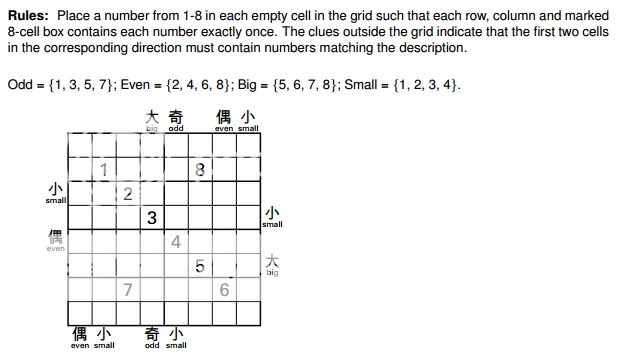
The curiously named Odd-Even-Big-Small Sudoku employs clues outside the grid to help you fill in some of the squares along the perimeter of the grid, telling you that two odd numbers, two even numbers, two small numbers, or two big numbers will occupy the nearest two spaces in that row or column.

This is a solving mechanic I’ve never encountered before in Sudoku, and I can see it posing an impressive challenge to the average Sudoku solver.

That unconventional style of cluing sets the tone for the rest of the unusual puzzles that competitors and solvers will encounter here. In the above grid, a Consecutive Pairs puzzle, those dots indicate that the neighboring numbers connected by those dots are consecutive numbers, like 5 and 6 or 2 and 1.

(You can also try Consecutive Pairs Sudoku in Will Shortz’s Sudoku and Sudoku Spectacular, both published by our friends at Penny Dell Puzzles.)

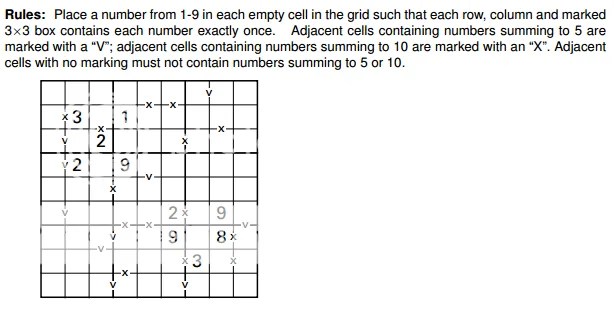
XV Sudoku works in similar fashion, with x’s and v’s instead of those little dots. The x’s mean the neighboring numbers add up to 10, and the v’s mean the neighboring numbers add up to 5.

This Eliminate Sudoku uses arrows to indicate that the number in the arrow box will not be repeated in any of the boxes that follow that arrow. So, for instance, if you place a 3 in that arrow box next to the 2 in the upper-right 3×3 grid, none of the boxes that arrow points at along that diagonal will contain a 3.

Like the dual grids in the Linked 6×6 Sudoku, this puzzle is interesting in offering more information on what’s NOT in a square than what IS.

The final new puzzle in the Instruction Booklet is my favorite, but that’s because I’m a sucker for palindromes in puzzles. This Palindrome Sudoku features gray lines that indicates spots where — you guessed it! — the chain of numbers reads the same backwards and forwards.

Similar to Thermo Sudoku in its solving style, Palindrome Sudoku takes advantage in the restrictive nature of Sudoku solving by adding a neat little twist.

You can check out the full Instruction Booklet here, and remember to keep your eyes peeled on June 10 when the actual puzzles go live!


Thanks for visiting PuzzleNation Blog today! Be sure to sign up for our newsletter to stay up-to-date on everything PuzzleNation!

You can also share your pictures with us on Instagram, friend us on Facebook, check us out on TwitterPinterest, and Tumblr, and explore the always-expanding library of PuzzleNation apps and games on our website!