Stopping at the McDonald’s on Memory Lane

I mentioned last month that I’ve been doing a bit of late-Spring cleaning, and the process continues. This weekend, I was poring through some McDonald’s toys my mother had saved over the years (and when you’re one of six kids, those toys add up quickly).

(One section of the counter absolutely covered with toys.)

And as I was organizing and sorting an egg box full of these silly little gems, I couldn’t help but find the puzzliest among them to share with my fellow puzzlers and PuzzleNationers.

It seems appropriate to start with toys that resemble the brand’s signature food items.

When it comes to puzzle toys, you really can’t go wrong with something that transforms. Figuring out the proper steps to reveal the hidden character or form inside can be simple or complex, depending on the toy. Obviously McDonald’s kept it simple with these Happy Meal handouts, but it didn’t make them any less weird or delightful.

These faux foods are from two different series of McDonald’s toys — the fries and hot cakes & sausage from 1986/1987, the burger and hotcakes from 1990 — and each transforms to reveal something unexpected.

As you can see, the late ’80s toys become robots (keeping in line with the whole Transformers mentality) while the 1990 toys become curious food/dinosaur hybrids.

1992 brought us these stackable circus characters, testing the balance and dexterity of younger minds to see what diabolical human towers they can cook up. In my house, this quickly became a Jenga-like game of each person selecting a piece and taking turns to stack them, often with disastrous results.

(My tower…just before it collapsed.)

But by far the puzzliest of the toys I uncovered was also one I’d completely forgotten about.

Back in 1991, McDonald’s partnered up with NASA to spark interest in space exploration with a run of Happy Meal toys all about astronauts, space technology, and more.

One of the best and most challenging sets was this small space module, complete with two astronauts, logos, and flames.

If memory serves, there were also a lunar rover and a satellite, all built with these wonderful double-sided cardboard pieces.

It was a blast to rediscover these puzzle-fueled delights amidst a plethora of TV and movie tie-in toys, animated characters, and other nuggets of fast-food childhood fun.

Did this post remind you of any puzzly toys you found in cereal boxes, fast food orders, or the like? Let me know in the comments section below!


Thanks for visiting PuzzleNation Blog today! Be sure to sign up for our newsletter to stay up-to-date on everything PuzzleNation!

You can also share your pictures with us on Instagram, friend us on Facebook, check us out on TwitterPinterest, and Tumblr, and explore the always-expanding library of PuzzleNation apps and games on our website!

It’s Follow-Up Friday: Indie 500 edition!

Welcome to Follow-Up Friday!

By this time, you know the drill. Follow-Up Friday is a chance for us to revisit the subjects of previous posts and bring the PuzzleNation audience up to speed on all things puzzly.

And today, I’d like to return to the subject of the Indie 500 crossword tournament!

Why, you ask? Because it’s tomorrow, June 4, and you still have time to register! Click here for all the details. You can compete in person in Washington, D.C., for just $30, or you can participate from home for only $10!

Not only that, but once again they’ve whipped up a meta-suite of puzzles to boot, and you name your own price for it!

This is the second year of the tournament, and I expect great things from the immensely talented team of constructors and directors they’ve assembled. With a prom theme, topnotch constructors, and pie (there’s always pie), you can’t go wrong!

Click here for the Indie 500 home page, here for an interview regarding this year’s event with constructor Andy Kravis, and here for a rundown of last year’s terrific puzzles!

Will you be competing? Or participating from home? Let us know in the comments below!


Thanks for visiting PuzzleNation Blog today! Be sure to sign up for our newsletter to stay up-to-date on everything PuzzleNation!

You can also share your pictures with us on Instagram, friend us on Facebook, check us out on TwitterPinterest, and Tumblr, and explore the always-expanding library of PuzzleNation apps and games on our website!

PuzzleNation Product Review: Slideways

One of the most popular forms of puzzle gaming involves placing four game pieces in a row on a board. Four-in-a-row games like Connect Four are rooted in the tactical simplicity of Tic-Tac-Toe or three-in-a-row solving, but take it a step further.

We’ve explored several four-in-a-row puzzle games before. ThinkFun’s All Queens Chess added a wrinkle by employing the rules of chess in four-in-a-row solving. Quarto used pieces of varying heights, colors, and shapes to create a more complex game play experience.

And now, Tricia McLaughlin and R&R Games bring us another evolutionary step in four-in-a-row puzzle gaming: Slideways.

At first glance, Slideways offers a simple 4×4 play area, where the blue squares can be rotated to reveal a gold or red square claimed by the player in a given turn. Each play claims one square per turn.

In this picture, two squares each have been claimed by the players. But Slideways allows the player to manipulate the play area itself by sliding a row one square in either direction, adding another dimension to the game.

So now players can claim blue squares or shift the rows to give themselves the best opportunity to not only get four in a row, but to thwart an opponent’s efforts to do the same. (Be careful, though, as the sliding feature can be a little clunky.)

But that’s not all. Slideways has one more trick up its sleeve.

Players also have the option of changing claimed squares to their own color! In this case, one player rotated a gold-claimed square into a red-claimed square.

And honestly, this is the feature that really separates Slideways from other four-in-a-row games, because it requires the player to constantly assess and reassess the game every single turn. You can’t take it for granted that a claimed square will stay claimed, or that the three squares you already have lined up will stay lined up.

There is one exception to this rule: you cannot reverse a square a player has just claimed. You have to wait a round before doing so.

So the red square claimed in the top row this turn cannot be immediately turned into a gold one. The other player has to wait until the next round, so instead, the other player changes one of the red squares in the third row into a gold one.

All of these possible moves — claiming a square, shifting a row, or taking an opponent’s square — make Slideways the most complex and controllable four-in-a-row puzzle game I’ve ever seen, and it can make for a fun and nerve-wracking playing experience, especially against a skilled opponent.

Plus games move so quickly (usually lasting less than 10 minutes) that you’re sure to play multiple rounds without giving up a huge chunk of your day. My opponent and I played 11 or 12 games in about half an hour, and each one felt new and different because of the many play options available to us.

(Plus there’s a three-player variation that starts with some squares flipped to red, others flipped to gold, and the third player uses blue as their color.)

Simple to learn, but tough to master, Slideways is a marvelous addition to the four-in-a-row puzzle game field, one that ensures you’ll take no move and no turn for granted. Portable and self-contained, this one is a treat.

[I discovered Slideways at the Connecticut Festival of Indie Games. You can pick it up on the R&R Games website for $11.99.]


Thanks for visiting PuzzleNation Blog today! Be sure to sign up for our newsletter to stay up-to-date on everything PuzzleNation!

You can also share your pictures with us on Instagram, friend us on Facebook, check us out on TwitterPinterest, and Tumblr, and explore the always-expanding library of PuzzleNation apps and games on our website!

Unraveling the Riddle of Math Puzzles!

Math puzzles are among the most intimidating in the world of puzzles. Many people will happily dive into a crossword or tackle a word seek at a moment’s notice, but drop some numbers into a puzzle, and they hesitate.

But there’s no reason to fear!

Math puzzles are certainly a different form of puzzling, but like all puzzles, there’s always a way in, if you know how to look for it. Today, we’re going to solve two math puzzles together in the hopes of demystifying this style of puzzle.

Let’s take a look at our first math puzzle, “Count the Votes.”

A problem developed at a recent election where 5,219 votes were cast for four candidates. The victor exceeded his opponents by 22, 30, and 73 votes, yet not one of them knew how to figure out the exact number of votes received by each. Can you?

Okay, where do we begin?

Let’s start with what we know. We know the total number of votes, 5,219. That will be one side of our equation.

We also know that the winner beat his three opponents by 22 votes, 30 votes, and 73 votes, respectively. Which means that the number of votes the winner received is the key to solving this puzzle. Let’s call that number of votes “x.”

The winner beat one opponent by 22 votes (x – 22), another by 30 votes (x – 30), and the last by 73 votes (x – 73).

We can build our simple equation from that information:

x + (x – 22) + (x – 30) + (x – 73) = 5219

Still a little daunting, but we can simplify it, because it doesn’t matter in which order we add or subtract things. So let’s look at that formula without the parentheses:

x + x – 22 + x – 30 + x – 73 = 5219

Now let’s reorganize it, putting the addition parts together and the subtraction parts together:

x + x + x + x – 22 – 30 – 73 = 5219

Subtracting those three numbers separately is the same as subtracting their total, so let’s simplify again:

x + x + x + x – 125 = 5219

Adding four x’s together is the same as multiplying one x by 4, so let’s express that:

4x – 125 = 5219

Now we’re getting somewhere.

And subtracting 125 from 4x is the same as adding 125 to 5219, so let’s do that:

4x = 5344

Finally, we divide 5344 by 4 to give us the value of x:

x = 1336

Which means that our victor got 1336 votes, one opponent got 1314 (x – 22), another opponent got 1306 (x – 30), and the last got 1263 (x – 73), totalling 5129 votes.

Now, that wasn’t so bad, was it? Let’s try another that’s a little bit harder.
This one is called “The Mathematical Cop.”

“Top of the mornin’ to you, officer,” said Mr. McGuire. “Can you tell me what time it is?”

“I can do that same,” replied Officer Clancy, who was known on the force as the mathematical cop. “Just add one quarter of the time from midnight until now to half the time from now until midnight, and it will give you the correct time.”

Can you figure out the exact time when this puzzling conversation took place?

Okay, this one isn’t as obvious about providing us with information, but the info is there if you look.

Since everything relates to the time “now,” we’ll make “now” our x.

Then we take each part of Officer Clancy’s statement in turn. “Just add one quarter of the time from midnight until now.”

“The time from midnight until now” is the same as “now,” x, so one quarter of that time is x/4.

And we’re meant to add that to “half the time from now until midnight.”

That’s a little bit tougher. After all, “the time from midnight to now” was easy, but “the time from now until midnight” covers the rest of a 24-hour day. So, if x covers the time from midnight to now, then “1440 – x” covers the time from now until midnight.

(There are 1440 minutes in a day, 60 minutes times 24 hours, and it’s easier to do all this in minutes, rather than hours and minutes.)

So “half the time from now until midnight” is (1440 – x)/2.

Okay, so what does our equation look like?

x/4 + (1440 – x)/2 = x

That’s pretty daunting, but we know what our goal is: to combine all those x’s and get them on the same side of the equal sign. And like the equation we built for “Count the Votes,” we can simplify it with some careful applied math.

The first step is to get rid of those pesky fractions.

Let’s multiply everything by 2 in order to remove the “/2” below “(1440 – x),” which gives us:

2x/4 + (1440 – x) = 2x

We can use the same trick to remove the “/4” below 2x:

2x + 4(1440 – x) = 8x

Now we’re getting somewhere! Let’s get rid of that 2x on the left by subtracting 2x from both sides:

4(1440 – x) = 6x

Let’s go a step further by multiplying both 1440 and x by 4:

5760 – 4x = 6x

One more step, and we’ve got all of those x’s combined on one side of the equation, as we’d hoped:

5760 = 10x

Divide 5760 by 10 and we’ve got x:

576 = x

If you recall, x represented the time “now,” but it’s still in minutes. To get the actual time, divide 576 by 60 to get the number of hours. 540 minutes = 9 hours, so 576 is 9 hours, 36 minutes.

It’s 9:36 AM, Officer, though to be honest, if you tell everyone the time this way, I imagine people stop asking you the time after a while.

I realize these are only two examples, and math puzzles come in all shapes and sizes, but hopefully, they don’t seem quite so intimidating, now that you know how to pick them apart for the important information.

Good luck! And if you find any math puzzles you need help with, send them our way! They could end up the subject of a future blog post!


Thanks for visiting PuzzleNation Blog today! Be sure to sign up for our newsletter to stay up-to-date on everything PuzzleNation!

You can also share your pictures with us on Instagram, friend us on Facebook, check us out on TwitterPinterest, and Tumblr, and explore the always-expanding library of PuzzleNation apps and games on our website!

It’s Follow-Up Friday: Word Mastery Answers edition!

Welcome to Follow-Up Friday!

By this time, you know the drill. Follow-Up Friday is a chance for us to revisit the subjects of previous posts and bring the PuzzleNation audience up to speed on all things puzzly.

And today, I’ve got the answers to last week’s edition of Word Mastery: Famous Expressions!

We posted twelve famous sayings or expressions that were reworded in a verbose and ridiculous fashion, and we challenged you to unravel them and figure out the original expressions. Let’s see how you did!


1.) A mobile section of petrified matter agglomerates no bryophytes.

A rolling stone gathers no moss.

2.) Desist from enumerating your fowl prior to their emergence from the shell.

Don’t count your chickens before they hatch.

3.) Scintillation is not always identification for an auric substance.

All that glitters is not gold.

4.) A plethora of culinary specialists has a deleterious effect upon the quality of purees, consummes, and other soluble pabula.

Too many cooks spoil the broth,

5.) A chronic disposition to inquiry deprived the domestic feline carnivorous quadruped of its vital quality.

Curiosity killed the cat.

6.) It is in the realm of possibility to entice an equine member of the animal kingdom to a source of oxidized hydrogen; however, it is not possible to force him to imbibe.

You can lead a horse to water, but you can’t make him drink.

7.) Persons deficient in the faculty of determining values move with impetuosity into places that purely spiritual beings view with trepidation.

Fools rush in where angels fear to tread.

8.) If John persists without respite in a constant prolonged exertion of physical or intellectual effort he will develop into a youth slow and blunted in perception and sensibility.

All work and no play makes Jack a dull boy.

9.) Immediately upon the absence of the domesticated carnivorous feline, the common house rodent proceeds to engage in sportive capers.

When the cat’s away, the mouse will play.

10.) A round vessel made of staves bound with hoops that is destitute of contents is productive of the most deafening din.

It is the empty barrel that rattles the loudest.

11.) Products of ingenuity are the offspring of exigency.

Necessity is the mother of invention.

12.) Residents of structures composed of silicate substances should refrain from casting hardened mineral objects.

Those who live in glass houses should not throw stones.


How did you do? Let us know in the comments section below!

Thanks for visiting PuzzleNation Blog today! Be sure to sign up for our newsletter to stay up-to-date on everything PuzzleNation!

You can also share your pictures with us on Instagram, friend us on Facebook, check us out on TwitterPinterest, and Tumblr, and explore the always-expanding library of PuzzleNation apps and games on our website!

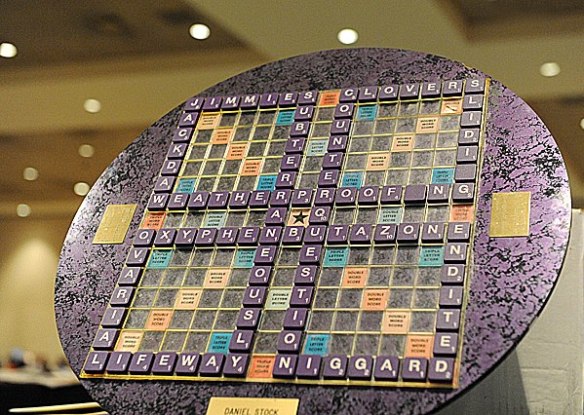
Scrabble-Rousers Change the Game with Shorter Words!

Whether we’re talking Scrabble, Words With Friends, or another word-forming game where points are king, there’s one abiding rule: bigger words are where it’s at.

They reach the bonus squares easier, they offer more slots for new letters in your rack, and there’s always the chance of scoring bonus points for using all your letters.

But as it turns out, bigger words are not the end-all be-all of Scrabble. Between computer analysis of scoring possibilities and the dedicated playtesting of champion-level Scrabblers from across the world, a sea change in gameplay is now underway.

Apparently, studying up on your 5-letter words is far more beneficial than shooting for 6- and 7-letter plays, since most of the bonus squares are four or five letters apart.

And slowly but surely, the formerly dominant North American and European players are losing ground to players from countries like Nigeria, culminating in a win last year for Nigerian Wellington Jighere at the World Scrabble Championship in Australia.

From The Wall Street Journal:

It was the crowning achievement for a nation that boasts more top-200 Scrabble players than any other country, including the U.K., Nigeria’s former colonizer and one of the board game’s legacy powers.

“In other countries they see it as a game,” said Mr. Jighere, now a borderline celebrity and talent scout for one of the world’s few government-backed national programs. “Nigeria is one of the countries where Scrabble is seen as a sport.”

[Image courtesy of The Wall Street Journal and Getty Images.]

And those sportsmen have exploited the West’s reliance on long words by strategically employing smaller words and being more judicious in their use of the letters in their racks.

Whereas Western players would often go for the maximum score every round (using every tile they can), they leave themselves open to bad draws of replacement tiles, which can hamper their efforts in following rounds.

This is considered poor rack management by players like the champion-level Nigerians:

Now, his [Jighere’s] method is changing the game. Champions have studied his defensive style, including his decision to put REPAIR on an S during the final, for 30 points. He could have earned 86, including a 50-point bingo, spelling PEREIRAS. Instead, Mr. Jighere kept an “e” for the next round.

“It’s this sort of strategic thinking that the Nigerians are embracing,” said American Chris Lipe, runner up in the 2014 world championship, who called Mr. Jighere’s performance a Scrabble master class.

It just goes to show you, bigger isn’t always better. (Though vocabulary still wins the day.)


Thanks for visiting PuzzleNation Blog today! Be sure to sign up for our newsletter to stay up-to-date on everything PuzzleNation!

You can also share your pictures with us on Instagram, friend us on Facebook, check us out on TwitterPinterest, and Tumblr, and explore the always-expanding library of PuzzleNation apps and games on our website!