Hello puzzlers and PuzzleNationers! Yes, we’ve got a second bonus blog post for you today, because there’s simply too much great stuff to announce today!
Start your mornings right with a hearty breakfast and some terrific crossword puzzles, courtesy of your friendly neighborhood constructors at PuzzleNation!
Offering 30 easy, medium, and hard puzzles, plus 5 breakfast-themed bonus puzzles to sate your puzzly appetite, no matter what your skill level, the Breakfast Deluxe puzzle set is part of a well-balanced day of solving!
Plus it’s available for both iOS and Android users!
Happy puzzling, everybody!
Thanks for visiting PuzzleNation Blog today! Be sure to sign up for our newsletter to stay up-to-date on everything PuzzleNation!
And the crew at Escape 101 offered an awesome deal to all PuzzleNation users!
For the entire month of October, if you make a reservation for a room at Escape 101 and you have one of the PuzzleNation puzzle apps on your phone, you can show it to them at the door and they’ll give you a 10% discount on the entire booking!
That’s right, whether it’s Daily POP Crosswords, Penny Dell Crosswords, Penny Dell Sudoku, or Penny Dell Crosswords Jumbo 1, 2, or 3, being a PuzzleNation solver will give you a discount on a terrific solving experience.
You can call or email Escape 101 to reserve a room, or book a room through their website. (It’s always best to do so at least a few days out from your desired date and time, just to give them the best chance to meet your expectations.)
They’ve got something for all skill levels. If you’ve never done an escape room before, the Ice Cream Truck room is the perfect introduction. And if you’re looking for a serious challenge, the Doomsday room will test your puzzly mettle.
With those and two other rooms to choose from, you’re guaranteed to find the right fit for you and your fellow solvers!
Enjoy! And let us know when you do! We’d love to hear from you!
Heck, we might even see you there!
Thanks for visiting PuzzleNation Blog today! Be sure to sign up for our newsletter to stay up-to-date on everything PuzzleNation!
The slow, steady march of technological advancement in all fields continues to progress, and the world of puzzles is no exception. In previous blog posts, we’ve discussed not only technological leaps forward in making puzzles (like 3-D printers), but also new developments in solving puzzles.
We’ve joked that robots are coming for our puzzles, thanks to advanced machines and AI programs that can play games like chess, Go, and Scrabble on par with — and sometimes, far better than — human experts.
It’s the same with Rubik’s Cubes and other twisty puzzles. Even though speed solvers continue to break new ground in terms of sheer speed and efficiency, we can’t compete with robots that solve cubes in the blink of an eye.
And now, it seems we’ve reached the natural end of this journey…
The creation of a Japanese technician and self-styled “hardware hacker,” this Rubik’s Cube is the same size as the traditional cube, but the similarities end there.
Instead of the traditional plastic network of connections that allows you to twist and turn the cube every which way, this cube is packed to the gills with electronics, wiring, a series of motors, and the interconnected pieces that give the Rubik’s Cube its signature movement and flexibility.
A marvel of miniaturization and design, this self-solving Rubik’s Cube clearly has its own built-in solving algorithm. It doesn’t simply memorize the twists employed to scramble the cube and then reverse them; the solution and scrambling are completely different chains of events.
All in all, it’s a thoroughly impressive creation. Of course, if I’d known there were going to be self-solving Rubik’s Cubes, I wouldn’t have wasted so much time trying to solve one myself!
Thanks for visiting PuzzleNation Blog today! Be sure to sign up for our newsletter to stay up-to-date on everything PuzzleNation!
A few weeks ago, we delved into the surprisingly deep history behind games still commonly played today, like Go, chess, and various dice games. But we barely scratched the surface when it comes to ancient gaming. There are numerous games that fell out of favor centuries ago, only to be resurrected in the modern day by game enthusiasts and historians.
In today’s blog post, I’d like to dust off a few of these ancient games and briefly discuss what we know about them. It’s game history time!
[Image courtesy of Wikipedia.]
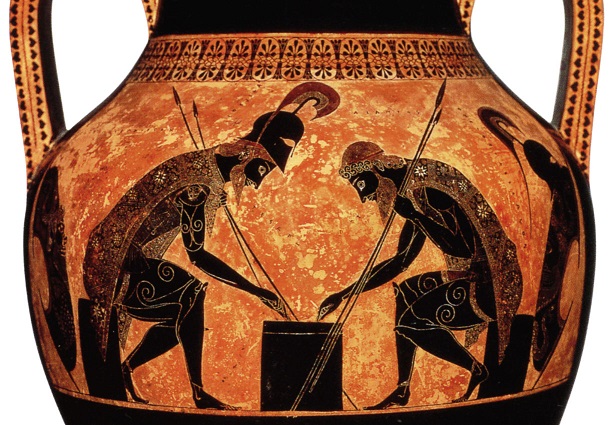
A popular Viking game whose heyday was between the fourth and twelfth centuries, Hnefatafl was a popular game throughout Scandinavia. This mouthful of a game — sometimes called Viking chess by modern game fans — was so ubiquitous back then that it was mentioned in several of the Norse Sagas.
Amazingly, although game pieces and fragments of game boards have been recovered, no one is entirely sure how the game is played, so rules have been reconstructed based on a similar game called Tablut.
Translated as “board game of the fist,” Hnefatafl is part of a family of games called Tafl games, all of which take place on a checkerboard-style play space with an uneven number of game pieces.
[Image courtesy of Wikipedia.]
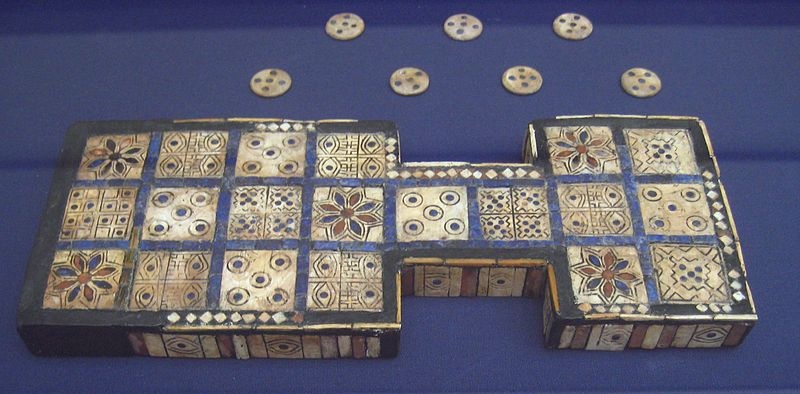
Unlike Hnefatafl, the Royal Game of Ur has survived the centuries pretty much unscathed, thanks to a copy of the rules recorded on a Babylonian tablet. Played in the Middle East centuries ago — in places like Syria and Iran — the Royal Game of Ur was clearly popular, as evidence of the game has been found as far away from the Middle East as Crete and Sri Lanka.
The game and its trappings penetrated deep into Middle Eastern society. An Ur game board was carved like graffiti into a wall in the palace of Sargon II (dating back to the 700s BC). The Babylonian tablet indicates that certain game spaces were believed to be good omens, and could be interpreted as messages from the beyond.
The game was eventually either supplanted by backgammon or evolved into a version of backgammon, depending upon different historical accounts.
Tori Shogi dates back to 1799 in Japan. Also known as Bird chess — thanks to game tiles named after phoenixes, cranes, and swallows — Shogi is played on a board seven squares wide and seven squares deep.
Unlike many chess variants, Tori Shogi allows for captured pieces to return to play, a nice twist that deepens the familiar gameplay style.
[Image courtesy of Bodleian Libraries.]
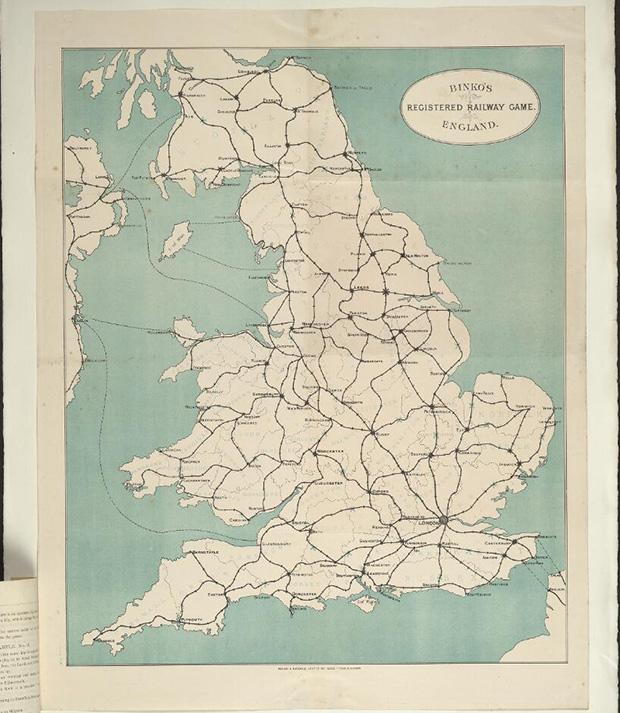
But chess and backgammon aren’t the only games with centuries-old precursors. The geographical game Ticket to Ride also has an aged forebearer in Binko’s Registered Railway Game, which was built around a map of the United Kingdom.
An educational game about placing trains on the map and determining how far they travel, this game has survived the decades relatively unscathed by time.
Those are just four examples of games that were either lost and then rediscovered, or games that fell out of favor, only to be resurrected by curious modern players.
And once again, these games are just the tip of the iceberg. There are centuries-old versions of The Game of Life, Parcheesi, a dating game, checkers, and more when you start digging!
As you can see, games have been a part of human civilization dating back millennia. We were always meant to play puzzles and games, it seems.
Thanks for visiting PuzzleNation Blog today! Be sure to sign up for our newsletter to stay up-to-date on everything PuzzleNation!
It’s fun to uncover little puzzly bits of history, but when history, puzzles, and entertainment intertwine, it always makes for intriguing viewing.
So when friend of the blog Darcy Bearman showed me a Felix the Cat cartoon from the 1920s that centered around an unsolved crossword puzzle, naturally I was intrigued.
It wasn’t hard to track down a copy, given how practically everything seems to be on YouTube these days.
Here are the official details:
Felix All Puzzled (1924)
Director: Pat Sullivan
Animator: Otto Messmer
Distributor: M.J. Winkler Productions
Originally Released on January 15, 1925.
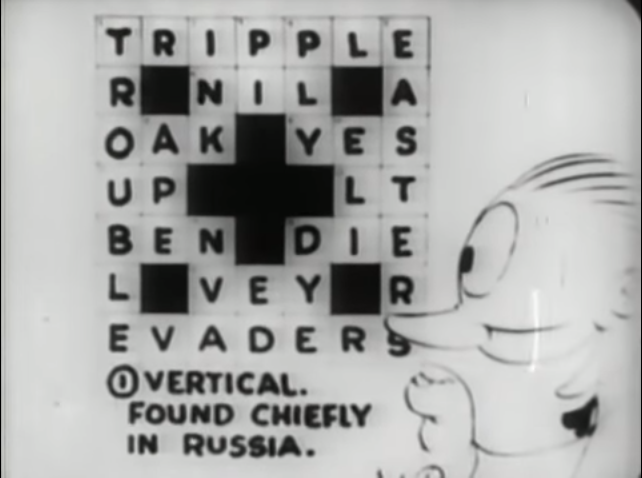
Felix is hungry, but his owner won’t feed him until he finishes his crossword puzzle. And he’s fixated on the down clue that will complete the puzzle, “Vertical. Found chiefly in Russia.”
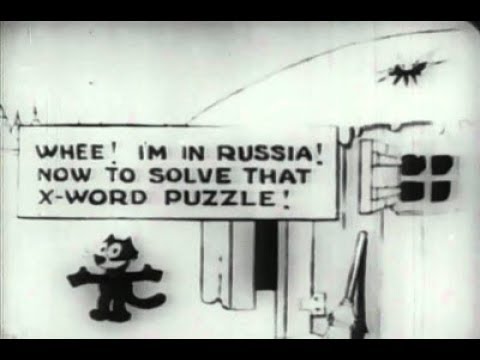
Pondering what the answer could be Felix, the cat laments that he could eat if only he could get to Russia and uncover the missing word.
A nearby mule kicks Felix all the way to Russia, seemingly out of spite — clearly a Moscow Mule — and Felix lands in a small hut. Momentarily mistaken for a bomb, he leaves the hut and heads into town.
He sees two Russians leaning over some papers, and presumes that the answer will be on those papers. But after sneaking into the building, he’s accused of spying, shot at, and chased out. As it turns out, these two men are plotting a revolution, and they toss bombs at Felix.
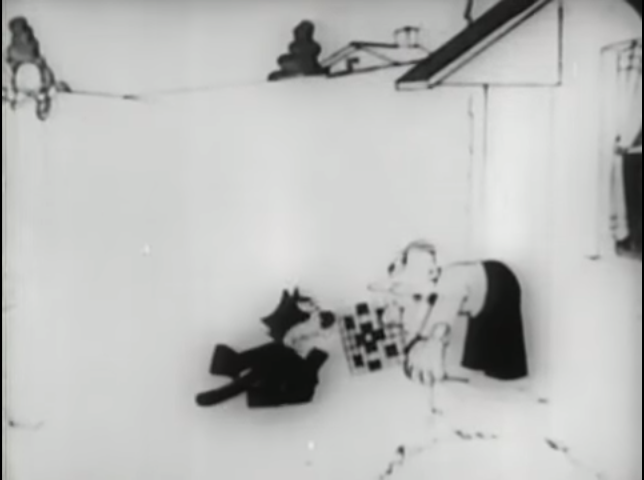
After avoiding several of them, Felix is blown into the air by the last one, and ends up back in America.
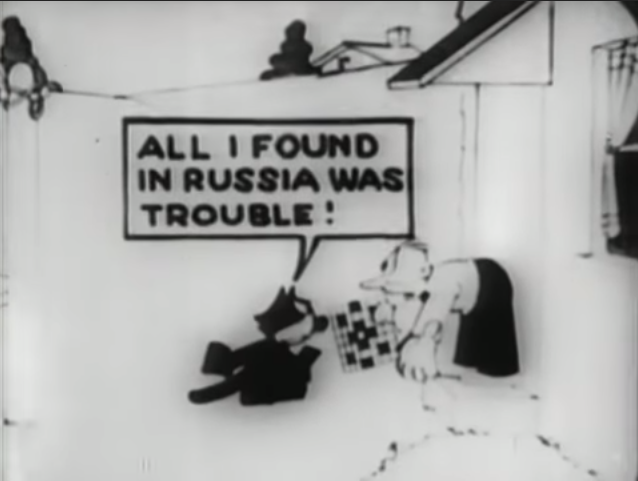
His owner, the ungrateful boor, immediately asks if Felix found the answer. He doesn’t ask how his trip was, or if he’s alright, or hey, can I get you a bite to eat after your mule-and-bomb-propelled world tour. What a jerk.
And Felix’s snarky reply turns out to be the correct answer.
Felix laughs. His owner does a little victory dance. And the cartoon ends.
Naturally, I can’t help but ask… DID YOU FEED FELIX NOW THAT YOUR PUZZLE IS DONE, YOU SELFISH DOOFUS? I mean, come on. It’s the whole reason that Felix bothers going to Russia. He wants to eat. Feed him!
But I digress.
You may have noticed that the cartoon is a little choppy. If you did, kudos to you. As it turns out, most of the copies of this cartoon that are in circulation are from a Kodascope print where several scenes were cut. Given that the original run time listing was 5 minutes, suddenly the choppiness makes sense.
A half-dozen sequences or so are missing from this version, and they explain some of the weirder moments in the cartoon. For instance, the mule kicks Felix because the question marks (from his attempts to figure out how to get to Russia) tickle the mule.
Additionally, if you were wondering why the first Russian Felix meets thinks he’s a bomb, it’s because he got a letter from the revolutionaries earlier that reads “Today, you die!” (Which is admittedly a little grim.)
Now, let’s talk about that puzzle.
TRIPPLE is a pretty strange 1-Across. A chiefly South African term for a horse’s gait (according to Merriam Webster, anyway), you can’t help but wonder if they simply misspelled TRIPLE.
But the rest of the puzzle is fairly straightforward. It’s a 7×7 grid with a few two-letter entries (which wouldn’t fly in most crosswords these days). The combination of EASTERS and EVADERS crossing at the S is admittedly underwhelming.
The only other entry that jumps out at me is NVA, but only because I wonder how it would be clued. It’s not like a 1925 cartoon would be referencing the North Vietnamese Army.
Upon further digging, I suspect this would have been clued referencing the National Vaudeville Artists, a union formed by Edward Franklin Albee. The clue “Theatrical organization” is used for NVA in a 1953 New York Times puzzle, according to XwordInfo.
Of course, with obtuse cluing like “Chiefly found in Russia,” even a small grid like this could prove to be a challenge!
Thanks for visiting PuzzleNation Blog today! Be sure to sign up for our newsletter to stay up-to-date on everything PuzzleNation!
A Rube Goldberg machine, for the uninitiated, is a device designed to accomplish a simple task in as many unnecessary, ludicrous steps as possible. The name comes, appropriately enough, from Rube Goldberg, a cartoonist and inventor most famous for his cartoons featuring singularly silly and elaborate machines like the one pictured below.
We’ve posted videos of Rube Goldberg machines in the past, because they’re a perfect example of a mechanical puzzle in action. Only when things happen in a precise order does the machine complete its task.
Teaming up with five machine-building YouTubers — essentially, videomakers who specialize in chain-reaction mechanical devices — Lily and the group descended upon an AirBnB in San Diego to build a Rube Goldberg machine that would span the entire house!
The Lemonade Machine, as they call it, travels from room to room, utilizing items commonly found in those rooms (silverware and a teapot in the kitchen, for instance) to construct an epic-length chain reaction with everyday household objects.
The end goal? Pouring a glass of lemonade for each member of the build team.
So, how did they do?
They constructed a real mechanical marvel here. It took three days to build, and another day to execute a complete successful run of all of the machine’s components in a single take. The end result was the largest Rube Goldberg device constructed in the United States this year.
Not only that, but Lily documented the entire process, so you can watch both the construction and the many MANY attempts on Falldown Day to achieve a successful run of The Lemonade Machine.
It’s a mind-blowing feat, combining puzzly skill, creativity, patience, and determination, and there’s no denying that they built something truly unique and pretty cool.
I’m gonna go watch it again.
Thanks for visiting PuzzleNation Blog today! Be sure to sign up for our newsletter to stay up-to-date on everything PuzzleNation!










 PuzzCulture