The King of the Monsters Rampages Across the World of Board Games!

monopolyvariations

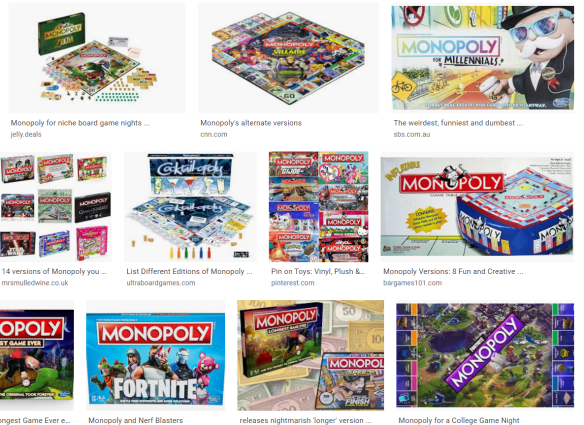
When it comes to licensing and variant titles, no board game comes close to the empire of different versions available that has been amassed by Monopoly.

Not only can you get one tailored to every one of the 50 states, but there’s a version of Monopoly for practically every pop culture phenomenon out there, covering everything from Game of Thrones and Star Wars to Spongebob Squarepants and The Office. There are versions with credit cards instead of cash, and even a cheater’s edition where players can be handcuffed to the board.

Sure, other classic board games are following suit. You can find versions of Clue centered around The Golden Girls or Dungeons & Dragons, and a Nightmare Before Christmas version of Operation out there.

But that’s a drop in the ocean compared to the myriad versions of Monopoly that are available for board game fans.

Even Godzilla is getting in on the fun.

monopolygodzilla

[Image courtesy of Mental Floss.]

Yes, there’s a Godzilla-themed Monopoly game now, complete with renamed properties, monster-influenced money, special game pieces, and rebranded Chance and Community Chest cards.

There are even factories and bases to build instead of houses and hotels.

But I must ask the obvious question. If you’re moving a monster token around the board, why aren’t you smashing houses and hotels instead of building bases and factories? I mean, the only monopoly your average kaiju is looking for is a monopoly on destruction, am I right?

Maybe a few intrepid players will cook up some fun variant rules that encounter the monsters to rampage rather than rebuild.

Of course, if you’re looking for an excuse for destruction, maybe the accompanying Godzilla-themed Jenga will be more up your alley.

godzilla-jenga

[Image courtesy of Bloody Disgusting.]

Yes, it’s just like normal Jenga, except the tower pieces are painted to look like pieces of a building, and Godzilla is slowly marching toward it, his atomic breath glowing as he anticipates the unbridled joy of knocking over yet another skyscraping edifice.

That’s certainly more in keeping with the King of the Monsters and his traditional manner for dealing with massive man-made structures. It won’t be as destructive as, say, Smash City or Terror in Meeple City, but it’s certainly a step in the right direction.

And, honestly, if there are two games that could use a little destructive sprucing up, it’s Monopoly and Jenga.


Thanks for visiting PuzzleNation Blog today! Be sure to sign up for our newsletter to stay up-to-date on everything PuzzleNation!

You can also share your pictures with us on Instagram, friend us on Facebook, check us out on TwitterPinterest, and Tumblr, and explore the always-expanding library of PuzzleNation apps and games on our website!

Farewell, Kazuhisa Hashimoto, Creator of the Konami Code

We talk about codes a lot in this blog. We’ve discussed codebreaking, hidden messages, encryption, spycraft, and password protection in the past. But we haven’t talked much about another kind of code, the sort that grants secret access to new abilities, powers, and other benefits.

In the video game world, these are commonly known as cheat codes. There are various famous ones from different eras of gaming, but one code stands head and shoulders above the rest: the Konami Code.

konamicode

[Image courtesy of Newegg.]

Up, Up, Down, Down, Left, Right, Left, Right, B, A, Start.

Ubiquitous in the 1980s and 1990s, the Konami Code was named for Konami, the video game publisher whose games utilized this code. It was first used in the Nintendo version of the arcade game Gradius in 1986, giving the player the full set of power-ups (rather than forcing the player to earn them throughout the game).

You see, the video game designer and producer working on converting the game, Kazuhisa Hashimoto, found the game too difficult to play during his testing phase. He then created a cheat code to make the game easier, allowing him to complete his testing. The code he chose became known as the Konami Code.

It’s most famously associated with the game Contra, a side-scrolling platformer that pitted Rambo-inspired heroes against an invading alien force. The game was famously difficult because one hit could kill you, and you only had three lives for the entire game. Entering the Konami Code granted the player 30 lives and a much greater chance of success.

(I, of course, could beat it without the Konami Code. But this article isn’t about me and my old-school video game wizardry.)

The code became part of video game pop culture, continuing to appear not only in Konami games, but all sorts of other games, up through the modern day. Often with different results.

In Teenage Mutant Ninja Turtles: Turtles in Time, you got extra lives. But if you used it in Tony Hawk’s Pro Skater 2, it would unlock a playable version of Spider-Man. If you use the code in Assassin’s Creed 3, a turkey will wear the character’s famous hood, weirdly enough.

The code has transcended gaming as well, not only becoming the name of a famous wrestler’s gaming-centric YouTube channel, but appearing everywhere from Family Guy and Wreck-It Ralph to Dance Dance Revolution and Rocket League.

It even allows for a bit of festive fun on the website for Bank of Canada. On the page revealing the new $10 bank note, inputting the code hilariously activates a rain of money-confetti and plays the Canadian National Anthem.

konamicanada

Sadly, the reason that I’ve got the Konami Code on my mind today is that Kazuhisa Hashimoto passed away this week. The veteran game designer was 61 years old, and after being hired by the company in his twenties, spent nearly 30 years working for Konami, first on coin-operated games and later on console titles.

There’s not a huge amount of information readily available about Hashimoto or his life outside the world of video games. In fact, some articles about Hashimoto claim he was 79 years old at the time of his death. And the one photo I can find that’s attributed to him appears to be a picture of Star Trek actor George Takei instead.

konamitakei

We here at PuzzleNation mourn the loss of this influential designer and contributor to pop culture. May both his games and his famous code live on as fine, smile-inducing examples of his hard work and playful nature.


Thanks for visiting PuzzleNation Blog today! Be sure to sign up for our newsletter to stay up-to-date on everything PuzzleNation!

You can also share your pictures with us on Instagram, friend us on Facebook, check us out on TwitterPinterest, and Tumblr, and explore the always-expanding library of PuzzleNation apps and games on our website!

A Puzzle Design Competition Hosted by a Secretive Puzzly Society?

yoshi0

[Image courtesy of Activist Post.]

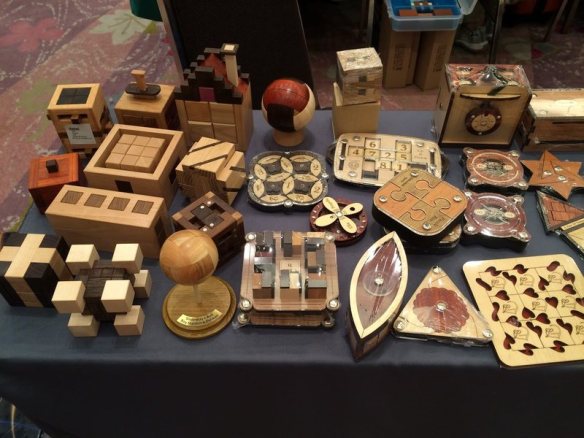
What if I told you that there’s a secret cabal of puzzle enthusiasts lurking in the shadows of the global puzzle community? A group that meets once a year in different locations, rotating between the United States, Europe, and Japan. An invite-only assortment of puzzle collectors and innovators who bring mechanical puzzles to challenge and delight their fellow attendees.

Yes, we’re talking about a clandestine event where puzzle collectors discuss, show off, and trade mechanical puzzles and brain teasers they’ve designed or crafted themselves.

yoshi2

[Image courtesy of Atlas Obscura.]

No commercially available puzzles can be brought as gifts, since you might duplicate a puzzle that’s already in someone’s collection.

But swapping and selling puzzles isn’t all that happens at one of these International Puzzle Party events. No, they’re also home to the Nob Yoshigahara Puzzle Design Competition, an annual award centered around mechanical puzzles. More specifically, the winners of the competition are announced at the IPP.

yoshi1

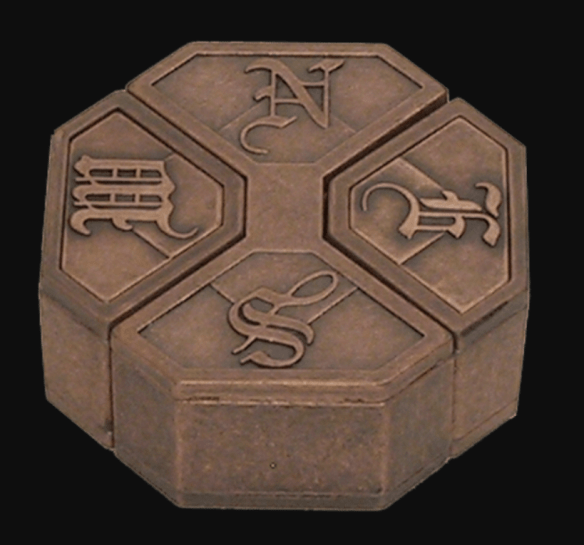
[One of Yoshigahara’s most famous puzzles. Image courtesy of Mr. Puzzle.]

Named after the prolific and innovative puzzle designer Nob Yoshigahara, the competition was founded in 2001, and named after Yoshigahara in 2005.

The entries for this year’s competition have until June 15th, 2020, to submit their puzzle for consideration. (This year’s competition was announced back in November of last year.)

Usually, only 5-7 puzzles out of all those submitted will be selected by one of that year’s judges for consideration. Each puzzle is graded on how innovative the concept is, how well the puzzle is physically designed (both aesthetically and mechanically), and how enjoyable the solving experience is.

[The 2017 competition winner, Kakoi.]

Anyone may submit his or her own mechanical puzzle design, independent of Puzzle Party affiliation.

There is a Puzzlers’ Award for the top design as well as Jury Prizes for other submissions (a grand prize, 1st prize, and honorable mention).

You can check out a listing of the 2018 competition submissions here to see the incredible variety and creativity represented in a single year’s pool of submissions. (Including links for purchase if any of them catch your eye!)

Personally, I’m a sucker for secret societies, invite-only activities, and so on, so I love the concept of a puzzle competition created for and judged by fellow puzzlers.

Oh, wait. Before I go. You may be asking yourself why all the secrecy? Well, apparently, there were several attempts by companies to infiltrate the event and bootleg puzzle ideas for market. It’s simultaneously insane and totally believable for spycraft like this to be taking place at a puzzle event.

In any case, I wish the best of luck to everyone submitting their puzzles to this year’s competition!


Thanks for visiting PuzzleNation Blog today! Be sure to sign up for our newsletter to stay up-to-date on everything PuzzleNation!

You can also share your pictures with us on Instagram, friend us on Facebook, check us out on TwitterPinterest, and Tumblr, and explore the always-expanding library of PuzzleNation apps and games on our website!

The Coronavirus Hits the Board Game Industry

coronavirus

[Image courtesy of NBC News.]

The coronavirus has dominated the news recently. Health organizations in numerous states and countries have posted informational guides on identifying the virus and the stock market has taken a hit due to an upswing in reported cases.

After a few weeks of reporting, we’re starting to get news stories about the global economic impact of the coronavirus, as boats loaded with shipping containers from China are being held up (if the warehouses and factories have been allowed to ship out products at all).

This has hit the board game industry particularly hard.

As you might expect, many board games are manufactured in China due to the competitive pricing available there, but the one-two punch of Chinese New Year and the coronavirus have left many game companies in the lurch with regard to product availability.

chinese-new-year-5

[Image courtesy of How Stuff Works.]

Chinese New Year is a period of tremendous turnover for staffing in factories in China, so production is often shutdown entirely or severely curtailed during the holiday. As new employees are hired, their training time also eats into production time.

Additionally, the Chinese government mandated that all “non-essential” companies stay closed until February 9th, and board game production is naturally considered non-essential. The ports are similarly either closed or dramatically reduced in staff.

Oh, and for many companies, that directive has been extended until March 2nd at the earliest. (Some publishers have speculated that delays of three months could be looming.)

So even in the areas where employees and manufacturers are thankfully healthy, they can’t work. I’ve gotten updates from a half-dozen different board game Kickstarter projects regarding coronavirus-related delays. Whether they’re trying to start production or they’ve got all their games printed, but trapped in warehouses waiting for shipment, they’re in limbo during this crisis.

containership

[Image courtesy of AGU.]

Our hearts go out to those affected by the virus. Here’s hoping the hard-working folks in those factories stay healthy, and can return to work soon.

But if you’re wondering why your Kickstarter goodies haven’t been delivered yet, or why your favorite game’s latest expansion isn’t on shelves yet, here’s why.


Thanks for visiting PuzzleNation Blog today! Be sure to sign up for our newsletter to stay up-to-date on everything PuzzleNation!

You can also share your pictures with us on Instagram, friend us on Facebook, check us out on TwitterPinterest, and Tumblr, and explore the always-expanding library of PuzzleNation apps and games on our website!

PuzzleNation Product Review: Pocket Brainteasers

4j0

[Note: I received a free copy of each brain teaser in exchange for a fair, unbiased review. Due diligence, full disclosure, and all that.]

Whether it’s composed of two simple pieces of twisted metal or a elaborate arrangement of parts, a mechanical brain teaser are great fun. It’s a plaything, a curiosity to be fiddled with, tinkered with, and explored, twisted and turned every which way until you feel like you’ve got a handle on all the different ways you can manipulate it.

And then, suddenly, BAM. Inspiration strikes! The a-ha moment happens, and you unravel its secrets.

ThinkFun, purveyors of deduction and logic puzzle games galore, have returned to the field recently, and in today’s product review, we look at a collection of brain teasers that each offer their own unique a-ha moment, if you’re willing to work at it.

ThinkFun’s Pocket Brainteasers range in difficulty from one to four (one being the easiest/least challenging), and you’ll find your puzzle skills tested in several ways as you tackle each. Although intended for solvers 8 and up, older solvers will still enjoy the puzzly tricks awaiting them in ThinkFun’s latest line of puzzle products.


4j1

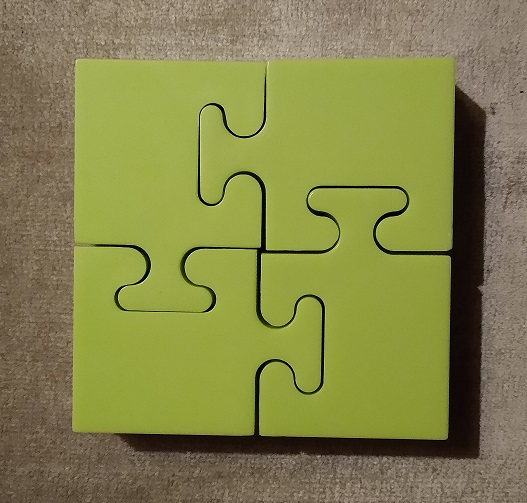
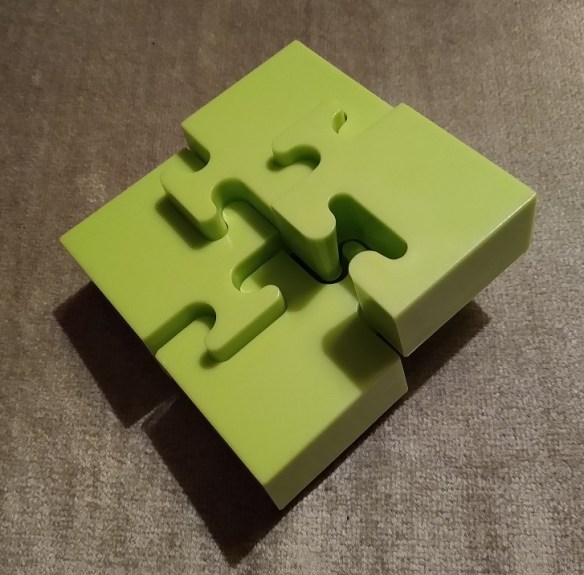
4-Piece Jigsaw

It sounds simple, doesn’t it? A four-piece jigsaw puzzle. Better yet, it’s already assembled for you! All you have to do is take it apart.

This level 1 brainteaser is obviously more than meets the eye, as the puzzle pieces shift back and forth but never quite seem to separate the way you’d expect.

4j2

The large plastic pieces are perfect for younger solvers to play around with, solid and resistant to the sometimes harsh manipulations of younger hands.

It’s not much of a challenge for an experienced solver, but it was genuine fun to suss out how the pieces worked together and how to finally separate them.

4j3

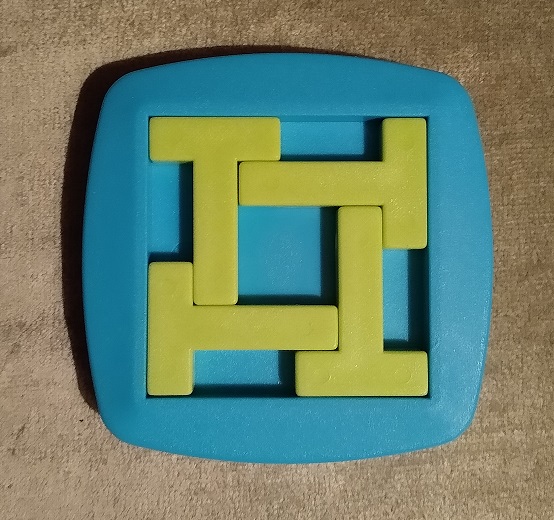
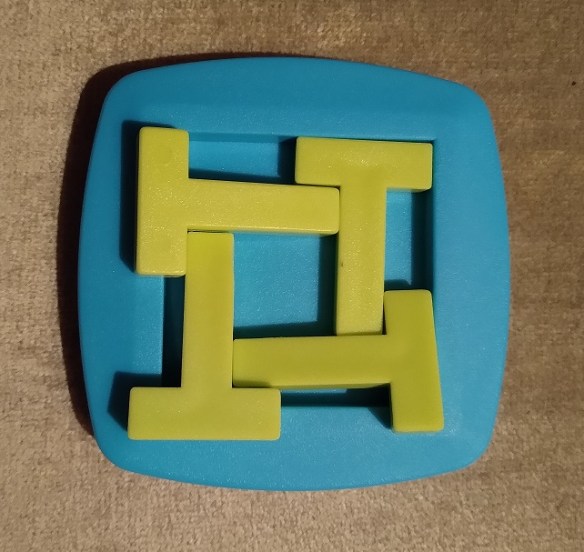
4-T Puzzle

This level 2 brainteaser followed the same basic formula as 4-Piece Jigsaw — four pieces to assemble — but in this case, their interactions were constrained by the small tray included with the puzzle.

4j4

As you can see, the solution offered on one side simply won’t work on the other because the tray is smaller, so solvers will have to be extra crafty to place all four T-blocks into the available space.

The T-shaped pieces made for curious solving — since they don’t fit flush with the corners the way traditional tangrams or Tetrominoes would — but patience and cleverness will be rewarded. It’s amazing how a relatively simple set-up — shapes and a tray — can result in a satisfying puzzly experience.

4j5

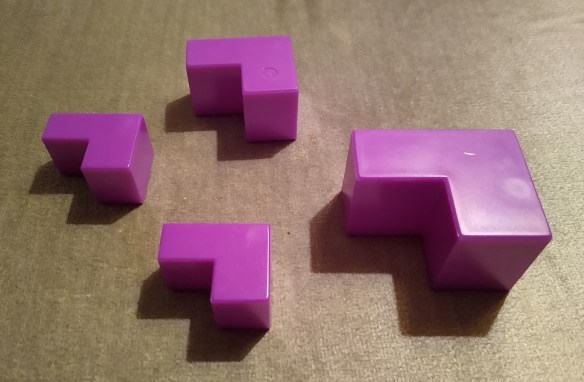
The Fifth Chair

This time around, there’s no tray or framework to negotiate. Instead, you’ve got four L-pieces (or “chairs”) and your goal is to make a larger L-shaped chair by combining the four you already have.

Like a three-dimensional version of tangrams, The Fifth Chair is an enjoyable solve, requiring you to maneuver the chairs in all sorts of combinations, seeing different relationships between them all as you try to figure out how to bring the fifth chair to life.

Despite being the level 3 puzzle in the set, I actually found this to be the most challenging of the quartet, as I was briefly overwhelmed by the sheer number of options available to me.

Of course, as soon as I figured out the solution, it felt obvious, and I breathed a sigh of puzzly relief as I conquered the third of four brainteasers for the evening.

4j6

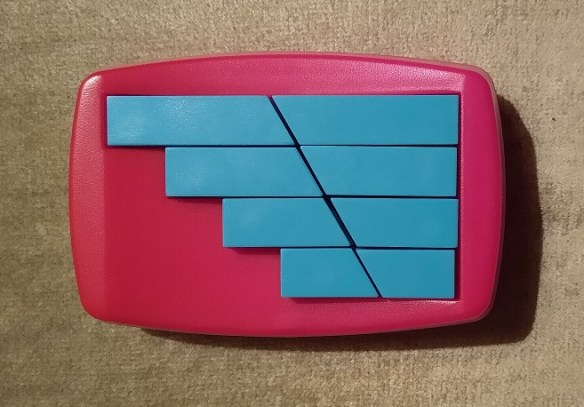
Rec-Tangle

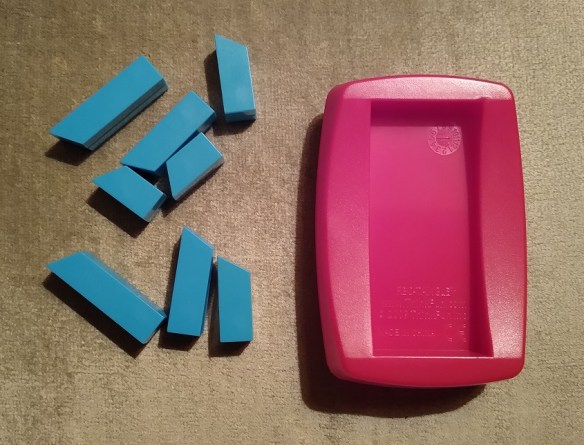
Designed to resemble the service bars of a cellphone or an internet connection, the “bars” are cut diagonally into halves, leaving the solver with 8 pieces to arrange.

This level 4 puzzle solves quite similarly to 4-T Puzzle. You have an array of pieces to place into a smaller space on the backside of the puzzle tray.

4j7

The unusual pieces — long and thin, with an angled edge on one side and a flat end on the other — offered all sorts of possibilities when it comes to placement in the tray, so I found myself discarding quite a few theories and ideas before alighting on the correct solution.

Nonetheless, I would still consider this puzzle easier than The Fifth Chair, though still harder than 4-T Puzzle or 4-Piece Jigsaw.


Tackling this tetrad of brainteasers was a treat, especially as it felt like I was exercising plenty of puzzly skills that aren’t used nearly as often as pen-and-paper puzzles usually demand.

The combination of spacial awareness, physical manipulation of puzzle pieces, and the strategy involved in cracking each made for a feast of puzzly experiences. Any one of the four would be fun, so getting to try all four was a delight.

Whether intended as stocking stuffers or affordable little puzzly surprises for the solver in your life, I suspect these pocket-sized puzzles will have the younger solvers you know puzzling away for a while to come.

Pocket Brainteasers are available from ThinkFun and select online retailers, only $6.99 each for 4-Piece Jigsaw, 4-T Puzzle, The Fifth Chair, and Rec-Tangle!


Thanks for visiting PuzzleNation Blog today! Be sure to sign up for our newsletter to stay up-to-date on everything PuzzleNation!

You can also share your pictures with us on Instagram, friend us on Facebook, check us out on TwitterPinterest, and Tumblr, and explore the always-expanding library of PuzzleNation apps and games on our website!
Intuitive vs. Non-Intuitive Puzzles

littlegirlatgrandmas

[Image courtesy of The Spruce Crafts.]

Sometimes, when you look at a puzzle, you know immediately what to do and how to solve. In my opinion, a great deal of Sudoku’s success is due to its intuitive nature. You see the grid, the numbers, and you know how to proceed.

Crosswords are similarly straightforward, with numbered clues and grid squares to guide new solvers. (The “across” and “down” directions also help immensely.)

That’s not to say that these puzzles can’t be off-putting to new solvers, despite their intuitive nature. I know plenty of people who are put off by crosswords simply by reputation, while others avoid Sudoku because they’re accustomed to avoiding ANY puzzle that involves numbers, assuming that some math is involved. (I suspect that KenKen, despite its successes, failed to replicate the wild popularity of Sudoku for similar reasons.)

But plenty of other puzzles require some explanation before you can dive in. A Marching Bands or Rows Garden puzzle, for instance, isn’t immediately obvious, even if the puzzle makes plenty of sense once you’ve read the instructions or solved one yourself.

The lion’s share of pen-and-paper puzzles fall into this category. No matter how eye-catching the grid or familiar the solving style, a solver can’t simply leap right into solving.

Thankfully, this won’t deter most solvers, who gleefully accept new challenges as they come, so long as they are fair and make sense after a minute or so of thought. Cryptic crossword-style cluing is a terrific example of this. At first glance, the clues might appear to be gibberish. But within each clue lurks the necessary tools to unlock it and find the answer word.

Brain teasers often function the same way. You’re presented with a problem — a light bulb you can’t see and three possible switches for it, for instance — and you need to figure out a way to solve it. It might involve deduction, wordplay, or some clever outside-the-box thinking, but once you find the answer, it rarely feels unfair or unreasonable.

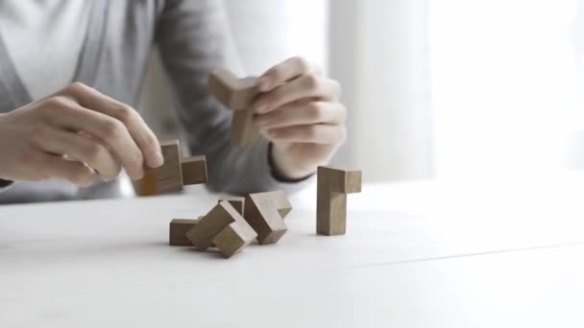
solvingwoodenbrainteaser

[Image courtesy of Deposit Photos.]

But, then again, there are also puzzles that can baffle you even once you’ve read the instructions and stared at the layout for a few minutes. Either the rules are complex or the solving style so unfamiliar or alien that the solver simply can’t find a way in.

In short, puzzles as a whole operate on a spectrum that spans from intuitive to non-intuitive.

Want an example of baffling or non-intuitive? You got it.

GAMES Magazine once ran a puzzle entitled “Escape from the Dungeon,” where the solver had to locate a weapon in a D&D-style dungeon. A very small crossword puzzle was found in one room on a paper scroll.

But the solution had nothing to do with solving the crossword.

The actual solution was to take the crossword to a magician who removed letters from the fronts of words. Removing the C-R-O-S left you with a sword, completing the overall puzzle.

That sort of thinking is so outside the box that it might as well be in a different store entirely. Video games, particularly ones from the point-and-click era, have more than their fair share of non-intuitive puzzles like this. You can check out these lists for numerous examples.

3122

And as escape rooms grow in popularity, more of them seem to be succumbing to less intuitive puzzling as a result of trying to challenge solvers.

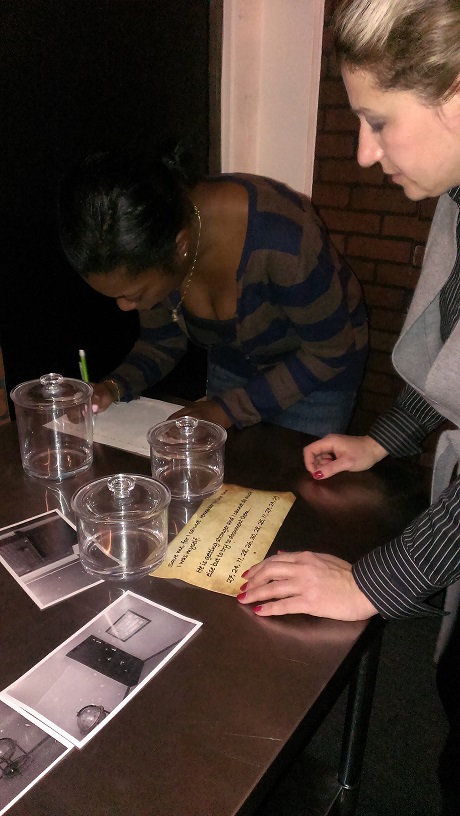
For example, in one escape room I tried, various fellow participants uncovered two stars, a picture of the three blind mice, and four different items that represented the seasons. Amidst all the locks to open, puzzles to unravel, and secrets to find, it never occurred to any of us that these three unconnected numbers would have to be assembled as a combination to a lock. By asking for a hint, we were able to figure out to put them together and open the lock, but it’s not a terribly intuitive puzzle.

Perhaps the greatest challenge for a puzzle constructor — be it a pen-and-paper puzzle, an escape room scenario, or a puzzle hunt dilemma — is not creating a dynamite, unique puzzle, but ensuring that finding the solution is fair, even if it’s difficult or mind-boggling.

This sort of thinking informs not only my work as a puzzlesmith, but the designs for my roleplaying games as well. If my players encounter a gap, there’s some way across. If there’s a locked door, there’s a way through it. Oftentimes, there’s more than one, because my players frequently come up with a solution that eluded me.

In the end, that’s the point. All puzzles, no matter how difficult, exist for one reason: to be solved. To provide that rush, that a-ha moment, that satisfaction that comes with overcoming the clever, devious creation of another sharp mind.

And non-intuitive puzzles are tantamount to rigging the game.


Thanks for visiting PuzzleNation Blog today! Be sure to sign up for our newsletter to stay up-to-date on everything PuzzleNation!

You can also share your pictures with us on Instagram, friend us on Facebook, check us out on TwitterPinterest, and Tumblr, and explore the always-expanding library of PuzzleNation apps and games on our website!