Roll with it!

When it comes to games, there’s probably no component more common or familiar than the six-sided die. From craps to Yahtzee, backgammon to Monopoly, everyone has played a game where the dice controlled your destiny.

And there are several games where the dice are integral to the puzzly gameplay.

The most obvious example is Boggle and its numerous variants. Boggle is played with a 4×4 grid of dice with letters on them, shaken up in order to randomize the letters shown. Players have a limited amount of time to spell out as many words as possible, moving from one letter to an adjacent one.

Testing both your vocabulary and anagramming skills, Boggle is great fun and a terrific challenge, depending on the letters you get. (It can also depend on which edition of the game you purchase, since some have different available letters in order to facilitate gameplay.)

Along that line, I actually received a great puzzly dice game as my Secret Santa gift in the office this year. (How did they know I like puzzles and games!?)

It’s called Campbell’s Alphabet Dice Game, and it’s a marvelous mix of Boggle, Yahtzee, and anagramming games, challenging the players to conjure words from the letters they roll.

The packaging is clever, and the game is designed with all sorts of puzzly references to cooking. With higher-valued letters and a low-stress game mechanic — if you’re stumped, everyone rerolls their letters instead of making one player suffer with crummy letters — it’s a nice addition to my puzzle game treasure chest.

And when it comes to letter-dice games, we have to talk about one of my all-time favorites, Scattergories.

In Scattergories, you roll a giant 20-sided die with numerous letters on it, determining what letter everyone will be using that round. Then players are required to come up with one word for each category that starts with that letter.

The puzzly aspect comes not only from coming up with appropriate words to fit each category, but trying to figure out which words your fellow players WOULDN’T come up with themselves, since answers duplicated by one or more players are worth zero points.

It can be a real challenge to not only come up with ten answers on the fly, but to then try to get into the heads of your opponents and guess what words THEY’D write. More than once, I’ve psyched myself out by assuming one answer was too easy and changing it, only to discover a friend had done the exact same thing. *laughs*

Of course, I would be be remiss if I didn’t mention Dungeons & Dragons, a dice game that goes far beyond the average board game-playing experience.

When it comes to conquering puzzles, some of the best puzzle-solving experiences of my life have been in sessions of Dungeons & Dragons with friends.

Whether it was unraveling a curious mechanical puzzle in order to unlock a door, solving a devious riddle to avert some horrible outcome, or devising a clever way to combine the tools at hand to overcome an unexpected obstacle, my puzzle skills often served me well, allowing me to match wits with dark wizards and perilous foes.

This weekend marked the 40th Anniversary of the birth of the world’s most famous roleplaying game, and it’s hard to deny the incredible legacy sparked by those curiously-shaped dice.

Dice games come in all shapes and sizes — as do the dice themselves! — but they add a marvelous wrinkle of randomness and challenge to the puzzle-game community.

What are your favorite puzzly dice games? Did I miss any major ones? Let me know in the comments!

Thanks for visiting the PuzzleNation blog today! You can like us on Facebookfollow us on Twitter, cruise our boards on Pinterest, check out our Tumblr, download our puzzle iBooks and apps, play our games at PuzzleNation.com, or contact us here at the blog!

PuzzleNation on the go!

Hello puzzlers and PuzzleNationers!

One of the most exciting developments for PuzzleNation has been our move into the mobile puzzle-game market with our apps and iBooks. You can take PuzzleNation puzzles with you wherever you go,

First off, we have our marvelous Classic Word Search iBooks! Volume 1, Volume 2, and Volume 3 are all available for the iPad! With an adaptable screen and plenty of puzzles to keep you busy, Classic Word Search is a terrific way to pass the time!

Classic Word Search is also available for Kindle Fire through the Amazon App Store!

And our friends at Penny/Dell Puzzles have a wonderful app for iPhone and iPad! Check out the Penny/Dell Crossword App, featuring smart navigation to move you to partially filled-in entries and an alternate-clue option to help you solve!

(And keep your eyes peeled for the Penny/Dell Jumbo Crosswords App, which launches in early February!

2014 promises to be our best and most accessible year yet, so please revisit this page to explore our latest additions to the PuzzleNation mobile line-up!

Bigger really is better, sometimes…

giantsudoku

[A massive Sudoku grid, created to promote a Sudoku gameshow in England in 2005.]

There’s just something about puzzles on a grand scale. From the Great Urban Race’s citywide scavenger hunts to the Internet-spanning curiosity that is Cicada 3301, puzzly ambition makes for some truly mindblowing experiences.

But those are puzzles of staggering complexity and scope, not actual physical size. When it comes to sheer dimensions, you have to go building-size.

There is, of course, the solvable crossword from Lviv, Ukraine, where the grid takes up the entire side of an apartment building, with clues hidden all over the city. It’s a brilliant tourism move and a terrific challenge (especially if you don’t read Cyrillic).

OLYMPUS DIGITAL CAMERA

There was also the classic MIT hack from 2012 where ambitious miscreants transformed one side of the Green Building into a multicolored, playable Tetris game. (I recently learned that students from Brown University in Rhode Island accomplished a single-color version of the same feat back in 2000. You can find video of both hacks here.)

tetris1_img6080

But Javier Lloret has upped the ante with Puzzle Facade, an art installation which transforms the Ars Electronica building in Linz, Austria into a solvable Rubik’s Cube.

Using a small handheld cube as an interface, a solver can manipulate the cube and watch the same changes carried out across two entire sides of the building in full color.

rubikbuilding

As you might expect, having only two sides of the cube available makes for a greater solving challenge, but who cares when you’re lighting up a building with every twist and turn!

It’s a fantastic meeting of puzzly fun and electronic wizardry, and the latest in a grand tradition of massive-scale creativity. I cannot wait to see what intrepid puzzlers come up with next.

Thanks for visiting the PuzzleNation blog today! You can like us on Facebookfollow us on Twitter, cruise our boards on Pinterest, check out our Tumblr, download our Classic Word Search iBook (recently featured by Apple in the Made for iBooks category!), play our games at PuzzleNation.com, or contact us here at the blog!

PuzzleNation Product Review: Pink Hijinks, Chrononauts, and Fluxx: The Board Game

fluxx0

Looney Labs is a game company with a creative model everyone can get behind: high replay value through wildly interactive, adaptable game play. Perhaps best known for their card game Fluxx, Looney Labs games are designed for portability, packing a lot of punch into smaller, more efficient packaging.

They offered us the opportunity to try out three of their games for the Holiday Puzzly Gift Guide, each with its own unique flavor and playing style, and we put them to the full PuzzleNation Blog test.

pink1

The set-up for Pink Hijinks seems simple enough. Three stacks of pink pyramids (small on top of medium on top of large, like a little tree) occupy the middle row of a 3×3 grid.

Based on the roll of the die, you and your opponent maneuver your pieces with one of two goals in mind: either trying to either fill your home row with all three pyramids of a given size, or pushing all nine pyramids into your opponent’s row.

It’s a miniature chess game, allowing for offensive and defensive strategies. After a few rounds, we started improvising new rules and different gameplay styles, and discovered how much fun you could have with nine little pink pyramids. Pretty good for a game that fits in your pocket.

pink2

Pink Hijinks is part of Looney Labs’ multi-colored Looney Pyramids series, an ever-expanding line of puzzle games built around their signature pyramid game pieces. Not only can you buy individual games, but the company is constantly releasing new variations on their games through their website, allowing players to combine pieces from multiple Looney Pyramids products and play brand-new games. (They’ve even compiled a listing of fan-designed games using Looney Pyramids!)

As far as I can tell, the Looney Pyramids series has the loftiest of goals: to offer as many unique playing experiences as a deck of cards, arguably the most adaptable tool in a gamester’s arsenal. And based on their lineup thus far, Looney Labs is well on their way toward reaching that goal.

chrono1

Time travel isn’t easy. If it was, everyone would do it. And Looney Labs takes that idea to the next level with Chrononauts, a card game where multiple time travelers are manipulating history, capturing artifacts, and racing to return to their own time with their missions complete.

Chrononauts is all about the cards. You’ve got mission cards, ID cards, timeline cards that make up the playing space, artifact cards, cards that change history (and others that change it back), as well as cards that can help or hinder your fellow time travelers.

chrono2

The history-changing aspect is the most puzzly part of the game, as you determine what moments to change (and which to protect from your opponents) in order for your timeline to come to pass, but ensuring you don’t accidentally end the game by creating too many temporal paradoxes. The designers did an impressive job figuring out how major points in history were interconnecting, and watching the effect ripple down through the cards after making a bold history-altering move is arguably the best part of the game.

My one caveat regarding Chrononauts is that the game goes far too quickly with only two players. It’s a game designed around consequences, and the more consequences that are out of your hands, the more engaging and challenging the game becomes. I’d recommend you always recruit as many players as possible to make the gameplay last.

fluxx2

There are certain things you take for granted when playing a board game. You pick your game piece, and that’s yours for the duration of the game. You draw a given number of cards per turn. The board itself is static, so you can strategize.

But in Fluxx: The Board Game (titled to distinguish it from Fluxx: The Card Game), all of these givens are up for grabs, making for easily the most gleefully chaotic board game experience I’ve ever had. The board is made up of nine individual tiles, which can be shifted or rotated by your fellow players. The rules can be changed, affecting the number of spaces you move per round, how many cards you can hold, and even how many goals you must achieve before the game is over.

fluxx1

[A simple punch card helps players keep track of the ever-shifting rules.]

It’s mind-melting fun, a game that demands constant awareness and a strong ability to think on your feet, since the rules can change in an instant. (One game, a card was played that made the players switch game pieces, so I went from little blue men to little green circles, and the swerve threw me off for at least two rounds.)

fluxx3

Fluxx is the perfect example of the Looney Labs creative model: high replay value through wildly interactive, adaptable game play. Every game of Fluxx is different, not only because the rules are so malleable, but because with multiple games under your belt, you and your opponents become craftier, more adeptly manipulating the board and the rules to your advantage. It’s a great time.

I think puzzle fans and board game fans alike will find quite a bit to enjoy with the games from Looney Labs. So if you’ve got some Christmas cash burning a hole in your pocket, check them out!


Thanks for visiting the PuzzleNation blog today! You can like us on Facebookfollow us on Twitter, cruise our boards on Pinterest, check out our Tumblr, download our Classic Word Search iBook (recently featured by Apple in the Made for iBooks category!), play our games at PuzzleNation.com, or contact us here at the blog!

The greatest gift exchange there never was…

It’s Christmas Eve, so hopefully you’ve perused our Holiday Puzzly Gift Guide and completed all your shopping in a timely and not-at-stress-inducing, hair-tearing-out manner.

But if not, fear not! Some of the puzzliest and cleverest people in the artistic, board game, and puzzle communities may have just come up with the perfect last-minute solution for you.

You’re probably familiar with the concept of the White Elephant gift exchange, wherein everyone supplies a gift, and then a game of keeping or swapping takes over, allowing people to take turns, develop friendly little rivalries, and generally enjoy a bit of holiday frivolity.

But have you ever heard of a White Heffalump exchange?

This year, numerous game designers, artists, and puzzlers were recruited to participate in a White Elephant gift exchange. But this exchange had a marvelous twist: every gift was imaginary.

So everyone involved — including such names as James Ernest (head of Cheapass Games, publishers of Veritas), John Kovalic (artist for Munchkin and creator of ROFL!) and puzzler constructions Eric Berlin and Brendan Emmett Quigley — created an imaginary gift for the exchange.

And then they all played the game on Twitter, so fans and friends could enjoy the madcap holiday cheer.

Here are a few of the “gifts” created for the White Heffalump gift exchange:

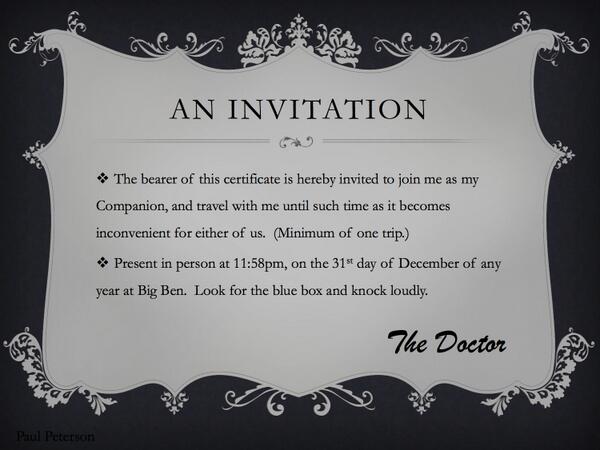
It’s easy to imagine a trip with The Doctor would be a highly sought-after prize.

What’s more heartwarming than retroactively sharing a friendship since first grade? (And possibly an iron-clad alibi, should you need one…)

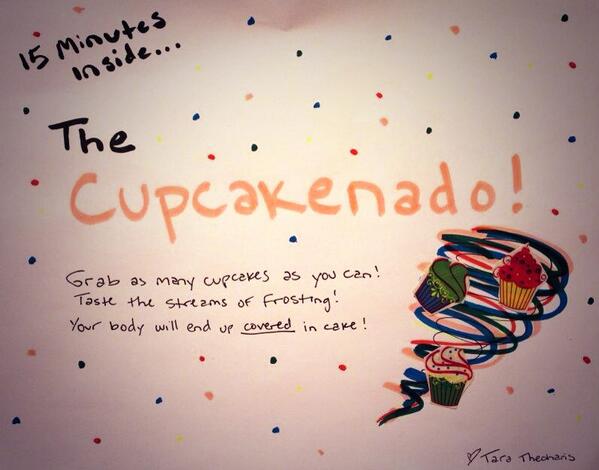
It’s like one of those grab-the-money booths from an old game show, but with SWEETS!

A formidable steed and a delicious meal all in one. You can’t lose!

And the wily Matt Forbeck offered up the ideal machine for generating presents for next year’s White Heffalump exchange.

From “time to play with toys” and a dapper platypus to a 29-word crossword and a wish-granting pocket pet, the gifts were hilarious, innovative, and absolutely ridiculous, and the gameplay back and forth as people traded and stole gifts was just as entertaining.

[For more details on the exchange, check out Matt Forbeck’s write-up here.]

So, if you’re still struggling with gift ideas, you can always go the White Heffalump route. It’s creative, low-budget, and loads of fun. Enjoy!

Thanks for visiting the PuzzleNation blog today! You can like us on Facebookfollow us on Twitter, cruise our boards on Pinterest, check out our Tumblr, download our Classic Word Search iBook (recently featured by Apple in the Made for iBooks category!), play our games at PuzzleNation.com, or contact us here at the blog!

PuzzleNation Product Reviews: The Stars Are Right and Castellan


Steve Jackson Games is a recognized and well-regarded name in both the roleplaying and board game communities. With a tradition of creating games that offer engaging and curious twists on well-worn puzzle and game templates, you never quite know what you’re getting yourself into when you pick up one of their products.

They offered us the opportunity to try out two of their games for the Holiday Puzzly Gift Guide, each with its own unique flavor and playing style, and we put them to the full PuzzleNation Blog test.

The Stars Are Right is a multiplayer card game where you rearrange the stars in the sky in order to summon minions and gather enough power to summon an elder god and destroy the world. It’s perfect for Christmas! =)

Seriously, though, this game is an effective fusion of several types of strategy and puzzle games. You have a simplified Magic: The Gathering-style card game with the different minions you can summon, as well as a wonderfully illustrated variant on a sliding tile puzzle in the 5×5 sky tiles laid out between the players.

Each card grants you a different opportunity to manipulate the sky (by flipping tiles over, swapping them, or shifting an entire row) and create new constellations. The more complicated the constellation, the more powerful the creature you summon, and the more points you get.

This sort of chain-solving and forward thinking becomes both more challenging and more enjoyable as you compete with other players and race toward your 10-point goal and victory. It’s as exciting to see someone change the sky to your advantage as it is frustrating to see your hard work foiled by an opportunistic move.

The artistic style of The Stars Are Right is thoroughly weird, channeling the works of H.P. Lovecraft and offering up all sorts of gross and bizarre creatures, which is juxtaposed nicely by the effective (and quite lovely) style of the sky tiles. It creates a curious separation between down-and-dirty (the card game aspect) vs. high-and-lofty (the elegant tile-puzzle aspect) that’s quite enjoyable.

All in all, The Stars Are Right is not only a strong introduction into more complicated card games, but a thoroughly fun puzzle game.

Which brings us to today’s second product review!

Castellan is a two-player puzzle-game where players both compete and collaborate to build an elaborate castle.

Every time a player completes a courtyard — walling it off completely from the rest of the game board — that courtyard is claimed, and the player is awarded points based on the number of towers framing the courtyard. The players have two small decks of cards that determine what pieces — towers, short walls, and long walls — they can play on their next turn, and once the cards are exhausted and every piece has been played, the player with the higher number of points wins, claiming the castle.

One of the most intuitive puzzle-games I’ve played in a long time, Castellan requires only a quick skim of the simple instructions before playing, making it a great introductory puzzle game for first-timers. And the molded plastic pieces add a wonderful tactile dimension to the playing experience. What kid, young or old, doesn’t want to build a castle?

But since the level of strategy and complexity is dictated by the players, this is hardly a game for kids alone. Puzzlers will find their spacial reasoning challenged as they assemble courtyards in their heads and try to determine which cards to play. Tactics and forward planning play a huge role in the gameplay, as you try to seize opportunities left by your opponent, claim courtyards, and use up your remaining pieces in ways that help you but won’t leave openings for your opponent to take advantage of.

And, quite honestly, it’s just fun to watch the board sprawl out as more and more pieces are added.

Castellan is appropriate for practically all ages (while The Stars Are Right’s monster art and general sensibilities could prove offputting to younger players or more traditional puzzle-gamers), but both bring something new to the table in terms of strategy, interactive gameplay, and puzzly challenges.

Thanks for visiting the PuzzleNation blog today! You can like us on Facebook, follow us on Twitter, cruise our boards on Pinterest, check out our Classic Word Search iBook (recently featured by Apple in the Made for iBooks category!), play our games at PuzzleNation.com, or contact us here at the blog!