The Art & Design of a Geometric Puzzle

It’s rare to get a glimpse inside the puzzly creative process.

Sure, plenty of crossword constructors are happy to share how particular puzzles of theirs came to be, but many constructors and designers, whether we’re talking mechanical puzzles, pen-and-paper puzzles, or electronic puzzles, keep their techniques and tricks secret. They’re like magicians that way.

So when a puzzler takes you behind the curtain, it’s a rare and special treat. The website Gamasutra recently hosted such an event when app designer and puzzler Paul Hlebowitsh explained in detail how he designs the puzzles for his app RYB.

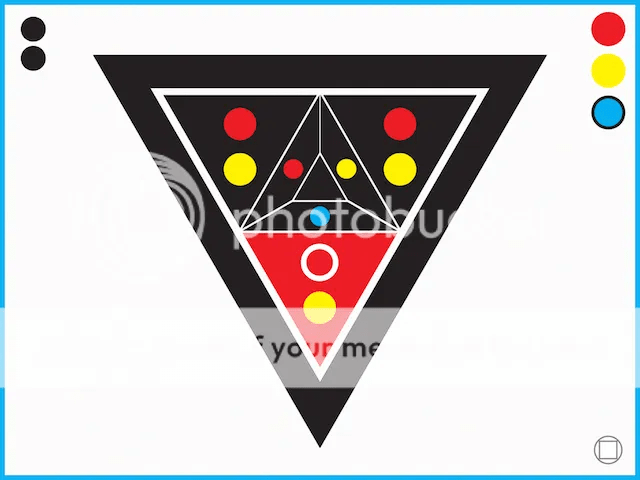
In Paul’s words, “RYB is very similar to ‘Minesweeper’ or ‘Hexcells,’ but instead of using numbers or symbols, it uses colors. The colored dots inside of a shape tell you how the neighboring shapes are colored.”

I love the devilish simplicity behind the solving. It’s so universal that it transcends the language barrier. Simply show another person the first step, and they’ll pick it up immediately.

Paul goes on to explain how one particular puzzle evolved as he sought the perfect mix of puzzly challenge and unique solvability.

He took this:

and eventually ended up with this:

It’s a fascinating read, one I can’t do justice to with a brief summary, so I suggest everyone check out the full post to watch an impressive constructor at work. Being walked step-by-step through a build by the designer is a delight.

I also have to praise the puzzles themselves. The mix of geometric shapes and colors creates a truly striking image. I think I’m gonna get a print made of this one and put it on my wall:


Thanks for visiting PuzzleNation Blog today! Be sure to sign up for our newsletter to stay up-to-date on everything PuzzleNation!

You can also share your pictures with us on Instagram, friend us on Facebook, check us out on TwitterPinterest, and Tumblr, and explore the always-expanding library of PuzzleNation apps and games on our website!

5 Questions for Author Derek Taylor Kent (Plus a Puzzly Announcement!)

Welcome to 5 Questions, our recurring interview series where we reach out to puzzle constructors, game designers, writers, filmmakers, musicians, artists, and puzzle enthusiasts from all walks of life!

It’s all about exploring the vast and intriguing puzzle community by talking to those who make puzzles and those who enjoy them! (Click here to check out previous editions of 5 Questions!)

And I’m excited to continue this series with Kubrick’s Game author Derek Taylor Kent as our latest 5 Questions interviewee!

Derek is a screenwriter, musician, and author, and his works have spanned print, TV, virtual reality, and soon, film. Although he’s better known for his middle grade efforts like Simon and the Solar System and the Scary School series, he has recently ventured into books for adults with his cinematic puzzle-fueled thriller Kubrick’s Game (which I recently reviewed here).

He has an exciting announcement connected to Kubrick’s Game to share with you, but before we get to that, let’s spend a little time getting to know this ambitious and amiable author, shall we?

Derek was gracious enough to take some time out to talk to us, so without further ado, let’s get to the interview!


5 Questions for Derek Taylor Kent

1. Was Kubrick’s Game your first foray into combining puzzles and writing? If so, what inspired the union of the two? If not, which came first for you, puzzles or writing?

In terms of puzzles being the crux of a plot, yes. I had incorporated some riddles and simple puzzles into some of my children’s fiction before, but only as a small element.

My primary inspiration for combining the two came from reading Ernest Cline’s Ready Player One back in 2011. In that book, the characters have to solve three intricate puzzles based on ’80s pop culture. The author was obsessed with 80s movies, music, and video games, so I began ruminating about what my subject would be if I were to write such a story. The obvious choice was Stanley Kubrick. He had been my favorite director since I was in high school and I was obsessed with his movies and all of the mystery that surrounded them.

As I delved further into it, the choice became more and more clear. Kubrick himself was an avid gamesman who loved puzzles, symbolism, and subliminal messages. The more I studied, the more I realized that it was not only believable, but almost likely, that he might have created a complex puzzle connecting each of his films. From there, it was just a matter of playing it out using markers that were already present.

[Image courtesy of Cinema Research Institute.]

2. How did the puzzles in the book come together? What did Kubrick’s game look like in its earliest iteration?

I had specific ideas for several of the puzzles and a general idea for others that I wanted to incorporate. Early in the process, I recruited two of the premiere puzzle-creators alive — Bob Glouberman and Larry Toffler of Fantastic Race. They create city-wide scavenger hunts, escape rooms, and puzzles for TV and movies. Luckily, they happened to be just as obsessed with Kubrick as I was and were very excited to come on board to help me create them.

If I were to write a book based on diabolical puzzles, I knew the book could only be as good as the puzzles themselves. While I could have probably created okay puzzles myself, I knew that theirs would be incredible and indeed they blew my mind.

I also knew that I wanted the puzzles to be Kubrickian, or cinematic in nature. That is, the clues would incorporate imagery, music, editing, and symbols, as opposed to wordplay or mathematical riddles. Also, they could only be solved by those familiar with the filmmaking process and masterful in its techniques, such as editing, lighting, projection, and sound design.

The final puzzle, which I dare not give away here, was present from the very beginning and had me most excited to write the book. I knew it had to end in that very special place, and was a type of puzzle that had never been created before, but it also made total sense considering the themes and hidden meanings of Kubrick’s final films.

3. If you’d been presented with a mystery like the one in your book, would you have taken the UCLA approach, the USC approach, or the antagonist’s approach?

Since the UCLA teammates are our protagonists, they were enacting my personal approach…most likely. They were most concerned with playing the game how Kubrick would have wanted it to be played, as opposed to other groups who, shall we say, put ethics aside for the sake of victory.

4. What’s next for Derek Taylor Kent?

Depending on how well Kubrick’s Game is received, I have plans for a continuation of cinema-themed puzzle adventure novels. I am also still writing middle-grade fiction and picture books and hope to have more of those released in the near future. I also wrote a horror feature film that is currently in pre-production, which will hopefully be coming out winter of 2018.

If your readers are interested in checking out any of my other work, everything is at DerekTaylorKent.com. Oh, and if you go to the Fun and Games section of ScarySchool.com, there’s a memory game you can play, and beating it will earn you the weirdest trophy you’ve ever seen.

5. If you could give the readers, writers, film enthusiasts, and puzzle fans in the audience one piece of advice, what would it be?

Well, since that is a very wide range of people, I think I will share my favorite piece of advice I ever received, which happened to come from the great actor Robert Forster. He told my class: “99% of everything you ever hear in your life will be somebody trying to convince you of something that’s not true in order to get into your pockets.”

What I like best about it, besides the encouragement of skepticism, is that as a novelist, I love being able to make a living selling something that isn’t BS. I can honestly tell kids, parents, or now my grown-up readers, that for a very reasonable price, my books will give you many hours of entertainment, and perhaps some enlightenment.


And speaking of hours of entertainment, it’s time for Derek’s big announcement!

As a marvelous real-world tie-in to Kubrick’s Game, Derek has launched The Game, an interactive solving experience guaranteed to challenge solvers and delight puzzlers worldwide!

This is a game for all readers to play.
If you’re reading this, play has already begun.
Six different puzzles each month to the day
Need to be solved for the game to be won.

That’s just a snippet of the introduction to set the scene. You can click here for full details — the first clue was revealed yesterday! — and sign up for his newsletter (bottom of the page here) to keep up on all things Derek Taylor Kent and Kubrick’s Game! (And, of course, you need to read the book to give yourself a fighting chance at solving The Game and finding the treasure!)

I think it’s an awesome way to expand on the world of the novel and to give solvers a puzzly conundrum to look forward to cracking! Good luck, my fellow puzzlers and PuzzleNationers!

Thank you, Derek, for taking the time out for 5 Questions! I can’t wait to see how The Game unfolds!


Thanks for visiting PuzzleNation Blog today! Be sure to sign up for our newsletter to stay up-to-date on everything PuzzleNation!

You can also share your pictures with us on Instagram, friend us on Facebook, check us out on TwitterPinterest, and Tumblr, and explore the always-expanding library of PuzzleNation apps and games on our website!

It’s Follow-Up Friday: Kickstarter Roundup edition!

Welcome to Follow-Up Friday!

By this time, you know the drill. Follow-Up Friday is a chance for us to revisit the subjects of previous posts and bring the PuzzleNation audience up to speed on all things puzzly.

And today, I’d like to return to the subject of crowdfunding.

2182c85d8c75501073538b61e615b14f_original

First, let’s talk about Herbaceous. Ed and the Herbaceous team were hoping for $6500 to make the game a reality, and they absolutely crushed that goal!

The final total was a staggering $59,032! Congrats to everyone involved, and kudos to all the PuzzleNationers that contributed!

And in the spirit of such marvelous Kickstarter success, let’s take a look at four very different projects that might appeal to puzzle fans and game enthusiasts!

originz

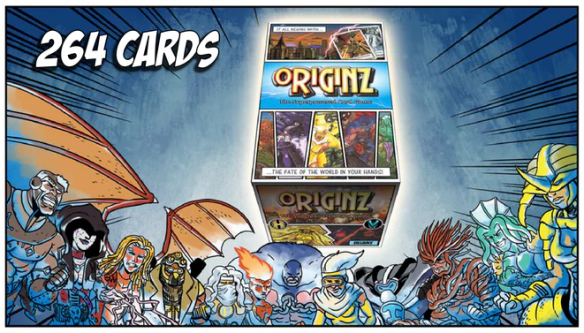
I missed my chance to try out Originz: The Superpowered Card Game at the CT FIG event earlier this year — though you can try it out at the CT FIG mid-year event this weekend in Newington, CT! — but I definitely like what I’ve seen from their Kickstarter campaign.

In this deck-building game, you try to equip your villain or hero with the best mix of powers imaginable to keep your foes at bay! This accessible game is richly illustrated and detailed, a sure-fire hit with any fans of superheroics in your household.

arch2o-into-mystery-by-eric-clough-01

If you’re looking for a more traditional style of puzzling, there are only a few days left to get in on the ground floor of LightBox, a Rubik’s-style light-up puzzle box.

By rotating and rearranging the layers of plastic that form the cube, you will illuminate different layers and create different patterns of light! Whether you’re solving to create a particular pattern or to shut the LightBox off entirely, you’re sure to work your brain into knots with this curious puzzle box.

worddomination

And speaking of short deadlines, there are only a few days left to contribute to Word Domination, an intriguing mix of Scrabble-style spelling and a strategy card game.

The concept is devilishly simple: by spelling words, you acquire artifacts to help you in your criminal escapades. The mix of tactical spelling — sometimes, shorter words have more value than longer words — with the roguish qualities of an evildoer allow for all sorts of gameplay possibilities.

I don’t think I’ve ever seen these two puzzle-game formats combined like this before, and the result could be something great.

b081a19a52e3bd99bf7a00754d2d77f0_original

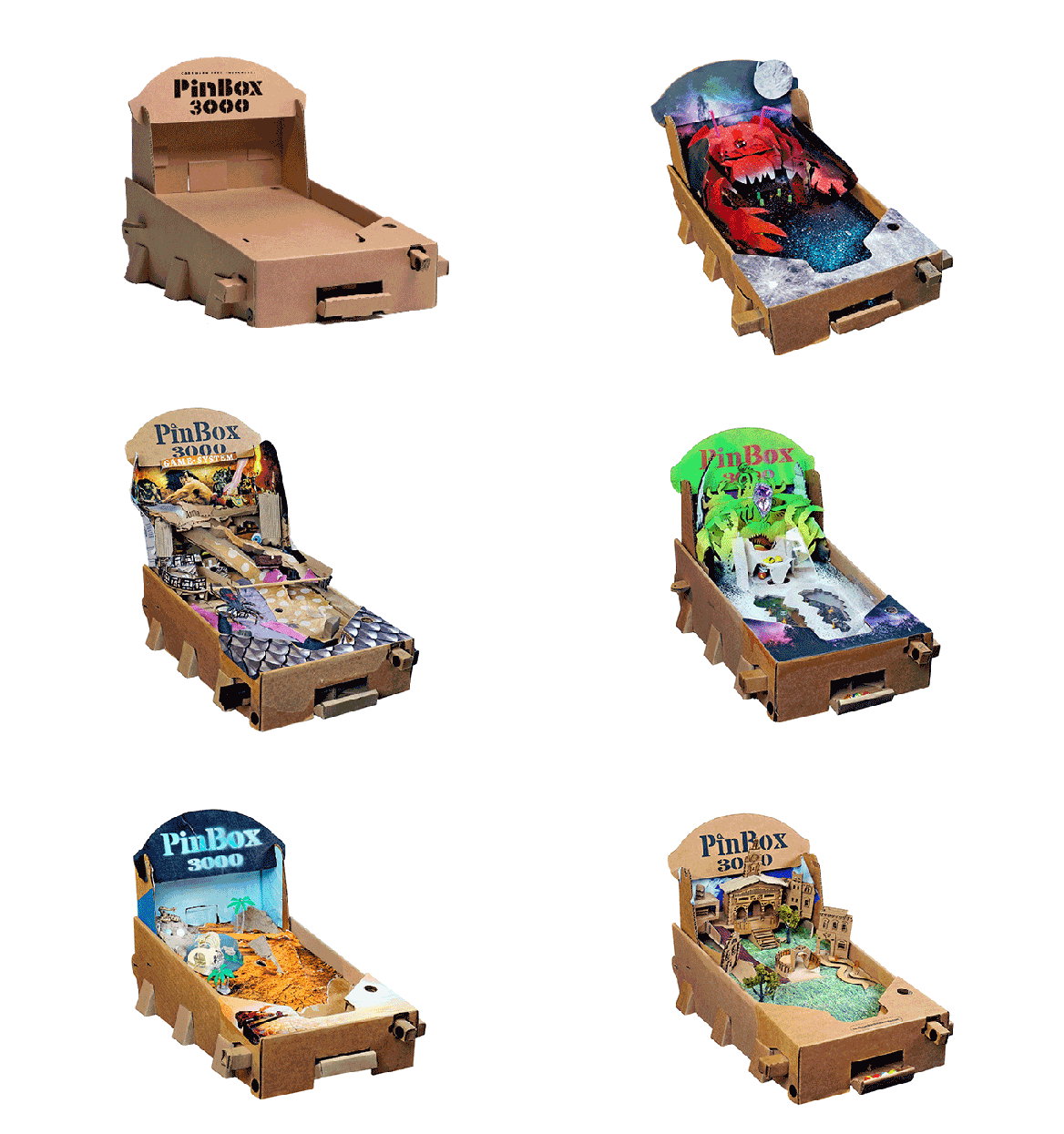
Our fourth and final project today has the most potential, simply because of its design. It’s the PinBox 3000, and it’s a foundation for designing, decorating, and constructing your very own pinball game.

Merging DIY possibilities with a classic form of game play seems like a no-brainer, and I can’t believe we haven’t seen something like this on the market before. This is the perfect community builder, and I can foresee forums and Pinterest pages popping up all over, as fans and creators share their unique designs. What an awesome palette to work with!

Hopefully one or more of these projects piques your interest, my fellow puzzlers and PuzzleNationers! I wish all of these creators the best of luck in shepherding their brainchildren toward success!


Thanks for visiting PuzzleNation Blog today! Be sure to sign up for our newsletter to stay up-to-date on everything PuzzleNation!

You can also share your pictures with us on Instagram, friend us on Facebook, check us out on TwitterPinterest, and Tumblr, and explore the always-expanding library of PuzzleNation apps and games on our website!

These brain teasers are the cat’s meow.

[Image courtesy of Psychlinks.ca.]

It’s difficult to write about the potential health benefits of puzzles. Believe me, I’ve tried.

But many scientific articles, research studies, and other professional analyses disagree on the short-term or long-term benefits that puzzles have on the brain. There’s a wealth of material out there on brain health and the impact of puzzles, but much of it is inconclusive.

I’ve always tried to be careful to discuss any scientific articles on brain health for that reason, especially after Lumosity’s two-million-dollar payout earlier this year for falsely advertising that their puzzle games could “reduce or delay cognitive impairment associated with age and other serious health conditions,” as well as “stave off memory loss, dementia, and even Alzheimer’s disease.”

That’s less of an issue, thankfully, when writing about other puzzle-solving creatures, though. In the past, we’ve seen crafty cockatoos, clever crows, outwitting octopuses, and deductive dogs. Apparently, we can also add cats to the list of fellow puzzlers!

[A mobile feeder toy. Image courtesy of Purina One.]

A recent article in the Journal of Feline Medicine and Surgery reports that their findings indicate that a healthy dose of puzzle-solving at mealtime is beneficial to a kitty’s welfare.

According to the folks at Gizmodo, by utilizing food puzzles that require cats to roll a toy to release some food or manipulate a game board to reveal food, “these puzzles take advantage of the feline hunting instinct, fulfilling their ingrained desires. By ‘foraging’ for food in this way, cats are more physically active, they experience reduced levels of stress, and they become less demanding of their owners.”

Apparently, it’s all about engaging the cats, giving them something to work against in order to earn the food. The case studies cited by the report include behavioral issues and obesity that were overcome thanks to the use of food puzzles.

[A stationary puzzle feeder. Image courtesy of CatFoodDispensersReviews.com.]

I already knew that cats were skilled at treasure and scavenger hunts — based on the absolutely ludicrous places I would find the toys my sister’s cats left behind, often weeks after their visits — but I had no idea they belonged among the elite puzzle-solving animals we’ve previously chronicled here.

Makes sense, though. I solve puzzles for snacks sometimes. *shrugs* It’s a living.


Thanks for visiting PuzzleNation Blog today! Be sure to sign up for our newsletter to stay up-to-date on everything PuzzleNation!

You can also share your pictures with us on Instagram, friend us on Facebook, check us out on TwitterPinterest, and Tumblr, and explore the always-expanding library of PuzzleNation apps and games on our website!

It’s Follow-Up Friday: Clue edition!

Welcome to Follow-Up Friday!

By this time, you know the drill. Follow-Up Friday is a chance for us to revisit the subjects of previous posts and bring the PuzzleNation audience up to speed on all things puzzly.

And today, I’d like to return to the subject of one of the classic deduction games: Clue.

[Image courtesy of Nerdist.]

Clue (also known as Cluedo) is a classic in several respects. It is a beloved board game, mentioned alongside Monopoly, Scrabble, Battleship, and Candyland as staples of board game culture, but one that is quite rare: a deduction-based game where you’re playing against both your opponents and the game itself. (The only other game I can think of that captures the same spirit of gameplay is Gameworthy Labs’ Oh My Gods!)

But the film version is also beloved by game devotees and comedy lovers alike. And although I’m dubious about the recently-announced remake of Clue coming to theaters in the near future, there is one revamp of the mystery property that I can get behind: a playable LEGO version of the game.

[Image courtesy of Nerdist.]

As part of the 2014 MOCOlympics — a competition between amateur LEGO designers, where MOC stands for “my own creation” — master builder Ian Spacek created this delightful set, which captures the spirit of each character and each of the game’s signature rooms in impressive miniature fashion.

You see, the challenge was to “build a game that you would choose to play on a rainy afternoon when the power’s out and you don’t have any juice left on your iDevices.” And I think Spacek’s design fits the bill with gusto.

[Spacek even designed a punch card to aid players. Image courtesy of Nerdist.]

I’d much rather see a company put money into releasing this little beauty than an unnecessary retread of one of my favorite films. (Unfortunately, since the MOC Olympics aren’t associated with the LEGO company, this set isn’t available for purchase.)

Somebody just needs to whip up a LEGO version of Murder By Death and I’ll be set for any rainy day to come.


Thanks for visiting PuzzleNation Blog today! Be sure to sign up for our newsletter to stay up-to-date on everything PuzzleNation!

You can also share your pictures with us on Instagram, friend us on Facebook, check us out on TwitterPinterest, and Tumblr, and explore the always-expanding library of PuzzleNation apps and games on our website!

PuzzleNation Book Review: Kubrick’s Game

Welcome to another installment of PuzzleNation Book Reviews!

All of the books discussed and/or reviewed in PNBR articles are either directly or indirectly related to the world of puzzling, and hopefully you’ll find something to tickle your literary fancy in this entry or the entries to come.

Let’s get started!

The subject of today’s book-review post is Derek Taylor Kent’s novel Kubrick’s Game.

Shawn Hagan is a film student at UCLA’s School of Film and Television, a gifted director of photography, cameraman, and lighting designer with aspirations toward directing. He’s probably like many cinephiles you know: obsessive, prone to losing himself in films, with a hard time relating to others.

He’s also a fan of puzzly scavenger hunts, tackling them with his friend Wilson, a former child star with his own directorial ambitions. They also recruit Shawn’s TA (and crush), Samira Singh, to join them. But when Shawn’s film professor asks for Shawn’s help deciphering the contents of a mysterious package, Wilson, Sami, and Shawn will find themselves on a puzzle hunt unlike anything they’ve ever seen.

The package is from visionary director Stanley Kubrick, a man who has been dead for fifteen years. Apparently, he left one last gift to his fans and fellow film lovers: an elaborate puzzle whose endgame could change history.

As Shawn, Wilson, and Sami unravel each clue, delving deep into Kubrick’s life and filmography, they discover they’re not the only ones in pursuit of the solution to Kubrick’s game; not only are students from other film schools also on the hunt, but shadowy forces are also working to solve the puzzle…forces that are willing to lie, cheat, steal, and worse to get what they want.

What could Kubrick have left behind to justify such means? Will Shawn, Sami, and Wilson solve the famous chessmaster’s last gambit?

Kubrick’s Game is a puzzly thriller/adventure piece very much in the vein of The Da Vinci Code, though a far more satisfying read, more akin to the Shakespeare-fueled mystery of Jennifer Lee Carrell’s Interred with Their Bones or Haunt Me Still than the smack-you-in-the-face-with-coincidence style of Mr. Brown. Kent is clearly a fan of Kubrick’s work, and that enthusiasm infuses every page of the story.

Part puzzle hunt, part tribute, and part whodunit, Kubrick’s Game revels in the minutiae of classic films, adding depth and meaning to cinematic quirks and questions that hardcore film geeks have been debating and theorizing about for years.

But Kent goes one step further by including relevant images and frames of film, allowing the reader to follow the narrative. You can’t quite solve the puzzles alongside the protagonists, especially in the later puzzles (unless you’re a serious Kubrick aficionado, that is), but you know enough to avoid any possible frustration.

On the puzzle side, there are really three puzzly narratives to unravel. The first is the puzzle hunt early in the game, which is very straightforward. The second is Kubrick’s game itself. The third is the whodunit of the story, pondering who Shawn and his team can trust and who they’re working against. It’s a multilayered narrative that never bogs down, despite the twists and turns and numerous characters in play.

[Image courtesy of Biography.com.]

Kubrick himself becomes a major player in the story, as his motivations, his choices, and his interests are crucial to the plot. His films as well become intriguing characters — particularly Eyes Wide Shut, often a maligned part of Kubrick’s legacy, though one I have more appreciation for after reading this book.

(And Kent is clearly having some fun with some of the conspiracy theories surrounding Kubrick’s life and works in this novel, but he does so without mocking.)

As for the human characters, Sami and Wilson are amiable support characters; they’re likable and capable, focused and flawed in their own ways, but Shawn is clearly the centerpiece of the novel, so most of Sami and Wilson’s more intriguing character aspects only emerge in reaction to Shawn.

As for Shawn, he’s a little polarizing, because you want to like him, but several of his choices make it hard to do so. Some of this can be attributed to Shawn’s social awkwardness and insensitivity; there are certain character moments that are selfish and border on the emotionally brutal.

(Some characters theorize that Shawn is on the spectrum, but I don’t feel comfortable commenting either way. It isn’t particularly germane to the plot, so long as you can accept that Shawn is fairly tone-deaf socially and has difficulty connecting with others.)

That being said, you cheer when Shawn succeeds and you root for him when he falters, which are signs of a solid protagonist.

Although the antagonists descend a bit into cartoonish villainy, that’s a minor quibble. For the most part, the stakes feel high and the mentality of Shawn, Wilson, and Sami’s team against the world is an easy one to buy into.

Kent has done an impressive job of constructing an elaborate mystery worthy of Kubrick’s labyrinthine storytelling, one that should satisfy thriller fans and puzzle fans alike.

Kubrick’s Game is available on Amazon in hardcover, softcover, audiobook, and ebook.

[Full disclosure: I received a free copy of today’s book in exchange for a review.]


Thanks for visiting PuzzleNation Blog today! Be sure to sign up for our newsletter to stay up-to-date on everything PuzzleNation!

You can also share your pictures with us on Instagram, friend us on Facebook, check us out on TwitterPinterest, and Tumblr, and explore the always-expanding library of PuzzleNation apps and games on our website!