Start your engines! It’s the Indie 500 crossword tournament!

Having recently attended the American Crossword Puzzle Tournament for the first time, I’ve been keeping my eyes peeled for other puzzle events and tournaments to check out.

And I stumbled across an upcoming tournament with a lot of positive buzz and interest: The Indie 500.

I decided to reach out to one of the participating constructors, Evan Birnholz of Devil Cross. Having met Evan at the ACPT this year, I knew he would be the perfect go-to guy to fill me in on everything Indie 500.

1.) What is The Indie 500?

The Indie 500 is a new crossword puzzle tournament started by five guys with their own free, independent crossword websites: Erik Agard, Peter Broda, Neville Fogarty, Andy Kravis, and myself. We’re each writing and editing the puzzles and we’re excited to hold our first tournament on May 30 down in Washington, DC.

2.) How does it differ from other crossword tournaments/events?

I think our tournament is, first, an outgrowth of the work we do on our respective websites. On a larger scale, it’s essentially a celebration of indie puzzling. The five of us behind the Indie 500 had published only a few puzzles in mainstream outlets before launching our sites, and now most of our crosswords are things that we’ve created for self-publication.

Because we each drew inspiration from independent puzzle writers like Brendan Emmett Quigley and Matt Gaffney and Ben Tausig, we wanted to give others who didn’t have many published puzzles to their name a chance to have a spotlight of their own, so we held a blind, open submission contest to find a sixth tournament constructor with fewer than ten publications in mainstream venues like The New York Times, The LA Times, CrosSynergy, and so on.

If nothing else, we figured this would inspire new constructors to be creative and submit something that they wouldn’t normally send in to a newspaper. We got several amazing submissions, and ended up picking a winner in Finn Vigeland.

[The six contributors to The Indie 500, plus initials.]

I believe our unique voices as puzzle-makers will help set our tournament apart from others. The puzzles on our sites tend to skew younger in content compared with mainstream puzzles — no surprise considering we’re all 31 or younger (I’m the oldest) — and so we like to dabble in themes and clues that reference modern and sometimes edgy material.

Because we don’t have the same space or “breakfast test” constraints that a newspaper puzzle might have, that gives us a lot of liberty to work with fresh and creative clues and themes, and we’re hoping to bring a similar vibe to our event.

We’re also throwing in some fun features that you likely won’t see at other tourneys. First, we’ll be releasing a separate meta puzzle suite before the tournament featuring puzzles by all five of us co-founders; the suite isn’t required for solving the tournament puzzles, but we think it will be fun all the same.

Next, the solvers who make it to the finals will get to have their own individual entrance music while we announce their names in style. How cool is that?

But the biggest thing that sets our tourney apart? Pie. There will be Pie. No other crossword tournament can promise you that.

[Pie: an Indie 500 guarantee.]

3.) How did it start? How did you get involved in the tournament?

We each started talking about running our own collaborative gig shortly after the 2014 American Crossword Puzzle Tournament. We just thought: events like this and Lollapuzzoola are such a blast, why not have our own tourney?

Of course we weren’t sure at first if it would be financially or logistically possible, but we got a great response from others in the puzzle world when we originally floated the idea. Over the last year, it’s just been a lot of planning, a lot of wrangling over the details, a lot of building and rebuilding grids… and now it’s almost here!

For myself, I just felt incredibly lucky to be included on the project with four other really talented puzzle constructors from the beginning. I had only published a small handful of puzzles on my website when we first discussed the idea of a new tournament, where the other four had been self-publishing for at least a year or two.

4.) As a constructor yourself, what’s your favorite part of an event like this? Do you have any favorite clues or puzzles you’ve crafted, either connected to the Indie 500 or on your own?

The best part about attending a crossword tournament is the camaraderie you get from hanging out with friends and meeting new people who enjoy the hobby of crosswords as much as you do. Solving the puzzles and creating them are fun to do, but that’s really secondary to the social aspect of a big event like this.

I’ve never had the chance to be on the other, more organizational side of things until now, but I will say that there’s a real rush I get from the thought of watching a whole room of people work on a puzzle of mine in real time.

[Solvers testing their skills at the Arlington Puzzle Festival.]

This won’t be the first time I’ve gotten that opportunity. Will Shortz once selected my first New York Times crossword as the final puzzle for the 2013 Westchester Crossword Tournament. That was a major thrill and I’m looking forward to that same adrenaline rush again.

As for favorite puzzles or clues of mine — I can’t really reveal much about what I’ve made for the tournament, but I’m a big fan of smooth grids with clues that really deliver a good a-ha moment, or at the very least make solvers laugh.

This early themeless puzzle is still one of my favorites because I was able to keep it relatively junk-free but still managed to fit in several longer, lively phrases.

This Halloween-themed puzzle was a nightmare to construct, but it had a fun gimmick and it gave me a chance to create some funny fake movie titles.

Often when I’m writing clues, I like to find quotations for famous people that may end up in my grids, especially comedians, since they’re usually a goldmine for funny sayings (like in 27-Down in this puzzle).

I’m also on the lookout for fresh angles on old crossword retreads — I once clued EDEN as [Apple site that was running perfectly until a couple of people violated its terms].

But for some reason, I still have a soft spot for a clue I wrote in the very first puzzle of mine that ever got published, in Ben Tausig’s Twenty Under Thirty compilation: [That’s what sheep said] (3 letters). The answer itself wasn’t exactly a great puzzle entry, but I figured, if the clue’s funny, people will still like it.


Thanks to Evan for taking the time out to answer my questions! You can check out the full details on The Indie 500 by clicking here!

I wish Evan and his fellow constructors the best of luck. Puzzle events and community-building efforts like this are always worthwhile endeavors.

Thanks for visiting PuzzleNation Blog today! You can share your pictures with us on Instagram, friend us on Facebook, check us out on TwitterPinterest, and Tumblr, and be sure to check out the growing library of PuzzleNation apps and games!

PuzzleNation wordplay = Now radiant puzzle ploy

[Alternate anagrams include “Puzzle patron, now daily” and “Plow into any rad puzzle.”]

Anagrams are a cornerstone of modern pen-and-paper puzzling.

They make frequent appearances in cryptic (or British-style) crossword clues, and many puzzles and puzzle games — from Anagram Magic Square and Text Twist to Secret Word and Bananagrams — rely heavily on anagrams as an integral part of the solve.

I’ve written about them several times in the past, but for the uninitiated, an anagram is a reordering of the letters in a word to form a new word or phrase. PEALS anagrams into LEAPS, PALES, LAPSE, SEPAL, and PLEAS.

As the old joke goes, “stifle” is an anagram of itself.

But the best anagrams rearrange the letters in a word into something related to that word. Fans of The Simpsons may recall that Alec Guinness anagrams into “genuine class.”

There are numerous examples of great anagrams all over the Internet. Here are a few classics:

  • The eyes = they see
  • Clint Eastwood = Old West action
  • Eleven plus two = Twelve plus one
  • Dormitory = Dirty room
  • A decimal point = I’m a dot in place
  • A gentleman = Elegant man

One of the best online anagram programs out there is hosted by wordsmith.org, and at the top of their page, they remind us that “internet anagram server” anagrams into “I, rearrangement servant.”

You can find some unexpected surprises when you play with anagrams. Did you know that William Shakespeare anagrams into both “I am a weakish speller” and “I’ll make a wise phrase”?

There are entire forums online dedicated to terrific anagrams, some fiendishly clever, others impressively insightful. (Of course, sometimes crafty punctuation makes all the difference.)

Madame Curie becomes “Me? Radium Ace.”

Monty Python’s Flying Circus becomes “Strongly psychotic, I’m funny.”

The possibilities seem endless when you delve into longer phrases. I’m going to close out this tribute to anagrams with two of the most amazing ones I’ve encountered during my time as a puzzler.

The first involves the iconic line as humanity took its first steps onto the surface of the Moon:

Neil Armstrong: That’s one small step for (a) man, one giant leap for mankind

anagrams into…

Thin man ran; makes (a) large stride, left planet, pins flag on moon! On to Mars!

[I’ve included both what Neil said and what was broadcast back to Earth. Hence, the A in parentheses in both versions.]

The second takes one of Shakespeare’s best known lines and offers some engagingly meta commentary on the play itself:

To be or not to be, that is the question, whether tis nobler in the mind to suffer the slings and arrows of outrageous fortune…

anagrams into…

In one of the Bard’s best-thought-of-tragedies, our insistent hero, Hamlet, queries on two fronts about how life turns rotten.

So whether you’re playing Scrabble or tackling David L. Hoyt‘s Jumble, anagramming is a worthwhile tool that belongs in every puzzler’s skillset.

Do you have any favorite anagrams, fellow puzzlers and PuzzleNationers? Let me know! I’d love to see them!

Thanks for visiting PuzzleNation Blog today! You can share your pictures with us on Instagram, friend us on Facebook, check us out on TwitterPinterest, and Tumblr, and be sure to check out the growing library of PuzzleNation apps and games!

It’s Follow-Up Friday: Birthday Puzzle edition!

Welcome to Follow-Up Friday!

By this time, you know the drill. Follow-Up Friday is a chance for us to revisit the subjects of previous posts and bring the PuzzleNation audience up to speed on all things puzzly.

And today, I’d like to return to the subject of birthday brain teasers!

Working on the Cheryl’s Birthday brain teaser a few days ago reminded me of another birthday-fueled puzzle that’s been around forever.

How many people do you need to enter a room before the probability of any 2 or more people sharing a birthday (day and month only, not year) is greater than 50%?

Assume for the sake of the puzzle that birthdays in the population at large are equally spread over a 365 day year.

Now, given that there are 365 days in the year, you’d assume the number of people necessary to get that probability of a shared birthday above 50% would be more than half of 365, or 183 people.

But it turns out that, statistically speaking, you don’t need anywhere near that many people.

Let’s break it down. Person A has a birthday. Person B has a birthday. There’s only one possible pairing, A-B. Person C has a birthday, but creates three possible birthday pairings: A-B, A-C, and B-C.

Person D could have a different birthday, but the introduction of Person D begins escalating the number of POSSIBLE shared birthdays. With these four people, we have SIX possible pairings: A-B, A-C, A-D, B-C, B-D, and C-D.

Our fifth person, Person E, allows for TEN possible pairings: A-B, A-C, A-D, A-E, B-C, B-D, B-E, C-D, C-E, and D-E. The probability of a shared birthday is increasing much faster with each new person.

As it turns out, it only takes 23 people to give us a 51% probability of a shared birthday.

And that would certainly save on catering.

Thanks for visiting PuzzleNation Blog today! You can share your pictures with us on Instagram, friend us on Facebook, check us out on TwitterPinterest, and Tumblr, and be sure to check out the growing library of PuzzleNation apps and games!

Palindromes and Magic Words

[Palindrome, written as an ambigram.]

Regular readers of PuzzleNation Blog know that I am a history buff. I love delving into the past and exploring the myriad ways that language and puzzles have evolved over the centuries. Whenever puzzles tie into a moment in history, whether it’s wartime cryptography or rumors of crossword espionage, I’m immediately hooked.

And it turns out that palindromes have been around far longer than I previously suspected.

Palindromes, as you probably know, are words, phrases, or sentences that can be read the same way backwards and forwards. From “race car” to “Madam, I’m Adam” to “Go hang a salami, I’m a lasagna hog,” palindromes are a classic example of wordplay.

One of the most famous palindromes is dated all the way back to 79 AD in Pompeii (though it has been found in other places throughout history), and is known as the Sator Square:

SATOR
AREPO
TENET
OPERA
ROTAS

Not only is this a working palindrome, but its use of five-letter words makes it a word square as well, since it can be read left-to-right in rows and top-to-bottom in columns, as well as in reverse in both directions.

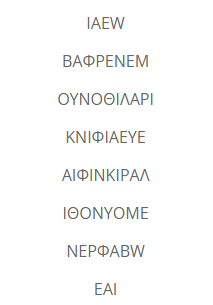
Another ancient palindrome has been uncovered recently on the island of Cyprus, and the amulet on which it appears dates back nearly 1500 years!

The amulet has multiple pieces of religious iconography on one side, including references to Egyptian and Greek mythology.

On the other side, there is a palindrome written in Greek:

According to LiveScience.com, it roughly translates to “Iahweh is the bearer of the secret name, the lion of Re secure in his shrine.”

It’s believed that the amulet was meant to protect the wearer from danger, illness, or harm. And the palindromic nature of the inscription was key to the amulet’s supernatural potential.

Although word games and wordplay have seemingly always been popular in one form or another throughout the ages, it’s worth mentioning the power many assigned to words.

These weren’t simply displays of linguistic trickery or deftness, these were incantations or wards.

These were magic words.

In Jewish mysticism, words were said to give life to the Golem. The word “abracadabra” was originally used to ward off malaria. Invoking the name of a god and utilizing these carefully chosen words to do so combined some potent magical elements.

And once again, a puzzly moment in history offers an opportunity for greater understanding. Aren’t puzzles great?

Thanks for visiting PuzzleNation Blog today! You can share your pictures with us on Instagram, friend us on Facebook, check us out on TwitterPinterest, and Tumblr, and be sure to check out the growing library of PuzzleNation apps and games!

Are you smarter than a Singaporean student?

We love brain teasers here at PuzzleNation Blog. Whether we’re dealing with curious parking spaces, men in hats, the crew of the Enterprise playing games, or the seesaw-based conundrum that so baffled Captain Holt on Brooklyn Nine-Nine, we thoroughly enjoy tackling these often diabolical and curious logic problems.

And one has been making the rounds on Facebook, Twitter, and other social media platforms recently. This one comes from a Singaporean classroom, and has made headlines all over the Internet.

Hmmm, doesn’t seem like a lot of information, does it?

So, we have ten possible dates.

Let’s put them in a chart to organize them as best as we can.

Now, let’s analyze each statement in order, since the progression is the key to solving this brain teaser.

Albert says: I don’t know when Cheryl’s birthday is, but I know that Bernard does not know too.

Since Albert is told the month, and there are multiple options for each month, there is no way he could know. At first. But he does know Bernard doesn’t know either. How?

Deduction. If Cheryl told Bernard 18 or 19 (the only days that appear once), Bernard WOULD know Cheryl’s birthday. So Albert can eliminate those two options.

And for Albert to KNOW that, Cheryl cannot have told him May or June, since those were the only months with days that appear once.

A lot of information in a single sentence. Let’s move on to the next sentence.

Bernard says: At first I don’t know when Cheryl’s birthday is, but I know now.

Bernard is on the same track as Albert. He’s eliminated May and June. And he says he knows Cheryl’s birthday. If you look at our chart now, there are three singlet dates (15 for August 15, 16 for July 16, and 17 for August 17). If he was told 14, he wouldn’t know if it were July or August, so we can eliminate those.

From ten possible days, we’re down to three. And Albert’s final sentence finishes the job.

Albert says: Then I also know when Cheryl’s birthday is.

Since Albert is only told the month, it has to be July, because there are two possible dates left in August.

Therefore, in impressively brisk fashion, both Albert and Bernard have deduced that Cheryl’s birthday is July 16. And so have we!

We’ve also deduced that Cheryl is sort of a pain in the ass. But I suspect that wasn’t much of a brain teaser.

Thanks for visiting PuzzleNation Blog today! You can share your pictures with us on Instagram, friend us on Facebook, check us out on TwitterPinterest, and Tumblr, and be sure to check out the growing library of PuzzleNation apps and games!

It’s Follow-Up Friday: Hashtag Game edition!

Welcome to Follow-Up Friday!

By this time, you know the drill. Follow-Up Friday is a chance for us to revisit the subjects of previous posts and bring the PuzzleNation audience up to speed on all things puzzly.

And today, I’d like to return to the subject of International TableTop Day!

You may be familiar with the board game Schmovie, hashtag games on Twitter, or @midnight’s Hashtag Wars segment on Comedy Central. Well, I decided to host our own wordplay game in honor of TableTop Day.

Our hook was: Penny/Dell Puzzle Movies!

Examples could be “Starspell Wars” or “Legends of the Quotefalls” or “Live and Let Die-agramless.”

I received over 100 responses from PuzzleNation and Penny/Dell employees, and I simply had to compile a complete list and share it with you! (I’ve included links for as many puzzles as I could find!)

So, without further ado, please enjoy our feature presentation.


Sudo-Cujo

One Flew Over the (Sudo)ku-koo’s Nest

Two for One Flew Over the Cuckoo’s Nest

The “Ken-Ken”tucky Fried Movie

A Scarlet Letterbox

Last Tangleword in Paris

Tanglewords and Cash

Django Un-Chain Words

What’s Left Pussycat?

Easy Crossword Midnight Express OR Midnight Express Easy Crosswords

The Good – the Bad, and the Ugly – Time Crosswords

Revenge of the Words

When Flower Met Power

The Flower Power and the Glory

Anagram Gables

The Trum-Anagram Show

(Eternal Sunshine of the Spotless) Mind Boggler

The Domino Theory of Everything

Domino (Conspiracy) Theory

Lord of the Ringers

(The Lord of the) Ringers: (The) Two-Step (Towers)

Lord of the Changeling

Lord of the Ring-master

Lord of the Diamond Rings

Diamond Rings are Forever

Nine of Diamonds Are Forever

Diamond Mines are a Girl’s Best Friend – (Starring Maria Monroe)

The Fantastic Four Corners

Four (Children of the) Corners

Harry Potter and the Sorceror’s Stepping Stones

Harry Potter and the Chamber of Secret Words

The Wizard Words of Oz

Desperately Wordseek-ing Susan

Star Trek 3: The Word Search For Spock

The Secret Message of NIMH

Patchword Adams

A Patchwords of Blue

Nightmare on Garfield’s Word Seek

Around the Bend It Like Beckham

Here and There Will be Blood

How to Train Your Zigzag-on

Heads and Tails from the Crypt

Tales from the Crypt-O-Grams

Crypto-Riddles of the Sphinx

(X-Men: First) Classified Ads

(Dead and) Buried Treasure

Split (Second) Personalities

A Framework Orange

Fiddler’s Frame on the Roof

Charlie’s ANGLEWORDS

Trading Places, Please

Places, Please in the Heart

Fill-In Minnesota

To Fill-In a Mockingbird

Rapid (Fire) Reader

Puzzle (Down and) Derby

THE WHOLE TRUTH About Cats & Dogs

Bill & Ted’s Excellent Match-Ups

(One Hour) Photo Finish

(500 Days of) Sum(mer) Triangles

Gold-Figgerits

Dial-a-Grams for Murder

Place Your Murder by Numbers

The LETTER COUNT of Monte Cristo

Mad Maxi-Point

Add One Fine Day

Scramble Across Five Aprils

Piece by Pieces of April

12 Mon-Keywords

SQUARE NINES From Outer Space

Anacrostics Karenina OR Anna Karenina–crostics

Raiders of the Crostics Ark

Raiders of the List-A-Crostic

The Seventh Syllacrostic

Schindler’s List-a-Crostic

Schindler’s Missing List

First and Last Action Hero

Meet Joe BLACK MAGIC

Full Metal JACKPOT

Gone with the Window Boxes

Rear Window Boxes

Doctor DoLotto

The Da Vinci Codeword

An American in Pairs

Double Trouble Indemnity

Face to Face/Off

(The World’s) End of the Line


There were even a few TV shows offered — Dora The Exploraword and ACROSS AND DOWNton Abbey — as well as a theater show: The Bookworms of Mormon.

And now, I open the hashtag game up to you, fellow puzzlers and PuzzleNationers! Can you come up with a Penny/Dell Puzzle Movie we missed? Message us on Facebook or Twitter! We’d love to see them!

Thanks for visiting PuzzleNation Blog today! You can share your pictures with us on Instagram, friend us on Facebook, check us out on TwitterPinterest, and Tumblr, and be sure to check out the growing library of PuzzleNation apps and games!