New Sudoku App!

Oh yes, the Sudoku revolution has come to your phones and tablets! Say hello to the new Penny Dell Sudoku app, available for both iOS and Android users!

This free app is loaded with terrific Easy, Medium, Hard, and Expert puzzles from our friends at Penny Press and Dell Magazines, who have been creating Sudoku puzzles longer than anyone! (Heck, Dell Magazines was the original publisher of Sudoku, dating back to 1979!)

With four difficulty settings to choose from, this app fits solvers of every age and experience level! You’re guaranteed to find the right Sudoku puzzle for you.

Bonus features include a timer to clock your solving speed, hints to point out errors or help you when you’re stuck, and a dynamite help section to walk new solvers through cracking their first Sudoku puzzle!

And to celebrate the release of this terrific new app, we’re holding a contest!

How do you enter? Well, it couldn’t be simpler! Just click this link or the picture below to sign up for our PuzzleNation Newsletter!

Not only will you be entered into the contest to win an in-app promo code for the Penny Dell Sudoku app, but you’ll also get all of the articles, updates, and terrific bonus content from our Newsletter, delivered right to your mailbox! It’s a win-win and completely free!

This contest will run until midnight, November 24, 2016 (aka Thanksgiving night), and we’ll announce five winners the following Monday, November 28, 2016!

The new Penny Dell Sudoku app is an exciting addition to our puzzle library, and we know whether you’re an iOS user or an Android user, you’ll absolutely love it!

Happy solving, fellow puzzlers and PuzzleNationers!


Thanks for visiting PuzzleNation Blog today! Be sure to sign up for our newsletter to stay up-to-date on everything PuzzleNation!

You can also share your pictures with us on Instagram, friend us on Facebook, check us out on TwitterPinterest, and Tumblr, and explore the always-expanding library of PuzzleNation apps and games on our website!

Contest details: No purchase necessary to enter. One entry per person, please. We are not responsible for entries that are not received. Entries must be submitted by 11:59 PM on November 24, 2016. The information you provide will only be used to notify winners and be entered into the PuzzleNation newsletter email mailing list. Must be 18 to participate. If selected as winner, you must respond to notification email or phone call with mailing address to receive prize.

PuzzleNation Reviews: ThinkFun’s Circuit Maze and Clue Master

[Note: I received free copies of these games in exchange for a fair, unbiased review. Due diligence, full disclosure, and all that.]

Deduction is one of the most powerful puzzle-solving skills, and honestly, it’s a difficult one to develop.

“If this, then that” thinking involves holding several pieces of information in your head at once, eliminating red herrings and unhelpful possibilities until you’re left with one solution that fits all the requirements. (Every Sudoku puzzle is an exercise in deduction, after all.)

And today, we’ve got two new ThinkFun products to review that are centered around learning the art of deduction in different ways: Clue Master and Circuit Maze.

Clue Master is centered around a 3×3 grid that the solver must fill with nine dog toys: three bones, three balls, and three bowls. Each symbol comes in three colors — green, red, and blue — leaving us with nine unique pieces to place in our grid. (The solving style is very similar to their Brain Fitness puzzle game Chocolate Fix.)

Completing the grid is the only way to open the secret door of Tippy the dog’s doghouse, returning the friendly, blocky puppy to his rightful place in the back yard. (Hence the dog toys.)

The instructions, puzzles, solutions, game board, and pieces are all contained within the single spiral-bound game book, making this one of ThinkFun’s most portable products yet. The magnetic pieces are fairly sturdy, as is the game board, so it will hold up nicely to the rigors of travel (and being stuffed into various carry-on bags).

The gameplay itself is all about interpreting the clues provided with each challenge card. Some clues give you colors only, others shapes only, and the occasional clue is centered around a given piece’s location on the grid.

Once you graduate from the Beginner and Intermediate difficulty levels, you’ll face a new wrinkle: negative clues. Negative clues are layouts that must be avoided, so instead of telling you where to place a piece, they tell you expressly where NOT to place a piece, ratcheting up the difficulty.

Clue Master truly lives up to the “8 to adult” age range of the product. The Beginner puzzles walk you through simple deduction techniques, allowing younger minds and new solvers alike the chance to get accustomed to that sort of if-then chain-solving.

For a bit more of a challenge, let’s check out Circuit Maze.


ThinkFun has a solid track record when it comes to maze games that involve some level of logic or deduction, whether it’s learning optics with Laser Maze Jr. (or the original Laser Maze) or navigating the three-dimensional twists, turns, and drops of Gravity Maze.

Now, they’ve turned their attention to current and electricity with Circuit Maze, challenging solvers to use switches, connective pathways, and light-up relays to complete the partially-built circuits on each of the game’s challenge cards.

One of the more intriguing twists built into Circuit Maze is that your starting and ending points are a pair of connected pieces: the blue positive piece containing the batteries and the blue negative piece that closes the circuit. The current has to flow from positive to negative, so that means your light-up relays (which are also marked with + and – paths) can only be placed in certain configurations.

To add to the difficulty, oftentimes one of the two blue starting and ending pieces is NOT set in the challenge cards, so you won’t necessarily know what your starting or ending point is, placing another obstacle between you and successfully closing the circuit and ensuring your relays light up as needed.

The switch is another delightful wrinkle on the ThinkFun logic maze formula, since each setting can have its own unique requirements.

For instance, the above setup requires a different relay to light up for each switch setting (meaning that the switch’s first setting lights up the red, its second setting lights up the yellow, and its third setting lights up the green). These multiple goals make building your pathway more challenging and really forces you to think about how to use each piece to its utmost.
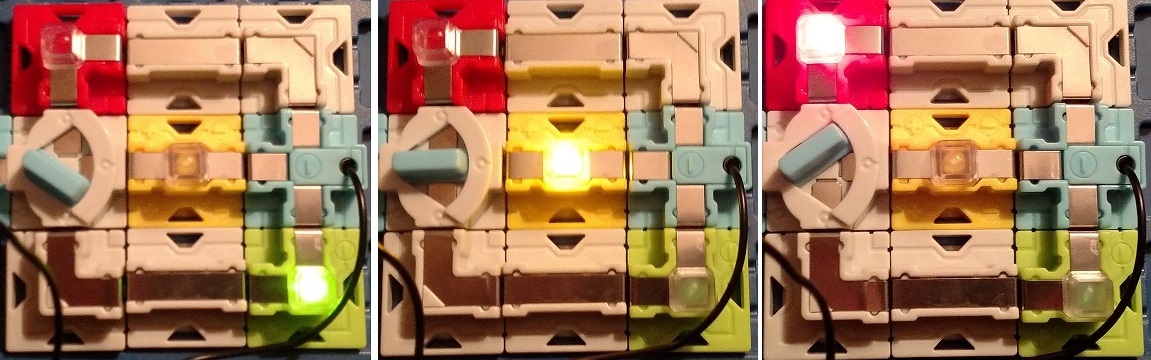
[Here the completed circuit causes each relay to light up with a flip of the switch.]

The challenge cards range from Beginner, which offers introductory tricks and lessons, to Intermediate, Advanced, and Expert puzzles, each with their own obstacles.

Sometimes, you know where a piece is placed, but not which direction it should face. Other times, you have to create pathways that will allow multiple relays to light up at once, and others where nothing lights up at all.

In the Advanced-level challenge card below, the solver has to make sure that the red relay always lights up, no matter what setting the switch is on, but other switch settings also have to light up either the yellow or green relays. It’s quite a mental workout!

Circuit Maze definitely rivals Gravity Maze as the most challenging ThinkFun product to date, but it’s a very worthwhile challenge to tackle. This is next-level deductive thinking, plotting out paths that accomplish different tasks at different times, all while maintaining a complete circuit and matching positive and negative current paths.

This serves as a strong follow-up to the deduction lessons new solvers learned in Clue Master, making for a solid one-two punch of logical puzzling the whole family can enjoy together (or you can play by yourself)!

Clue Master and Circuit Maze are both available this holiday season at Amazon or Target!


Thanks for visiting PuzzleNation Blog today! Be sure to sign up for our newsletter to stay up-to-date on everything PuzzleNation!

You can also share your pictures with us on Instagram, friend us on Facebook, check us out on TwitterPinterest, and Tumblr, and explore the always-expanding library of PuzzleNation apps and games on our website!

It’s Follow-Up Friday: More UK Puzzles edition!

Welcome to Follow-Up Friday!

By this time, you know the drill. Follow-Up Friday is a chance for us to revisit the subjects of previous posts and bring the PuzzleNation audience up to speed on all things puzzly.

And today, I’m returning to the subject of big international puzzle events!

A few weeks ago, the UK Puzzle Association hosted the 2016 UK Sudoku Championship. And this weekend, they’ve got another major puzzle event in store for puzzlers worldwide: The 2016 UK Puzzle Championship!

The event spans June 24 through June 27, and chairman Alan O’Donnell of the UK Puzzle Association sent out the Instruction Booklet for this year’s event a few days ago, continuing a string of major puzzle events in Europe and across the world.

Although the UK Puzzle Championship is only open to competitors from the UK — with the top two earning a place on the UK team for the 2016 World Puzzle Championship — international players are welcome to test their puzzly mettle as guest solvers.

But even if most PuzzleNationers aren’t eligible to compete, you can still enjoy the challenge of some topnotch puzzles. Let’s take a look at some of the diabolical puzzles they’ve cooked up for this year’s event!

This Banknotes puzzle sets the tone for much of the Instruction Booklet to come, offering a number-placement puzzle with clues outside the grid. In this case, you have different valued 3×1 “banknotes” to place in the grid, and their total values add up to the numbers outside a given row or column.

So this is a bit like the game Battleship, except with different valued ships instead of different sized ones.

Here we have a more traditional Fill-In puzzle, but with an nontraditional grid shape. This one is all about efficient word placement.

Instead of placing words into this grid, the Cloud puzzle asks you to fill in which squares are covered by “clouds,” based on the total number of cloud-covered cells given on the outside of the grid. This is essentially a small Logic Art puzzle.

This Hidoku turns the usual Sudoku-solving on its ear by requiring you to place the numbers 1 through 25 into the following grid so that they form an unbroken chain. Consecutive numbers must touch, either horizontally, vertically, or diagonally.

For fans of Penny Dell Puzzles, this is like Sudoku and Word Maze had a diabolical little baby.

[I left the solution in with this one to help illustrate the solving style.]

Hashi is an intriguing deduction puzzle that follows the same cluing mentality as Blackout! or Minesweeper. Each circle contains a number indicating how many “bridges” connect that “island” to the other islands either vertical or horizontal to that island.

You’re essentially building your own Word Trails puzzle with Hashi, except you’re using numbers instead of the letters in a famous saying.

This is probably my favorite of the puzzles I’ve encountered in this Instruction Booklet, and I’m definitely looking forward to solving it this weekend.


These puzzles are just a sampling of the numerous puzzles you’ll tackle if you accept the UK Puzzle Championship challenge.

Not only are Kakuro and Sum-Doku (or Killer Sudoku) included, but also other twists on classic solving styles like Fill-Ins, Deduction puzzles, and Logic Problems.

You can check out the full Instruction Booklet here, and remember, you’ll have two and a half hours to solve as many of the 29 puzzles in the packet as possible, so good luck on June 24!


Thanks for visiting PuzzleNation Blog today! Be sure to sign up for our newsletter to stay up-to-date on everything PuzzleNation!

You can also share your pictures with us on Instagram, friend us on Facebook, check us out on TwitterPinterest, and Tumblr, and explore the always-expanding library of PuzzleNation apps and games on our website!

The UK Sudoku Championship: The Aftermath

This weekend, I sat down at my desk with a few sharpened pencils and a copy of the UK Sudoku Championship puzzles, ready to pit my puzzly skills against sixteen Sudoku and Sudoku variant puzzles.

According to UK Puzzle Association rules, I had two hours to complete as many puzzles as I could.

And let me tell you, my fellow puzzlers and PuzzleNationers, I don’t think I could have completed this entire packet in twice that time. The UK must feature some seriously impressive and speedy Sudoku solvers.

[If only I could puzzle with both hands like this brilliant youngster.
Image courtesy of Deccan Herald.]

Now, I’m by no means a weak Sudoku solver — deduction puzzles don’t faze me — but I’m not a fast Sudoku solver, so I knew the two-hour time limit was, at best, a pipe dream. Nonetheless, I set my timer, determined to give it my all.

The packet opened with a Linked 6×6 Sudoku, which was a pleasant starter. The two grids complemented each other nicely, and only needing the numbers one through six once per 2×3 box kept the solve quick.

That was not the case for puzzle #2, a Deficit Sudoku. In the Linked 6×6, you knew that the 2×3 boxes within the grid would contain the numbers one through six, which made it easy. In the Deficit Sudoku, the 2×3 boxes contained six numbers, but the options were numbers one through seven, so that certainly that came with puzzle #1 vanished instantly.

The Deficit Sudoku was certainly hard, and given that those two puzzles were only page one, my progress thus far didn’t bode well for the rest of the championship experience.

[A sample Deficit Sudoku.]

Puzzle #3 ratcheted up the difficulty with a Surplus Sudoku, one that featured boxes of eight squares in various shapes. Each box featured the numbers 1 through 7, plus one of the numbers again. If the design was to overwhelm the solver with possibilities, mission accomplished!

After laboring over the puzzle for a good twenty minutes or so, I had to move on without completing it. This would become a recurring theme in this puzzle packet.

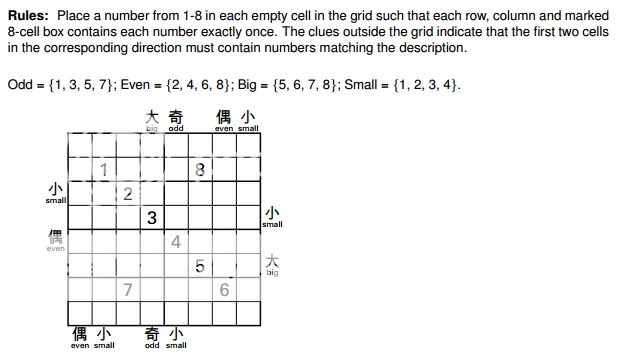
Puzzle #4 was the elaboratedly named Odd-Even-Big-Small Sudoku, and although I got farther with this one than the Surplus Sudoku, I also had to bow out and move on after hitting the wall. This was page 2 of the championship, and it was a brutal step-up in challenge from page 1.

[A Sudoku loaded with numbers and adjectives.]

Puzzle #5 was a Classic Sudoku, obviously designed to restore a solver’s confidence after the one-two punch of Surplus Sudoku and Odd-Even-Big-Small Sudoku, and I knocked it out quickly. Huzzah! Back on track!

Puzzle #6 was also a Classic Sudoku, but one with desperately few set numbers. The upper-right 3×3 box and the lower-left 3×3 had NONE, and the upper-left 3×3 box and the lower-right 3×3 box only had two apiece.

Although I was able to fill the body of the grid quickly, those four corners had me stymied. For the third time in just over an hour, I put a puzzle aside unfinished.

That lack of set numbers was a recurring theme in the championship packet, making Puzzle #7 (a diagonal Sudoku) and Puzzle #8 (a Jigsaw Sudoku), much tougher solves than I expected. By this point, I put aside the timed aspect of the solve entirely (my two hours was nearly up, and I’d been interrupted a few times anyway), and just focused on doing my best to complete as many puzzles as possible.

This was about puzzly pride at this point. *laughs*

The next four puzzles — an Extra Regions Sudoku (where the shaded-in areas also contained the numbers 1 through 9), a Sum-Doku (or Killer Sudoku) with no set numbers, a Consecutive Pairs Sudoku with only eight set numbers, and an Odd Sudoku (with the shaded boxes requiring odd numbers only) — I’d categorize as tough, but fair.

I can see how a championship packet like this would separately the very good solvers from the truly great.

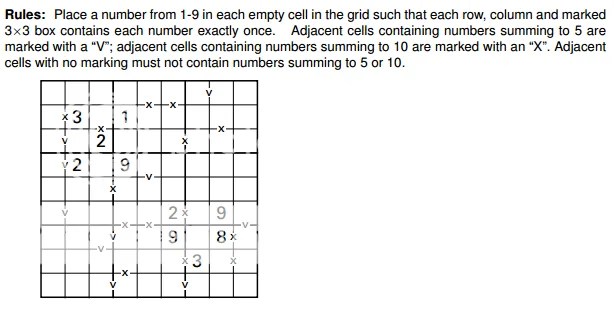
[A diabolical XV Sudoku.]

That was clearly the goal of puzzles #13 and #14. A Thermo Sudoku with only nine set numbers taxed me to my limit, and the XV Sudoku that followed was the hardest puzzle in the entire set. Admittedly, I was a little burnt out at this point, but it remains the toughest Sudoku puzzle I’ve ever attempted.

The final two puzzles, a Palindrome Sudoku and an Eliminate Sudoku, felt like a cakewalk compared to the gauntlet of challenging puzzles that preceded them. It was nice to close out my solving experience strong, nearly four hours into the challenge.

I fully intend to go back and take another crack at all the puzzles that bested me, but for now, I need a little break from these devious little grids.

Kudos to everyone who tackled the UK Sudoku Championship, and to some of the world-class contenders I saw on the final results board, I tip my hat to you all. The top nine finished all 16 with perfect scores in under an hour and a half! That is a blistering speed!

I may not have what it takes to be a UK Sudoku Champion, but I’m glad I accepted the challenge. It was a satisfying, intriguing, and occasionally humbling way to pass a few hours.

You can give the 2016 UK Sudoku Championship puzzles a shot yourself by clicking here. Good luck!


Thanks for visiting PuzzleNation Blog today! Be sure to sign up for our newsletter to stay up-to-date on everything PuzzleNation!

You can also share your pictures with us on Instagram, friend us on Facebook, check us out on TwitterPinterest, and Tumblr, and explore the always-expanding library of PuzzleNation apps and games on our website!

The UK Sudoku Championship! (Or should that be Sudo-UK?)

Hot on the heels of The Indie 500 crossword tournament last weekend, the UK is also gearing up for a major puzzle event: The UK Sudoku Championship!

The event spans June 10 through June 13, and chairman Alan O’Donnell of the UK Puzzle Association sent out the Instruction Booklet for this year’s event a few days ago, which kicks off a string of major puzzle events in Europe and across the world, including the UK Puzzle Championship in a few weeks.

Although the UK Sudoku Championship is only open to competitors from the UK — with the top two earning a place on the UK team for the 2016 World Sudoku Championship — international players are welcome to test their puzzly mettle as guest solvers.

But even if most PuzzleNationers aren’t eligible to compete, you can still enjoy the challenge of some topnotch Sudoku puzzles. Let’s take a look at some of the diabolical puzzles they’ve cooked up for this year’s event!

[An Extra Regions puzzle, a variation on Classic Sudoku.]

In addition to some Classic Sudoku, Extreme Sudoku, Sum-Doku (or Killer Sudoku), Jigsaw Sudoku (or Geometric Sudoku), and Thermo Sudoku — all of which I explored in detail in my Wide World of Sudoku post — there are some variants I’ve never seen before, like this Linked 6×6 Sudoku.

In this puzzle, you have two grids to complete, but with the additional wrinkle that no number placed in the left 6×6 grid will occupy the same square in the right 6×6 grid. So you have more solving information than expected, but it’s spread out across two grids.

This Deficit Sudoku puzzle also uses the 2×3 box format, but arrayed in a 7×7 grid. This means that any of the numbers 1 through 7 can be in each 2×3 grid, which makes it slightly harder than if you were only using the numbers 1 through 6.

(Plus you have no information on what number goes in that solo square in the center of the grid.)

The curiously named Odd-Even-Big-Small Sudoku employs clues outside the grid to help you fill in some of the squares along the perimeter of the grid, telling you that two odd numbers, two even numbers, two small numbers, or two big numbers will occupy the nearest two spaces in that row or column.

This is a solving mechanic I’ve never encountered before in Sudoku, and I can see it posing an impressive challenge to the average Sudoku solver.

That unconventional style of cluing sets the tone for the rest of the unusual puzzles that competitors and solvers will encounter here. In the above grid, a Consecutive Pairs puzzle, those dots indicate that the neighboring numbers connected by those dots are consecutive numbers, like 5 and 6 or 2 and 1.

(You can also try Consecutive Pairs Sudoku in Will Shortz’s Sudoku and Sudoku Spectacular, both published by our friends at Penny Dell Puzzles.)

XV Sudoku works in similar fashion, with x’s and v’s instead of those little dots. The x’s mean the neighboring numbers add up to 10, and the v’s mean the neighboring numbers add up to 5.

This Eliminate Sudoku uses arrows to indicate that the number in the arrow box will not be repeated in any of the boxes that follow that arrow. So, for instance, if you place a 3 in that arrow box next to the 2 in the upper-right 3×3 grid, none of the boxes that arrow points at along that diagonal will contain a 3.

Like the dual grids in the Linked 6×6 Sudoku, this puzzle is interesting in offering more information on what’s NOT in a square than what IS.

The final new puzzle in the Instruction Booklet is my favorite, but that’s because I’m a sucker for palindromes in puzzles. This Palindrome Sudoku features gray lines that indicates spots where — you guessed it! — the chain of numbers reads the same backwards and forwards.

Similar to Thermo Sudoku in its solving style, Palindrome Sudoku takes advantage in the restrictive nature of Sudoku solving by adding a neat little twist.

You can check out the full Instruction Booklet here, and remember to keep your eyes peeled on June 10 when the actual puzzles go live!


Thanks for visiting PuzzleNation Blog today! Be sure to sign up for our newsletter to stay up-to-date on everything PuzzleNation!

You can also share your pictures with us on Instagram, friend us on Facebook, check us out on TwitterPinterest, and Tumblr, and explore the always-expanding library of PuzzleNation apps and games on our website!

The end of Sudoku?

I recently read in Owen O’Shea’s book The Call of the Primes that there are 5,472,730,538 unique solutions for a 9×9 Sudoku grid.

Yes, five billion is a very big number, but these days, billions aren’t what they used to be. I mean, think about how many newspapers, magazines, and puzzle books feature Sudoku puzzles. It’s a huge amount of material every year.

So, the thought occurs to me…how long before those 5,472,730,538 unique solutions run out?

To be fair, it’s not like reaching Peak Oil or a point of no return. I’ve solved a lot of Sudoku puzzles, and never once have I felt like I was re-solving a grid I’ve seen before, even if I was. This is purely a matter of mathematical curiosity. How long would it take for us to use up every last possible 9×9 grid?

Man, where do I begin?

Well, if I’m going to talk Sudoku puzzles, it makes sense to start with our friends at Penny Dell Puzzles.

Across seventeen Sudoku titles, they publish approximately 23,236 Sudoku puzzles a year, and probably an additional 350 per year across their Crossword/Variety and Variety titles for a total of 23,586 puzzles in a calendar year.

Now, Penny Dell Puzzles is the top puzzle publisher in North America — #humblebrag — and let’s assume there are another half-dozen publishers worldwide matching their output. That gives us a ballpark of 165,100 Sudoku puzzles published worldwide.

But what about newspapers?

According to the Newspaper Association of America, there were 1,331 daily newspapers in 2014, and there were 1,450 daily newspapers in 2005, making an 8.2% decrease from a decade before. If we apply that percentage to the number of daily newspapers worldwide as of 2005, 6,580 titles, we get 6,040 daily newspapers worldwide. And although they may not ALL have a daily Sudoku, this will help cover some of the major magazines that also carry Sudoku that I’ve excluded from my ballpark calculations.

That gives us 6,040 newspapers x 365 puzzles a year for a total of 2,204,600 puzzles a year.

Now, for other publishing efforts regarding Sudoku, Amazon.com lists 20,718 results for Sudoku, and if we apply an average of 217 puzzles per title — which seems a fair approximation, based on the stats published by our friends at Penny Dell Puzzles, the fact that some books will have more puzzles, and some results will be ABOUT Sudoku and probably contain few to none actual puzzles — that’s 4,495,806 puzzles available right now in the world’s biggest bookstore. (Yes, obviously not all of them were published this year, but hey, this is meatball mathematics.)

Unfortunately, statistics on Sudoku are sketchy at best for the mobile app market, online puzzling, and downloadable puzzles through Playstation Network, Wii, and other gaming platforms, so I can’t factor those puzzles into my calculations.

But just with the numbers I’ve got here, we’re talking about 6,865,506 Sudoku puzzles worldwide. So, if each of those Sudoku puzzles is unique — which is possible, if unlikely — that barely makes a dent in our total of possible Sudoku grid layouts, which you recall is 5,472,730,538.

So, if we’re producing 6,865,506 unique Sudoku puzzles a year, it’ll take nearly 800 years to use every possible 9×9 grid! (For the folks at Penny Dell Puzzles, it would take nearly 232,033 years! So they’re in the clear. *laughs*)

I guess we won’t be running out anytime soon.


Thanks for visiting PuzzleNation Blog today! Be sure to sign up for our newsletter to stay up-to-date on everything PuzzleNation!

You can also share your pictures with us on Instagram, friend us on Facebook, check us out on TwitterPinterest, and Tumblr, and explore the always-expanding library of PuzzleNation apps and games on our website!