PuzzleNation Product Review: Scrimish

The best card games are simple. People love War and Poker and Hearts and Go Fish because, at their core, they’re games you can learn quickly and play endlessly. There are no long tutorials or play-throughs, so you can learn all the complexities and rules with ease.

It’s difficult to find puzzly card games that are as accessible and replayable. Scrimish, a card game created by Danny Zondervan and recently funded through Kickstarter, fits the bill nicely. The rules are simple, but the strategy in the actual game is what gives Scrimish major replay value.

[On a very festive battlefield, I’ve finished setting up my cards
(bottom of the frame), while my opponent is still working on hers.]

Scrimish is an elegant mix of War, Chess, and Memory.

Each player gets a set of 25 cards, arranging them into five piles of five cards each, face down. The goal? Find your opponent’s crown card before they find yours.

Then you take turns drawing a card from the top of one of your piles and attacking the top card of one of your opponent’s piles in a one-on-one battle. Here’s where the War aspects begin. You see, each card has a number value, and the higher number wins. The losing card is discarded, and the winning card goes back to whatever pile it came from.

So in every encounter, both players learn something, because even if you lost that attack, you’ve learned the value of one of the cards on top of one of your opponent’s piles.

That’s where the Memory aspect comes in, because you have to remember what cards of your opponent’s you’ve seen. (You can check your top cards or your piles as often as you and your opponent see fit.) Then you can plan other moves and try to uncover their crown card.

You’ve got shield cards to defend with, archer cards to attack with, numbered weapon cards to battle with, and one crown card to defend. So, essentially, you’re playing a miniature game of chess with your opponent, except your pieces are hidden from them.

And that’s what makes for such a satisfying playing experience. You’ve got all sorts of strategy going on, plus chances for misdirection in both your attacks and your placement of cards at the beginning of the game. Do you go out heavy with high numbered cards early, or do you test their defenses with low cards? Do you arrange attack stacks and defensive stacks, or do your spread your resources out across all five stacks?

Plus, every card you attack with is one less you have in your stacks. So you’ve got a resource management aspect as well. All of this gameplay and puzzly potential, with fewer cards than your standard poker deck.

It takes only a few minutes to learn, but all the thought that goes into it makes every game of Scrimish feel fresh and new.


Thanks for visiting PuzzleNation Blog today! Be sure to sign up for our newsletter to stay up-to-date on everything PuzzleNation!

You can also share your pictures with us on Instagram, friend us on Facebook, check us out on TwitterPinterest, and Tumblr, and explore the always-expanding library of PuzzleNation apps and games on our website!

PuzzleNation Product Review: Stuff and Nonsense

In today’s product review, we look at a puzzly game all about telling stories.

Many games are about grand adventures, but only Stuff and Nonsense is about pretending to go on grand adventures to scam your fellow would-be adventurers. Can you sneak around London and gather the props you need for your impressive lie, all while avoiding the fiendishly clever Professor Elemental?

Stuff and Nonsense is a game of position, strategy, and opportunity. You travel around the game board — made of map cards — visiting various spots and picking up cards that will help you tell your fictional tale of derring-do. When you’ve collected the right cards — or enough to sell your fake story — you head to the Adventurer’s Club to tell your story.

Each time you do so, you can cash in those cards for points. Point values can range wildly depending on the cards you have and the value of your setting at a given time.

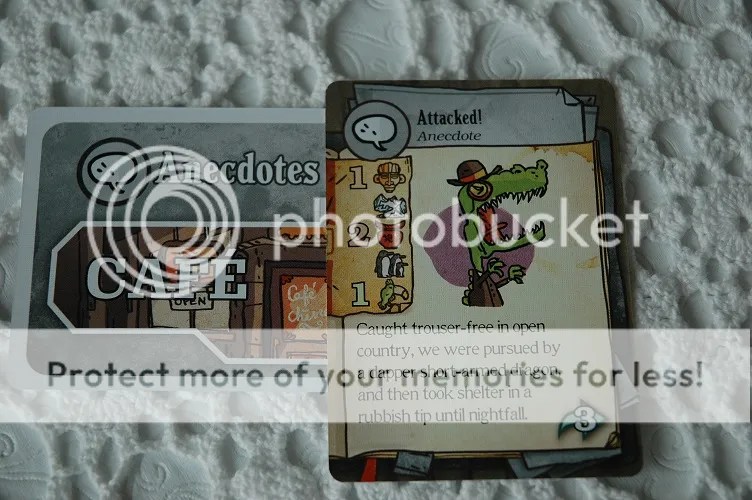
The cards are silly, creatively imagined, and often hilarious, discussing mythical events, explaining weird artifacts, and offering much-needed color to help sell your false tale.

All the while, you must dodge Professor Elemental, who is moving around the board investigating your shenanigans. If you end up in the same spot as him, you face a penalty (either losing a card or having every card in your hand drop one point each in value.)

[The game comes with these colored tokens (top), but you can opt for the slightly more expensive (& delightful) Meeples of the Professor & various faux adventurers (bottom).]

What makes this game such a puzzly treat is the mix of strategy and opportunity. You can take whatever cards you get and hit the Adventurer’s Club frequently to rack up smaller amounts of points more frequently, or you can bide your time and then hit the club less often for higher point values.

But either way, there’s always the looming threat of crossing paths with the Professor at a bad time and losing a key card or crucial points.

Plus, the map is different every game based on how you lay it out, so there’s a lot of replay value here.

Stuff and Nonsense is available from Cheapass Games for $25, and is featured in our Holiday Puzzly Gift Guide! What great fun.

[youtube https://www.youtube.com/watch?v=JuhGMA–r7M]


Thanks for visiting PuzzleNation Blog today! Be sure to sign up for our newsletter to stay up-to-date on everything PuzzleNation!

You can also share your pictures with us on Instagram, friend us on Facebook, check us out on TwitterPinterest, and Tumblr, and explore the always-expanding library of PuzzleNation apps and games on our website!

It’s Follow-Up Friday: Puzzlesaurus Kickstarterus edition!

Welcome to Follow-Up Friday!

By this time, you know the drill. Follow-Up Friday is a chance for us to revisit the subjects of previous posts and bring the PuzzleNation audience up to speed on all things puzzly.

And in today’s post, I’m returning to the subject of puzzly crowdfunding campaigns!

I’ve covered various campaigns for board games, card games, and puzzle projects across the Kickstarter and Indiegogo crowdfunding platforms over the years, and today I’d like to share a few more that deserve your attention.

These are some of the cards for Scrimish, a card game so simple and elegant that I cannot believe I haven’t seen this game mechanic before.

Essentially, it’s a chess match with cards. You set up your five piles of cards face down in front of you, hiding a crown card in one of your piles. Then, you play cards against your opponent’s piles in the hopes of revealing his crown card. So strategy, rather than luck, is the name of the game here.

There’s only a day or two left in this campaign, and it’s already blown past its initial goal, so if you donate, at the very least, you’re guaranteed a copy or two of the game. (Sometimes, this is one of the advantages of jumping onto a Kickstarter bandwagon at the eleventh hour.)

Did you know that more dinosaur skeletons were discovered by just two scientists — Cope and Marsh — than by anyone else in history? And did you know that they got so competitive with one another that they actually began damaging dig sites and blowing up fossils in order to sabotage each other?

This ridiculous and amazing period in history is the source material for The Great Dinosaur Rush, a game where you attempt to build a complete dinosaur skeleton while stealthily (and sometimes, not-so-stealthily) combating your opponents’ efforts to do the same.

I’ve been waiting months for this Kickstarter to launch, ever since I first heard about the game, and now it’s well on its way to being funded. Why not take history into your own hands and mess with your friends and fellow scientists while you’re at it?

There are so many more I could cover, all with varying degrees of puzzliness. There’s the card game Master Thief (where you compete with fellow players to rob a museum), the magnetic jigsaw-style Enigma Orbs, a Cards Against Humanity-inspired bounty hunting card game called Skiptrace, and Covalence, a board game where you race to figure out molecular structures!

Heck, there’s even a collection of drinking glasses that link together (called, appropriately enough, Cupzzle)!

I highly recommend taking a little time to surf the puzzle and game pages of Kickstarter and Indiegogo, because you never know what terrific and unexpected products you might help bring to life.


Thanks for visiting PuzzleNation Blog today! Be sure to sign up for our newsletter to stay up-to-date on everything PuzzleNation!

You can also share your pictures with us on Instagram, friend us on Facebook, check us out on TwitterPinterest, and Tumblr, and explore the always-expanding library of PuzzleNation apps and games on our website!
PuzzleNation Product Review: Tak•tak

When it comes to strategy puzzle games, no matter how complex or how simple the actual game mechanics, the game itself hinges on the two players involved. After all, two extremely tactical puzzlers can make checkers look like chess.

Now, imagine a game that combines the pattern-matching of Uno, the strategy of chess, and the mechanics of Upwords, and adds a scoring element to boot. It might sound complicated, but I promise, it’s as simple as checkers.

Tak•tak is a two-player strategy scoring game designed by the folks at Twizmo Games, and it’s another puzzle game brought to life thanks to a successful crowdfunding campaign. Although Twizmo Games is best known for twisty puzzles (or Rubik’s Cube-style puzzles), they’ve taken a strong step into the traditional board game market with Tak•tak.

Each player starts with 12 tiles, each tile bearing a different score (10, 20, 30, or 40) and a different color (green, blue, or yellow). The two rows nearest the player form that player’s safe zone. The three rows in the middle are the war zone.

Your goal is to get as many points as possible into your opponent’s safe zone by stacking your tiles, crossing the war zone, and either capturing or maneuvering around your opponent’s tiles. You can only move forward (either straight or diagonally), so this is a game about tactics and initiative.

You build your stacks by matching either point values or colors. For instance, you can stack a yellow 20 and a yellow 40, or a yellow 30 and a green 30, and either of those new stacks would represent 60 points. This enables you to move more tiles around the board quickly. (But careful: once you’ve stacked tiles, they stay stacked for the rest of the game.)

But those matching rules also apply to your opponent’s tiles! When you and your opponent cross paths in the war zone, you can stack your tiles onto theirs and steal those points for yourself. (The stacks you make from your own tiles can only go three tiles high, but stacks made from your tiles AND your opponent’s tiles can go as high as you want! Heck, a stack might change owners several times and tower over the game board!)

The game ends when one player has no more available moves. (There are other ways to end the game if you choose to use the advanced game play rules, but we’ll stick with the basic rules for now.) And then it’s time to count your tiles.

You earn points for all of the tiles you’ve moved into your opponent’s safe zone (including any of your opponent’s tiles that are in stacks you control), plus points for any tiles your opponent never moved into the war zone. (Meaning they were never “in play.”) Highest score wins!

Tak•tak builds a lot of versatility and play possibilities into a game with checkers-simple mechanics, and the more you play, the more fun it is to delve deeper into tactics and strategy. It was worth losing 50 points for keeping a few tiles in my safe zone when they prevented a stack of my opponent’s tiles from scoring.

The clever mix of classic game-play elements not only makes Tak•tak so easy to dive into, but also ensures new players can more time actively playing and less time worrying about learning the rules (a common downfall for more complicated strategy games).

The designers claim the game is appropriate for ages 8 through 108, and I think they’re right on the money.


Thanks for visiting PuzzleNation Blog today! You can share your pictures with us on Instagram, friend us on Facebook, check us out on TwitterPinterest, and Tumblr, and be sure to check out the growing library of PuzzleNation apps and games!

PuzzleNation Product Review: Adorable Pandaring

Crowdfunding has significantly changed the world of puzzles and games by offering a new avenue for creators and fans to directly interact and determine whether a game or a puzzle suite becomes a viable product. Many puzzle constructors and game companies are using crowdfunding to both assess the public’s interest in a given game or puzzle AND to raise funds for an initial printing.

And in today’s product review, I’ll be giving the full PuzzleNation treatment to a card game born on Kickstarter and realized through crowdfunding. Let’s talk about Adorable Pandaring, created by Chris Cieslik and Asmadi Games!

In Adorable Pandaring, your goal is to gain bamboo by collecting as many adorable pandas as possible. The trouble is, everyone else is collecting pandas too, and the definition of adorable can change depending on the cards on the table! It’s panda law.

Each panda card has a value and an action. The value lets you know if the panda is adorable or not, depending on the panda law at the time. Sometimes high-numbered pandas are adorable, sometimes low-numbered ones are. Sometimes even-numbered pandas are adorable, sometimes odd-numbered ones are.

The action allows you to affect either an opponent or the game itself. You might gain bamboo, change the panda law, trade cards with an opponent, reveal hidden pandas… there are lots of options, some with exciting consequences.

This is a wonderful mix of poker-style strategy — which card information you share with your opponents and which you conceal — and Fluxx-style rule-shifting chaos. At any time, the panda law can change and your adorable pandas lose their value, or everyone’s hidden cards are revealed and bamboo is awarded.

[A random sampling of the super-cute pandas AND
several ways you can affect the game by playing them.]

And the art is delightful. The pandas are hilarious and, yes, adorable, whether they’re disappointed by dropped ice cream cones or looking sharp in secret agent tuxedo-wear.

Great fun for three to five players, Adorable Pandaring promises adorable pandas and delivers a lot more, making a terrific gateway card game for younger players and a delightful quick-play game for all ages.

(You can pick up a copy from the Asmadi Games store here.)

Thanks for visiting PuzzleNation Blog today! You can share your pictures with us on Instagram, friend us on Facebook, check us out on TwitterPinterest, and Tumblr, and be sure to check out the growing library of PuzzleNation apps and games!

PuzzleNation Product Review: Fidelitas

In today’s product review, we delve into a medieval world where courting influence wins the day and the best players can move people like chess pieces. Welcome to Fidelitas, a card game created by Green Couch Games and distributed by the good folks at Game Salute.

In Fidelitas, each player tries to manipulate characters into position around the city in order to accomplish specific tasks and gain valuable allies.

There are two sets of cards in Fidelitas: Missio cards and Virtus cards. Virtus cards allow you to manipulate the cards and maneuver characters into place, while Missio cards detail the tasks you must complete in order to earn points.

Virtus cards can affect how many cards you play that turn, where you can play them, and sometimes, where other players can play their cards. (Regular players of Fluxx or one of its many variations will be familiar with this sort of short-term rule-shifting gameplay.)

Different Missio cards have different point values, reflecting how difficult that card’s given task is. The player with the most points at the end of the game wins, having proven him or herself the master manipulator at the table.

Seven cards make up the City, the setting of the game. There are nine guild alignments (which work almost like the suits in a standard deck of cards), and several of the locations are tied to specific guilds. With many location-specific Missio cards, a strong knowledge of the City is crucial to advantageous gameplay.

Fidelitas is reminiscent of another card game I’ve mentioned in previous blog posts, Guillotine. But in Guillotine, you’re only manipulating the order of characters in a single line, whereas in Fidelitas, you’re dealing with numerous locations and plots in motion. It ratchets up the difficulty level somewhat, but the core mechanic remains simple and accessible, both key components to a great group card game.

It took me a few games to get the strategy of the game under my belt, since between trying to achieve my own Missio tasks and trying to hinder other players in their gambits, it was hard to be sure if the card I was playing would end up helping me or my opponents and their mysterious Missios.

If you’re hunting for a game with some historic flavor, look no further. This one will test your diplomatic skills as you try to sway people to your side, as well as your poker skills by seeing how well you can read your opponents and devise a plan to thwart their Missio cards from being completed.

Fidelitas incorporates a lot of quality gameplay elements in a small package, not only making it a great quick-play game, but one with more replay value than you’d expect.

Thanks for visiting PuzzleNation Blog today! You can share your pictures with us on Instagram, friend us on Facebook, check us out on TwitterPinterest, and Tumblr, and be sure to check out the growing library of PuzzleNation apps and games!