Kickstarter Roundup!

I’ve covered a lot of puzzle-centric Indiegogo and Kickstarter campaigns here at PuzzleNation Blog, because I think it’s fascinating how many puzzle variants there are, and how many creators are enthusiastically seizing the opportunity to add their own delightful gaming and puzzling twists to the market.

In previous posts, we’ve seen Baffledazzle‘s jigsaws with a twistCompletely Puzzled‘s community-building outreach, and 64 Oz. Games‘ campaign to adapt popular board games and card games for vision-impaired players. Some very creative and worthwhile projects have been realized with the help of crowdfunding.

So let’s take a look at some projects that are currently seeking funding and see if any pique your interest!


For any game enthusiasts out there who have problems organizing or transporting their collection, the crew at Init Gear have you covered with The Gamefolio System 2.0.

A line of binders, inserts, and duffles designed for all types of card games and board games, this system is all about helping you get the most out of your game collection while keeping it mobile and easy to tote along with you to game nights! You won’t be hefting a bunch of boxes with wasted space. Instead, you can condense your collection into something far more portable.

Plus, this project has already surpassed its initial funding goal, so there’s an excellent chance you’ll see your pledges fulfilled in a satisfying and timely fashion.

With only a week or so to go to get in on this one, time is of the essence.
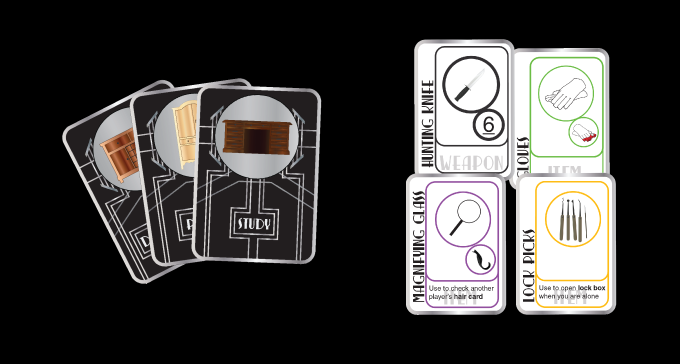
And speaking of games, if you’re looking for a party game that mixes strategy and socializing, Death of the Party might be right up your alley.

A mix of Clue, Mafia, and bluffing games like The Resistance, Death of the Party is all about uncovering the identity of the murderer(s) before you get killed. It cleverly melds several established types of gameplay into a card game with a few other bits and bangles.

I must admit my bias on this one, since the premise is straight out of one of my all-time favorite movies, the comedic mystery film Murder By Death. Just like in the movie, every character plays a parody of a famous detective, trying to unravel the mystery without getting killed.

With almost two weeks left to fund, this one has a good chance of exceeding expectations.
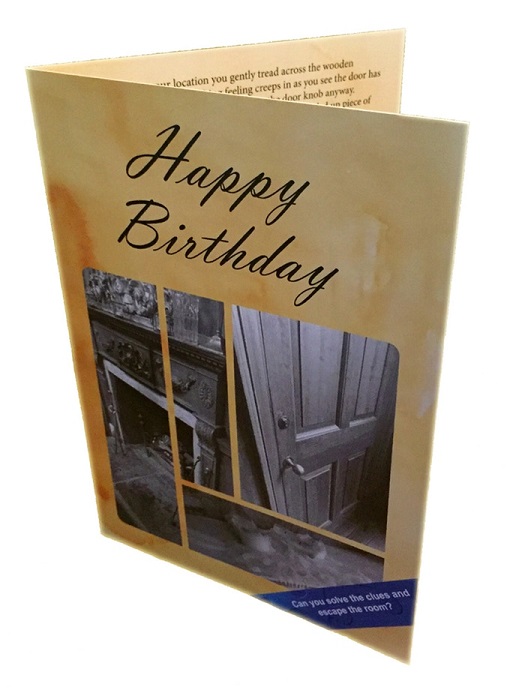
If you’re looking for something a bit more puzzly, check out Puzzle Card.

This is an escape room/brain teaser contained entirely within a greeting card. It’s a fascinating concept, but given that there are only a few days left to fund the project — and they only ship to the UK, which hurts interest from puzzlers in other countries — it’s dubious whether this one will fund.

Still, it’s a very cool idea.
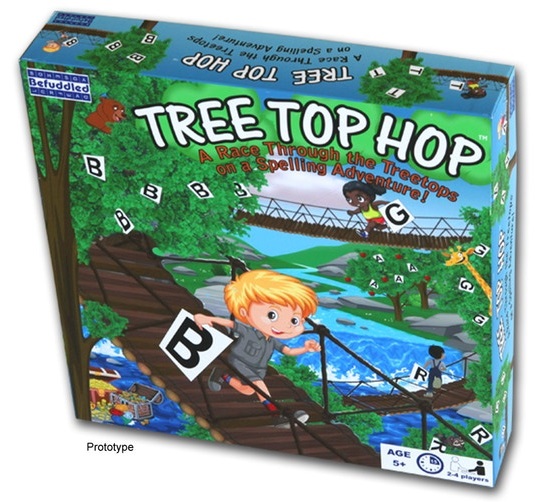
Turning from a puzzly challenge for adults to one for kids, we’ve got Tree Top Hop.

A spelling game for younger solvers, Tree Top Hop has players maneuvering through an elaborate network of trees connected by rope bridges in order to spell out different words.

It’s a nice intermediate step for kids to move them beyond simpler board games and into more strategic ones, all while encouraging spelling and other puzzly skills.

I had a chance to try out this game at this year’s New York Toy Fair, and I was impressed by the adaptive design and how quickly kids could get into the game play.

With nearly a month before its closing date, I suspect this offering from Befuddled Games will do well.

Finally, from the wholly unexpected idea pile, we have Plan 9 From Outer Space: The Deckbuilding Game.

Yes, someone has devised a card game based on one of the most infamously awful films in history, Ed Wood’s classic Z-grade alien invasion film.

Loaded with screenshots from the film — as well as references to both the plot itself and various in-jokes that have emerged among B-movie fans over the decades — this game puts you in the role of one of the movie’s heroic protagonists. Can you thwart the devious aliens and their undead minions as they try (for the 9th time) to conquer the Earth?

With three weeks left to fund, I think this one will squeak across the finish line, depending on the level of fan interest and crossover appeal to gamers. On the puzzly side, there does seem to be a fair amount of strategy to the gameplay itself, though luck will no doubt also play a big role in the cards you draw.


Let us know if you end up contributing to any of these campaigns, fellow puzzlers! We’re always interested in what interests you!

Thanks for visiting PuzzleNation Blog today! Be sure to sign up for our newsletter to stay up-to-date on everything PuzzleNation!

You can also share your pictures with us on Instagram, friend us on Facebook, check us out on TwitterPinterest, and Tumblr, and explore the always-expanding library of PuzzleNation apps and games on our website!

Game Boy: A Puzzly Step Forward for Mobile Gaming

It’s no secret that we’ve got skin in the puzzle app game. The Penny Dell Crosswords App is our flagship project, and it’s part of a thriving puzzle app market.

But if you think back, mobile puzzle gaming really started decades ago with Nintendo’s Game Boy handheld video game console. It was a precursor to the smartphone app system we have today, even if the Game Boy didn’t exactly fit in your pocket.

And at a time when classic video game systems are being revived and re-released — the 8-bit Nintendo Entertainment System, the Super Nintendo, and the Sega Genesis have all seen repackagings in the last year — could a Game Boy revival be far behind?

The crew at Gizmodo think so, and they made a list of 25 Game Boy games that belong on a revived system.

And as you might expect, there are several puzzle games suggested.

It makes sense, because many industry experts attribute some of the Game Boy’s success to the fact that every machine was packaged with a copy of Tetris, the addictive piece-moving game.

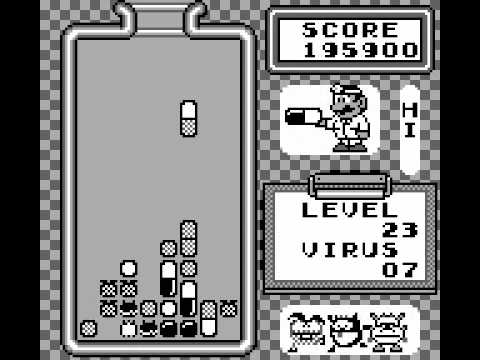
But that wasn’t the only puzzle game to make an impression on young gamers. Dr. Mario was all about pattern-matching in order to eradicate different colored viruses with stacks of similarly colored pills.

Either as a one-player challenge or in competition with another player, Dr. Mario taxed your ability to strategically use each pill provided, trying to eliminate as many viruses as possible.

And for a pure puzzle solving experience, there was Mario’s Picross.

This was a logic art puzzle where you had to use the lists of numbers along the top and side of the grid to deduce where to place black squares in order to reveal an image.

Although there was a timer attached to each puzzle, it wasn’t nearly as stressful a solving experience as Dr. Mario or Tetris, and it introduced an entirely new form of puzzle-solving to many young gamers.

Without the Game Boy and these puzzle games, it’s hard to imagine the success and growth of puzzle apps like the Penny Dell Crosswords App.


Thanks for visiting PuzzleNation Blog today! Be sure to sign up for our newsletter to stay up-to-date on everything PuzzleNation!

You can also share your pictures with us on Instagram, friend us on Facebook, check us out on TwitterPinterest, and Tumblr, and explore the always-expanding library of PuzzleNation apps and games on our website!

Get Into the Puzzly Swing of Things with Swinger!

Puzzles are infinitely adaptable. They’ve gone from riddles to pen and paper puzzles to mechanical puzzles made of wood, steel, plastic, and onward into video games, and now, apps on your phone. More puzzle apps than ever before are available on all platforms; it’s the new frontier of puzzle-games.

One of the puzzle apps that has recently been making some waves in the online market is Swinger, an addictive little puzzly delight.

In Swinger, your goal is to capture the little blue sparkling objects known as balls. To do so, you must tag them with a swinging arm that moves back and forth at your command.

Tap on one of those green rings to anchor one end of your swinger, and it will circle that ring like the spoke of a bicycle wheel. You can tap that same green ring to change direction, swinging your swinger back and forth as needed.

Navigate the ever-changing landscape of green rings to capture the balls, but be careful to avoid the obstacles that crop up over time, because they’ll block your swinger and damage your overall score.

A fun mix of quick reflexes and clever strategy, Swinger is all about adapting to your environment. Timing is key as your swinger swings toward each blue ball, before you tap another ring to move it, either to avoid one of the obstacles or to snag the next ball on the screen. You might even find yourself flipping the grid around in order to jump your swinger from one ring to another!

The concept is simple, but the gameplay grows increasingly complex with each passing screen as the obstacles become more bothersome and the swinger varies in size from ring to ring.

It’s an interesting mechanic that I haven’t seen in app form before. (For long-time video game fans, it has the feel of advanced platform games like Bionic Commando, Ratchet & Clank, or Super Mario Galaxy!)

Swinger is available from PiPiPass Studios on Google Play for Android devices.


Thanks for visiting PuzzleNation Blog today! Be sure to sign up for our newsletter to stay up-to-date on everything PuzzleNation!

You can also share your pictures with us on Instagram, friend us on Facebook, check us out on TwitterPinterest, and Tumblr, and explore the always-expanding library of PuzzleNation apps and games on our website!

PuzzleNation Product Review: Word Domination

Gathering letters to spell words and gain points… it’s a game mechanic so familiar and traditional that it’s easy to take for granted these days. Whether you’re talking about the wooden tiles of Scrabble or the electronic tiles of Words With Friends, the mind-bending spin of Unspeakable Words or the three-dimensional challenge of Upwords, it’s a classic concept.

Word Domination builds on that concept by adding a new strategical element. As you spell words, you claim letters from a shared letter pool. It’s essentially a more aggressive form Boggle.

Each player assumes the identity of a James Bond-style villain, and each letter tile doubles as a prize or piece of loot that can be captured by a player.

The player then uses a letter tile drawn at random with some of the letters laid out in the play area to spell a word, temporarily capturing those letters. (Unlike Boggle, the letters in the word don’t need to be touching.)

For example, in the first round, Player 1 spells the word ODYSSEY, placing zeppelin tokens on each of the 7 letters in the world, including the O that the player added on their turn. Player 1 then draws a new random tile for the next round, and play moves to Player 2.

Player 2 spells the word FORGERY and places her zeppelin tokens. And since she used three letters that Player 1 had captured, she captures those letters and removes his zeppelin tokens from the board.

Let’s jump ahead slightly. Player 3 spells the word TESSERACT, stealing some captured letters from both Player 1 and Player 2, and that concludes the first round. When round 2 starts up, Player 1 spells the word DYNASTY and places his zeppelins.

And since the letters D and Y were already captured by Player 1 in the first round, capturing them a second time means Player 1 has stolen those letters from the game board, and claims them for himself.

Those letters are given to Player 1 to use for the rest of the game, and replaced with STOLEN tiles, which are worth points at the end of the game.

After six rounds of play, the player who has claimed the most territory (and earned the most points) wins the game.

Now, naturally there are wrinkles to add to the gameplay, like helping other players spell words in order to split the profits with them, arming yourself with certain rare letters and weaponizing them, and even utilizing special abilities only your character has access to.

Between these twists and the baseline gameplay, you have a rich and variable game experience that really allows a strategic player to shine when matched up against players that might have stronger vocabularies or better luck drawing letter tiles.

And the game aesthetic really adds to the playing experience. The idea of stealing letter treasures, claiming territory with little zeppelin tokens, and running amok as a film villain (complete with bizarre letter-based weapontry and a punny name) is the perfect mix of silly and clever, spicing up a solid game with enjoyable little quirks.

Word Domination balances luck, strategy, and vocabulary skills to create a game that feels familiar but keeps you on your toes. What a treat.

Word Domination is created by Jeff Beck and is available through Uproarious Games and select online retailers for $32.99.


Thanks for visiting PuzzleNation Blog today! Be sure to sign up for our newsletter to stay up-to-date on everything PuzzleNation!

You can also share your pictures with us on Instagram, friend us on Facebook, check us out on TwitterPinterest, and Tumblr, and explore the always-expanding library of PuzzleNation apps and games on our website!

PuzzleNation Product Review: Less

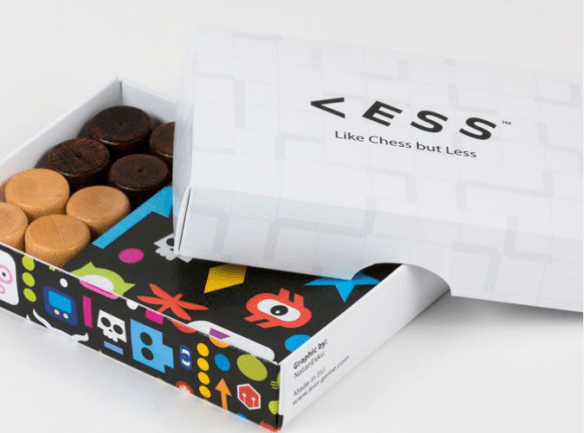
lessgame

There are many games out there that pair nicely with food or drink. Many party games even revolve around this mechanic, like Jason Anarchy’s alcohol-fueled roleplaying game Drinking Quest.

But I think Less is the first game where the playing tiles intentionally double as coasters for your drinks. It feels like a game that could be played in a tavern at a moment’s notice, which lends its minimalist style an old-world gaming charm.

less1

But I’m getting ahead of myself here. Less is a strategy game that combines the tactical planning of chess with the dynamic maneuverability of checkers.

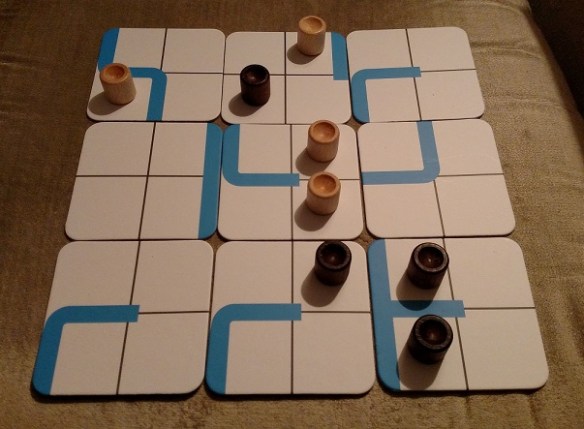
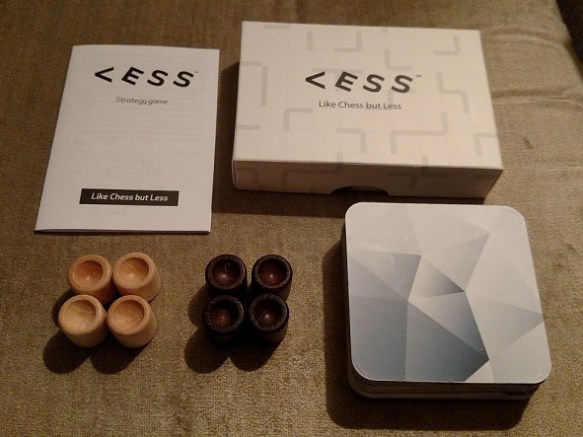
The game consists of 12 tiles and 8 game pieces, 4 white and 4 black. The players randomly select 9 of the 12 tiles and arrange a 3×3 game board. (With 12 tiles and four ways to place each tile, you’re virtually guaranteed a different game board every time you play.)

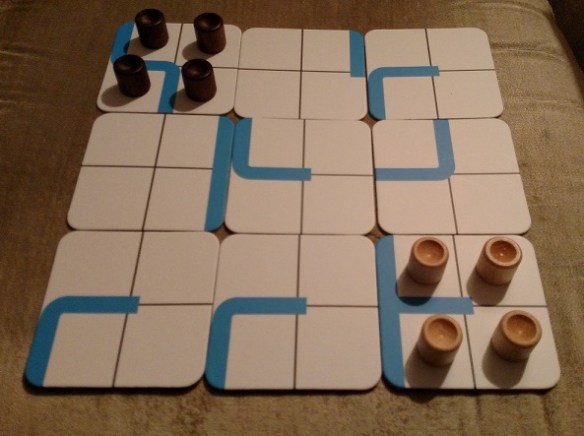
One player sets up their 4 game pieces in one corner, and the other player sets up their game pieces in the opposite corner. The goal of the game is to move all 4 of your pieces into your opponent’s corner before your opponent can occupy your corner.

less2

To do so, you are allowed three moves per turn. You can use all three moves for a single game piece, or spread them out over multiple game pieces. Moving a piece from one square to a neighboring square is one move. Jumping over a game piece to the next open square is also one move. (Here’s where checkers-style planning comes in handy.)

By now, you’ve probably noticed those blue walls on some of the tiles. Those walls require an extra move to traverse, so moving a game piece over a wall requires two moves. (And if neighboring squares each have a wall between them, jumping that double wall requires all three moves that turn.)

This three-move system offers players loads of options going forward, but your best bet is to arrange a sequence of leapfrog jumps to move your pieces as efficiently as possible across the board. (Unlike chess or checkers, there is no capturing or removing your opponent’s pieces from the board.)

less3

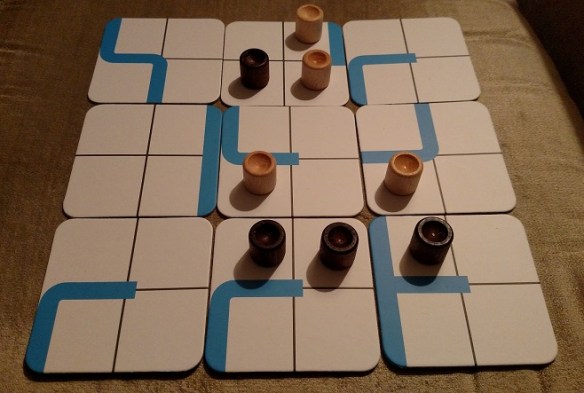
[Here, black has more pieces near the opposing corner, but that blue wall will make it harder to occupy the corner efficiently. Meanwhile, more of white’s pieces are farther away, but there are fewer obstacles to slow those pieces down.]

Mixing a tactical approach with the improvisation that comes with reacting to your opponent’s movements makes Less a very engaging gaming experience, even if a game routinely lasts less than ten minutes. And on the puzzle side of things, figuring out the most efficient way to navigate a path toward your opponent’s corner is great fun, since every game is different, and your opponent has different obstacles to tackle than you do, given the random placement of walls on the board.

Plus, if you’re willing to invest in two copies of the game, you can play with four players, as you and your partner coordinate your efforts across a 4×4 game board in the hopes of occupying your opponents’ corners first.

It’s a game that takes a few minutes to learn and offers near-infinite replayability. It might be called Less, but it feels like a very complete, very satisfying challenge.

less4

Less is published by InventedFor and is available online at less-game.com (with numerous coaster designs for the reverse side of the tiles). Click here for full details.


Thanks for visiting PuzzleNation Blog today! Be sure to sign up for our newsletter to stay up-to-date on everything PuzzleNation!

You can also share your pictures with us on Instagram, friend us on Facebook, check us out on Twitter, Pinterest, and Tumblr, and explore the always-expanding library of PuzzleNation apps and games on our website!

Rise of the Machines!

hqdefault5

I don’t mean to alarm you, fellow puzzlers and PuzzleNationers, but the machines may be taking over.

First, there was Deep Blue, defeating Russian chess grandmaster Garry Kasparov under standard chess tournament time constraints.

Then, there was IBM’s supercomputer Watson, sitting at the buzzer on Jeopardy!, besting previous champions Brad Rutter and Ken Jennings to nab a million-dollar prize.

An AI program called Deep Mind can play several Atari games with superhuman proficiency.

These days, you can design robots with LEGOs that are capable of solving Rubik’s Cubes in seconds flat.

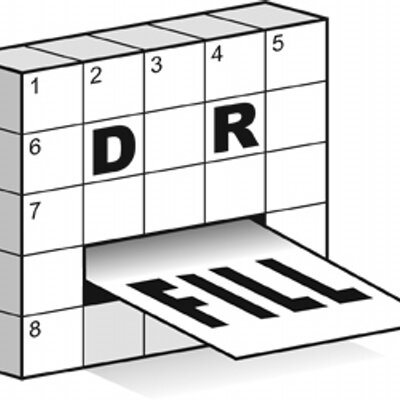
And, of course, crossword fans probably know of Dr. Fill, the crossword-solving computer program that competes at the American Crossword Puzzle Tournament each year. In a matter of five years, it has jumped from 141st place in the 2012 tournament to 11th place in the 2017 tournament.

drfill_400x400

Now, the machines are coming for Go players next. Google has developed an artificial intelligence known as AlphaGo which twice conquered Ke Jie, the 19-year-old Go tournament champion ranked number one in the world.

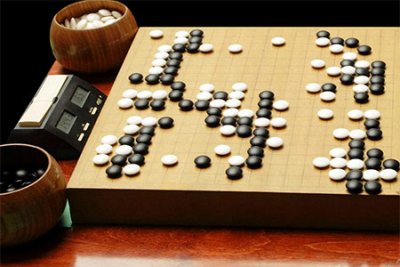
This strategy board game is played with white and black gamepieces called stones, and the objective is to surround a greater total amount of territory on the game board than your opponent. Along the way, you can surround your opponent’s pieces in order to capture them and remove them from play.

Wikipedia aptly describes the depth and difficulty of the game:

Despite its relatively simple rules, Go is very complex, even more so than chess, and possesses more possibilities than the total number of atoms in the visible universe. Compared to chess, Go has both a larger board with more scope for play and longer games, and, on average, many more alternatives to consider per move.

go-game

People have been playing Go for over 2,500 years, and yet, machines have already surpassed our greatest player.

Science fiction movies have been warning us about this for years. I just never expected them to come after our games and hobbies first.


Thanks for visiting PuzzleNation Blog today! Be sure to sign up for our newsletter to stay up-to-date on everything PuzzleNation!

You can also share your pictures with us on Instagram, friend us on Facebook, check us out on TwitterPinterest, and Tumblr, and explore the always-expanding library of PuzzleNation apps and games on our website!