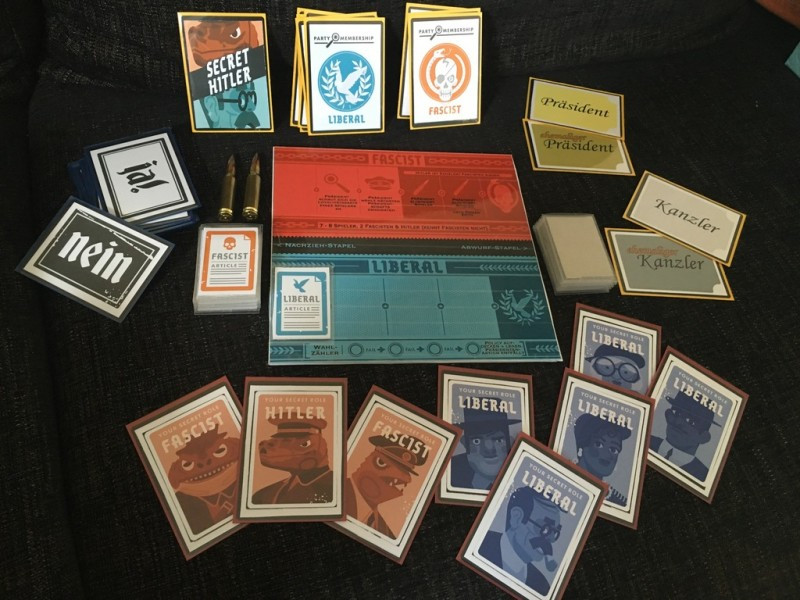
Social Deduction Games and Blood on the Clocktower!

Social deduction games are terrific party activities. A social deduction game involves players being assigned secret roles or allegiances, and the goal of the game is to unravel these secret roles before the opposing side can eliminate you from the game.

Usually it means the good guys trying to root out the bad guys before the bad guys take power, kill the good guys, or outwit the good guys into acting against their own best interests.

There are a lot of social deduction games out there for you to enjoy. Ultimate Werewolf, Are You a Robot?, Salem 1692, The Resistance, and Secret Hitler are all affordable ones with tons of replay value. (Of course, for affordability, you can’t beat Mafia. You can play a round of Mafia with just a deck of cards, proving that social deduction games are more about the players than the game pieces.)

But, when it comes to social deduction games, one game stands head and shoulders above the rest in terms of complexity, variation, challenge, and immersion.

Blood on the Clocktower.

There are usually only a few different roles to play in social deduction games. In Are You a Robot?, there are humans and robots. In Ultimate Werewolf, villagers and werewolves. In Secret Hitler, there’s Liberals, Fascists, and Hitler. In Mafia, there are mafia members, townspeople, a doctor/guardian angel, and a detective.

The limited number of character archetypes allows you to introduce to new players to the game quickly, which is definitely a bonus for games that require a large number of people.

But these limited roles can also hurt replay value if your players are looking for more to sink their teeth into.

That’s where Blood on the Clocktower comes in.

Yes, there are only two teams (good and evil), but EVERY player gets their own role, including powers and requirements that change over the course of the three “nights” that the game takes place. Every role is unique, and victory or defeat can hinge on the special abilities of a single player.

Blood on the Clocktower is the Tri-Dimensional Chess to every other social deduction game’s Chess. There is so much going on, so much to keep track of, so many possibilities that you can’t help but fall fully into the immersion of the game. It’s your only chance to survive.

And the game is so involved that it lends itself well to be “performed.” Watching a great game of Blood on the Clocktower being played is sometimes just as fun as playing.

I have seen some amazingly entertaining actual play videos of Blood on the Clocktower. YouTube channels like Smosh and No Rolls Barred have played, and now, Good Time Society is hoping to fund a Kickstarter for a series of actual plays of the game:

Some of the best actual play personalities in the board game and roleplaying game are teaming up for this, and it looks like they’re going to make something special here.

So click this link if you’d like to contribute. If not, hopefully you’ll watch some of these actual play videos and check out the game for yourself.

Game companies continue to push the envelope in terms of storytelling, presentation, and immersion, and Blood on the Clocktower has become the new benchmark. Who knows what’s coming next!

Do you have a favorite social deduction game? Let me know in the comments below! (For me personally, I love the simplicity and replay value of Mafia!)

And happy deducing, everyone!
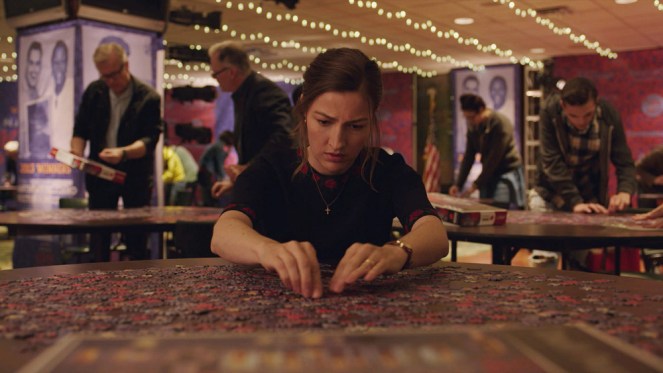
What’s Better in Puzzles and Games – Loud or Quiet?

One of my favorite things about puzzles is how peaceful they are.

Sure, escape rooms can be cacophonous, and dropping a jigsaw puzzle can be infuriating, but for the most part, puzzles are soothing.

The satisfying scratch of pencil on paper as you fill in a word, watching the pile of unplaced jigsaw pieces slowly dwindle as the picture continues to form, getting a little victory chime when you solve a puzzle in your favorite app…

Board games, on the other hand, tend to get loud.

Sometimes, it’s good-natured debate or enthusiastic contributions, like when things get tense in a cooperative game, or when the game generally encourages rambunctiousness, like Throw Throw Burrito.

Other times, it’s a by-product of the gameplay itself. There’s a fair amount of frenzied clacking in Hungry Hungry Hippos, for instance, but I never hear people complain about the noise that comes along with a round or two of marble-chomping.

[Image courtesy of Grey Mass Games.]

Of course, that increase in volume can be for reasons that are a little more heated. Maybe someone betrayed someone else in a game like Sheriff of Nottingham. Monopoly famously inspires people to flip the board in frustration.

Social deduction games where identities are secret, or where there’s some level of deception involved, also tend to get pretty loud. Whether it’s Mafia, Ultimate Werewolf, Secret Hitler, Blood on the Clocktower, or others, raised voices are common.

But when it comes to loud board games, I think we can all agree that one particular dexterity takes the cake.

Say it with me now…

JENGA!

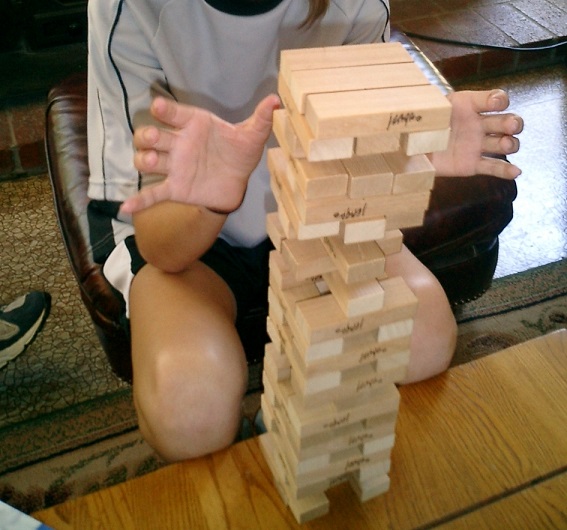
Yes, Jenga — by design — is loud. The only way the game can end is with a toppling tower of wooden blocks. CRASH! I know several board game cafes that have banned it for that specific reason.

Sure, KerPlunk can be loud, but even a stack of falling marbles doesn’t seem to compare to the jarring clatter of a stack of Jenga tiles hitting the table and/or the floor.

Sure, Perfection can be loud, but that’s kind of the point. You’re trying to complete the task BEFORE the buzzer. So it is possible to play without the cacophony.

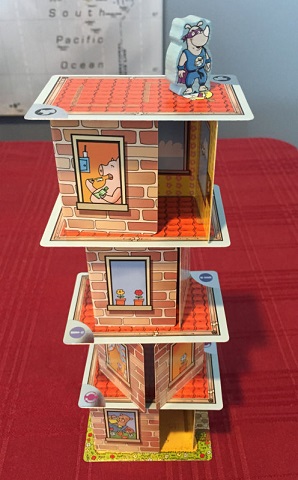
Jenga is so infamously loud that there are other games that sell themselves on being quieter than Jenga but offering the same stacking mechanic. Rhino Hero and Rhino Hero Super Battle employ cards instead of wooden blocks, so the collapse is less more tolerable, while Catch the Moon employs ladders, which makes for an oddly soothing yet still stressful game experience.

But where do you stand on noise-making games and puzzles? Do you like them soothing and soft or calamitous and crashing? And just what is the loudest game? Let us know in the comments section below. We’d love to hear from you.


Thanks for visiting PuzzleNation Blog today! Be sure to sign up for our newsletter to stay up-to-date on everything PuzzleNation!

You can also share your pictures with us on Instagram, friend us on Facebook, check us out on TwitterPinterest, and Tumblr, and explore the always-expanding library of PuzzleNation apps and games on our website!

A Game Kerfuffle in Wisconsin Politics?

We have a game day in the office once a week. Wednesday has been known as Game Day around here for years now, and we have a small group of regulars who use their lunch hour to eat, socialize, and play games. It’s a marvelous way to break up the work week, meet new friends, try out new games, and relax a little.

Those are all positives. It has never impacted productivity or caused any problems, save for the occasional scheduling snafu when people need the conference room.

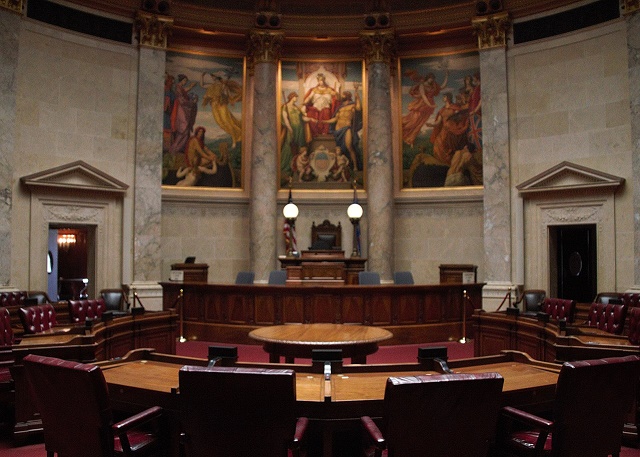
But apparently, similar activities are causing problems in the Wisconsin State Senate.

secrethitler1

[Image courtesy of Wikipedia.]

According to a reporter for the Wisconsin State Journal, the legislative pages have been playing games during work time.

There are conflicting reports about how much time has been spent playing games; some folks are upset with people playing games on company time, while others point out that downtime is common and as long as their duties are being performed capably, what’s the big deal?

Well, the game they’re playing is probably what’s raised eyebrows.

secrethitler2

[Image courtesy of the New York Times.]

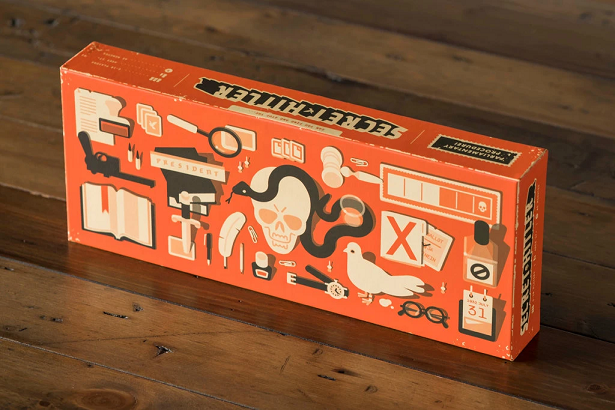
It’s called Secret Hitler, and given the emotionally charged political climate in the United States, it’s understandable how this particular choice of game might be controversial.

For the uninitiated, Secret Hitler is a social deduction game, similar to Werewolf, Mafia, and other games, where the goal is to root out a hidden traitor among the players.

Only in this case, as the game’s title states, instead of a mafia member or a werewolf, it’s a Secret Hitler lurking among the players, as well as players trying to place the Secret Hitler into a position of power.

More controversially still, there’s an expansion pack to the game that adds members of the current administration to the game.

It’s unclear which version of the game has been making the rounds in the Wisconsin State Senate offices. After all, in February 2017, free copies of Secret Hitler were shipped to all 100 members of the United States Senate by the game’s creator.

secrethitler3

[Image courtesy of TabletopFinder.]

Now, I am purposely not going to make any statements about this administration, regardless of my personal feelings. I make a point of not getting into politics in this blog. It’s supposed to be a place for puzzle and game fans to find out news, read reviews, and revel in all things fun and puzzly about the world.

That being said, I’m sure the choice of Secret Hitler was deliberate.

Maybe it was intended as a way to blow off steam in a political climate that is more tense than ever. That certainly wouldn’t be the most diplomatic choice, but you can easily see how it would make for a tongue-in-cheek way to defuse office stresses.

On the other hand, maybe it was intended as a statement, a sly shot at the current administration and ill feelings towards particular people in the government or political limelight. I don’t know.

But it’s pretty clear to me that it’s the game that got these pages in trouble, not the act of playing games. If they were playing Forbidden Island or Fluxx or Chutes & Ladders or any of a hundred other games in their downtime, it probably wouldn’t be a big deal.

I’m curious to see what the fallout from this story will be. According to reporter Riley Vetterkind, the game has been confiscated and HR is investigating the matter.

I hope nobody loses their job because of a game, whether it’s a political statement or just a ballsy choice of time-wasting and indulgence.

But it makes you wonder if any other games are popular in political offices and whether they’d prove as controversial as this one.


Thanks for visiting PuzzleNation Blog today! Be sure to sign up for our newsletter to stay up-to-date on everything PuzzleNation!

You can also share your pictures with us on Instagram, friend us on Facebook, check us out on TwitterPinterest, and Tumblr, and explore the always-expanding library of PuzzleNation apps and games on our website!