Queer Games Bundle: Undoing the Curse

For the second year in a row, queer indie game developers and gamers alike are celebrating Pride Month with the Queer Games Bundle. Until the end of June, interested parties can download almost 600 games and game-adjacent zines for $60, with a cheaper option available to those for whom that cost is prohibitive. Described as “an initiative to collaboratively support as many queer indie/micro/art devs and makers as possible,” the bundle is a project of swampbabes, a small New York organization of game artists. Swampbabes, as a collective, is “interested in sharing experimental, non-commercial, renegade games-related art and projects and providing a platform for diverse voices and bodies outside the structures of already established hierarchies.” 
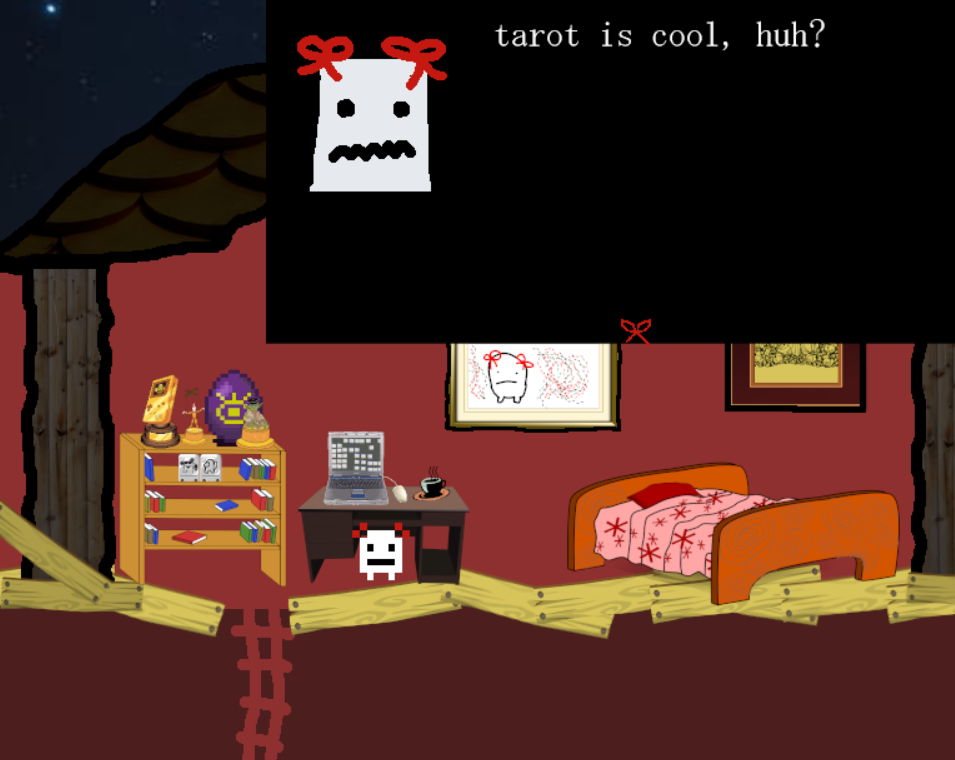
“kate sees your future,” by game creator Bagenzo

The bundle certainly provides a platform for diverse voices. There is a massive amount of content in the bundle, so much so that the selection might be intimidating. Let me provide some starting points. For those intrigued by last week’s blog post, there are two volumes of a zine chockablock with Twine tips and tricks, called “The Twine Grimoire.” Wordle fanatics might be entertained by “Herdle,” which casts Wordle’s distinct collections of squares as farm animals in need of herding. Did my post about stealing back your time via poetry resonate with you? You might find joy in “Time Bandit,” a game for Windows and MacOS that forces the player to slow down.

If tabletop roleplaying is your preferred gaming mode, never fear—included TTRPG guides range from the adorable and arguably self-explanatory “Rodents With Guitars” to the cyberpunk “Escape from Neo-Millenia.”  I was pleasantly surprised by the number of bundle entries incorporating tarot, like the solo journaling game “My One True Wish,” the browser-based “kate sees your future,” digital tarot deck, “Slimegirl Tarot,” and “A Note in Time,” a TTRPG about writing a letter to your younger self.
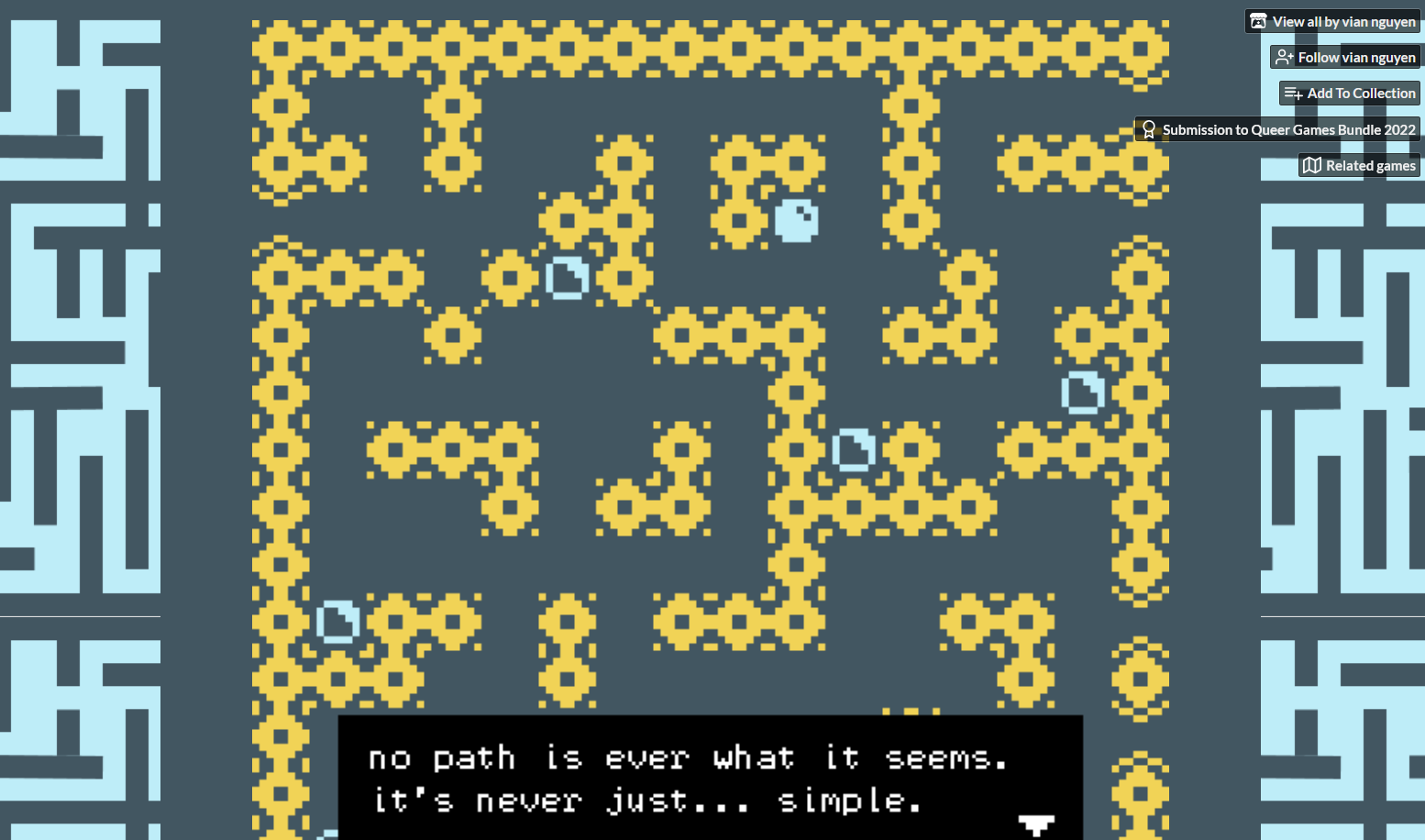
“people are labyrinths” by game creator Vian Nguyen

The puzzle-minded among you are likely to enjoy the game RESYNC, available for Windows, MacOS, and Linux (the bundle can be filtered according to the operating systems compatible with each game). RESYNC challenges you to work with robots as allies, solving puzzles to “uncover the true purpose of the mysterious outpost” on which your character has crash-landed. Then there’s the browser-based “people are labyrinths,” a collection of mazes studded with wistful dialogue boxes meditating on topics such as loss, the complex inner workings of other people, and an unwanted job.

Swampbabes states on their website that they hope the community their work fosters “begins to undo the curse inherited from mainstream video game culture.” They leave up to the imagination what exactly that curse is, but if you too feel that mainstream video game culture is cursed, and want to do something about it, purchasing the Queer Games Bundle is a win-win situation: hours of fun for you, and financial support for queer game developers. As of this writing, over a thousand gamers have purchased the bundle, raising almost $66,000 that will be split among the creators at Pride Month’s end.  


You can find delightful deals on puzzles on the Home Screen for Daily POP Crosswords and Daily POP Word Search! Check them out!

Thanks for visiting PuzzleNation Blog today! Be sure to sign up for our newsletter to stay up-to-date on everything PuzzleNation!
PN Product Review: GeoLogic

[Note: I received a free copy of this puzzle in exchange for a fair, unbiased review.]

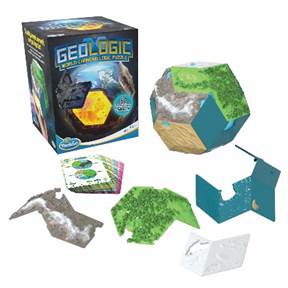
Imagine embodying the forces behind the Big Bang. Science fiction writers do this all the time, bringing into being entire new planets, studding them with swathes of land and bodies of water, devising chemically unfamiliar atmospheres. While I am a writer, fiction is not my forte, meaning that the wonders of world-building are typically out of my wheelhouse—at least, they were. Enter Thinkfun’s GeoLogic: World-Changing Logic Puzzle. This puzzle sells itself as an opportunity to “create your own world,” and “become a planetary architect,” promises that appeal to me as a science fiction fan. The puzzle is recommended for ages eight and up, and requires only one player, though planet-building can be a team activity too.

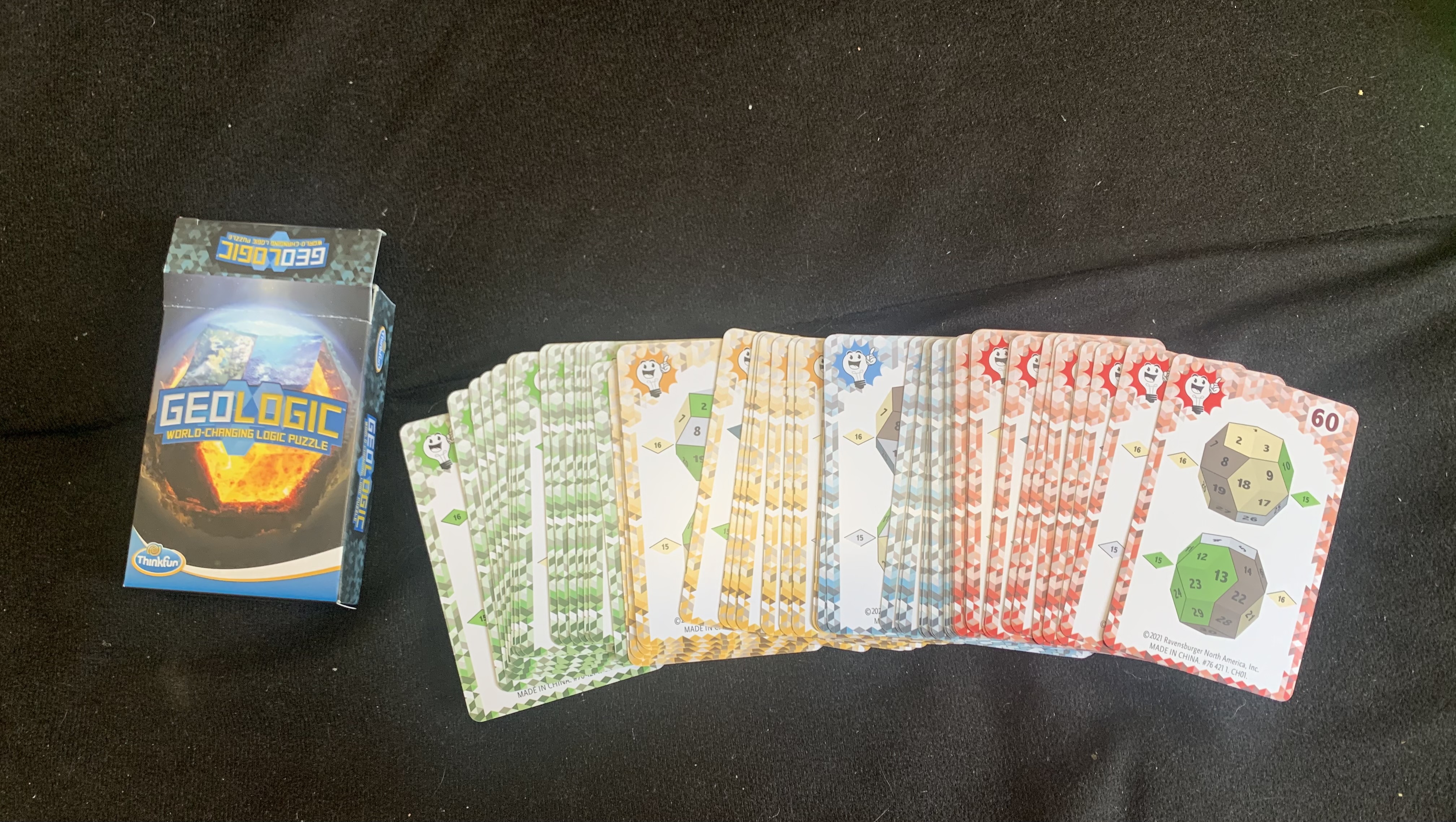
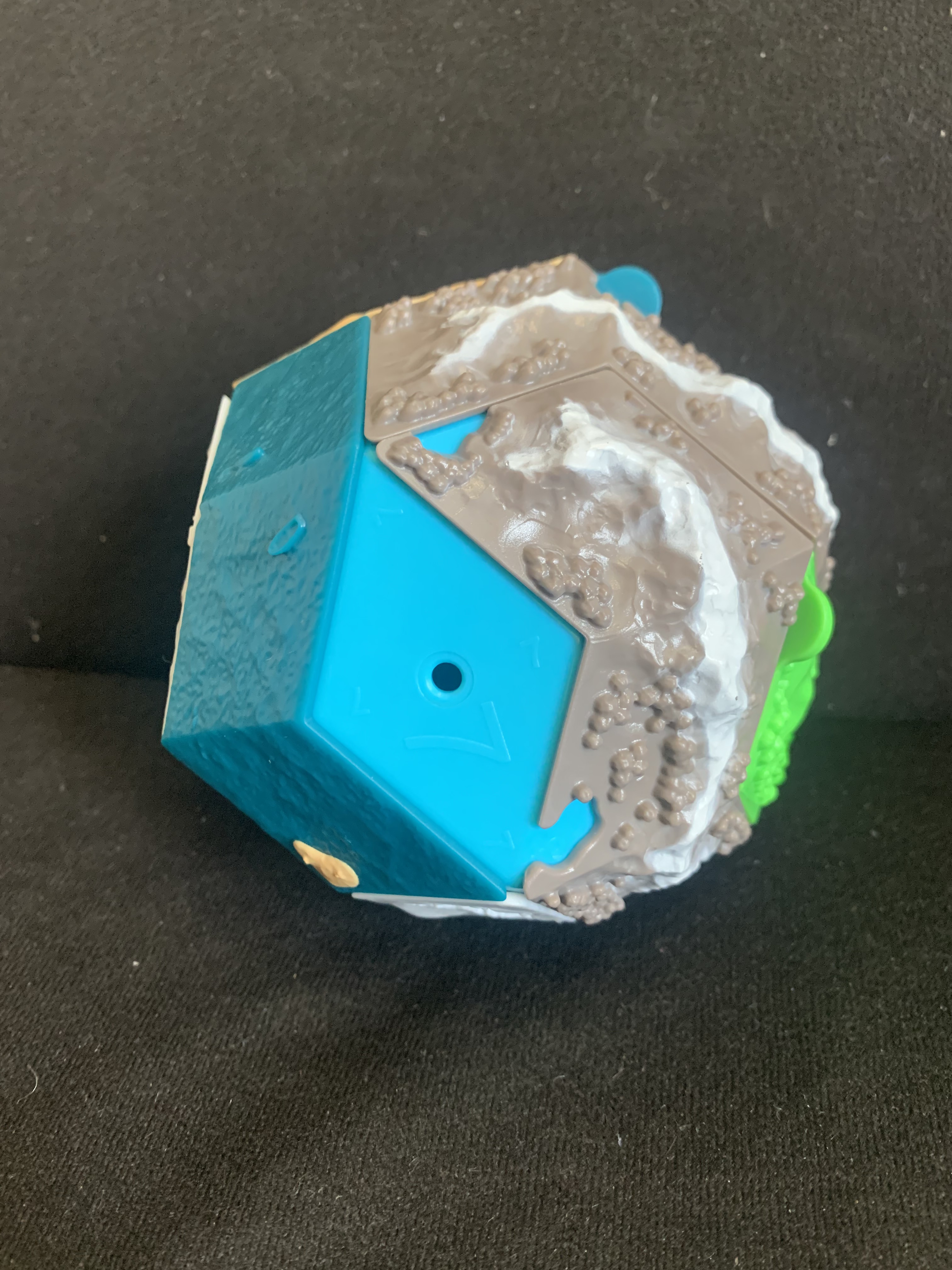
GeoLogic offers a route to science-fictional world-building other than the written word, bringing the invention of alien landscapes into the hands-on, three-dimensional realm. Born from a conversation between inventors Ken and Jeremy about the concept of a thirty-sided game die, the puzzle consists of a thirty-sided planetary core, fourteen snap-in-place pieces representing five biomes, and sixty challenge cards. Cards range from easy to expert, each indicating where certain biome pieces should go on the planetary core to start. The solver is then left to figure out where to insert a list of remaining biome pieces in order to completely cover the globe’s surface.

The challenge cards are optional; they are intended for players who would prefer to test spatial-logical skills rather than engage in more free-form, creative play. This mode of engaging with GeoLogic still has a science-fictional appeal; it just happens to fall more into the category of consuming science fiction than acting as its mastermind. If you dream of discovering new planets through a process of trial-and-error, then you’ll likely find using the challenge cards a perfect way to spend an afternoon, working your way up the ladder of difficulty levels.

If you’d rather ignore the challenge cards instead, you can take the game up on its suggestion that you “get creative and design your own planets.” As the box asks, “Want to create the largest landmass known to humans? Or oceans that span half the globe?” Now’s your chance! This approach to GeoLogic does require a certain amount of spatial-logical skill, as the goal remains the same: cover all thirty sides of the planetary core in some combination of awkwardly-shaped desert, forest, mountains, tundra, and ocean. If you are looking for a purely creative exercise, you might find the limitations of where the different biome pieces fit to be a frustrating hindrance to your imagination running wild.

An example of a built world that does not meet the goals of the game.

The solver most likely to be enchanted by GeoLogic, by my estimate, is the Tetris fan who longs for a more tactile experience—snapping the pieces into place on the core is very satisfying—and who can appreciate a sprinkling of science-fictional creativity. Those driven to the product by the idea of creating new worlds are less likely to feel fulfilled, but the core and biomes could certainly be used as a jumping-off point for contemplating what different worlds are possible. Dreaming big and freely when it comes to alternate worlds is important, yes. Possibly more important, for those interested in changing the world we’ve been handed, is knowing how to still dream big when complex limitations are imposed upon us from outside.


You can find delightful deals on puzzles on the Home Screen for Daily POP Crosswords and Daily POP Word Search! Check them out!

Thanks for visiting PuzzleNation Blog today! Be sure to sign up for our newsletter to stay up-to-date on everything PuzzleNation!
Puzzly Podcasts: 99% Invisible and Revisiting the “Average Solver”

A geodesic dome.

Buckminster Fuller, inventor of the geodesic dome and the World Game, once said, “Ninety-nine percent of who you are is invisible and untouchable.” This quotation inspired the title of 99% Invisible, a podcast about aspects of the designed and built world that typically go overlooked. Hosted by journalist Roman Mars, 99% Invisible began in 2010 as a joint effort between the San Francisco-based American Institute of Architects and SF public radio station KALW. Since April 2021, the podcast has been owned by broadcasting giant Sirius XM, but has remained essentially the same. On a weekly basis, Mars continues to provide listeners with calmly narrated explorations of topics like efforts to track the pandemic, the history of grocery store “ethnic food” aisles, and the skull logo representing Marvel’s Punisher character, including its memetic use among reactionaries.

It might sound counterintuitive, or in Mars’ words, like a “perversity,” to break down elements of design in a purely sound-based format. Without accompanying visuals, how are we meant to truly appreciate a discussion of graphic design in film and television, or the history of Hawaiian shirts? Mars considers the absence of images a boon, saying, “I thought the concept of doing a design radio show where you strip away the visual aesthetics actually made sense, it got to the parts of design I really loved, which was the problem solving.”

This element of problem solving at the core of every episode will likely appeal to any die-hard puzzler. If you’re interested in episodes more explicitly aligned with your love of puzzles and games, I would recommend starting with episode 189, “The Landlord’s Game,” about Monopoly, or episode 335, “Gathering the Magic,” about—you may have guessed—Magic the Gathering, or even episode 349, “Froebel’s Gifts,” which more broadly considers the history of play as a tool of intellectual development.

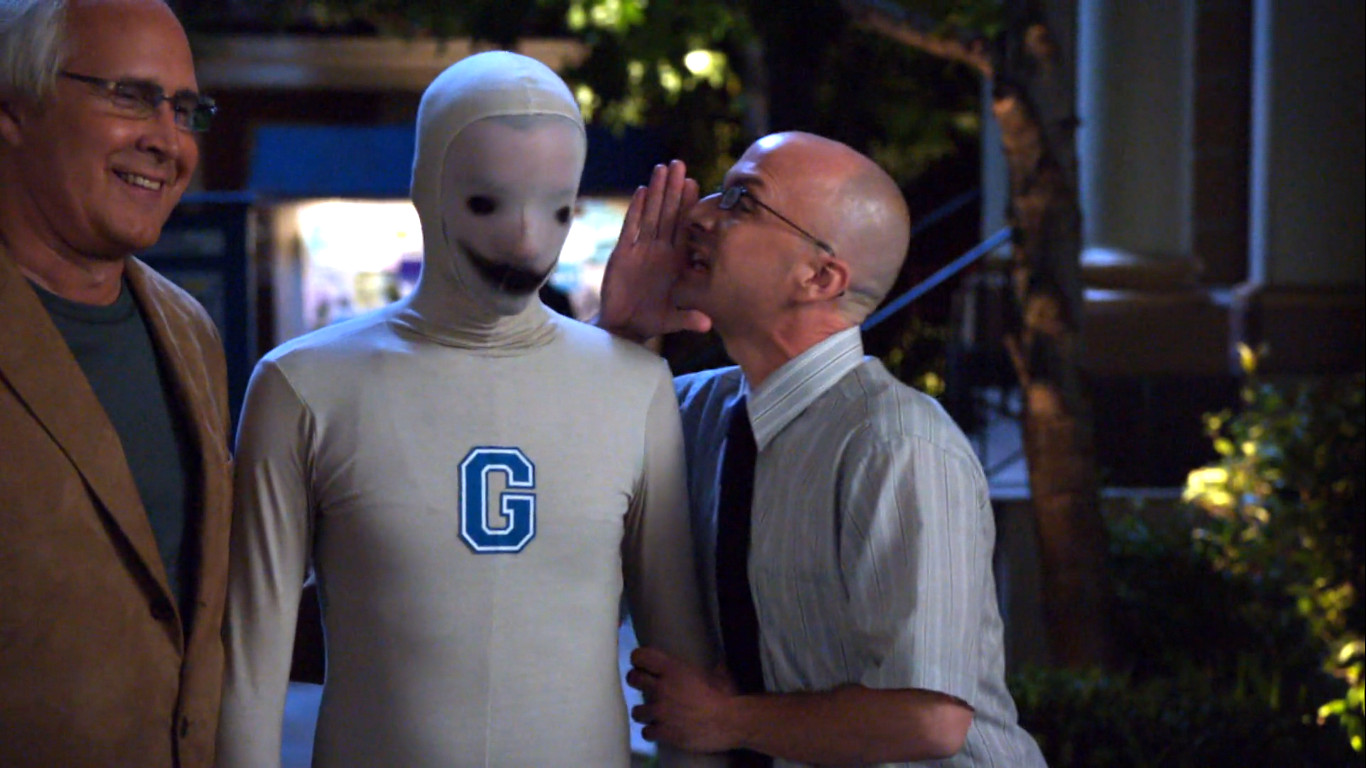
In Community, the attempt to represent an average human being led to this terrifying mascot.

Then there’s episode 226, “On Average.” My predecessor on the blog previously discussed the issues with the concept of the “average” crossword solver, questioning popular ideas that the average solver might not be familiar with spoon theory or arepas, and what these assumptions imply about the average solver’s identity. “On Average” takes Glenn’s questioning a step further, walking listeners through a nineteenth-century astronomer’s innovation of reducing human populations to statistical averages. The episode focuses most closely on the practice of flattening people out to bodily averages, but also discusses average calculation for social phenomena like marriages and murders, and the rise of the idea that the “average” is “morally the way to think about people.”

99% Invisible‘s host and guests take the stance of critiquing the average as ideal. One example the episode traces is the WWII design of Air Force planes for the average pilot. Most WWII pilots were not anywhere near average; in fact, zero of the 4,063 pilots measured in one study came anywhere close to perfectly fitting the average, and even when standards were relaxed, only a meager handful had average measurements. Todd Rose, author of The End of Average, sums the issue up thusly: “If you are designing something for an average pilot, it’s literally designed to fit nobody.”

The same might be said of puzzles. If we construct a puzzle for the average solver, are we really constructing a puzzle for anyone at all? Or has all the life been sucked out of the puzzle, all the potential for anyone to connect with its quirks? To settle into the cockpit and soar? If ninety-nine percent of who we are is invisible and untouchable, then ninety-nine percent of who we are cannot be reduced to statistics, cannot be turned into averages. Whether physically or mentally, people are more than patterns, more than perfectly proportioned crash test dummies, and every aspect of the world should be designed with this in mind, from planes to puzzles.


You can find delightful deals on puzzles on the Home Screen for Daily POP Crosswords and Daily POP Word Search! Check them out!

Thanks for visiting PuzzleNation Blog today! Be sure to sign up for our newsletter to stay up-to-date on everything PuzzleNation!
Escape Rooms and Bottle Episodes: A Condensed, Horrific History

When they appear in sitcoms, escape rooms are played for laughs and sentimentality, true to their common real-life role as a fun diversion and a team-bonding activity. On the other hand, horror media has a lot to say about the sinister side of being trapped in a room and dependent on only your wits to free you; a whole bevy of twenty-first-century films depict escape rooms from Hell. Consider the horrific potential of pairing claustrophobia with psychologically intricate tasks, and it makes sense that the recent rise of escape rooms as a pastime would be accompanied by a rise in twisting that pastime for terrifying purposes.

Escape room horror is not, however, a new concept, despite the modern appellation. Before No Escape Room (2016), Riddle Room (2016), Escape Room (2018), Escape Room (2019), Escape Room 2: Tournament of Champions (2020), and even before Fermat’s Room—which came out in 2007, the same year as the first documented real-life escape room—there was the 1997 movie Cube. In Cube, six strangers are trapped within a harrowingly booby-trapped setup of cubic rooms, and must rely on math and logic to escape death.

“It’s like something out of that twilighty show about that zone,” Homer said before entering his three-dimensional predicament in this Halloween episode of The Simpsons.

I am not here to recommend that you watch Cube, not unless you’re a fan of creative, vivid gore. Still, it is remarkable as a precursor to escape room horror directly inspired by actual escape rooms. Back in 1994 when director and writer Vincenzo Natali first completed the script, the closest relative to Natali’s vision was the Twilight Zone episode “Five Characters in Search of an Exit.”

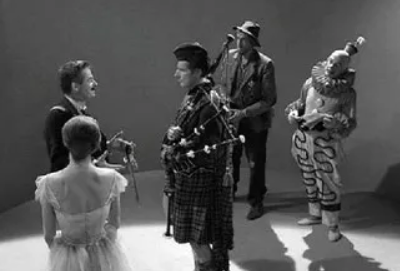
“Five Characters” originally aired in December 1961, sandwiched between episodes about time travel and World-War-II-era body-swapping. Compared to those premises, the episode’s set up is simple. Frustratingly so; the lack of bells and whistles is the source of the horror. The characters who wake up trapped together don’t even have names: they are simply, according to narrator Rod Serling, “Clown, hobo, ballet dancer, bagpiper, and an army major—a collection of question marks.”

These question marks play out the episode in essentially a featureless void. There are no brainteasers or riddles to unravel, no booby traps to dodge or calculations to perform. Rather, the puzzles are both larger and more bare-bones, existential: who are they, where are they, and is it possible to be somewhere else? Is it worth it to be somewhere else?

We might also call this story an example of bottle episode horror. In a 2014 interview, New Girl showrunner Elizabeth Meriweather said about the bottle episode, “Background Check,” “For a bottle episode, the stakes have to be very, very high, or else you’re feeling the claustrophobia of not leaving the loft.” This is a good rule of thumb for a sitcom, but what about a horror show, wherein you want to feel the claustrophobia? I’d argue that high stakes are just as necessary for bringing the claustrophobia home as for obscuring its presence; the line between effective comedy and effective horror, here, is thin.

The Community episode “Cooperative Calligraphy” makes no effort to obscure the claustrophobia of the situation; rules were made to be broken.

Does “Five Characters” offer the emotional depth and palpable claustrophobia necessary to bring out the horror of the situation? A review posted on The Twilight Zone Project seems divided on the issue, speaking to the episode’s building suspense but also calling the characters “cartoonish” and the twist “cheap.” “Five Characters,” you see, concludes with the reveal that the clown, hobo, ballet dancer, bagpiper and army major aren’t just playing a game of escape; they themselves are playthings, dolls in a charity toy drive bucket.

I have seen this episode several times, and still don’t know what exactly to make of this twist. What meaning can be gleaned from it, what metaphor? Uncertain what exactly the cast’s toy status tells us about humanity or anything else that lofty, I’d rather think of the episode as an historical artifact, and situate the concept of the players as the playthings in the context of the escape room and/or bottle episode horror television that has followed in its wake. Stay tuned for next week, when I examine a clear, modern descendant of “Five Characters in Search of An Exit.” (No, it’s not Cube.) Let the suspense build . . .


In the meantime, you can find delightful deals on puzzles on the Home Screen for Daily POP Crosswords and Daily POP Word Search! Check them out!

Thanks for visiting PuzzleNation Blog today! Be sure to sign up for our newsletter to stay up-to-date on everything PuzzleNation!

Piecing the Language Together

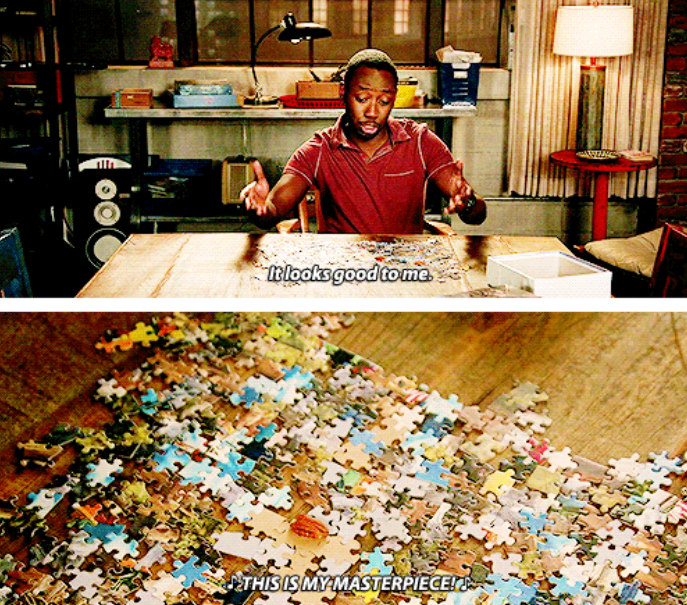
New Girl’s Winston Bishop doesn’t let his colorblindness get in the way of his passion for jigsaw puzzles. Should you take a page out of his book?

In January, I came across a tweet from poet NM Esc, also known as Neon Mashurov, reading, “I think translating activates the same part of my brain as doing jigsaw puzzles, which, for anyone who has never seen the absolutely obsessive way I tackle jigsaw puzzles, means I might have a new favorite project genre.” As a monolingual writer, I lack the tools necessary to fully immerse myself in the jigsaw experience of transforming, from scratch, one language into another. As someone who has assisted a former classmate with the process of editing poetry translations, however, I see exactly why a jigsaw puzzle would be an obvious point of non-linguistic comparison.

Each word in a translated poem should accurately evoke the meaning of the original; that much is obvious. Less obviously, depending on the poem and its style and artistic or ideological goals, a translated word might also need to evoke the original’s shape, its sound, its rhythm, its rhyme. It might need to carry a whole world of connotations on its back. There is rarely just one option for the right word in a translation, so the translating poet must shift through a mess of word-pieces, seeking whichever will lock into place exactly with the others, fitting comfortably and bringing the desired larger image to life.

There are limitations to this metaphor. Mainly, because as Willis Barnstone explained in the 2001 piece, “An ABC of Translating Poetry,” “A translation is an x-ray, not a xerox.” The poetry translator’s goal is not to perfectly recreate the image on a box. Rather, it is as though the translator is looking at the image on a box and then imagining what lies just beneath. The skin is stripped away and a skeleton is constructed for the image, from deduction and imagination, in a kind of cryptozoological (cryptopaleontological?) act of artistry. We see not what readers of the original language see, but we see what made the original language work. What made it stand up and move. This might not be the work of a jigsaw-solver, but it certainly presents a puzzle.

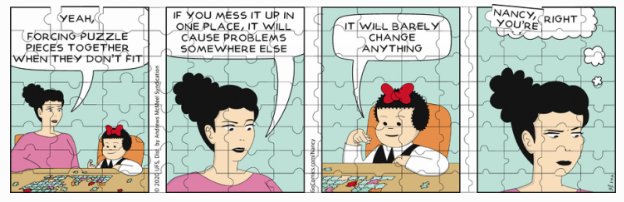
Barnstone’s work also tells us, “A good translation is a good joke. Reader, you are fooled.” A successful pun considers, transforms, and makes art from a word’s multiple meanings and dimensions, and a successful translation does the same. Translating poetry is fundamentally an act of wordplay. One must play with the words as if with Lincoln Logs or Play-Doh—or jigsaw pieces! In an earlier post on poetry, I featured the above comic strip, in which Nancy takes a creative, boundary-breaking approach to solving the jigsaw puzzle of her surroundings, and perhaps that is the most accurate metaphor for translation.

In a 2018 conversation with NPR, translator and poet Aaron Coleman posits, “The language lapses that inhibit an ideal interpretation can ultimately be ‘a creative, productive failure.’” Coleman goes on to say, “Maybe it can open up a new way for us to see what can happen in English and what can happen in Spanish, for me, or whatever the original language is.” Nancy, in switching around the puzzle pieces, has engaged in creative, productive failure, opening up a new way for us to see what can happen in the language of the puzzle. I love this perspective on translation, as someone who would not typically be considered to have the language skills necessary to translate from one language to another.

If you too are hesitant to try poetry translation because of the limits of your language, I’d like to invite you to go ahead and try anyway, even if you have to lean on Google Translate every step of the way. Even if you resort to marking some sections entirely untranslatable. In the words of The Magic School Bus’ Ms. Frizzle, “Take chances, make mistakes, get messy,” this National Poetry Month! Find some creative, productive failures that open up new ways for you to look at language. Maybe your finished product will be the verbal equivalent of Winston’s jumble of a jigsaw puzzle at the top of this post; that doesn’t mean you can’t call it a masterpiece.


You can find delightful deals on puzzles on the Home Screen for Daily POP Crosswords and Daily POP Word Search! Check them out!

Thanks for visiting PuzzleNation Blog today! Be sure to sign up for our newsletter to stay up-to-date on everything PuzzleNation!
Puzzles in Pop Culture: Person of Interest

In 2011, speculative CBS thriller Person of Interest began with the premise that a computer genius named Finch (played by Michael Emerson) had built an AI that could tell when acts of violence were about to occur in New York City. In order to intervene, he hired a former special operative named Reese (Jim Caviezel). The only information that the AI ever provides is a social security number; each episode, this leaves Finch and Reese to solve the central question: does this SSN belong to a victim of an impending crime, or a perpetrator? Do they need to be stopped, or saved?

Solving this question typically involves a veritable cornucopia of guesswork, research, hacking, plot twists, and pieces of paper taped to walls and connected by webs of string (one of my favorite TV tropes, featured in Supernatural and It’s Always Sunny in Philadelphia). Chess also features prominently, as do various secretive systems of communication. No episode is quite as likely to appeal to your inner solver, though, as season four, episode two, “Nautilus,” which aired on September 30th, 2014.

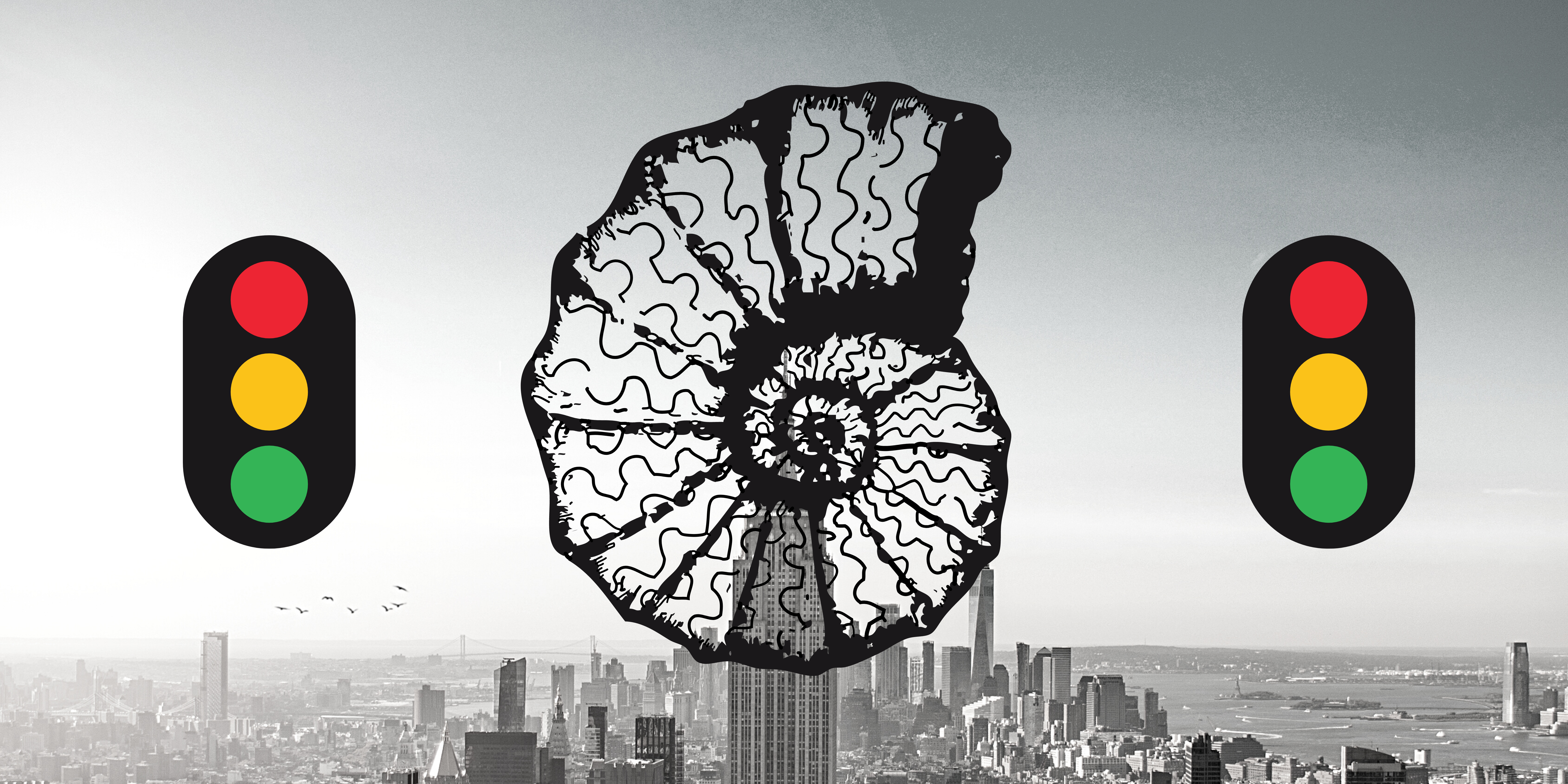
In this episode named for its chambered nautilus shell motif, Finch and Reese receive the SSN for chess grand master and college student Claire Mahoney (Quinn Shephard). She’s AWOL from school and chess in pursuit of a mysterious game’s prize. The game began with a post on an obscure message board: an image of a nautilus, captioned, “If you seek enlightenment, be the first to walk through the chambers.” There was data hidden in the image of a nautilus, and it sent Claire off down the rabbit hole.

Following her, Finch watches as she pulls a tab of paper from a lost dog sign, with a nautilus watermarked behind the numbers. After calling the number leads to nothing, Finch realizes: “It’s not a phone number . . . it’s multiplication.” Multiplying produces GPS coordinates, pointing to a location in Harlem.

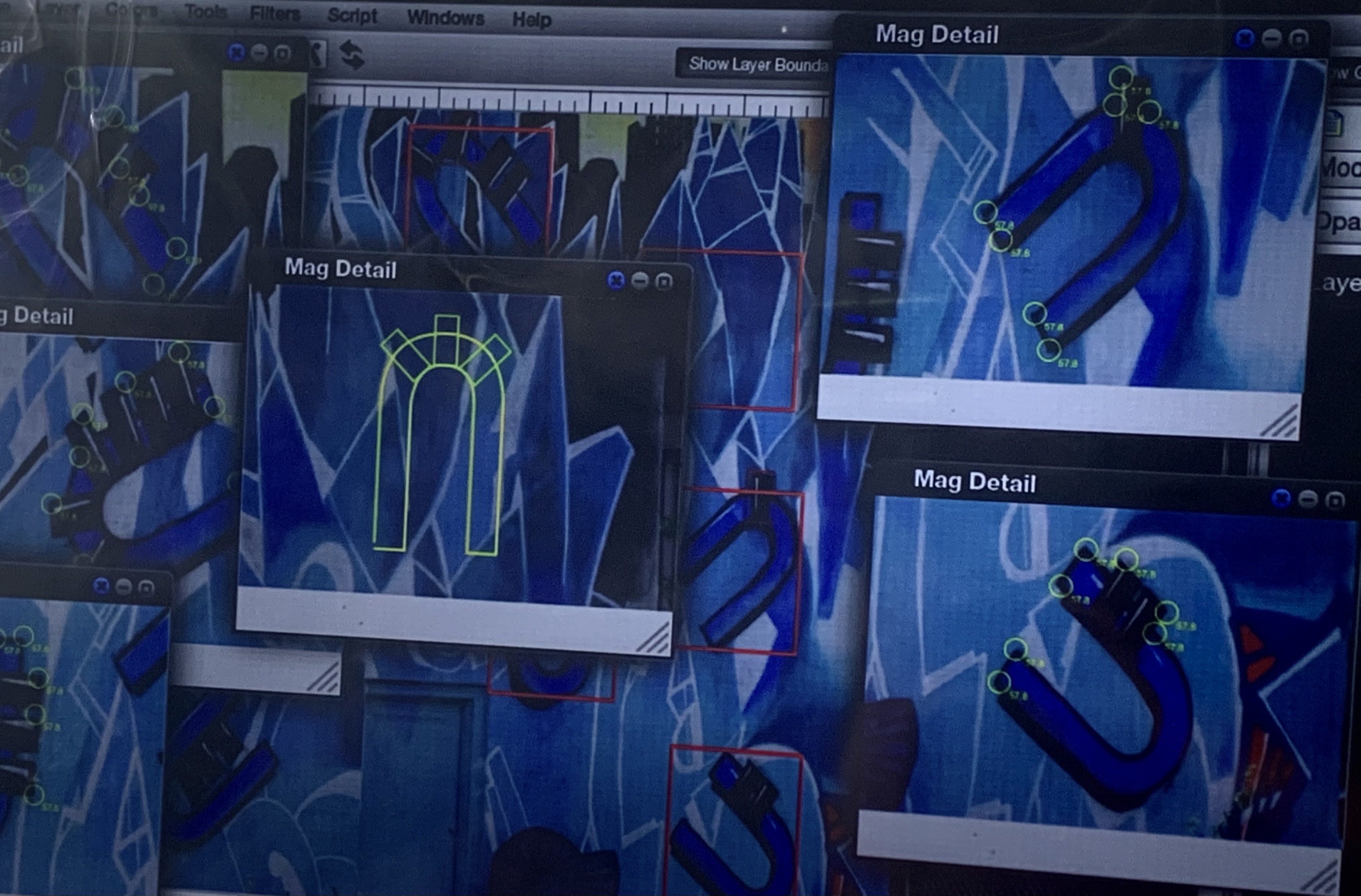
There, a mural of seemingly random shapes (painted by artist Apache Gonzalez) covers a wall. Once again, there’s the nautilus. Back in his office, Finch studies a photo of the mural, finally recognizing it as a variation on a Bongard Problem. He explains, “This particular type of puzzle presents two sets of diagrams. The diagrams in the first set share a common feature. The blocks never overlap with the curved lines. Conversely, in the second set, the blocks do touch the curves, but there’s another common element.”

Reese interjects, “There’s a different number of blocks in each diagram.”

“Using this pattern,” Finch continues, “I can fill in the blank space with the only number of blocks left out, which is three, thus solving the puzzle, creating a sort of three-pronged arch.” Googling, Reese finds a matching photo of an arch in Central Park.

That night, Claire is near the arch, standing in traffic. When Reese interrogates her about her apparent death wish, they’re interrupted, but later, the answer comes to light. If you stand at the right point in the street, banners for “motorcycle safety month” visually blend together to show the faint image of a nautilus. Beneath the nautilus: pictures of traffic lights that Finch correctly identifies as the equivalent of Braille dots. They spell out, “184th and 3rd.”

Claire’s next found in a biker bar at 184th and 3rd, staring at a bulletin board decorated in gang logos. One features a skull with nautiluses for eyes; letters surround the skull in a seemingly random arrangement. At an otherwise dead end, Reese sits at his desk, rewriting the letters over and over, seeking a scrambled word, until Fusco (Kevin Chapman) determines that the letters refer to musical notes, forming the tune to “New York, New York.” Reese is able to deduce a location: the Empire State Building’s observation deck.

Here on out, the puzzles become simpler, less compelling; from a Doylist standpoint (referring to author Sir Arthur Conan Doyle’s perspective, as opposed to fictional character John Watson’s), we might assume that the writers have decided that it’s time for the plot to dominate, turning the puzzles into mere perfunctory means to an end. I’m convinced, however, by the Watsonian explanation, that Claire has sufficiently proven herself, and the AI game-master is content now to lead her by the hand.

But why the nautilus shell? In the episode, computer hacker Root (Amy Acker) refers to the nautilus as one of nature’s examples of a logarithmic spiral. It’s commonly also referred to as an example of the golden ratio, but as explained in “Math as Myth: What looks like the golden ratio is sometimes just fool’s gold,” that’s not so true. Is that they key—that the prize Claire seeks is fool’s gold?

The episode’s primary puzzles have been solved, and the series has come to an end (though it can be streamed on HBO Max). Still, this one question of the nautilus’ significance remains. What is the symbolic connection between a nautilus shell’s chambers and the “enlightenment” the game promises? Is enlightenment encoded in the logarithmic spiral, or in something more particular to the mollusk itself? I don’t have the answers, but as the nineteenth-century poem “The Chambered Nautilus” by Oliver Wendell Holmes Sr. shows, Person of Interest’s screenwriters were not the first to see something spiritual in the nautilus, and I doubt they’ll be the last.

In closing, I offer the following excerpt from Melissa Febos’ Body Work: The Radical Power of Personal Narrative to mull over in your own pursuit of the nautilus shell’s deeper meaning:

The spiral does not belong to the nautilus shell, unless it also belongs to the whirlpool, the hurricane, the galaxy, the double helix of DNA, the tendrils of a common vine. If there are golden ratios that govern the structures of our bodies and our world, then of course there must be such shapes among the less measurable aspects of existence.


You can find delightful deals on puzzles on the Home Screen for Daily POP Crosswords and Daily POP Word Search! Check them out!

Thanks for visiting PuzzleNation Blog today! Be sure to sign up for our newsletter to stay up-to-date on everything PuzzleNation!