Hey there, fellow puzzlers and PuzzleNationers. I’ve got a question for you today:
Have you ever accidentally created a puzzle for yourself?
It could take any number of forms.
A vase you accidentally knocked over and the pieces simply won’t fit back together (until you realize one of the pieces slipped under the table).
An item left in a prominent place, meant to remind you to do something, fix something, move something, accomplish something, complete something.
A Post-it note with a quickly scratched phrase that made total sense when you scribbled it down, but now proves to be nigh-incomprehensible gibberish. (Everyone at one point or another has jotted down a phone number and later struggled to decode it. At least, everyone before the advent of smartphones.)
Gizmodo writer Brian Menegus was presented with a scenario similar to our last example when his modem stopped working. After it didn’t respond to reboots, being unplugged, or “strong language,” he ended up with a new modem after a service call.
All he needed to complete the process and rejoin the greater Internet community was to enter his log-in and password.
And therein lies the puzzle.
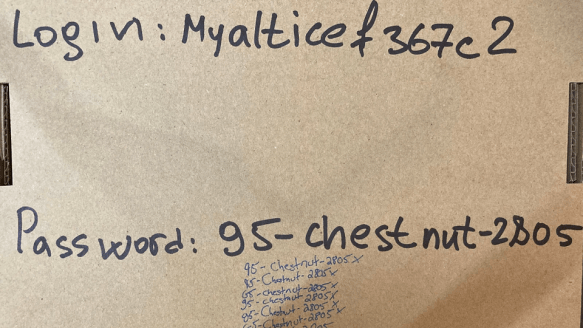
The password didn’t work as written. The problem was… some of those characters are a little ambiguous.
The first character could be a lowercase G or a 9. The third-to-last could be an 8, an ampersand, or a capital B. Chestnut could be one word or two. There were a litany of different possible interpretations of what was written here.
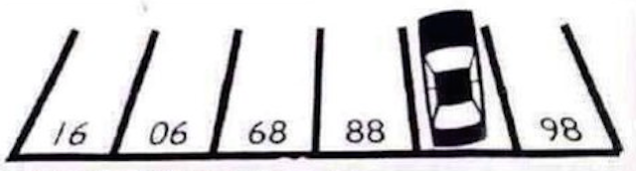
Multiple interpretations are at the heart of some visual puzzles. Long-time readers may remember the parking lot puzzle, where the solver must unravel how the numbering of spaces in this parking lot works:
The trick is simple: the numbers are upside-down.
Similarly, the wifi password employs a similar level of misdirection, although in this case, it’s quite unintentional.
As you can see from the scribblings at the bottom of the image, Menegus made a list of the possible permutations and tried them all one-by-one, a classic brute force form of puzzle-solving.
So, which version was it?
Well, after trying every combination and getting nowhere — and then resetting the modem to its factory settings — it turned out to be the most obvious one: 95-chestnut-2805.
Sadly, many of these self-made puzzles end up having frustratingly simple solutions.
Still, they do keep life interesting.
Thanks for visiting PuzzleNation Blog today! Be sure to sign up for our newsletter to stay up-to-date on everything PuzzleNation!
And now, there’s a zebra photograph that’s playing tricks on viewers.
This photo, taken in Kenya at the Maasai Mara national game reserve by wildlife photographer Sarosh Lodhi, was shared on Twitter, and he asked a supposedly simple question:
Which zebra is the one facing the camera?
And yes, those with good memories may recall that this isn’t the first zebra-related optical illusion we’ve posted on the blog, but I do think it’s the most challenging.
Some solvers focused on the folds in the left one’s neck, or the position of its ears, to determine which was the zebra in question.
Others found ample evidence to believe it’s the zebra on the right.
A few even posited that they thought it was a trick, and there was a third one in the middle facing the camera.
So, which do you think it is, fellow puzzlers and PuzzleNationers?
Here’s the photo again, with some space to think, before we share the answer:
.
..
…
….
…..
Ready?
……
…….
……..
………
……….
Are you sure?
……….
………
……..
…….
……
Last chance to turn back!
…..
….
…
..
.
Okay, here we go! Did you guess left or right?
The correct answer, according to the photographer himself…
Is the zebra on the left.
How did you do? Did you get it right? Or are you still convinced there’s trickery afoot? Let us know in the comments section below! We’d love to hear from you.
Thanks for visiting PuzzleNation Blog today! Be sure to sign up for our newsletter to stay up-to-date on everything PuzzleNation!
The thirteenth edition of Lollapuzzoola, as is tradition, arrived on a Saturday in August, but for the first time ever, it was hosted online to allow tournament solving from home. As one of the highlights of the puzzly calendar, I was glad to see it make the virtual jump, as Boswords did before it.
I was not in virtual attendance, but I did sign up for the Next Day Division puzzle packet. Last weekend, I finally had a chance to sit down and try my hands at this year’s tournament puzzles, and I was not disappointed. Lollapuzzoola continues to push the envelope with inventive themes and unique spins on how to bring crosswords to life.
This year’s theme was “Don’t Touch That Dial!” so every puzzle had something to do with television or TV channels, and the constructors were clearly inspired in all sorts of ways. Let’s take a look at what they came up with.
Instead of Brian Cimmet’s usual Twinlets puzzle as a warm-up, this year featured two practice puzzles. The first, constructed by Patrick Blindauer and entitled “I Want My MTV,” allowed solvers to hit the ground running.
The accessible theme — adding the letter M to established TV shows, a la SCOOBYDOOM or AMERICAN MIDOL — is the sort of fun and frivolous idea to spark solver imaginations and ready them for a proper day of puzzling.
Interesting grid entries included DATUM and I’LL BE BACK (as well as some nice misdirection with YEE-haw instead of HEE haw), and my favorite clue was “Traffic cop?” for NARC.
The second practice puzzle, a themeless mini constructed by Brian Cimmet, offered a slight uptick in difficulty and a nice preview of the sort of solving tournament attendees would see in the final.
Interesting grid entries included BOBA TEA, ORCHESTRATE, and ROLLED R (as well as tournament constructor STELLA Zawistowski getting referenced!), and my favorite clue was “One of three in ‘Alexander and the Terrible, Horrible, No Good, Very Bad Day'” for COMMA.
Puzzle 1: Soap Operas by Brooke Husic
The competition puzzles kicked off with this terrific opener, a 17×13 grid that showed off the flexibility and creativity of construction and grid design that keeps Lollapuzzoola fresh. (Also, I’m a sucker for a punny start to a tournament, so the theme was a plus for me.)
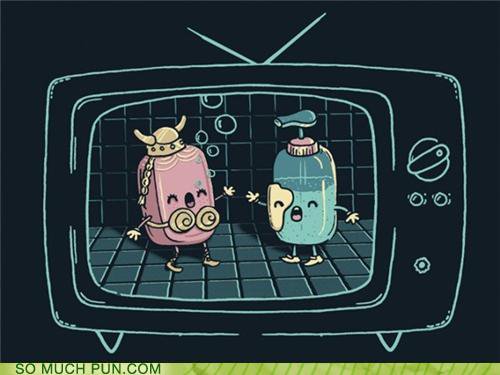
The themed entries featured commercial soap brands as part of common phrases (like IVORY TOWER and DOVE TAILED), which were then clued as “soap operas” for viewers.
It was a nicely constructed grid that flowed well, and it’s exactly the sort of puzzle to introduce new solvers to tournament puzzles while entertaining the established vets.
Interesting grid entries included DIWALI, ACADIA, and HOPE SO, and my favorite clue was “Card game that can go on and on and on and on and on and on and on, like this clue” for WAR.
Puzzle 2: The Final Countdown by Sid Sivakumar
This tall, thin 12×25 grid (coupled with THAT title) virtually guaranteed that Europe’s faux-epic anthem would be stuck in your head for a good chunk of the tournament, but I’ll forgive Sid, because I really enjoyed this puzzle’s hook.
The theme entries all began with a number (like 4 LETTER WORDS or 3-D TELEVISION), and as you expect, they counted down until reaching the climactic pronouncement AND WE’RE LIVE at the bottom part of the grid. It’s a fun idea that was complimented nicely by the unusual grid, and the puzzle flowed nicely from top to bottom as the entries counted down.
Interesting grid entries included PEARLED, RETURN KEY, MR SULU (which, before I looked at the clue, I kinda hoped would be MR. SHOW), and BUNGALOW. My favorite clues were “[Feed me! Pet me! Feed me! Play with me!] … or actually sometimes [Leave me alone!]” for MEOW and “‘Do not feed the ____’ (advice for bridge travelers and internet users)” for TROLL.
At this point, I noticed that both Puzzle 1 and 2 had an all-caps clue where the answer was a TV network. This feature continued throughout the tournament as a nice little through line, though its ultimate purpose wouldn’t reveal itself until after Puzzle 5. Stay tuned.
[Image courtesy of Pixar.]
Puzzle 3: Flipping Channels by Rachel Fabi
A swapping-themed puzzle is practically a tradition at Lollapuzzoola at this point, so I wasn’t at all surprised to see that idea adapted for TV with Puzzle 3’s hook. Each pair of theme entries not only included the names of channel, but swapped the second halves of phrases including those channels. For instance FOXGLOVES and OXYGENMOLECULES became OXYGENGLOVES and FOXMOLECULES.
As I solved, I wasn’t sure if these would be random pairs swapped, mirrored pairs swapped, or a continuous chain of swaps throughout the puzzle, so it took me a little longer to complete the grid. This was a definite step-up in difficulty from Puzzle 1 and 2, but not excessively so. (Some of the vocabulary also slowed me down, since I didn’t know NITTANY or INFODEMIC.) Still, it was a solid puzzle and an appropriate challenge for the midway point of the tournament.
Interesting grid entries included NOGOODNIK, CHEETO, HOT POCKET, GO GREEN, and the aforementioned INFODEMIC, and my favorite clues were “Nanjiani’s ‘The Lovebirds’ costar” for RAE and “Bisexual Greta of Old Hollywood” for GARBO, two clues that felt very fresh and topical, particularly for entries that solvers have seen plenty of times before.
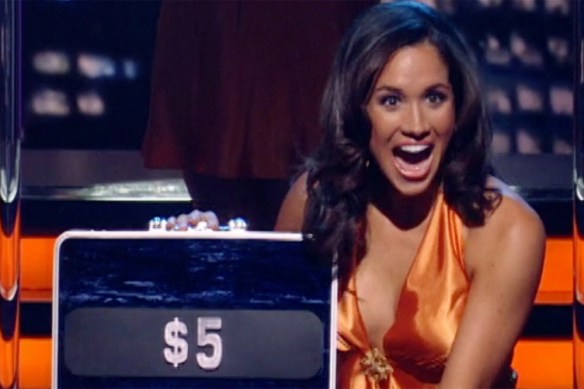
[Image courtesy of Game Show Network.]
Puzzle 4: Deal or No Deal by joon pahk
A big jump in difficulty and complexity, Puzzle 4 was an immensely clever and well-executed grid that took a familiar crossword concept — removing or adding letters from entries — and mined it for unexpected depth. On the left-hand side of the grid, a letter was added to both the clue AND the entry. For example, “Entranced cover” clued DAWNING. [Bolding is my own to highlight the added letter.]
On the right-hand side of the grid (but in the same row, one black square away), that entry was complemented by the same letter subtracted from both clue AND entry. The example above, for instance, was matched by “Go _own a spout” cluing _RAIN OUT. [Again, spacing added is my own to highlight the missing letter.]
These letter trades — the deal or no deal of the title — were tightly executed and made total sense to the solver without any explanation needed. Not only that, but the added/missing letter was always taken from the same part of the word on the other side! (Third letter E in FREIGHT was the missing third letter in SH_ARING next door.)
It’s incredibly impressive construction that is nicely balanced by solid fill and strong cluing. This is easily my favorite joon pahk puzzle I’ve ever solved, and will no doubt make my list of top puzzles of the year.
Interesting grid entries included GONZAGA, MEERKAT, NIP/TUCK, TWYLA, and SCHLEP, and my favorite clues were “Slightly subpar, ironically” for ONE OVER, “Wednesday the third?” for SILENT D, and “Snow or paint, in certain arenas” for AMMO.
Puzzle 5: Schedule Swaps by Stella Zawistowski
This 21x marked the end of the regular tournament puzzles, and it felt like a suitable final boss for most solvers in the competition. The grid was dense, well-constructed, and challenging, featuring another smartly-executed swapping gimmick. This time around, the theme was common phrases where one of the words was also a TV show, but that show was replaced with another TV show to make a new phrase.
For example, the phrase BIRTHING COACH became BIRTHING SCRUBS as COACH was relocated elsewhere in the grid. Fitting in all these themed entries — six of them! — plus their accompanying TV shows was no doubt a hefty challenge for the constructor, but Zawistowski made it feel effortless in this demanding but well-made puzzle.
Interesting grid entries included GALILEO, SAN PEDRO, DISCIPLE, PETSIT, AIRPOPS, and SO SUE ME (as well as the thoroughly baffling ONE O’ CAT, which I had to look up after), and my favorite clue was “‘Silver Springs,’ to ‘Go Your Own Way'” for B-SIDE.
As for the all-caps TV network clues we spotted earlier? They also appeared in Puzzles 3, 4, and 5, and it turns out, they were part of a clever little metapuzzle hidden in the tournament grids.
The five TV networks, one in each puzzle, turned out to be TBS, VH1, SyFy, ESPN, and TNT. And if you take the first letter of each, you get the hidden answer TV SET.
Very nicely done, constructors!
Puzzle 6: Finals by Robyn Weintraub
As always, there were two sets of clues for the Finals puzzle, the Local and the more difficult Express clues. No matter which clues you were working with, you were in for a terrific tournament finale.
With a pair of 12-letter entries from classic children’s television as anchors for the puzzle — MISTER ROGERS and BERT AND ERNIE — Weintraub delivered a tight grid with some strong fill and plenty of long, crossing entries in the corners to keep solvers guessing.
For me, this was a nice tournament landmark, as I powered through the Express clues and completed the grid without having to reference the easier Local clues once. I know this is commonplace for the top solvers, but it was a nice confidence boost for me as an enthusiastic solver, but hardly the fastest or the most competent.
It was a perfect final puzzle to wrap up one of the most consistent and enjoyable puzzle sets they’ve ever assembled for the tournament. With over 1,000 solvers participating through the online format, I can’t think of a better way to introduce them to the spirit and style of Lollapuzzoola than this year’s puzzles. Nicely done, team!
Interesting grid entries included WENT TO BED, SQUARE PEG, FALSE ALARM, PECOS, and NSFW. Both the Local and Express sets of clues had some gems, so I’ll list them separately below:
Local clues:
“Big cheese with the bacon” for CFO
“Escape room finds” for KEYS
“Month in which National ‘Twilight Zone’ Day is observed” for MAY
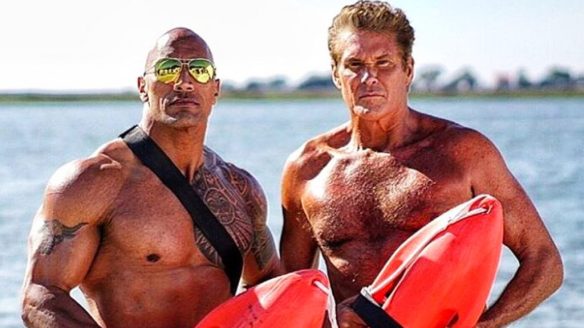
“‘____ Pressure’ (‘Baywatch’ episode with a punny title)” for PIER
Express clues:
“Place after place” for SHOW
“Canal zone?” for EAR
“‘Ua Mau ke Ea o ka ‘Aina i ka Pono’ or ‘Excelsior'” for STATE MOTTO
“PBS ‘Viewers Like You'” for DONORS
“‘Panic at Malibu ____’ (‘Baywatch’ pilot episode) for PIER
[Top(less) puzzlers.]
There was also a tiebreaker themeless mini by Amanda Rafkin (who we recently interviewed!). The mini was a quick and satisfying solve, loaded with great vocabulary, offering a nice cooldown after a strong tournament and several really engaging puzzles.
Interesting grid entries included MACARONI ART and SO EXTRA, and my favorite clue from the mini was “One paying dollars for quarters” for TENANT.
The puzzles at Lollapuzzoola always impress, and this year was no exception. The grids were tight, there was little crosswordese, and the creative themes, grid designs, and puzzle mechanics ensured that not only would fun be had by all, but that the puzzles would linger in your memory.
Mission accomplished, and congratulations on the competitors and the organizers who made it all happen, especially in a virtual format with so many additional solvers. Lollapuzzoola is only getting more creative, more groundbreaking, and more clever with each passing year, and it’s just awesome to watch it grow and evolve.
I can’t wait to see what they come up with next year!
Thanks for visiting PuzzleNation Blog today! Be sure to sign up for our newsletter to stay up-to-date on everything PuzzleNation!
Welcome to 5 Questions, our recurring interview series where we reach out to puzzle constructors, game designers, writers, filmmakers, musicians, artists, and puzzle enthusiasts from all walks of life!
It’s all about exploring the vast and intriguing puzzle community by talking to those who make puzzles and those who enjoy them! (Click here to check out previous editions of 5 Questions!)
And we’re excited to welcome Deb Amlen as our latest 5 Questions interviewee!
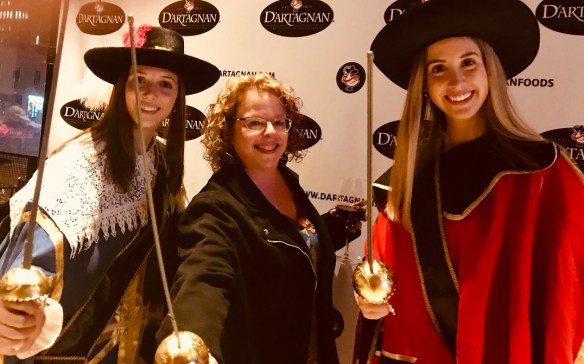
[Deb in the center, flanked by her fellow Musketeers.]
Deb is a talented crossword constructor, but these days, it’s more likely you know her for her role as the head writer and senior editor of Wordplay, the crossword blog and educational/humor column associated with The New York Times crossword puzzle.
One of the most public faces associated with the crossword, Deb entertains and informs across both the blog and its associated Twitter account, as well as hosting a live-solving show on YouTube with fellow constructor Sam Ezersky and celebrity guests!
Deb was gracious enough to take some time out to talk to us, so without further ado, let’s get to the interview!
5 Questions for Deb Amlen
1. How did you get started with puzzles?
Word games like “Ghost” were always my favorite things to play when I was a child, but I didn’t really get into puzzles until I was a young adult. I watched my father solve the New York Times crossword when I was really young, but I didn’t start solving on my own until I bought myself a subscription to New York Magazine after college and discovered Maura Jacobson’s puzzles.
I started constructing crosswords when my own kids were young because, as a stay-at-home mom, I desperately needed a creative outlet that didn’t involve Pokémon or Elmo. I read everything I could about puzzle making and learned how to make crosswords from Nancy Salomon. Nancy has mentored hundreds of constructors to publication.
2. As the flagbearer for crosswords in the public eye, The New York Times crossword is often the most scrutinized when it comes to cultural sensitivity regarding entries and clues, and more than once, that has depicted the Times puzzle in an unflattering light.
As a very public figure for the brand — not to mention the de facto social media gatekeeper — this puts you in the unenviable position of being between the audience and the editorial team. How do you handle these situations, and as an enthusiastic solver yourself, how do you think the Times is doing in this arena?
The crossword does get a lot of flack, doesn’t it? Honestly, some of it is warranted, some of it is not.
There is definitely a need to bring the flagship puzzle into the 21st century in terms of diversity and representation. Like most large companies, however, sometimes change happens slowly at The New York Times.
A lot of work is being done by the company and the puzzle editors behind the scenes, though, to increase diversity on their team and to be more aware of content that is inflammatory, and I think the recent puzzles reflect that. They have a ways to go, but the conversation is active and ongoing, and I’m very optimistic about the future of the crossword.
As far as social media goes, people tend to conflate “the Wordplay Twitter account” with “Everything The New York Times Does With Regard to Puzzles and Games.” So, since I run the Wordplay account and the puzzle editors are not really on social media, I tend to be the target of people’s complaints, which is hilarious because I’m just the columnist. Luckily, The Times has allowed me to expense a thick skin, so I’m doing OK. When I’m not, I take a break from social media, which I highly recommend and think everyone should do.
On the other hand, most people are well-wishers and are a lot of fun. They tweet their solving victories to me and I give them a gold medal emoji, which people really respond to. It’s very satisfying to be able to lift people up and encourage them, especially on social media, which can be very negative.
3. For the 75th anniversary of the New York Times crossword, constructors and celebrity guest puzzlers collaborated on numerous puzzles. Which celebrity constructors surprised you the most with their work, and who would you like to see as guest constructors in the future?
[Author’s note: When asked about her puzzle, Natasha said, “Working with Deb Amlen to create this puzzle has quite literally been a lifetime highlight for me.”]
4. What’s next for Deb Amlen?
Dinner, probably.
5. If you could give the readers, writers, aspiring constructors, and puzzle fans in the audience one piece of advice, what would it be?
Enjoy yourself. This is not like sitting down to take the SAT; it’s a game. And games should be fun. Life is too short to sweat the crossword.
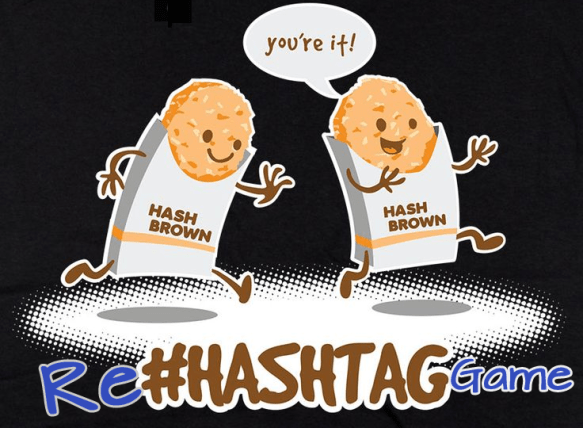
You may be familiar with the board game Schmovie or hashtag games on Twitter.
For years now, we’ve been collaborating on puzzle-themed hashtag games with our pals at Penny Dell Puzzles, and this month’s hook was #PennyDellPuzzleSports. Today’s entries all mash up Penny Dell puzzles with teams, athletes, famous quotations, and more things associated with the world of sports!
Examples include: Seventh Inning Stretch Letters or Basketball For One.
(The entries leaned heavily towards baseball — understandably, since it only returned a few weeks ago.)
So, without further ado, check out what the puzzlers at PuzzleNation and Penny Dell Puzzles came up with!
Puzzly Athletes!
CrackerJackie Robinson
Simone Biles Says
Tara Blipsinski
Wayne Grepsky
Puzzly Teams!
Arizona Diamond Ringbacks
MilwauKeyword Brewers
Minnesota Twin Crosswords
Philadelphia Fill-Innies
Tampa Bay Sunrays
Washington Wizard Words
Orlando Magic Squares
Chicago Bull’s-Eye Spiral
Puzzly Sports Terminology!
FenWord Ways Park
Doubleheader Trouble
A Few Fielder’s Choice Words
Box Scoremaster / Lucky Box Score
Perfect Dart Game / Perfect Fit Game
Right of Way field
End Zone of the Line
End of the Line drive
BaseLine ‘Em Up
Base Pathfinder
Baseball Diamond Mine
Grand Tour slam
Draw the Defensive Lineman
False Start and Finish
Game, Set, Match-up!
Hall of Framework
These Three-Pointers
Super Bowl Game
Scramble Across & Touchdown
Picker-Upper Deck Home Runs
Puzzly Famous Quotations!
“Are you ready for some Quotefalls?!”
“…The Thrill of Victory and the Agony of Delete”
“I never said most of the Everything’s Relative I said.” – Yogi Berra
“This is like Deja vu All Four One again.” – Yogi Berra
“It ain’t Overlaps til it’s over.” -Yogi Berra
“Window Boxes isn’t everything, it’s the only thing” — Red Sanders
“…it seems to me they give these ball players now-a-days very peculiar names… Well, let’s see, we have… Guess Who’s on first, What’s Left on second, You Know the Odds is on third…”
Several of our puzzlers went above and beyond, crafting calls from the announcers at these puzzly events!
The Call of the Game presented by Hall of Framework puzzle announcer Neil Simon Says:
“There’s two Drop-Outs here in the bottom of the Nine of Diamonds, One & Only one man on base, and Wade Mind Boggler steps up to the plate for the Tampa Bay Sunrays. This will be his First and Last at bat of the Word Games World Series. The Pitcher Sleuth looks to his What’s Left, then checks his Right Angles, sets his feet and Square Deals the pitch. It’s swung on by Mind Boggler and holy cow it’s a walk-off Home Run! That Baseball for One was crushed to Bits & Pieces! The Scoreboard says it all folks with a Three-to-One victory for the Sunrays. Who in the world could Picture This kind of ending? Just wow!”
Wide World of Sports reporting from the National Figure Skating competition:
Today, during the synchronized figure skating event, The Ice Chips team, sponsored by Penny Dell Puzzles, began their program divided up into Pairs and glided out onto the ice Two at a Time, and Step by Step taking their positions Face to Face. They gracefully began their number, first skating in a Mirror Image, then dividing up into Odds and Evens. A Small Change in the pace of the music brought a sequence of fast mohawks, turns, spread eagles, swizzles, lifts, and a Shuffle.
Have you come up with any Penny Dell Puzzle Sports entries of your own? Let us know! We’d love to see them!
Thanks for visiting PuzzleNation Blog today! Be sure to sign up for our newsletter to stay up-to-date on everything PuzzleNation!
We’ve spent a lot of time over the last few months discussing treasure hunts, but those are far from the only puzzly adventures that can send solvers out into nature. If you prefer your puzzling to have a codebreaking or cryptographic angle, we’ve got you covered there as well.
There are three mysterious stones in the United States alone that bear mysterious messages that have boggled the minds of puzzlers for decades upon decades.
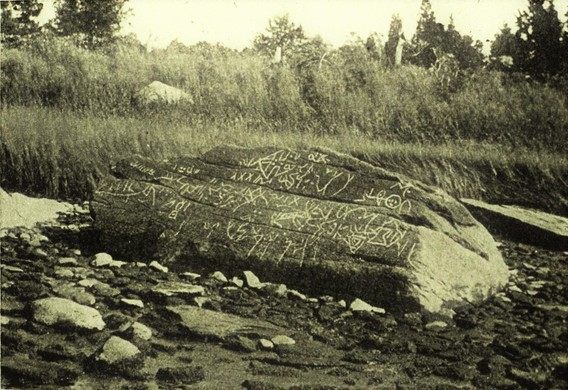
In Massachusetts, an eponymous state park museum is the home of the Dighton Rock, a stone covered in petroglyphs that has baffled viewers for centuries. (The earliest writings about the rock date back to 1690!)
[Images courtesy of Atlas Obscura. Look at the difference
between the two photos. Time is definitely running out…]
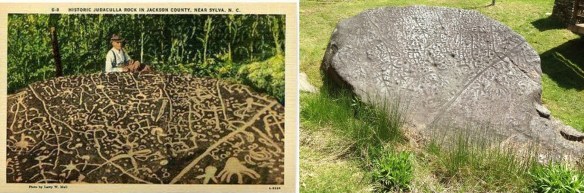
In the mountains of North Carolina, the petroglyphs of the Judaculla Rock defy decoding. Even dating the petroglyphs proves difficult, with estimates placing the origins of the rock’s message between 200 BC and 2000 BC. Sadly, efforts to solve the mystery of this former sacred site of the Cherokee people are fighting the forces of time itself, as erosion threatens the integrity of the glyphs.
And for solvers in the Southwest, New Mexico has the Decalogue Stone, which bears an inscription that, depending on the language used to decode it, could be a record of the Ten Commandments or a report from a lost explorer or warrior. (The possibility that it’s a hoax has been floated by more than one investigator as well.)
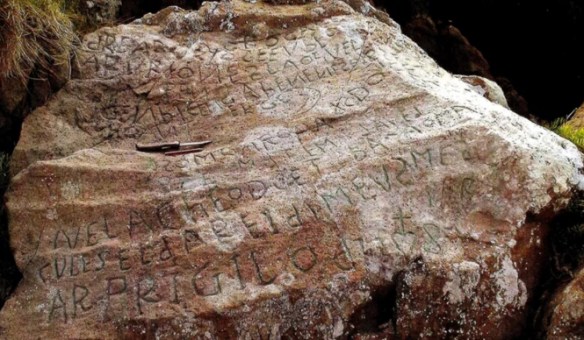
But for today’s mystery, we turn toward the country of France, more specifically the village of Plougastel-Daoulas in Brittany, the home of a rock that has baffled solvers for at least a century.
Unlike the Dighton Rock, which was moved from the waterline of the Taunton River, the inscription on this rock spends most of its time submerged in the Atlantic Ocean, revealing itself only at low tide. The 20-line inscription utilizes letters from the French alphabet, but the actual language used has eluded solvers. Suggestions include Basque and Old Breton. (There are also two dates on the rock: 1786 and 1787.)
Those dates lead some articles to estimate that the inscription’s origins date back as far as 250 years, but I think that’s unlikely. The rock was only discovered four or five years ago, so that’s a huge window wherein those dates could’ve been carved into the rock.
So, what makes this rock so interesting, given the examples we’ve shared above? Well, this rock inspired the village of Plougastel-Daoulas to host a contest last year to decipher it, offering a prize of 2000 Euros to anyone who could translate it.
In February of this year, the prize was awarded to two solvers who pitched different solutions to the inscription:
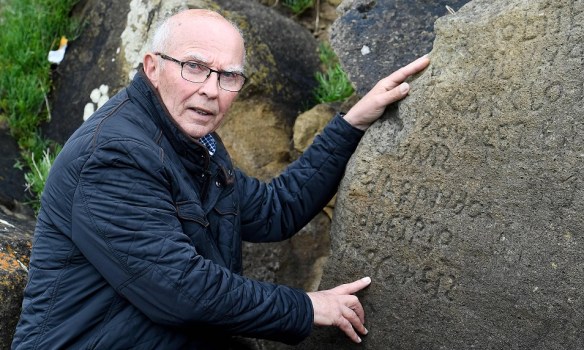
The first hypothesis came from Noël René Toudic, professor of English, who has a degree in Celtic Studies. He said that the inscription was likely about a soldier, Serge Le Bris, who may have died at sea during a storm. Another soldier, Grégoire Haloteau, was then asked to engrave the rock in memory of the dead man.
The second hypothesis came from reporter and writer Roger Faligot, and comic book author and illustrator Alain Robert. They suggested that the inscription was by someone expressing their anger against those who caused the death of a friend.
Despite those pitches — and all of the headlines declaring the mystery solved — this case is not officially closed yet. Perhaps other towns will follow the Plougastel-Daoulas model to encourage both visitors and solvers.
It certainly couldn’t hurt.
Thanks for visiting PuzzleNation Blog today! Be sure to sign up for our newsletter to stay up-to-date on everything PuzzleNation!








 PuzzCulture