We love brain teasers here at PuzzleNation Blog. Whether they’re riddles, logic problems, math puzzles, or challenging bits of wordplay, we take on all comers here.
There’s a long, proud PuzzleNation Blog tradition of cracking whatever brain teasers come our way, whether we find them ourselves, stumble across them in pop culture, or receive them from our marvelous PuzzleNationers when asked for solving assistance.
A friend of the blog discovered two brain teasers in a book of riddles and puzzles during a bookshelf cleanout recently, and they sent them our way to share with you!
We’ll post them below, and share the solutions next week! Good luck, fellow puzzlers!
Brain Teaser #1:There is a three digit number. All three digits are different. The second digit is four times as big as the third digit, while the first digit is three less than the second digit. What is the number?
Brain Teaser #2: When asked about his birthday, a man said, “The day before yesterday, I was only 25, and next year I will turn 28.” This is true only one day in a year – what day was he born?
Have you unraveled either of these brain teasers? Let us know in the comments section below! We’d love to hear from you.
Whether you play board games, role-playing games, card games, dice games, puzzles, or logic games, this is the holiday for you, family, and friends to come together and enjoy games.
So, to celebrate, we’ve got a grab-bag of different ideas for you today. Want to learn more about games through video playthroughs? We’ve got you covered. Want to solve a Mix and Match puzzle all about games? We’ve got you covered. Want to play something similar to Monopoly that’s not Monopoly? We’ve got you covered.
Please enjoy this somewhat chaotic sampling of board game-themed goodness in honor of Tabletop Day!
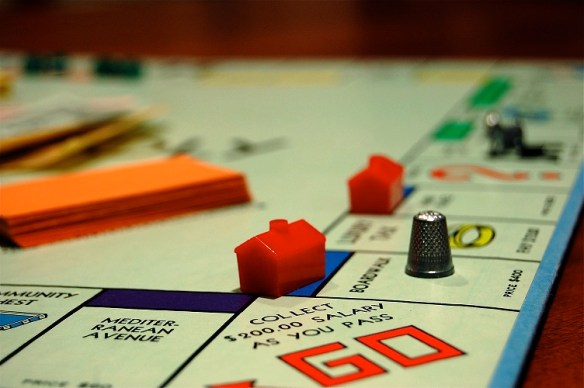
Monopoly is the most famous board game in history. We really can’t discuss the topic of board games without mentioning Monopoly.
But Monopoly has its issues. It takes a long time to play, and if you fall behind, it’s incredibly difficult to catch up. Plus, if you get eliminated, it’s not fun to watch other people keep going.
So what do you do if you like some of the game mechanics in Monopoly but not the total package? Easy! Use our handy-dandy guide to find other games that do part (or ALL) of Monopoly better than Monopoly!
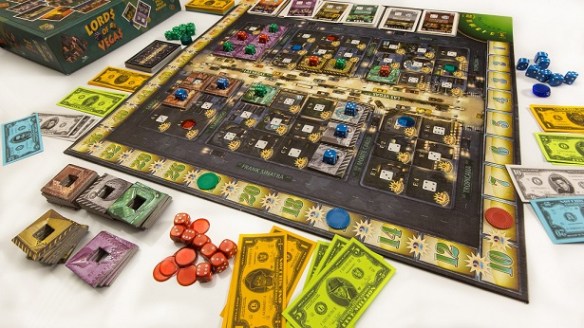
Maybe you enjoy buying property and building it up with enhancements and making money with it. That’s great. You should check out Lords of Vegas.
It’s a casino-building game set in the early days of Las Vegas. It’s got play money, dice, all sorts of strategy, plus a gambling mechanic where you can make up for monetary shortfalls. It’s a brilliant game and so so much fun.
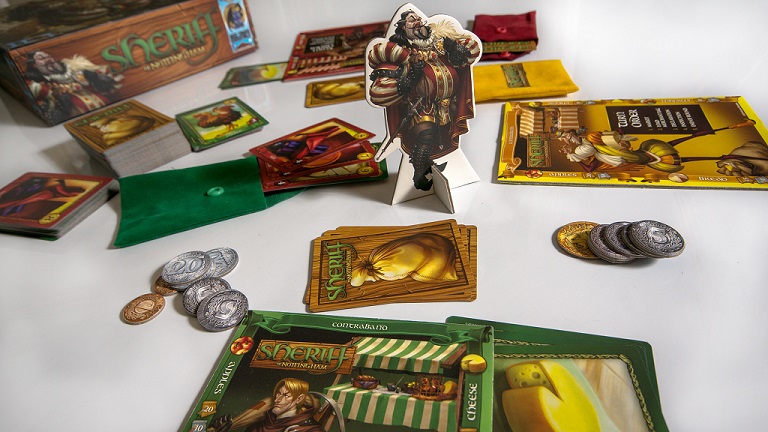
Maybe it’s collecting valuable cards, negotiating and trading with other players that you enjoy most about Monopoly. Terrific! You should try Sheriff of Nottingham.
In Sheriff of Nottingham, players collect cards with different goods to take to market — apples, chickens, bread, and cheese — as well as cards of contraband items (like spices, mead, and weapons). Each turn, one player is the Sheriff, trying to stop the other players from sneaking contraband into the market. So you can bluff, or bribe, or try to sneak goods past the Sheriff, or just play it straight with regular goods.
The game allows for trading, cutting deals, being sneaky, and bonuses for being the person with the most of certain goods (apples, for instance) at the market. It’s so much fun, and allows for lots of fun interaction throughout the game, since nobody is ever eliminated.
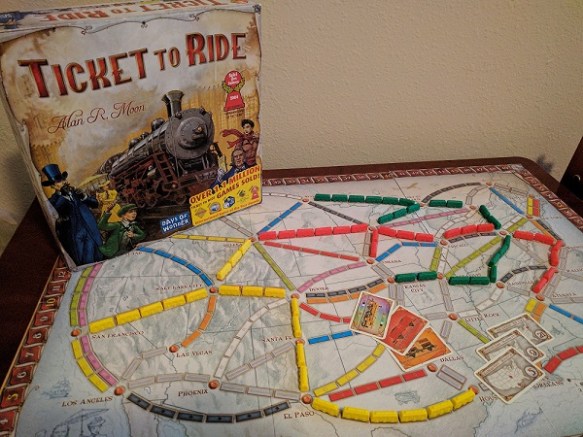
Do you like completing colored sets of items? Outmaneuvering other players? Claiming valuable property that other players want? Pretty much everything involved in Monopoly is also part of Ticket to Ride.
In Ticket to Ride, players collect cards and play train cards on a map in order to complete different train routes to earn points. Not only can you score by completing those routes under your banner, but you gain bonus points if you can connect distant locations through your railways.
It covers a lot of the strategy and craftiness that made Monopoly famous, but in a sleeker, quicker package.
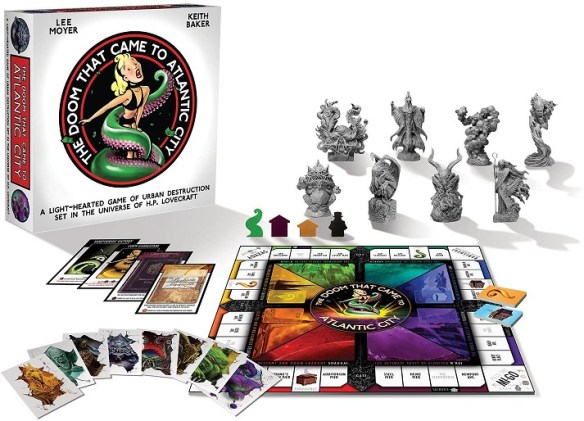
Oh, and if you want a totally off-the-walls Monopoly-inspired game, there’s always The Doom That Came to Atlantic City.
In this game, you crush houses to claim properties, play Chants (instead of Chance) cards, and basically try to be the best doomsday cultist at the table, summoning your monstrous god to end the world before the other players can.
It’s delightfully tongue-in-cheek, great fun, and a hilarious inversion of a lot of classic Monopoly tropes. I highly recommend it.
Oh, were you looking for some great video content? We’ve got you covered!
If you’re looking for great recommendations and playthroughs of games that your family will love — like Sushi Go, Codenames, Tak, or Takenoko — Girls’ Game Shelf is one of my favorite YouTube channels. The hosts (Kiki and AnnaMaria) are brilliant and insightful, the players are hilarious, and the game choices are topnotch.
It’s been a few months since they’ve uploaded, but there’s a load of terrific content already waiting for you there. Check out Girls’ Game Shelf!
And for slightly less-family friendly — but still fantastic — fare, No Rolls Barred‘s game playthroughs are uproariously funny. Whether they’re bickering over Telestrations, betraying and misleading each other in epic-length games of Blood on the Clocktower, or simply pitching insane products with Snake Oil, their videos are incredibly entertaining.
Plus the channel has top ten lists of games by genre or play-style, skits, and glimpses of game history. They recently passed 50,000 subscribers on YouTube, and their content keeps getting better. Check them out!
Yes, it’s a puzzle on International Tabletop Day. Hey, we’re PuzzleNation, we’ve got to include some puzzly fun, don’t we?
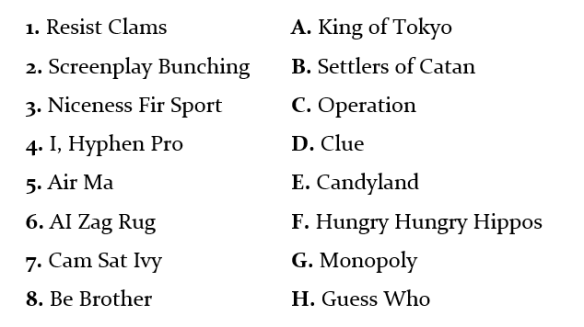
Today, we’ve got a Mix and Match puzzle for you. Can you anagram these phrases into the names of characters from famous board games, and then match them up with their board game?
How are you celebrating International Tabletop Day? Let us know in the comment section below! We’d love to hear from you.
Thanks for visiting PuzzleNation Blog today! Be sure to sign up for our newsletter to stay up-to-date on everything PuzzleNation!
In today’s blog post, we’ve got a movie title game for you. The challenge is simple: can you name these pairs of movies with titles that are opposites?
We’ll give you the genre for each film, the year each was released, and one star from each film. (Occasionally, we’ll offer a bonus hint as well!)
For example, let’s give you this breakdown:
-Horror, Horror
-2016, 1996
-Kate Siegel, Neve Campbell
Did you come up with Hush and Scream?
We’ve got more fifteen pairings for you to figure out! Let’s go to the movies!
#1
-Comedy, Romcom
-1985, 1995
-Madeline Kahn, Paul Rudd
(Bonus hint: Tim Curry, Alicia Silverstone)
#2
-Action/Crime, Drama/Crime
-1995, 1990
-Will Smith, Robert DeNiro
(Bonus hint: Martin Lawrence, Joe Pesci)
Heck, there’s a coffee mug where you can fill out different crosswords that all fit the same empty, fillable grid on the outside of the mug. I have a crossword analog wall clock that’s solvable.
But this is definitely the first time I’ve seen a crossword made of snow.
I think the gripping nature of this artistic act of puzzly expression was best summed up by his brother on Twitter:
This is a REAL crossword puzzle with REAL questions and solutions (see the thread) constructed on a REAL ice rink done by my REAL brother who is REALLY impressive.
I’m curious if other frigid puzzle styles will follow suit. Will we see an ice rink word seek where he has to skate around the words to loop them? Perhaps a rime-crafted rebus to challenge observers with wordplay?
There are definitely possibilities here, with a natural timer built-in as well!
Forgive the unintentional pun, but this is pretty cool.
Thanks for visiting PuzzleNation Blog today! Be sure to sign up for our newsletter to stay up-to-date on everything PuzzleNation!
It’s National Puzzle Day, also known as International Puzzle Day, depending on where you are and whether your puzzly activities extend across borders.
Maybe your puzzly Zoom group spans several countries. Maybe you and a friend are using remote-controlled robots to play Jenga. Maybe you’ve gotten hooked on Polish crosswords you’re solving through Google Translate. These are some of most common international ways to enjoy puzzling, of course. I’m sure you have plenty of additional suggestions.
But whether your Puzzle Day is National or International, we have some fun puzzly events and information to share with our fellow puzzlers and PuzzleNationers.
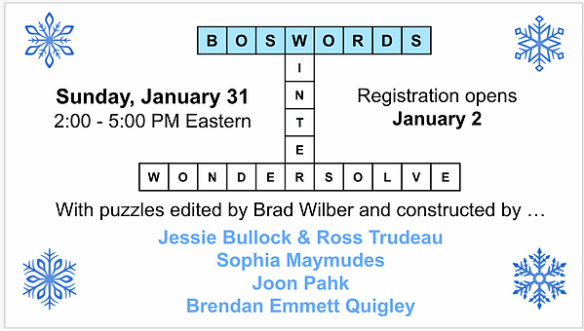
The first is that tomorrow marks the latest virtual puzzle event being hosted by the ever-inventive Boswords crew. After the wild success that was the Fall Themeless League, they’re hosting a one-day puzzle event on Sunday, the Winter Wondersolve.
Participants will have four puzzles awaiting them — three themed crosswords and a themeless — designed by top-notch constructors, and it’s only $20 to compete live! (If you just want to solve the puzzles outside the tournament, that’s only $10!)
Considering how terrific both the 2020 Boswords tournament and the Fall Themeless League were, I’m expecting a great day of puzzling from the Winter Wondersolve.
Speaking of puzzly events, the long-awaited fourth installment in the Crossword Mysteries series is debuting on Hallmark Movies & Mysteries on Sunday, February 14th at 8 PM Eastern.
And what would be more perfect for Valentine’s Day than a crossword-themed murder mystery about an elevator accident entitled Terminal Descent?
Exactly.
Of course, the easiest way to celebrate your (Inter)National Puzzle Day is to solve with us! Whether you enjoy crosswords, Sudoku, word seeks, or story-driven puzzling, we’ve got you covered with the click of a button!
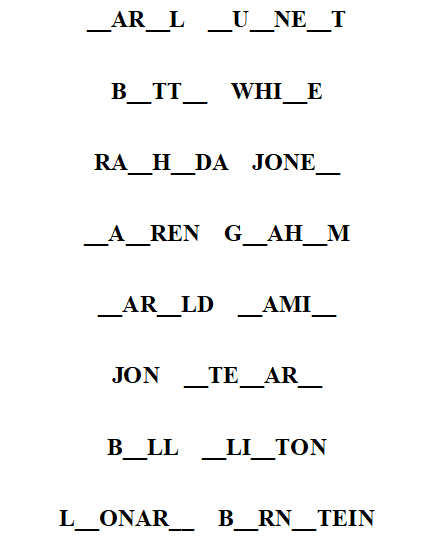
Names like Normal Mailer, Mike Mussina, Beverly Sills, Neil Patrick Harris, and many more are proud puzzle fans, so I thought I’d whip up a quick little puzzle about famous crosswords solvers.
Below is a list of eight names.
As you can see, there are letters missing from each name. Coincidentally, those missing letters spell out the phrase CELEBRITY CROSSWORD ENTHUSIASTS.
Can you place the letters in the correct spots to reveal this octet of puzzle-solving celebs?
Good luck and happy solving!
Thanks for visiting PuzzleNation Blog today! Be sure to sign up for our newsletter to stay up-to-date on everything PuzzleNation!
So let’s take a look at how to untangle this puzzle and sort things out so everyone enjoys the holiday, shall we?
First, a quick reminder about the puzzle, so the clues are fresh in our minds (and you have one last chance to solve it before we walk you through the solution).
On a curious Thanksgiving in 2020, five housemates were social distancing, each engaged in different activities throughout the day. (One was streaming Hulu.)
Each housemate (including Brian) wore a different outfit — one was wearing a tank top and shorts — and was doing their activity at a different time that day (1 PM, 2 PM, 2:30 PM, 3 PM, or 3:30 PM).
From the information provided, can you determine what time each housemate did which activity, as well as what outfit they were wearing?
1. The person doing Zoom trivia did so earlier than Alex but later than the one who wore a t-shirt and jeans.
2. Luke’s activity was earlier in the day than Denise’s, but later than that of the person who wore a Christmas sweater and pants.
3. Alex (who was wearing a Pokemon onesie) had her activity earlier than the person texting Grandma but later than Denise.
4. The person playing Among Us did so later than the person Facetiming their Mom, but earlier than the one wearing pajamas (who did their activity earlier than Adam).
Okay, first things first, let’s organize the information we have.
There are five housemates: Adam, Alex, Brian, Denise, Luke.
There are five activities: Facetiming Mom, playing Among Us, streaming Hulu, texting Grandma, doing Zoom trivia.
There are five outfits: Christmas sweater/pants, Pajamas, Pokemon onesie, Tanktop/shorts, T-shirt/jeans.
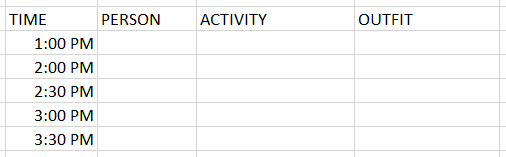
Since many of the clues reference who or what happened earlier or later than other events, it makes sense to use the times as our anchor points, so our starting grid should look like this:
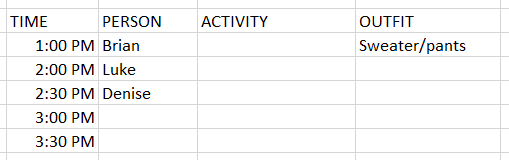
And we can immediately mark down who did the activity at 1 PM. In clue 1, the person doing Zoom trivia did their activity earlier than Alex, so Alex wasn’t the person at 1 PM. Clue 2 tells us that both Luke and Denise had someone doing activities before them, so it couldn’t be them at 1 PM. And Clue 4 tells us that the person in pajamas did their activity before Adam, so he couldn’t be the 1 PM person either. That leaves Brian as the 1 PM person.
That information tells us more as well. Alex can’t be the 2 PM person, because Clue 1 says both the Zoom trivia person and the person in t-shirt and jeans did activities before Alex. Denise can’t be the 2 PM person, because Clue 2 says both Luke and the person in the Christmas sweater did activities before Denise. And Adam can’t be the 2 PM person because Clue 4 says that both the person playing Among Us and the person wearing pajamas did activities before Adam. So Luke must be the 2 PM person.
Not only that, but since Luke did his activity after the person in a Christmas sweater and pants, that makes the sweater/pants Brian’s outfit.
We can fill in one person based on time as well. Clue 3 tells us that Alex’s activity was after Denise’s, so Alex can’t be the 2:30 PM person. And Clue 4 tells us that Adam’s activity happened after the person Facetiming Mom, the person playing Among Us, and the person in their pajamas, so Adam can’t be the 2:30 PM person. That leaves Denise as the 2:30 PM person.
So now our chart looks like this:
Let’s look at the outfits now. We know from Clue 3 that Alex is wearing the Pokemon onesie, but we’re not sure where to place Alex yet. But we can place the pajamas based on what we know.
In Clue 4, we’re told that the person wearing pajamas has their activity after the person Facetiming Mom and the person playing Among Us, and before Adam. So Adam is out. Alex and Brian are also out, because we know what they’re wearing. And Luke can’t be the person in pajamas, because his activity is second (2 PM) and at least two activities have to be done before the person wearing pajamas. That leaves Denise as the person in pajamas.
That leaves only two outfits unaccounted for: the tanktop/shorts and the t-shirt/jeans. But we can eliminate those as well. In Clue 1 we’re told that the person in t-shirt and jeans does their activity before both the person doing Zoom trivia and Alex. But Adam can’t be that person, because Adam’s activity happens after the person Facetiming Mom, the person playing Among Us, and the person wearing PJs. So Adam is wearing a tanktop and shorts, and Luke is wearing a t-shirt and jeans.
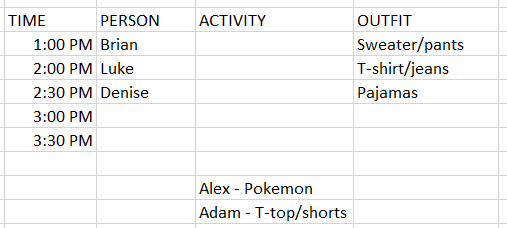
Let’s look at our chart now:
As you can see, I’ve added notes below for person/outfit combos we know that we can’t yet place.
But the information above does tell us something else.
Clue 4 tells us that the person playing Among Us did so later than the person Facetiming Mom, but earlier than the person wearing pajamas. And we know the person wearing pajamas is Denise. So that means Luke is playing Among Us and Brian is Facetiming Mom.
This information also tells us what Alex is doing. Clue 1 tells us Alex is not doing Zoom trivia, and Clue 3 tells us that Alex is not texting Grandma. And since she can’t be playing Among Us or Facetiming Mom, the only remaining option is streaming Hulu.
This same process of elimination can tell us who did the last two activities. We know Denise isn’t playing Among Us, Facetiming Mom, or streaming Hulu. But Clue 3 tells us she wasn’t texting Grandma either, so she must have been doing Zoom trivia.
Which means Adam was the one texting Grandma.
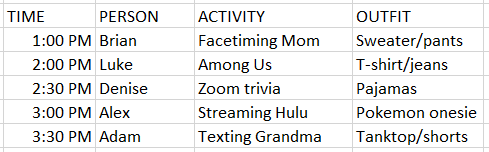
And since Clue 3 tells us that Alex’s activity happened before the person texting Grandma, we can complete our grid:
How did you do? Did you manage to unravel this holiday puzzler? Let us know in the comments section below! We’d love to hear from you!
Thanks for visiting PuzzleNation Blog today! Be sure to sign up for our newsletter to stay up-to-date on everything PuzzleNation!