PuzzleNation Product Review: Strata Sphere

In today’s product review, we look at a puzzle game with a simple premise: get your spheres from the top level of the grid to the bottom before your opponent does. All that stands between you and victory? Four levels of sliding walls and a wily opponent.

Today, we tackle the multi-layered challenge of Strata Sphere.

Strata Sphere is a puzzle game for two players that challenges you to outthink and outmaneuver your opponent in order to get your four spheres through the grid first. Imagine the gravity-fueled fun of Ker-Plunk with the chain-reaction planning of chess, and you’ve got something approximating Strata Sphere.

This game is all about tactics and adaptation. First, you and your opponent take turns placing the twelve sliders into the grid. There are four levels to the grid, each level accommodating three sliders.

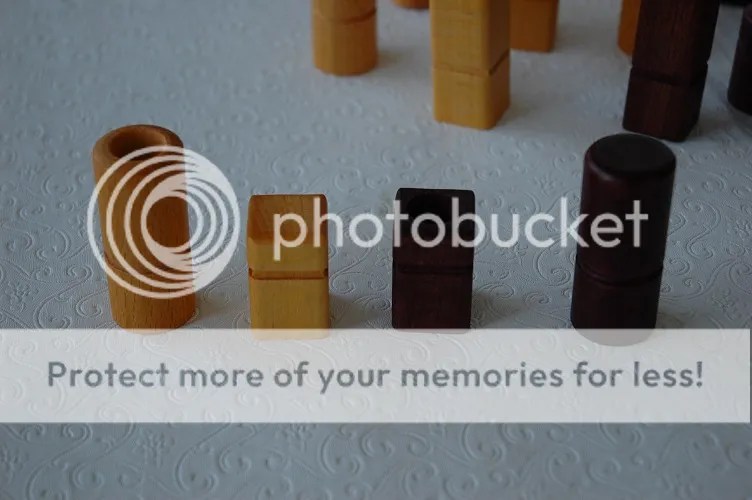
As you can see, some of the sliders have holes in different places, and others have no holes at all. Placement of these sliders is only part one of the game, but it’s a crucial one.

Once all twelve sliders are in place, the players choose their color spheres (red or black), and take turns placing them into the columns atop the grid, one sphere per column.

[As you can see, some of the spheres have already dropped to level 2,
thanks to the placement of holes in several of the sliders in level 1.]

Now the real strategy begins, because with each turn, a player may select any slider and pull it out of the grid one notch. (Each slider has three notches, allowing it to interact with three different columns.) As the game progresses, players can also push sliders in one notch.

Whether the slider moves out of the way of a sphere or moves a hole into place so a sphere may drop through, each move has the potential to drop a sphere a level (or two!) closer to freedom.

After one or two games, we actually ended up putting the game on a lazy susan, so we could rotate it, observe the grid more easily, and gain better access to all the sliders.

This form of three-dimensional puzzle-solving is a real challenge, because you’re not just dealing with your opponent’s next move, you’re dealing with all the setup (slider placement, sphere placement) that preceded it. Here’s where your ability to adapt comes into play, because all that strategy can go completely out the window at a moment’s notice.

Tension ratchets up quickly as you and your opponent maneuver back and forth, manipulating the sliders and helping gravity guide your spheres through the grid and toward the open tray below. The first player to free all four of their spheres wins.

Strata Sphere is a puzzle game that’s easily explained to younger players, but one that offers a great deal of complexity for older players as well, taxing your tactical abilities, spatial awareness, and your ability to seize unexpected opportunities when they arise.

Being forced to take turns makes long-term planning more difficult, and the four levels of gameplay will push your visualization skills to the max. (Planning out moves on a chess board is one thing, the multi-tiered slider system of Strata Sphere is quite another.)

The gameplay is engaging, the design is simple and elegant, and I daresay there’s no more satisfying sound than the click of a well-earned sphere hitting the tray, freed. What a treat.

Strata Sphere is for ages 8 and up, available now from Family Games America.


Thanks for visiting PuzzleNation Blog today! Be sure to sign up for our newsletter to stay up-to-date on everything PuzzleNation!

You can also share your pictures with us on Instagram, friend us on Facebook, check us out on TwitterPinterest, and Tumblr, and explore the always-expanding library of PuzzleNation apps and games on our website!

PuzzleNation Product Review: Quarto

Tic-Tac-Toe is probably the first strategy game a child encounters, and it’s a simple concept: get three in a row. Other games expand on this idea, like Connect Four, which increases the pattern to four in a row and adds the vertical play aspect to the game. ThinkFun put their own spin on the idea with All Queens Chess, adding the rules of chess to that Connect Four aesthetic.

And Quarto ups the ante significantly, adding elegance and variety to this particular corner of the puzzle-game genre.

You have a board with sixteen spaces laid out in a 4×4 grid, and your goal is to place four pieces in a row. Sounds simple, right? Sure. But when you look at the playing pieces, it gets a little more involved.

As you can see, across these sixteen differently-shaped pieces, eight different characteristics are possible: light, dark, round, square, solid, hollow, tall, and short. Each piece represents four of these characteristics.

So you have to make a row of four pieces with at least one characteristic in common. It could be four hollow pieces (meaning shape, color, and size don’t matter), four dark pieces (meaning shape, size, and solid/hollow don’t matter), or any of six other possible common factors.

And to add a little more challenge to the gameplay, your opponent chooses which piece you play each round. You have to strategize on the fly, because you never know which piece you’ll be placing next!

For example, here’s a game in progress. There are three dark pegs in a line, so naturally, your opponent picks a light-colored piece, preventing you from taking advantage.

But wait! They accidentally chose a hollow piece, allowing you to complete a line of four hollow pieces in a row! But remember to yell “Quarto!” when you do, or it doesn’t count!

There’s so much strategy wrapped up in such a simple mechanic. Quarto can be explained in a few seconds, but it offers a massive amount of replayability. Especially when you consider how much of the gameplay is happening in your mind as you try to figure out not only what piece to choose for your opponent, but what you might do with whatever piece you’re handed next.

Quarto is a wonderful variation on a classic style of puzzly gameplay. The beautiful playing pieces are well-made and offer plenty of possibilities, and it’s quickly become a favorite in my house as a palate cleanser between longer game sessions.

Quarto was created by Blaise Muller, is published by Gigamic Games, and is available from Marbles: The Brain Store and Amazon.


Thanks for visiting PuzzleNation Blog today! Be sure to sign up for our newsletter to stay up-to-date on everything PuzzleNation!

You can also share your pictures with us on Instagram, friend us on Facebook, check us out on TwitterPinterest, and Tumblr, and explore the always-expanding library of PuzzleNation apps and games on our website!

PuzzleNation Product Reviews: Takat and Noueni

In today’s product review, we look at two card games that are all about matching colors, identifying patterns, and scoring points, but in very different ways. Today, we put Takat and Noueni under the PuzzleNation Blog microscope!


Let’s start with Takat.

A card game for 2 to 4 players designed by Tyler Kilgore, Takat is different from most pattern-matching tile games or card games because it’s not about maximizing points…it’s about scoring as few points as possible as you place cards and create different colored shapes on the board.

The game starts with each player secretly drawing a card that reveals that player’s color for this game. Not only are you trying to conceal your color from your opponents, but you’re trying to guess what color they have, based on how they place cards and build shapes on the board.

[Some of the multicolored tiles. There are only two legal plays represented here: the second and third tiles in the top row, and the third tile in both the top and bottom rows.]

The multicolored patterns on the cards allow for all sorts of placement options. When you place a card, you can either neighbor a card on the board or partially overlap it, but you always have to make sure the colors match. If the edge of a card is red and blue, the card you place beside it must also be red and blue.

Since the goal of the game is to score as few points as possible, the strategy quickly becomes a mix of bluffing and deduction. You have to complete shapes in your opponents’ colors without revealing your own. (For instance, if you keep building red, blue, and yellow shapes but not green ones, you’ve told your opponents you’re purposely avoiding green, which will only encourage them to build green shapes and give you more points.)

In this game in progress, the players have mostly avoided completing any shapes; there’s the mostly-round yellow shape on the top right as well as the pointy red shape below it (which is partially formed by two overlapping tiles, unintentionally obscuring the black line at the bottom right of the yellow shape.) Those two are the only shapes completed, which means those shapes are worth more points than shapes that aren’t enclosed by black lines.

But since you can score points on neighboring tiles as well as completed shapes, you have to pay as much attention to who placed a tile as you do to what tile they placed.

For instance, on the bottom left, there’s 2 points for the neighboring red tiles, 3 points for the blue shape above it, and 2 points for the yellow rectangle beside the blue shape, despite none of those shapes being closed by black lines.

The game ends when all cards have been played. Then the players reveal their colors, and the points on the board are tallied up, based on how many shapes were made (and how many were completed), as well as how many cards were used in making each shape. The lowest score wins.

The game play of Takat is pretty easy to pick up, but the scoring is a bit more esoteric and takes some getting used to. It does, however, make for a fun variation on the usual tile-placement scoring game, and as a fan of games like Mafia and other bluffing/concealment games, it does make for a more tense playing experience than your average round of Qwirkle.


Now let’s take a look at Noueni.

Designed by 263 Games, Noueni is also a card game for 2 to 4 players that involves pattern-matching, color-based scoring, and cards that can either overlap or sit next to other cards. But there are some important distinctions between Noueni and Takat.

For example, each player chooses their color at the start of the game, and there’s no attempt to conceal it from your opponents. Also, like many pattern-matching games, highest score wins. In this game, your score is determined by how many of your scoring orbs are on the board by the end of the game.

Each card has two colored scoring orbs and a pattern of black lines emerging from them. Those lines are the connectors, and they determine how the cards placed on the board line up. Any card played must link up with the other cards on the board, whether there’s zero, one, two, or three connectors along that neighboring edge.

As you can see, the green scoring orb on the upper left connects to the red orb by three connections, but the other red orb connects to a yellow orb with only two. So far, there have been no overlapping cards played, so all four players are tied with two scoring orbs showing apiece. (The connections aren’t part of the scoring; they’re just the mechanism for lining up cards.)

A few moves later into the game, the yellow (upper right), red (upper left), and blue (middle) players have all added to the board using those matching connections, but the green player has overlapped half of a blue card, using those connections and obscuring the blue scoring orb.

Overlaps allow you to cover your opponents’ scoring orbs and claim those spots for yourself, but you have to exactly match the connections they left behind. (You can only overlap half of a card already on the board, so even if the green player had a card exactly matching BOTH of the blue card’s connections, that’s an illegal play. The green player could, however, overlap half of one card and half of another, if the connections lined up.)

And that’s where the strategy aspect of Noueni comes into play. It’s a mix of expanding the board and placing as many scoring orbs as possible, but also seizing the opportunity to hide your opponents’ orbs and match those same connection patterns.

The game ends when all cards have been placed, and the player with the most visible scoring orbs wins.

Noueni is more straightforward than Takat, which will make it more accessible to new players, but it also lacks the tension of hiding your color and ferreting out your opponents’ colors. On the flip side, Noueni does maintain that ever-present paranoia that at any point, someone might drop a card on top of yours and steal a key scoring orb at a crucial moment in the game.

Both are terrific games that build on the pattern-matching color tile game format in interesting ways, requiring more from a player than simply outscoring their opponents. You need to outthink them too.

Takat and Noueni are both available from The Game Crafter.


Thanks for visiting PuzzleNation Blog today! Be sure to sign up for our newsletter to stay up-to-date on everything PuzzleNation!

You can also share your pictures with us on Instagram, friend us on Facebook, check us out on TwitterPinterest, and Tumblr, and explore everything PuzzleNation on our website!

PuzzleNation Product Review: Schrodinger’s Cats

Even if you don’t know the science behind it, you’ve probably heard of Schrodinger’s cat at some point in your life. If you haven’t, let me give you the short short version: there’s a box with a cat in it, and a substance that may or may not release inside the box and kill the cat.

So until you open the box, there’s no way of knowing whether the cat is alive or not. Schrodinger posited that, since we can’t know which is the case, both are true until the box is opened. It’s essentially a thought experiment which delves far deeper into quantum mechanics and particle physics than I’m going to in this review.

But the idea that someone created a card game based on the concept of Schrodinger’s cat is not only audacious, but pretty impressive. (And the puns are just the icing on the cake.)

[Some of the cat physicists in the game: Sir Isaac Mewton,
Sally Prride, Madame Purrie, and Neil deGrasse Tabby.]

Schrodinger’s Cats was funded through a Kickstarter campaign last year, and it’s the brainchild of Heather Wilson, Heather O’Neill, and Chris O’Neill. A mix of bluffing, deduction, and wagering, this game combines Name That Tune-style bravado and strategy with Poker-style game play.

Each player is a cat scientist forming hypotheses on how many boxes contain live cats, dead cats, or nothing at all. (While Schrodinger is away, of course. As the old saying goes, when the scientist’s away, the cats will play. Or something like that.)

Every player receives one box card for each player in the game (so if there are three players in the game, each player receives three box cards), as well as one cat scientist card.

Once the cards are dealt, players look at their box cards and see what each box contains, hiding this info from the other players. Then the players begin hypothesizing. They wager on how many of each result are in ALL of the boxes on the board. So, in the game layout above, there are nine boxes, and each scientist has to wager what’s in all the boxes.

But instead of starting with a high guess and then wagering lower totals (as you would in Name That Tune), you start low in Schrodinger’s Cats and wager upward. Scientists can also affect the wagering by “showing findings” — revealing one or all of their own boxes to either prove their hypothesis or make the other players doubt their own — or by swapping out some boxes. (Each cat scientist card also allows for a one-time-use special action for a player, which can also prove useful.)

When a player either refuses to wager higher or challenges another player’s hypothesis by yelling “Prove it!”, all of the boxes are revealed and the hypothesis is proven or debunked (meaning the player stays in the game or leaves). After multiple experiments (rounds of play), one character remains and wins the game (and an honorary doctorate from Cat Tech University).

What I enjoyed most about this game (other than all the pseudo-scientific jargon involved in playing the game) was the wagering, bluffing, and reading of opponents that is integral to the game play. With so few possible cards to reveal (only four, in varying quantities, as opposed to 13 different cards across four suits in poker), it’s not nearly as challenging as the classic card game, but offers a lot of similar game mechanics.

It’s great fun to try to outwit or read your fellow players in order to make the best hypothesis, and that’s a sort of puzzling that is often left behind in puzzle games. Often, you’re so busy trying to achieve a certain goal or acquire points that you stop actively interacting with the other players; but in Schrodinger’s Cats, a lot of puzzling and game play takes place in the actions and reactions of the other players. It’s a delightfully social game.

Although you can play with as few players as two or as many as six, I recommend playing with at least four characters to keep the game moving and interesting. Between raising hypotheses, showing findings, and trying to puzzle out what your fellow players are hiding, the more uncertainty you can introduce to the game, the better.

Schrodinger’s Cats is available from 9th Level Games and can be found here.


Thanks for visiting PuzzleNation Blog today! Be sure to sign up for our newsletter to stay up-to-date on everything PuzzleNation!

You can also share your pictures with us on Instagram, friend us on Facebook, check us out on TwitterPinterest, and Tumblr, and explore the always-expanding library of PuzzleNation apps and games on our website!

PuzzleNation Product Review: Scrimish

The best card games are simple. People love War and Poker and Hearts and Go Fish because, at their core, they’re games you can learn quickly and play endlessly. There are no long tutorials or play-throughs, so you can learn all the complexities and rules with ease.

It’s difficult to find puzzly card games that are as accessible and replayable. Scrimish, a card game created by Danny Zondervan and recently funded through Kickstarter, fits the bill nicely. The rules are simple, but the strategy in the actual game is what gives Scrimish major replay value.

[On a very festive battlefield, I’ve finished setting up my cards
(bottom of the frame), while my opponent is still working on hers.]

Scrimish is an elegant mix of War, Chess, and Memory.

Each player gets a set of 25 cards, arranging them into five piles of five cards each, face down. The goal? Find your opponent’s crown card before they find yours.

Then you take turns drawing a card from the top of one of your piles and attacking the top card of one of your opponent’s piles in a one-on-one battle. Here’s where the War aspects begin. You see, each card has a number value, and the higher number wins. The losing card is discarded, and the winning card goes back to whatever pile it came from.

So in every encounter, both players learn something, because even if you lost that attack, you’ve learned the value of one of the cards on top of one of your opponent’s piles.

That’s where the Memory aspect comes in, because you have to remember what cards of your opponent’s you’ve seen. (You can check your top cards or your piles as often as you and your opponent see fit.) Then you can plan other moves and try to uncover their crown card.

You’ve got shield cards to defend with, archer cards to attack with, numbered weapon cards to battle with, and one crown card to defend. So, essentially, you’re playing a miniature game of chess with your opponent, except your pieces are hidden from them.

And that’s what makes for such a satisfying playing experience. You’ve got all sorts of strategy going on, plus chances for misdirection in both your attacks and your placement of cards at the beginning of the game. Do you go out heavy with high numbered cards early, or do you test their defenses with low cards? Do you arrange attack stacks and defensive stacks, or do your spread your resources out across all five stacks?

Plus, every card you attack with is one less you have in your stacks. So you’ve got a resource management aspect as well. All of this gameplay and puzzly potential, with fewer cards than your standard poker deck.

It takes only a few minutes to learn, but all the thought that goes into it makes every game of Scrimish feel fresh and new.


Thanks for visiting PuzzleNation Blog today! Be sure to sign up for our newsletter to stay up-to-date on everything PuzzleNation!

You can also share your pictures with us on Instagram, friend us on Facebook, check us out on TwitterPinterest, and Tumblr, and explore the always-expanding library of PuzzleNation apps and games on our website!
The Year Ahead

Normally today I would be doing a Follow-Up Friday post, but since it’s the first day of 2016, instead of looking back, I thought I would look forward and talk a little bit about what’s to come in 2016!

On the PuzzleNation Blog side of things, I’ve got some great stuff planned for the new year.

For instance, game and puzzle reviews. Good lord, I have the fruits of so many Kickstarter and Indiegogo campaigns to show you, plus 2016 is promising to be a great year for both puzzles and games, so I have no doubt there are many surprises and terrific solving experiences awaiting the PuzzleNation audience next year.

I’m also bringing back our interview segment 5 Questions. In the past, we’ve had musicians, comedians, puzzle constructors, and even a game-show host appear for 5 Questions, and I’ve already lined up a few interviews that should really interest the readership.

Also, after the positive response to the interview we did with Fred when we announced the addition of a free daily puzzle to the Penny Dell Crosswords App, I’m hoping to interview the rest of the PuzzleNation Team in 2016 and give our fellow PuzzleNationers a glimpse behind the curtain!

On the app side, Fred and the PuzzleNation Team are keeping mum when it comes to new apps and features, but that’s simply because they know I’d immediately run to you guys with any news I heard. *laughs*

But our 2015 Deluxe Combo puzzle set AND the new Penny Dell Crosswords App for Android devices should tide you over until I can pry a few juicy secrets from Fred and the team.

And, of course, I’d love to hear from you! What sorts of posts would you like to see from PuzzleNation Blog in 2016? Let me know!

Thank you for all your support in 2015. On behalf of PuzzleNation, I can promise you that 2016 will be our best, most ambitious year yet!


Thanks for visiting PuzzleNation Blog today! Be sure to sign up for our newsletter to stay up-to-date on everything PuzzleNation!

You can also share your pictures with us on Instagram, friend us on Facebook, check us out on TwitterPinterest, and Tumblr, and explore the always-expanding library of PuzzleNation apps and games on our website!