PuzzleNation Reviews: ThinkFun’s Circuit Maze and Clue Master

[Note: I received free copies of these games in exchange for a fair, unbiased review. Due diligence, full disclosure, and all that.]

Deduction is one of the most powerful puzzle-solving skills, and honestly, it’s a difficult one to develop.

“If this, then that” thinking involves holding several pieces of information in your head at once, eliminating red herrings and unhelpful possibilities until you’re left with one solution that fits all the requirements. (Every Sudoku puzzle is an exercise in deduction, after all.)

And today, we’ve got two new ThinkFun products to review that are centered around learning the art of deduction in different ways: Clue Master and Circuit Maze.

Clue Master is centered around a 3×3 grid that the solver must fill with nine dog toys: three bones, three balls, and three bowls. Each symbol comes in three colors — green, red, and blue — leaving us with nine unique pieces to place in our grid. (The solving style is very similar to their Brain Fitness puzzle game Chocolate Fix.)

Completing the grid is the only way to open the secret door of Tippy the dog’s doghouse, returning the friendly, blocky puppy to his rightful place in the back yard. (Hence the dog toys.)

The instructions, puzzles, solutions, game board, and pieces are all contained within the single spiral-bound game book, making this one of ThinkFun’s most portable products yet. The magnetic pieces are fairly sturdy, as is the game board, so it will hold up nicely to the rigors of travel (and being stuffed into various carry-on bags).

The gameplay itself is all about interpreting the clues provided with each challenge card. Some clues give you colors only, others shapes only, and the occasional clue is centered around a given piece’s location on the grid.

Once you graduate from the Beginner and Intermediate difficulty levels, you’ll face a new wrinkle: negative clues. Negative clues are layouts that must be avoided, so instead of telling you where to place a piece, they tell you expressly where NOT to place a piece, ratcheting up the difficulty.

Clue Master truly lives up to the “8 to adult” age range of the product. The Beginner puzzles walk you through simple deduction techniques, allowing younger minds and new solvers alike the chance to get accustomed to that sort of if-then chain-solving.

For a bit more of a challenge, let’s check out Circuit Maze.


ThinkFun has a solid track record when it comes to maze games that involve some level of logic or deduction, whether it’s learning optics with Laser Maze Jr. (or the original Laser Maze) or navigating the three-dimensional twists, turns, and drops of Gravity Maze.

Now, they’ve turned their attention to current and electricity with Circuit Maze, challenging solvers to use switches, connective pathways, and light-up relays to complete the partially-built circuits on each of the game’s challenge cards.

One of the more intriguing twists built into Circuit Maze is that your starting and ending points are a pair of connected pieces: the blue positive piece containing the batteries and the blue negative piece that closes the circuit. The current has to flow from positive to negative, so that means your light-up relays (which are also marked with + and – paths) can only be placed in certain configurations.

To add to the difficulty, oftentimes one of the two blue starting and ending pieces is NOT set in the challenge cards, so you won’t necessarily know what your starting or ending point is, placing another obstacle between you and successfully closing the circuit and ensuring your relays light up as needed.

The switch is another delightful wrinkle on the ThinkFun logic maze formula, since each setting can have its own unique requirements.

For instance, the above setup requires a different relay to light up for each switch setting (meaning that the switch’s first setting lights up the red, its second setting lights up the yellow, and its third setting lights up the green). These multiple goals make building your pathway more challenging and really forces you to think about how to use each piece to its utmost.
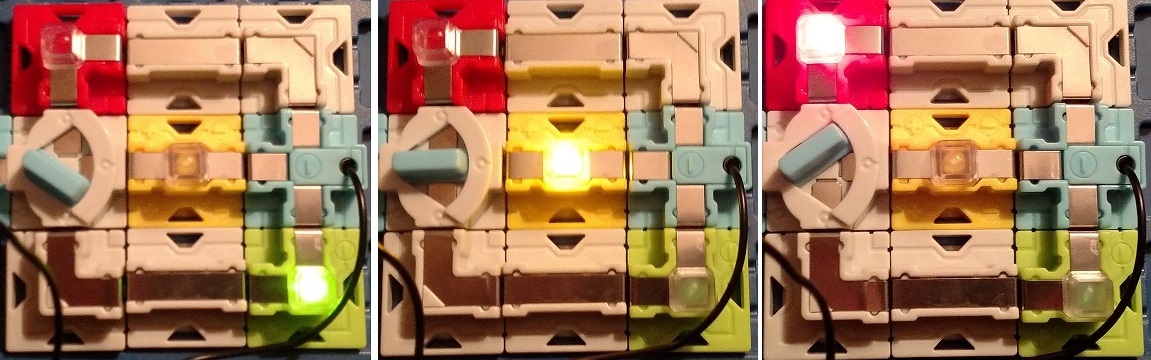
[Here the completed circuit causes each relay to light up with a flip of the switch.]

The challenge cards range from Beginner, which offers introductory tricks and lessons, to Intermediate, Advanced, and Expert puzzles, each with their own obstacles.

Sometimes, you know where a piece is placed, but not which direction it should face. Other times, you have to create pathways that will allow multiple relays to light up at once, and others where nothing lights up at all.

In the Advanced-level challenge card below, the solver has to make sure that the red relay always lights up, no matter what setting the switch is on, but other switch settings also have to light up either the yellow or green relays. It’s quite a mental workout!

Circuit Maze definitely rivals Gravity Maze as the most challenging ThinkFun product to date, but it’s a very worthwhile challenge to tackle. This is next-level deductive thinking, plotting out paths that accomplish different tasks at different times, all while maintaining a complete circuit and matching positive and negative current paths.

This serves as a strong follow-up to the deduction lessons new solvers learned in Clue Master, making for a solid one-two punch of logical puzzling the whole family can enjoy together (or you can play by yourself)!

Clue Master and Circuit Maze are both available this holiday season at Amazon or Target!


Thanks for visiting PuzzleNation Blog today! Be sure to sign up for our newsletter to stay up-to-date on everything PuzzleNation!

You can also share your pictures with us on Instagram, friend us on Facebook, check us out on TwitterPinterest, and Tumblr, and explore the always-expanding library of PuzzleNation apps and games on our website!

An Unexpected Tribute to a Loyal Solver

Crossword solvers are creatures of habit. Whether it’s a Sunday morning thing or an every day thing, you have your certain puzzle, which you solve in your certain spot, with a certain drink in hand.

The Washington Post unintentionally disrupted that routine for many solvers last Wednesday when they accidentally left the crossword out of the paper.

One solver in particular, though, found it to be a most appropriate interruption.

A man named Sidney Schulman was a devotee of the Washington Post crossword, and his great-grandson Justin Green reached out to The Post‘s Design Director, Greg Manifold, to share this story:

There are moments in life when pieces fall into place so perfectly, it seems meant to be. This must’ve been one of those times.

[Thanks to Evan Birnholz for sharing this tweet.]


Thanks for visiting PuzzleNation Blog today! Be sure to sign up for our newsletter to stay up-to-date on everything PuzzleNation!

You can also share your pictures with us on Instagram, friend us on Facebook, check us out on TwitterPinterest, and Tumblr, and explore the always-expanding library of PuzzleNation apps and games on our website!

Halloween Hallowhimsy!

Hello there, fellow puzzlers and PuzzleNationers!

It’s Halloween, that spookiest of holidays, and I’ve got two puzzly videos loaded with today’s traditional tricks and treats!

The first video comes from musician and comedian Ali Spagnola, who has created a masterful mashup of 20 tunes loaded with Halloween spirit! Can you name all 20 songs?

I’m a little disappointed that Warren Zevon’s “Werewolves of London” didn’t make the cut, but otherwise, this is awesome.

The second video comes from domino artist and friend of the Blog Hevesh5, who has created a new domino chain to celebrate All Hallow’s Eve in eerie, energetic fashion!

Whether it’s ghosts or goblins, ditties or dominoes, we hope you have a marvelous Halloween!


Thanks for visiting PuzzleNation Blog today! Be sure to sign up for our newsletter to stay up-to-date on everything PuzzleNation!

You can also share your pictures with us on Instagram, friend us on Facebook, check us out on TwitterPinterest, and Tumblr, and explore the always-expanding library of PuzzleNation apps and games on our website!

It’s Follow-Up Friday: This Illusion’s Got Legs edition!

Welcome to Follow-Up Friday!

By this time, you know the drill. Follow-Up Friday is a chance for us to revisit the subjects of previous posts and bring the PuzzleNation audience up to speed on all things puzzly.

And today, I’d like to return to the subject of viral optical illusions.

Last year, we had The Dress. Then, in March of this year, we had The Jacket. And in May, we asked the question How Many Girls?

Whether we’re spotting iPhones or looking for cats in woodpiles, we can’t seem to get enough of optical illusions.

And there’s a new one making the rounds recently:

[Image courtesy of TheChive.com.]

A woman named Bree tweeted this image of a pair of bare legs that look incredibly shiny. Are they false legs? Are they lotioned or wrapped in Saran wrap? What’s going on here?

I’ll give you a few moments to ponder the image before revealing the secret behind it. Because, as Bree said, “Once you see it, you can’t unsee it.”

Ready? Okay, here we go.

Like most optical illusions, the answer is startlingly simple.

[Image courtesy of TheChive.com.]

The illusion of shininess is actually the result of strategically placed streaks of white paint or toothpaste or something similar.

Pretty impressive once you really look at it, isn’t it?

This image has truly gone viral. As I write this, it’s been retweeted over 16,000 times, and liked over 20,000 times. Bree herself seems baffled by the attention the post has received.

Amazing what you can do with a bit of white paint.


Thanks for visiting PuzzleNation Blog today! Be sure to sign up for our newsletter to stay up-to-date on everything PuzzleNation!

You can also share your pictures with us on Instagram, friend us on Facebook, check us out on TwitterPinterest, and Tumblr, and explore the always-expanding library of PuzzleNation apps and games on our website!

PuzzleNation Book Review: Tetris: The Games People Play

Welcome to another installment of PuzzleNation Book Reviews!

All of the books discussed and/or reviewed in PNBR articles are either directly or indirectly related to the world of puzzling, and hopefully you’ll find something to tickle your literary fancy in this entry or the entries to come.

Let’s get started!

The subject of today’s book review is Box Brown’s graphic novel Tetris: The Games People Play.

[Image courtesy of Macmillan.]

Tetris was a masterpiece right out of the gate. Simple, elegant, and infinitely replayable, it would go on to become one of the most beloved video games in history. And that popularity, that universal charm, sparked a bidding war unlike anything the video game world has ever seen. With secret meetings, dubious contracts, language barriers, and the involvement of the suffocating Soviet regime, it was a recipe for sitcom-style misunderstandings on a global scale.

Tetris: The Games People Play brings the whole ridiculous story to life with immense charm and style. From the creation of Alexey Pajitnov’s delightfully addictive brainchild to the globe-spanning race that ensued as production rights went international, this is a story as convoluted and madcap as it is epic.

Although the drawings accompanying the story are relatively simple, the large cast of characters — from executives and game designers to members of the Soviet government — never feels overwhelming or confusing.

[Image courtesy of DownTheTubes.net.]

Illustrator and author Box Brown brings the story to life with the same panache and colorful style that made his visual biography of Andre the Giant such a warm, enjoyable read. The rounded edges and busy frames help sell both the silliness and chaos of the story, and the mix of yellow, black, and white shading in each illustration harkens back to the earliest days of video games.

(The yellow feels especially inspired, given how easily the story could’ve bogged down in the omnipresent gray tones of Soviet society or the bureaucratic doubletalk that typifies business negotiations.)

Most importantly, Brown never allows readers to lose sight of Alexey’s role as creator and keeper of the faith, a man who, under one of the most oppressive regimes in history, brought to life a game that continues to delight generations of fans.

As entertaining as it is insightful, Tetris: The Games People Play is a fun, fascinating read.

[Tetris: The Games People Play is available in paperback wherever books are sold.]


Thanks for visiting PuzzleNation Blog today! Be sure to sign up for our newsletter to stay up-to-date on everything PuzzleNation!

You can also share your pictures with us on Instagram, friend us on Facebook, check us out on TwitterPinterest, and Tumblr, and explore the always-expanding library of PuzzleNation apps and games on our website!

We Found Some Ancient Puzzly Graffiti!

[Image courtesy of Patheos.com.]

The other day, I was perusing Crossword Kathy’s daily news post, and I stumbled across an article with this provocative title: “Ancient crossword puzzle found in Smyrna

Naturally, I clicked, being something of a puzzle historian. (I also looked up “Smyrna” because I wasn’t sure precisely where that is. Turns out it was an ancient Greek city, now known as Izmir, a city in Turkey.)

This puzzle was found on the wall of an old basilica in the marketplace (or agora, for the crossword fans in the audience), and dates back to somewhere between 2,000 and 2,500 years old.

[Image courtesy of Patheos.com.]

According to the person in charge of the excavations, Akin Ersoy:

It looks like an acrostic. The same words are defined both top to bottom and left to right in five columns. The word ‘logos’ in the center is said to have been used by a Christian group to communicate with each other during times of oppression. We want to consider this as a puzzle because there are benches in front of these wall paintings. The lives of those who were working here are depicted in these paintings.

Unfortunately, calling this a crossword is a bit of a misnomer. The puzzle is a 5×5 grid where the entries read both across and down. This isn’t a crossword, it’s a word square.

[Pictured above is perhaps the most famous word square in history,
known as the Sator Square. Image courtesy of Wikipedia.]

The Smyrna word square consists of five words, and some researchers believe there’s a Christian message or some religious intent behind the square.

[The full text of the Smyrna square.
Image courtesy of Cryptotheology.wordpress.com.]

The middle word, Logos, for instance, is shaped in a cross, and is believed to represent the incarnation and work of Christ.

But whether this is a religious message or simply some impressive puzzling that has stood the test of time, it’s fascinating to turn up more examples that puzzles in some shape or form have been with us not only for centuries, but for millennia.


Thanks for visiting PuzzleNation Blog today! Be sure to sign up for our newsletter to stay up-to-date on everything PuzzleNation!

You can also share your pictures with us on Instagram, friend us on Facebook, check us out on TwitterPinterest, and Tumblr, and explore the always-expanding library of PuzzleNation apps and games on our website!