Horse of a Different Color, Posts of a Different Blogger

Please briefly pay attention to the man behind the curtain.

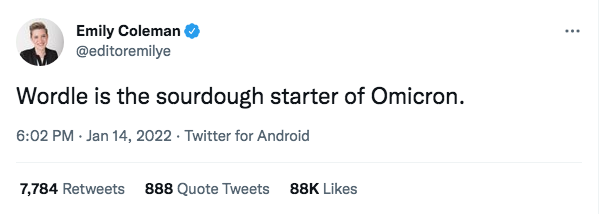
You may remember that when long-time blogger Glenn stepped down from posting at the beginning of this year, he assured you all that it was time “for a new voice to take over.” Obviously, his prediction came true, and it’s been fun these past few weeks, regaling you with discussions of Wordle, a biblical adventure, and tarot cards. Maybe you’ve wondered, however, exactly whose voice you’re hearing. I think it’s time we get to know each other. This week, I pull back the curtain and reveal your new Wizard of Blog.  

The Wizard of Oz revealed his full name to be Oscar Zoroaster Phadrig Isaac Norman Henkle Emmanuel Ambroise Diggs, but I’m going to go easy on you; you can just call me Rae. Puzzle fans are often excited to learn my name, pointing out that RAE is a common crossword entry. When you come across clues such as [“Call Me Maybe” singer Carly ___ Jepsen], [“Wayne’s World” actress ___ Dawn Chong], [Rap duo ____ Sremmurd], or countless others, you’ll already know the answer.

In addition to handling social media here at PuzzleNation, I act as our Editorial Assistant and as an occasional writer of Daily POP clues. Previously, I worked for Dell Magazines, writing clues for a range of crossword titles in addition to assisting the editors of Dell’s mystery and science fiction publications. Although my own writing is strictly nonfiction and poetry—I’m currently an MFA candidate in both disciplines—I am emotionally committed to genre fiction, mystery and sci-fi especially. You can expect to see those two genres making appearances on the blog in the future!
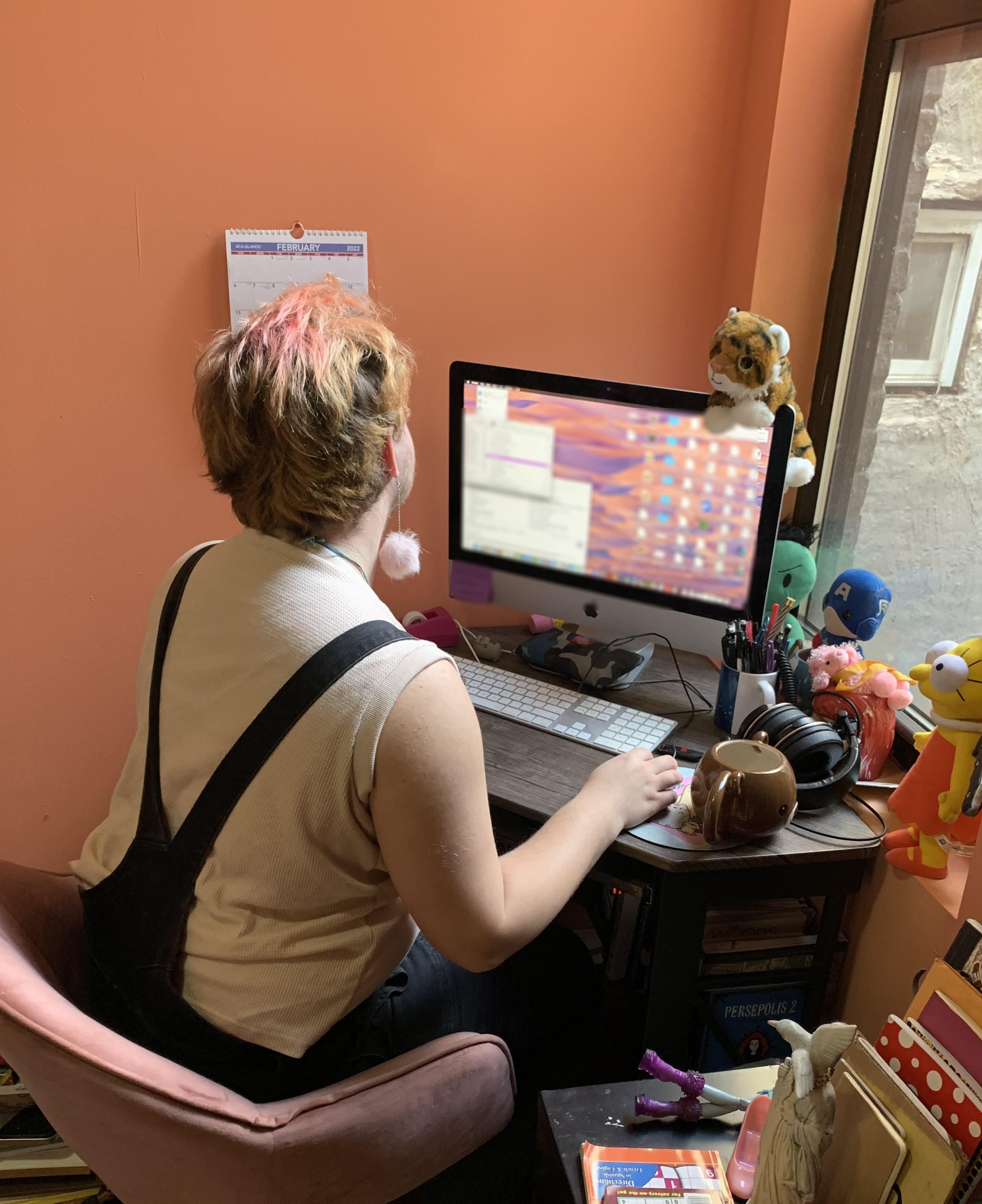
Your blogger in his natural habitat.

Outside of work, I’m a Simpsons buff and general television nerd, a voraciously omnivorous reader, a fan of superhero and heist media, and a painter. Wordplay, problem-solving, and board games are a few of my favorite things (the classic Clue is my favorite of the latter). As you may have inferred from blog posts thus far, I do read tarot, and yes, I try to solve Wordle right on the dot of midnight, turning to Queerdle immediately after (the artificial stress of Absurdle is a sometimes snack).

So what else, exactly, do I plan to bring to this digital table? The future holds a broad spectrum of posts, examining poetry and literature, art and music, TV shows and movies, video games, board games, and the scientific and historical sides of puzzles and games. Human interest pieces are close to my heart too—the puzzle and gaming worlds are full of fascinating people doing creative, groundbreaking things, and I can’t wait to spend time connecting with some of those individuals and bringing their stories to your screens.

On that note: it’s your turn! I would love to hear more about who’s reading. And if there’s anything in particular you’re interested in seeing on the blog, don’t be afraid to ask the Wizard for what you want.


One thing the Wizard can offer you now is delightful deals on puzzles!
They can be found on the Home Screen for Daily POP Crosswords and Daily POP Word Search! Check them out!

Thanks for visiting PuzzleNation Blog today! Be sure to sign up for our newsletter to stay up-to-date on everything PuzzleNation!
Returning to Wordle: The Evolution of a Phenomenon

Suddenly, for Josh Wardle, every square is green.

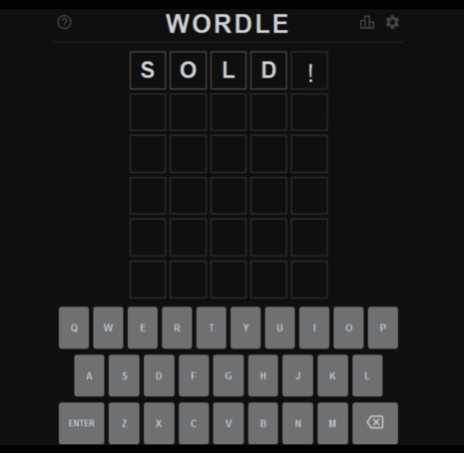
Each day brings a new five-letter word for Wordle’s devotees to deduce. If I had to pick one five-letter word to describe Wordle’s current moment, it would be SHIFT, as in seismic movement and mutation. This is for a couple of reasons. The first is a piece of news that rippled through the puzzle-loving internet at the end of January: Wordle has been purchased by the New York Times, and will be packaged with games like Spelling Bee and Letter Boxed going forward. Creator Josh Wardle’s Twitter announcement pointed out, “If you’ve followed along with the story of Wordle, you’ll know that NYT games play a big part in its origins and so this step feels very natural to me.” For anyone who hasn’t done a deep dive into Wordle’s genesis: Wardle is referring, here, to the fact that he created the game as a gift for his partner after she got hooked on Spelling Bee and the Times crossword.

Despite how it started, Wordle is no longer just “a love story” (as a January 3rd Times headline said). It’s also a story of hitting the jackpot—reportedly, Wardle sold the game for a number in the low seven figures—and it could become, as well, a story of the internet’s ongoing privatization. Wardle’s tweet stated that the game will be “free to play for everyone” even after its migration to the Times website, but fears to the contrary abound. A Mashable article about the news features the sub-headline, “’Paywall’ has too many letters,” and ends by gloomily describing Wordle as “beautiful while it lasted.” Twitter user @mcmansionhell summed up the ordeal: “the NYT took one nice and simple thing that a lot of people really liked, a dumb bit of fun in our exhaustingly dark times, and implied that they’ll stick it behind a paywall. exhausting.” Overall, ominous social media speculation has little to do with resenting Josh Wardle’s laudable success, and everything to do with anxiety about the once-free commons of the internet becoming less and less free by the day.

In response to this anxiety, solvers are already finding workarounds for the possible future paywall. One solution is downloading the Wordle site to your device, a process with instructions located here. Another alternative is playing on the Wordle Archive, which recycles previous days’ words.

Even if the Times does decide to throw Wordle behind a paywall, its story will remain a love story. I’m not just talking about Wardle’s love for his partner; I’m referring to the public’s intense love for the game. Regardless of who officially owns Wordle, it has taken on a life of its own, and that’s the second reason why SHIFT is the word of the moment. Minimalist though it may appear, Wordle has sparked widespread creativity, inspiring memes and jokes, craft projects, and spin-off puzzles that take the game’s basic premise and alter the specifics just enough to be novel. In a short span of time, Wordle has mutated, in many incarnations, away from where it began in Wardle’s Brooklyn home.

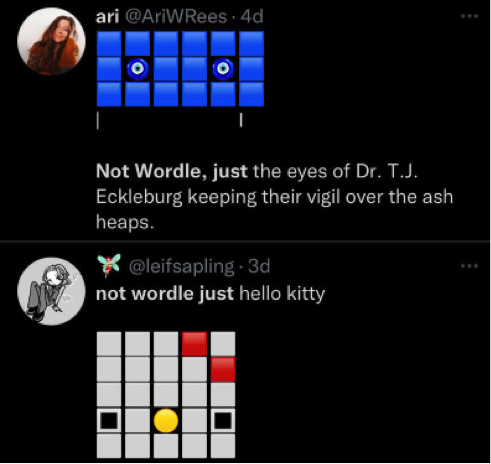
“Not Wordle, just XYZ” memes are everywhere these days, much like Wordle results themselves

Absurdle, for instance, is a version of Wordle that does not start out with one secret word in mind. Instead, behind the scenes, the site responds to the player’s guesses by—as slowly as possible—whittling down a mammoth list of possible words until the player essentially traps the computer into only having one word left. If you identified with my earlier post speculating that Wordle’s appeal lies in its un-bingeable nature and the way it provides all players with a short, sweet shared experience, then maybe the infinitely replayable Absurdle is not for you. On the other hand, if you prefer your puzzles to have concepts that can be difficult to wrap your brain around, then dive on in. You might also love to read a further explanation from the creator of the exact mechanics of the computer’s adversarial actions.

Then there’s Queerdle, a Wordle lookalike in which the word is a different length each day, but all are themed around LGBTQ culture and history. Answers have included COMPTON—in reference to the 1966 Compton Cafeteria Riot, a San Francisco-based Stonewall Riot predecessor—and DIVINE, as in the name of the drag queen best known for appearances in Hairspray and other John Waters films. When players guess correctly, a pop-up appears with a GIF or different snappy indicator of the word’s queer significance, and a grid of snake, coconut, and banana emojis meant to emulate Wordle’s shareable squares.

Byrdle is a version of Wordle where all answers are related to choral music. Gordle is Wordle for hockey fanatics. Squirdle invites players to guess names of Pokemon, Weredle howls words at the full moon, and you can probably guess the theme organizing Lordle of the Rings. Call them knock-offs, parodies, or homages, these variations most importantly are multiplying explosively. The New York Times may own the original game, but they cannot commandeer the inventive passion that Wordle has stoked in puzzlers everywhere.

____

Not Wordle, just a different exciting opportunity to solve new word puzzles each day:

You can find delightful deals on puzzles on the Home Screen for Daily POP Crosswords and Daily POP Word Search! Check them out!

Thanks for visiting PuzzleNation Blog today! Be sure to sign up for our newsletter to stay up-to-date on everything PuzzleNation!
The Fool, The Magician, The High Priestess, and The Gamer

Jane Seymour reading tarot as the James Bond character Solitaire in Live and Let Die

What do you think of when you think of tarot cards? Puzzles, games, logic, and creative problem-solving? Or crystal balls, tea leaves, palmistry, and vibes?

Popular imagination seems to be split on this. Googling “tarot” brings me recommendations for psychics I might want to visit; a significant chunk of the other search results occupy astrology and “lifestyle” websites. A Teen Vogue introduction to tarot states, “To those who think the practice of reading tarot is an occult art reserved for spook sessions, let me say: You’re wrong,” but goes on to explain that a tarot reading is an intimate conversation.

However, according to A History of Games Played with the Tarot Pack, Volume 1,tarot cards were invented for gaming, not for fortune-telling, when they originated in 15th century Italy. And while their modern role in the world of games and puzzles is fairly divorced from their roots, many still see them as having puzzly potential.

The final puzzle in horror video game Silent Hill 3, for example,requires players to arrange tarot cards in a specific order. New tabletop narrative puzzle game The Light in the Mist involves unraveling a mystery with a deck of tarot cards as your greatest resource. A 2018 Nerdist article gives advice on how to incorporate tarot into tabletop role-playing regardless of the original game’s design. There are also many jigsaw puzzles drawing on the designs of various tarot decks, including the classic 1909 Rider-Waite deck, and the “Life is Like a Board Game Tarot” is a fully functional deck modeling itself after Monopoly.

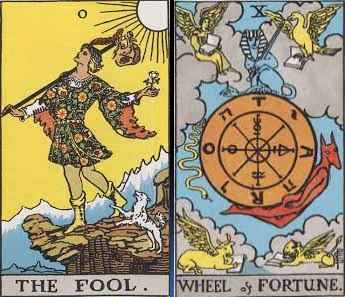
A couple of Rider-Waite major arcana cards. The Fool is commonly the trump card in tarot games. The Wheel of Fortune is unfortunately unrelated to the game show.

The Nerdist article does suggest that using tarot for role-playing is “poor form and bad luck,” and that it would be safest to use a special, dedicated deck for any gameplay rather than mixing and matching your fictional fortunes with your more “factual” future. But just as it’s a personal choice whether to treat a Ouija board as a spiritual artifact and potential gateway to demonic possession or to take it very literally as a toy by Hasbro, only you can decide how much weight to give this word of caution.  

Yes, some people fear that they are tempting fate by using a tarot deck for both serious and recreational purposes—but maybe you’re perfectly comfortable tempting fate! Or maybe you’ll choose to acquire a deck that will only ever be used recreationally. Either way, you can have a lot of fun with tarot, even beyond the possibilities of incorporating it into your usual tabletop role-playing hijinks.

The original Italian trick-taking tarot card games introduced the concept of cards trumping other cards to the realm of gameplay, a concept we can trace all the way to modern fantastical, battle-style competitive card games like Pokemon and Yu Gi Oh. After occupying Milan, the French adopted the idea of playing with the tarot deck, and the game of French tarot quickly became favored more highly than chess. The full rules to playing French tarot can be found here, though you might decide that you’re more interested in playing Grosstarock, which Stewart Dunlop describes as “really cool, if you want to play for real stakes, but are tired of poker.” Or perhaps your fancy will be struck by Hungarian Tarokk or Königrufen, the latter of which is wildly popular in Austria. These games differ in exact rules, number of players, and even number of cards used from the tarot deck, but are united by gameplay featuring bidding and the assignment of point values to the cards.

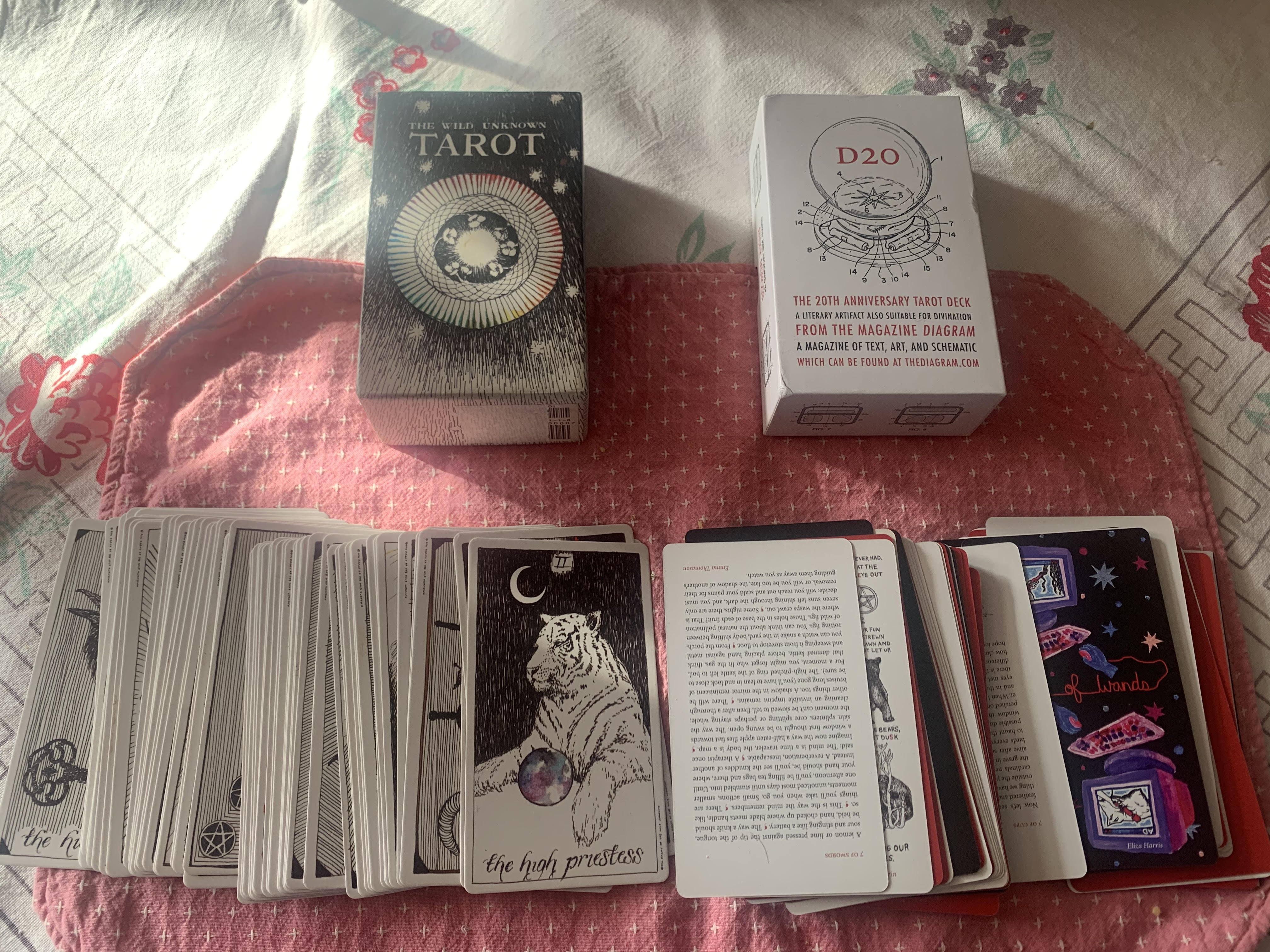
Your blogger’s preferred tarot decks

Between trick-taking, tabletop gaming, and forecasting the future, tarot is replete with many marvelous uses. While its forecasting function appears to tie into the mystical side of the cards more than the puzzly side, I’d argue that it sits comfortably in both realms. Michelle Tea, who wrote The Modern Tarot: Connecting With Your Higher Self Through the Wisdom of the Cards (my personal go-to volume for discerning meaning in my own readings), describes her early experience with tarot thusly:

I was in a growing state of awe at their intuitive accuracy, the way the small stories encapsulated in each illustration knit together into a wider narrative that made sense, sometimes poetic, sometimes chillingly pointed.

What I see in this take, above all, is the word narrative, drawing me back to the allure of tying tarot and tabletop gaming together. There may be no dice or character stats involved, but tarot still enables us to tell compelling stories. Considering that we are living in a world in which forces such as Lifehacker urge us to gamify our lives via apps, I think now is tarot’s time to shine. Maybe pointedly using the same deck for both role-playing games and connecting with your inner truth is actually the perfect way to go, a strategy for injecting your day-to-day life with the magic of games.

Move over habit trackers and apps that turn jogging into an escape from zombies! Here comes something more poetic and more pointed: in Michelle Tea’s words, “an ancient story system” that will fill your life with wonder.


I see in your future . . . a tall, dark stranger, a voyage across the sea, and some delightful deals on puzzles. You can find those deals on the Home Screen for Daily POP Crosswords and Daily POP Word Search! Check them out!

Thanks for visiting PuzzleNation Blog today! Be sure to sign up for our newsletter to stay up-to-date on everything PuzzleNation!

A Wordle a Day Keeps the Burnout Away

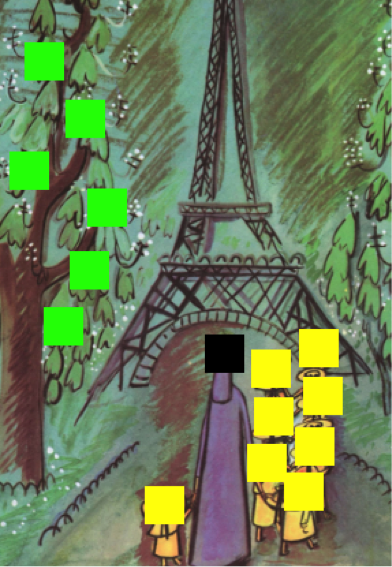
If you’re like me, in the past few weeks your Twitter timeline has become a parade of yellow, green, and black-or-white squares all lined up in rows like Madeline and her schoolmates walking through the streets of Paris. Early on, I discovered that the squares were part of a game called “Wordle,” but I initially assumed that arranging the squares was itself the game, that there was some kind of subtle pattern creation at work. Plugging “Wordle” into a search engine led to trying to solve one Wordle puzzle, just to see what all the fuss was about, and that immediately led to making Wordle an essential part of my daily routine (just like Madeline’s daily walks).  

As demonstrated by those squares on Twitter—and by a recent flurry of news coverage— I’m not alone. Maybe you too are riding the Wordle wave, eagerly waiting for midnight, when you’ll be granted a new chance to deduce a secret five-letter-word. On the surface, the fact that we only get one Wordle challenge each day seems like it could be a point of frustration. In a pop culture landscape dominated by the model of “binging” media, we tend to always want more, more, more of what we enjoy. So why have so many people become riveted by a website that not only doesn’t ask for more than a little slice of your day but actively doesn’t allow you to participate for more than a single six-guess puzzle at a time? 

Sarah Demarest, a library youth services provider in western Massachusetts, theorized to me that our overfamiliarity with binging the latest trends is exactly why something like Wordle can catch on; a large part of its charm is its model’s rarity. She explained, “For me a lot of the appeal is in the fact that you can’t just play nonstop. You get a new episode every day.” Picking up on her television analogy, I pointed out that this meant Wordle was like a return to classic patterns of TV consumption, and she agreed, adding, “I have always been a strong believer that we need an equal mix of serialized and bingeable TV. But I have never thought about how that applies to other trends too.”

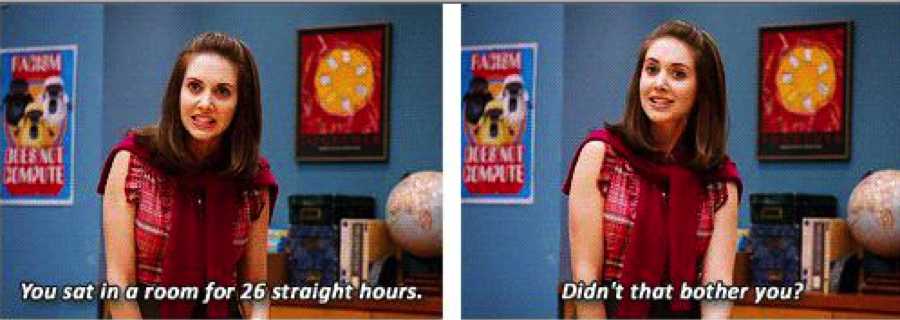
You watched Tiger King for five straight hours. Didn’t that bother you? Maybe!

A tweet by screenwriter Eden Dranger @Eden_Eats with more than 4,000 retweets and 44,000 likes places Wordle in a list of “Covid Eras” beginning with the Netflix documentary series Tiger King. Both have been pandemic sensations, topics of memes and group-chat conversations alike, but this shift from Tiger King to Wordle, taking Sarah’s theory into account, indicates that maybe we are seeing an overall shift from a passion for the bingeable to a passion for the serialized. At a time when so many of us are burned out for larger, heavier reasons than a pop culture trend, do we really need to be inviting more of that exhaustion into our brains?

The game’s creator, Josh Wardle, is conscious of how his site fits into our greater historical context, explaining on an episode of Spectacular Vernacular that the choice to remove attention-manipulating features like push notifications and endless play “had this effect where the game feels really human . . . And that really resonates, you know, [with] where we’re at right now in the world in light of Covid.” When we ourselves are so often, on Zoom, reduced to little squares on a screen, a different set of little squares on a screen has the ironic power to remind us of our humanity. After all, not being able to binge means having to move at the same speed as everyone else. We are all walking next to each other. 

A New York Times article about Wardle and his game states that the limit on one game per day “enforced a sense of scarcity . . . which leaves people wanting more.” There’s probably some truth to that, but in spite of what the creator of the copycat website Wordle Unlimited might think, maybe we’re just ready to pace ourselves instead of being deluged with constant streams of entertainment.

Pacing ourselves instead of binging is our philosophy when it comes to our Daily POP crosswords and word search puzzles. You know that we love pop culture enough to consume our favorite pieces of media for five—or twenty-six—straight hours ourselves. However, in this binging-saturated world, we’re happy to provide something steady and serialized for contrast. So, after you finish tweeting your Wordle squares for the day, why not hop on over to Daily POP and continue your slow-burn love affair with word puzzles?


Treat yourself to some delightful deals on puzzles. You can find them on the Home Screen for Daily POP Crosswords and Daily POP Word Search! Check them out!

Thanks for visiting PuzzleNation Blog today! Be sure to sign up for our newsletter to stay up-to-date on everything PuzzleNation!
Do You Accept the Challenge of “The Impossible Crossword”? You absolutely should!

Part of the challenge for many crossword solvers is that you can’t adjust the difficulty of the cluing on a given day. The clues you get are the clues you get.

New York Times crossword solvers are intimately familiar with this, talking about Tuesday puzzles and Saturday puzzles and understanding what each means in terms of expected puzzle difficulty.

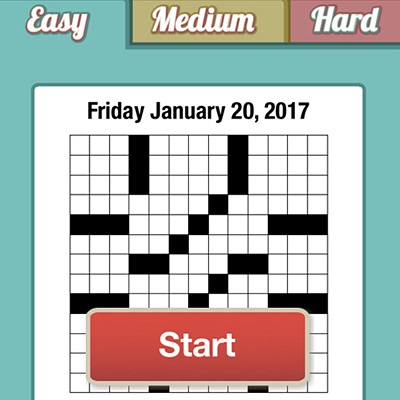
Our own Penny Dell Crosswords App offers free puzzles across three difficulty levels each day, but those are three distinct puzzles, not three different clue sets for one particular puzzle.

Having options for more than one set of clues is fairly rare. Lollapuzzoola has two difficulty-levels for their final tournament puzzle, Local and Express. GAMES Magazine previously offered two sets of clues for their themeless crossword, entitled The World’s Most Ornery Crossword.

The tournament final of the American Crossword Puzzle Tournament offers different clue difficulties for three separate divisions. The Boswords Spring and Fall Themeless Leagues work in a similar manner, offering three levels of clue difficulty — Smooth, Choppy, and Stormy — for competitors to choose from.

The concept of Easy and Hard clues is not unheard of… it’s just rare.

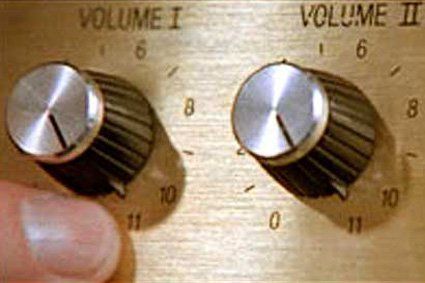
And it’s only natural that someone, eventually, was going to take this concept and dial it up to a Spinal Tap 11.

The pair of someones in question are Megan Amram and Paolo Pasco.

Paolo is fairly well-known around crossword circles, having contributed puzzles to the American Values Club crossword, The New York Times, The Los Angeles Times, The Wall Street Journal, and other outlets, while also serving as associate crossword editor for The Atlantic.

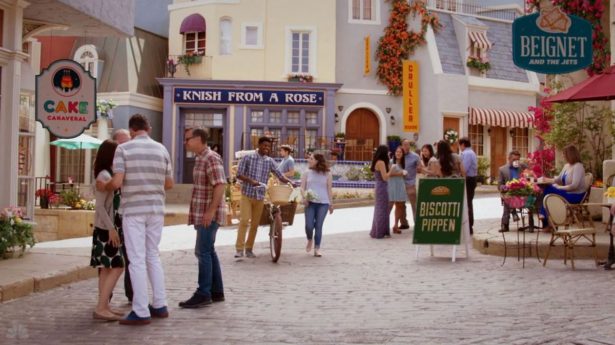
And Megan is an incredibly talented television and film writer who has written for Parks and Rec, The Simpsons, and The Good Place. Anytime you saw a hilariously shameless punny name for a store in The Good Place, it was undoubtedly one of Megan’s.

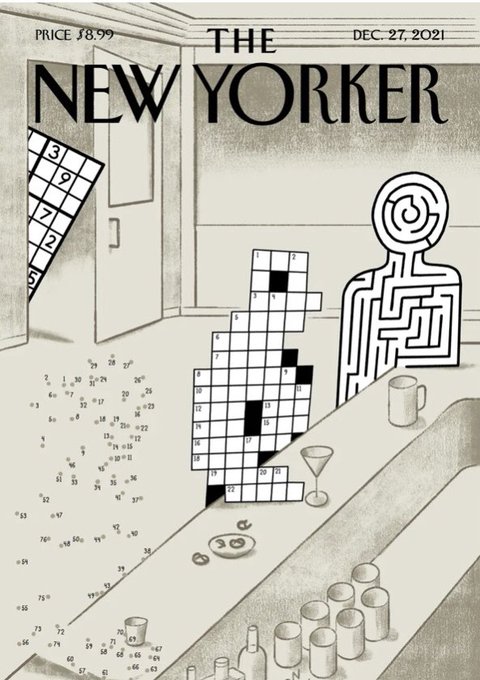
Together, they unleashed The Impossible Crossword in the print edition of The New Yorker‘s December 27 issue, its first ever Cartoons & Puzzles issue. (It was made available on the website the week before.)

The instructions are simple: This crossword contains two sets of clues to the same answers. Toggle to the set labelled “Hard” to impress people looking over your shoulder. (And toggle to “Easy” when they look away.)

This 9×9 crossword’s Easy clues were fair and accessible, but the Hard clues were the real stars. They ricocheted between immensely clever, wildly obscure, and hilarious parodies of themselves.

For instance, the word JEST was clued on the Easy side as “Infinite ____” but received the brilliantly condescending add-on “Infinite ____” (novel that’s very easy to read and understand) in the Hard clues as a reference to the famously dense and impenetrable nature of the novel.

For the word APPS, the Easy clue was “Programs designed to run on mobile devices,” while the Hard clue was “Amuse-gueules, colloquially.”

(I had to look that one up. An amuse-gueule is “a small savory item of food served as an appetizer before a meal.”)

And those are just two examples.

When you finally finish the puzzle, this is your reward:

“You’re a genius! You can tell your mom to get off your case about going to law school.”

All at once, The Impossible Crossword manages to be a fun puzzle to solve on its own, a riotously fun gimmick that lampoons clue difficulty in general, and the most meta puzzle I’ve solved all year.

Kudos to Megan and Paolo for pulling it off. What a way to welcome the Cartoons & Puzzles era of The New Yorker while the rest of us close out another year of puzzling.


   dailypopwsicon

Treat yourself to some delightful deals on puzzles. You can find them on the Home Screen for Daily POP Crosswords and Daily POP Word Search! Check them out!

Thanks for visiting PuzzleNation Blog today! Be sure to sign up for our newsletter to stay up-to-date on everything PuzzleNation!
Sweep Your Eyes Across These Ugly Puzzly Sweaters!

proper ugly sweater

It’s December, and you’ve probably already received an invitation to some sort of holiday event. Maybe it’s a housewarming, or a holiday luncheon, or a game night. But, maybe, it’s an ugly sweater party.

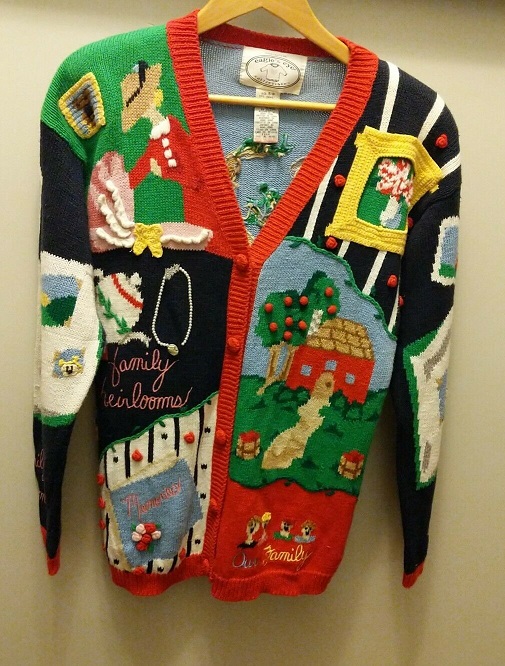
Ugly sweater parties used to be events that ironically appreciated sweaters that were made with genuine affection, but simply didn’t please the eye. But once ugly sweaters became a part of pop culture, they became, as all things do, a cottage industry, and now companies release “ugly” Christmas sweaters for every pop culture property imaginable.

Most of them are simply underwhelming — and a few are often actually quite lovely — but none of them really capture the spirit of the original ugly sweater party ideal.

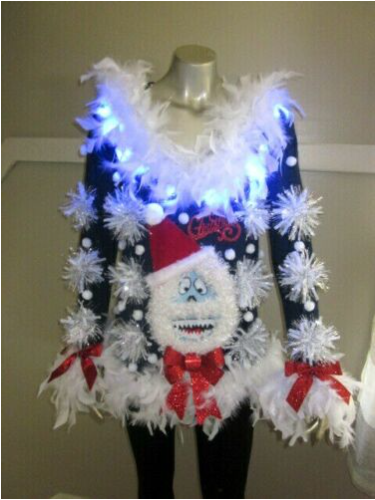
abominable sweater

Of course, there are exceptions.

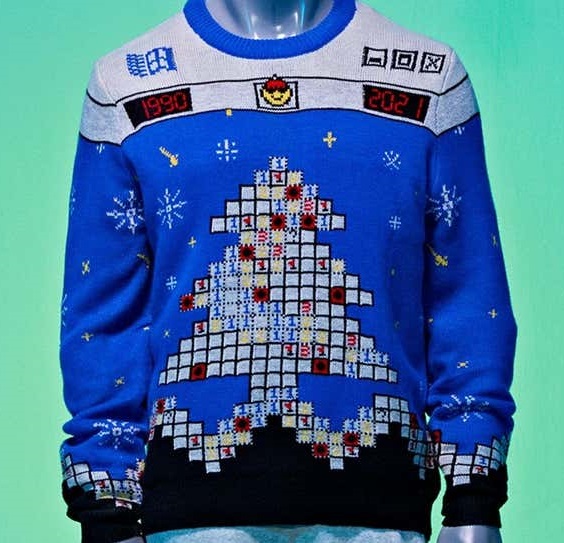
And then, there are the ones I’m on the fence about. Check out this Minesweeper-inspired ugly sweater from Microsoft:

minesweeper sweater

It’s not garish by any means. It’s cleverly designed and weirdly festive. But I also can’t imagine anyone buying it.

It’s certainly unique.

But it raised the question…

What other puzzly ugly sweaters are out there? Would they all feel too corporate like the modern ugly sweater patternings, or could I find some genuine diamonds in the rough?

Let’s find out, shall we?


Of course, when you type “puzzle ugly sweater” into Google, you find an amazing array of jigsaw puzzles featuring ugly sweater designs. And honestly, what a great idea for an image for a jigsaw. The riot of colors alone would make for a pretty fun jigsaw solving experience.

So I started pairing different puzzle brands with “ugly sweater” in my searches, and I began to yield some results, however mixed.

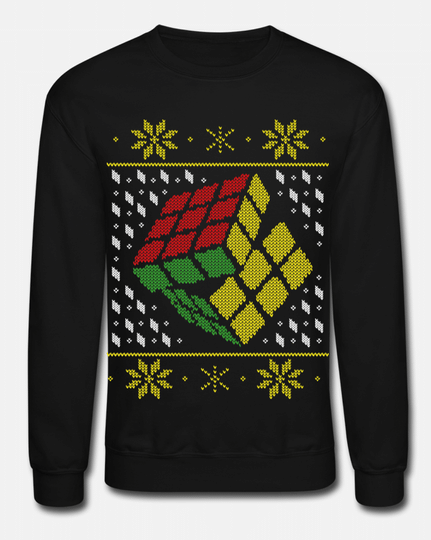
rubiks color sweater

There’s this Rubik’s sweater design, which I find a bit meh. It’s nice, it’s unoffensive. But it’s not the colorful visual assault I was hoping for.

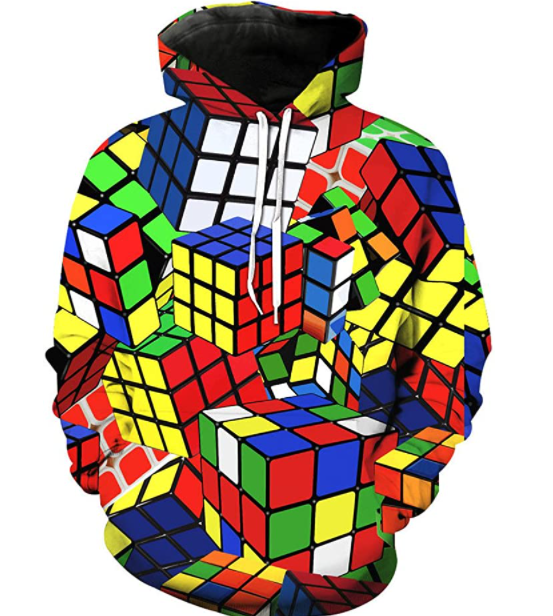
I mean, look at this Rubik’s hoodie on Amazon. At least that seems to be trying to overwhelm your senses.

ugly rubik hoodie

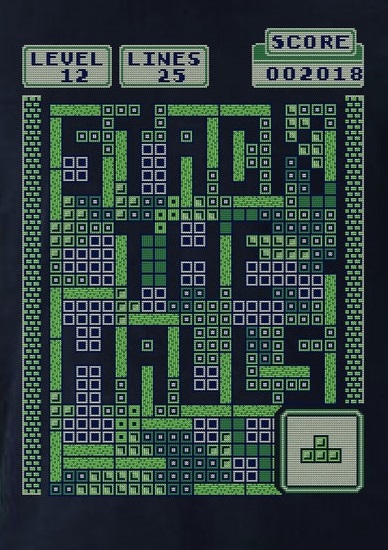
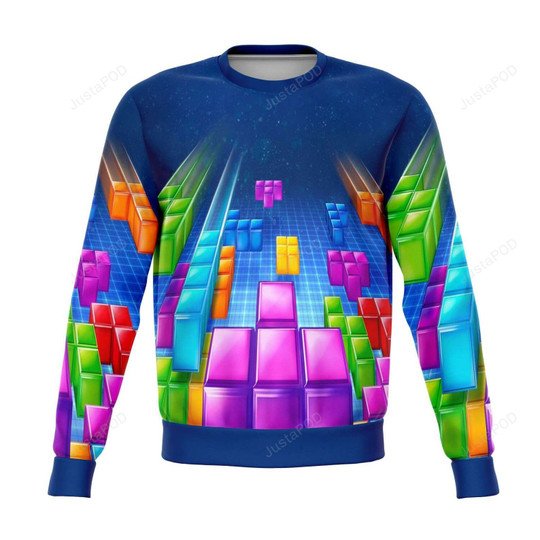
So what about Tetris? Tetris is part of the fabric of modern puzzling. Surely there must be some Tetris-fueled designs for ugly sweaters.

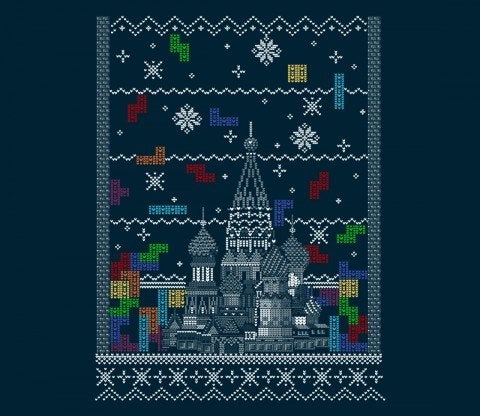
tetris moscow sweater orig

The first result I found was this pattern, which is actually quite lovely. It’s discontinued in its original sweater form, but lives on as a print for t-shirts.

tetris stack shirt

There’s also this festive message delivered in the style of the monumentally successful Game Boy Tetris version of the puzzle classic. (I’ll probably end up ordering this shirt.)

These are festive, but hardly fit the ugly sweater criteria.

falling tetris sweater

Okay, now we’re getting somewhere. It’s not particularly Christmas-y, but it does manage to barrage the eyes with color.

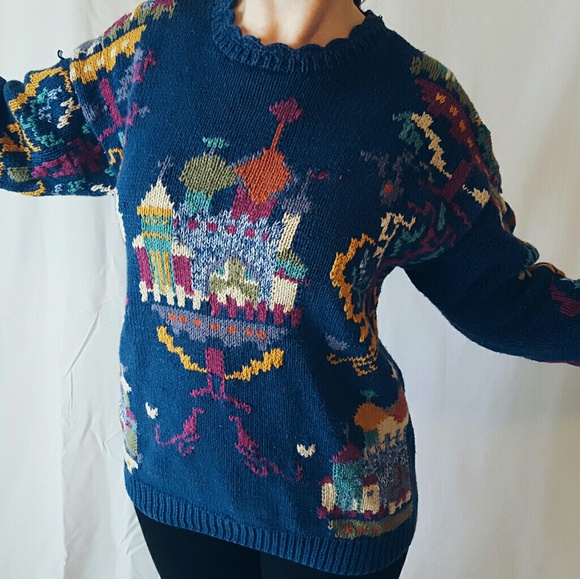
ugly tetris sweater

I found this one on Poshmark, and supposedly it won some sort of ugly sweater contest. Not sure who judged that one. This isn’t great, but it’s hardly ugly.

Alas, where else can we look?

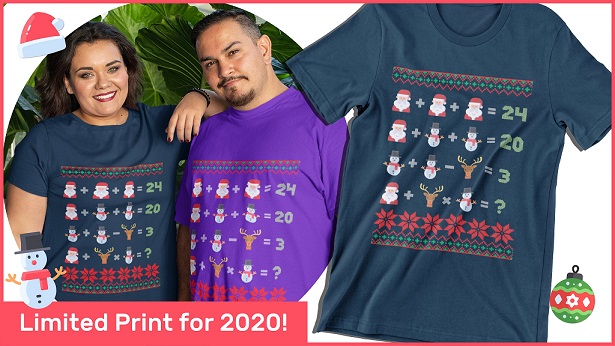
math sweater

Well, there’s this ugly sweater-patterned take on the math puzzles that periodically circulate on social media. I couldn’t find it in actual sweater form, but it’s a start.

(It also exemplifies the unsatisfying corporate nature of the modern ugly sweater pattern. Festive borders on the top and bottom, and the hook in between. Nothing on the sleeves or back, no real effort involved.)

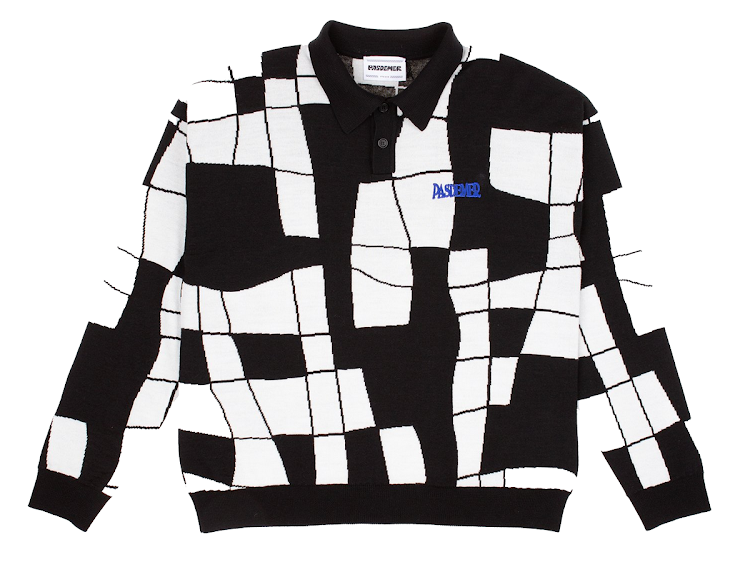
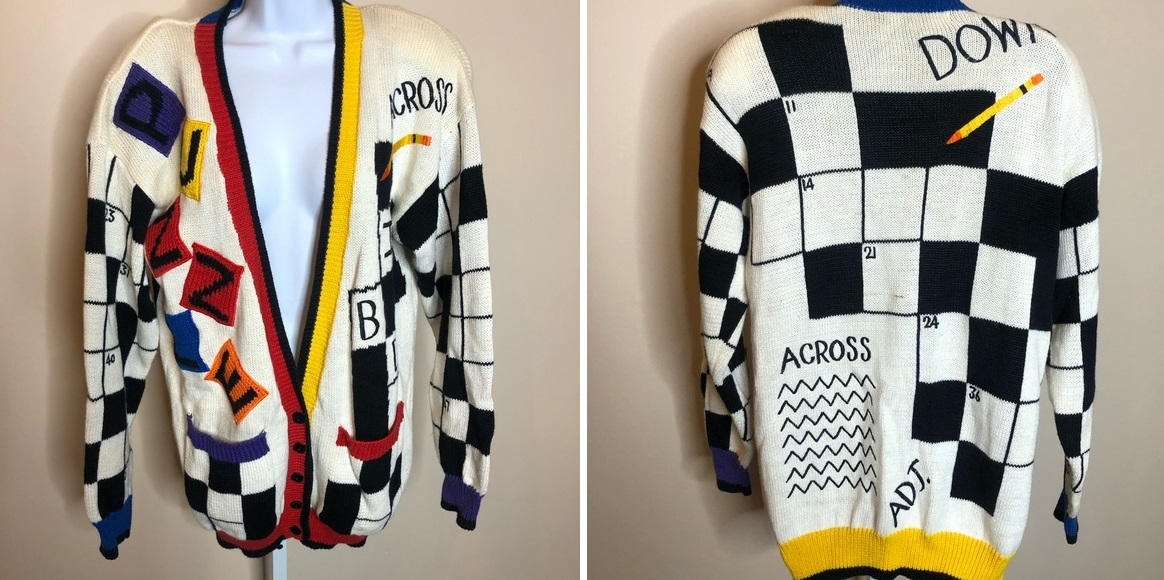
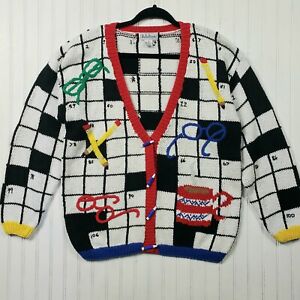
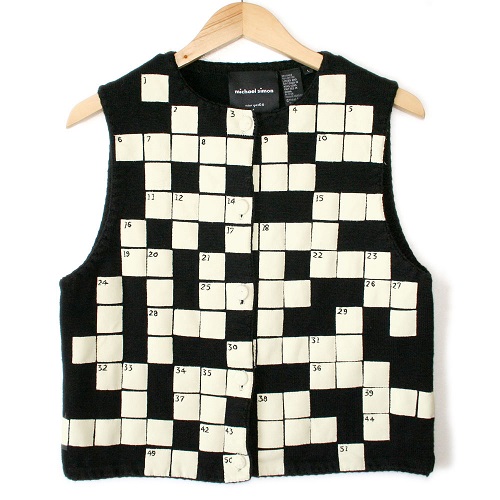
Finally, I turned my attention to crossword-specific sweaters, and I struck gold. None of these are particularly festive, but you could slap a bow on them and get past any discerning bouncer at the ugly sweater party of your choice in these.

pas de mer crossword sweater

This pas de mer sweater feels like you’re looking at a cryptic crossword grid through a funhouse mirror.

poshmark diffusion crossword sweater

I also found this sweater on Poshmark. You’ll be heartbroken to discover it’s already been sold. But man, you could easily wear this one at the crossword tournament or ugly sweater party of your choice and turn a few heads.

ebay ugly sweater

I wish I could find a bigger picture of this one somewhere. It was clearly made with love, and it’s one of the few that actually feels like a proper crossword grid.

crossword sweater vest

What is it about a sweater vest that somehow makes this worse than a normal sweater? Maybe it’s how the boxes don’t quite line up, or the two-letter words trailing off near the armpits. Man, this is pretty bad.

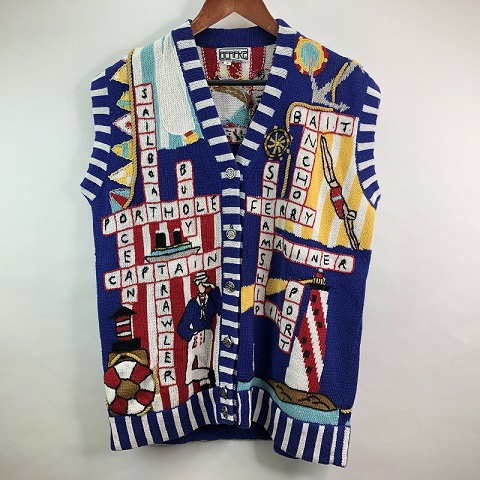
boating crossword sweater

And this one, fellow puzzlers, was the pièce de résistance. The random crisscross placement. The color palette. The way the lighthouse beam doesn’t make it past the center buttons, condemning the proud cross-legged sailor nearby to a disastrous collision with the rocks near the shore.

This might not be a Christmas sweater, but man, does it fit the bill in every other way.

Do you have any favorite ugly sweater designs? Are any of them puzzle-fueled? Let us know in the comments section below! We’d love to hear from you.


   dailypopwsicon

Treat yourself to some delightful deals on puzzles. You can find them on the Home Screen for Daily POP Crosswords and Daily POP Word Search! Check them out!

Thanks for visiting PuzzleNation Blog today! Be sure to sign up for our newsletter to stay up-to-date on everything PuzzleNation!